SIOUX FALLS, S.D. (Dakota News Now) - A
Sioux Falls woman is in custody, facing accusations of abuse and neglect
of an 18-year-old victim with special needs.
Kimberly Marshall faces one felony count of Abuse or Neglect of a Disabled Adult or Elder.
The
investigation began when bystanders called a welfare check for the
victim, who was standing outside at a bus stop for nearly 2 hours in
September 2025.
When officers arrived, the victim was wearing an adult diaper that reportedly smelled strongly of urine.
Police later learned from educators at the victim’s school that they required assistance from caretakers to function.
The teacher reported to officers that the victim had a feeding tube and noticed it to be unsanitary and had leftover contents.
Police also learned the victim would occasionally wear the diaper for more than one day at a time.
An arrest warrant was issued on Feb. 18, and Marshall was arrested that day.
According
to online court records, Marshall’s first hearing was on Thursday, and
she was released from jail without having to pay bond.
SANDY
SPRINGS, Ga. — Sandy Springs police have arrested two people in
connection with what investigators describe as a jury duty scam that
targeted multiple victims, including an 80-year-old widow who lost more
than $40,000.
Bryan
Jesean Jackson, 21, was arrested Feb. 16 and charged with theft by
extortion, exploitation of an elderly person and impersonating a public
officer, according to police. Jaell Draughn, 19, was also arrested and
faces the same charges. Jail records show Draughn was booked Sept. 28
and later released on bond.
Police told Channel 2’s Michael Seiden that a third suspect, Nicolas Lo, remains on the run.
A probate judge bragged about how she violated court rules “every day” just before she hugged a felon in open court.
She was caught on court cameras joking about turning off the microphones. She laughed.
The Arizona Commission on Judicial Conduct did not.
It found Maricopa County Superior Court Commissioner Vanessa Smith didn’t violate one rule that day but three of them.
The
commission reprimanded her in January for eroding public confidence in
the court, failing to act impartially and showing bias or prejudice.
The
only thing that stopped it from issuing formal charges and meting out
more severe discipline was Smith’s willingness to admit what she did was
“inappropriate,” court records show.
“The commissioner’s
contrition and acknowledgement of the violations prompted the decision
to issue a reprimand,” Commission Chair Christopher Staring wrote in a
Jan. 28 order.
But Smith appears to be having second thoughts and
is pushing back on the discipline. A court spokesperson said Smith was
challenging the order.
“She filed a Motion for Reconsideration
that we understand is pending with the Arizona Commission on Judicial
Conduct. This means that the Commission’s order is not final,” Tasya
Peterson, the court’s communications director, said in a Feb. 18 email
to The Republic.
Smith declined comment. She would not say if she remains contrite or disagrees her conduct was inappropriate.
The
reprimand came after The Republic reported on Smith’s conduct at a
court hearing during which she befriended a man fresh out of prison who
was convicted of financially exploiting his 97-year-old mother.
In
the span of a nearly hour, Smith told the man how young and wonderful
he looked. She offered career advice and personal growth tips. She
talked favorite concerts, weight gain, bucket lists and the quality of
In-N-Out french fries. She also coached him on ways to secure visits
with his mother.
Then Smith asked if she could step down from the bench and give him a hug.
Lawyers and legal scholars described the April 25 hearing as a troubling and clear violation of ethical standards.
William
Black, a white-collar criminologist who served as a visiting scholar at
the Markkula Center for Applied Ethics, said Smith’s hearing appeared
to subvert fundamental judicial training and etiquette.
He called Smith’s conduct “completely unethical”
Commissioners
in probate court have many of the same powers as judges. Among other
duties, they monitor cases of people ruled to be incapacitated, whose
bank accounts, property, possessions and continued care are turned over
to third parties known as legal guardians.
Smith’s conduct
illustrates the insular nature of probate court, where a tight-knit
group of judges and lawyers hold sway over the health and wealth of
people unable to care for themselves.
Hearings regularly take
place in near-empty courtrooms without the public scrutiny or attention
given to criminal prosecutions. Nevertheless, decisions on individual
freedom and finances can be as consequential as a life sentence, with or
without parole.
The Commission on Judicial Conduct filed its own complaint against Smith over the April 25 hearing.
“The
Commission considered the public nature of the conduct, the damage to
the reputation of the judiciary, and that the Commission had previously
issued a public reprimand to another judicial officer for similar
conduct,” it said in its order.
The commission has held wide sway
over Arizona judges and justices since its creation in 1970. It has the
authority to investigate complaints leveled against members of the
Arizona Supreme Court, Court of Appeals, Superior Court, justice of the
peace courts and municipal courts.
In its order against Smith, the
commission recounted her stepping down from the bench when she was
recorded as saying: “I realize I probably violate judicial behavior code
every day.”
Smith, in her response to the complaint, indicated
empathy for Karl Edmark III. She said the 70-year-old felon suffered
from “cognitive function issues” but allowed she should not have hugged
him in a courtroom setting, according to the commission’s order.
“Commissioner
Smith stated that while this was well intentioned, it created an
appearance inconsistent with the expectations of judicial demeanor and
impartiality,” the order stated.
Phoenix probate lawyer Tom Asimou
said the Judicial Conduct Commission did not go far enough in punishing
Smith. “To maintain the integrity of our court system, she needs to be
terminated immediately,” he said in a Feb. 18 interview. “She just
doesn’t get it.”
Asimou was not in the courtroom when Smith hugged
Edmark. He represented the company charged with overseeing the physical
and financial wellbeing of Edmark’s mother and had fought to prevent
him from visiting without strict supervision.
Edmark’s mother,
Mary Miller, was the former wife of Karl William Edmark, a
cardiovascular surgeon who gained international fame — and enormous
wealth — for developing the modern defibrillator. He died in 1994.
Edmark III in 2021 took a plea deal
William
Black, a white-collar criminologist who served as a visiting scholar at
the Markkula Center for Applied Ethics, said Smith’s hearing appeared
to subvert fundamental judicial training and etiquette.
and
admitted to stealing more than $150,000 from Miller while acting as her
guardian. While incarcerated, Edmark reported that he was suffering from
seizures and petitioned the court to appoint a guardian, saying he was
unable to care for himself.
When Edmark got out of prison in
March, he immediately sought to see his mother in person. Enter Smith.
Her role was limited to making sure Edmark’s health and finances were
being managed. She lacked the authority to grant Edmark rights to visit
his mother.
That didn’t stop her from trying to help him — and
using her position on the bench to give Edmark pointers on how to
legally make it happen.
Smith during the April 25 hearing referred
to Edmark’s conviction as “allegations of theft from a vulnerable
adult” and announced in court her desire to “reach some sort of
agreement so Karl could see his mom.”
Judges and commissioners
don’t typically address people appearing before them by first name. But
Smith said during the hearing she felt as if she could relate to Edmark
and told him: “I always refer to you in my head as Karl.”
Two of
Edmark’s siblings called the hearing “bizarre” and “appalling.” They
said Smith seemed to abandon objectivity and professionalism, becoming
personally invested in their brother’s case — and his cause. They
questioned why a judge would take an active role in helping an abuser
get access to his victim.
Miller lapsed into a coma and died Oct. 1 before Edmark was able to visit.
Smith became a commissioner in 2022. Her time on the bench has included earlier public controversies.
Commissioners
in Maricopa County are chosen by a committee of judges and lawyers and
appointed by the court’s presiding judge. Their roles are limited
compared with judges. But probate court commissioners have wide latitude
to oversee cases.
Smith graduated from law school in 2004 and
worked for most of her career in the Maricopa County Office of the
Public Defender, according to her biography on the court’s website.
She
got high marks in her 2024 performance review, with litigants and court
staff giving her 100% in surveys on a range of categories.
Her
highest scores among attorneys were for maintaining control of the
courtroom. knowledge of evidence rules and clearly written legal
decisions.
Her lowest score was for “judicial temperament” and being respectful to all individuals.
Asimou
in March 2025 accused Smith in a judicial conduct complaint of using a
racial slur to describe a man seeking to become his adult son’s
guardian. He also accused her of retaliating against the man in
subsequent hearings.
The commission dismissed the complaint. And
Smith was vigorously defended by the former Maricopa County Superior
Court presiding judge.
Judge Joseph Welty told The Republic in a
March statement that he didn’t even need to read the complaint to know
it was without merit. He said it was clear Smith’s comments were not
racially motivated.
“My office takes such accusations seriously,”
Welty said. “But this is a frivolous accusation against a court
commissioner who was recently awarded for her integrity.”
CHARLOTTE COUNTY, Fla. — An
affidavit from the Charlotte County Sheriff's Office said William
Hartin was arrested after he was accused of elder abuse following a call
to 911 Tuesday night, where he was reportedly crying hysterically and
asking for resources to help care for his 92-year-old mother with
dementia.
An affidavit said Hartin told the operator that caring
for his mother was too much and that he needed help or he would
reportedly put her on the street, leaving her homeless.
Charlotte County deputies arrived at his home at Maple Leaf Golf and
Country Club on Kings Highway and found the older woman outside in a
wheelchair. It was less than 50 degrees, and she was cold. The woman
told deputies she was freezing and began to cry.
Sarah Gualco from
the Area Agency on Aging for Southwest Florida emphasized the
importance of avoiding burnout and stress to prevent cases of elder
abuse.
"We want to avoid burnout. We want to avoid stress and ultimately prevent cases of elder abuse," Gualco said.
She noted that over 80% of the calls they receive are from individuals seeking funded long-term care services.
"I would say over 80% of calls we receive are individuals looking for funded long-term care services," Gualco said.
She added that their help is free and available through a hotline. HELPLINE: 866-413-5337
"We
can do what is available to help, create, basically, a safety net for
this family so that, you know, it doesn't result in a crisis or tragedy
like this," Gualco said.
Gualco explained that the agency acts as a
coordinated entry for state and federal services, including long-term
care services available through funded programs.
"We're kind of
like coordinated entry for some state and federal services, long-term
care services that are available through funded programs," she said.
She stressed the importance of knowing about their services before a crisis occurs.
"The
message we try to push out is know us before you need us. Because often
when individuals are in the midst of crisis, and they reach out, we
might not be able to respond as immediately as a crisis would require,"
Gualco said.
Former Sullivan County public administrator Joan Brummitt answered for her oversight as guardian
by Matt Flener
MILAN, Mo. — A former
Sullivan County elected public official faced pointed questions from a
judge on Tuesday for how she handled the estates of 13 people whom she
oversaw as guardian or conservator.
The judge ordered former
longtime Sullivan County Public Administrator Joan Brummitt to appear
before him on Tuesday — in one case asking why she did not transfer more
than $400,000 from a ward’s estate to the new public administrator in
the county after Brummitt resigned from office.
Sullivan County Associate Circuit Judge Adam Warren on Tuesday, after
hearing an explanation from Brummitt’s attorney, gave Brummitt more
time to transfer ownership of that specific ward’s bank and brokerage
accounts to the new county public administrator before holding her in
contempt.
In 12 other probate cases of former wards, Warren cited
Brummitt for failing to file various reports. Brummitt cleared most of
those cases by filing the reports in the court record and before Warren
on Tuesday.
Brummitt declined to comment to KMBC 9 News about the cases.
Brummitt’s court appearance marks the latest questions from a judge.
In a separate criminal case, she is facing four felony counts of
financial exploitation of an older/disabled person and four felony
counts of stealing $750 or more.
She has pleaded not guilty.
Brummitt, in her role as Sullivan County Public Administrator, had the responsibility to care for wards of the state.
Public
administrators are elected in Missouri to take care of financial and
medical decisions for elderly or mentally ill patients when a judge
decides family or friends can no longer care for them.
Court documents in Brummitt's criminal case
Previous
court documents allege Brummitt moved money last October from an
elderly ward’s bank account to her personal bank account on four
separate occasions.
A Missouri State Highway Patrol investigator
said on Oct. 14, 2025, Brummitt used her personal cell phone and online
banking app to send money from the ward’s account through three separate
transactions, totaling $999, $1,900 and $1,980.
She made another online $999 transfer on Oct. 16, the MSHP investigator said in court documents.
The total amount came to $5,878.
Brummitt
is charged with four felony counts of financial exploitation of an
older/disabled person and four felony counts of stealing $750 or more.
A
Missouri State Highway Patrol investigator testified last month that
Brummitt admitted to the highway patrol that she moved money from the
ward’s account to hers.
The investigator told the court that Brummitt admitted to highway patrol investigators that hackers told her to move the money.
Brummitt’s criminal attorney, Mark Williams, has previously told KMBC 9 News that Brummitt is innocent until proven guilty.
In
a series called "Paper Prisons," KMBC 9 News is investigating ways to
systemically improve the care of those under guardianship by
highlighting stories of people struggling to navigate a tangled system
of legal paperwork, medical records and court orders.
When families enter probate court, they expect protection. They
expect oversight. They expect a system designed to safeguard vulnerable
adults who cannot protect themselves.
What many families say they do not expect, according to sworn filings
now before California courts, is isolation, financial consolidation,
rapid medical deterioration, and a wall of administrative opacity.
For some, the moment is unforgettable. A judge speaks. A ruling is
made. And in an instant, a mother, a father, a son, or a daughter, a
human being who has fought to survive, becomes a ward of the county.
Families who reorganized their entire lives around caregiving are
suddenly reduced to observers. The people who knew the conservatee’s
medical triggers, emergency thresholds, daily rhythms, and hard won
progress are deemed unfit, often without a meaningful opportunity to be
heard.
Decision making authority over health care, living arrangements,
doctors, and treatment shifts to court appointed professionals
previously unknown to the family. Introductions are not required.
Approval is not sought. Oversight is assumed. Families walk out of court
stunned, disoriented, and often traumatized, grappling with how years
of intimate, hands on care could be erased in minutes by a procedural
ruling.
That experience forms the backdrop of what is now before the courts
in Ventura County in the matter of Joshua Saeta, a medically fragile,
wholly dependent adult.
Joshua did not enter the probate system because of age, dementia, or
gradual decline. According to sworn filings and medical records
submitted to the court, he became wholly dependent after suffering a
catastrophic cardiac arrest in 2017 that resulted in a severe anoxic
brain injury. His brain was deprived of oxygen long enough to cause
permanent neurological impairment. He survived, but survival came at a
cost.
From that point forward, Joshua required round the clock care,
complex medical management, and constant monitoring to remain alive. He
could not advocate for himself. He could not manage his medical needs
independently. His survival depended entirely on the consistency,
precision, and continuity of the care surrounding him.
In the years that followed, Joshua did not languish. According to
physician letters and court filings, he achieved relative medical
stability under a physician directed, home based care model. That model
emphasized continuity, familiar caregivers, specialized nutrition
protocols, carefully monitored therapies, and immediate response to
subtle changes that could signal medical emergency.
Central to that care was his sister, Jennifer Saeta, who became his
primary caregiver and medical advocate. For more than eight years, she
lived beside him, learning his baseline condition, emergency warning
signs, and recovery thresholds. Treating clinicians relied on her
longitudinal knowledge to prevent life threatening decline. The
stability Joshua achieved, according to the record, was not accidental.
It was built deliberately, over years, through constant hands on care.
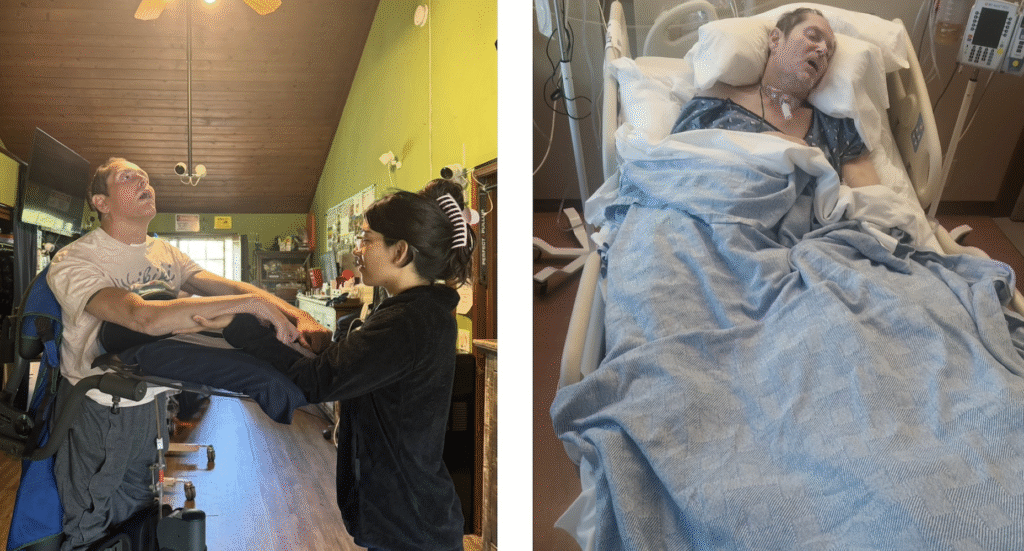
Left:
Josh Saeta in August 2025 under his sister’s care. Right: Josh’s
condition has significantly deteriorated under Ventura County Probate
Care.
This is not a social media dispute or a family disagreement reframed
as legal drama. What has been filed in Ventura County Superior Court
under Case No. 201700495761PRCE, and in related appellate proceedings,
is an extensive emergency record alleging a repeatable pattern within
probate administration, one that according to the filings begins with
caregiver removal and culminates in severe medical decline.
The allegations are not informal. They are sworn, structured, and supported by documentary exhibits.
According to Jennifer Saeta’s sworn filings, Joshua’s stability
deteriorated after conservatorship authority shifted. The care structure
was altered. Placement changed. Family access was restricted. She
asserts that this sequence functioned as a divide and conquer process,
first removing the individuals most knowledgeable about Joshua’s daily
medical management, then isolating him from the continuity of care that
had sustained him for years.
Jennifer further alleges that no meaningful investigation preceded
her removal and that she was denied a full opportunity to advocate for
her brother before decisions affecting his life and care were finalized.
These assertions are presented as allegations, not adjudicated
findings.
Families caught in this process often describe the same refrain. You
may visit, but you may not intervene. Advocacy is reframed as
obstruction. Objection is characterized as noncompliance. While families
are told to support court appointed conservators, they allege they are
instead forced to watch as quality of life diminishes under the control
of strangers with no prior relationship to the conservatee.
The emergency petition in the Saeta matter does not accuse criminal conspiracy. It documents patterns.
On February 10, 2026, Andrew Rose submitted a sworn declaration in
support of emergency appellate review. Under penalty of perjury, he
describes recurring similarities he states he has observed across
unrelated Ventura County probate matters. Long standing caregivers
characterized as uncooperative. Sudden exclusion from medical decision
making. Institutional placement. Rapid medical decline. Restricted
communication. Difficulty obtaining records.
Attached to that declaration is a Unified Pattern Summary, which
explicitly states that it does not allege criminal conduct or reach
legal conclusions. It consolidates recurring factual similarities across
cases and leaves questions of culpability to judicial or investigative
review.
In the Saeta matter specifically, Jennifer Saeta alleges that a court
appointed professional charged with safeguarding Joshua’s interests
failed to function as an independent advocate. She does not allege
explicit collusion or criminal coordination. Instead, she asserts that
the professional’s actions and billing records reflected conduct
inconsistent with independent advocacy, leading her to conclude that
Joshua’s interests were not being meaningfully advanced. That
distinction is central to the filings, which frame the issue as systemic
misalignment rather than overt misconduct.
The financial dimension of the case is significant, though partially
shielded by confidentiality provisions. Court exhibits confirm that
Joshua is associated with a high value trust governed by a nondisclosure
agreement. Jennifer Saeta alleges that while Joshua’s physical
condition declined, substantial administrative and professional fees
were drawn from the trust. She argues that the pattern reflects
incentive rather than coincidence. These claims remain allegations and
have not been adjudicated.
Additional exhibits include a certified Ventura County Clerk Recorder
search documenting numerous estate related filings associated with a
recurring fiduciary name. The filings themselves are not alleged to be
unlawful. They are presented to demonstrate frequency, volume, and
concentration of fiduciary activity within a limited professional
ecosystem.
As the legal record expanded, the medical situation intensified.
While declarations were being prepared and exhibits compiled,
Joshua’s medical condition deteriorated. According to physician letters
submitted to the court, based on photographic review, longitudinal
treatment history, and clinical assessment, he now exhibits extensive
muscle wasting, depleted subcutaneous fat stores, and findings
consistent with severe malnutrition.
The filings state that Joshua has declined to the point of requiring
total parenteral nutrition, an intravenous intervention typically
reserved for cases in which the gastrointestinal system can no longer
sustain life through enteral feeding. The reviewing clinician
characterized his condition as an imminent threat to life, citing
aspiration risk, pressure ulcer risk, and medical instability associated
with prolonged bed confinement.
Jennifer Saeta attributes this decline to the sequence of legal and
medical decisions she is challenging. That attribution is presented as
her allegation.
The filings cite statutory frameworks governing elder and dependent
adult protection in California. Those statutes impose affirmative duties
to prevent neglect, broadly defined, and to investigate when a
dependent adult experiences unexplained decline. The filings do not
assert that Ventura County or its officials have been criminally
charged. They ask whether statutory obligations were fulfilled when a
wholly dependent adult declined precipitously under court supervised
care.
What began as a dispute over authority within a complex probate
structure has, according to the petitioner, evolved into an urgent life
safety matter. Jennifer Saeta states that after she sought independent
legal counsel and challenged decisions affecting Joshua’s care, she was
removed from participation in his daily medical oversight. She argues
that what appears procedurally administrative on paper has, in practice,
resulted in prolonged separation from the person most familiar with
Joshua’s medical baseline.
One of the most consequential aspects of the emergency petition is
procedural rather than financial. The Unified Pattern Summary notes that
in multiple probate matters, conservatees allegedly declined beyond
recovery before appellate review could occur. By the time higher courts
addressed the issues, the medical outcomes rendered the legal questions
effectively moot.
DISCLAIMER: Investigative reporting in high-profile litigation cases published by The Current Report is
non-commercial, fact-based journalism; any project fees compensate
research and reporting labor only, sources participate solely in
accuracy verification, and final publication is approved exclusively by
The Current Report after fact-checking is confirmed.
A caregiver is accused of yelling at and slamming a 90-year-old dementia
patient during a late-night incident inside a Pennsylvania home,
according to court documents obtained by Daily Voice.
by Jillian Pikora
Dhyshamier Lamar Holmes, 27, of Harrisburg, was charged with Misdemeanor Abuse of a Care-Dependent Person, court records show.
East Pennsboro Police were dispatched to the 100 block of Center
Street in Enola at 8 a.m. on Jan. 20 for a reported non-active assault,
according to a release issued Monday, Feb. 23.
The elderly victim told officers she had been assaulted by her caregiver, police said.
According
to the affidavit of probable cause, officers later learned the alleged
abuse involved a 90-year-old woman identified as A.S., who is deemed a
“care dependent person”.
On Feb. 5, police were contacted by Aging and Community Protective
Service Investigator Kyndra Strait regarding the case, the affidavit
states.
Strait provided three videos of the incident, and advised
that between Jan. 30 and Jan. 31, the caregiver was “yelling and
cursing” at A.S., the affidavit details.
The videos allegedly show Holmes “picking up A.S. and slamming her on
the couch,” and “yelling profanities at A.S.,” according to the
affidavit.
Holmes was later identified as the suspect and charged
under state law prohibiting a caregiver from striking, shoving, kicking,
or otherwise subjecting a care-dependent person to physical contact.
His preliminary hearing is scheduled for Wednesday, April 1, at 2:15
p.m. before Magisterial District Judge Michael Sanderson, court records
show.
COLUMBIA S.C. (WACH) — Families often
don’t notice financial abuse until significant money is gone, and
experts say it frequently goes unreported, leaving many victims without
help.
“It is one of the most common types of abuse that goes
unreported. In fact, it is under reported,” said Dr. Macie Smith, an
elder care professional.
Smith
said financial abuse is one of the most common forms of elder abuse and
is often committed by someone the victim knows and trusts.
She
said victims may not acknowledge what’s happening because they still
trust the person involved, or they may stay silent out of fear.
In
a situation like that when they don’t accept the fact that they haven’t
abused because they still really do trust this person and sometimes
they don’t say anything because of fear. Fear of losing this person
because they think they’ve helped them all the time,” Smith said.
Smith also warned that people with power of attorney can misuse their authority.
Sometimes
people feel like when they have the power of attorney, that they can do
whatever they want to do on behalf of the other person. That is false.
Even though there is a power of attorney, they can still make their own
decisions,” she said.
Experts say warning signs of elder
financial abuse can include an older adult seeming confused about recent
transactions, showing changes in behavior, becoming more isolated than
usual, or expressing fear about money.
Smith recommended families
take steps early to help protect loved ones, including regularly
reviewing bank statements, considering a trusted third party to oversee
finances, and keeping open lines of communication about money.
She said South Carolina nursing homes are also required to help where they can.
They
are required to post flyers about financial exploitation, and they are
required to provide training to their residence about financial
exploitation,” Smith said.
For elders or vulnerable
people on Medicaid, families are encouraged to look at the Medicaid
exclusion list online, which includes many criminals who have abused
Medicaid along with their crimes.
Smith said anyone who suspects abuse should report it immediately to
Adult Protective Services so the situation can be investigated before
losses grow.
Sheriff’s office investigation leads to arrest of Keith Michael McEvoy
By Na'Khalia Frazier
LEE COUNTY, Ga. (WALB) - The Lee County Sheriff’s Office arrested Keith
Michael McEvoy Thursday, Feb. 19, on charges of exploitation and
intimidation of disabled adults, elder persons and residents.
The investigation began when Adult
Protective Services notified police about allegations involving elder
abuse in Lee County, according to the sheriff’s office.
The
sheriff’s office Criminal Investigation Division completed an
investigation into the accusations and secured an arrest warrant for
McEvoy.
Arizona Attorney General Kris Mayes announced the settlement last month with the California-based company following allegations of elder abuse and fraud.
By Jason Barry
MESA, AZ (AZFamily) — The owners of Heritage Village Assisted Living facility have been permanently banned from operating healthcare facilities in Arizona.
As part of the settlement with the Arizona Attorney Generals’ Office they also must pay a $100,000 fine.
Arizona AG Kris Mayes announced the settlement last month with the California-based company following allegations of elder abuse
and fraud at the Mesa facility. The agreement prohibits the owners from
providing healthcare services to vulnerable adults in Arizona.
The case began after multiple reports in 2023 and 2024
exposed issues at Heritage Village that led to a state investigation
and lawsuit. Families reported incidents of mistreatment and abuse of
residents at the facility.
Family says settlement is insufficient
Renee Caruss said her mother, Carol, was among the residents who were mistreated at Heritage Village. In one incident, Carol was reportedly attacked by another patient.
“You
expect with all the money they get that she would be taken care of
properly - she wasn’t - she wasn’t taken care of,” Caruss said.
She believes the settlement does not provide enough accountability for what happened at the facility.
“The
people that were running that facility knew exactly what they were
doing the person the director at the time she’s working at another
facility right now,” Caruss said.
Attorney General defends actions
The
Attorney General’s office said its priority was protecting Heritage
Village residents and preventing similar issues at other long-term care
centers.
“Protecting Arizona’s most
vulnerable residents has been one of my top priorities since taking
office,” Mayes said in a statement. “In the Heritage Village case alone,
we seized control of the facility, replaced its management, forced the
sale to responsible ownership, and removed the prior owners from
operating two other Arizona facilities.”
The
Attorney General’s office noted that when Heritage Village faced
foreclosure and potential license revocation, their intervention
prevented mass displacement of elderly residents.
Legislative changes follow case
Dana Kennedy, state director of AARP Arizona, said the Heritage Village case led to important legislation that better protects vulnerable adults.
The
changes include stiffer penalties on care facilities, with fines
increased from $500 per day to $1,000 per day per resident per
infraction. The legislation also increased training for memory care,
added hiring restrictions for caregivers accused of abuse or neglect,
and expanded oversight.
“One important
thing is it closed a licensing loophole so it prevents bad actors from
evading oversight and it doesn’t allow DHS they cant transfer license to
another person it holds them accountable,” Kennedy said.
Case continues against other defendants
The
case remains active against several other defendants despite the state
settlement. An attorney for one of the victims said that families are
unlikely to receive money in civil cases they have filed.
The former manager of Heritage Village
can still work in the industry, but her license has been revoked, and
she will never again be able to manage a long-term care center.
Attorney Jennifer Wasserman represents the former owners who reached the settlement.
“This
agreement ends strongly-contested claims without any admission of
wrongdoing,” Wasserman said. “Regardless of the Attorney General’s
self-serving statements in their press release on this topic, the health
and safety of the employees and residents at Heritage Village have
always been a high priority to the defendants.”
Gary Langendoen, representing the defendants, said they disputed the validity of the Attorney General’s claims.
“We have always disputed the validity of the Attorney General’s claims,
particularly after some of the assertions stated in their press releases
were proven to be false based on incomplete and inaccurate information
from the receiver’s office,” Langendoen said. “Putting this litigation
behind us allows these defendants, the dedicated employees and valued
residents to move forward.”
San Antonio’s Department of Human Services is committing to increase
its support for senior citizens at risk of scams and neglect after a
request by a council member was filed last month.
During a Public
Safety Committee meeting this week, city staff told council members the
department would beef up its preventative messaging and initiatives and
report back regularly to the council about neglect, abuse, and scams.
The
Council Consideration Request (CCR) filed by District 5 Councilwoman
Teri Castillo calls for creating or enhancing initiatives that could
protect seniors from fraud.
A CCR is similar to introducing a bill
in the legislature to create new city policies. It requires getting the
support of four other council members and going through a committee
process before going for a vote in front of the full city council.
Castillo's requests include:
Auto-enroll seniors in the federal and state do-not-call registries
Provide
access to legal aid which can help seniors assign a trusted guardian,
create a living will, and/or other legal mechanisms to protect
themselves from fraud and abuse.
Create and provide seniors with
COSA-sponsored No Soliciting yard and door signage for seniors to ward
off scammers and unwanted salespeople.
Create guides for seniors which show them how to use their mobile phone to ward off scam calls.
Castillo
said her request was born out of a trend of scams in her district where
elderly residents had fallen victim to fraudulent door-to-door sales.
“They're
going under the guise of being part of CPS energy, or a trustworthy
solar company, and essentially were signing on to $95,000 loans, which
then would result in a lien on their property, and then, oftentimes,
solar panels that were not even connected,” Castillo said.
In
Bexar County there’s about 316,000 people over the age of 65 out of more
than 2 million residents. The Texas Department of Family and Protective
Services said there were 1,120 allegations of exploitation against
seniors; there were also 5,558 investigated allegations of neglect and
abuse in Bexar County in 2024.
Jessica Dovalina, deputy director
of the city’s Department of Human Services told the city council’s
public safety committee that of the more than 5,500 investigations,
about 92% were identified as self-neglect.
“Of those cases, 81%
were physical neglect, and 19% were medical neglect. And so that is
something that we continue to see at our senior centers, as well as
something that our providers continually lift up as part of the
discussions about what's happening in our community, given the high rate
of self-neglect as well as poverty in our community, which also has
increased, those are important factors,” she said.
Self-neglect is
when a person is no longer able to take care of themselves and provide
for their basic needs. She said the city’s senior centers serve about
22,000 active residents annually. “There we're addressing things like
social isolation, food insecurity, access to preventative screenings for
medical care, as well as caregiver training and resources and benefits
navigation and financial counseling.”
Later this summer, the
department has plans to release a “Status of Older Adults in San
Antonio” report that would focus on elder fraud, neglect, abuse and
exploitation, housing insecurity and cost burden, food insecurity,
social isolation, community, healthcare, and transportation. That’s
scheduled for September
Among the initiatives planned by the
department, it’s committing to create printable door and yard signs to
deter solicitors, develop metrics, cost estimates and resources needed
to expand the city’s services beyond senior centers, and create resource
guides regarding senior rights and tailored guides for cellphone users.