Monday, February 10, 2020

Virginia: Levine’s guardianship bill faces unexpected last-minute objection from state bar lawyer

By Bridget Balch

Delagate Mark Levine
For the third year, Del. Mark Levine, D-Alexandria, proposed a bill intended to strengthen family members’ and loved ones’ rights to visit adults who are under legal guardianship. After spending a year working with numerous stakeholder groups to refine the bill into something everyone agreed upon, he was surprised when a lawyer from the Virginia Bar Association stood in opposition during the bill’s subcommittee hearing.


Levine’s first attempt at the bill was inspired by a constituent, Mike Jacobs, who came to Levine with a story about how he had been unfairly banned from seeing his longtime partner, Jane Lopez, who had Alzheimer’s disease, by an attorney serving as Lopez’s legal guardian, Levine said.


Shannon Laymon-Pecoraro
Shannon Laymon-Pecoraro, an elder attorney representing the Wills, Estates and Trusts Section of the state bar, objected to several parts of the bill. Among them is a provision that would place greater emphasis on the guardian ad litem determining whether any conflicts of interest exist among the parties in the guardianship case. A guardian ad litem is an attorney appointed by the court to investigate a guardianship case and represent the allegedly incapacitated person’s best interests.
 

“It’s our position that the guardian ad litem is not an ethics expert and it’s the attorneys’ job themselves to determine whether or not there’s an ethical issue,” said Laymon-Pecoraro, who asked that the bill be delayed another year. “We have proposed that because this is a major overhaul and the bill has continued to evolve rapidly over the course of the last few months, that we not act in haste and that instead that we continue to work with Del. Levine.”


Levine said that provision in the bill was intended to addresses issues like those reported in the Richmond Times-Dispatch three-part investigative series into guardianship that revealed that VCU Health System and other health care providers were taking low-income patients to court and requesting that their own attorney be appointed the patient’s guardian. The guardianship orders gave the hospital’s attorney control over the patient’s medical decisions and finances. The series also found that the same guardian ad litem was employed in nearly 90% of all of cases over the past six years and that her fees were paid by VCU Health. 


“Hospitals are sometimes trying to get rid of difficult patients — difficult because they cost the hospital a lot of money — so they get their guardian and their guardian ad litem and they all pay these people and then no one’s there to represent the interest [of the patient],” Levine said, in defense of the provision. “The point is so the judge knows who’s paying the fees.”


He also referenced Yolanda Bell, a Manassas resident who attended the subcommittee hearing to advocate for the bill. Her sister was put under guardianship at the request of Inova Health System and she later faced visitation restrictions imposed by her sister’s guardians.


“As a family of faith, our religious beliefs are very important to us, and because of the severe restrictions imposed by the guardians, even clergy were turned away from my sister,” Bell told the subcommittee. “She was not able to receive the last rites of the church.”


Laymon-Pecoraro also objected to a provision in the bill that would allow a close relative or intimate partner to request a court-appointed lawyer on behalf of the allegedly incapacitated person. Under current law, the incapacitated person has a right to a court-appointed lawyer, but only if requested. And it is up to the guardian ad litem to determine whether a lawyer is needed even if the patient requests one.


“The right to counsel is a due process right of the respondent and not that of anybody else,” Laymon-Pecoraro said.


The Times-Dispatch investigation found that the guardian ad litem in the majority of health care provider-sponsored guardianship petitions in Richmond almost never recommended a lawyer for the patient, and on at least one occasion, said she did not believe it was necessary even though the allegedly incapacitated person requested it.


Levine expressed frustration that the bar’s concerns were not brought to him before the subcommittee meeting and said that the latest draft of the bill — draft 23 — addresses the concerns Laymon-Pecoraro had detailed.


“I can give a point-by-point rebuttal to every single — every single issue she raised is addressed in the substitute because I have been working with [the Virginia Academy of Elder Law Attorneys] and AARP and the National Guardianship Association and Alzheimer’s [Association],” Levine told the subcommittee members.


Laymon-Pecoraro said that the Wills, Trusts and Estates Section of the state bar association had not attempted to discuss the legislation with Levine and that the section members had only been able to discuss the bill the previous Friday.


Del. Patrick Hope, D-Arlington, who is a health care lawyer, said that he had mobilized elder law attorneys to help stop Levine’s guardianship bill during the last legislative session and that he was disappointed that concerns with the bill still hadn’t been addressed.


Levine said that Virginia Bar Association representatives were involved with discussions around the bill and that he had incorporated all of their suggestions.


Brad Brickhouse, an elder law attorney who opposed Levine’s bill last year, said he supports the version presented to the committee.


“I still disagree with Del. Levine on pretty much everything else, but this bill is OK,” Brickhouse said. “I can’t think of any group that wasn’t at the table.”


The subcommittee directed Levine and Laymon-Pecoraro to work on a compromise in time for the bill to be heard before the full House Courts of Justice Committee on Friday.


“My impression from the way we do things here though is we kind of like to kick everybody out and tell them to come back when they’ve worked their differences out,” said Del. Marcus Simon, D-Fairfax, a member of the subcommittee. “Perhaps this can be ready by Friday, if not it can go by for the session.”


Levine said he was willing to hash out the details with Laymon-Pecoraro on Wednesday night after the subcommittee meeting, but that she did not have authority to negotiate on the state bar’s behalf. Instead, she directed him to Tom Yates, chair of the legislative committee of the bar’s Wills, Trusts and Estates Section.


Yates and Alison Zizzo, who represented the Virginia Bar Association in stakeholder meetings to discuss Levine’s bill, did not respond to questions sent Thursday.


Another House subcommittee agreed Wednesday to send a letter to the Joint Legislative Audit and Review Commission, the state’s oversight arm, requesting a study of guardianship and ways to prevent abuse, which was proposed by Levine and Del. Danica Roem, D-Prince William.


Full Article & Source:
Virginia: Levine’s guardianship bill faces unexpected last-minute objection from state bar lawyer

Newly formed task force works to tackle elder fraud

Click to Watch Video
SAN ANTONIO – Bexar County Probate Court Judge Veronica Vasquez deals with emergency removal of seniors almost daily, and she says many of those cases involve financial exploitation.

“If you hear the things that I hear my courtroom, you can’t help but want to do something about it. So it’s incredibly frustrating when you feel like on the other end nothing is happening,” she said.

Vasquez said she’s seen many different cases of elderly exploitation, including people stealing their Social Security checks, selling them plastic Mardi Gras beads for hundreds of dollars or scamming them over roof repairs.
Courtesy: Texas Department of Family and Protective Services
The current system did not track how many cases, if any, investigated and submitted to law enforcement by the Texas Adult Protective Services, or APS, were ever prosecuted, Vasquez explained.

State Sen. Jose Menendez, D-San Antonio, formed the Bexar County Elder Abuse and Exploitation Task Force to figure out a new system to ensure financial crimes against seniors don’t fall through the cracks. 

Since fall 2019, agencies including APS, law enforcement, banks and the Bexar County District Attorney’s Office meet to go over solutions and cases.

“We also have a legislative committee to look at the statute to see how can we beef up some of these statutes or what can we do to ensure successful prosecution,” Vasquez said.

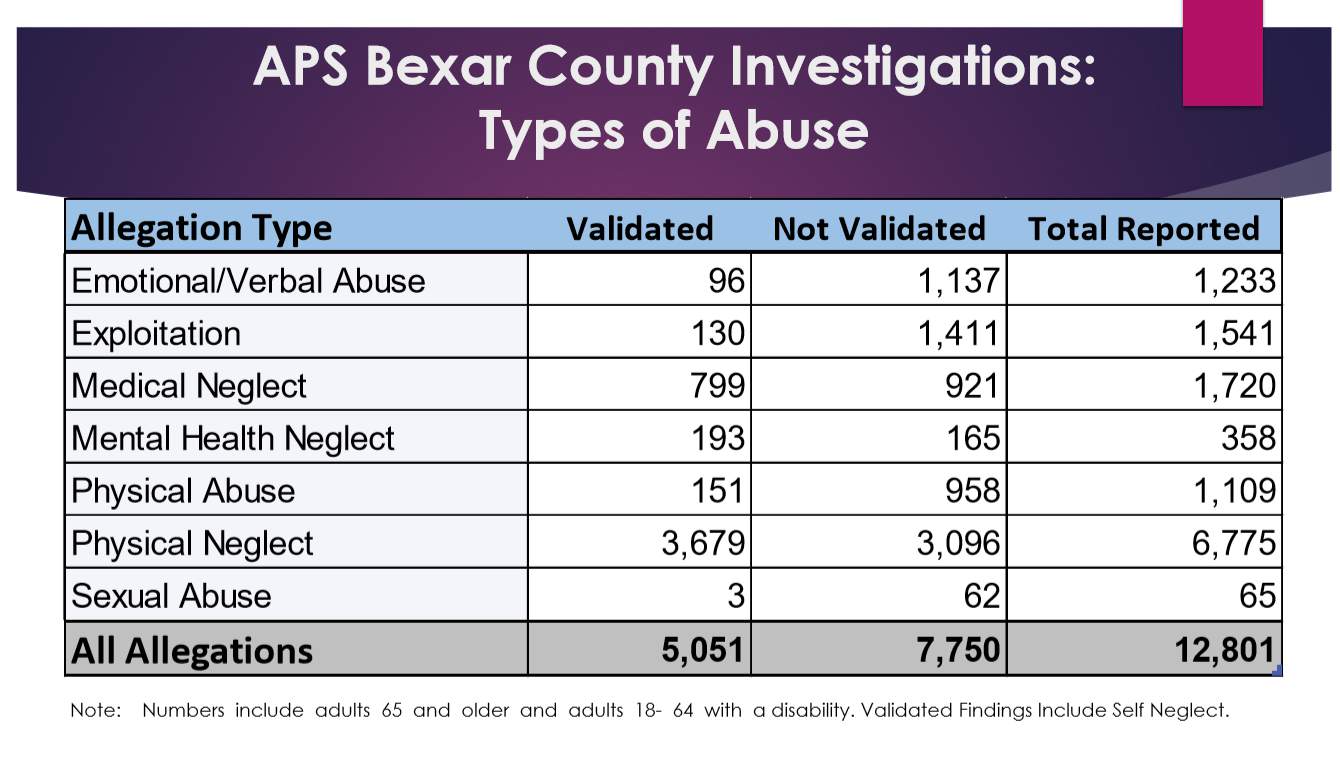
APS reports that in 2018, there were 130 validated exploitation cases in Bexar County, second to Harris County, which had 175 cases. 

An APS validation means a staff member investigated a case and found there was enough evidence to send the information to law enforcement for criminal prosecution. But no one tracks what happens to those cases once they leave the hands of APS investigators.
Courtesy: Texas Department of Family and Protective Services
Vasquez said the task force has already identified those types of cracks at every agency and is working to ensure a better process that results in prosecuting more cases. At this point, Vasquez said it’s not about pointing fingers but taking action.

Menendez said his office will help oversee what, if anything, those agencies need to do their jobs, whether it’s more money or statutory changes.

“We need to be protective of those people who’ve done so much for all of us," Menendez said. "I mean, most of us wouldn’t be here without someone in our life that was there as a role model, as a caretaker, as a parent or grandparents, a teacher, someone who took care of someone before them.”

APS figures show Bexar County has the largest percentage population of people over 65 years old at 12%. Tarrant County is has 10.7%.

Officials hope to see results sooner rather than later.

“Every single one of us has a loved one that’s going to age, or we’re going to age and we may be in this situation. And so it’s something that affects every single person in the population," Vasquez said.

The next step is educating the public on how to report elder financial fraud abuse and reassure them the cases will be prosecuted.

Full Article & Source:
Newly formed task force works to tackle elder fraud

Minnesota law gives green light to safety surveillance cameras in senior homes

Cameras have become an important tool for families who suspect abuse in senior care facilities. 


At 2 a.m. on a November morning, Shirley Breitman began to scream for help from the bed of her assisted-living facility in St. Louis Park.

Her pained cries were streamed live to the smartphones of Breitman’s two adult children — Richard in Minneapolis and Laurie in Los Angeles — through an internet-connected camera placed in her bedroom. Within minutes, Richard was on the phone with the facility’s nursing staff, asking them to check on their 98-year-old mother, who has advanced dementia and was experiencing an adverse reaction to new medication.

“Once you install one of these cameras, you can’t imagine living without it,” said Breitman, an attorney. “It gives you peace of mind knowing that another set of eyes is on our mother.”

In recent years, a raft of new video surveillance technology has made it possible for families to monitor the daily movements and care of their aging relatives with remarkable clarity and precision. Yet Minnesota law has long been silent on whether people actually had the right to install such equipment in residents’ rooms at care facilities, an omission that sowed confusion and conflicts between families and senior homes.

Now, after years of legal wrangling, state law is finally clear: Minnesotans have the right to use electronic monitoring devices in most senior care facilities, provided they notify the facility and obtain consent from residents being monitored. Effective this month, nursing homes and assisted-living facilities across the state are required to inform residents of their right to use the cameras.

The small, internet-enabled cameras can bring peace of mind to families who suspect abuse of a loved one, or who simply want to keep better tabs on their care. The remote monitoring systems, which can be purchased online for less than $200, have become increasingly sophisticated. People can now receive automatic alerts to their smartphones when someone enters a loved one’s room, or when there is unusual activity or sound.

Breitman said the streaming videos are so vivid that, on a recent morning, he could see the type of food aides left for his mother as well as the quality of the bandages on her injured wrist. “It’s stunningly good,” Breitman said as he watched the video feed.

But not all seniors want to live under round-the-clock surveillance. Last year, elder care advocates, industry representatives and state health officials struggled to work out a compromise between invasion of privacy and fears of resident abuse. The result is a complicated set of new reporting requirements and some confusion over how the new law will be implemented. Some advocates worry that the bevy of new rules will discourage the very surveillance it was designed to protect and that some people may be subject to retaliation for using the devices.

Modeled after legislation in Illinois, Minnesota’s law requires that families obtain the resident’s consent to the use of a camera and notify the facility of their plans. If a resident occupies a shared room, the roommate must also provide consent. In cases where senior residents are too frail or cognitively impaired to give consent, relatives must fill out a 9-page form with a written statement from a medical professional.

The prior notification requirements also have advocates worried about possible retaliation. In the past, families who suspected abuse or neglect of a loved one could put hidden cameras in their loved one’s room without ever telling facility staff. In many cases, families would take this step as a last resort, when attempts to work out problems with facility staff had failed, advocates noted.

Now, however, residents or family members who install a surveillance camera without first notifying the facility and completing the required consent forms are violating state law. The new law does allow for an exception: If a resident or family member fears retaliation, they can install the device for two weeks without notifying the facility, provided they submit a special form to the Office of the Ombudsman of Long-Term Care.

Jean Peters, president of Elder Voice Family Advocates, a nonprofit that advocates for safe and quality care in long-term care facilities, said the new law and its bevy of new rules are “unnecessarily punitive” and leave families vulnerable to retaliation.

“All people want to do is monitor the care of their loved ones, to make sure they are getting what they are paying for,” Peters said. “These reporting requirements will have a chilling effect on families.”

Sean Burke, public policy director at the Minnesota Elder Justice Center, which helped craft the regulations, acknowledged that some families may find the new paperwork overly burdensome. But, he said, the state had to respect the privacy rights of seniors, including those who may be incapable of understanding that they are being filmed.

“With this new technology, it’s literally like ‘The Truman Show,’ ” Burke said. “You are putting [your loved one’s] entire life on film, potentially, including their most intimate cares. That is an awesome power.”

Staff tampered with camera

Allegations of abuse in senior homes are notoriously hard to prove, and hidden cameras are one of the few ways that families can corroborate claims by elderly relatives. Increasingly, the footage is also being used by law enforcement officials and state health regulators, in some cases to bring criminal charges.

Across Minnesota, many seniors and their relatives are learning about the technology for the first time. Care Providers of Minnesota, a long-term care industry trade group, is urging its member facilities to include information about the new law in admissions packets for new residents.

“Eventually, everyone should be educated,” said Patti Cullen, president and chief executive of Care Providers.

Lisa Papp-Richards is among the first to take advantage of the new law. Three years ago, she tried to install a camera in the Bemidji nursing home where her 77-year-old mother lived after she noticed a sudden decline in her health without any clear explanation. Soon, however, facility staff began tampering with the camera — even placing a towel over it — and eventually seized the camera without her consent. The family filed a police report alleging theft.

Last week, emboldened by the new law, Papp-Richards reinstalled the camera in the same place, high atop a wooden cabinet, with a clear view of her mother’s room. Already, she is checking the video stream on her smartphone four to five times a day, and she’s noticed an improvement in her mother’s mental well-being. Her mother, she said, has become “more relaxed” knowing that her daughter is keeping a closer watch on her care. On the video feed, Papp-Richards could see staff joking and interacting well with her mother, which helped assuage worries that her mother was being left alone.

“At my mother’s age, things can change in an instant, so it’s vitally important to be able to react immediately,” Papp-Richards said. “The cameras are a reassuring, last line of defense.”


Full Article & Source:
Minnesota law gives green light to safety surveillance cameras in senior homes

Sunday, February 9, 2020

Bogus 'guardians' steal money, sometimes life | Opinion

Editorial Board, Lakeland Ledger

The concept of “retirement,” along with government social welfare programs to support old folks who no longer worked, dates to the 1880s. That’s when German Chancellor Otto von Bismarck concluded that a little socialism for the elderly — Germany set retirement its age at 70 — was better than blanket entitlement programs for all his constituents.

As Bismarck’s idea circulated across the Atlantic, Florida didn’t take long to catch on. The New York Times noted a few years ago that by 1910 middle-class retirees joined the wealthy in discovering the Sunshine State as an appealing place to live out their golden years. Retirement communities began popping up within the next two decades.

Thus, for a century Florida has marketed itself and catered to the elderly, becoming a top destination of elders seeking a retirement pasture.

But that influx of senior citizens made Florida a target-rich environment for hucksters, shysters and ne’er do wells out to con them — or harm them in other ways. And on occasion that abuse came from those entrusted to watch out for their interests.

Now, state Rep. Colleen Burton has joined an effort to better protect our seniors.

The Lakeland Republican has sponsored a bill that would toughen oversight of the state’s guardianship program for seniors, which is managed by the state Department of Elder Affairs.


Focus on this arm of the tiny agency began last summer after media reports surfaced about Rebecca Fierle, an Orlando-based guardian. The Florida Department of Law Enforcement investigated her after one of her clients, Steven Stryker, 75, died from choking on food while hospitalized in Tampa. Fierle reportedly filed a “do not resuscitate” order, which precluded hospital staff from treating Stryker, without permission from either Stryker or his family.

Subsequently, an audit by Orange County determined Fierle had billed Advent Health more than $4 million over 10 years, double-billing the hospital system and court for the same services. Fierle also had clients in Volusia and Flagler counties, and after news of the Tampa case broke, Volusia County Circuit Judge Margaret Hudson started requiring that guardians seeking a DNR appear before her for an evidentiary hearing with medical testimony and notice to the ward’s family.

A few months before Stryker’s case became news, the website RealClearInvestigations.com reported on Lillie White, an 88-year-old from Palm Coast. During an August 2016 doctor’s appointment, while her niece remained in the waiting room, a guardian took White and declined to say where she went. Two years later White’s family learned that her sole granddaughter, who had been cut out of White’s will, had persuaded a judge White needed guardianship.

White, who was worth $4 million, was housed in an assisted living facility 35 miles from home. The guardian, without White’s family’s knowledge, sold her house and some of her other assets to pay the fees of the guardian as well as a court-appointed lawyer and other people overseeing her case.

WFTS in Tampa recently reported on a Pinellas County guardian charged with draining her 92-year-old client’s bank account of $541,000 in just 10 months. She had convinced him to grant her power of attorney over his affairs and proceeded to pay herself $1,600 a day.

Meanwhile, the state’s director of the program resigned last year amid a lengthy backlog complaints about guardians — which the Department of Elder Affairs now says has been addressed.

In response, Burton and Sen. Kathleen Passidomo, R-Naples, have filed bills that will strengthen protections for the more than 3,800 Floridians managed by guardians. Included in the proposals are requirements that:
  • Judges look more closely at possible conflicts of interest and other disqualifying factors before appointing a guardian;
  • Guardians seek court approval for DNR orders, and be prohibited from seeking their own appointment;
  • Guardians could not recieve bonuses, referral fees, commissions or other potential kickbacks from service providers.
We believe that most of the state’s 500-plus guardians are professional, conscientious, devoted to the best interests of their wards and law-abiding.

But as noted above, some are not. In order to protect Florida’s elderly who need this service, as well as the state’s reputation as a haven for senior citizens, we must have stricter rules governing this program. For working for that, we applaud Rep. Burton and Sen. Passidomo.

This editorial was originally published in the Lakeland Ledger.

Full Article & Source:
Bogus 'guardians' steal money, sometimes life | Opinion

AdventHealth outlines guardianship changes after paying disgraced guardian nearly $4 million | Exclusive

AdventHealth Orlando CEO Daryl Tol in his office. Thursday, Nov. 21, 2019. Tol revealed changes the hospital is making to its guardianship practices in the wake of the Rebecca Fierle scandal. (Sarah Espedido / Orlando Sentinel)
AdventHealth Orlando will make sweeping changes to how it handles court-appointed guardianships for vulnerable patients after a probe found the hospital paid disgraced guardian Rebecca Fierle nearly $4 million to care for hundreds of its incapacitated patients.

The hospital will no longer pay private guardians to take on cases, will form a review panel to ensure at least two doctors determine whether patients can no longer make their own decisions before asking a judge to appoint a guardian, and will provide more training to care managers, said Daryl Tol, president and CEO for AdventHealth’s Central Florida Division, in an exclusive interview with the Orlando Sentinel.

The changes come after the hospital hired an outside law firm to conduct an audit of its campuses in Orange, Seminole and Osceola counties. Tol said the hospital will also put its political heft behind statewide reforms for the troubled guardianship program, advocating for lawmakers to increase funding, add more oversight for guardians and clarify the legal definition of incapacity.

“We have put too much trust in a flawed system,” Tol said. “And that is not something we want to continue doing or want to do again.”

Tol, who did not provide the Sentinel with a copy of the audit during an interview Thursday, said no wrongdoing was found on the part of hospital staff. He said the Sentinel’s reporting about flaws in the guardianship system served as a “positive catalyst” for some of the changes.

Fierle first came under scrutiny when one of her incapacitated clients, 75-year-old Steven Stryker, died at a Tampa hospital in May after staff were unable to perform life-saving measures because of a “do not resuscitate” order Fierle filed against his wishes and refused to remove, according to state reports. Less than a year before his death, AdventHealth Orlando had petitioned a judge to appoint Fierle as Stryker’s guardian when he was a patient there, despite him having a health-care surrogate.

The embattled guardian later admitted to routinely filing DNRs on her wards.

An audit by the office of Orange County Comptroller Phil Diamond later found Fierle improperly billed AdventHealth close to $3.96 million over a decade for services she provided to 682 of its patients, either as a court-appointed guardian, durable power of attorney, heath care surrogate or proxy. The hospital system paid at least $3.7 million, according to Diamond’s office.

Tol said the hospital spends about $30 million a year on care management for patients, which until now has included payments to guardians along with other costs, such as helping patients transition to group homes or other facilities.

As an example of the how challenging it can be to find long-term care for patients, he said employees once made more than 1,000 phone calls to find a group home for a man who was able to make his own decisions, but couldn’t live alone and didn’t have any money or family. AdventHealth Orlando is now paying for the man to live in a group home in California, he said.

About 70 patients a year are admitted to one of the hospital’s Orlando campuses who end up needing a court-appointed guardian because they can no longer make decisions and do not have family or friends who can do so for them, he said.

“If you call a smaller hospital, it could literally be years in between these situations because of the volume,” Tol said. “Because of the 140,000 admissions a year, it just so happens that a rare thing happens more frequently here.”

Typically, private and public guardians are paid through the ward’s assets or by the state to make all legal, financial and medical decisions for incapacitated people. But the multimillion-dollar arrangement, which is not allowed under Florida law without a judge’s approval, has been described by experts as virtually unheard of in the industry. It is problematic, they say, because the hospital’s wishes could conflict with the best interests of the ward.

“I would say, with regret, that it was a misunderstanding and the payments were made in good faith for the services as deemed appropriate by our care management team,” Tol said.

At times, Fierle submitted identical invoices to the hospital and the court to get paid twice for the same service and net three times the court-approved maximum fee, according to the comptroller’s probe. The probe only reviewed AdventHealth hospitals in Orange, Seminole and Osceola counties but did not look at the company’s other entities, which likely also paid Fierle.

“We were unaware that there was double billing happening, and we were an unwitting victim of that,” Tol said.

Tol said AdventHealth’s relationship with Fierle developed over 20 years. The hospital company used other guardians but primarily relied on Fierle because she was “responsive” and would take cases quickly.

“She would take on cases very easily, was easy to work with from the perspective of the team’s ability to get in touch with her,” he said. “And yet, of course, the team didn’t realize the things that have been brought to light. … Sometimes there are bad actors in the middle of a lot of good people trying to do good work.”

AdventHealth spokesman Bryan Malenius previously told the Sentinel the hospital petitions a judge to appoint a guardian as a “last resort” because it can’t discharge patients unless they have a safe place to go. AdventHealth asks the Florida Department of Children and Families to step in when those situations arise, but the state agency regularly declines, Tol said.

“We have faced over the years a very challenging dynamic in which DCF will reject the responsibility for the situation, and frankly, just leave it in our hands,” he said. “That leaves our team of advocates dealing directly with the courts and with guardians.”

DCF spokeswoman Kristi Gray has previously said guardianship is “not a DCF process.”

“When the agency identifies a need for guardianship on an open case, our attorneys navigate that judicial process,” Gray said in a statement in October.

Tol said AdventHealth has petitioned the courts for professional guardians in order to expedite safe discharges to a “better and healthier location” because the wait for a public guardian to be appointed can be lengthy.

“The hospital is not intended to be a long-term safe residential facility,” Tol said. “If the public guardian is not readily available, it is not in the interest of the individual when they’re not in an acute health care episode to remain in the hospital setting surrounded by other very sick people. They are much better off in the appropriate care setting.”

The hospital CEO and president said AdventHealth believes Florida should clarify and strengthen the responsibility of DCF to care for incapacitated people.

“We think there needs to be an intensive review of cases where DCF has refused to assist patients so that at least it’s understood why that was the case,” Tol said. “... We’re not looking to point fingers or identify bad guys, other than perhaps the guardian in question, but aside from that, we just think it’s got to be a better team effort.”

The AdventHealth Orlando CEO said the hospital is cooperating with law enforcement in criminal investigations into Fierle but the company is not pursuing independent legal action against the former guardian.

“We want to be a partner with all those trying to get to the bottom of it in this specific case,” Tol said.

Fierle, who has resigned as a guardian, is not currently facing any charges.

Full Article & Source:
AdventHealth outlines guardianship changes after paying disgraced guardian nearly $4 million | Exclusive

See Also:
Attorney General Ashley Moody fires back at embattled former Florida guardian

Ex-guardian Rebecca Fierle charged Altamonte Springs facility $100K, illegally pocketed refunds, investigation finds

Florida Elder Affairs chief announces ‘immediate’ changes as embattled Orlando guardian Rebecca Fierle resigns from all cases

Florida professional guardian Rebecca Fierle: Devoted or dangerous? | Exclusive

Cremated remains of 9 people found at Orlando office of disgraced former guardian Rebecca Fierle

Expert’s complaint against Florida guardian Rebecca Fierle was ignored for years before scandal erupted | Exclusive

Orlando guardian accused of filing unauthorized ‘do not resuscitate’ orders resigns from Seminole cases

Watchdog: In Short Hearing, Fierle Given Guardianship Over Patient

Judge releases confidential information to authorities investigating former Orlando guardian Rebecca Fierle

Nursing Facility Patients’ Bill of Rights summary language rejected by Ohio AG Dave Yost

By Jeremy Pelzer

COLUMBUS, Ohio—Ohio Attorney General Dave Yost on Thursday announced he has rejected summary language for a proposed state constitutional amendment that would create a Nursing Facility Patients’ Bill of Rights.

In a letter to backers of the proposal, Yost wrote that the language -- a succinct explanation of the proposal provided to voters asked to sign a petition supporting the measure – “fails altogether to inform potential signers and voters of the factual findings they are being asked to make.”

He concluded: “As written, the summary fails to inform signers what factual findings they are elevating to a constitutional standard.”

The amendment seeks to set minimum staffing levels for nurses and certified nurses’ aides at every nursing facility, nursing home and rehab facility in the state.

It was put forward by Jesse Ruffin Jr., a real-estate agent from Maple Heights whose wife was almost killed from a fall while she was in a nursing home. Ruffin placed part of the blame on the workload of her nurses, whom he said each were responsible for taking care of 20-25 patients at a time during 12-hour shifts.

When asked Thursday whether he intended to revise his summary language and resubmit it to Yost’s office, Ruffin said, “Nothing’s going to stop this initiative from moving forward.”

There’s no deadline for supporters of the proposal to resubmit revised summary language. However, they will have to gather a new batch of 1,000 signatures to turn in to Secretary of State Frank LaRose’s office.

Full Article & Source:
Nursing Facility Patients’ Bill of Rights summary language rejected by Ohio AG Dave Yost

Saturday, February 8, 2020

How Judge Elizabeth Lippitt and Coven of Evil Threaten the Lives and Property of the Elderly


by Richard Lee Abrams
ONE MAN’S OPINION--The coven of evil, which holds sway over the Los Angeles County Probate- Conservatorship court, is not limited to Judge Elizabeth Lippitt nor is it confined to Los Angeles County. 
When families seek judicial intervention, they have no clue of the web of judicial abuse, deception and theft of the family’s assets that will soon ensnare them.

One typical scenario, which compels a family to seek judicial help, is an elderly family member is being held hostage while his/her assets are drained. The family does not foresee that the abuse of the hostage taker is about to be replaced by the abuse by the probate court. The various mechanisms employed by the court are limited only by the ingenuity of the judges, but certain patterns are often seen.

As explained previously Financial Rape: Business as Usual in LA County Probate Court, Judge Lippitt forces the elder person to mediation where the person is subjected to fraud, coercion and exhaustion.  All the elder has to do to gain her freedom from the seemingly endless mediation is sign whatever documents the coven of evil shoves in front of her.

As Judge Paul Suzuki explained, all that matters is that she signed the settlement agreement.  The  Mozer v Augustine supports Judge Suzuki. It does not matter if the elder is comatose during the mediation, all that counts is that somehow the elder’s signature appears.  How it got there is irrelevant and no amount of fraud, threats, lies, etc. may ever be introduced into court to show that the elder was financially raped.  (Mozer cites: Evid. Code, § 1119 (a)-(c) mediation communications are confidential. “Sign this or never see you son again” – not admissible under Mozer)

How Judge Lippitt Champions Attorney Misconduct

As those who follow the Widow M’s saga realize, while under Judge Lippitt’s supervision, Attorney Audre Delahoussaye-Quantrell, the Widow M’s court appointed attorney, owes no duties to the Widow M.   The Rules of Professional Responsibility which allegedly govern the ethical conduct of all attorneys have become propaganda tools to mislead the public into falsely believing attorneys place the client’s interests before the attorney’s personal and financial concerns.
Let’s Take a Look-See at Some of State Bar Propaganda

State Bar Rule 3-310.  An attorney cannot represent a client when the attorney has “a legal, business, financial, professional, or personal relationship with another person or entity the member knows or reasonably should know would be affected substantially by resolution of the matter.”

Ha. Double Ha-Ha, Pshaw if you think that rule prevents CAC Delahoussaye from continuing her representation of the Widow M after admitting that she is forcing the widow to sell her property because CAC fears she will be sued if she follows the Widow M’s desire not to sell her property.  CAC exact words were:

“If I request that the petition to approve it be waived, I believe that I am putting myself in a position to be sued for breach of contract and I am not willing to do that.  If it's not approved, I can walk away and not have to be concerned about being sued for breach of contract.” CAC’s July 22, 2019 email [bold added]

How Should the Court and the State Bar React to Such a Written Admission?

“Lawyers owe every client an ethical obligation to represent the client free of competing interests or loyalties, including the lawyer’s own personal interests, that would materially impair the lawyer's representation of the client.” State Bar Ethics Opinion, 2019-197

In its propaganda campaign that attorneys owe duties of faithfulness to their client, the State Bar continues:

“The duty of loyalty owed to current clients "forbids any act that would interfere with the dedication of an attorney's 'entire energies to [the] client's interests . . . .'" Flatt v. Superior Court (1994) 9 Cal.4th 275, 289 State Bar Opinion 2019-197

The propaganda continues with the State Bar’s writing:

“"Conflicts of interest broadly embrace all situations in which an attorney's loyalty to, or efforts on behalf of, a client are threatened by . . . his own interests."). The duty of loyalty is reflected in the California Rules of Professional Conduct, including rule 1.7, as well as by case law and common law.”

The Widow M demanded to know who would be suing CAC Delahoussaye if the CAC placed the Widow M’s financial well-being ahead of the CCA’s fear of being sued.  No response. What misinformation does the State Bar have for the public about a client’s right to be kept in formed by his/her attorney?

“The fiduciary duty that attorneys owe to their clients includes a duty of communication. “[T]he dealings between practitioner and client frame a fiduciary relationship. The duty of a fiduciary embraces the obligation to render a full and fair disclosure to the beneficiary of all facts which materially affect his rights and interests.” Neel v. Magana, Olney, Levy, Cathcart & Gelfand (1971) 6 Cal.3d 176, 188-189 [98 Cal.Rptr. 837]. (referring to Rule 1.4)

How Do We Know That the State Bar Is Feeding Us Propaganda?

After Judge Lippitt sees the CAC’s conflict of interest admissions, Judge Lippitt affirms that Delahoussaye is The Widow M’s attorney and without notice fires the Widow M’s private attorney who brought CAC Delahoussaye’s misconduct to Judge Lippitt’s attention. Then Judge Lippitt and CAC engage in a cover-up where they withhold transcripts and orders from the Widow M so she has no idea what’s happening.  CAC Delahoussaye claims that she doesn’t have to show her client documents like transcripts as the widow can rely on whatever the CAC says!

We know that the State Bar’s lofty words are propaganda from the fact that Judge Lippitt and CAC Delahoussaye would not be so openly brazen about trashing the law if these rules were genuine.  Crooks know that when they operate under judicial immunity, the law does not apply to them.  All that matters is that the financial rape of the Widow M continues. The State Bar’s and the Commission on Judicial Performance’s true function is to protect the abusers.

“Power tends to corrupt and absolute power corrupts absolutely.” Lord Acton 1887.  The time to kill off judicial immunity is centuries overdue.

Full Article & Source:
How Judge Elizabeth Lippitt and Coven of Evil Threaten the Lives and Property of the Elderly

Lawmakers propose plan to treat mentally ill people without their consent

Bill plans pilot program placing people who are incapacitated in executorship, appoint guardian 

by Leona Vaughn

People unable to care for themselves due to mental illnesses could be subject to receiving treatment, even without their consent, if Washington state legislators pass a law to establish executorships for people who are incapacitated.

“Our mental health and addiction system of care is failing, in my view, the most vulnerable,” said the proposed bill’s primary sponsor, Sen. Steve O’Ban, R-Pierce County.

If passed, Senate Bill 6109 will initiate a four-year pilot program in King, Pierce, and Snohomish counties, effective Jan. 1, 2021.

Each county would be responsible for treating 10 persons during the pilot.

The bill places people who are incapable of caring for themselves because of a mental health disorder in an executorship, and requires that the counties provide services, such as housing and treatment. The executorship may be renewed after one year if a petition is made to do so.

According to the Centers for Disease Control and Prevention, there were almost 45,000 suicides in the U.S. in 2016 and 46 percent of suicides are committed by those with a known mental illness.

“We are losing hundreds, probably thousands, of our young people,” O’Ban said. “They’re our sons and daughters, and they could live lives of dignity, of creativity, and of service. The enormous waste of human potential is tragic.”

Jerri Clark, founder of Mothers of the Mentally Ill, lost her son when he took his own life last March. He suffered from severe bipolar disorder and made several suicide attempts before he succeeded, Clark said during a press conference held Friday, Jan. 31.

Instead of receiving effective treatment, he cycled in and out of hospitals, homeless shelters and jails, Clark said.

“He was forced into the margins of society by a system that not only refuses to help, but actually requires violence and destitution before help of any sort that is reasonable is available at all,” Clark said at the press conference.

Several people who suffer from a mental health disorder also experience anosognosia, a condition in which someone is unaware that they are suffering at all, according to the National Alliance on Mental Illness.

“They do not have the ability to take care of this illness on their own because of the illness itself,” Clark said.

A person who has had “at least five detentions in the most recent 12-month period” is eligible for the executorship, according to the Senate Bill Report. An investigation is conducted by a court appointed resource executor officer who determines if an individual is incapacitated.

The bill defines a person as incapacitated when they are at a significant risk of personal harm based on their inability to care for their own health, housing, or safety. The person who is incapacitated will receive guardianship, the extent and duration of which is decided by the court.

Some mental health advocates worry that an incapacitated person may lose several of their rights to their guardian. A person may lose their right to, “marry, divorce, or enter into a domestic partnership; vote; enter into a contract, or make or revoke a will; have a driver’s license and drive; buy, sell, own, or lease property; consent to or refuse medical treatment; decide who will provide care, and; to make decisions,” under this guardianship, according to the Senate Bill Report.

“Guardianship is a complete loss of civil rights,” said Melanie Smith, a representative for the National Alliance on Mental Illness Washington and who testified in opposition of the bill at a public hearing held Jan. 31.

David Lord, director of Public Policy for Disability Rights Washington, suggested implementing a supported decision-making agreement instead of appointing a guardianship, which is outlined in Senate Bill 6287, at the Jan. 31 hearing.

The agreement is a “legally recognized strategy where people identify supporters, and then they’re able to make a plan,” Lord said.

The bill currently waits to be passed out of committee, and will move on to the Senate floor if it does.

“The cycle must end of refusing treatment, followed by hospitalization or jail, followed by refusal of treatment, followed by hospitalization or jail,” O’Ban said at the Jan. 31 press conference.

“The cycle must end.”

Full Article & Source:
Lawmakers propose plan to treat mentally ill people without their consent

Crime Insider: State investigating deadly stabbing at Richmond nursing home

By: Mike Bergazzi , Jon Burkett

RICHMOND, Va. -- The Virginia Department of Health has launched an investigation into the brutal death of a patient at a Richmond nursing home and rehabilitation center.

Kim Beazley, deputy director of VDH’s Office of Licensure and Certification, said that her office is handling the probe.

The on-site investigation began January 21, six days after the fatal stabbing of Robert Massie Willoughby, who was found dead inside his room at ManorCare Health Services-Imperial on Bellevue Avenue.

Richmond police have arrested Lynwood Lee Main, 65, and charged him with the murder of the 86-year-old.
Linwood Main
Main was Willoughby’s roommate.

“Reportedly, the residents were arguing and one resident fatally stabbed the other with a pocketknife,” a spokesperson for the Centers of Medicare and Medicaid Services in Philadelphia said. CMS officials are monitoring the situation and have been in contact with Virginia officials, they wrote in an email

A timeline for the state investigation is unknown. Within 10 days of its completion, VDH must submit a report to CMS, according to Washington

Willoughby’s death sent shock waves from Richmond to western Virginia, where he was born and raised.

“It’s been tough, that’s the best I can say,” said Randy Harris, Willoughby’s nephew. “It shouldn’t have happened the way it did.”

Family members say Willoughby – a veteran of the Korean War – was a man who always put his family first.

“Robert was there for me, supported me,” Harris said. “I’ll never forget him for it.”

Sources tell CBS 6 that Willoughby’s throat was slashed.

“No one ever wants to lose a loved one, but this was a particularly bad way to go,” he said.
Robert Massie Willoughby.jpeg
According to court records, Main has a long history of criminal activity and mental illness. In the past, he has been hospitalized at Central State Hospital, which houses some of Virginia’s most violent psychiatric patients.

So how did he end up sharing a room with the elderly Willoughby?

“I’ve been taught all my life that you don’t make decisions until you have all the information, but I will say that it’s concerning,” Harris said.

When CBS 6 reached out to the company that runs ManorCare, a spokesperson wouldn't go into details, but said that they monitor patients for behavior issues, and address those with a "care plan."

But a nurse who works at the Imperial location tells CBS 6 that staff knew that there had been confrontations between Main and Willoughby, and that they should been moved to separate rooms. But the nurse claims that did not happen because the facility is "short staffed."

In mid-January, the official Medicare website showed that ManorCare Health Services-Imperial had just a one out of five stars overall rating, which is described as "much below average."

Last week, that rating was upgraded to two stars, or "below average."

Specifically regarding staffing, the facility currently has a "below average" rating. Per the Medicare site, the total number of licensed nurse staff hours per resident per day at ManorCare Imperial is 1 hour and 31 minutes, which is below the state and national average.

During the most recent health inspection, the facility received 24 citations, double the statewide average, and triple the national number.

Willoughby's family said they are glad that the state is investigating his death because they want to know how this tragedy occurred, and if it could have been prevented.

In the meantime, their thoughts are not just with their lost loved one, but also his accused killer.

"We’re gonna pray for him, and we hope that God will forgive him," Harris said.

"Hopefully one day we’ll find the strength to do the same."

Full Article & Source:
Crime Insider: State investigating deadly stabbing at Richmond nursing home