When COVID-19 tore through Donald Wallace’s nursing home, he was one of the lucky few to avoid infection.
He died a horrible death anyway.
Hale
and happy before the pandemic, the 75-year-old retired Alabama truck
driver became so malnourished and dehydrated that he dropped to 98
pounds and looked to his son like he’d been in a concentration camp.
Septic shock suggested an untreated urinary infection, E. coli in his
body from his own feces hinted at poor hygiene, and aspiration pneumonia
indicated Wallace, who needed help with meals, had likely choked on his
food.
“He
couldn’t even hold his head up straight because he had gotten so weak,”
said his son, Kevin Amerson. “They stopped taking care of him. They
abandoned him.”
As more than 90,000
of the nation’s long-term care residents have died in a pandemic that
has pushed staffs to the limit, advocates for the elderly say a tandem
wave of death separate from the virus has quietly claimed tens of
thousands more, often because overburdened workers haven’t been able to
give them the care they need.
Nursing
home watchdogs are being flooded with reports of residents kept in
soiled diapers so long their skin peeled off, left with bedsores that
cut to the bone, and allowed to wither away in starvation or thirst.
More
than 90,000 long-term care residents have died of the coronavirus in
the United States. But experts say tens of thousands more have died from
neglect and sorrow related to the pandemic. Beyond that,
interviews with dozens of people across the country reveal swelling
numbers of less clear-cut deaths that doctors believe have been fueled
not by neglect but by a mental state plunged into despair by prolonged
isolation ̶ listed on some death certificates as “failure to thrive.”
A
nursing home expert who analyzed data from the country’s 15,000
facilities for The Associated Press estimates that for every two
COVID-19 victims in long-term care, there is another who died
prematurely of other causes. Those “excess deaths” beyond the normal
rate of fatalities in nursing homes could total more than 40,000 since
March.
These extra deaths
are roughly 15% more than you’d expect at nursing homes already facing
tens of thousands of deaths each month in a normal year.
“The
healthcare system operates kind of on the edge, just on the margin, so
that if there’s a crisis, we can’t cope,” said Stephen Kaye, a professor
at the Institute on Health and Aging at the University of California,
San Francisco, who conducted the analysis. “There are not enough people
to look after the nursing home residents.”
Comparing
mortality rates at homes struck by COVID-19 with ones that were spared,
Kaye also found that the more the virus spread through a home, the
greater the number of deaths recorded for other reasons. In homes where
at least 3 in 10 residents had the virus, for example, the rate of death
for reasons besides the virus was double what would be expected without
a pandemic.
That suggests the
care of those who didn’t contract the virus may have been impacted as
healthcare workers were consumed attending to residents ill from
COVID-19 or were left short-handed as the pandemic infected employees
themselves.
Chronic
understaffing at nursing homes has been one of the hallmarks of the
pandemic, with a few homes even forced to evacuate because so many
workers either tested positive or called in sick. In 20 states where
virus cases are now surging, federal data shows nearly 1 in 4 nursing
homes report staff shortages.
On
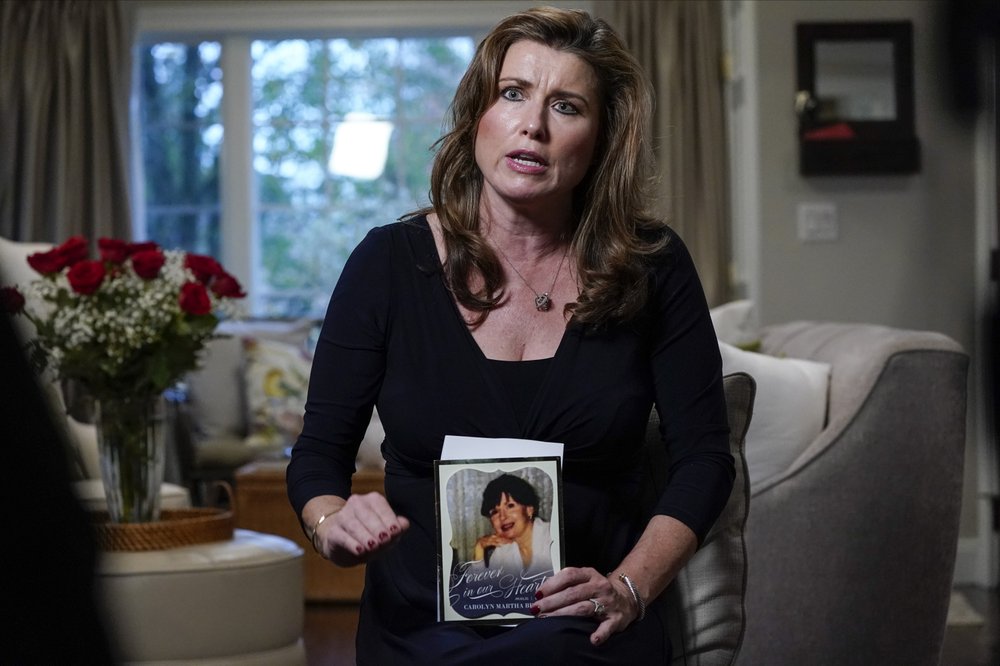
New York’s Long Island, Dawn Best saw that firsthand. Before COVID-19
arrived at Gurwin Jewish Nursing Home, she was pleased with the care her
83-year-old mother Carolyn Best received. She enjoyed activities, from
tai-chi classes to visits from a pony, and was doted on by staff.
Dawn
Best says her mother never contracted COVID-19 but died instead of
dehydration, perhaps because the staff was so consumed with caring for
COVID-19 patients that no one made sure she was drinking enough fluids.
But
when the lockdown started and the virus began to spread in the home,
Best sensed the staff couldn’t handle what they had been dealt. The
second time her mother, a retired switchboard operator, appeared on
screen for a scheduled FaceTime call, she looked awful, her eyes closed
as she moaned, flailed her arms above her head and just kept repeating
“no.” Best insisted a doctor check her out.
A few hours later, the doctor called, seemingly frantic, saying she only had a moment to talk.
“The
COVID is everywhere,” Best remembered her saying. “It’s in every unit.
The doctors have it, the nurses have it and your mother may have it.”
In
the end, 59 residents at Gurwin would be killed by the virus, but
Best’s mother never contracted it. She died instead of dehydration, her
daughter said, because the staff was so consumed with caring for
COVID-19 patients that no one made sure she was drinking.
“My
mom went from being unbelievably cared for to dead in three weeks,”
said Best, who provided medical documents noting her mother’s
dehydration. “They were in over their head more than anyone could
imagine.”
Representatives
for Gurwin said they could not comment on Best’s case. The home’s
administrator, Joanne Parisi, said “COVID-19 has affected us all” but
that “our staff at Gurwin has been doing heroic work.”
West
Hill Health and Rehab in Birmingham, Alabama, where Wallace lived prior
to his Aug. 29 death, said he was “cared for with the utmost
compassion, dedication and respect.” Wallace’s son provided medical
documents outlining the conditions he described.
The nursing home
trade group American Health Care Association disputed that there has
been a widespread inability of staff to care for residents and dismissed
estimates of tens-of-thousands of non-COVID-19 deaths as “speculation.”
Dr. David
Gifford, the group’s chief medical officer, said the pandemic created
“challenges” in staffing, particularly in states like New York and New
Jersey hit hard by COVID-19, but added that, if anything, staffing
levels have improved because of a drop in new admissions that has
lightened the patient load.
“There have been some really sad and disturbing stories that have come out,” Gifford said, “but we’ve not seen that widespread.”
Another
industry group, LeadingAge, which represents not-for-profit long-term
care facilities, said staffing challenges are real, and that care homes
are struggling in the face of federal inaction to provide additional
stimulus money to help pay for more workers.
“These
incidents, stemming from the challenges being faced by too many
committed and caring nursing home providers during this pandemic, are
horrific and heartbreaking,” said Katie Smith Sloan, LeadingAge’s
president. “I hope that these tragedies will wake up politicians and the
public.”
When
facilities sealed off across the country in March, advocates and
inspectors were routinely kept out too, all while concerning reports
trickled in, not only of serious injuries from falls or major medical
declines, but of seemingly banal problems that posed serious health
issues for the vulnerable.
Mairead
Painter, Connecticut’s long-term care ombudsman, said with dentists
shut out, ill-fitting dentures went unfixed, a factor in mounting
accounts of malnutrition, and with podiatrists gone, toenails went
untrimmed, posing the possibility of painful conditions in diabetes
patients.
Even
more widespread, as loved ones lost access to homes, was critical help
with residents’ feeding, bathing, dressing and other tasks. The burden
fell on aides already working tough shifts for little pay.
“I
don’t think anyone really understood how much time friends and family,
volunteers and other people spent in the nursing home and supplemented
that hands-on care,” Painter said.
Strict
rules barring in-person visitation persist in many homes, but as
families and advocates have inched back inside, they’ve frequently been
stunned by what they found.
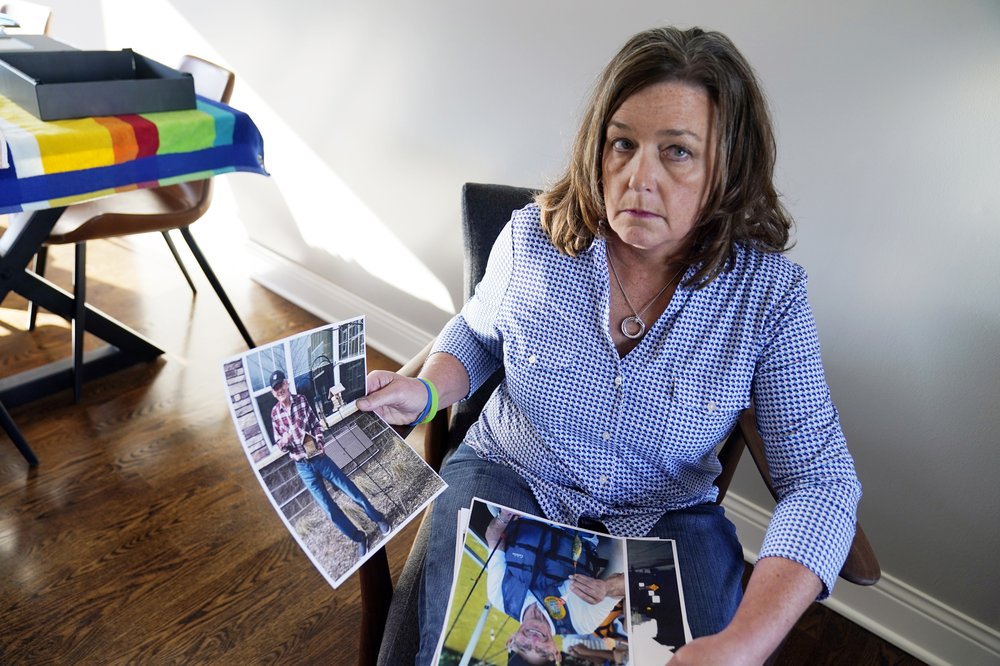
June Linnertz poses with photos of her father at her Chaska, Minn., home.
When
June Linnertz returned to her father’s room at Cherrywood Pointe in
Plymouth, Minnesota, in June for the first time in three months, she was
struck by a blast of heat and a wall thermometer that hit 85 degrees.
His sheets were soaked in sweat, his hair was plastered to his head and
he was covered in bruises Linnertz would learn came from at least a
half-dozen falls. His nails had been uncut so long, they curled over his
fingertips and his eyes crusted over so badly he couldn’t get them
open.
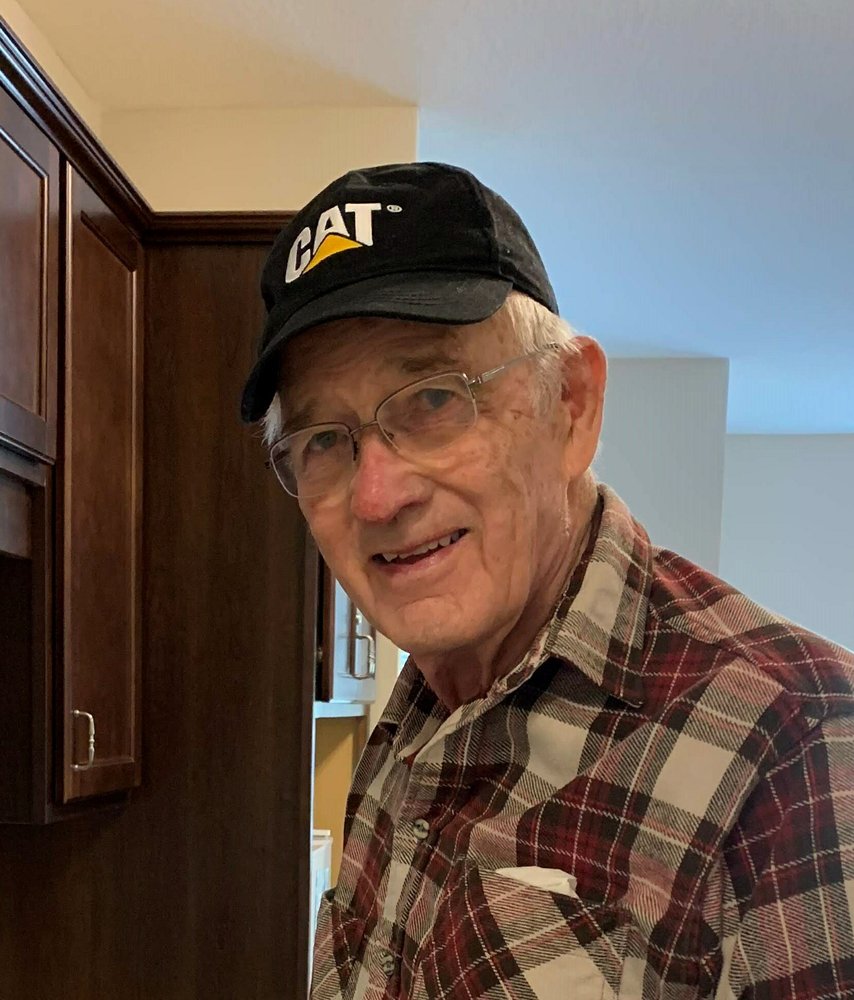
The father,
78-year-old James Gill, screamed, thinking he had gone blind, and
Linnertz grabbed an aide in a panic. She snipped off his diaper,
revealing genitals that were deep red and skin sloughing off.
Two
days later, Gill was dead from Lewy Body Dementia, according to a copy
of his death certificate provided to the AP. Linnertz always expected
her father to die of the condition, which causes a progressive loss of
memory and movement, but never thought he would end his days in so much
needless pain.
This April 17, 2020, photo provided by June Linnertz shows her father, James Gill.
“What
the pandemic did was uncover what was really going on in these
facilities. It was bad before, but it got exponentially worse because
you had the squeeze of the pandemic,” Linnertz said. “If we weren’t in a
pandemic, I would have been in there … This wouldn’t have happened.”
The
assisted living facility’s parent company, Ebenezer, said: “We strongly
deny the allegations made about the care of this resident,” adding that
it follows “strict regulatory staffing levels” required by law.
Cheryl
Hennen, Minnesota’s long-term care ombudsman, said dozens of complaints
have poured in of bedsores, dehydration and weight loss, and other
examples of neglect at various facilities, such as a man who choked to
death while he went unsupervised during mealtime. She fears many more
stories of abuse and neglect will emerge as her staff and families are
able to return to homes.
“If we can’t get in there, how do we know what’s really happening?” she said. “We don’t know what we can’t see.”
The
nagging guilt of unnecessary death is one Barbara Leak-Watkins
understands. It was just in February that her 87-year-old father, Alex
Leak, went for a check-up and got lab work that made Leak-Watkins think
the Army veteran, contractor and farmer would be with her for a long
time to come.
Sisters
Barbara Leak-Watkins, right, and Alberta Lynn Fantroy pose with photos
of their late father, Alex Leak Jr., at Watkins' home in Greensboro,
N.C.,
“You’re going to outlive all of us,” Leak-Watkins remembered the doctor saying.
As
nursing home outbreaks of COVID-19 proliferated, Leak-Watkins prayed
that he be spared. The prayer was answered, but Leak was nonetheless
found unresponsive on the floor at Brookdale Northwest in Greensboro,
North Carolina, his eyes rolled back and his tongue sticking out.
After
he arrived at the hospital, a doctor there called Leak-Watkins with
word: Her father had gone so long without water his potassium levels
rocketed and his kidneys started failing. He’d be dead two weeks later
of lactic acidosis, according to his death certificate, a fatal buildup
of acid in the body when the kidneys stop working. For a man whose
military service so drilled the need for hydration into him that he
always had a bottle of water at hand, his daughter had never considered
he could go thirsty.
“The
facility is short-staffed ... underpaid and overworked,” Leak-Watkins
said. If they “can’t provide you with liquids and fluids to hydrate
yourself, there’s something wrong.”
Two
buttons handed out to mourners at Alex Leak Jr.'s graveside service sit
on an ottoman in his daughter's home in Greensboro, N.C.
The
daughter is considering filing a lawsuit but a North Carolina law
granting long-term care facilities broad immunity from suits claiming
negligence in injuries or death during the pandemic could stymie her
efforts. Similar laws and executive orders have been enacted in more
than two dozen states.
The
owner of the father’s facility, Brookdale Senior Living, said it
couldn’t comment on individual cases but that “the health, happiness and
wellbeing of each of our residents will always be our priority.”
Around
the country, the heartache repeats, not only among families who have
already buried a member, but also those who feel they are watching a
slow-moving disaster.
In
Hendersonville, Tennessee, Tara Thompson was able to see her mother for
the first time in more than six months when she was hospitalized in
October. The 79-year-old had dropped about 20 pounds, her eyes sunken
and her legs looking more like forearms. Doctors at the hospital said
she was malnourished and wasting muscle. There were bedsores on her
backside and a gash on her forehead from a fall at the home. Her
vocabulary had shrunk to nearly nothing and she’d taken to pulling the
blankets over her head.
The
facility Thompson’s mother lived in had been engulfed in virus
outbreaks, with more than half its residents testing positive and dozens
of employees infected, too. She never caught it, but shaken by the lack
of care, Thompson transferred her mother to a new home.
“It
has nothing to do with the virus. She’s declined because she’s had
absolutely no contact with anybody who cares about her,” she said. “The
only thing they have to live for are their families and, at the end of
their life, you’re taking away the only thing that matters to them.”
“Failure
to thrive” was among the causes listed for Maxine Schwartz, a
92-year-old former cake decorator whose family had been encouraged prior
to the lockdown by how well she’d adjusted to her nursing home, Absolut
Care of Aurora Park, in upstate New York. Her daughter, Dorothy Ann
Carlone, would coax her to eat in the dining room each day and they’d
sing songs and have brownies back in her room. Several times a week,
Schwartz walked the length of the hallway for exercise.
When
the lockdown began March 13, Carlone feared what would happen without
her there. She pleaded to staff: “If you don’t let me in to feed her,
she won’t eat, she will starve.”
On
March 25, when a staffer at the home sent a photo of Schwartz, Carlone
was shocked how thin she was. Carlone was told her mother hadn’t been
eating, even passing up her favorite brownies.
Two
days later, Carlone got an urgent call and when she arrived at the
home, her mother’s skin was mottled, she was gasping for breath and her
face was so drawn she was nearly unrecognizable. An hour later, she
died.
Dawn
Harsch, a spokeswoman for the company that owns Absolut Care, noted a
state investigation found no wrongdoing and that “the natural
progression of a patient like Mrs. Schwartz experiencing advanced
dementia is a refusal to eat.”
Carlone is unconvinced.
“She
was doing so good before they locked us out,” Carlone said. “What did
she think when I wasn’t showing up? That I didn’t love her anymore? That
I abandoned her? That I was dead?”
Before
the lockdown, Carlone’s mother would wait by an elevator for her to
arrive each day. She thinks of her mother waiting there when her visits
stopped and knows the pain of the isolation must have played a role in
her death.
“I think she gave up,” she said.