Monday, September 11, 2023

Ohio attorney investigated for adding himself, family members to clients' wills

by Dean Narciso

A longtime attorney who specializes in estate planning, probate and guardianship cases is being investigated by Ohio's Office of Disciplinary Counsel for including himself and a relative as beneficiaries in the wills of his elderly and legally incompetent clients.

The disciplinary counsel, a branch of the Ohio Supreme Court that investigates, and prosecutes attorneys and judicial officers who are accused of ethical misconduct, is not permitted to comment on specific cases before formal charges are filed. But at least two grievances have been filed against John B. Mashburn, a long-time Groveport attorney, according to the woman who filed one of them.

Donna Harlow, a retired government worker from Warren County, learned about a Mashburn will involving her mother's cousin, Marjorie Chester.

Marjorie Chester died in April, six years after being declared incompetent and assigned attorney John Mashburn as her guardian. Mashburn in 2018 was named a beneficiary in her estate valued at more than $1 million. The case is still open in Franklin County Probate Court.

Marjorie Chester died in April, six years after being declared incompetent and assigned attorney John Mashburn as her guardian. Mashburn in 2018 was named a beneficiary in her estate valued at more than $1 million. The case is still open in Franklin County Probate Court.

Chester was declared a ward of Mashburn in 2017. As guardian, Mashburn was ethically bound to look after Chester's physical and emotional well-being, for which he was compensated in regular payments from her estate.

But a year after that agreement, Mashburn had a will written for Chester. And Harlow, who was familiar with legal documents and working with attorneys, was shocked to see that Mashburn was named as a beneficiary. Worse still, Mary Mashburn, the attorney's spouse and a paralegal for her husband, was also listed in the will. Each were to receive 5% of an estate worth more than $1.5 million, upon Chester's death, Harlow said.

Chester died on April 15 at age 97. The will is still open and now being contested by Harlow and others.

"We kind of feel he's weeding out the vulnerable and wealthy, those with no family and under guardianship," Harlow told The Dispatch recently. "We just feel like she (Chester) has been taken advantage of."

While Harlow, her sister and her mother stand to gain financially, her quest is about justice, not money, she said.

She continued searching probate court records including Mashburn and found another will in which Mashburn, as legal guardian, names himself and his wife as beneficiaries of his ward's estate.

"If I found these cases, how many others are there out there?" Harlow asked. "He has hundreds of wards and I just wonder how many others he's taking advantage of."

Mashburn doesn't dispute the veracity of the wills. But he said that an unrelated attorney prepared and executed them for him.

Alvin Mathews, Mashburn's attorney said that Harlow and others are "ignoring a significant fact that makes the situation appropriate," specifically that Mashburn had another attorney involved.

In addition to filing her grievance with the Ohio Disciplinary Counsel, Harlow's also reported the situation to the Ohio Attorney General, Columbus Bar Association, Franklin County Guardianship Service Board and Central Ohio Area Agency on Aging, among others.

So far, Harlow received just one response, from a Franklin County Probate Court magistrate saying that her complaint had been dismissed because of Chester's death. She was encouraged to seek additional advice from a private attorney.

Should guardianship attorneys be included in their clients' wills?

The Dispatch has asked several attorneys if it is ethical to name yourself as a beneficiary in a will that is written on behalf of your client.

Without hesitation, they all said that they would never do it.

"Even if the client insists, the law would generally say no, because I represent you," said attorney Jay Michael, who specializes in such cases. One solution would be for the attorney to withdraw from the case and (have the ward) seek independent counsel to process the will.

"The reason we've appointed a guardian is because we've ruled that the person is incompetent," said Delaware County Juvenile Court Judge David Hejmanowski, who also handles probate cases. Having yourself included in a will "creates the impression that you are inappropriately influencing the person you represent."

The Ohio Rules of Professional Conduct that governs attorney actions agrees:

"A lawyer shall not solicit any substantial gift from a client. A lawyer shall not prepare on behalf of a client an instrument giving the lawyer, the lawyer’s partner, associate, paralegal, law clerk, or other employee of the lawyer’s firm, a lawyer acting “of counsel” in the lawyer’s firm, or a person related to the lawyer any gift unless the lawyer or other recipient of the gift is related to the client."

In each of the Mashburn wills, there is no evidence that he is related to any of his clients.

Paul Pfeifer, executive director of the Ohio Judicial Conference, said the answer may be "wrapped up" in the relationship between the ward and guardian.

"I would suspect that it's highly unusual," he said. "God help us if that's the norm."

If there is reason to include the guardian as beneficiary, Pfeifer said "the will should articulate the very special relationship that goes above and beyond the guardian that justifies that."

Joe Caligiuri, Ohio disciplinary counsel, is not permitted to discuss the Mashburn cases or even acknowledge that investigations are ongoing. He did comment about including yourself in wills, noting that "there could be some situations where that might be OK" But, he said, "generally speaking, that would be a no-no."

If an attorney is charged with misconduct, the Ohio Supreme Court has the authority to determine a range of punishment, from reprimand to losing your license to practice in Ohio.

Who is John Mashburn?

At 74, Mashburn is nearing retirement after more than 50 years practicing law in Ohio. He has had a long and trouble-free relationship with colleagues and those in Franklin County Probate Court, those who know him say. The Ohio Supreme Court's attorney directory states that he has no investigations or sanctions.

He is perhaps best known for inheriting the cases of now-deceased attorney Paul S. Kormanik, who in 2014 was investigated for the excessive billing of his elderly, disabled and incompetent clients for mundane work such as house cleaning, opening mail and buying Christmas presents with clients' own money.
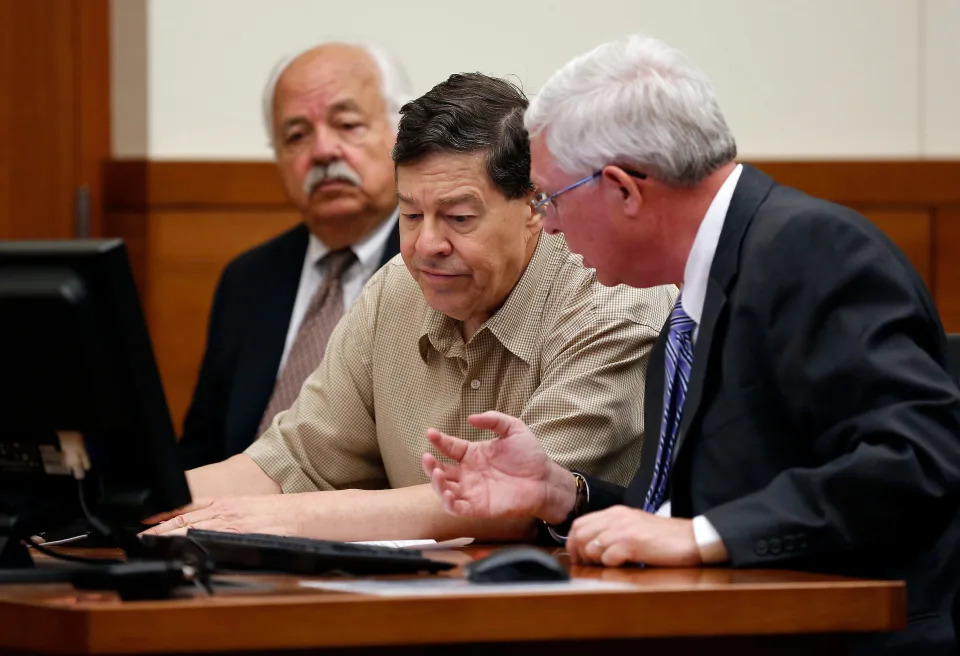
Former court-appointed guardian Paul Kormanik, middle, consults with his attorney Richard Cline before pleading guilty to 10 charges related to mistreating his wards in front of Judge Michael Holbrook in the Franklin County Common Pleas Court on Aug. 4, 2015. Kormanik was also represented by defense attorney S. Michael Miller, left. (Adam Cairns / The Columbus Dispatch)

In 2014, Mashburn told The Dispatch that he and Kormanik had so many cases that retired Franklin County Probate Court Judge Robert G. Montgomery told the attorneys that if something bad happened to one or both that Montgomery would have to shut down the court's normal operations and immediately scramble to find guardians for their wards.

A year after the investigation, Kormanik pleaded guilty to four counts of stealing from people for whom he was a court-appointed guardian, and to other charges connected to taking taxpayers’ money and falsifying records. Within days of his court appearance, Kormanik was found dead by suicide in his Upper Arlington home.

Since then, Mashburn has been admired for his longevity and character, said his former partner Steve McGann, who still works in the Groveport office they shared since 2017.

He describes Mashburn as "a typical country lawyer — he'd get up early and get his work done. He really did a lot of good."

"He's done a great job for a lot of people," said McGann, when asked about the ethical issues Mashburn faces. "But sometimes the lines get blurred."

"I sincerely think that John didn't think he was doing anything wrong," McGann said.

After their partnership ended after five years in 2022, McGann was cleaning up some of Mashburn's belongings and found a will and hand-written notes listing Mashburn and his wife among the beneficiaries. The will, he said, was written by Mary Mashburn, a paralegal who works for her husband.

He collected the information and notified Franklin County Probate Court officials. But he didn't hear back.

He wondered if he should do more to help protect the reputation of guardianship attorneys.

"I wrestled with it for several months," McGann said. "If I don't bring this up and it comes up later, it's going to look like I let John off the hook ... or the reputation of probate attorneys in general," McGann recalled thinking.

"I called a couple of my friends to ask what my responsibility is to the bar," McGann said, who said he eventually sent a detailed chronology and exhibits to the Ohio Disciplinary Council, including the decision from a 2022 case: "Toledo Bar Association versus Cook" which states "There are no circumstances under which an attorney may prepare a will or trust in which the attorney, the attorney’s family, or the attorney’s affiliates are named beneficiaries, unless the beneficiary is related to the client."

He eventually called Mashburn, telling him "Hopefully, I'm doing you a favor."

What Mashburn says

Contacted at his Dublin home, Mashburn declined to answer specific questions related to the wills, except to say that maybe his wife typed up the documents.

He said that McGann was likely upset about their partnership ending in November and chose to file complaints against him.

He said that many of his colleagues already know about the investigations and that reporting it in the news won't help, but added, "I understand what you have to do."

"I tried to retire four years ago and then this comes up," he said.

"I've never known him to be unethical," said attorney Jay Michael, who has known Mashburn for years. "I'm surprised. This is somewhat of an outlier. I've always found him to be honorable."

Meanwhile, Donna Harlow said she just wants answers from authorities who can prevent similar problems happening to others.

"Why does it take some nosy person like me? If I can dig this stuff up, why can't they do it? Why are they letting other attorneys do this."

She would also like some form of justice for Chester, and a message sent to others who might take advantage of the elderly or incompetent.

"She had no kids or siblings that are alive. If that was me," Harlow said, pausing to collect herself, "I would hope that someone would stick up for me at 97."

dnarciso@dispatch.com

This article originally appeared on The Columbus Dispatch: Ohio attorney John Mashburn named as beneficiary in clients' wills

Full Article & Source:
Ohio attorney investigated for adding himself, family members to clients' wills

AG Jennings Warns Seniors Of Uptick In Financial Scam Reports

Department of Justice Press Releases | Featured Posts | Date Posted: Wednesday, September 6, 2023


In the wake of an uptick in reports of financial exploitation of seniors, Attorney General Kathy Jennings and the Delaware DOJ’s Investor Protection Unit (“IPU”) is cautioning seniors to be vigilant for scams.

Delaware law requires banks, credit unions, and certain other financial institutions to report suspected exploitation of a senior or vulnerable adult to the IPU. Recent reports involve a number of different kinds of scams, including: 

  • Tech support scams in which a fraudster leads the victim to believe that their computer has been hacked
  • Money and check transfer scams, in which a fraudster asks the senior to help them transfer funds or deposit a check
  • Social media romance scams, in which a fraudster feigns romantic interest in the victim in order to convince them to send money

“Anyone can be the victim of fraud, but scammers frequently target seniors specifically,” said Attorney General Jennings. “Protecting Delaware’s seniors is a top priority, and it’s an all-hands-on-deck job. I’m grateful to the financial professionals who have reported suspected exploitation to the Investor Protection Unit. They’re doing their part to help protect our seniors.”

While the increase in reports has been specifically noted in Kent and Sussex Counties, it is unclear whether downstate seniors are being targeted because of their location. Attorney General Jennings urges seniors across the state to be vigilant and take precautions to protect themselves from investment scams by doing the following:

·         Remember: if it sounds too good to be true, it probably is.

·         Never deposit money or transfer a check for someone you do not know.

·         Never send money to someone you do not know.

·         Never pay money to receive money.

·         Never send money or provide credit card or online account information to anyone you do not know and trust.

·         If you get a phone call you did not expect from someone who says there’s a problem with your computer, hang up.

·         If you are looking for computer tech support, contact a company you know and trust.

Financial institutions may file a report of senior exploitation with the Investor Protection Unit using the form available here: https://attorneygeneral.delaware.gov/fraud/ipu-exploitation-of-seniors/

Source:
AG Jennings Warns Seniors Of Uptick In Financial Scam Reports

Cases of senior self-neglect are 'tremendous crisis' increasing in every Richmond-area locality


By: Tyler Layne

CHESTERFIELD COUNTY, Va. -- As seniors on fixed incomes are struggling to afford to take care of themselves, adult protective services investigations are dramatically on the rise in every social services department in Central Virginia.

Susan McCammon, executive director of Shepherd's Center in Chesterfield County, said she and her volunteers are noticing the challenges of the aging population firsthand.

“It just tears your heart out, and it’s everyday -- phone calls for us. It’s every day," McCammon said. “It’s a tremendous crisis with our aging population, and it’s just so sad, and they have no one to help them.”

Shepherd's Center provides transportation to those over 60-years-old, driving them to medical appointments, grocery stores, food banks, and other places to meet their needs.

She said since the pandemic, a growing number of elderly adults are not taking care of themselves as rising rent prices, food costs, and inflation have taken a significant toll.

McCammon said seniors are being forced to make tough decisions such as choosing to buy groceries over medication.

“Our volunteer drivers are the people who take them to the grocery store, and they can see the decline in their health because they’re not going to the doctor," McCammon said. "They've said, 'I'm not going to the doctor, I don't have the money for [prescriptions.] I just need food to survive.' So usually, they sacrifice their meds and being compliant with their doctor’s orders.”

Others have depleted their benefits, bypassed paying utility bills, and/or are facing eviction.

"They're looking for assistance to pay their rent, and we also noticed that we probably get seven or eight calls for that every day," McCammon said.

When Shepherd's Center volunteers encounter a senior in severe crisis or suspect a senior is in a position of neglecting their well-being, they'll escalate a report to social services.

And data collected by CBS 6 shows every local social services department has seen an increase in adult protective services investigations since the start of the pandemic. That means cases of abuse, financial exploitation, and most commonly, self-neglect, are on the rise.

Here's a look at the numbers of adult protective services investigations by fiscal year (July 1-June 30 of each year), provided by each social services department:

CHESTERFIELD:
FY 2019: 367 FY 2023: 986
Increase: 169%

HENRICO:
FY 2019: 533 FY 2023: 1,373
Increase: 158%

RICHMOND:
FY 2019: 255 FY 2022: 464
Increase: 82%

HANOVER:
FY 2019: 113 FY 2023: 206
Increase: 82%

"Self-neglect is the highest substantiated type of maltreatment that our adult protective services team is dealing with. This is a situation where the individual may neglect their hygiene, feeding or may not tend to their medical needs appropriately. This increase in self-neglect has definitely been impacted by the rise in housing and food costs as many of our seniors live on a fixed income," said Danika Briggs with Chesterfield-Colonial Heights Social Services during an August presentation to the Board of Supervisors.

Another explanation behind the increase in cases, according to local social services leaders, is the resumption of operations for in-home providers and day programs that were paused during the pandemic. Upon returning to regular services, those programs highlighted challenges among seniors that previously went unnoticed.

"With a great deal of APS referrals coming from health workers like doctors, nurses and Certified Nursing Assistants, COVID caused an absence of having “eyes” on the elder population during visits and conditions unfortunately went unknown," said Daricka Jones, Hanover County Social Services Director in an email to CBS 6. "In 2022, as things became “normal” again, in home visits, in person doctor appointments and family visits returned and inadequate health and living conditions of adults became known, possibly leading to a significant increase in referrals from the parties involved with adults needing assistance."

McCammon said recently, she's noticed it can take up to a month for social services to perform a welfare check on a senior due to the overwhelming demand.

“They’re inundated. They can’t even keep up with how many calls they get," McCammon said. "They don't have enough people working, and the workload is tremendous."

However, sometimes there's not much social services can really do beyond connecting seniors to resources, which Briggs acknowledged can be frustrating for community members who contact social services for assistance but do not notice improvements after social services gets involved.

But Briggs said if adult services questions an individual's mental capacity, they can initiate a psychological evaluation which could lead to a legal process in order to make decisions on their behalf.

McCammon said while Shepherd's Center and other area nonprofits are working to provide support to those in crisis, she's worried it won't be enough as the problems facing seniors are showing no signs of slowing down.

“Policymakers need to realize this is really a crisis. This is really important, and they need to do something to help with this," McCammon said. "I don't feel there are enough resources. Even the state and county resources, they're just to the edge of what they can offer. There needs to be more."

"Something's got to give," she said. 

Full Article & Source:
Cases of senior self-neglect are 'tremendous crisis' increasing in every Richmond-area locality

Sunday, September 10, 2023

Elderly exploitation charges dropped against former Santa Rosa County Sheriff's employees

by Kai Davis


SANTA ROSA COUNTY, Fla. -- Charges of elderly exploitation against two members of the Santa Rosa County Sheriff's Office have been dropped.

In June 2022, Deputy Carl Scheel III and Civilian Clerk Alicia Scheel were both charged with felony count of exploiting the elderly out of an amount greater than $10,000 but less than $50,000.

The Santa Rosa County Sheriff's Office announced that both Carl and Alicia Scheel were separated from the sheriff's office back in June 2022, and charged accordingly.

“Agency employees will always be held to high standards, both on and off duty," Sheriff Johnson previously stated in a release. "Although an arrest has been made, we are continuing this investigation and it remains very active."

The sheriff's office says they arrested both Carl and Alicia after a months-long investigation that took place from February to June of last year.

According to a report, Carl and Alicia Scheel were accused of moving a pickup truck from Carl's father's name into their names without the father's consent.

But just over a week ago, prosecutors filed to drop charges against both Carl and Alicia Scheel, and the case was closed.

Both Carl and Alicia remain separated from the sheriff's office.

WEAR News reached out to the sheriff's office for comment. There is no statement at this time.

Full Article & Source:
Elderly exploitation charges dropped against former Santa Rosa County Sheriff's employees

Robbery Suspects Arrested Allegedly Preyed on Elderly Women

by Jim Emerson


BERKELEY — Two men face multiple charges for allegedly robbing elderly women in Berkeley and Oakland. One of the suspect’s 19-year-old Jordan Gaines is a resident of Oakland. The second suspect is Tyler J. Magee, 21, of Vacaville.

On July 6, two women were followed home from Mechanics Bank on Shattuck Avenue in downtown Berkeley. One victim was robbed at an apartment house parking garage on Alcatraz Avenue in Berkeley. Another victim was robbed the same day on Mosswood Road in Berkeley.

Two more women were robbed on August 29, when they exited from a vehicle. Both victims were knocked to the ground when this robbery occurred on the 600 block of Oakland Avenue in Oakland.

Gaines allegedly fled the Oakland crime scene to a waiting vehicle purportedly stolen. It seems the getaway vehicle belongs to Gaines’ former girlfriend. It was followed overhead by a helicopter to Fresno Avenue in Berkeley. Gaines and Magee were both arrested there on August 29 by Berkeley PD.

Gaines faces charges for second-degree robberies involving vulnerable victims in Oakland on August 29. Additional charges for his actions that day concern carrying an unregistered loaded firearm. Regarding the July 6 robberies, he also faces charges for second-degree robberies involving vulnerable victims in Berkeley. However, Gaines is no longer in custody.

His companion Magee remains in custody at Alameda County Santa Rita Jail in lieu of $50,000 bond. Magee faces multiple charges including second-degree robberies of vulnerable victims for the August robberies in Oakland. In addition, he is charged with carrying an unregistered loaded firearm.

Full Article & Source:
Robbery Suspects Arrested Allegedly Preyed on Elderly Women

Lost dog's escape leads to heroic rescue of elderly man on National Dog Day

Two good Samaritans looking for a lost dog's owner ended up potentially saving an elderly man's life. (Credit: Jennings County Sheriff's Office)

LOUISVILLE, Ky.
- Two good Samaritans looking for the owner of a lost dog ended up potentially saving an elderly man's life, according to a Kentucky sheriff. 

In a Facebook post, the Jennings County Sheriff's Office said that a dog had broken from her chain over the weekend and was found by two good Samaritans on what happened to be National Dog Day. 

The pair attempted to locate the dog's owner. 

As they were going door to door, they heard a man yelling for help inside a home. The pair entered the home and found an elderly man who needed immediate medical attention and had been down and immobilized for at least two days. 

The pair then called 911. First responders said they didn't know if the elderly man could've survived much longer. 

Meanwhile, the dog was transported to animal control and was eventually reunited with her owners.  

"Thank you to these good Samaritans for their kindness in caring about the dog but also potentially saving the elderly male," the sheriff's office said in a post. 

"Dogs truly are man's best friend. Although it was not her owner, this pup breaking loose likely saved a life."

Full Article & Source:
Lost dog's escape leads to heroic rescue of elderly man on National Dog Day

Saturday, September 9, 2023

Reedsburg lawyer stole $1.6 million from client's trust to pay for home improvements, 2 trucks and a tractor

by Chris Ramirez


A Reedsburg lawyer will spend nearly four years in federal prison for embezzling $1.6 million from a client's trust accounts.

U.S. District Judge William M. Conley on Thursday ordered Kristin Lein, 61, to serve 45 months in prison, followed by three years of supervised release. She pleaded guilty in June to wire fraud, money laundering and filing a false tax return.

Prosecutors alleged that in June 2019, Lein began transferring money from several accounts belonging to the client’s trust to her own personal bank account.

Lein and the beneficiary of the trust spoke in a Feb. 2, 2022, phone call about financial matters. She told the person the trust balance was over $1.8 million. 

But that wasn't true.

Prosecutors alleged the amount in the trust was significantly less due to her actions, and that she continued to embezzle money until the funds were depleted in September 2022. 

Timothy M. O’Shea, the U.S. Attorney for the Western District of Wisconsin, said in a statement an investigation revealed Lein used the embezzled funds to pay personal expenses, including improvements to her home in Sauk County.

She also used the money to buy multiple vehicles, including a 2019 F-250 pickup truck, a 2017 Toyota Tacoma pickup truck and a 2020 Mahinda tractor, the statement said. 

Lein admitted she failed to report the income she obtained from the embezzlement on her 2019 personal tax return.   

The charges against Lein were a result of an investigation conducted by IRS Criminal Investigation. 

Assistant U.S. Attorney Aaron Wegner handled the prosecution.

Full Article & Source:
Reedsburg lawyer stole $1.6 million from client's trust to pay for home improvements, 2 trucks and a tractor

When long-term care becomes a slugfest

by James M. Berklan


If you ever want to see something really wrong, just watch two sides fight when both think they’re really right. It usually isn’t pretty.

That describes the climate created by the nursing home staffing mandate proposed on Friday.

Even before the release, providers had lobbied hard to impress upon rulemakers that there isn’t enough money in the government propped-up system to fund what they want. Nor enough bodies to fill the workstations they desire.

On the other side of the arena stands a crowd of regulators, consumers/voters, labor groups and academics who want more for patients. Some seem to be suspicious of any provider that doesn’t prolong health status indefinitely. Most are pretty adamant that they are going to fight for higher nurse-hours-per-day requirements, and — fair warning — they will have public sentiment on their side.

With the official publishing of the rule in the Federal Register today, the Centers for Medicare & Medicaid Services opens a 60-day comment period on its staffing proposal. Hold on to your hats, folks. It’s likely to become one of the most prolific, passionate comment periods ever.

All in the name of getting the “right” views out.

Who’s right? Those who want more people to live longer lives. Those who say they could use a lot more help making this happen, especially since government funding is supposed to make it all work.

Those who say there aren’t enough nurses to meet targets in the controversial proposal — and won’t be for years, even with increased focus on raising the number. Those who say Friday’s proposal could have been much worse for providers. Those who think the final rule will make providers’ tasks tougher.

Those who say bolstering training programs for nurses — and their would-be educators — is needed. Those who sneer that 75 million federal dollars for building such programs is anywhere near enough to do it.

Who else is right? Those who say there ought to be some kind of floor put on the level of staffing in skilled nursing facilities. Those who say a one-size-fits-all approach won’t work. 

Those who want surveyors to be more consistent, and more open with advice. Those who wonder where more surveyors will come from since their ranks are also so depleted.

Who else is right in this Story of the Year showdown? Centers for Medicare & Medicaid Services report authors who found “no single staffing level that would guarantee quality care.” Also, those who believe that report will be one of providers’ most powerful tools against mandated staffing levels. 

Also right are those who look to build flexibility and waivers into any final rule.

The right crowd includes those who say more skilled nursing wings, floors and entire facilities will continue to close if staffing levels have to go up. And maybe even if they don’t. Others right include anyone who frets that out on the prairie, and other secluded areas, it is going to get tougher if you need, or want to provide, nursing home care.

Who else is absolutely right? Those who say skilled nursing is a needs-based industry that will never go away. 

Most of all, those who are right include those who see Friday’s proposal as only the beginning. 

In other words, considering all of the above, everyone has some share of “right” in their corner.

The howling about the rule picked up right after it was released Friday. But more, stiffer blowback is coming — and from all directions. On that, I know I’m right.

James M. Berklan is McKnight’s Executive Editor.

Opinions expressed in McKnight’s Long-Term Care News columns are not necessarily those of McKnight’s.

Full Article & Source:
When long-term care becomes a slugfest

Friday, September 8, 2023

UNCONSTITUTIONAL: NEW YORK GUARDIANSHIP JUDGE "GAGS" PETER MAX'S DAUGHTER, LAWYERS, AND OTHERS - DENYING MEDIA ACCESS AND FORBIDDING COMMUNICATION WITH THE PUBLIC OR THE PRESS - IN EXTRAORDINARY COURT ORDER

News provided by


Emery Celli Brinckerhoff Abady Ward & Maazel LLP
07 Sep, 2023, 11:53 ET


Libra Max, Whistleblower and Advocate Against Guardianship Abuse, Represented by Civil Rights Law Firm Emery Celli Brinckerhoff Abady Ward & Maazel, LP, Faces Sanctions for Violating Order

September 8 Hearing in Manhattan

NEW YORK, Sept. 7, 2023 /PRNewswire/ -- Attorneys for Libra Max, the daughter of world famous artist Peter Max, today disclosed that their client has been silenced by New York State Supreme Court Justice Lisa A. Sokoloff (Index No. 500198/2015) under an extraordinary court order forbidding her from speaking publicly or to the press about her father's circumstances or releasing filings and transcripts of court proceedings from the case where she is challenging her father's guardianship. [The order was issued in the wake of a news report where the judge in the case was quoted; the judge objected that the quote lacked context and made it appear that she had spoken to the press in violation of the canon of judicial ethics.] 

The June 27, 2023 written "gag" order followed a similar April 10, 2023 ruling by Justice Sokoloff. Both have had the effect of forbidding Ms. Max from speaking freely about the New York State Court System's handling of her father's guardianship, as well as her attempts to shed light on alleged violations of the law, improper court proceedings, and the secrecy of guardianship courts in New York. 

"Gag orders like this one are extremely uncommon, and rarely lawful. They restrict freedom of speech—a core value in our constitutional system," said Ms. Max's attorney, Andrew G. Celli, Jr. of the law firm of Emery Celli Brinckerhoff Abady Ward & Maazel, LP, an expert in First Amendment and civil rights law. "This order meets none of the requirements for a constitutional gag order; it is unsupported by any of the necessary legal justifications, and it is so broad as to forbid speech of the highest constitutional value – speech critical of government. We believe it is flatly unconstitutional and we are challenging it at every level. In the meantime, however, the Court is threatening to sanction Ms. Max for exercising her free speech rights. This is un-American."

Ms. Max's involvement with the guardianship system began when she reported what she regarded as abuse within the system and spoke out against the guardianship imposed on her father, the artist Peter Max. An aggrieved daughter advocating for the end of her father's guardianship, Ms. Max has become a national advocate against exploitative guardianships and a whistleblower, exposing rampant abuses that have been committed at the behest of court-appointed guardians and their attorneys and ultimately with the blessing of local judges. 

Ms. Max has argued broadly that the culture of secrecy in New York's and other states' guardianship courts has resulted in denial of due process; and it has cost law-abiding citizens control over their finances, their property, their healthcare decisions, and even over whether they can see their own family.

The guardianship of Mr. Max has garnered the attention of media, lawmakers, and activists – largely due to the unyielding efforts of Ms. Max. But she points out that the issue is far larger than Peter Max's situation – about which she is now forbidden to speak.

Guardianship reform advocacy organizations identify a typical pattern of problematic guardianships: the person under guardianship is isolated, medicated, and his/her assets are liquidated. Ms. Max alleges her father's guardianship has followed the same course.

In the order, Justice Sokoloff points to news coverage of the Peter Max guardianship as stimulating her interest in the parties' statements to the press.

"While it may be uncomfortable for a court to have Libra Max criticize its actions, or for the press to scrutinize them, the law entitles Ms. Max to speak about how the judicial branch conducts itself, and it entitles the press to cover that. Ms. Max is entitled to speak about the lack of transparency in our court system, and how that is affecting her father in real time. And she is entitled to use her own family's experience to critique an area of law that has affected Americans of every stripe – from celebrities to ordinary elderly people swept into the system," said Mr. Celli, attorney for Ms. Max. "I have never before seen a court openly acknowledge that its order gagging the parties was stimulated by the fact that the judge did not like the way her remarks in court were reported in the press. It's extraordinary."

On September 8, 2023 at 12 noon at Courtroom 540, 60 Centre Street, New York, N.Y., Justice Sokoloff will be holding a hearing to determine whether Ms. Max will face sanctions and/or be held in contempt for violating the court's gag order. It is important that the media demand the transparency afforded to them in the United States Constitution by attending the hearing.

Read the gag order at: https://ecbawm.com/wp-content/uploads/2023/09/Redacted-Gag-Order-Peter-Max-Guardianship-Case.pdf

Source:
UNCONSTITUTIONAL: NEW YORK GUARDIANSHIP JUDGE "GAGS" PETER MAX'S DAUGHTER, LAWYERS, AND OTHERS - DENYING MEDIA ACCESS AND FORBIDDING COMMUNICATION WITH THE PUBLIC OR THE PRESS - IN EXTRAORDINARY COURT ORDER