Tuesday, July 2, 2019

Amid growth of assisted living, some renew calls for federal oversight

The number of assisted-living centers in the United States has jumped dramatically in the past 20 years, but there have been few efforts to systemically re-evaluate staffing or training guidelines necessary to properly serve residents. (Lisa DeJong, The Plain Dealer)

CLEVELAND, Ohio — To work as an aide in an assisted-living center in Ohio requires empathy, compassion and very little training.

About 20 hours, to be exact.

In Kansas, it’s much different. Aides there must take a 90-hour class and pass a test. North Carolina requires aides to take 80 hours of instruction. But there are other states, such as Montana, that say training is needed, but don’t specify how much.

The number of assisted-living centers in the United States has jumped more than 150 percent in the past 20 years, fueled by an increase of residents with cognitive issues, a willingness of facilities to take more frail patients, and families who wish to avoid nursing homes.

But while the centers’ clientele has changed dramatically, there have been few efforts to systemically re-evaluate staffing or training guidelines necessary to properly serve residents. This has led some advocates of the elderly to renew the call for federal oversight of the facilities, much like nursing homes.

For instance, nearly half of the nation’s states lack extensive training programs for the facilities’ employees, with most requiring some form of a job orientation and less than a dozen hours of instruction.

When it comes to staffing, the differences are even more stark. Thirty-eight states leave the amount of personnel needed to care for residents up to individual facility owners.

In Ohio, facility owners must make sure “sufficient numbers of staff” are present to meet residents’ needs. That’s different than in South Carolina, where one aide or staff member must be present for every eight residents during the day.

"This is an enormous problem,” said Kristine Sundberg, the president of Elder Voice Family Advocates in Minneapolis. “[Federal oversight] would be better, of course. It would provide for greater consistency.”

But the nation’s leading voice for assisted-living centers disagrees, fearing federal oversight would push “paperwork over patients.”

“We believe that states are better equipped to help assisted-living centers adapt and customize the care needed,” said Rachel Reeves, a spokeswoman for the National Center for Assisted Living in Washington, D.C. "The states offer greater flexibility. They can see what is best for residents and deal with those issues.”

Industry officials also see a potential cost to federal oversight: The expense of hiring more staff could be passed on to residents.

Medicaid’s role in assisted living

Nursing homes rely on Medicaid, in most cases, to pay for the services for residents. In large part, that’s why the federal government oversees the facilities.

Assisted-living centers, meanwhile, are mostly private pay. But Medicaid provides waivers for a small, but growing fraction of residents in 42 states. In Ohio, the waivers pay a facility about $1,500 to $2,100 a month per resident for care and services, such as monitoring, medication assistance and transportation. Residents must pay for room and board.

Medicaid spent $47.8 million for Ohio residents using the waiver in fiscal year 2016, according to the most recent figures available from the Ohio Department of Medicaid. Currently, about 5,500 residents receive the waiver.

In May, Jean Thompson, the executive director of the Ohio Assisted Living Association, went to the state capital, seeking a boost to the Medicaid reimbursement facilities receive, saying it is needed to pay for staffing levels and services.

She testified before the House Finance Committee, saying that some assisted-living centers may leave the waiver program if the reimbursement isn’t raised. At the time, the House proposed a 2.7% increase in reimbursements for the state budget. The Senate has increased that to 5.1%. Gov. Mike DeWine must sign the budget by the end of the month.

But because Medicaid’s role is increasing in assisted living, advocates for the elderly say the U.S. Centers for Medicaid and Medicare Services, which oversees nursing homes, should also monitor assisted-living facilities.

Toby Edelman, the senior policy attorney for the Center for Medicare Advocacy in Washington, D.C., said the increased role of Medicaid, as well as the uneven way states oversee assisted living, indicates that federal oversight is needed.

“It’s time – it’s past time – for federal oversight in assisted living,” Edelman said. “The federal government shouldn’t just give money away with no strings attached.”

But Sheryl Zimmerman, the director of aging studies at the University of North Carolina’s School of Social Work, and others said they aren’t sure federal scrutiny is the answer.

“We have to be realistic,” Zimmerman said. “By and large, the people who run the facilities know the [staffing and training] that is needed there.”

Differences in staffing, training

Paula Carder, a professor at the Institute on Aging at Portland State University, said states have different admission policies that can affect staffing and training requirements.

Take Alabama and Colorado. Assisted-living facilities there, like in many states, do not admit residents if they have health conditions that require extensive care, such as paralysis or feeding tubes. 

Because of the admission policies, the states can avoid stricter staffing and training requirements.

Other states, however, continue to push strict standards.

Missouri and Mississippi are among the strictest with staffing ratios for assisted living, with each requiring one aide or staff member per 15 residents during the day.

“We believe the more staffing, the better the quality of care," said Tracy Bowen, the long-term care ombudsman for Mississippi. The ombudsman office in each state offers help to families navigating long-term care. Often, the office fields complaints and deals with legislators on issues involving the elderly.

Some critics said that the ratios don’t necessarily guarantee better care. They stressed that nursing homes have had ratios for years, but the ratios have not prevented abuse or neglect.

A former official at two Northeast Ohio assisted-living centers said staffing, however, is a key issue in a resident’s stay, as older, more frail residents with mental-health needs live at the facilities.

“There is a great stigma to put[ting] Mom and Dad in a nursing home," the former official said. “Families will do anything to keep their parents and loved ones away from that."

Genevieve Gipson, the executive director of the National Network of Nursing Assistants, agreed.

“We have people in assisted living who can’t take care of themselves,” said Gipson, of Akron. “They can’t move."

As far as training, states such as Kansas, North Carolina, Washington and Massachusetts lead the nation, offering demanding course work. Aides also must receive annual training.

Employees who work with residents who have cognitive impairments receive additional, specialized training.

“We certainly think that training matters," said Barbara Hickert, the long-term care ombudsman in Kansas. “A well-trained work force is probably the most important part of quality care."

In Ohio, aides must have first-aid certification, complete a general training and orientation program and take two hours of initial instruction. Eight hours of continuing training are required each year.

All told, that’s about 20 hours total in the employee’s first year.

Beverley Laubert, the long-term care ombudsman for Ohio, said the state has stressed providing the training that meets the specific needs of an individual facility and of its residents.

For instance, she said one facility might specialize in cognitive issues, while another might have more residents who are quite independent. A one-size, fits-all training program would not meet the specific needs of facilities, she said.

Others aren’t so sure. They said more training can never hurt.

“Care is based on the abundance of qualified care," said Brian Lee, the executive director of Families for Better Care, a national advocacy group. “There is a changing world of long-term care. The first option for a family will be assisted living. It is more home-like. But many assisted-living centers are quasi-nursing homes."

And that leads some to consider the advantages of federal oversight.

“There would be consistency across all the states that way," said Bowen, the long-term care official from Mississippi.

Full Article & Source:
Amid growth of assisted living, some renew calls for federal oversight

Monday, July 1, 2019

Conflict between a journalist and AGs office may highlight shortcomings in MI Elder Abuse Task Force

Teternote
Attribution: Provided by Chris Abood
 
This note, written by an elder rights activist and signed by Division Chief Scott Teter, is the latest issue of contention between Teter, journalist Gretchen Rachel Hammond, and some members of the community of people trying to reform guardianship practices in Michigan. Teter denies telling activist Chris Abood to tell Hammond to "back off on Facebook."


While elderly Michiganders and their families struggle with a probate guardianship system that many allege is rife with abuse, a journalist who has been investigating Oakland County’s probate courts claims that members of Attorney General Dana Nessel’s staff have interfered with her work.

According to reporter Gretchen Rachel Hammond, Nessel’s communications director Kelly Rossman-McKinney called Hammond’s former editor to have her barred from a March press conference--and, more recently, an elder rights’ activist forwarded a note signed by Teter to Hammond. Among other things, the note includes the crossed-off line: “Back off on Facebook.”

Hammond also told me that, in her opinion, neither the attorney general nor the new task force have shown a commitment to investigating and holding probate judges or professional guardians accountable for ignoring existing laws designed to protect vulnerable adults from having their rights taken away from them.

For their part, both Scott Teter, a division chief in the AG’s office and the person coordinating the new task force, and Rossman-McKinney deny taking any action to interfere with Hammond’s work or discourage her from exercising her First Amendment rights. 

Teter further said that, by refusing to provide his office with details about 30 seniors whom she alleges are being held in unlicensed nursing facilities, Hammond is actually endangering the people she’s trying to help.

The most recent incident in the conflict between Hammond and Teter specifically was sparked by a handwritten note, signed by Teter, which was originally written down by elder rights activist Chris Abood during an event earlier this month at Madonna University in Livonia. 

Abood, who told me that her mother died after being placed under a guardian by Oakland County Probate Judge Linda Hallmark, first met Teter during a March 12 meeting between Teter, reporter Hammond and her team of investigators, and other self-reported victims of guardianship abuse along with other members of the attorney general’s staff.

According to a March 14 email from Hammond to Teter, during that meeting Hammond and her team showed Teter samples of redacted documents from their nine-month review of “nearly 3,000 court dockets belonging to former Public Administrator Jon B. Munger and Public Administrators Thomas Brennan Fraser, John Yun and Jennifer Carney,” in cases presided over by Oakland County probate judges including Linda Hallmark.

According to Hammond’s email, during their March 12 meeting her team presented Teter and his team with evidence indicating a pattern of Oakland County probate courts and professional guardians ignoring the law and victimizing senior citizens and their families alike. Hammond said her team found a pattern of guardianships being appointed without medical evidence being presented; wards and would-be wards being discouraged from attending hearings about their cases; judges ignoring family members’ existing durable powers of attorney and granting guardianship instead to for-profit, private guardians; and wards being placed in unlicensed nursing care facilities, including “two homes in which either the kitchen or refrigerator had been padlocked shut.”

Hammond’s March 14 email was in response a March 12 email from Teter in which he requested specific information about the sale of a home Hammond alleged was sold at more than $100,000 below market value. In addition, Teter wrote, “we are looking for the most egregious case that involved either the guardian ad litum ignoring the ward (who isn’t incapacitated) or one of the Cases that had the [durable power of attorney] that was ignored” in order to investigate and take action. 

Teter’s March 12 email doesn’t mention Hammond’s evidence of seniors being kept in unlicensed facilities or ask for help investigating those allegations. (During a June 24 interview with me, Teter said that he had asked Hammond for details about the unlicensed facilities during their meeting, and that to date he has “... exhausted probably 40 man hours of staff time trying to find people that were ... placed in non-licensed foster homes.”)

Unlicensed nursing facilities aren’t mentioned in the note that Abood said she took down while talking to Teter.

“I spoke with him and I said... What do you want me to say to Gretchen?,” Abood remembered. “He said, ‘Okay, what I need from her is a case, a file number and a name.’” The note, as taken down by Abood according to what she said was Teter’s instruction, asks for a case name and file number, “specific incidence when abuses criminal,” the file number for houses sold under value, and “... moving property to a small group of people.”

The note also contains the sentence, “Back off on Facebook,” which both Abood and Teter agree that Teter crossed out when he took the note from her to sign it. “He said to tell her to back off on Facebook. And I'm thinking, what's he doing looking at her Facebook? And then, when he got the card to sign it, he crossed it off even though he said it. And he said, ‘Well, I don't want it to come from me. Let it come from you.’”

Teter denies the allegation. “I don't instruct people on what to do on Facebook,” he said, “and so when she wrote that down, I said, ‘No. I'm not telling her what to do or what not to do on Facebook. That's entirely up to you.’”

The disputed note isn’t the first time that Hammond alleges that a member of the attorney general’s staff has attempted to or actually interfered with her work. Hammond also claims that, prior to the March 25 press conference announcing the new Elder Abuse Task Force, Kelly Rossman-McKinney from the attorney general’s office called Hammond’s then-editor at The Detroit Free Press to bar her from the press conference. 

Rossman-McKinney denied the allegation in a June 24 email. The editor, Mark Rochester, declined to comment on the matter in a June 25 email.

Hammond also said that, contrary to Teter’s claim that she hasn’t attempted to alert authorities about the plight of senior citizens being kept in unlicensed facilities, she had in fact reached out to Detective Sgt. Sunshine Ponzetti of the Michigan State Police.

According to Hammond, “The last conversation I had with Ponzetti was around March 19, when I offered to send her a flash drive with all the evidence I had if she provided me with an address to which to send it. She said she would consult with her colleagues and let me know,” but never followed up. Michigan State Police spokesperson Lt. Mike Shaw told me that “we are unable to comment on ongoing investigations,” including whether or not an investigation is taking place.

Hammond said that her nine-month investigation into guardianship abuse at Oakland County’s probate courts will be published soon. In the meantime, Attorney General Nessel admitted in a recent interview with WXYZ that the guardianship system needs to be reformed, but failed to say whether or not either probate judges or professional guardians will face investigation. While talking with me on June 24, Teter said he is “absolutely” committed to investigating past behaviors and pursuing any appropriate disciplinary measures allowed by law.

For her part, Hammond isn’t reassured. “Everything I’ve seen in the past 12 months is that the majority of these crimes have been committed by probate attorneys and endorsed by probate judges,” she said. “I’m glad to see (AG Nessel) saying something that’s never been said before in terms of guardianship being reformed, but I don’t see any evidence that she’s putting consequences to people who have perpetrated abuses in the past.”

Report Elder Abuse – Including Issues With Professional Guardians and Probate Judges.

To report elder abuse, including issues with professional guardians or local probate judges, contact the Attorney General’s office at: 800-242-2873. Click here to learn more about the Elder Abuse Task Force, including locations, dates, and times for Attorney General Nessel’s Listening Tour to hear from senior citizens, family members, and the wider community.

Full Article & Source:
Conflict between a journalist and AGs office may highlight shortcomings in MI Elder Abuse Task Force

Why Californians With Severe Mental Illness Are Caught Cycling From Prison To The Streets

by Alyssa Jeong Perry


Family photos of Audrey Woolfolk and her daughter, Julie. (Chava Sanchez/LAist)
There's an acoustic guitar propped up near the center of Audrey Woolfolk's living room. It seems out of place against the floral and lace decor, but Woolfolk likes it there. It's the one visible trace in her Orange County condo of her only child, Julie, now 29.

Other memories of Julie are tucked away in photo albums and a plastic storage bin filled with childhood mementos like a handmade quilt, little dresses and dolls.

Woolfolk said Julie had her first psychotic break in her early 20s, back in the summer of 2011. Since then, she's been diagnosed as having schizoaffective disorder, which causes her to suffer from symptoms of both schizophrenia and a mood disorder similar to bipolar disorder.

"It wasn't safe for me to be around Julie anymore," Woolfolk said softly. She said she moved to a new home in Orange County when Julie's mental health began to severely decline after her daughter refused treatment.

For the past eight years, Julie has been cycling in and out of jail, in and out of treatment, and on and off the streets. But there was a time between 2014 and 2017, said Woolfolk, when Julie was doing better. Woolfolk had become her legal guardian, known under California laws as a conservatorship. It's a legal process in which the county or a private individual, like Woolfolk, is appointed by a judge to handle decisions for a person with mental illness.

In 2017, Julie petitioned to be free. She was able to make her own decisions again. Julie refused to take her medications, said Woolfolk, and fell apart. She ended up back on the streets and in and out of jail.

Since last summer, Woolfolk has desperately tried to get Julie conserved again.

The debate around conservatorship raises not only a legal question, but also an ethical one. When, if ever, should we take away someone's civil liberties if they refuse treatment?

These days, Woolfolk feels relieved when she sees Julie's name and birth date listed in the L.A. County Sheriff's Department online database where you can look up inmates. It means her daughter is alive.

Audrey Woolfolk keeps an acoustic guitar in her living room. Growing up, Julie took guitar lessons and loved to play music. (Chava Sanchez/LAist)
HOW WE GOT HERE

In 1959, there were 37,500 patients in California's mental hospitals — a high for the state.

That number fell over the next few decades as state resources were cut and the number of psychiatric hospitals shrank.

In 1967, the treatment of people with mental illness drastically shifted when the Lanterman-Petris-Short Act (LPS) was signed into law by then-California Gov. Ronald Reagan. LPS, which was in full effect in L.A. County by 1972, ended the ability to institutionalize people against their will or for an indefinite amount of time.

The law limits the involuntary detention of people who are mentally ill to no more than 72 hours before going before a judge. It's known as a "5150 hold", after that section of the law.

At the end of a 5150 hold, if a judge finds a person to be gravely disabled or a danger to themselves or others, they can be placed on a temporary hold for up to 30 days. Then the process of a permanent conservatorship can be begin.

Researchers say shortly after LPS was implemented, there was a significant increase in the number of individuals with mental illness who entered into the criminal justice system. The act is still in effect in California today.

"We have to look at, how is the mental health disorder preventing them from obtaining their basic needs of food, clothing and shelter?" said Connie D. Draxler, Deputy Director of L.A. County's Office of the Public Guardian. "And one of the things that the court will look at is, does the person have a viable plan for obtaining their food, clothing and shelter?"

In 2014, Julie ran away from Orange County. Woolfolk said she found her in San Francisco in a hospital after being on the streets.

"She hadn't taken care of herself in months," Woolfolk remembered. "Her hair was this complete mess. All she wanted to do in that hospital was just hoard trash in a room." That's when the courts allowed Woolfolk to become Julie's conservator.

A "permanent" conservatorship lasts for a year, or until a clinician or the court determines the conservatee no longer meets the legal requirements for conservatorship. A petition to renew can happen at the end of the year, if the conservatee still meets the legal criteria and there are no other alternatives.

By 2017, a doctor said Julie was well enough to make her own decisions, according to Woolfolk.
But within four months, she stopped taking medication, wandered the streets and ended up in the L.A. County jail system.

The cycle for Julie started all over again.

THE CYCLE

Currently, a third of California jail and prison inmates are considered to be severely mentally ill.

Last year, Woolfolk pleaded with L.A. County Supervisors, the head of L.A. County Department of Mental Health and L.A. County Superior judges to get her daughter conserved by the county. Woolfolk felt she could no longer be responsible. In 2018, Woolfolk was diagnosed with Stage 2 breast cancer.

There was a court hearing in September to see if Julie was sick enough to be conserved. She walked into the courtroom in DTLA, her hands shackled, wearing a yellow jumpsuit — the color reserved for inmates with mental illness. She had red lipstick smeared across her mouth.

The judge said the doctor did not find that Julie was gravely disabled. He provided her treatment options, but she refused and asked to take the time served.

This November, she was released onto the streets again. No one called Woolfolk.

And Julie went missing.

Three months later, Woolfolk still hadn't heard from her. So she went to a neighborhood near downtown LA to look for her and pass out missing person fliers.


This February, Audrey Woolfolk went to Boyle Heights to look for Julie and pass out missing person fliers. She hadn't heard from Julie since November 2018. (Alyssa Jeong Perry/LAist)
THE LAWS AROUND CONSERVATORSHIP

In the past few years, California lawmakers have discussed amending the conservatorship laws to make it easier to conserve if someone with a serious mental illness refuses treatment. State Senator Scott Wiener (D-SF) authored a bill, SB 1045, which passed last summer.

Under Wiener's bill, a person who has been in a hospital or psychiatric facility due to mental illness and/or substance abuse eight times in one year can be conserved.

"These people are not just on our streets, these are people who are dying," Wiener said. "They are unable to care for themselves or make decisions."

Wiener said it will only apply to the smallest fraction (50 to 100) of severely mentally ill people that need the most help.

Right now, it's only a five-year pilot program that's active in San Francisco.

But civil rights advocates, including the American Civil Liberties Union, believe that the government should instead do more to build supportive housing and create options for community mental health treatment.

"We have to try less restrictive options of supporting and stabilizing people before we take all of their civil liberties away by conserving them," says Susan Mizner, ACLU's disability counsel.

Others are worried that if there are more patients being conserved, it will put a strain on an already fragile mental health system, according to David Meyer, professor of Law and Psychiatry at the USC School of Medicine.

"We don't have enough doctors, we don't have enough housing," Meyers says. "So immense investments in these things need to be made in order to meet the demand."

MOVING FORWARD

This February, Woolfolk found Julie. She was back in L.A. County jail.

Julie had been arrested for assaulting a police officer in Glendale. In April, there was a court hearing in Department 95, the county's mental health court. It was to see if Julie was competent to stand trial. The judge ordered an evaluation.

Woolfolk seemed relieved, but also reluctant.

"I wish this would end," she said. "It's a horrible cycle."


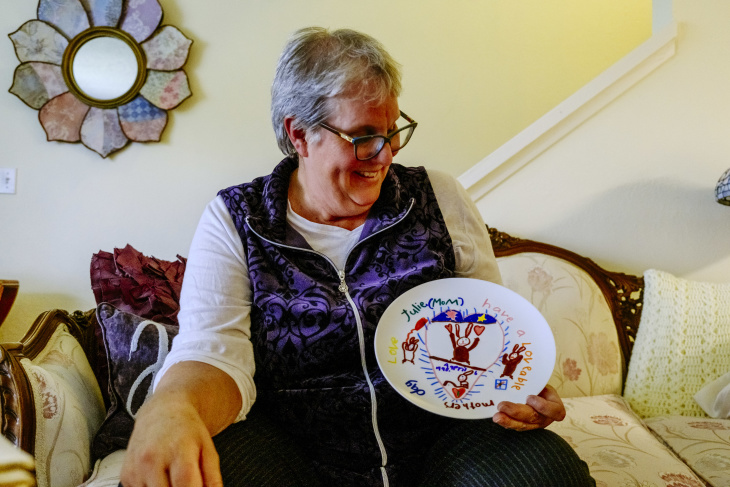
Audrey Woolfolk holds up a decorative plate that Julie made for her on Mother's Day back when she was young and before she became sick. (Chava Sanchez/LAist)
This Mother's Day, Woolfolk visited Julie in the Twin Towers Correctional Facility, where many of the most severely mentally ill inmates are housed.

"I would sure love to be able to give her a big hug," Woolfolk said. "I mean, you go visit her in the jails and there are these glass walls."

Ultimately, Woolfolk dreams of a time when her daughter's day-to-day reality might improve.

"I'm hoping that she'll get to experience a better quality of life."

Full Article & Source:
Why Californians With Severe Mental Illness Are Caught Cycling From Prison To The Streets

Britney Spears' Dad Files Lawsuit Against Blogger Responsible For #FreeBritney Campaign

Watch what you write, bloggers! Britney Spears' dad Jamie is taking the #FreeBritney accusations seriously and he's even filed suit against one web site that allegedly defamed him as conservator of Britney's estate, claiming Brit is being controlled against her will.

The suit claims Absolute Britney web site owner Anthony Elia made false and malicious claims that Jamie and his conservatorship controlled Britney's Instagram account to make her seem less stable and more in need of psychiatric help than she actually is, according to Fox News.

"It is time for the conspiracy theories about Britney Spears' well-being and the mob #FreeBritney movement to stop," the lawsuit says in its opening line.

Elia's blog and social media accounts launched the #FreeBritney campaign with numerous conspiracy theories about Brit being held against her will and about her Instagram account being controlled by the conservatorship (aka, Jamie). The suit claims Elia "has made it his mission to spread false and malicious lies on the internet about Britney, her conservatorship and her team, including that those around Britney are harming her and not acting in her best interests."

Beyond these legal issues, Jamie, as conservator, has reportedly received death threats. Sources say followers of the #FreeBritney movement have taken so seriously the conspiracy theories that Brit is being held against her will that they've threatened Jamie's life. Law enforcement has gotten involved.

Meanwhile, the conservatorship was granted an extension on the restraining order against Brit's former manager/friend Sam Lutfi for another five years.

Can you imagine how much they're spending on lawyers! 

Full Article & Source:
Britney Spears' Dad Files Lawsuit Against Blogger Responsible For #FreeBritney Campaign

Sunday, June 30, 2019

Woman claims mother was sexually assaulted by employee at Tucson nursing home

Click to Watch Video
TUCSON, Ariz. (KOLD News 13) - An investigation is underway at a Tucson nursing home after a woman who lives at the facility reported she was sexually assaulted by an employee.

“Obviously, you can’t trust anybody," said Selina Poss, the resident’s daughter.

Poss said her 63-year-old mother receives around-the-clock care at Sapphire Tucson Nursing and Rehabilitation, 2900 E. Melber Street.

While she said the family had issues with her mother’s care before, it was a call over the weekend that stopped her in her tracks.

During the phone call, Poss said her mother told her she was sexually assaulted by a nurse tech she was unfamiliar with. The resident said, according to Poss, the man put his genitals in her hand and then started inappropriately touching her.

“He told her, ‘This is our secret,'" Poss said.

Poss claimed her mother told other employees what happened before their phone call, but nothing was done.

“They didn’t call. To me, an incident like that, you call somebody and then you get that person to the hospital so they can be tested," Poss said. "I mean, who knows how many other females he’s done this to?”

The Tucson Police Department confirmed a report was made Sunday, June 23. According to a case management document provided by Poss, a detective was assigned to the investigation Tuesday, June 25.

Poss said she is frustrated over the lack of help by the facility.

“They just give us every runaround. Nobody really talks, nobody says anything," Poss said. "Everything I’ve found out, I basically had to call, to make the report for my mom.”

KOLD News 13 reached out to Sapphire for information regarding the alleged sexual assault that occurred on or around June 21. In a statement, an administrator with the facility wrote:

“As with any allegation of abuse or neglect, senior living facilities are required to investigate, as well as inform the proper authorities. The investigation by the facility and the authorities is ongoing and will be concluded.”

“It’s hard to watch her. It’s hard to see what it’s done to her," Poss said. “She’s already had a traumatic life. She’s already had to go through stuff, I’m supposed to be her protector. I’m the one who is supposed to take care of her and I just feel like I failed.”

Poss said she plans to pursue legal action as they wait on test results taken at the hospital after the alleged sexual assault.

For the time being, Poss said her mother has been moved to another room at the facility on what she describes as a floor with more security. She said she is working with her mother’s insurance provider to get her moved into her home for care.

Poss said she won’t stop fighting for an answer. Not just for her mother, but for other residents at the facility.

“I’m going to do everything in my power ... to make sure this man is not going to do it again," Poss said.

According to the Arizona Department of Health Services, Sapphire of Tucson Nursing and Rehab, LLC has a quality rating of “B.”

The quality rating is based on results of the most recent licensing survey. AZDHS notes the quality rating does not necessarily reflect the facility’s current compliance.

The facility received 45 citations during a yearly survey in January. The severity of most of the citations were graded C, D, E or F, which ranges from “widespread minimal harm” to “potential for more than minimal harm.”

According to AZDHS online records, all of the citations were corrected by April.

KOLD News 13 reached out to the Arizona Department of Health Services for comment on the allegations. As of Tuesday evening, we had not yet heard back.

Full Article & Source:
Woman claims mother was sexually assaulted by employee at Tucson nursing home

Brooklyn Woman Allegedly Pretends to Be Lawyer, Gets Indicted for Stealing Thousands from ‘Clients’

She’s not a lawyer, she just plays one in court.

A Brooklyn woman pretended to be an attorney and defrauded three “clients” out of thousands of dollars, according to the Brooklyn district attorney.

Natasha Riley, 56, allegedly told the clients her name was Natasha Riley-Applewhite from January 2017 until January 2019. In something that sounds straight out of “My Cousin Vinny,” there is an actual licensed attorney in New York by the name of Natasha Applewhite, but her full name is Natasha Holly Applewhite and has no affiliation with Riley.

The Flatbush resident is accused of adopting the name Applewhite to make potential clients believe she was a licensed attorney, according to Kings County District Attorney Eric Gonzalez.

Riley was hit with multiple charges including grand larceny, identity theft and practicing law without a license. She was indicted Thursday in Brooklyn Supreme Court on a 17-count indictment, and was ordered held on bail.

In her time allegedly participating in real-life mock trials, Riley fraudulently took nearly $5,000 from three different clients who hired her to represent them in a range of matters.

The first victim, a female college student, initially paid Riley — who she thought was Natasha Riley-Applewhite — $500 to attend an academic hearing with her at her college. She paid another $3,000 to get a trademark for a not-for-profit organization she formed. She never obtained the trademark.

Riley was also paid $700 to represent a litigant in a divorce proceeding and appear as counsel in Kings County Supreme Court. She also represented a third victim in employment negotiations with the victim’s former employer, for which she was paid $500, according to the DA.

An investigation into Riley alleged actions began after real attorney Natasha Applewhite learned the defendant was using her name and filed a complaint with the district attorney.

Her next court date is scheduled for August 7. Information regarding an actual, real-life lawyer for Riley was not immediately available.

DA Gonzalez urges anyone who believes they were a victim of this scheme to call the District Attorney’s Action Center at 718-250-2340.

Full Article & Source:
Brooklyn Woman Allegedly Pretends to Be Lawyer, Gets Indicted for Stealing Thousands from ‘Clients’

More support coming to prevent elder abuse, exploitation in RI

 by: Julianne Lima

PROVIDENCE, R.I. (WPRI) — A task force designed to protect elderly Rhode Islanders is asking state lawmakers to address the prevalence of financial abuse among seniors and vulnerable adults.

The Special Task Force to Study Elderly Abuse and Financial Exploitation released its final report Friday that provides recommendations on new policies and legislation that would educate seniors and prevent others from taking advantage of them.

The task force was formed in 2018 at the request of the Rhode Island AARP. The group – consisting of several organizations including the RI State Police, the Attorney General’s office and the RI Division of Elderly Affairs – studies the prevalence and impact of elder abuse and financial exploitation in the state.

“The number of Americans age 65 and older is projected to more than double by more than 2060, and the National Council on Aging reports that one in ten Americans age 60 and older have experienced some form of elder abuse,” Task Force Chairwoman Sen. Cynthia Coyne said.

Coyne recognized two pieces of legislation the General Assembly recently approved that align with the task force’s priorities.

One bill expands a law that requires people who have reasonable cause to believe a person over the age of 60 is being abused, neglected or mistreated to report it to the Division of Elderly Affairs, which will report the incident to law enforcement if appropriate.

The other bill requires a nationwide criminal background check for anyone seeking guardianship or limited guardianship of another adult.

The task force also made several other suggestions, including supporting programs that educate seniors (including the Division of Elderly Affairs), exploring potential federal grant opportunities to fund increased monitoring, data collection and education within the state’s guardianship program and changing the definition of an “elderly person” within existing state law so that all definitions align.

“With technology changes, with people living longer, we want to make sure that our Rhode Island seniors are well cared for and are given the resources that they need and the education they need to better protect themselves and their families,” Coyne said.

The task force will meet again in the fall where they will discuss a survey distributed to all 39 probate courts in the state, designed to collect data on the status of the guardianship program and to assess if any further recommendations are needed with regard to monitoring.

Full Article & Source:
More support coming to prevent elder abuse, exploitation in RI

Saturday, June 29, 2019

Sunday Night Live


Source:
Sunday Night Live

Court-appointed assistance for homeless should be expanded, City Councilmen say

Los Angeles officials could soon take a proverbial machete to the red tape preventing many Angelenos from being protected under conservatorship laws.

City Councilman Jose Huizar and David Ryu, whose council districts are among the most affected by homelessness, proposed Wednesday expanding conservator appointments for people incapable of caring for themselves due to severe mental illness or substance abuse issues.

According to Huizar, conservatorships could prevent Angelenos suffering from mental illness from falling into homelessness and help those fighting substance abuse find help.

“It’s no secret that a third of those experiencing homelessness in the City and County deal with mental-health and substance-abuse issues,” Huizar said, citing the most recent homeless count by the Los Angeles Homeless Services Authority. “The current, vicious, revolving-door system where the same people are shuttled in and out of our jails and hospitals, again and again, 72-hours at a time, is a failed system.”

The details of the proposal would have Los Angeles lobbyists in Sacramento push for an audit of the 1967 Lanterman-Petris-Short Act, which regulates California’s laws on involuntary commitment of the mentally ill. An audit would find areas of the law in need of clarification, or update.

Those suffering from drug addiction, repeated commitments, or exceptionally frequent use of emergency medical services could also be appointed a public conservator by courts. Those who have been involuntarily detained for psychiatric hospitalization at least eight times in a year under section 5150 of California’s welfare and institutions code would be most likely to enter conservatorship.

Currently, only mentally ill people who pose a danger to themselves or others or are “gravely disabled” can be held for involuntary evaluation and treatment in a psychiatric setting. Ryu and Huizar have argued the definition of “gravely disabled” is unclear.

“I have worked in community mental health care for years, and when we deny proper conservatorship, we are denying proper care. We need more mental health resources and facilities in Los Angeles, but we also need to reform conservatorship law so that we can provide care to those who need it most,” Ryu said.

Full Article & Source:
Court-appointed assistance for homeless should be expanded, City Councilmen say