Tuesday, November 9, 2021

Government tells 87-year-old woman her social security benefits will be held until she’s 100

by Shannon Behnken
 

TAMPA, Fla. (WFLA) – Mamie Walker is sick and tired of the government abruptly cutting off her social security benefits, leaving her unable to pay her rent and buy food. She said it’s all because of a mistake no one can explain.

Walker hasn’t received benefits for the past two months. She received a letter from the U.S. Social Security Administration saying she owes over $237,000 in “overpayments” and won’t receive benefits again until September, 2034. She would be 100 years old.

“You know I ain’t got that kind of money, baby,” Walker said. “If I did I wouldn’t be calling you about this.”

Walker said she’s terrified about how she’ll pay her bills and her landlord is already tacking on late fees.

“My kids don’t have nothing to try to help me, so I’m just down in a hole,” Walker said.

This is the second time Walker contacted Better Call Behnken for help after her social security benefits were cut. In 2019, the government claimed Walker owed over $200,000 in old student loan debt. Walker, who never went to college, had no idea what that was about.

Back then, a Social Security Administration representative vowed to Investigator Shannon Behnken that they would investigate. Walker’s benefits were then restored and there’s been no problem, until now.

Walker’s son, Morrison Walker, said he’s fed up and worried about his mother.

“She worked all her life for her social security money to come in, and now they’re taking it from her,” he said.

A Social Security Administration representative said this would be investigated again and they’ll try to assist Walker in getting her benefits back.


Full Article & Source:

74-Year-Old Woman Saves Dog from Alligator: ‘Providence Must Have Been with Me’

Courtesy of Suzan Marciano to the Palm Beach Post

by Nick Gilbertson

A 74-year-old Florida woman saved her dog’s life by fighting off an alligator that latched onto the golden retriever mix.

Suzan Marciano brought her dog Nalu to a lake at Burt Aaronson park near Boca Raton, Florida, on the evening of August 24. Marciano and Nalu were playing fetch in the shallow water when she noticed a dark shadow to the right of Nalu. She quickly realized that the shadow was a six-foot-long alligator.

“My heart dropped,” Marciano recalled in an interview with the Palm Beach Post. The alligator then seized the golden retriever mix and punctured the animal’s stomach and thigh. “I wasn’t thinking,” she explained. “I did the only thing I could do. I came down on the alligator with all my weight.” 

Her quick thinking freed Nalu from the alligator’s jaws but the predator latched onto Marciano’s hand. “As I’m pulling away, he grabbed my hand, the alligator grabbed my hand, I just kept pulling and he let go,” Marciano explained as reported by WPLG Local 10. 

“Providence must have been with me,” she told the Palm Beach Post. “It was all one big blur. I was in such shock. I didn’t feel any pain.” Marciano recounted that she was crying and bleeding from her palm as she fled the scene of the attack and headed toward her car in the parking lot. 

A friend convinced her to seek medical attention at the hospital for her injury and she required five stitches to mend her hand. Marciano then took Nalu to an emergency veterinarian hospital where the dog underwent a two-hour surgery in which its wounds were drained and stitched. 

“I had this feeling that she was going to survive,” Marciano told the Post. “If she survived that, she can survive the surgery.” In the time following the attack, Nalu was quiet and more subdued. The pair would go for short walks around the neighborhood, but Nalu would stop often to take a break, the Post reported. 

“If I hadn’t done what I did, I would have lost her and that would have been even more horrific for me,” she explained according to WPLG Local 10. 

A Florida Fish and Wildlife Commission officer and a park ranger investigated the lake after the attack but found no sign of the alligator per the Palm Beach Post.

According to the Florida Fish and Wildlife Commission, “Florida has averaged 7 unprovoked bites per year that are serious enough to require professional medical treatment. The frequency of these serious bites is variable but there has not been a significant trend in the past 10 years.”
 
Full Article & Source:

Monday, November 8, 2021

I am NOT Incapacitated: I Do NOT Need a Guardian

 
Hi. My name is Jenna Hiniker. I live in Grand Rapids, MN. My vulnerable adult financial cadi waiver case manager Erin Kienlen from Blue Earth County, MN petitioned to take away ALL my guardianship rights away. She is stating I am incapacitated and not able to provide, food, water, safety, shelter, medical care and not able to make responsible decisions. 
 
She stated I am in need of a guardian because she stated I need someone to sign releases of information, coordinate care and find proper housing for me. 
 
I do all of this myself. I sign releases of information, have huge coordinated team of medical and mental health professionals working with me and I am on housing lists to get an apartment in my community. 
 
I have shelter, food, water, medical care, and I am safe and making responsible decisions for myself. 
 
This is best I have done in 5 years of my life. I have worked really hard to get to where I am today. I refused to be silent on this matter.
 
I want the public to know truth about abusive and corrupt probate guardianship and need for guardianship reform. I want to thank Dr. Sam Sugar, MD and founder of Americans Against Abusive Probate Guardianship. He has advocated for me. I am grateful for his passion in helping others and shedding light on the issue of guardianship reform. His website: https://aaapg.net/
 
Source:

Supported Decision Making: Treasure Coast group supporting bill to help people with intellectual disabilities preserve their rights

Click to watch video

By: Meghan McRoberts

STUART, Fla. — A Treasure Coast man is fighting to help people with intellectual disabilities get their fair shot at a full, independent life.

Michael Lincoln is trying to gain support for a bill that would make it harder for someone to be put on a court-ordered guardianship without a judge first considering an option that does not strip them of their rights to get married, drive, and vote.

Lincoln said he has an intellectual disability, and grew up primarily in foster care.

When he was aging out of foster care, Lincoln said a St. Lucie County judge considered him incapacitated and put him under a court-ordered guardianship.

He lost his right to vote, get married, choose his job, choose where he wanted to live and make basic decisions for himself.

He was put in a group home where he said he felt trapped.

“I said enough is enough,” Lincoln said.

By being his own advocate and seeking out legal help from Disability Rights Florida, he regained his rights after more than 2 years and was taken out of the guardianship program.

Instead, he was allowed to be a part of Supported Decision Making.

“I was named the first person in Florida to get Supported Decision Making in the state,” Lincoln said.

That means he could choose the support network that would help him make big decisions and give him guidance and advice as needed.

He works closely with the nonprofit, Stand Up For Independence.

“Our mission is to teach advocacy in the community, to teach people they have the right to vote, to be in the community, go to church,” said Kimberly Martinez, an advisor for Stand Up For Independence.

It is made up of others with intellectual disabilities working together to support each other’s independence.

“We are independent,” said Amanda Baldwin, President of Stand Up For Independence.

“I also live independently, and we drive, and we have an 18-month-old baby,” said Stand Up For Independence Communications Coordinator, Erin Hyne.

Lincoln hosted a community education session Friday at the ARC of Martin County to continue spreading the word about Supported Decision Making. He’s working to gain more support for HB and 681 and SB 1010, which would require judges to consider Supported Decision Making before ordering someone to the guardianship program.

The bill died last year, but they hope that it might be successful this session.


Full Article & Source:

Couple arrested after elderly woman found bedridden with exposed spinal cord

by Sandy Hodson

An Augusta couple charged with neglect of a disabled adult or elderly person remain in jail without bond since their arrest Oct. 28.

Jacob A. Brigham, 24, and Breann K. Murray, 23, were taking care of Murray's 78-year-old bedridden grandmother in Hephzibah. . According to an incident report, they were living with responsible for the elderly woman's care after Murray's mother died a couple of years ago, according to an incident report. She was discovered with bed sores that exposed her spinal cord.

Murray told deputies sent to the home around 2:40 a.m. Oct. 28 that there had been a nurse who would check on her grandmother, but no nurse had been there since June. Brigham told deputies the victim was bedridden because she was lazy, according to the incident report.

The emergency medical worker who called for the sheriff's office told the deputy he found the victim's backside covered in blood, puss and human waste and that her spinal cord was exposed, according to the incident report.

Brigham and Murray appeared in Richmond County Magistrate Court Oct. 29, but because the charge they face is considered a family violence crime, bond can only be addressed in Superior Court. Neither Brigham nor Murray has any criminal arrests in the Augusta or Columbia County Judicial Circuits, according to court records.

Full Article & Source:

Sunday, November 7, 2021

Uncovering Guardianship Abuse

by Anthony Palmieri, JD, CFE, CIG, CIGI, CIGA, CGI, CIA, CCSA
"No one is more hated than he who speaks the truth." – Plato

"Silver Collar Crimes" are financially motivated crimes intentionally perpetrated against elder persons with diminished cognition, using the court system or legal documents. Silver Collar Crimes are a subsection of elder exploitation and include court-adjudicated guardianships, official land records, powers of attorney, wills, and trusts. Substantiated allegations of fraud in guardianships with the notion of court-oversight deteriorates the public’s trust. Collusion and organized schemes in guardianships are arguably the most egregious of Silver Collar Crimes. Persons under guardianship are often the most silent and innocent victims, but sometimes there are ancillary or family victims as well. A smaller division of so-called victims have abhorrently unclean hands or exhibit symptoms of being mentally unhealthy themselves, some whose conduct precipitated their loved one’s guardianship. Schemes occasionally involve unreasonably separating incapacitated persons from family; misusing psychotropic drugs, “off-label” usage of medications, or using over-the-counter anticholinergic medications that exacerbate dementia-like symptoms; or neglecting conditions such as urinary tract infections, depression, hypothyroidism, and diabetes. Aside from children, elderly incapacitated persons are society’s most vulnerable and exploited citizens. Greed, entitlement, rationalization, complacency, overreliance, disinterest, naivety, and negligence are contributing factors to guardianship fraud.

The Palm Beach County Clerk of the Circuit Court and Comptroller, Division of Inspector General (“IG”) Guardianship Integrity Assurance Team, comprised of highly credentialed professional auditors and investigators, are tasked with rooting out fraud, material errors, and misconduct. The IG team applies generally accepted auditing standards to give assurance that the court can rely on the guardian’s reports. In conjunction with IG accreditation standards, the investigators also utilize a robust investigative framework when the guardian’s reports are materially unreliable, or when validating or discrediting complaints against a guardian. The IG targets anyone willing to prey upon society’s most vulnerable, silent, and innocent persons. The IG has jurisdiction of the approximate 2,800 to 3,200 open guardianship proceedings in Palm Beach County and all alleged misconduct involving the 550 state-registered professional guardians in Florida.

Interjecting independence

The Florida Constitution sets forth the Clerk of Court as an arm of the judiciary, but the elected Clerk is organizationally separate from the judges and court administration.

This independent relationship ensures the public can trust judicial processes such as jury pool selections, evidence handling, and guardianship monitoring. A hallmark of professional auditing and investigating is independence from personal, organizational, and external impairments. Florida’s Clerks have the duty of independently auditing, and, if warranted, investigating the annual guardianship reports filed by court-appointed guardians and advising the court of audit findings. In order for the court to exercise oversight, the guardian’s reports must be reliable to start. This unique combination of jurisprudence, mandatory annual reporting, required auditing, and an independent auditor without impairments from stakeholders including decision-makers, is scarcely found at the national level.

Florida’s aging demographics may help explain the infrequency of these statutory best practices elsewhere. Florida has the largest percentage of residents over 65 years of age in the United States.

Florida is projecting more than 6.6 million senior residents by 2040. Even prior to the first Baby Boomer turning 65 years of age in 2011, Palm Beach County had the largest number of 85 and older persons in Florida, and had 99,849 persons who were 80 or older, nearly the same population as the city of West Palm Beach. At the same time, Florida was tied with two other larger population states at the time, California and New York, for the most centenarians.

Perpetrators of guardianship fraud include guardians, both professional and non-professional, attorneys, family members, caregivers, and others in close contact to incapacitated persons. Alleged fraud by professionals vastly overshadows other parties in television and print media, which gives decision-makers and the general public a distorted view of problems. Additionally, professional guardians are ineffective at publicly defending their conduct because of perceived confidentiality constraints.

Fraud is a human condition

Fraud is not only confined to guardianship professionals. The prominent theory about a person’s decision to commit organizational fraud is the Fraud Triangle. The Fraud Triangle, which can be used to understand guardianship fraud, includes

  1. pressure; 
  2. opportunity; and
  3. rationalization.

All persons within their individualized realized levels of pressure, opportunity, and rationalization will commit fraud.

Under the Fraud Triangle, all persons, regardless of industry, with the right concoction of pressure, opportunity, and rationalization will commit guardianship fraud.

A decade ago, the Palm Beach County Clerk’s IG launched a hotline and hired professional auditors with extensive investigative experience and legal backgrounds to tackle guardianship fraud. The hotline was among the first hotlines in the nation dedicated to guardianship and specializing in investigating guardianship fraud allegations. Since October 2011, more than 1,200 tips were lodged to the hotline, including numerous complaints about a nefarious state-registered and court-appointed professional guardian by the name of Lynrod Douglas.

Apex predator

As she was dialing the last few digits of the hotline’s phoneword, “F-R-A-U-D”,

April Wilson prepared to speak; she listened and followed the prompts prior to talking to an investigator.

“You’ve reached the Guardianship Integrity Assurance Hotline in the Clerk’s Division of Inspector General. To speak to an investigator and file a report now, please press 2.”

“Hello, Clerk’s Inspector General, how can I help you?”

After hearing her cue to speak, April Wilson unloaded the complaint:

“…Lynrod Douglas is my estranged husband’s guardian. Our marital relationship is over. We are separated but have a joint bank account together. Lynrod closed the account. I own half of the $55,000 in the account and Lynrod won’t give me my half…”

Red flags

The IG investigators examine every word of each complaint lodged with the hotline. At first blush, the investigators internally rejected several statutes, court rules, and administrative rules that, if not pursued further, would have casually explained the guardian’s actions. However, one of the core principles of performing independent audits and investigations is diligence. Diligence means making a good faith effort to perform investigative services to the best of the investigators ability, to analyze  complaints critically, and to exercise professional skepticism.

Diligence means leaving no stone unturned. When performing complaint intake, investigators are especially attuned to “red flags.” According to fraud research, a red flag is a set of circumstances that are unusual in nature or vary from normal activities. It is a signal that something is out of the ordinary and may need to be investigated further.  Red flags do not indicate guilt or innocence.

The following are real-life examples of “red flags” identified by the IG during other investigations:

  • A non-professional guardian, who was an attorney, rekindled an old high school romance with the daughter of an elderly mother. The daughter was the mother’s caregiver. The mother was a multi-millionaire and the guardian managed the mother’s trust. In the same case, there were two other adult children with financial difficulties, and significant family discord. The guardian charged over $96,000 for administrative tasks in 10-months without objection from the daughter. The daughter was reimbursed by the guardian for voluminous and questionable expenditures totaling over $220,000; for example, steak dinners and apple martinis for two to “maintain the mother’s lifestyle and relationship with her daughter.” However, according to medical records, the mother had severe end-stages-of-life dementia, and a feeding tube was inserted into her stomach for nutrition. The daughter perjured herself by making intentionally false statements that she repaired her mother’s sliding glass door. The investigation found the daughter purchased a $1,065 watermelon tourmaline crystal cabinet specimen, a $3,250 Egyptian sarcophagus, a $1,400 wrinkle-removing laser, $600 for Kentucky bluegrass seed, along with hundreds of thousands of dollars of other frivolous spending.
  • A professional guardian, who was an attorney, frequently submitted unavailability notices to the court for hearings and trials in her civil and probate cases when going on vacation and traveling out of the state. The guardian shared details about her travel to places like the Mitchell Corn Palace and the Badlands National Park in South Dakota on social media. The guardian submitted numerous fee petitions for overlapping periods of time and services, and for services that could not possibly have been performed while on vacation and out of the state to North Dakota. The guardian sold the elderly person’s property at a fraction of the fair market value (FMV). The real estate agent, who unbeknownst to the court was the guardian’s son, inadvertently expressed happiness about a cancellation of a contract for the FMV of the elderly person’s house even though he would have been paid an uncustomary 8-percent commission on a higher selling price. The son’s business partners purchased the discounted house, and flipped it for a hefty profit.
  • A non-professional guardian, who was the daughter of an elder person, did not disclose that her father owned a large plot of farm land. The daughter quit-claimed the land to herself without a court order. The daughter disbursed large sums of cash to herself as reimbursements for expenses to maintain the property. The daughter perjured herself by making intentionally false statements that she purchased a tractor, fencing materials, a generator, and a storage shed through an on-line marketplace. The daughter actually siphoned and skimmed money from the father’s bank account after receiving negligent legal advice from her attorney.

There were several red flags that surfaced from April Wilson’s report, but the alleged subject of the complaint was not unfamiliar to investigators. Lynrod Douglas had been on the IG’s radar from nearly the moment he registered as a professional guardian with the state. Soon after his first court appointment, the IG received an anonymous tip that Douglas was “trolling” residential settings for his clients and, in hindsight, potential victims.

According to the complaint, Douglas was offering “kickbacks” to front desk and administrative staff to find residents with moderate to severe cognitive declines and no involved family.

A kickback is a payment made to someone who facilitated a transaction with an illicit purpose and is similar to a commission but without the victim’s knowledge. A kickback is not necessarily a criminal violation but can be criminal as well. Nine days later, another blip appeared on the monitoring radar. This hotline complaint came directly from another incapacitated person. Bob Peter, the incapacitated person, walked into the courthouse and to a customer service window to report that Douglas “assaulted” him. The complaint was forwarded to the IG, and a memorandum was immediately docketed into the court record with an administrative recommendation for the court to schedule a hearing with Bob and the guardian. At the status conference, Bob and Douglas conceded to the judge that the episode was just a “misunderstanding” and both parties committed to working better with each other. Later, the Clerk’s operational auditors, who perform administrative audits and reviews on the thousands of guardianship reports filed in Palm Beach County every year, called the IG to complain about Douglas regarding yet another proceeding:

“I’m unsure if Lynrod Douglas is capable to fulfill his duties as a guardian since it seems he’s unable to file an accounting that I can audit and recommend approval to the court.”

Another complaint was filed about Douglas placing an elderly person into a six-bed assisted living facility (ALF) with allegations of deplorable nutritional offerings, restricting visitations, and other allegations. After an unannounced visit to the ALF, IG investigators and the Long-Term Care Ombudsman found nothing alarming, and the IG unsubstantiated the allegations. 

During the course of the investigation, the ALF owners were arrested for elder abuse (physically restraining another elderly resident to a bed) , and it was revealed that a Certified Nursing Assistant notified Douglas about the owners being “verbally abusive” to residents.

Being on the radar transitioned to being in the center of the bullseye, once IG investigators assessed confidential court records, performed an interview with April Wilson, and after the IG subpoenaed third-party records. Bank records revealed that Douglas transacted a teller withdrawal totaling $55,197, and the withdrawal slip was signed by Douglas as “Guardian for the Ward.” Douglas did not disclose any portions of the joint bank account to the court, nor did he list the funds on the initial verified inventory.

Money, money, money

Tracing the money from the source to the final disposition is a fundamental investigative technique. When IG investigators followed the money, they discovered that April Wilson’s money and her husband’s money was placed into a series of personal and business bank accounts owned or managed by Douglas. In other words, Douglas was playing a shell-game with the money, and laundering the ill-gotten funds.

Then, another hotline complaint was received alleging that Douglas took the proceeds from an overpayment for room and board at an ALF after another resident unexpectedly died.

When challenged by a family member, Douglas produced a balanced amended accounting report and a bank statement purporting to show a refund totaling $3,746 was deposited into the bank account. The IG performed an extensive forensic examination on the submitted bank statement and determined the statement was altered and forged. Creating, altering and forging documents is the most prevalent method of asset concealment when perpetrators commit white collar fraud.

The IG subpoenaed the bank statements in question from the original source and confirmed that the filed statement was indeed fictitious and Douglas committed perjury in an official proceeding. The bank statement also confirmed that assets were missing and Douglas committed grand theft.

At this point, the IG investigation, in conjunction with law enforcement detectives, identified a large sum of bank certificates of deposit missing from an initial inventory. The team also discovered more created and altered documents, pointing to illicit disbursements in even more guardianship proceedings. As a part of our accreditation, ethical, and moral standards, the IG will refer allegations of criminal activity to law enforcement when a reasonable suspicion is established. Once Douglas’ modus operandi was identified, other fraudulent conduct quickly surfaced. Douglas was ultimately adjudicated guilty for fifteen counts of exploitation of an elderly person, grand theft, money laundering, and perjury for misappropriating approximately $420,000 from five elderly persons. He used illicit proceeds to pay off a mortgage, buy a property, pay off credit cards, and buy a Mercedes-Benz.

Prior to his arrest, Douglas was reportedly trying to exit the guardianship business because of increasing statewide investigations and oversight; he was planning to open one or more six-bed ALFs instead. On September 29, 2021, the sentencing hearing for Lynrod Douglas was continued since he contracted COVID-19 in jail, was quarantined, hospitalized twice, and remained in the medical unit of the jail. At this point, it is unclear if his sentence will include additional jail time, as a “ward” himself in the Florida Prison System, restitution to victims, community service, and a complete bar from being anyone’s guardian or fiduciary into perpetuity. The IG’s work to better protect incapacitated persons continues regardless.

Optimism for the future

There were several forward-thinking recommendations adopted at the 4th National Guardianship Summit by voting experts, advocates, and stakeholder delegates of the National Guardianship Network

that will better protect incapacitated people and help prevent fraud. The recommendation with the biggest ripple effect was abolishing plenary guardianships in favor of allowing people to retain the maximum of rights, and if guardianship is necessary, the guardianship orders should be narrowly tailored. The 4th summit ever so subtly cantilevered the overarching framework of the 2nd national summit, better known as Wingspan. The majority of delegates at Wingspan, 20 years previously, embraced a controversial viewpoint that the fundamental nature, goals, and methods of guardianship should be adversarial and litigious in nature. The majority argued that guardianship should be hotly contested until the ultimate level of review (or assets) are exhausted. The minority view was that guardianship served a therapeutic and less expensive role; and facilitated benevolent provisions and services for incapacitated persons. The 4th summit nudged the focus of guardianship away from being guardian-attorney centered and more toward leveling the playing field for incapacitated persons and being person-centered. The legal red herrings “due process” for guardians and attorneys using the incapacitated person’s assets for their defense, non-substantive “ex-parte communications” to assist the court administer proceedings, and excessive concern about “privacy” rights, which tipped the scales in favor of the guardians, attorneys, and more litigation, are slowly transitioning toward being more focused on dignity, respect, restoration, rehabilitation, and autonomy. The inflated price of protection seemingly is not passing the public’s integrity test for the system.

From a fraud perspective, the 4th National Guardianship Summit embraced the guiding star for professional auditing and investigating by recommending that an independent statewide entity be tapped with investigating guardian misconduct. Additionally, voting delegates nearly unanimously recommended that states emphasize education and training for all involved in guardianships, which is especially important for guardianship auditors, investigators, reviewers, and monitors. The 4th summit recommended ongoing collection of data, uniform statewide forms, technology to validate reports, flagging potential problems, and continued legal representation at a minimal expense to the incapacitated. If codified into state statute, provisions exemplified by the Palm Beach County Clerk’s Guardianship Integrity Assurance Team and the related 4th National Guardianship Summit recommendations will continue to fight Silver Collar Crimes occurring in guardianship for the next decade.

Full Article & Source:

Britney Spears' Mom Lynne Requests $650,000 in Attorney Fees as Singer Slams Her on Instagram

As Britney Spears' conservatorship inches closer to an end, her mother Lynne is requesting more than $650,000 in attorney-related fees.

In a petition for payments filed on Monday, Lynne, 66, requested that her attorneys be paid for by Britney's estate for their involvement in her conservatorship case. The request comes as Britney, 39, slammed her mother Tuesday evening in a since-deleted post.

"Pssss my dad may have started the conservatorship 13 years ago … but what people don't know is that my mom is the one who gave him the idea !!!!" Britney wrote on Instagram. "I will never get those years back."

She added, "She secretly ruined my life."


Calling out both her mother and her former manager Lou Taylor in the post, she wrote, "So take your whole 'I have NO IDEA what's going on' attitude and go f— yourself !!!! You know exactly what you did."

Lynne and Taylor did not immediately respond to PEOPLE's request for comment.

In the court filing for fees Monday, Lynne's attorneys claimed that the popstar's mother reached out to them to "help Britney free herself from what she saw as a very controlling existence." They also state that they engaged in "researching and vetting appropriate qualified expert doctors" for Britney in May 2019 and later said they advocated for Jamie's removal from the conservatorship.

"Lynne discussed joining the conservatorship as an interested party extensively with Britney and Britney enthusiastically agreed, and indeed asked her mother to join in the case in any capacity that would help to end her nightmare and the crisis she was enduring," the document read.

As for the breakdown of fees, Lynne's attorneys at Jones Swanson stated that their fees amounted to $840,000, but were "willing to apply a 40% discount" and ask for $504,000. The other fees would correspond to attorneys at Ginzburg & Bronshteyn, which requested $146,548 in fees.

The attorney fees are set to be discussed during a Dec. 8 court hearing, following the Nov. 12 hearing where Judge Brenda Penny will decide whether or not to terminate Britney's conservatorship.

In court documents submitted by Jamie's attorney Alex Weingarten Monday, the father of the pop star requested that her conservatorship be "immediately terminated."

"Britney's recent testimony and requests to take personal control of her estate and affairs have made clear that continuing the Conservatorship is contrary to her desires," the document read. Therefore, "Jamie sees no reason why the Conservatorship should continue for any amount of time and asserts he has no interest in the Conservatorship continuing."

Weingarten adds that Jamie's request is "unconditional" and he "does not make this request subject to a demand for releases or compensation."

"Jamie unconditionally loves and supports his daughter. Full stop. As he has done for her entire life, Jamie will do everything he can to protect and care for her," Weingarten writes. "For the last 13 years, that included serving as her Conservator. Now, it means ending her Conservatorship."

However, Jamie's filing comes after Britney's attorney Mathew Rosengart claimed that Jamie had ulterior motives for unexpectedly wanting an end to the conservatorship, questioning whether the popstar's father was "motivated by a desire to bolster his reputation or to avoid his deposition or responding to the outstanding discovery served on him in August."

Full Article & Source:
Saturday, November 6, 2021

Free Peter Max: a daughter’s fight to remove her dad from the clutches of ‘predatory’ guardianship

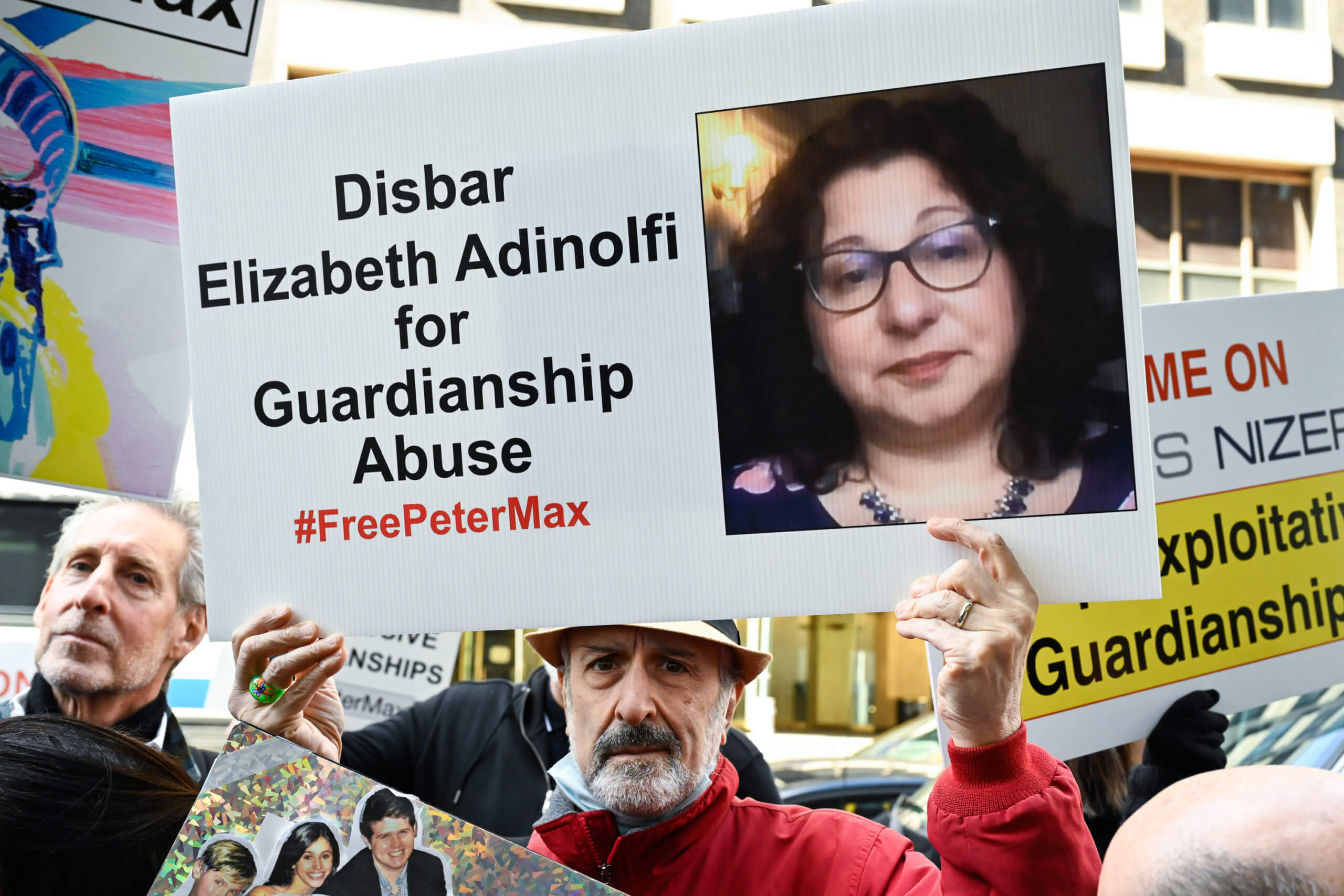
Libra Max (M), daughter of pop-artist Peter Max, friends and animal rights activists protested outside the law firm Phillip Nizer demanding an end of the artist's forced guardianship. (Photo by Gabriele Holtermann)

While Britney Spears’ nightmare conservatorship has ended after 13 years, thanks partly to the tenacity of the “Free Britney” movement, family and friends of renowned pop artist Peter Max have been fighting a legal battle since 2019 to free the 84-year-old Holocaust survivor from a guardianship his family and supporters describe as abusive and exploitive. 

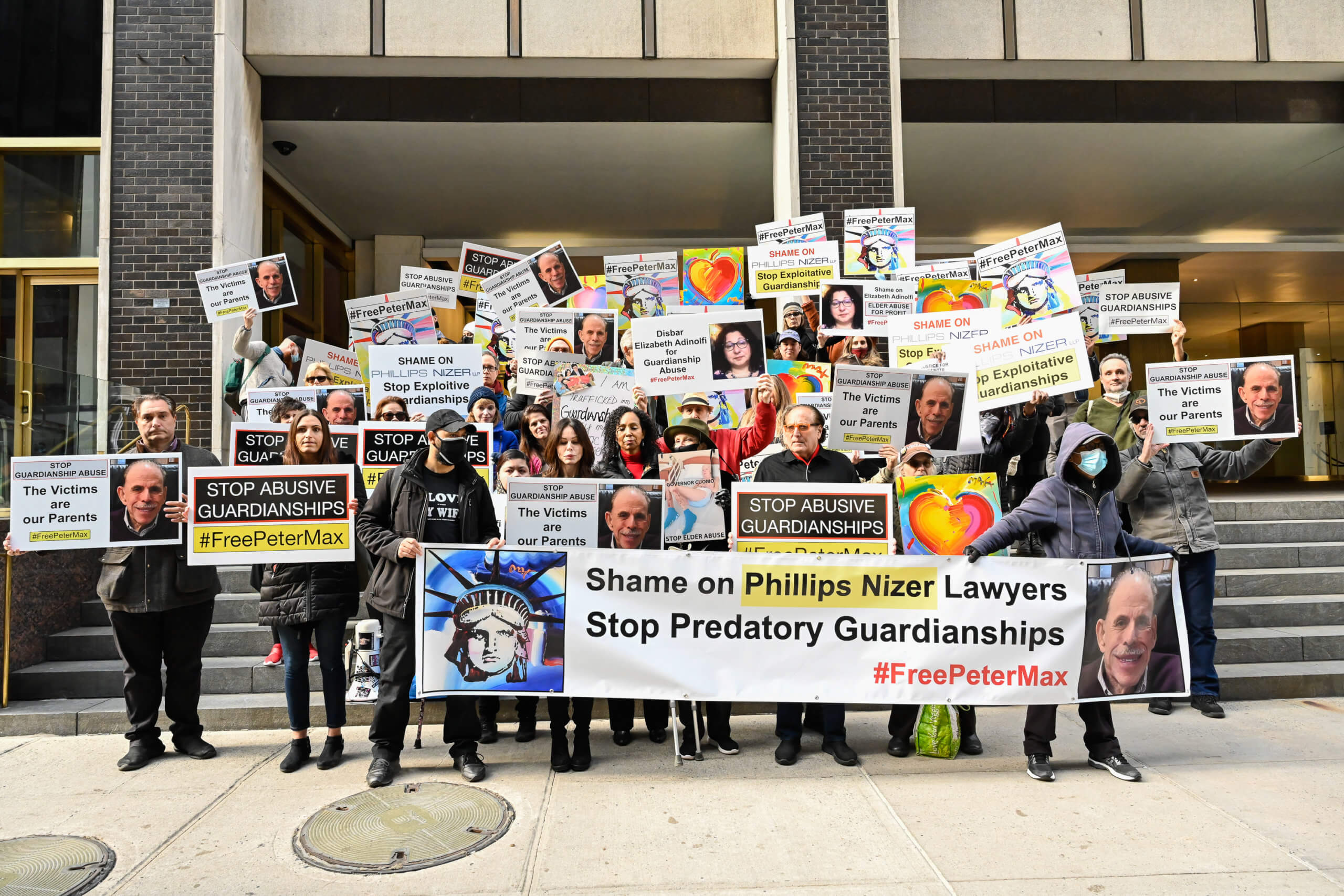
At a protest outside the law office of Phillips Nizer LLP in Midtown Manhattan on Nov.4, his daughter Libra Max rallied for her father’s freedom with the support of animal rights activists and family members of victims of guardianship abuse. 

Peter Max, who has Alzheimer’s and made a name for himself with his colorful psychedelic paintings in the 60s and 70s and whose works hang in the Museum of Modern Art, was placed under guardianship in 2016 because of alleged mistreatment by his wife Mary, who committed suicide in 2019 at the age of 52. 

Friends and animal rights activists protested alongside Libra Max, daughter of pop-artist Peter Max, outside the law firm Phillip Nizer demanding an end of the artist’s forced guardianship. (Photo by Gabriele Holtermann)

Libra Max shared that they didn’t encounter any problems with the first two guardians because they didn’t interfere with her dad’s life. The older Max’s nightmare began in 2019 when his court-appointed attorney Elizabeth Adinolfi, a partner with Phillips Nizer LLP, picked attorney Barbara Urbach Lissner of Lissner & Lissner LLP as his legal personal guardian. 

Libra Max and her supporters allege that Adinolfi and Urbach Lissner and Peter’s legal property guardian, Lawrence Flynn, worked together in the past and that his estate is being depleted under their guardianship and that they control all aspects of his life.

“The problem is when somebody steps into that role, a court-appointed role, and they don’t have proper motives, and they don’t have proper ethics, and they’re there for greed. There is no oversight, and you can’t get them out,” Peter Max’s daughter said. 

Friends and animal rights activists protested alongside Libra Max, daughter of pop-artist Peter Max, outside the law firm Phillip Nizer demanding an end of the artist’s forced guardianship. (Photo by Gabriele Holtermann)

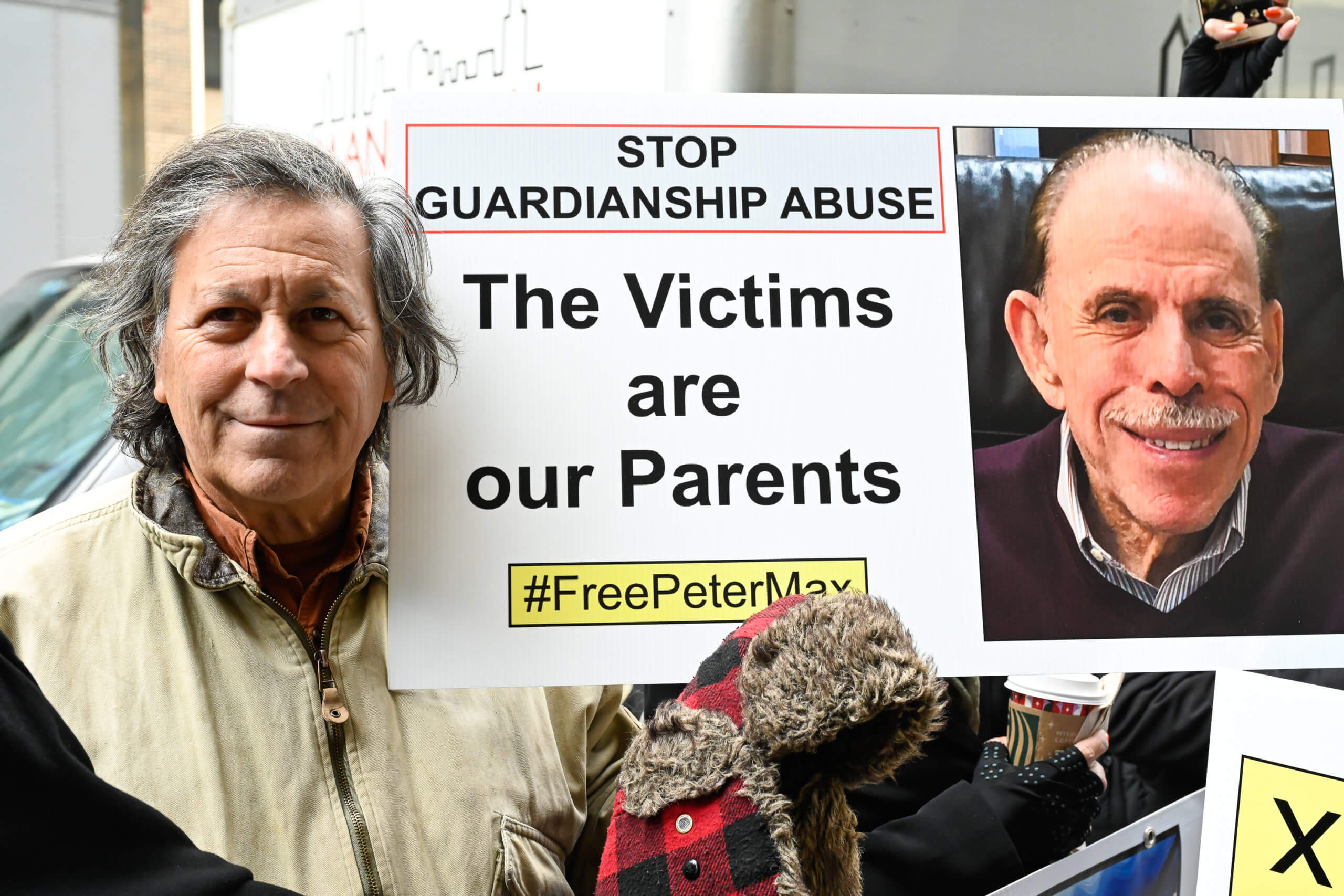
Speaking to about thirty supporters holding up signs reading “#FreePeterMax” and depicting some of his most iconic paintings, Libra Max shared that she can only see her dad three times a week for an hour under strict supervision -on a public park bench in Riverside Park. She is prohibited from entering her childhood home on the Upper Westside, where her father lives in complete isolation. She claims that her dad has to ask for permission to call his family and friends – something four of Peter Max’s long-time friends attested to in an affidavit to the New York State Supreme Court– and the guardians even got rid of his five beloved rescue cats.

Libra Max said that her father, who she estimates barely weighs 100 pounds, has been begging to be released to the care of his family.

“That is what was in [Peter Max] estate planning documentation, which has all been voided by the guardianship system,” Libra Max explained. “When you are put into guardianship, all of your estate planning is voided. All of your documentation is voided. Your human rights are voided. Your constitutional rights are voided. You have less rights than a convicted felon!”

Libra Max, daughter of pop-artist Peter Max, friends and animal rights activists protested outside Phillips Nizer LLP demanding an end of the artist’s forced guardianship. (Photo by Gabriele Holtermann)

Libra Max pointed out that about 1.3 million Americans are in guardian and conservatorships in the United States. While some guardians certainly represent the interests of their wards, many might have more sinister motives since $50 billion are in the care of conservators. 

“This is a money-making industry. This is not about protection,” Libra Max, who recently submitted a written statement to the U.S. Senate Judiciary Subcommittee on the Constitution regarding Toxic Conservatorships: The Need for Reform, said. 

“My father escaped the Holocaust,” Max said. “He came to this country as a teenage immigrant with nothing. He started from nothing. He believed in the American dream. And because he achieved the American dream, it has now made him a target.”

Friends and animal rights activists protested alongside Libra Max, daughter of pop-artist Peter Max, outside Phillips Nizer LLP demanding an end of the artist’s forced guardianship. (Photo by Gabriele Holtermann)

Every person who ever crossed paths with Peter Max described him as a deeply caring, warm-hearted man with an abundant love for animals.  

Animal rights campaigner Donny Moss joined the rally to help free vegan Peter Max from his alleged predatory guardianship and support Libra Max in her quest to get her father back. 

“Peter Max, for as long as I can remember, opened his legendary art studio to the animal rights community,” Moss said. “And now he’s being abused in many of the same ways that he was fighting against. He’s being stripped of his freedom, of his family, of his dignity.”

Friends and animal rights activists protested alongside Libra Max, daughter of pop-artist Peter Max, outside Phillips Nizer LLP demanding an end of the artist’s forced guardianship. (Photo by Gabriele Holtermann)

Edita Birnkrant, executive director of NYCLASS, a non-profit animal rights organization, has known Peter Max for many years and was grateful for his support of NYCLASS and his efforts banning the horse carriage industry.

“It’s so wrong what’s happening,” Birnkrant said about Max’s situation. “That someone who fought against injustice and cruelty and exploitation for people and animals is now suffering and doesn’t even have his freedom. It’s like he’s in jail.”

Birnkrant promised to fight as vigorously for Peter Max’s freedom as he fought to free abused and exploited animals. 

“We’re just so heartbroken that his own freedom and dignity is being stripped of him,” Birnkrant expressed.

Friends and animal rights activists protested alongside Libra Max, daughter of pop-artist Peter Max, outside Phillips Nizer LLP demanding an end of the artist’s forced guardianship. (Photo by Gabriele Holtermann)

Animal rights activist Rachel Levy Ejsmont worked with Peter Max on the “Surrender Your Heart” video by Missing Persons in 1983 and described him as a “sweetheart and gentle, gentle being.”

“There’s absolutely no reason for him to be held in captivity,” Levy Ejsmont said and pointed out that like animals, humans don’t thrive in isolation. “Animals are driven to lunacy, and they’re driven to madness when they’re kept isolated and captive from their loved ones.”

In a statement, which the law firm handed out to protesters and signed by Marc A. Landis, Managing Partner, Phillips Nizer LLP wrote that the firm supported the First Amendment right to peaceful protest and referred to the firm’s long history of First Amendment advocacy. It rejected the claims made by Libra Max and her supporters. 

Friends and animal rights activists protested alongside Libra Max, daughter of pop-artist Peter Max, outside Phillips Nizer LLP demanding an end of the artist’s forced guardianship. (Photo by Gabriele Holtermann)

“Phillips Nizer is providing legal services to a client as ordered and approved by the New York State Supreme Court. We serve this client, as we do all of our clients, in accordance with our professional and ethical responsibilities as attorneys. 

The claims made by Libra Max and her allies are demonstrably false and defamatory to our firm and attorneys. We will address this at the appropriate time and in the appropriate forum.

Due to the sensitive nature of guardianship proceedings, and pursuant to the duty of privilege that we owe to our clients, we will not offer any further comments at this time.”

Friends and animal rights activists protested alongside Libra Max, daughter of pop-artist Peter Max, outside Phillips Nizer LLP demanding an end of the artist’s forced guardianship. (Photo by Gabriele Holtermann)

 
Full Article & Source:

Lewiston attorney suspended six months for lying and misconduct

Attorney Stephen Link was found to have been intentionally dishonest with one client and to have failed to follow through on representing another. 

 
By Matt Byrne

A Lewiston-based attorney has been suspended from practice for six months after being found to have lied to one client about filing a case on her behalf and failed to file a case for another client despite collecting a $1,500 fee.

Stephen J. Link was suspended Oct. 31 after the two clients filed complaints with the state Board of Overseers of the Bar, the professional licensing agency for attorneys in Maine.

Attorneys who are admitted to the bar agree to follow strict rules of professional conduct or risk losing their right to practice. Complaints against attorneys are investigated by the overseers. If a complaint is found to have merit, a recommendation for sanctions is often presented to a single justice of the Maine Supreme Judicial Court, who decides what penalties are appropriate.

Link was admitted to the Maine bar in 2015. A listed phone number for his Lewiston office is disconnected, and he could not be reached for an interview Thursday. His corporation, Stephen J. Link, Attorney at Law, LLC, was dissolved in 2020 after he failed to file an annual report with the Maine Secretary of State’s Office as required by law.

Link filed an initial response to the bar complaints, but failed to participate in further proceedings and the findings of misconduct were entered as a default judgment, meaning the case presented by the bar board was heard unopposed.

In her Oct. 29 decision against him, District Court Judge E. Mary Kelly, who was designated to write the opinion, found that Link has no disciplinary history, was relatively new in practice and that some of his errors could have been unintentional. But she said that his failure to engage in the disciplinary process meant he was unable to discharge his duties as an attorney, and she highlighted his deception of one of the clients who complained.

“The Court cannot determine whether Attorney Link’s failure to participate in this process is the product of disdain or disability, but finds that in either event before Attorney Link returns to practice he must demonstrate his fitness to do so,” Kelly wrote.

The first case that resulted in a complaint began in late 2018, when Pamela Stowe hired Link to represent her in a probate matter, a contested will, and paid Link a $1,500 advance fee.

Two months later, Stowe instructed Link to file a lawsuit on her behalf, but Link never filed it. From January 2019 into that summer, Stowe attempted to contact Link but could not reach him.

He replied to her in August 2019, apologized and offered to refund the $1,500. By January 2020, Stowe still had not received repayment.

Link’s failure to file the lawsuit at the proper time means Stowe is now barred under law from pursuing the matter because of rules setting time limits on when certain claims must be made.

The second case began in 2019, when a woman engaged Link to represent her in another probate matter in which she sought to be named personal representative of a dead man’s estate, according to Kelly’s decision. Such filings are a routine aspect of settling a deceased person’s affairs.

The client, Jennifer Cutting, asked Link via email in late February 2019 to provide a progress report on the probate case. Link told her his pleadings were not accepted by the court because he needed the addresses of the heirs listed in the deceased man’s will, and Cutting provided the addresses the same day, Kelly’s decision said.

About a week later, Cutting again asked for a status report, and Link told her he expected to hear back from the court in about a week.

Cutting contacted him again more than a week later. When he did not reply, she called the court and learned that the matters Link had promised to pursue had not been filed, according to the decision. Thirteen days later, Link responded, telling Cutting that the probate matter was proceeding – but in reality, he waited another month to file it.

By early May, Cutting still had not received the paperwork she expected, and attempted to contact Link again. Another week passed before Link told her on May 20 that there had been a mix-up with the death certificate but that it had been addressed.

In fact, Link did not file the death certificate until the next day, May 21. Finally, in June, Cutting directed Link to withdraw from the case, but he failed to file that paperwork, as well.

Full Article & Source: