Wells Fargo continues to make disconcerting claims about Wendy Williams’ health.
A week after locking the daytime diva out of the millions in her account due to fears of “dementia or undue influence,” the bank has now alleged The Wendy Williams Show host is an “incapacitated person” who needs a guardianship.
On Thursday, Wells Fargo sent a letter to New York Supreme Court Judge Arlene Bluth requesting a hearing to determine whether the media personality needs a professional to intervene in her affairs. Attorney David Pikus wrote on behalf of the bank in the letter:
“We are concerned about [Williams’] situation. It is our hope that
the Guardianship Part [of the court] will imminently appoint a temporary
guardian or evaluator to review the situation and ensure that
[Williams’] affairs are being properly handled.”
Yikes. When a bank is concerned, we should probably be concerned, too, right…?
The note came after Williams’ attorney Celeste McCaw
filed an emergency petition last Friday claiming Wells Fargo had “for
more than two weeks” denied the 57-year-old access to her “accounts,
assets and statements” after her former financial adviser Lori Schiller alleged Wendy — who hasn’t hosted her daytime talk show since July 2021 due to ongoing health issues — was “of unsound mind.”
In the court docs, McCaw said Williams had fired Schiller as her
adviser due to alleged “malfeasance” involving her accounts as well as
“improper conduct in relation to their professional relationship.”
Innerestingly, though, the lawyer admitted Williams “continues to rely
on Schiller’s advisement.” Huh?? On Wednesday, Pikus argued in a
separate letter sent to the judge that Wells Fargo “has strong reason to
believe” Williams is a “victim of undue influence and financial
exploitation.” He requested to keep the case “under seal” to “preserve
the confidential nature.”
The bank’s attorney alleged Schiller had “recently witnessed signs of
exploitation, including [Williams’] own expressed apprehensions” about
the people around her, adding that “other independent third parties who
know [Williams] well … share these concerns.”
In response to Wednesday’s letter, McCaw wrote that Williams “denies
that she is the victim of undue influence and financial exploitation.”
Wendy’s lawyer requested a temporary restraining order against the bank
to restrain it “from freezing [Williams’] accounts and interfering with
her right to access her financial assets and statements.”
A spokesperson for Wells Fargo said in a statement to Page Six Thursday:
“We deny any allegations of improper actions with respect to Ms.
Williams’ accounts and are fully participating in a court process to
reach a resolution that is in her best interest. The financial
well-being of our clients is at the heart of everything we do.”
This is getting stranger by the day, Perezcious readers. Who do U think is telling the truth here?
A Connecticut
judge has been summoned before the state Supreme Court to explain why
she should not be disciplined or fired for failing to show up to work
for at least the past two years while continuing to be paid
By DAVE COLLINS
HARTFORD, Conn. (AP) — A Connecticut
judge has been summoned before the state Supreme Court to explain why
she should not be disciplined or fired for failing to show up to work
for at least the past two years while continuing to be paid.
The high court issued the summons on Thursday to Judge Alice Bruno and ordered her to appear before the justices on April 5.
Bruno,
who is assigned to Waterbury Superior Court, is accusing court
officials of refusing to accommodate her disability so she can return to
work. She also claims Judicial Branch officials have retaliated against
her.
Messages
seeking comment were left for Bruno and court officials on Friday, when
state workers were off for the Lincoln's Birthday holiday.
“Judge
Bruno shall show cause why her failure to perform judicial functions
for at least the last two years is not a violation of the following
Rules contained within the Code of Judicial Conduct: 1.2 (Promoting
Confidence in the Judiciary); 2.1 (Giving Precedence to the Duties of
Judicial Office); 2.5 (Competence, Diligence, and Cooperation),” the
summons says.
Bruno’s absence
from work was first reported in November by lawyer and Hartford Courant
columnist Kevin Rennie, a Republican former state lawmaker. The judge
has not reported to work since Nov. 14, 2019, but the state has paid her
more than $350,000 since then, according to judiciary documents Rennie
obtained under the state Freedom of Information Act.
Bruno's
lawyer, Jacques Parenteau, told The Associated Press on Friday that the
judge has been out of work because Judicial Branch official refuse to
accommodate her disability. The judge has lodged that allegation in a
120-paragraph complaint with the state Commission on Human Rights and
Opportunities, Parenteau said in an emailed statement.
The
complaint also accuses court officials of retaliating against her for
seeking the accommodation, which her doctors are requiring, Parenteau
said.
“Judge Bruno continues to seek an accommodation that would allow her to return to work,” he said.
Parenteau declined to elaborate on the judge's disability.
In
a letter Parenteau wrote to a court system human resources official in
October 2020, he said the Judicial Branch appeared to be violating the
federal Family and Medical Leave Act by refusing to allow Bruno to seek
medical care to treat various physical and psychological conditions, and
making disparaging remarks to her when she did seek care.
“Indeed,
the hostility toward her conditions created a work environment that
increasingly became more intolerable as the vicious cycle of anxiety
leading to failure to perform resulted in hospitalization for heart
attack-like symptoms in November of 2019,” Parenteau wrote.
He claimed mistreatment by court officials led to her accommodation requests and her being out of work.
State
Rep. Steven Stafstrom, a Bridgeport Democrat and co-chair of the
legislature's Judiciary Committee, supported the Supreme Court's
summoning of Bruno to a hearing.
“It's
about time,” he said. “Whenever anybody hasn't shown up to work for two
years, presumably their employer has an obligation to have an
understanding of why. My understanding is the Judicial Branch is
questioning why she's still unable to perform her duties and she should
have to explain that to the Supreme Court at this point.”
Nursing home employee charged with mistreating elderly
By: Andres Gutierrez , Jack Anstine
OLATHE, Kan. — KSHB 41 News usually doesn't show mugshots anymore, but its doing so in this case because the 39-year-old suspect faces a slew of charges that involve stealing from the elderly.
On
Monday, the Johnson County District Attorney's Office stated their
investigation isn't over and are encouraging other victims to come
forward.
Patrica Ann Myler is charged with seven counts of mistreatment of an
elder person, six counts of identity theft and three counts of computer
crime targeting elderly residents at an Olathe nursing home, according
to the Johnson County District Attorney's office
Beginning in March of 2019, Myler oversaw billing at the Villa St. Francis Nursing Home in Olathe.
During which time, the Johnson County District Attorney says she targeted elderly clients with a variety of crimes.
Her
former boss says when Myler resigned in Dec. 2020, his team discovered
thousands of dollars were improperly routed and they notified
authorities.
"The billing should have gone to the state or through villa and that
it was not done that way," Rodney Whittington, CEO of Villa St. Francis
Nursing Home said in a phone interview Monday.
It was not only a shock but also an alert to review oversight.
"If
you have ultimate authority and access then and you choose to abuse
that, then it could happen that we continue to strengthen our processes
re-examine it," Myler said.
Before Villa St. Francis, the Johnson
County District Attorney says Myler was employed at AdventHealth Care
Center in Overland Park at 6501 West 75th St. from June 2018 to February
2019.
A spokesperson for AdventHealth referred inquiries
pertaining to the former employee to the Johnson County District
Attorney's Office who wants to hear from residents who have may noticed
any financial irregularities during the time Myler worked at either
facility.
Myler was arrested for the alleged crimes after a
collaborative investigation by the Kansas Department of Children and
Families' Adult Protective Services division, the Olathe Police
Department and the Johnson County District Attorney's office.
"Our older adults feel a lot of shame, a lot of embarrassment when
these situations occur," Chrisy Khatib, with the Kansas Department for
Children and Families said.
Almost a quarter of the cases Kansas DCF investigated last year involve financial exploitation of the elderly.
There are some red flags loved ones should watch out for.
"Are
bills being paid on time? Are there additional people being added to
signature cards? Are there large transactions missing? Large
transactions meaning large money transactions being removed from bank
accounts?" Khatib said
The AARP believes elder finance abuse is a growing threat that is largely under-reported.
"You
know, sometimes people don't know they're being taken advantage of
financially," Mary Tritsch with AARP Kansas said. "It may just be
because they don't pay attention to their finances. Or maybe there's
some cognitive problems impairments happening."
Usually learning about it in the first place begins with having an honest conversation.
"Just questions and make sure if you're a family member, that you let
other family members know that you're concerned and that you're looking
into it so that they don't think you're part of the problem," Tritsch
said. "But it's really asking questions."
If you suspect your
loved one to be victim of fraud in Kansas you call the Johnson County
District Attorney’s "White Collar Crime" hotline at (913) 715-3140 or
the Kansas Protection Report center at 1-800-922-5330.
Myler
posted bond via Heartland Bail Bonds Monday evening after making her
first appearance earlier in the day, according to court records.
Her attorney, Brandan Davies, released a statement to KSHB 41 News.
"We
are at the initial steps of the legal process with Ms. Myler’s case.
Our firm is doing an investigation into the allegations against Ms.
Myler. Currently, the case is in litigation and we cannot comment
further on a pending matter," Davies wrote in an e-mail
Another hearing is set in Myler's case on Feb. 17 at 9:00 a.m. in Division 3 at the Johnson County Courthouse.
WENDY Williams’ bank called her an “incapacitated person” who is the
possible “victim of financial exploitation” in an ongoing lawsuit, The
Sun can exclusively report.
Wendy's legal team filed for an emergency petition last week demanding Wells Fargo allow her access to her bank accounts, which they alleged had been frozen for more than two weeks.
4
Wendy Williams' bank called her an 'alleged incapacitated person'Credit: Mega
4
Wells Fargo has filed a petition for a guardianship hearing for the ailing hostCredit: Fox
The Wendy Williams Show host's financial advisor had allegedly alerted the bank that the host appeared to be “of unsound mind,”
and the bank further believed she was the victim of “exploitation,
dementia or undue influence,” according to her team’s petition seeking
to reopen the accounts.
The Sun can now exclusively reveal that Wells Fargo has responded to
Wendy’s team, and told the court that they have filed a petition for a
guardianship hearing, “concerning the client’s capacity."
The bank’s attorney further alleged “Wells Fargo has strong reason to
believe that the petitioner is the victim of undue influence and
financial exploitation.”
Wells Fargo's team also suggests the guardianship proceedings
continue under seal, as they would like “to preserve the confidential
interests of the alleged incapacitated person.”
The bank's response also claimed that Wendy has been a client of the
financial advisor for the past 15 years and that her financial advisor
has an “unblemished record in 23 years in the industry."
In their determination to freeze Wendy’s accounts, Wells Fargo
claimed they relied on reports of the financial advisor, “who has
recently witnessed tell-tale signs of exploitation, including the
petitioner’s own expressed apprehension.
The bank also claimed to have spoken to "independent third parties who know the petitioner well and share these concerns.”
Wendy’s team filed their response, and denied Wells Fargo’s claims
that “Wendy is the victim of undue influence and financial
exploitation.”
‘IRREPARABLE FINANCIAL HARM’
As The Sun previously exclusively reported, Wendy says she has been frozen out of her accounts containing millions of dollars for over two weeks.
Wendy and her representatives claimed that Wells Fargo had told them
they would be given a ruling after she provided them with a “properly
executed, witnessed, and notarized Power of Attorney and signed letter
of representation."
A power of attorney gives a designated individual the right to make
decisions about another person's property, finances, or medical care
when the person is unable to do so.
The court papers do not specify who is authorized to act on her behalf or what powers were assigned to that person.
Wendy argued in the papers that the bank “repeatedly denied" her
requests to access her financial assets, which total over "several
million dollars.”
She wrote: “I have submitted multiple written requests to Wells Fargo
and I have visited various Wells Fargo branches in the South Florida
area in an effort to resolve this matter outside of the courtroom.
“I have defaulted and I am at risk of defaulting on several billing
and financial obligations, including, but not limited to, mortgage
payments and employee payroll.”
'DEMENTIA' CLAIMS
As The Sun previously reported, Wendy claimed that Wells Fargo
officials had justified their decision to keep Wendy’s accounts frozen
by referencing their authority to “pause or reject instructions for a
proposed transaction, pending judicial or administrative remedies,
should they suspect financial exploitation, dementia, or undue
influence."
The host’s legal team claimed that the bank had overreached in its
authority, in part because Wendy had not proposed any transaction which
should give the bank the discretion to stop her access to the
accounts.
Her attorney has sought court orders to allow her “access to her
financial accounts, assets, and statements," while her dispute with
Wells Fargo is resolved in arbitration, but since Friday, the case has
escalated with the temporary restraining order filed Wednesday.
After a rotating roster of guest hosts, TMZ first reported that Sherri will be a permanent replacement barring a recovery and potential return from Wendy.
WHAT’S WRONG WITH WENDY?
As The Sun previously reported, the daytime presenter has been battling a health crisis for some time.
Sources said the once witty, sharp host of The Wendy Williams Show
isn't the same as she used to be as she battles multiple medical
problems.
A source close to the show told The Sun: “The spark is gone. That Wendy, who for ten years had that spark in her eyes, that cheeky grin and that little wink is not the same now.”
The insider added some days are better than others for the once feisty daytime diva.
On November 8, the show’s Instagram released a statement from Wendy
saying she was still coping with health issues, and as a “woman of a
certain age” she knew to listen to her doctors and that “right now,
Wendy has to focus on Wendy.”
The Sun exclusively reported that at the start of the pandemic
lockdown in 2020, the host allegedly struggled with her addiction issues
which spiraled into a dark and troubling incident in May of that year.
According to sources, Wendy’s manager was summoned to her penthouse apartment after she had appeared unwell during a Zoom show taping earlier in the week.
Her manager and a small group of confidants arrived at the host’s
home to lend support to the struggling talk show queen.
According to multiple sources, Wendy had stripped naked in her room and was shouting vulgar comments.
The host was eventually taken to the hospital, where she would remain for weeks.
Reps for Wendy and The Wendy Williams Show did not respond to The Sun's multiple requests for comment.
To prevent future abuse of the elderly and people
with disabilities state-wide, professionals including the OCM and the
Conservatorship Association of Tennessee are pushing for the inclusion
of mandatory training in the conservatorship process.
Amy Bryant
by Amy Bryant
Would you hire a financial planner with zero
experience or education? Probably not. However, it is estimated that
hundreds of millions of dollars and thousands of individuals are under
the care of conservators throughout Tennessee who are not required by
the state to complete any form of training.
Conservators
need to be trained before being entrusted with the lives and finances
of some of the state’s most vulnerable individuals. There is a need for
change and change is on the horizon.
Recently
brought into the spotlight by the movement to free Britney Spears, a
conservatorship is the appointment of a protector by a judge to manage a
disabled individuals finances and/or daily life but is defined
differently throughout the country. In Tennessee, the terms used to
describe a person who has been appointed by the Court to have authority
for an adult person deemed to have a disability is called “conservator
of the person,” “conservator of the property (or estate)” or
“conservator of the person and property.”
Conservatorship in Tennessee
In
Tennessee, the term “guardianship” is used to describe persons under
the age of 18. To establish a conservatorship in Tennessee, you must
prove the individual is disabled by presenting clear and convincing
evidence including a sworn statement from a medical professional.
An individual with a disability for purposes of a
conservatorship is one for whom autonomy has become either partially or
totally impaired. While most conservatorships operate in good faith,
there continues to be abuse of the system.
In
2013, the conviction of former attorney John Clemmons sparked change in
Davidson County and lead to the creation of the Davidson County Office
of Conservatorship Management (OCM). Clemmons, a Nashville attorney, was
disbarred and sentenced to 18 years after stealing $1.3 million from
three conservatorship clients.
The OCM now provides an extra layer of protection in Davidson County,
but the other 94 counties in Tennessee remain unprotected. Current
Tennessee law requires mandatory annual reporting from conservators and
annual accounting— with additional requirements based on a case by case
basis. This is overseen by the Probate Court.
In Davidson County, the OCM provides a second
layer of oversight and protection of adults under conservatorships by
completing welfare visits and financial reviews.
Improving the conservatorship process
The
OCM offers free training on their website. The training includes
informative videos accompanied with quizzes on different subject matters
including what is expected of conservators in Tennessee. For more
information please visit https://officeofconservatorshipmanagement.nashville.gov/ to take advantage of these resources.
To prevent future abuse of the elderly and people
with disabilities state-wide, professionals including the OCM and the
Conservatorship Association of Tennessee are pushing for the inclusion
of mandatory training in the conservatorship process.
Tennessee
SB 2095 and HB 2286 are bills in this 2022 legislative session that as
introduced, authorizes a court or clerk to waive an in-person fiduciary
oath if certain conditions are met; requires appointed conservators to
complete court-approved training; requires that certain documents be
signed and notarized.
This requirement will
help provide competent conservators who are capable to perform the
necessary duties to protect the interests of the disabled adult.
Training will be free and accessible via internet access.
A Marion Oaks caretaker accused of stealing thousands of dollars from an elderly resident has accepted a plea bargain that calls for an 18-month prison term and 10 years of probation.
Local
court records show Ruth Oumarjeet, 51, was adjudicated guilty of grand
theft by Circuit Judge Lisa Herndon during a hearing on Wednesday.
When
she was arrested, Oumarjeet was charged with two counts of grand theft
and one count of felony fraudulent use of a credit card. The credit card
and one of the grand theft offenses were eventually dropped by
prosecutors.
The plea bargain also says that she cannot have
contact with the victim, cannot go within 100 feet of any vehicle
occupied by the victim or within 50 feet of the victim's residence, and
may not go to Harbour House Assisted Living, where she once worked.
Oumarjeet was ordered to pay $27,006.41 in restitution to the victim, with payments of $500 a month.
In June 2019 law enforcement was notified about a
caregiver at the assisted living facility allegedly stealing thousands
of dollars from a then-88-year-old man.
A
Marion County Sheriff's Office report states the victim had $67,000 in
his bank account. When deputies began their investigation, the man only
had $10,000.
According to Oumarjeet's arrest report, she reportedly used the money to pay for personal expenses.
The report also states that the victim was a resident of Harbour House,
but left after an injury. Oumarjeet, who was an employee at the
facility, was fired, according to assisted living officials.
As our ongoing series “The Price of
Protection” continues, the ABC Action News I-Team uncovers how the
daughter of a man in guardianship lost her home after speaking out about
what she believed was her father’s poor care.
By: Adam Walser
SEFFNER, Fla. — As our ongoing series “The Price of Protection”
continues, the ABC Action News I-Team uncovers how the daughter of a
man in guardianship lost her home after speaking out about what she
believed was her father’s poor care.
The same guardian who sued her for libel and won is currently awaiting trial for exploitation, perjury and grand theft.
“I’ve got my four dogs in my car right now and I don’t even know where I’m going to sleep tonight,” said Lesa Martino.
The sign taped to what used to be her door was delivered by deputies carrying a court order, with a locksmith in tow.
That order said Martino can’t return to the home she’s lived in for the past eight years.
WFTS
Lesa Martino watches as trash haulers load her belongings into a trailer.
A $480,000 house… the price of speaking out
Martino, a licensed pharmacist, bought the house for $295,000 in 2014.
It's located in a quiet Seffner subdivision.
“This is unbelievable,” she said. “My home that I worked for and paid cash for because I had worked so hard.”
The new owner is Gainesville attorney John Hayter, who obtained the four-bedroom, three-bath, 2,900 square foot house at a court-ordered levy sale with a bid of $100,000.
“He used ‘judgment credit’ so he didn’t actually dish out $100,000 at the bidding,” Martino said.
That judgment credit came from Hayter’s client, disgraced former professional guardian Traci Hudson. She's currently awaiting trial on 20 felony counts after being charged with stealing from elderly people under her care.
Martino’s trouble started when Hudson, then known as Traci Samuel, was appointed guardian of her father Roland Martino.
Roland is a retired pharmacist with dementia.
“When
she became the guardian, within a month, my father had bruises on him
and he seemed like he was being drugged,” Lesa Martino said.
Lesa Martino
Lesa and her father Roland Martino in 2017
Lesa Martino
Lesa complained to state agencies and in court documents that her father appeared drugged under Traci Samuel's care.
Martino repeatedly complained about her father’s care which led to
the guardian obtaining a gag order and later a “no contact order”
preventing Martino from communicating with her father and his guardian.
In 2018, Martino filed complaints about her father’s care with multiple agencies, according to the lawsuit.
Those
agencies included the Florida Department of Children and Families, the
Florida Department of Elder Affairs and the Pinellas County Sheriff’s
Office.
Those complaints didn’t result in any charges.
“It’s just so unfair … I was a whistle blower to the corruption and then I get punished,” Martino said.
According
to the lawsuit, Martino also left remarks on social media and reviews
on websites referring to Samuel as a “liar,” “exploiter,” “vulture” and
“witch.”
“I end up getting a surprise lawsuit of libel-slander, saying the things I said were slanderous,” Martino said.
In
August 2018, a judge issued a default judgment, writing in the order
that Martino “failed to file a response or introduce any evidence.”
Martino said she didn’t receive notice of the hearing.
The judge awarded the guardian $160,000 in damages.
Guardian who won libel case charged with felonies
Fifteen months later, Hudson was arrested after prosecutors say she stole more than $500,000 from another senior under her care.
Last year, Hudson was indicted on additional charges involving two additional victims.
Pinellas County Sheriff's Office
Traci Hudson being booked in 2019 for felony charge of exploitation of a senior citizen.
The investigating agencies were the same ones Martino contacted about her concerns.
As
Hudson prepared for trial on the criminal charges, attorney Hayter
started foreclosure proceedings against Martino, adding an additional
$80,000 for attorney fees.
Hayter argued Martino’s house, which
was deeded to a limited liability corporation comprised of Martino and
her two children, should be sold to satisfy the judgment.
“There was nothing about the house because the house was in an LLC. The LLC was not the one being sued,” Martino said.
But the judge disagreed.
Martino spent thousands on attorneys.
After running out of money, she represented herself and filed dozens of motions and multiple appeals.
On January 25, Martino argued to the Florida Court of Appeals that her home should be protected under Florida’s Homestead Law.
Courtesy: Florida 2nd DCA
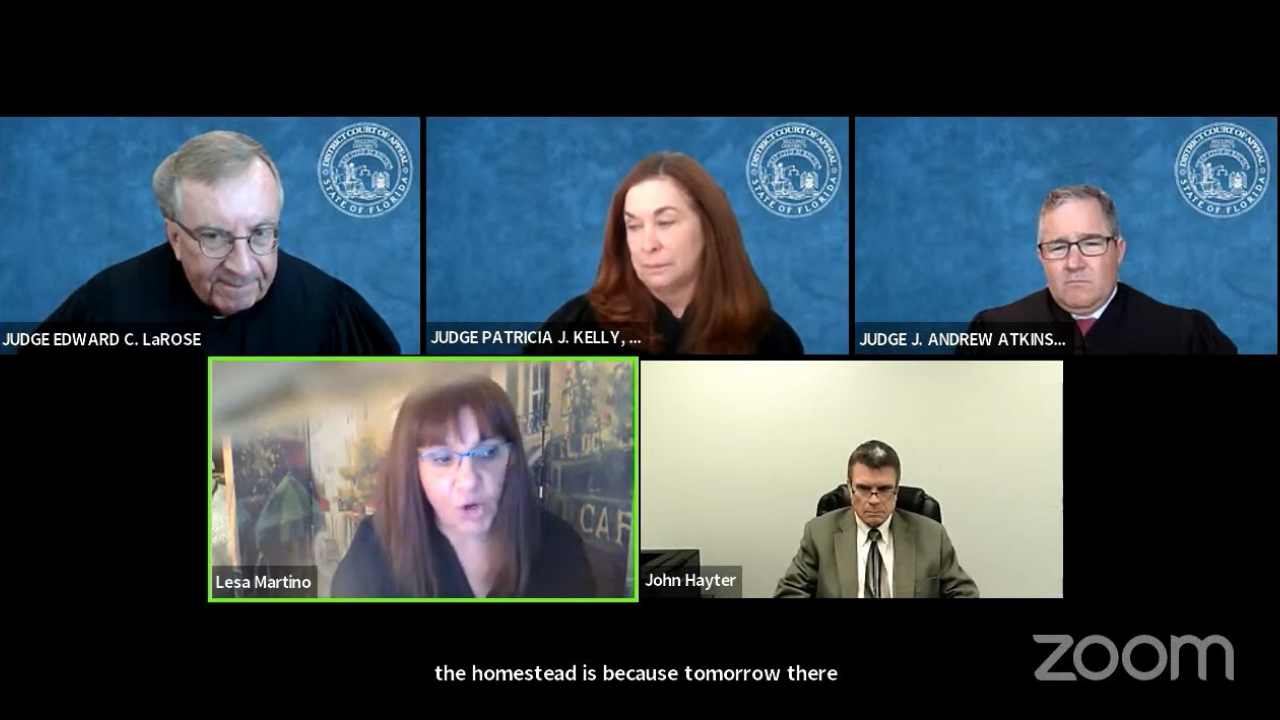
Lesa
Martino argues to the Florida Court of Appeals in late January, arguing
that her home should be saved from foreclosure. Attorney John Hayter
argued she had no standing under Florida's Homestead Law.
Article X, Section 4 of the Florida Constitution says, “There shall
be exempt from forced sale under process of any court, and no judgment,
decree or execution shall be a lien thereon.”
“I have been living
in this home consistently since March 2014. There’s no other homestead.
There’s been no proof I’ve lived anywhere else,” Martino said.
Hayter argued during the hearing that the property was not in her name, so didn’t qualify for protection.
“Until
sometime right around the levy, the property was either held in the
name of the LLC or the name of the appellant’s daughter,” Hayter said.
Martino
also argued the original judgment shouldn’t stand, since there was no
proof her statements were untrue or harmed the reputation of the
guardian.
“The case involves an alleged felon. And the law’s the law. I’m entitled to equal protection under the law,” Martino said.
The day after that hearing, before the Florida Court of Appeals ruled, Hayter bought the property.
The judge in the original libel suit signed an order allowing the sale to move forward.
Eight days later, Martino was locked out of the home.
She said she didn’t have time to arrange for movers to remove her personal items.
The
next day, Hayter came to the house and immediately called the
Hillsborough County Sheriff’s office requesting that our news team be
removed from a public sidewalk beside a county-owned road.
Deputies did not respond while we were there.
When we asked Hayter about the case, he responded “No comment, period.”
Employees of a trash-hauling company then cleared out the contents of Martino’s home and loaded them into a trailer.
WFTS
Attorney John Hayter oversees a crew cleaning out Lesa Martino's former home.
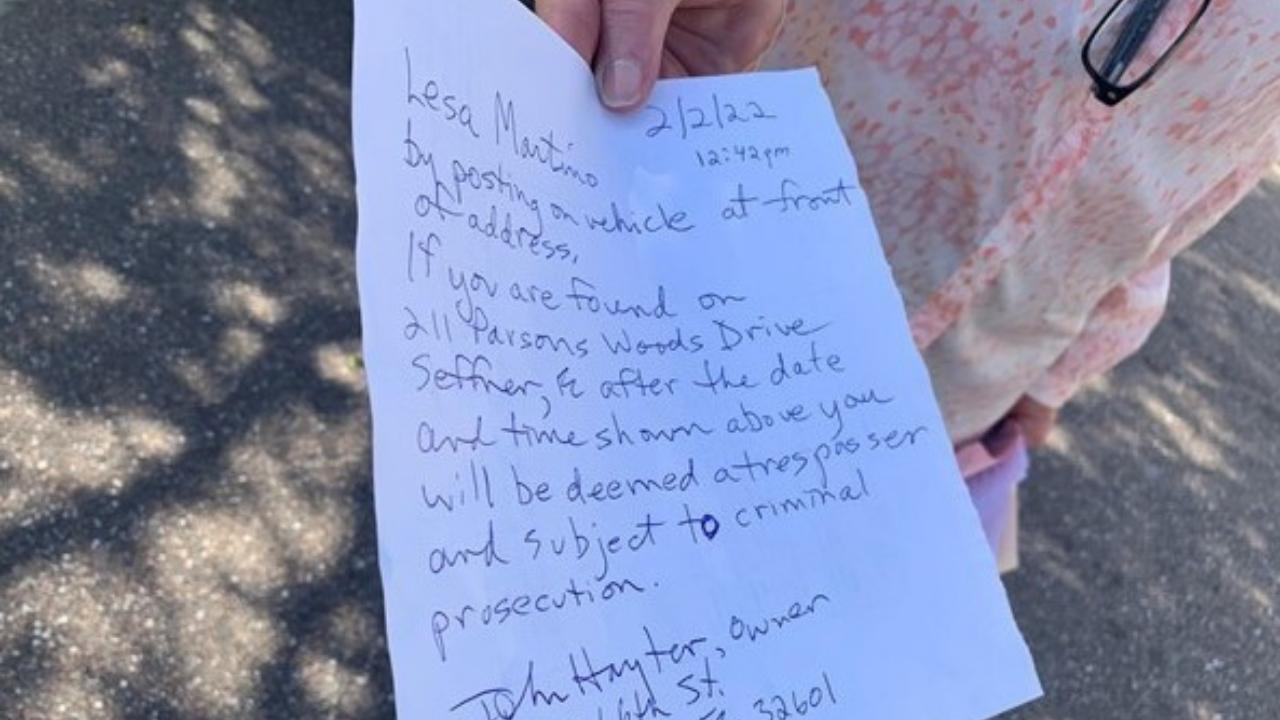
WFTS
Note left
on Lesa Martino's car which appeared to come from attorney John Hayter
warning her she would be prosecuted if she was found at her former home.
They did not tell Martino where they were taking her things
“All
I know is it belongs to me, it doesn’t belong to them,” she said. “This
is really just unbelievable that this can even happen in our country.”
She
filed an emergency motion to try to keep her possessions from being
thrown into the dump, but no immediate action was taken by the court.
Martino is staying in a hotel and has no idea where she’s going to
live next. She said she’s exhausted all of her savings on litigation and
doesn’t even have enough money to pay a deposit on an apartment.
If you have a story you think the I-Team should investigate, email us at adam@abcactionnews.com.
A woman is facing numerous charges for allegedly taking advantage of
elderly people in Johnson County while she was working at two
facilities.
OLATHE, KS (KCTV) -- A woman is facing numerous charges for allegedly taking advantage of elderly people in Johnson County.
According to a release from District Attorney Steve Howe's office, 39-year-old Patricia Ann Myler has been charged with:
Seven counts of mistreatment of an elder person
Six counts of identity theft
Three counts of computer crime targeting elderly residents at Villa St. Francis Nursing Home in Olathe while employed there
Court records show she is accused of stealing more than
$25,000 but less than $100,000 from three victims, and more than $1,500
but less than $25,000 from three other victims. In one incident, she is
accused of stealing less than $1,500 from one victim.
According to the release, Myler was identified as having worked at:
The AdventHealth Care Center located at 6501 W. 75th St. in Overland Park from June 2018 until February 2019
Villa St. Francis located at 16600 W. 126th St in Olathe from March 2019 to December 2020
Her bond has been set at $15,000 cash or surety.
A
spokesperson for the Villa St. Francis nursing homes said Myler
resigned from her job. After her resignation, staff made concerning
discoveries and contacted state authorities including the Kansas
Attorney General’s Office. The spokesperson said through insurance and
company policies they were able to make the residents and their families
whole. They added the nursing home has policies in place including
background checks and audits to protect residents.
A spokesperson for AdventHealth sent a written statement that said, “This individual is not employed by our organization.”
Anyone
who has a friend or family member who was a resident at either of the
facilities mentioned during the aforementioned time periods, and who
noticed financial irregularities, is asked to contact the DA's White
Collar Crime hotline 913-715-3140.
by James J. Ferraro, JD, Vice President/Legal Counsel
A mom tosses her smiling toddler in the air. He has Down Syndrome. Getty Images
Estate planning is not a requirement. No one can force you to make
your will, create a power of attorney or to own your property in a way
to avoid probate. As a result, people too often let common estate planning excuses stand in their way.
For
those who fail to plan, states have default laws for managing the
transfer of their property and assets at death or for controlling their
property if they lose this ability because they’re critically injured or
at an advanced age.
However, these laws should be viewed as a backup plan, not an ideal
arrangement — especially if you have a family member with a disability.
By relying solely on the default laws in the probate or guardianship
code of your state without considering your heirs’ current or potential
eligibility for certain benefits, you might unintentionally disqualify
your disabled child or grandchild from receiving public benefits, or
these benefits may be substantially reduced. Thoughtful planning on your
part can create additional benefits for your heirs by preserving
resources made available through private or public sources.
A
person with a physical or cognitive disability may qualify for
taxpayer-sponsored public benefits or privately funded benefits to
support his or her living expenses, since he or she may be unable to
work or to gain full employment due to a disability. These public
benefits, called Supplemental Security Income (SSI) are “means tested,”
meaning that to apply (or re-apply) for them, a person must utilize, or
“spend down,” most of their savings or funds that are available without
restriction.
Grandpa’s problematic old estate plan
I was
recently introduced to a widower who has five grandchildren. His
grandson suffered a severe head injury and compound fractures to his leg
in an automobile accident when he was 16. He will have difficulty with
fine motor skills for the remainder of this life and can’t stand for
extended periods. He is now 22 and qualifies for SSI to supplement his
earned income. His grandparents had a typical estate plan created before
the accident. It provided that at the death of the first spouse, the
balance of that person’s estate would pass to the surviving spouse. Upon
the surviving spouse’s death, the balance of the remaining joint estate
would be divided, leaving shares directly to their surviving children
and grandchildren.
This plan would have caused an unintended
consequence for this grandfather’s disabled grandson. Since his grandson
would receive this inheritance directly, the Department of Human
Services in his state would have considered his inheritance an available
resource, disqualifying him from continuing to receive full
governmental benefits, including Medicaid health insurance, until these
funds were fully used. His problems would have been compounded if his
father wasn’t living at his grandfather’s death, because he would have
also been entitled to the share set aside for his father.
Thankfully,
the grandfather updated his estate plan (described in detail below).
Had he not, it still would have been possible for his grandson to
continue receiving public benefits, but this would have required the
state to be reimbursed for the benefits paid during his lifetime before
any remaining funds could be distributed to other family members. The
grandfather was resolute in his decision to change his estate plan when
he became aware of the likelihood that the state would be paid a
portion, if not all, of his legacy.
How supplemental needs trusts work
After
collaborating with an estate planning attorney experienced in the
complicated arena of public benefits planning, we explained to the
grandfather that funds can be held in a trust that won’t reduce his
grandson’s present benefits or disqualify him or other heirs from future
benefits. These trusts are known as supplemental needs trusts or special needs trusts (SNT).
An SNT can be either a first-party trust created by a parent,
grandparent, guardian or a court using the beneficiary’s own funds or a
third-party trust funded with assets belonging to the trust’s creator.
Because the beneficiary’s assets are used, a first-party SNT requires
that the state benefits provider be reimbursed for lifetime benefits
paid by it on behalf of the beneficiary. A first-party SNT could have
been created by the court had the grandfather not changed his original
plan, but state reimbursement would have been required.
The
grandfather’s new plan created a third-party SNT for the primary benefit
of his grandson that will supplement, but not supplant, his public
benefits. Upon his grandson’s death, the remaining balance of the trust
will be distributed to his grandson’s descendants or his other
grandchildren.
Since the trust is funded with the grandfather’s
money, and not his grandson’s, there is no need to reimburse any state
for public benefits received. The grandfather also made similar
provisions for any of his other children or grandchildren who are not
presently receiving public benefits but may qualify in the future.
Alternatives to special needs trusts
Special
needs trusts are one of several solutions that can be used to plan for
descendants who currently receive disability benefits or may in the
future. Choosing an experienced trustee
to oversee a special needs trust for his grandson’s benefit was a good
solution for this client, based upon the overall size of his estate and
the nature of his assets. Under different circumstances, he may have
considered other alternatives, such as an ABLE account, a pooled trust
or purchasing exempt resources (such as a car or house) for his
grandson.
ABLE accounts
ABLE accounts
were created with the passage of the Stephen Beck Jr. Achieving a
Better Life Experience Act of 2014. An ABLE account is a savings
accounts for individuals with disabilities. They are like 529 education
savings accounts with similar tax advantages. There is a limited amount
that can be held in an ABLE account, but the balance will not be
considered an available resource. The maximum amount that can be
contributed to an ABLE account annually is set by the federal government
and is adjusted for inflation each year. In 2022 this amount was
increased to $16,000. The balance held in ABLE accounts can increase
from year to year as long as it doesn’t exceed the maximum amount
permitted in the state where the disabled person resides. This limit
currently ranges from $235,000 to $550,000, with many states allowing
more than $500,000 to be held in an ABLE account.
Pooled trusts
A
pooled trust can be a first-party or third-party special needs trust.
This type of trust is managed by a nonprofit organization and is often a
cost-effective solution, because the funds of many beneficiaries are
combined into one master trust for administrative and investment
purposes. Sub-accounts are then created for each beneficiary, with the
disabled person’s account receiving a proportionate share of the entire
fund’s earnings.
Distributions may be made by the nonprofit
trustee from the beneficiary’s share and used for his needs. One
important thing to note: Pooled trust providers typically can’t hold a
house for a disabled beneficiary, unlike a trust created for a single
beneficiary.
Purchasing exempt resources
When determining a
disabled person’s resources in calculating his or her benefits, the
value of personal property and household goods, one automobile and a
home occupied by the person will not be counted. Purchasing exempt
resources, such as an automobile or residence, can be an effective
strategy for some people, particularly when combined with a pooled trust
or ABLE account.
It is a good idea for everyone to review their
estate plan from time to time, particularly because beneficiaries’
personal circumstances can change or there might be developments in
state laws that could be advantageous to them or their beneficiaries.
The time you take to carefully plan with a qualified estate and benefits
planning attorney can improve your beneficiaries’ quality of life and
provide additional public resources for a disabled child, grandchild or
other family member.