 |
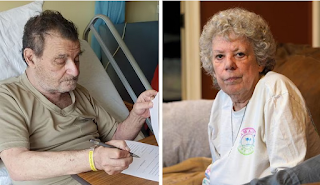
| Peter Bonanno (l.) and Suzanne Araneo, who both signed a durable power of attorney that handed full control of their savings, money and assets to a man they never met.Photo of Bonanno courtesy of Lauren Irwin-Szostak/Araneo photo by Patti Sapone | NJ. Advance Media for NJ.com |
By Ted Sherman
What happened to them was “just awful,” said state Sen. Joseph Vitale.
One
woman said she returned to her home in Keyport from what she expected
would be a brief period of rehabilitation in a Hazlet nursing home, only
to find it emptied of everything. Her bank accounts had been cleaned
out. Her car was gone. What had not been sold off had been tossed in a
dumpster.
She
had not been burglarized. It was all taken away by someone working on
behalf of the long-term care facility that had been caring for her,
after she was encouraged to sign a power of attorney giving him full
authority over her assets and finances.
The
same fiscal agent moved tens of thousands of dollars out of the joint
savings held by another nursing home resident with his sister, causing
her to default on the property taxes for the small house they once
shared, according to documents sent to prosecutors who have yet to take
any action. That resident had also signed away control of whatever he
had, including his pension, through a power of attorney.
On Monday in the wake of those stories brought to light by NJ Advance Media,
Vitale — who serves as chairman of the Senate Health, Human Services
and Senior Citizens Committee — introduced legislation in Trenton that
would set restrictions on the ability of nursing homes to manage the
financial affairs of their residents.
“There
has to be some sort of mechanism so that when somebody needs help,
we’re not going to drain their bank accounts,” said Vitale, the
Middlesex Democrat who has long pushed for reforms to protect residents
in the state’s nursing homes.
Under
the legislation, co-sponsored by Sen. Robert Singer, R-Ocean, no owner,
administrator, officer or employee of a nursing home — or any entity
affiliated with a long-term care facility — would be permitted to manage
the affairs of a nursing home resident absent a court order appointing
that individual as a guardian. A companion measure was introduced in the
lower house by Assemblyman Herb Conaway Jr., D-Burlington.
Specifically, the bill, S-3606
in the Senate and A-5194 in the Assembly, would prohibit anyone
associated with a nursing home from managing the affairs of a resident
“except pursuant to an order of the Superior Court appointing that
person as guardian.”
At
the same time, the legislation would prohibit nursing home owners or
their employees, from acting under a power of attorney on behalf of a
resident, as was alleged in the cases that were the focus of the NJ
Advance Media investigation into Future Care Consultants, a Brooklyn-based company that provides financial services to the long-term care industry, and its CEO, Shmuel “Sam” Stern.
“There’s clearly a policy that enables this kind of behavior,” said Vitale. “We’re going to fix that.”
 |
| State Sen. Joseph Vitale, D-Middlesex, who introduced legislation on Monday that would set restrictions on the ability of nursing homes to manage the financial affairs of their residents.Michael Mancuso | NJ Advance Med |
The accounts of those alleged abuses included
the nightmare that Suzanne Araneo recounted
after signing a power of attorney while under heavy medication. The
document gave Stern — who has ties to a number of New Jersey nursing
homes, federal records show — the authority to sell, transfer or dispose
of her assets, according to a lawsuit still being litigated.
Araneo
later returned home to find her home completely emptied of all its
possessions, including her family photo albums, her televisions, her
furniture and all her clothing. All of it was either sold off or thrown
in a dumpster while preparations were made to sell her house, she said.
Even her car was taken away.
Two days after her story appeared on NJ.com
in August, inspectors from the New Jersey Department of Health went to
the nursing home where she had been living to inquire into the matter,
according to documents filed by the agency. It cited the facility for
alleged deficiencies in connection with the incident.
In
a similar episode, authorities were alerted to the tug-of-war over
Peter Bonanno’s assets after he was admitted to a Passaic County nursing home
in early 2019. Not long after arriving there, legal documents show that
with his sister already holding control over his assets, Bonanno signed
a new power of attorney handing that control over to Stern.
Attorney David Fassett of Arseneault & Fassett in Chatham,
who was working on behalf of a close friend of Bonanno, alerted the
Passaic County Prosecutor’s office that Stern allegedly soon liquidated
four bank accounts that the then-67-year-old man held jointly with his
sister, moving their money into the nursing home’s accounts. The
facility then billed him at a higher private pay rate rather than the
less-profitable Medicaid rate as a result of the joint funds to which it
had no claim, the attorney noted to prosecutors
Bonanno’s
sister would not learn their savings was gone until bouncing numerous
checks and defaulting on their health insurance premiums and property
taxes, the attorney told prosecutors, who did not respond to requests
for comment.
Stern
has not responded to requests for comment, although his lawyer said of
Araneo’s case that “there’s a lot of stuff out there that really does
not fit the facts as she alleges them at this time.” He characterized
the complaint regarding Bonanno and Future Care as an issue that had
been “part of a collection process.”
Nursing home administrators in both matters have not returned calls or emails seeking comment.
Vitale’s
bill would invalidate any power of attorney executed by a nursing home
resident naming an owner, administrator, officer, or employee of that
facility — as well as any entity affiliated with the nursing home that
stood to benefit financially from that relationship.
The
legislation would require the appointment of a guardian in consultation
with the state’s Office of the Public Guardian for Elderly Adults,
meanwhile, setting new protections in place.
Guardianships,
which require a court’s review and approval, typically are invoked to
protect those incapable or incompetent to handle their affairs. A judge
must make the call whether it is in the best interest of an individual.
In
the cases of Bonanno and Araneo, however, there was no such
determination. Instead, they allegedly signed away their rights to Stern
under a power of attorney, with no one to question whether someone else
should be handling their affairs. Legal experts say the assumption is
that anyone signing a power of attorney is competent to make that
decision.
The
two each put signatures on legal agreements that were simply witnessed
by members of the nursing home staff, giving Stern complete control over
the disposition of their assets, their lawyers said. They added that
neither ever met Stern.
State inspectors, meanwhile, found that Araneo’s signature on the power
of attorney documents was notarized by someone who was not in the room
when she signed it, nursing home administrators told them, according to a
health department report.
“This
legislation is designed to protect the assets and well being of
unsuspecting residents from unscrupulous or criminal activity,” said
Vitale.
Araneo’s attorney, Deborah Gough of Hackensack, applauded Vitale’s proposed legislation.
“Every
day, nursing home residents who are incapable of caring for themselves
are being financially victimized by predatory nursing homes and the
companies with whom they associate. These practices will not stop
without oversight from the justice system,” she said. “The laws
proposed, if enacted, are our best hope to safeguard our most vulnerable
citizens and punish bad acting nursing homes when they break the law
with abusive conduct.”
Full Article & Source:
They lost everything. New measure would prohibit nursing homes from preying on residents.


