Showing posts with label Elder Abuse Awareness Month. Show all posts

Saturday, June 10, 2023

DFPS hosts Crimes Against the Elderly Conference at EPCC

by Fallon Fischer

The Texas Department of Family and Protective Services (DFPS) held its "14th annual Crimes Against the Elderly Conference” in El Paso on June 7, 2023, as part of Elder Abuse Awareness Month. (KFOX14/CBS4)

EL PASO, Texas (KFOX14/CBS4) — The Texas Department of Family and Protective Services (DFPS) held its "14th annual Crimes Against the Elderly Conference” in El Paso Wednesday as part of Elder Abuse Awareness Month.

The event at El Paso Community College aimed to help educate the public about the importance of keeping vulnerable seniors safe from abuse and or neglect.

"More and more we're seeing seniors in our community reach the age of 65, that third stage in their life, but so many are being abused, neglected and exploited and they don't know what to do about it, so we thought we'd hold a conference, raise awareness," Adult Protective Services Community Engagement Specialist Grace Ortiz said.

Ortiz said more than 3,000 cases of elderly abuse, neglect and exploitation in the El Paso area in 2022.

"I don't even think it's the tip of the iceberg," said Ortiz.

Ortiz said people can help by checking in on seniors in their life or who live nearby.

To learn more about signs of abuse of elderly individuals or people with disabilities, click here.

If you or someone you know are in need of adult protective services or to report abuse or neglect of the elderly, call 1-800-252-5400 or go to www.txabusehotline.org.

June is Elder Abuse Awareness Month! It's a good reminder for all Texans to look out for and help older adults in our communities.

Full Article & Source:
DFPS hosts Crimes Against the Elderly Conference at EPCC

Sunday, June 7, 2020

SENIOR LOKOUT: Self-neglect an often overlooked form of elder abuse

June is Elder Abuse Awareness Month. World Elder Abuse Awareness Day is June 15. It was launched in 2006 by the International Network for the Prevention of Elder Abuse and the World Health Organization at the United Nations.

Elder abuse is a largely hidden and growing problem in the United States. It is defined by law as “an act or omission, which results in a serious physical or emotional injury to an elderly person or financial exploitation of an elderly person, or the failure, inability or resistance of an elderly person to provide for himself or herself one or more of the necessities essential for physical and emotional well-being, without which the elderly person would be unable to safely remain in the community.”

Elder abuse can include physical, sexual and emotional mistreatment, neglect, and financial exploitation. Another form of elder abuse is self-neglect.

In Massachusetts, self-neglect is a serious and reportable component of elder abuse. Older adults who are not successfully able to care for themselves, and who refuse help, are at tremendous risk of ill health and even death. According to a survey of elder care experts, self-neglect among the elderly is a growing problem that commonly goes unreported.

The survey, conducted by the National Association of Professional Geriatric Care Managers, found that self-neglect among seniors is the most common form of elder abuse encountered by care managers. Self-neglect in older adults is a poorly understood problem with public health implications. Although lacking a standardized definition, it is characterized by profound inattention to health and hygiene.

Self-neglect is a complex issue. There are many things that can cause an elder to stop taking care of him or herself, including dementia, depression, disease, poverty and isolation. If an elder is deemed clinically capable of making his or her own decisions, even if there are signs of self-neglect, the individual can choose to refuse help and protective services providers (such as SeniorCare’s Protective Services Department) are bound to respect that decision. For these elders who are capable of making their own choices, there may be a societal and psychological element at play.

Children and animals — whose abuse issues, unlike elder abuse, capture major media attention — are not expected to care for themselves. But an aging adult has different self and societal pressures for self-care. They have spent their adult lives not only caring for themselves, but, in most cases, being responsible for the care of others. Adults moving into a phase of life where they need assistance to be independent can experience a challenge to their self-identity and self-worth. Asking for help can be emotionally and psychologically difficult.

Many older adults who experience a decline in their ability to take care of day-to-day matters fear that asking for help will lead to a loss of independence and possible placement in a nursing home or other long-term care facility. The paradox is that, by accepting help, a person will become more capable of maintaining his or her independence and living at home. SeniorCare’s mission is to provide and coordinate services for elders and others that enable them to continue living at home and in their communities.

SeniorCare and our community partners typically hold elder abuse awareness rallies in communities around the North Shore through the month of June. With the current COVID-19 situation, we are not able to hold those rallies this year. Please help our elder community by keeping your friends and family members in mind and checking on them regularly. Remind them to be cautious of phone calls from possible scam artists. Make sure they know that you are available if a need arises for assistance.

If you ever suspect elder self-neglect or other abuse, please call the Massachusetts-based Elder Abuse Hotline at 1-800-922-2275.

Tracy Arabian is the communications officer at SeniorCare Inc., a local agency on aging that serves Gloucester, Beverly, Essex, Hamilton, Ipswich, Manchester-by-the-Sea, Rockport, Topsfield and Wenham.

Full Article & Source:
SENIOR LOKOUT: Self-neglect an often overlooked form of elder abuse

Wednesday, June 5, 2019

Alabama is a hotbed for retirees, and financial predators know it

June 01-- Jun. 1--Note to readers: June is Elder Abuse Awareness Month. The following story is one of millions that take place across the country.

Lois Woodard was 15 when she met the love of her life. Fresh out of Air Force basic training, Willie Woodard was three years her senior when he saw her walking down the street. The two tied the knot a year later and spent the next 38 together.

The Woodards had a child, traveled the world courtesy of the Air Force and eventually built their home in east Montgomery. As construction was progressing, they'd wait until the contractors left and take their lawn chairs to sit within the frame of the house, marveling at what they'd been able to achieve after decades of working.

All of that would eventually be taken from Lois.

The house was finished in 1997 and the couple spent five years in their new home together before Willie Woodard died from mesothelioma. Before that, the retired master sergeant asked Richard Sanks, a friend and fellow serviceman at Maxwell Air Force Base, to look out for Lois and handle her finances. She'd never even filed taxes.

"When they told me (Willie) had lung cancer, I said 'that's OK, you can just take one lung out of me, and we can live on the other one'," Lois Woodard said about her husband's diagnosis. She didn't quite understand the severity, but over time, his lungs blackened, and Sanks was by the couple's side in the hospital all of the time.

"He trusted him," she said of her husband's relationship with Sanks.

Now at age 72, Lois Woodard is waiting for Sanks to pay back more than $200,000 and sign the deed of her house back to her. Originally charged with a felony charge specific to elder abuse, Sanks pleaded guilty to theft in the first degree in October 2018. Approved to participate in the county's pretrial diversion program, he has three years to pay back his restitution to avoid jail time.

After Willie's death, Sanks had taken over making sure the bills were paid and the house maintenance kept up. He also helped redo the cabinets and repainted the house.

Full Article & Source:
Alabama is a hotbed for retirees, and financial predators know it

Thursday, June 2, 2016

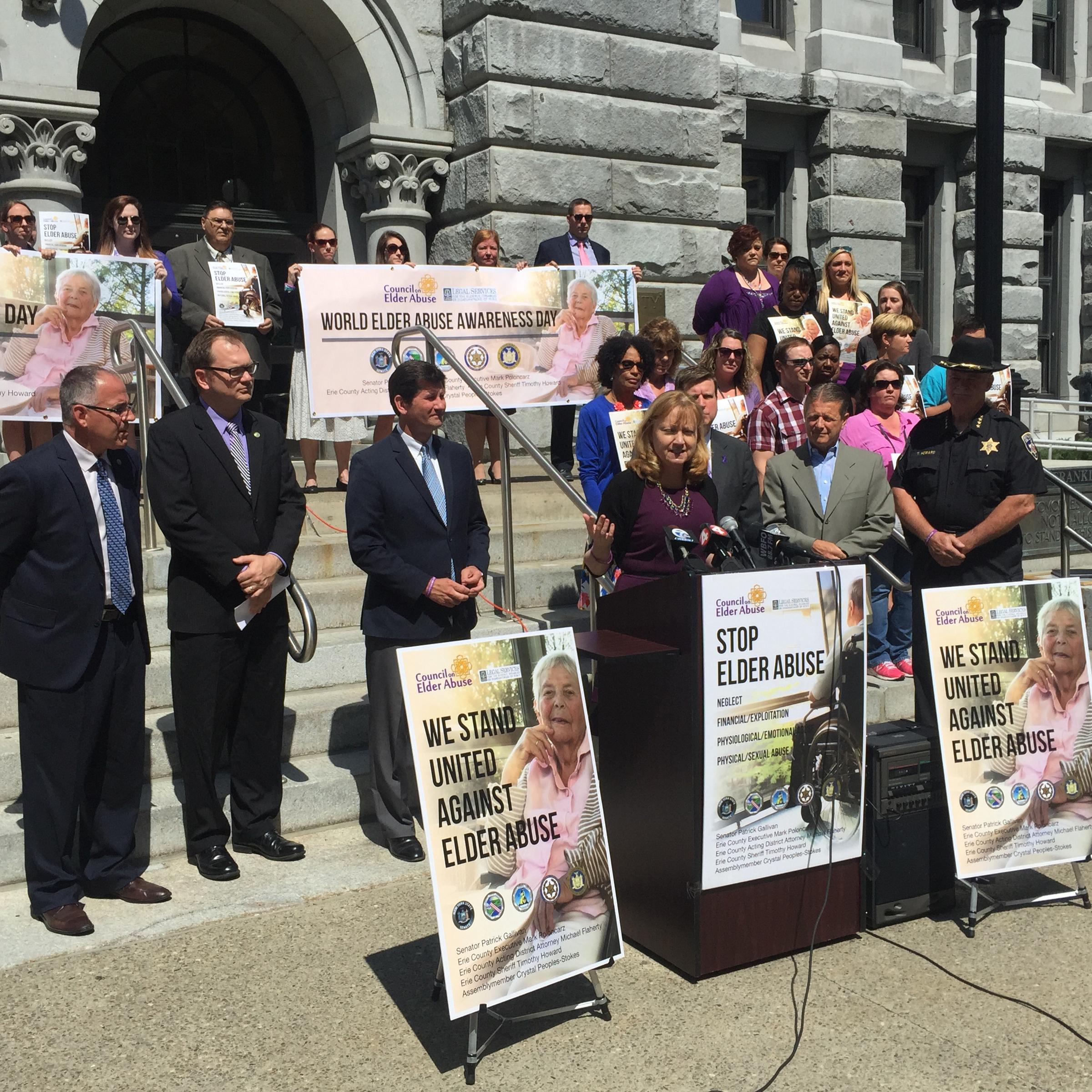
Local, state leaders ignite call-to-action for Elder Abuse Awareness Month


Only one in 24 cases of elder abuse are reported in New York State, according to the Council on Elder Abuse. June is World Elder Abuse Awareness month and, in New York, local and state officials are working to create a safer community for senior citizens by working to bring those who take advantage of the elderly to justice.

Erie County Executive Mark Poloncarz is calling on the entire community to unify and stop elder abuse.

“Most of these allegations and what we know of elder abuse generally does not get reported,” Poloncarz said. “Why? Because the individual who was taken advantage of doesn’t want to admit that the individual who hurt them was a family member or a caretaker. That’s why we all have to come together to address this.”

Elder abuse can take many forms – psychological, sexual, physical and financial. Nationally, $36 billion is lost to financial exploitation of the elderly each year. The New York State Senate passed legislation in April that will help prevent the financial exploitation of mentally impaired elderly individuals.

State Senator Patrick Gallivan is working with community leaders to bring awareness to the critically underreported issue of elder abuse.

“It’s really hard to know the extent of the problem that we face, but we know that we have a problem,” Gallivan said. “And we know that to try to tackle it, and to try to do something about it comes in the form of education, and awareness, and people standing together and working together to try to do something about it.”

Karen Nicolson, CEO of Legal Services for the Elderly
Credit Dan Almasi / WBFO News
 
Karen Nicolson, CEO of Legal Services for the Elderly, is leading a call-to-action, urging the community to take a stand against elder abuse. Nicolson reminded the public that while Elder Abuse Awareness Month is a great platform to bring light to the issue, there is a need for proactive efforts to stop elder abuse year-round.

According to Legal Services for the Elderly, the victim knows his or her abuser in 90 percent of all elder abuse cases.

“It makes it a really difficult issue to get people to come forward and to discuss, and it makes it a really difficult issue for law enforcement to even hear about it,” Nicolson said. “So, we really are excited today that we can shine a spotlight on elder abuse prevention.”

Both Buffalo City Hall and the Peace Bridge will be illuminated purple – the official color of World Elder Abuse Awareness – on June 15th.

Full Article & Source:
Local, state leaders ignite call-to-action for Elder Abuse Awareness Month