Alabama is mourning two German-born sisters who
endured the Holocaust to raise families in Birmingham before recently
dying just days apart, leaving behind powerful personal stories of
tragedy, survival, determination and courage.
Ruth
Scheuer Siegler, 95, died Saturday and Ilse Scheuer Nathan, 98, died on
Aug. 23 after living within walking distance of each other for years.
They were
barely teens when their family fled Hitler's Germany for Holland with
plans to travel to America. But the war started and borders were closed.
Their father was sent to Westerbork, a refugee transit camp, in 1940, and two years later the family voluntarily reported there rather than be deported.
Later they were sent to Auschwitz-Birkenau,
where their mother died. Their father and brother also died in camps.
The girls were shipped to Poland to clear runways for German planes and
were later abandoned to die.
They
were found by Russian troops and sent back to Holland, where they
reconnected with relatives before arriving in the U.S. in 1946. They
married, settled in Birmingham and raised families.
“They
were always together,” Ann Mollengarden, the center's education
director, told Al.com. “When Ilse died, I think Ruth was ready.”
Mollengarden says Ruth Siegler's dedication to the
work of the center has "shaped what the organization has become today."
She gave speeches and allowed the use of her story for teacher
workshops. And the Siegler Fellowship created by her children for her
90th birthday provides opportunities for students to research Holocaust
survivor-related topics.
She also wrote a memoir, primarily for family members, with a dedication that explains why.
"This book is dedicated to my children and grandchildren," she wrote.
"So that the suffering I endured, along with millions of others, will
never be forgotten."
The daughter of the celebrated artist is suing the New York courts over
claims that he is being mistreated in a case that could affect the
entire system
The daughter of celebrated pop artist Peter Max, seen here in 2017, is suing the New York court system. Photograph: Julie Jacobson/AP
The daughter of a celebrated pop artist who
created famous images of the “cosmic sixties” is suing the New York
court system over what she claims are secretive communications between
her father’s court-appointed guardian and judges that drastically affect
his life and violate her basic rights.
Libra Max lodged a federal lawsuit
on Wednesday in which she alleges that her father, Peter Max, 84, is
being held in virtual isolation by a court-appointed guardian. She
claims multiple judges have allowed the guardian to communicate with
them behind closed doors, without the family’s knowledge, leading to
one-sided decisions that profoundly affect his life and that constitute a
gross distortion of justice.
The lawsuit says “Kafka would blush” were he to review the case.
“This case is about the denial of one of the most
fundamental federal rights in the American justice system – to hear and
respond to all evidence your adversary presents to the court.”
The
multi-millionaire artist, best known for his psychedelic posters from
the 1960s and 70s, still lives in the family home and art studio in
Manhattan’s Upper West Side. He has been under a court-appointed
guardianship since 2015, having suffered from Alzheimer’s and advanced
dementia for many years.
He is in failing health, by some accounts approaching the end of his life.
The
terms under which Max is being kept a ward of court have become the
subject of intense disputes, between the guardian and individual members
of the Max family, as well as between Libra Max and her brother Adam
Max. For the past three years, Libra Max has been attempting to persuade the courts
to set her father free of the guardianship on grounds that the
court-appointed lawyer who controls his personal affairs, Barbara
Lissner, has allegedly cut him off from his loved ones.
Peter Max has been under a court-appointed guardianship since 2015. Photograph: Erik Pendzich/Shutterstock
The
lawsuit, lodged with the civil division of the southern district of New
York, claims Lissner tightly restricts visits to Max from family and
friends including Libra, who is only able to visit her father – in the
home in which she was born and raised – on very proscribed terms. It
also alleges the guardian refuses to disclose to the family the artist’s
medical condition or even the identity of the doctors treating him, and
has installed video cameras in his apartment as a form of surveillance.
In
the latest twist, Libra Max claims judges in the New York court system
are effectively in cahoots with Lissner. The defendant in the case is
Deborah Kaplan, the administrative judge responsible for the section of
the New York supreme court that covers guardianships in Manhattan.
It
says Kaplan has presided over an arrangement that has allowed judges
sitting in guardianship courts to communicate directly with Lissner in
total secrecy. Libra Max says she knew nothing about the exchanges, and
as a result had no way to correct the record or respond to allegations
raised against her.
Such secretive
communications have left Libra Max legally “blindfolded and thus
blindsided”, the lawsuit says, “robbed her of her ability to fairly
advocate for her father’s freedom … and ultimately robbed Peter of
precious years with his loved ones”.
The exclusion from court proceedings of one party to a dispute is known in legal parlance as ex parte
communications, which are normally strictly forbidden. Such one-sided
contact appears to be almost routine practice for guardianship judges in
New York, a state of affairs Wednesday’s lawsuit now challenges.
“This
case is so critical because the constitutional right at stake is so
basic: to hear and respond to all of the evidence that your adversary
presents to the court,” said Andrew Celli, of the law firm Emery Celli
Brinckerhoff Abady Ward & Maazel, the lead attorney in the case.
Celli
added: “This is the bedrock of our justice system and it ensures
fairness. This emblematic case is the first of its kind but it won’t be
the last. The shroud of secrecy over the guardianship system must be
lifted.”
Libra Max and Peter Max in 2019.
Photograph: The Max family
Neither Lissner nor the office of court
administration that oversees New York’s guardianship courts immediately
responded to a request for a comment on the lawsuit. Lissner, Max’s
guardian since 2019, has denied the allegations and is suing Libra Max
for defamation.
In the defamation suit,
Lissner rebuts the claims made against her and says: “Mr Max has never
been isolated from friends and loved ones; requests to see Peter Max by
friends and loved ones are always accommodated.”
The legal battles now engulfing Max form a bitter end to a life as colourful as the artist’s creations. The New York Times has written that his posters “became wallpaper for the turn on, tune in, drop out generation”.
He
was born Peter Max Finkelstein in 1937 in Berlin, to German Jewish
parents. He grew up in Shanghai, Haifa and Paris before moving to
Brooklyn at 16.
His work took off with a
famous poster collection that he labelled Cosmic ’60s. He became a
figure in the counterculture, designing leaflets for “Be In” hippie
gatherings in Central Park.
Success in the
counterculture gained him attention in the mainstream culture.
Appearances on The Ed Sullivan Show, in which he drew live in front of
the camera, and album covers for bands including Yes followed.
In
1974 he designed a US postage stamp that is credited as one of the
first environmentalist stamps. Its message: “Preserve the environment.”
His pop art images gained an increasingly commercial following, with one
of his main sources of income becoming auctions on sea cruises.
The
Norwegian Cruise Line commissioned him to paint the hull of one its
ships in his trademark brilliant colours. In 1969, Life Magazine put him
on its front cover with the headline: Peter Max: portrait of the artist as a very rich man.
Max’s
estate by some estimates continues to be worth hundreds of millions of
dollars. His financial affairs are now also in the control of
court-appointed guardians.
Peter Max Photograph: The Max family
As the legal fight over Peter Max’s life reaches fever pitch, it forms part of growing concern across the US
about how older people and people in vulnerable physical or mental
health are being trapped in allegedly overbearing and abusive
guardianship programmes. Public attention was drawn to the problem by
the singer Britney Spears, who was held in what she claimed was an
“abusive conservatorship” for 14 years until it was dissolved last year.
There
are about 1.3 million adults under the care of guardians who in many
cases have great power, including control over access by family and
friends, medical treatment, and financial affairs, with guardians
collectively managing about $50bn of assets.
Keeping track of the programmes is virtually impossible
as they are regulated by the 50 states, many of which do not keep
public data. A 2017 study by the American Bar Association found that “an
unknown number of adults languish under guardianship beyond the point
of need … Adult guardianship is generally viewed as permanent. With the
stroke of a judge’s pen, rights are lost and are seldom regained over an
individual’s remaining lifetime.”
A report
from the US Government Accountability Office identified hundreds of
allegations of “physical abuse, neglect and financial exploitation by
guardians” in 45 states between 1990 and 2010.
The Peter Max lawsuit chronicles what it claims were improper ex parte communications
between Lissner and four unidentified New York judges in the past three
years. It notes that Lissner obtained an ethics opinion from a
specialist, regarding whether her decision personally to sue Libra Max
for defamation amounted to a conflict of interest.
The conclusions reached by the ethics specialist are unknown, as the opinion has not been disclosed to the Max family.
Libra Max, the daughter of famed artist Peter Max, is fighting to free
her father from what she claims is an 'irrational' guardianship case.
(Courtesy)
(New York Jewish Week)
— The latest chapter of the surreal saga over who is making decisions
for the aged pop artist Peter Max is pitting two children of Holocaust
survivors against each other.
One is Libra Max, Peter Max’s
daughter. The other is Barbara Lissner, an attorney who represents
Holocaust survivors, including in their efforts to secure restitution.
She became Peter Max’s guardian in 2019, shortly after the New York Times first reported alleged abuse by Max’s previous guardian and exploitation by his business associates.
Libra Max is suing Lissner in federal
court, saying that Lissner has blocked her access to her father,
allowed the artist to be overmedicated, improperly disbursed more than
$16 million from Peter’s estate — and even took away his rescue cats.
Lissner, meanwhile, has sued Libra
Max for defamation, saying that Libra baselessly accused her of
kidnapping Peter Max. Among Lissner’s supporters is Adam Max, Peter
Max’s son and Libra’s brother.
The protracted saga has been playing
out in court for years and reached a new milestone Monday when Peter’s
guardianship judge refused Libra’s request to hear medical testimony
about Peter’s need for oxygen. According to Libra’s attorney,
Jeffrey Eilender, the judge “refused Libra’s request to hold an
evidentiary hearing… before the potentially life-and-death decision is
made about the removal of [his] oxygen.”
The dizzying allegations allow for
little clarity beyond one incontrovertible fact: A 20th-century Jewish
artist whose candy-colored psychedelia spoke to hippies and squares
alike in the 1960s and ’70s, and who is now 84 and battling severe
dementia, appears unable to speak for himself.
Peter Max became one of the most prominent artists of the 1960s for painting posters,
flyers, album covers and more. (Courtesy)
Lissner’s law firm, Lissner and Lissner, was started by her husband’s family to provide legal services to Holocaust survivors, according to its web site.
Lissner is the daughter of Holocaust survivors, including her father,
who was rescued by Oskar Schindler. Among the firm’s services are what
it calls Victim of Nazi Persecution Restitution Trusts, through which
eligible candidates are able to preserve their assets in the event that
they require long-term health care. The firm also offers estate
planning, asset protection, Medicaid planning and guardianship
proceedings.
After the Times report, Max’s second
wife, Mary Balkin — who first sought a guardianship to take over her
impaired husband’s business — committed suicide. Within 24 hours, Lissner
was appointed by New York State Supreme Court to oversee the artist’s
business affairs under a guardianship arrangement that Libra Max at
first supported.
Yet Libra soured on Lissner, telling
the New York Jewish Week she has not been able to visit her father in
his home since June 2019, and that her father’s friends and other family
members have not been allowed inside, either. She added that when
family and friends have observed Peter via FaceTime, he appears to be
sedated.
In 2020, Libra, along with 17 of
Peter’s cousins, attempted to remove Lissner as Peter’s guardian in
filings submitted to the New York State Supreme Court. She also started a
website called Free Peter Max, where thousands of friends, associates and others have signed in support of ending Lissner’s guardianship over the artist.
Libra Max alleges that Lissner has confiscated Peter’s phone, refuses
to share medical information with the family and isolated Peter in his
Upper West Side apartment, where Libra was born and raised. “The pain of
this all for me has been watching my father suffer,” Libra said. “These
last three years should have been warm, beautiful and loving. We’ll
never get the time back.”
Lissner did not respond to requests for comment.
“This is about my father’s human rights,” Libra added. “Why is this
man, this beautiful, traditional, Jewish immigrant man, who survived,
who came here, who became the American dream, why is he being locked up
by the government?”
Libra Max said that she hasn’t been able to visit her father in his Upper
West Side apartment since June 2019. (Courtesy)
Peter Max was born Peter Max Finkelstein
in 1937, and fled with his family from Berlin to Shanghai in 1939. The
family later lived in Haifa and Paris before settling in Bensonhurst,
Brooklyn. After attending the Art Students League of New York, he began
producing posters, flyers, album covers and even TV commercials
featuring kaleidoscopic, counterculture imagery. In 1969 he was featured on the cover of Life magazine, for a profile titled “Portrait of the artist as a very rich man.”
In more recent years he was asked to paint everything from a race car to a cruise ship to a section of the Berlin Wall.
For Libra, her father’s case is an
indictment of “abusive” guardianship laws in which elderly or impaired
people are isolated from family members and medication is administered
as a form of control. In many such cases, she and other critics of the
system assert, guardians liquidate their clients’ assets and then
intimidate family members and loved ones.
“If you have an ethical person coming
in as guardian, even a court-appointed one, the system can actually
work,” Libra said. “There were two guardians for a few years [before
Lissner] and they did not interfere with our family at all.”
According to Goldfarb Abrand & Salzman, a New York law firm specializing in work with senior citizens, adult guardianships can be an effective legal tool
in assisting incapacitated adults who are unable to care for themselves
or whose families need assistance to manage their property and
financial affairs.
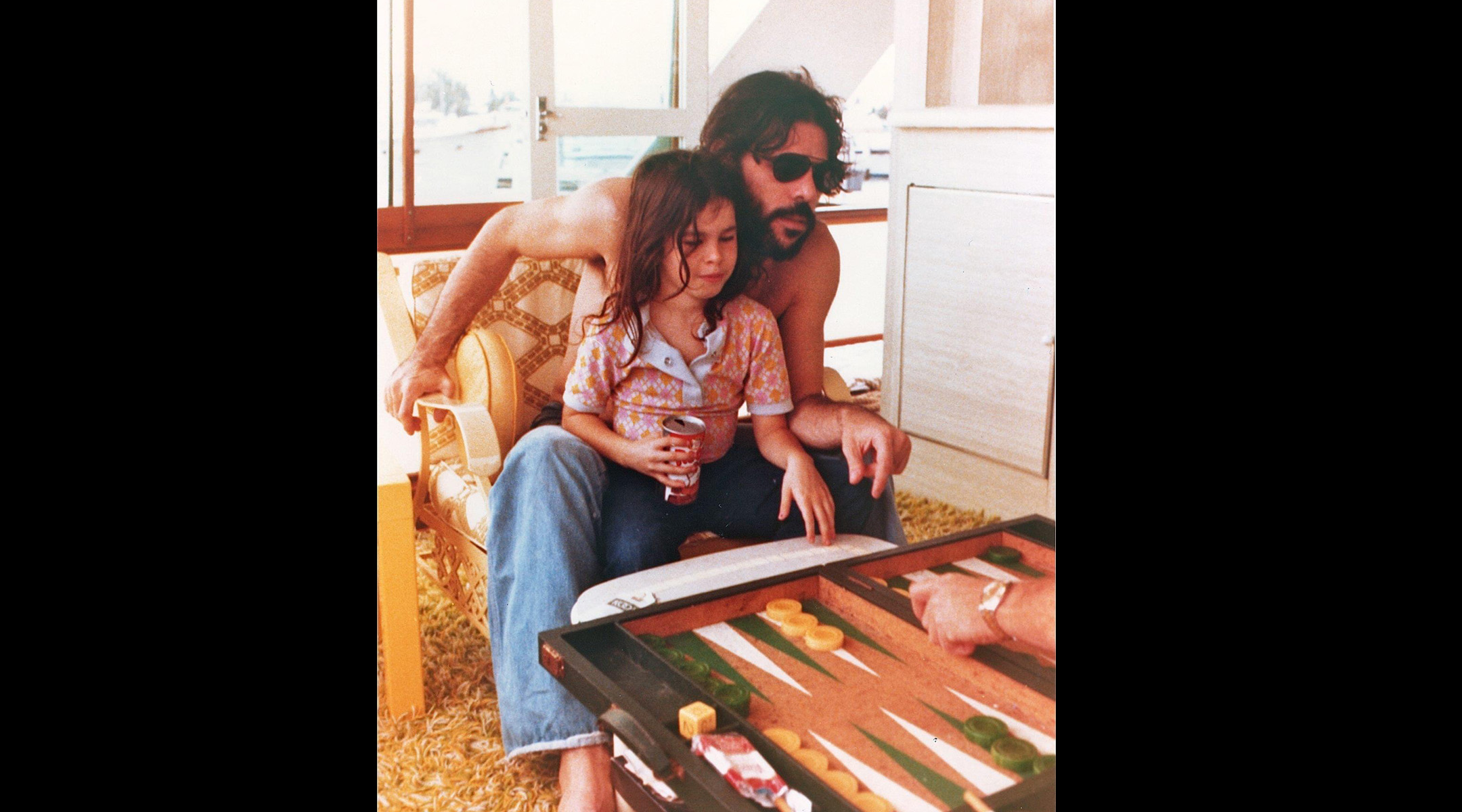
Libra Max with her father Peter Max in 1973. (Courtesy)
Guardianship cases are brought under
the New York Mental Hygiene Law, which is intended to meet the needs of
incapacitated adults.
But Libra said that guardianship has
been “a welcoming ground for predators,” with the courts and doctors and
lawyers all involved.
“It’s a whole money-making process,”
Libra said. “They will just put somebody into guardianship. Your estate
is completely wiped out, you have less rights than a convicted felon,
you can’t even choose your own attorney.”
Beverly Newman, who said her own
Holocaust survivor father, Al Katz, was abused under a guardianship
arrangement, told the New York Jewish Week that Holocaust survivors are
“easy targets.”
“They do not have families or large
families,” Newman said. The families “were killed off or diminished
decades ago. They are also non-combative. These are people who just want
to live their lives. They don’t want to fight. They don’t want to
litigate.”
The guardianship system, she alleges,
is an entire network of guardians, judges, attorneys and service
providers working together to prey upon susceptible individuals.
“There is a code of silence,” Katz
said. “If you break that code of silence, you will be punished. My dad
passed away in 2010 and they are still trying to get his property, still
keeping open his estate, which was completely insolvent, and they’re
doing that to punish us.”
“Libra is not just fighting for
herself, her father and her family,” Eilender said. “She’s fighting for
all the people who are suffering because of an abusive guardianship.”
Meanwhile the legal back and forth
goes on. Lissner filed a lawsuit in New York State Supreme Court against
Libra for defamation in January 2022, alleging that she has been
falsely accused of kidnapping Peter. His son, Adam Max, told the New York Post in January that he backs Lissner in her lawsuit.
Adam Max did not respond to requests for comment.
Now Libra is countersuing in New York State Court: In a filing on June 17, she alleges that
Lissner has caused severe emotional distress while lying to the court
as well as violating anti-SLAPP laws, which are meant to prevent
frivolous lawsuits intended to silence or suppress free speech.
Libra said videos from 2019 show her
father in “great health” and saying that he only wants her and her
brother making medical decisions for him.
In another video, Peter asks Libra to
come upstairs. When she says she cannot because of the guardianship
laws, Peter responds saying,“Can I talk to the judge?”
“It’s very clear what his wishes are,” Libra said.




.webp)