SPRINGFIELD, Ill. (WAND) — Gov. JB Pritzker signed multiple bills into
law Thursday to uplift vulnerable people across the state. Democrats and
Republicans worked together to tackle financial exploitation of seniors
and improve mental health evaluations in nursing homes.
One law
will allow financial institutions to disclose suspicions of financial
exploitation to trusted contacts, co-owners and beneficiaries of account
holders. The measure also creates a Department on Aging online portal
to receive reports of suspected financial exploitation and abuse.
"This
bill permits a financial institution to place a transactional hold on
an eligible adult's account if there exists reasonable suspicion that a
transaction or disbursement from the account may involve financial
exploitation of an eligible adult," said Senate Majority Leader Kimberly
Lightford (D-Maywood).
A separate law will allow courts to issue temporary restraining orders in cases involving abuse, neglect and financial exploitation.
"There
are an alarming number of accounts of scams and financial abuse
targeting older adults," said Sen. Steve Stadelman (D-Rockford). "This
will ensure that we have more tools and can act more quickly to protect
older adults regarding their safety and financial security."
The state is also taking steps to improve nursing home mental health evaluations.
Gov. JB Pritzker approved a bill calling on the Illinois Department of
Human Services or a designee to visit any person admitted to a nursing
home with a diagnosis of serious mental illness within 60 days of
admission.
"Prompt DHS visits will be required after a significant
change in a physical or mental condition," said Rep. Nicolle Grasse
(D-Arlington Heights). "This has the support of the Illinois Hospice and
Palliative Care Organization, AARP and DHS."
This law also
requires DHS to ensure there are no conflicts of interest among
employees administering pre-admission screenings. Sponsors hope this
change will give families confidence residents are evaluated fairly.
A separate bill
signed Thursday will ensure children who are deaf, hard of hearing or
deaf blind have equitable access to early literacy development. The law
creates a language needs assessment program informed by deaf educators,
early childhood experts and Illinois Deaf and Hard of Hearing Commission
members.
The former owner of an
Illinois-based nursing home has been charged with healthcare fraud in
connection with an alleged scheme involving more than $64 million in
fraudulent Medicare claims related to durable medical equipment (DME).
Rajiv Shah, who was the primary owner of
St. Anthony’s Nursing and Rehabilitation Center in Rock Island, Ill.,
has been charged with a conspiracy to commit healthcare fraud and wire
fraud, in connection with the alleged scheme, according to charges filed
by the U.S. Attorney’s Office for the Southern District of Florida.
Shah also owned and operated ACC-Q Data
LLC, a medical billing company that allegedly conspired with DME
suppliers to submit fraudulent Medicare claims, the indictment states.
“Rajiv Shah and his co-conspirators
submitted and caused the submission on behalf of the DME Companies of
more than $64 million in false and fraudulent claims to Medicare, via
interstate wire communications, for DME that was medically unnecessary
and ineligible for reimbursement,” the indictment filing dates June 18
alleges.
Medicare allegedly paid the DME companies
over $23 million for these claims, the filing further states, noting
that the companies paid Shah a percentage of the reimbursements they
received from Medicare totaling approximately $1.127 million from June
2019 through December 2025.
“We are the billing company. We just bill for different companies,” Shah told Skilled Nursing News.
Prosecutors allege Shah advised the
companies on how to avoid Medicare scrutiny and conceal the fraudulent
nature of the claims.
However, Shah explained that he merely
handled billing, was no longer involved with the companies after October
2023, and denied responsibility for the alleged $64 million fraud.
“Though I would have taken $1 million, the
claim is $64 million. But those guys were already convicted,” Shah told
SNN. “In the last few years, I didn’t keep tab of it because what
happens in a medical billing business is that people come in, you do
billing for two years, they sell the company or they buy another company
or they start doing billing themselves. It is a completely turbulent
industry. So, [with] all these people, I’m not done billing. I do not
know any of them, where they are even from October 2023. That was the
last billing I did for these four companies.”
Shah previously held more than a 90% ownership stake in St. Anthony’s from April 2022 until April 2026, he said.
The charges do not allege wrongdoing
involving St. Anthony’s and are part of the Department of Justice’s
(DOJ) 2026 National Health Care Fraud Takedown, a nationwide enforcement
effort targeting hundreds of defendants accused of defrauding federal
healthcare programs. Shah was indicted in June 2026.
The DOJ said the broader 2026 Health Care
Fraud Takedown resulted in charges against 455 defendants, including 90
physicians and other licensed medical professionals, for schemes
involving more than $6.5 billion in false claims.
The investigation also included provider
suspensions, billing privilege revocations, asset seizures exceeding
$182 million, as well as coordinated enforcement actions by federal and
state agencies. tigation also included provider suspensions, billing
privilege revocations, asset seizures exceeding $182 million, as well
as coordinated enforcement actions by federal and state agencies.
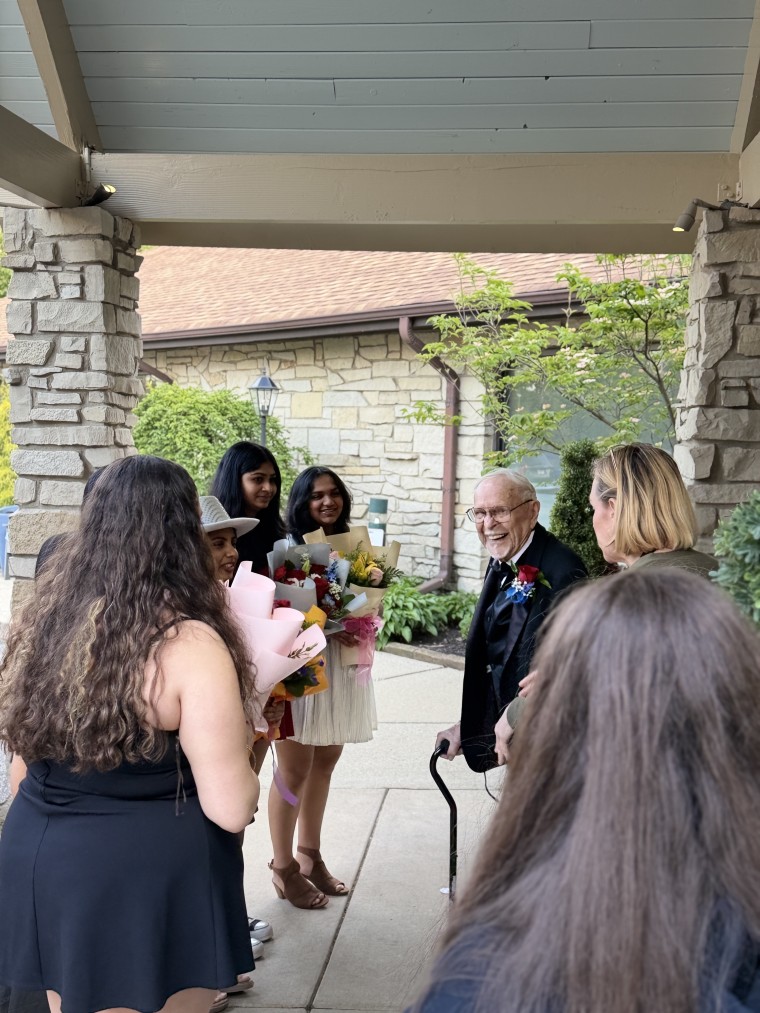
Ray Svejnoha’s community surprised him with everything he needed for the high school milestone.
by Aryelle Siclait
When attending his first prom at age 100 last month, Ray Svejnoha noticed how differently teens dance these days.
“During
my time, when we danced with a girl, we held her,” Svenjnoha tells
TODAY.com. “They danced in a circle of about 20 people and jumped up and
down like little bunnies.”
“And
the noise, my God, I couldn’t recognize the songs at all, but that’s
the way it is,” he laughs. It was one of the best nights of his life.
Svenjnoha
is a resident at Independence Village of Naperville, a senior living
facility in Illinois. He didn’t get to go to his prom. “I left for the
service,” he recalls.
He was
drafted into the Air Force during World War II with three months left in
high school. Although he was able to graduate, he missed out on some
milestones. He never thought much about having missed his prom, but six
high school students — girls who volunteer at the senior living facility
and teach residents how to use their smartphones — wanted to do
something special for him.
They teamed up with Independence Village staff to surprise Svenjnoha with a prom night he’d never forget.
Teens
who volunteered to teach seniors how to use their smartphones surprised
100-year-old Ray Svenjnoha by taking him to the prom since he missed
his own.Courtesy Ray Svejnoha
Local
businesses donated a trolley, flowers and styled Svenjnoha’s prom
haircut. Everything, he says, was taken care of. “It was really great.
It was one of the nicest things that’s happened.”
The
night was an homage to Svenjnoha’s rich social life and his love of
chit-chat — both of which he’s said have contributed to his long life.
He spoke with TODAY.com as part of the Incredible Centenarians series to share some other secrets to his longevity.
Fall in Love
“I had a terrific marriage,” says Svenjnoha. “I brag about it constantly.”
He
boasts of their teamwork, raising their two sons “who grew up to be
great men,” how they instantly clicked when his sister introduced them,
and how his wife would catch more fish than him, though she was less
experienced at the sport — but “that was to be expected,” he says.
Before
she died from cancer, she threatened Svenjnoha: She’d haunt him if he
didn’t keep living, maintaining his friendships and relationships. So,
he did.
Ray Svejnoha missed his prom because he was drafted into the Air Force.Courtesy Ray Svejnoha
Invest in Your Friendships
“It seems like I can make friends with anybody,” says Svenjnoha. “This is what God put me on this earth for.”
He plays bingo and bunco daily with his fellow residents and says hi to every new face.
Whatever
programming the senior center has planned for the day, Svenjnoha says
he’s game to interact with whoever’s there, approaching it all with
positivity.
“If you’re going
to be grouchy, don’t talk to me because I have no room for that,” he
says. “I’ve got plenty of room to laugh and kid and do things like that
and enjoy (myself).”
Do Work You’re Proud Of
Svenjnoha
started training to be an electrician as a teen. His neighbor growing
up enlisted the help of neighborhood kids interested in learning the
trade. When his neighbor joined the local union, Svenjnoha joined, too.
“This was my call,” says Svenjnoha.
Ray Svejnoha met his wife and worked as an electrician when he returned from the Air Force.Courtesy Ray Svejnoha
Move Your Body
Except for a recurring ache in his left leg, “I feel like a 20-year-old,” says Svenjnoha.
He’s
tried various treatments to soothe the pain, but nothing helps. “I’ll
just grin and bear it,” he says. He can’t give up movement, least of all
dancing.
“Dancing was my
best treat,” he says. “I used to love to dance.” And because it doesn’t
happen too often these days, he’ll do it any chance he gets. Prom was
his moment. “There were 25 girls in a circle, and we were dancing,” he
recalls. “It was on TV, by God.”
His granddaughter in Anchorage, Alaska, called to tell him she’d spotted a clip of him on the dance floor captured by Naperville Community Television.
Independence
Village of Naperville, the local Rotary Club and the high school
students who got to know Ray Svejnoha had a trolley, flowers and
Svejnoha's haircut gifted to him.Courtesy Ray Svejnoha
For
30 years, Svenjnoha taught swimming to children and adults with
arthritis at the local pool. He swam with his kids in his backyard pool
he’d invite the neighbors to use. He also took the neighborhood kids and
his children fishing. And a friend taught him how to play tennis.
Gov. JB Pritzker signed House Bill 862 into law June 17, creating the Illinois Department of Disability Advocacy and Guardianship (IDAG).
According to a release:
Through its three primary divisions, the department will continue to
provide critical support to thousands of individuals with disabilities
across Illinois. The Division of State Guardian will serve as guardian
of last resort for nearly 5,000 adults with disabilities.
The Division of Legal Advocacy will continue to provide legal counsel
to thousands of Illinoisians each year in cases of involuntary
treatment and related court proceedings, and the Division of Disability
Rights and Protections will continue to investigate disability rights
violations impacting thousands of Illinois Citizens with Disabilities. A
newly-established Advisory Council consisting of leaders from across
Illinois will provide valuable ongoing input into the department’s work.
“By establishing the Department of Disability Advocacy and
Guardianship, we are making it crystal clear that disability rights are a
priority in Illinois,” Pritzker said. “I am proud to establish this
agency, and I will continue to fight hard to empower people with
disabilities and their families all across our state.”
The new department will begin operations on July 1, 2027.
A bill aimed at strengthening protections for vulnerable adults under
guardianship gained approval from Illinois lawmakers six months after a
Tribune investigation revealed troubling consequences of area hospitals’ use of guardianship.
If signed into law by Gov. JB Pritzker, the legislation will create a
number of additional oversight mechanisms for hospitals and other
parties that request guardianship for an adult with whom they have no
personal relationship, as well as for private professional guardians.
Guardianship is a life-altering and often permanent legal process
that strips disabled adults of control over their life decisions. Under
the new legislation, institutions that petition for guardianship and
recommend a private guardian will be required to provide information to
the court describing their “efforts to contact the (person’s) nearest
relatives.” They would also need to notify the county public guardian of
the case.
The bill also encourages private professional guardians to meet with
the allegedly disabled adult prior to being appointed to the case or as
soon as is feasible. An earlier version of the bill had required that such guardians attest in court that they had met with and assessed the adult prior to their appointment.
The Tribune’s investigation last year found that area hospitals filed guardianship petitions
on behalf of patients hundreds of times during an 18-month period. The
reporting revealed that the hospitals’ use of guardianship often eased
the way to discharge patients to subpar nursing homes and sometimes
stripped family members of the ability to make decisions for their loved
ones. Tribune reporters spoke with several family members or close
friends of patients who said they were taken by surprise when a hospital
filed for guardianship, recommending that someone else make decisions
for their loved one.
While most of the patients placed under guardianship had limited
financial assets and were represented by the Office of the State
Guardian, the Tribune found that patients with financial assets like a
home or savings were often placed under the care of the same private
guardianship organization. In several instances, the Tribune found, the
private guardian and its lawyers billed the former hospital patients for
thousands of dollars in fees on top of hefty nursing home costs,
quickly draining lifelong savings.
Other guardrails in the bill include naming an individual on the
guardianship petition instead of an organization, requiring
certification of all staff working in guardian roles at private
guardianship organizations, and periodic background checks of those
employees.
Private guardians will also be required to notify the court at least
60 days prior that they are planning to refer the disabled adult under
their care to the state or county guardian, and to estimate as part of
the budgeting process how much longer the disabled adult can afford
their fees and services before their estate is depleted. They also need
to notify the court if the disabled adult’s home would be required to be
sold to pay for continued services within the next 36 months.
Two prior bills that aimed to address the steep costs charged by
private professional guardians and their lawyers in guardianship cases
initiated by hospitals, nursing homes and similar institutions faced
staunch opposition because they barred private guardians from being
appointed. The recent bill still allows for the appointment of private
guardianship organizations in those cases.
Although the final version of the bill includes several compromises
from the original language, Cook County Public Guardian Charles Golbert,
who along with AARP Illinois helped champion the bill, said it still
represents real progress in safeguarding the rights of vulnerable
adults.
Golbert, whose staff oversees the cases of more than 600 adults under
guardianship, said face-to-face meetings are standard practice in his
office prior to appointment and are crucial to properly assessing the
person’s needs. He said more than 20% of all cases in his office involve
people under a limited guardianship that allows the person some control
over their life. In the Tribune’s 18-month review, only seven of the
hospital-initiated guardianships, or roughly 2%, were limited in nature.
“I think all guardians should be seeing and evaluating their people
before they’re appointed,” Golbert said. “I think that’s key to
preventing unnecessary guardianships and from preventing a full
guardianship when the person might only need a limited or a temporary
guardianship.
“But the bill still does a lot. I still support it.”
State Sen. Michael Halpin, a Rockford Democrat and one of the bill’s sponsors, said in a news release
citing the Tribune’s investigation: “This kind of abuse taking place in
Illinois is unacceptable. When our most vulnerable are put in the care
of a stranger we have to guarantee that individual’s safety and
financial security.”
In an emailed statement, AARP Illinois State Director Philippe
Largent said the AARP worked with Halpin and another sponsor, Rep. Marti
Deuter, in collaboration with “aging, hospital, and guardianship
advocates to pass a meaningful measure that helps protect older adults,
caregivers, and all Illinoisans” who are involved in private
guardianships.
“This bill reflects a strong commitment to improving lives,
strengthening accountability, and ensuring greater protections for
vulnerable individuals across our state,” Largent said.
A spokesperson for Pritzker’s office said in a written statement that
state agencies were “heavily involved in negotiations” around the bill
and its passage. The spokesperson did not confirm whether the governor
intends to sign the bill into law, stating “the Governor will carefully
review everything that comes across his desk.”
SPRINGFIELD — Illinois would soon join a
growing list of states that have expanded alternatives to traditional
guardianship to maximize independence, thanks to legislation passed by
State Senator Sara Feigenholtz.
“The goal is to prioritize an individual’s autonomy in making
personal decisions about their own life. Everyone has a right to
self-determination when it comes to important life decisions,” said
Feigenholtz (D-Chicago). “By expanding this model of support, we are
providing people with more control over their own decision-making.”
A supported decision-making agreement allows an individual to
identify a supporter to help them interpret information, weigh options,
and communicate their decisions about health care, life choices, and
financial matters. This unique model fosters confidence and supports
people’s ability to make informed decisions while maintaining autonomy.
Traditional guardianship is more restrictive than a supported
decision-making agreement in terms of the autonomy someone has over
their finances, employment, housing and other life decisions. Many
people do not need to enlist a traditional guardian prematurely but will
instead benefit from their chosen decision-making assistant when making
complex or weighty decisions.
To maximize opportunities for greater autonomy, Feigenholtz’s
proposal would establish clear guidelines for implementing and
overseeing supported decision-making, ensuring the law’s effective and
safe application.
“Being able to make informed decisions about your own life is
fundamental – yet many individuals, especially older adults and people
with disabilities, have that fundamental right taken away through
guardianship when less invasive alternatives exist,” said Feigenholtz.
“With expanded supported decision-making, we are creating a new path:
one of person-centered support that respects individual freedom.”
Based on the multiple billions of dollars lost to scams and
exploitation of elderly and disabled adults each year, victims,
lawmakers and interest groups want to move legislation that would
require Illinois banks to provide new protective measures to prevent
fraud.
Rep. Katie Stuart, D-Collinsville, is the sponsor of House
Bill 4767, which would create new requirements for banks and credit
unions to report potential financial exploitation of elderly and
disabled adults.
Reports under the legislation would be sent to the Illinois Department on Aging, the agency behind the bill.
IDoA Director Mary Killough said financial exploitation is one of the
most common forms of elder abuse reported in the state of Illinois, and
$4.9 billion was reportedly lost by adults over 60 in 2024 – according
to FBI data.
“Our legislation allows financial financial
institutions to temporarily pause suspicious transactions and contact
trusted representatives when exploitation is suspected,” Killough said.
“We have the responsibility to ensure older adults can age with dignity
and security not fear, preventing financial exploitation before it
occurs is one of the most effective ways to do that.”
Stuart said she thinks the bill is especially pertinent due to reports of fraud becoming more sophisticated.
“If
they don't have a clear picture of everything that's going on, this
fraud is getting more sophisticated, much easier to be duped, much more
devastating, much more quickly getting more information and other things
about vulnerable people,” Stuart said.
The children of two fraud victims spoke in support of the proposal as well.
He said the case involved the scammer impersonating a U.S. Marshal.
Lori Hendren with AARP Illinois said her organization sees devastation from such scams.
“This
is not about money, it impacts individuals' independence, their health,
housing stability, sense of security, and overall quality of life. For
many older adults, their family and or their caregivers, losing
hard-earned savings means losing control of their future,” Hendren.
The bill has some opposition in financial institutions.
Stuart
said after a long negotiation process, she was able to add language to
the bill that accounted for their concerns about who on staff would be
responsible for reporting potential fraud.
Despite the
negotiations, bank and credit union groups still oppose the bill over
the new requirements that would be imposed on their operations.
As for the cost of implementing the fraud prevention plan, Killough said the department doesn’t expect to need more resources.
“We
already spend a lot of money in that direction. I don't think it's
going to add any more, but what we're hoping for is when we investigate
for abuse, it's not for a crime, it's to ensure that the individual
receives the services that they need so they won't be victimized,”
Killough said.
The bill was introduced in early February, and currently awaits progress in the House of Representatives.
First you get a call from a company you know well, saying a number of
product purchases are connected with your name and your bank account.
Then someone from a federal law enforcement agency gets on the phone and
warns you your account is in danger and scammers are after your money.
This person tells you there is a way for you to protect yourself. But
you must hurry.
That's the call and the convincing pitch a
suburban Chicago man received in March. The person on the other end of
the line gave his name and even texted a photo of himself holding his
U.S. Marshals badge to prove he was the real thing.
Now, the
victim is out $69,000 — a big chunk of his cash savings — and we're
asking the experts what can be done to prevent this type of fraud in the
future?
The call and the pitch
The man
who shared his story with CBS News Chicago Investigators is too
embarrassed to reveal his face or use his name, but his son Tony helped
explain what happened.
He said his father was watching television
when he got a phone call. The caller ID said "Apple," but Tony said it
was actually an "imposter that was acting like Apple."
"They had
asked him about some fraudulent charges they noticed on his account,"
Tony said. "And they said, it looks like your account's been
compromised."
Tony's father said he was given an urgent warning
from the woman on the phone, who told him that if he wanted to protect
"your property, your money and everything," then she'd transfer him over
to speak to a man "who works for the U.S. government."
Tony said his father then started speaking with another person, a
man, who told him, "I don't want you [to] think that I'm a scammer. I'll
send you the proof that I am not."
The proof was a texted photo.
It showed the name of the man he thought he was speaking with, Silas V.
Darden, U.S. Marshal, on an official-looking identification badge.
"He says, go to the bank. I'll give you the number to transfer the dough," Tony's father said.
He
thought the two new accounts were set up in his name and that he was
transferring the money to himself to protect his savings.
So he went to a Bank of America branch in Woodridge, not his usual
branch, because that one was too busy. He said he would have to wait too
long. He thought he had to act fast.
In Woodridge, he asked a
bank officer to transfer $24,000 to one of the accounts at Wells Fargo.
He signed a digital waiver and the transfer went through.
After
several more phone calls with the man he believed to be a U.S. Marshal, a
few days later, he went back to the same Bank of America and this time
transferred $45,000 to a second Wells Fargo account. A branch manager
had to sign off on that transaction. It also went through.
That's
when he decided to go to a nearby Wells Fargo to make sure his money was
safe, asking them to verify if it was in his name or not.
Instead, he found out that neither account was in his name and both accounts had been closed. His $69,000 was gone.
"For him, it's more than 40% of his total lifetime cash liquid savings," said Tony.
The scam
How was Tony's father convinced to make these wire transfers?
After he heard about what happened, the first thing Tony did was
search online for Silas V. Darden. That name appears in official agency
press releases, identifying Darden as a deputy director. A real person.
But,
when CBS News Chicago contacted the U.S. Marshals Service (USMS), we
were told Darden left the USMS a couple of years ago. And, that photo
texted to Tony's father?
"Oh, that was completely generated by
AI," said Brady McCarron, Deputy Chief in the Office of Public Affairs
for the USMS. It was not the real Darden.
McCarron says no one in federal law enforcement would ever do what this scammer did.
"Law enforcement will never call you. We will never ask for any money," he said.
According
to FBI Internet Crime Complaint (IC3) data, government impersonation
scams were the seventh largest crime type reported, with more than
34,000 in 2025, nearly double the number reported the year before. In
total, nearly $798 million was lost in 2025, an increase of 97% from
2024.
"They believe the phone number's real. They believe the photo is real," said McCarron.
And all age groups can be convinced to do what the scammer says,
especially if they think they're speaking with a federal agent. McCarron
said he's seen the scam work on college students, married couples,
professionals, senior citizens and more.
In
2025 more than 17,000 complaints of government impersonation scams were
filed for people ages 30 to 59. Those groups lost more than $221
million.
More than 8,600 scams were reported by people aged 60 and older. They lost just over $413 million.
The FBI has also started reporting the number of complaints of specific types of scams that use artificial intelligence, or AI.
McCarron said generative AI use has become more prevalent recently, especially with government impersonation scams.
"They're now using pictures, those pictures are created by AI. Don't fall for them," he said.
Suggestions and solutions
After
inquiries by CBS News Chicago Investigators, Tony said he has been in
contact with both Bank of America and Wells Fargo concerning his
father's case. He has also filed reports with local police, the Federal
Trade Commission and the Illinois Attorney General concerning the fraud.
Wells Fargo sent CBS News Chicago a statement, writing, "Anytime we
identify or are alerted to potential fraudulent or scam activity
involving any account, we investigate and take swift and appropriate
action, including, when warranted, the closure of accounts and alerting
or working with the appropriate authorities to help combat fraudsters."
And,
Bank of America sent this in a statement, writing ""We recognize the
emotional toll and hardship faced by anyone who becomes a victim of a
scam. We prioritize client protection and take action to mitigate risk
to clients from scams, including proactively warning clients during
these transactions. Unfortunately, clients sometimes ignore our warnings
and insist on completing the transactions. To be clear, the root of the
problem is criminals who prey on hardworking Americans, and we will
continue to work closely with government and law enforcement to hold
them accountable."
Both financial institutions provide online resources to help their customers protect themselves. You can visit these pages from Bank of America and Wells Fargo to find that information.
Neither bank could tell CBS News Chicago anything specific to Tony's father's case because of financial privacy laws.
But
there's one piece of advice security experts say is critical to staying
safe. You should ask to be added to your loved one's account as a
Trusted Contact so you can learn of potentially suspicious transaction
requests before any money transfers or withdrawals take place.
Additional protections are part of an Illinois bill introduced in the House of Representatives in February. HB4767
would expand the Adult Protective Services Act to cover all financial
institutions, including banks and credit unions. The changes allow any
bank to place a hold on the accounts of adults with disabilities or
older adults, if an employee suspects financial exploitation. The hold
would be limited to a maximum number of days and mandate the
institutions notify law enforcement if fraud is involved.
The bill currently sits in the House Rules Committee.
According to the American Bankers Association, 28 other states have
this type of protection in place, including several that passed the
legislation recently.
A spokesperson for the IL Attorney General's
office said in a statement, "Our office is committed to protecting
seniors from financial exploitation, fraud and scams. Fraud-induced
transfers are a serious problem that affects all consumers, particularly
seniors, and our office is open to working with the Legislature on
proposals to help combat this issue."
There are companion bills before the U.S. House and Senate
which would create a task force on payment scams to study trends and
issue recommendations. The goal: to prevent this type of fraud. There's
been no movement on those bills since June and August of last year.
After months of debate, legislation inspired by a Tribune
investigation into some Chicago-area hospitals’ questionable use of the
state’s guardianship system has advanced from the Illinois House as
supporters seek to strengthen court oversight and other protections for
the rights of vulnerable adults.
Earlier versions of the bill
would have banned the appointment of private professional guardians in
cases where a hospital, nursing home or similar institution has asked a
judge to rule that a person needs court-ordered oversight because he or
she is unable to make medical, financial and other personal decisions.
The Tribune’s investigation,
published in November, revealed that when the patients in question
owned property or other financial assets, hospitals typically
recommended that a private guardianship organization rather than a
county public guardian be put in charge of their lives. Paying for that
organization’s work, along with fees billed by lawyers on the case,
sometimes drained people’s savings at a rapid pace, the Tribune found.
But
the proposal to bar private guardians completely drew objections from
hospitals and others who argued it would force some patients to remain
hospitalized beyond medical necessity. The amended bill would allow
private guardianship appointments but enact requirements aimed at giving
probate court judges more authority to hold the entities accountable.
The
measure has yet to gain the approval of a longtime opponent, the
Illinois Health and Hospital Association, but after advancing to the
Senate on a recent 81-28 vote in the House it has survived longer than
earlier attempts and has turned several past opponents into supporters.
In its investigation, the Tribune found that Chicago-area hospitals had initiated hundreds of guardianship petitions
in an 18-month period. Hospital representatives said the petitions were
intended to protect incapacitated patients who are too disabled to make
their own decisions and who have no family or friends willing or able
to take charge.
But the Tribune found many cases where the
petitions eased the way for hospitals to discharge patients to subpar
nursing homes, sometimes bypassing family members who disagreed with the
hospital’s choice or were slow to make other arrangements.
The
hospital association also had expressed opposition to similar
legislation introduced in previous sessions by former state Rep. Terra
Costa Howard, now a judge. State Rep. Marti Deuter, an Elmhurst
Democrat, worked with AARP Illinois on the latest bill, which picked up
14 other sponsors in the House before the April 16 vote.
After
months of discussions with opponents, supporters say the amended version
of Deuter’s bill represents a compromise but still would set important
safeguards around private guardianship appointments.
For example,
the bill would require employees of private guardians to undergo
criminal background checks every five years and get the education
necessary for national certification. And a private guardian corporation
would have to submit to annual independent audits if it manages more
than $1 million in assets.
The bill also seeks to prohibit private
guardians from having financial ties to other for-profit entities
involved in the person’s case and would give the court more information
through annual budgets and fee schedules.
Also, in certain cases
where a private entity is seeking to pass the case to a public guardian
as successor, which typically happens when the estate is running out of
money, a 120-day minimum notice to the court would be required.
The
hospital association still objects to the part of the bill that would
require the private guardian to meet with the hospital patient prior to
accepting the appointment, citing concerns that such a requirement may
slow the process as well as timing issues concerning medical consent.
To
address the possibility that a person may be too incapacitated to meet
with the guardian or be unwilling to meet, supporters changed the bill
to specify that if the meeting is “not reasonably possible” the
prospective private guardian must certify in court that “they will meet
with the respondent as soon as feasible after the appointment.”
In
response to Tribune questions, a spokesperson for the hospital
association said the organization will continue working with the bill’s
sponsors on the language.
“IHA supports the goal of strengthening
existing protections in the guardianship statute and is committed to
working through any remaining unintended consequences of the proposed
legislation on patients, like the previously mentioned delays in
obtaining timely consent for treatment that directly impacts patient
outcomes,” Paris Ervin said in a statement.
Cook County Public Guardian Charles Golbert, whose staff oversees the
cases of more than 600 adults under guardianship and has helped
champion the bill, said face-to-face meetings are standard practice in
his office prior to appointment and are crucial to properly assessing
the person’s needs.
He said more than 20% of all cases in his
office involve people under a limited guardianship that allows the
person some control over their life. In the Tribune’s 18-month review,
only seven of the hospital-initiated guardianships, or roughly 2%, were
limited rather than full guardianships.
“That’s scandalous in my
mind,” Golbert said, “and that’s what happens when guardians accept
appointments with people who they have never met.”
Another
compromise supporters made to advance the legislation was deleting
language that would have temporarily prevented private guardians from
collecting court-approved fees if it meant the person had to sell their
home for nonmedical reasons. Supporters said the proposal was met with
skepticism by lawmakers who recognize the private entities do not have
taxpayer funding like their public counterparts and need to be paid for
their services.
Under the latest version of the bill, fees may be
collected but the private guardian would be required to notify the court
as soon as “it estimates the estate of the person with a disability can
no longer afford the services” or “if the sale of (the person’s)
residence would be required for the continued services” within 36
months.
The hope is the court would step in at that point to
either reduce fees or appoint a public guardian, such as Golbert, who
said his office delays fee collection when doing so allows a person to
remain in their home.
Besides the hospital association, the bill
had faced opposition initially from other important voices, including
the Catholic Conference of Illinois, which runs a private guardianship
program for elderly people that receives hospital referrals. The group
dropped its opposition after the bill recognized a place for private
guardianships, said Marilou Gervacio, director of social services/social
justice.
The vast majority of the hospital guardianship petitions
reviewed for the Tribune’s investigation involved people with little
money who were placed with the Office of State Guardian at the
hospitals’ expense, rather than under a private guardian or a county
public guardian like Golbert.
The Illinois Guardianship and
Advocacy Commission, which operates the state guardian’s office, said it
initially opposed the bill because of a provision that would have
required the office to receive notice if a facility determines that
someone may need a guardian.
“That provision would have created an
administrative obligation without a clear purpose or authority to act,
and no additional resources to manage the volume of notices,” the
commission said in a statement. The language was removed in the amended
version of the bill.
Despite the compromises, supporters say the
legislation still would go a long way toward improving the system. Other
changes would require private guardians to attest to the court that
their efforts to locate family or friends were exhausted prior to
appointment. And the petition would need to name the private entity’s
president, director or other corporate officer as the preferred
guardian, rather than a business name, with the goal of encouraging more
personal responsibility.
Besides Golbert and AARP Illinois, other
backers include the Illinois State Bar Association and the Illinois
Long-Term Care Ombudsman Program.
“The bill moves Illinois closer
to a system that respects independence, protects savings and prioritizes
dignity for older adults,” Philippe Largent, AARP Illinois’ state
director, said in a statement.
Added Golbert: “These are really
commonsense types of safeguards and protections for truly our most
vulnerable people — we are talking about people with advanced dementias —
who don’t know what’s going on and don’t understand what’s happening to
them or who either have no family or have family that is financially
exploitative or otherwise unavailable. These guardrails are just
critical for our most vulnerable people.”
Sen. Michael Halpin, a
Rock Island Democrat, has picked up the bill in the Senate. The spring
legislative session is scheduled to adjourn May 31.
Cathy Solway remembers a promise made with her brother to take care
of their aging parents when their health began to decline and they moved
into assisted living: "We're gonna take care of mom and dad as a team.
We're gonna do this together."
But then she made a discovery that changed everything.
"I
left the bank, sat in my car and about had a complete breakdown from
what I was seeing. A lot less money than I knew should have been in that
account," she said.
Growing up
Cathy Solway and her brother, Robert Carlson, grew up in suburban Streamwood.
"We had a pretty great childhood. My brother and I were pretty happy growing up," she said.
Their parents, William and Caroline Carlson, got married in 1958 and raised their family in a modest house.
"My
mom was a stay-at-home mom. She was the room mom. My dad worked hard,
but they never missed anything that we were involved in," said Solway.
William Carlson served in the Air Force as a young man. After his
stint in the military, he worked for United Airlines, the FAA and the
Village of Streamwood. He worked practically his entire life, his
daughter said.
"He was getting a decent amount of retirement benefits," said Solway.
But then came the official word her parents' health was declining.
"They
both were just not able to take care of themselves," she said. "They
both were in various stages of Alzheimer's. They were diagnosed in 2017
to 2019."
In 2022 the family decided to move them into assisted living, first
at an Illinois facility and then into a Wisconsin facility, closer to
her brother Robert.
"And my brother was like, 'You know, I'm going
to make sure that their finances are taken care of and, you know, we'll
make sure that their bills are paid for the house.' They still had the
house that they had lived in," Solway said.
Solway knew her parents had enough money to cover those bills plus the assisted living facilities' fees.
"I knew my dad was very good at saving money. He was very careful with his money," she said.
But her brother had surprise news.
"He
just suddenly told me in March of '23 'We need to sell their house,'"
she recalled. "To be told that there's no money left was a little odd."
The discovery
After asking her brother questions and getting vague answers, Cathy said she went to the bank to check the account balance.
"When they went into assisted living [in 2022] they had over $165,000
in their savings account," she explained. "When I saw how much was left
in the account, I felt that was like a gut punch."
With that
initial balance, plus their parents' monthly social security and benefit
payments and minus the living expenses, Solway estimated the remaining
balance should still have been a large amount.
"I'm doing the
math in my head. At some point, there should be around $80,000 in
there," she said. But the actual balance was much lower. "There was only
about $9,200."
She looked through other statements, and said she
spotted multiple large deposits, several withdrawals and checks for
thousands of dollars each.
"This is what would happen: $30,000 would go in and about $30,000 would go out, but not in one lump sum," she said.
She,
along with her mother, called the three financial institutions that
held her father's retirement accounts and found in the one that held her
father's 401k there was a zero balance. She found just $600 left in
another one.
"Over $110,000 and that was just from those three accounts," she said.
Within months, her brother had sold the family home in Streamwood for
around $160,000. That money was supposed to be used for their parents'
living expenses.
Her brother had been designated power-of-attorney
for the parents in early 2023, an arrangement made as part of a trust
prior to the Carlsons' failing health. But by the end of the year,
Solway was legally challenging his power over their financial affairs.
The court case and admissions
Solway
and her attorney filed a petition to remove her brother as
power-of-attorney and trustee of the family trust in December 2023 in
Walworth County Civil Court.
Through the probate case, she was
able to get access to detailed financial records and audio recordings
from financial institutions.
"When we subpoenaed all the audio
records, there were multiple times that he called and made withdrawals.
They were all my brother," she said.
She said her brother called
and told representatives he was his father, William Carlson. And in a
deposition taken for the case he admitted the voice on the recordings
was "Mine."
Some of the checks seen in the statements were made
out to her brother's business, Looking Good Turf. Some had Robert
Carlson's signature, but many appeared to be signed by his father.
"There were checks through '23 written for his landscaping company,"
Solway said. "Writing thousands of dollars of checks to his landscaping
company and signing my dad's name to it."
And in his deposition, when Robert Carlson was asked who signed his parents' names on documents and checks, he answered, "Me."
By
July 2024 a Walworth County judge removed Robert Carlson as
power-of-attorney and trustee over the family trust. The ruling also
ordered him to repay the trust more than $430,000.
Elder Financial Exploitation
The
Illinois Department on Aging, or IDoA, released new data from 2025
showing financial exploitation is the leading type of abuse against
people over the age of 60, and adults with a disability of any age.
Twenty-five percent of elder abuse is financial exploitation. and the 6,000 cases in 2025 are an increase from 4,500 in 2004.
"This
is due to the growth of the program, but it's also due to increased
prevalence of exploitation among the population," said Brian Pastor,
division manager of Advocacy and Prevention Services in the IDoA.
He said the abuser is often close to the victim.
"They're a family member. They're a trusted individual," he explained.
The
agency's data shows most often, in 34% of all cases, the abuse is
committed by the victim's adult child, especially when it comes to
money.
"They really do feel often in these circumstances that they
are entitled to these funds because they're going to get them
eventually. Which may or may not be true," Pastor said.
Solway
said she doesn't expect her brother will ever repay the money. She has
received compensation from at least one of the financial institutions.
Wintrust,
the Carlsons' bank, told CBS News Chicago in a statement, that the
judicial order did not pertain to it, so it will not repay any of the
money Robert Carlson withdrew via checks to his business or for other
bills.
CBS News Chicago tried to contact Robert Carlson in
Wisconsin, but could not find him. Neighbors told us they thought he had
moved to Florida.
Solway advised others to make sure more than
one person has power-of-attorney privileges. Her parents both passed
away within a few weeks of each other in 2025.
Patricia Martin, a lawyer turned judge who spent 24 years on the
bench, rising to become the top judge in Cook County's Juvenile Court,
seemed to have the credentials to be trusted handling the finances of
Oscar Lawton Wilkerson as he reached his mid-90s.
She had been
related to the former Tuskegee Airman and agreed to help. Instead of
helping Wilkerson, court records show Martin instead helped herself to
his cash, moving money from his accounts and buying bitcoin.
Eric
Puryear has known Wilkerson his entire life, as his grandfather was
Wilkerson's best friend. They trusted Martin to manage the money,
considering her an adopted family member.
"Every box for
trustworthiness seemed to be checked there, and so she seemed to be the
perfect person," said Puryear. "She seemed like the perfect person on
paper. In hindsight, she was not."
The first sign of trouble came
in August 2020, when the nursing home where Wilkerson was living called
to say they had not been paid in months, and $41,000 was owed
immediately. Puryear started looking into what happened with Wilkerson's
finances.
"Account balances weren't right, checks were being dishonored," said Puryear. "Serious financial problem."
This didn't make sense to Puryear. Wilkerson had saved plenty and now was facing a new battle after all he sacrificed.
"He's a Tuskegee Airmen, World War II veteran, just an all-around
wonderful person," said Puryear. "Dealing with segregation, dealing with
all of that while still also flying, it is amazing."
Wilkerson
made history as one of America's first Black military pilots. Tuskegee
Airmen took frontline risks and then took heat as boundary breakers that
many didn't like. After the military, Wilkerson flew for fun and became
a Chicago-based radio technician. He married, never had kids, and saved
for his golden years.
"It was clear Lawton should have had
hundreds of thousands of dollars, certainly enough to take care of him
for the rest of his life, because he'd worked so hard and saved so
hard," said Puryear.
Puryear reached out to Martin about the missing funds, but wasn't getting an answer from her.
"She attempted to dodge and evade, like apparently she'd been doing
for some number of months at that point, and she didn't seem to have the
time to return a phone call over such an important thing," said
Puryear. "You'd think, if she was innocent, that would have caused her
to want to communicate right away, but she didn't."
It was a
critical time for Wilkerson since, without paying what he owed the
nursing home, he was told he was going to have to move out of the place
he called home if things weren't settled.
"She stole the money, we
can see from some of the documents we've gotten," said Puryear. "All of
her actions, they shock the conscience."
Court documents show 11 withdrawals over 18 months, with Martin shutting down accounts and pocketing more than $245,000,
moving most of her new wealth into hard-to-track bitcoin. She was
arrested and faced various charges, including money laundering and
financial exploitation of an elderly person. She pleaded guilty to one
felony theft count and was sentenced to four years of probation.
"Probation
and a felony conviction for that sort of theft from that sort of a
victim just is not quite enough," said Puryear. "It's hard to think of
something more evil for her to have done, but she did."
Puryear,
an attorney, filed a lawsuit on Wilkerson's behalf to get his money
back, accusing Martin of stealing more than $380,000. During that case,
Martin repeatedly failed to show up for court hearings. The judge
ordered her to halt all transactions, but court documents show she
ignored that, too, and moved more money. In the end, the judge ordered Martin to pay up nearly $1.2 million in damages – triple the amount she stole.
"It makes me wonder what is wrong in Patricia's heart that she would do that to somebody," said Puryear.
Martin appealed the lawsuit judgment and had it overturned, in part
because Wilkerson died. Wilkerson's loved ones are planning to file
another lawsuit, continuing their fight to get back the money Martin
took.
She lost her law license because of all this, admitting: "… the evidence would clearly and convincingly establish the facts and conclusions of misconduct."
Wilkerson's
care never suffered due to Martin's theft, but for a man whose legacy
is etched in history, the moves of Martin are etched in the minds of
those who loved him most.
"Lawton was such a fine man; one of the
finest people I have ever met in my life," said Puryear. "And Patricia
Martin is one of the absolute worst humans, and to see that contrast
between them is breathtaking."
Martin declined to speak with CBS News Chicago for this story. The former judge continues to draw her government pension.
Chicago hospitals funnel patients into long-lasting guardianships, angering friends and family
By Emily Hoerner, Christy Gutowski and Lisa Schencker
Gary Brown, shown in October, said he was taken by surprise when
Northwestern Memorial Hospital filed a petition to place his father,
Gary Ellis, under guardianship of the state. Ellis died before the
family could regain control. (Eileen T. Meslar/Chicago Tribune)
As Gary Ellis lay dying in August 2023, no one at the facility caring for him called his son.
Instead, staffers called Ellis’ court-appointed state guardian, who
had recently taken charge of all decisions related to the 69-year-old
man’s care. Not until it was too late did Gary Brown learn his father
had been at death’s door, Brown told the Tribune.
“When I went there the nurse was like, ‘We’ve been trying to call
someone all night but nobody answered the phone,’” Brown said. “All I
got was ‘I’m sorry.’ ‘I’m sorry’ didn’t do nothing to help me or my
dad.”
The scenario was exactly what Brown feared when he learned, to his
surprise, that Northwestern Memorial Hospital had moved to appoint a
guardian for his father. The family said Northwestern had been treating the retired CTA bus driver for months, except for a brief stint at a rehabilitation facility, after he suffered a fall in April 2023.
Ellis’ family told the Tribune that by mid-May the hospital began
pressuring them to approve a transfer to a nursing facility, saying his
insurance coverage had stopped. Brown said he was still trying to
navigate his best option when a judge signed off on the temporary
guardianship petition, taking away Brown’s ability to decide anything on
his father’s behalf.
Putting someone under guardianship has profound consequences, often
stripping the individual of the right to make personal, medical and
financial decisions for the rest of their lives. Courts, government
officials and advocates for adults with disabilities say it should be an
option of last resort, used only when people cannot make their own
decisions and no less restrictive solution is available.
Gary
Brown holds a memorial card honoring his father, Gary Ellis, who died
under guardianship after a hospitalization. (Eileen T. Meslar/Chicago
Tribune)
Yet Chicago-area hospitals recently initiated hundreds of
guardianship petitions in just 18 months, a Tribune investigation has
found, sometimes to the dismay of family members or friends who did not
want people they loved to be placed under someone else’s control.
In many cases, guardianship eased the way for hospitals to discharge
patients to subpar nursing homes, sometimes bypassing family members who
disagreed with the hospital’s choice or were slow to make other
arrangements.
Many relatives or friends wound up battling on their loved ones’
behalf long after the hospital had solved one of its immediate problems —
a patient it wanted to discharge.
Some hospitals moved for guardianship over the objections of patients
who later successfully fought to regain their freedom, or in cases
where the patient’s rapid subsequent improvement raised questions about
the need for such drastic measures.
In cases where patients have little money, hospitals often seek to
place them with the publicly funded Office of State Guardian at the
hospitals’ expense. But if the patient does have assets, the Tribune
found, the hospitals and their hired lawyers almost always recommend a
certain private care management organization as guardian. That opens a
pipeline to the patient’s life savings, which can be rapidly drained to
pay for the care they receive as well as fees charged by the private
guardian and the lawyers working on the case.
The consequences of guardianship can be so severe and long-lasting
that some hospitals, even those that serve many low-income patients,
told the Tribune they try hard to avoid it.
Yet two of the area’s largest and most prestigious medical
institutions, the University of Chicago Medical Center and Northwestern
Memorial Hospital, had by far the most guardianship cases during the
period examined, even in comparison to other big hospitals.
The Tribune identified 369 hospital-initiated adult guardianship
petitions filed from January 2023 through June 2024 after combing
through thousands of pages of court records in Cook, DuPage, Kane, Lake,
McHenry and Will counties. Of these, 68 came from University of Chicago
Medical Center and 35 from Northwestern Memorial. By contrast, Rush
University Medical Center had six, John H. Stroger Jr. Hospital had five
and Loyola University Medical Center had none.
The
University of Chicago Medical Center filed 68 guardianship petitions in
18 months, the most by any hospital in the six-county Chicago area.
(Eileen T. Meslar/Chicago Tribune)
The University of Chicago Medical Center and Northwestern both did
not grant interviews and would not comment on individual cases, sending
written general statements instead.
Northwestern called guardianship a “compassionate solution” and a
“vital safeguard for individuals who are unable to make decisions for
themselves and who lack family, friends or legal representatives acting
in the patients’ best interest to advocate on their behalf.” The
guardianship process “plays a critical role in protecting vulnerable
patients,” said the statement from University of Chicago Medical Center,
and the number of guardianship petitions it files “reflects the medical
complexity and vulnerability of the patients we serve.”
Each hospital said guardianship is sought in only a fraction of cases
— or, for Northwestern, “0.000175%” of the more than 200,000 patients
the 11-hospital system discharged in a recent 12-month period.
For Ellis, his ordeal began when he injured his leg after falling on a
fire hydrant, according to Brown. His father chose Northwestern
Memorial for his treatment, believing it had the best care to offer in
the area, Brown said. The injury, plus heart problems, resulted in Ellis
moving back and forth between Northwestern and a nursing care facility.
Northwestern
Memorial Hospital filed the second-largest number of guardianship
petitions. A spokesperson called it a "compassionate solution" for some
patients. (Eileen T. Meslar/Chicago Tribune)
Brown said he tried to go to the hospital every day after work, and
before the guardianship he said he answered the phone at any time of the
day or night when health care workers needed permission to perform
procedures for his dad.
After learning of the guardianship petition, Brown sent an anguished,
handwritten motion to the judge, pleading to be appointed guardian
before the next court date at the end of August 2023. He had been in the
process of visiting nursing homes but “didn’t move fast enough” for the
hospital, the motion states.
“I don’t want my father passing in guardianship of the state when he
has a whole family that loves him,” Brown wrote. “I honestly don’t know
how they could say this when he’s had visitors almost every day
literally!”
Two weeks later, his father died under guardianship of the state, in a
long-term acute care hospital, with none of the people who loved him
there to bear witness.
‘They weren’t listening’
In the best-case scenario, a hospital files a guardianship petition
because there is no other viable option. Hospitals have a responsibility
to discharge their patients safely, and some people who cannot function
on their own do not have anyone close who is willing and able to take
charge.
But the Tribune found multiple instances where patients had people
who said they were willing to step in — or even held power of attorney —
but the hospital filed a petition nominating someone else.
For example, when the University of Chicago Medical Center filed a
guardianship petition for one patient in 2023 because of her cognitive
impairment, the petition stated she had no close family members who were
entitled to be notified regarding the guardianship.
But the patient did have a family, including her brother, William
Donaldson, who told the Tribune he had been visiting her at the
hospital. He said he was disappointed to find that his sister, 76, had
been placed under guardianship and discharged to a nursing home.
“They kicked her out of the hospital without telling me,” Donaldson
told the Tribune. “I had been going back and forth to the hospital to
see her. I called the hospital looking for her and she was gone.”
Donaldson has since gained guardianship of his sister after four
months in court with the help of an attorney. Of the situation, he said
simply: “It is a nightmare.”
In some cases, as with Gary Brown, a hospital’s decision on
guardianship had irrevocable consequences. Families saw the time run out
on their loved one’s life before they could regain control.
Kenya
Lawrence said she and other family wanted to take her grandmother,
Earsline Rose, home with them to the Milwaukee area. Instead, Rose died
in a South Side nursing home. (Eileen T. Meslar/Chicago Tribune)
Kenya Lawrence, a granddaughter of the late Earsline Rose, told the
Tribune she became aware of the University of Chicago Medical Center’s
temporary guardianship petition only after Rose’s family found the
paperwork in her hospital room.
Lawrence said she and her siblings showed up at a 2023 court hearing
on the petition for Rose, who was 90 years old, and tried unsuccessfully
to make the case that the family should be in charge.
“She had no business in the system; she has relatives,” Lawrence
said. “I fought tooth and nail; I fought very hard. They weren’t
listening to that.”
Rose’s grandchildren had hoped to take the nonagenarian home with
them to the Milwaukee area and care for her in her final days. Instead,
she was discharged to a poorly rated nursing home in Chicago’s South
Shore neighborhood, many miles away. She died there in July 2023, four
days after Lawrence formally petitioned a judge to take over as her
grandmother’s guardian, records show.
For Rose’s family, the process felt “shady,” frustrating and cruel.
“Everybody’s going to get old,” Lawrence said, “and you’re going to wish that doesn’t happen to you.”
"She
had no business in the system; she has relatives," Kenya Lawrence said
of her grandmother, Earsline Rose, shown in an old publication. (Eileen
T. Meslar/Chicago Tribune)
Though the University of Chicago Medical Center would not comment on
individual cases, it contended in its written statement that “the
medical center pursues guardianship … only after exhaustive efforts are
made to locate family or close friends.”
Joyce Anderson told the Tribune it came as a surprise when Chicago’s
St. Mary of Nazareth Hospital filed a petition naming a private
organization as the recommended guardian for her 81-year-old aunt, Betty
Robertson, instead of anyone who knew her.
It happened, Anderson said, while she was still working on finding an
acceptable facility where her aunt could live after discharge. As she
made calls and visited nursing homes, various family members continued
visiting the elderly woman at the hospital.
Once guardianship was in place, the hospital sent Robertson to a
nursing home that Anderson did not find to be acceptable for someone she
loved. Robertson has since died.
“They did not care, that’s the best way for me to put it,” Anderson
said of the hospital. “I understand financially, I understand about all
of that, but you should have just given us more of a chance to try to
find some place.”
Ascension, which owned the hospital at the time, did not answer
Tribune questions. Court records show that a nurse had acknowledged that
relatives regularly visited the patient but said the family was
“nonresponsive” regarding medical decisions.
Derrell Collier said he spent hours at his mother’s bedside after she
went into cardiac arrest outside a grocery store at age 69 in early
2023 — mainly at Loyola University Medical Center and then at Kindred
Chicago Lakeshore, a long-term acute care hospital that has since
closed.
Derrell
Collier washes the hands of his mother in October at a Chicago nursing
home. A hospital had previously tried to place her under guardianship.
(Eileen T. Meslar/Chicago Tribune)
After several months, Collier said, Kindred told him his mother’s
insurance would soon cease to cover her stay and the hospital wanted to
discharge her. Collier was opposed, and while he was still navigating
how to get his mother’s care covered, Kindred’s administration grew
impatient and sought the appointment of a public guardian in the fall of
2023, writing in a petition that her “family refuses to participate and
consent to discharge planning.”
Collier, who had his mother’s power of attorney for health care, said
he showed up for court to argue that he and his brother were very much
involved, present and able to act on the wishes his mother had expressed
before she fell ill. The hospital withdrew the guardianship petition
after Collier found another placement for his mother.
“When you show up every day it’s difficult for them to do certain
things, it’s hard to go in front of a judge and say he doesn’t care,”
Collier said. “They took me there because of the money. … They were
trying to take charge and stick her in any-old-nursing-facility
any-old-where.”
A spokesperson for ScionHealth, which operated Kindred Chicago
Lakeshore, declined to comment on specific patients. In a written
statement, the health system said the “safety, dignity and well-being of
our patients are always our highest priorities.”
Nearly a third of patients in the hospital guardianship cases
reviewed by the Tribune went to nursing homes that, during the year the
guardianship was initiated, had an average one-star rating from the
Centers for Medicare and Medicaid Services, the lowest possible. A
similar percentage of patients were discharged to nursing homes that
were flagged for patient abuse for the majority of the year in which
they were placed under guardianship.
"They
were trying to take charge and stick her in any-old-nursing-facility
any-old-where,” Derrell Collier said of the now-closed hospital that
wanted to discharge his mother against his wishes. (Eileen T.
Meslar/Chicago Tribune)
In one case, the University of Chicago Medical Center nominated the
mother of a 53-year-old patient as guardian in October 2023, only to
renege after the mother objected to the poorly reviewed nursing home the
hospital had selected for discharge, RYZE on the Avenue.
In the months before the hospital filed its petition, federal
regulators had fined that nursing home more than $80,000 after finding
the facility had failed to protect residents from physical abuse from
other residents, failed to properly care for wounds and left an
incontinent patient in soiled clothing for more than two hours.
The hospital nominated a different guardian, and the patient was
discharged to the nursing home. She died months later. RYZE did not
respond to the Tribune’s requests for comment.
Jim Berchtold, a Nevada attorney and the recent director of Justice
in Aging’s guardianship policy program, said that when hospitals are the
ones arranging for discharge, the focus is on getting the person out
the door.
“They don’t care what level of care they’re receiving, they can say,
‘It was a safe discharge, we’re in the clear,’” said Berchtold, who
developed a program to provide legal counsel for adults facing
guardianship in his home state of Nevada. They may think: “‘Hopefully …
the guardian will step in and transfer them someplace better.’ (They’re)
pushing it off to the next person.”
Choosing the ‘nuclear option’
Once a guardianship is in place, it takes time, money and effort to make the case for freedom.
Brian Sivley, a 36-year-old man with physical disabilities, wound up
under guardianship after he suffered a fall, was treated at Northwestern
Memorial Hospital and didn’t like the hospital’s plan to discharge him
to a nursing home. A hospital doctor determined Sivley had an “inability
to appreciate the risks of returning home.”
Sivley had lived in a nursing home before, but he’d recently
succeeded in living on his own with the help of government services. He
wanted to keep his hard-won autonomy.
Northwestern officials filed a petition for temporary guardianship
anyway. It would take a year before Sivley, with legal help from the
disability advocacy organization Equip for Equality, was able to resume
making his own health and living decisions.
The hospital withdrew its petition for a longer-term guardianship
arrangement earlier this year after Sivley signed documents giving his
power of attorney for health care to a former teacher he had stayed in
touch with over the years.
“I don’t know why they took the nuclear option,” Sivley’s attorney,
Jin-Ho Chung, said of the hospital. “Like the doctor that we retained
said, one might agree or disagree with Mr. Sivley’s choices; that
doesn’t mean that he needs a legal guardian.”
“From our experience, it seems that it’s more difficult for
individuals to terminate a guardianship than to have one appointed,”
said Cristina Headley, another attorney with Equip for Equality who
works on the organization’s adult guardianship initiatives.
In a written statement, Sivley told the Tribune he “felt really mad” about the forced guardianship.
“I knew that there were ways I could get rehab at my apartment and it
would be covered by my insurance because of prior experiences,” Sivley
wrote. “It hurt even more because I had just moved into my first
apartment.”
Anita Raymond, a licensed independent social worker who has written
about the so-called hospital-to-guardianship pipeline, said hospitals
may err in relying on the court’s checks and balances to catch
questionable petitions.
“Hospitals may think, ‘We don’t know what else to do. If we’re wrong
the court-appointed attorney will fight the petition,’” Raymond said,
referring to the guardian ad litem who helps assess what decision is in
the person’s best interest. “And then the judge ultimately decides
whether to appoint the guardian or not. People presume, ‘It’s OK if I do
this even if I’m wrong.’”
But health professionals and other advocates say these judges often
don’t have much more information to go on than the medical evaluations
coming from the hospital itself, which has a vested interest in the
outcome.
Cook County Circuit Judge Daniel Malone, who presides over the
probate division, said in an interview that the judges make decisions
based on the information in front of them. The standard for finding
someone to be disabled — clear and convincing evidence — is high, he
said.
“We’re taking people’s rights away from them,” Malone said. “It’s not something any judge here wants to do lightly.”
The medical evaluations provided to the court also are sometimes
conducted early in the person’s stay, when they may be at their worst,
advocates said.
Andre
Daniels, left, brings food to his father, Frank Daniels, at a La Grange
Park nursing home this month. Andre Daniels is now his father's
guardian after a fight in court. (Eileen T. Meslar/Chicago Tribune)
Andre Daniels, whose father was placed under temporary guardianship
at age 76 in February 2024, said he is bothered by the fact that Frank
Daniels was assessed at the beginning of his hospitalization and his
ability to make decisions was not meaningfully reevaluated afterward.
“He’s very perceptive, he’s very aware, he still writes everything
down,” Daniels said of his father. “How did he get to the stage where he
was deemed incapable (when) he is basically capable?”
The younger Daniels said he had been estranged from his father, a
trained welder who served in Vietnam as a Marine, before learning about
the situation from his brother in October 2024. He then worked with an
attorney to take over as guardian earlier this year.
Much of what the elder Daniels has to his name was the result of
fighting and advocating for himself, according to his son. In the late
1980s, Daniels won a racial discrimination lawsuit,
along with a substantial financial settlement, after complaining about
unequal treatment for Black welders in the white-dominated Chicago
Pipefitters Local 597 union. His fight had lasting effects, with a federal judge later mandating oversight of the union’s practices.
He is now in a nursing home but wants to return to the multifamily
home he owns and lived in with two of his daughters before being treated
at University of Chicago Medical Center, Daniels said. He said they are
now working toward that goal together.
Frank
Daniels, shown holding a list of appointments, is “very perceptive,
he’s very aware," his son said. “How did he get to the stage where he
was deemed incapable (when) he is basically capable?” (Eileen T.
Meslar/Chicago Tribune)
The Tribune’s review found Black patients were overrepresented in
hospital guardianship petitions in diverse Cook County, raising
questions of implicit bias in both health systems and the courts related
to those patients and their families. While the patient’s race was not
always available in court records, at least 39% of the patients were
identified as Black, compared with about 22% of the county’s population.
“There are hundreds of decision points, even before the case is
filed, about that person, about their capacity, about their behaviors,
about the decisions they are making,” said Berchtold, formerly of
Justice in Aging. “The people making those decisions are almost
inevitably white individuals who know nothing about this person or where
that person is coming from.”
Dr. Kahli Zietlow, a geriatrician and clinical associate professor at
the University of Michigan who is studying guardianship outcomes, said
physicians who see patients in a hospital setting may have no history
with the patient, don’t know firsthand how well the person might
function at home and may not completely understand the implications of
their evaluations.
“Physicians don’t necessarily realize when we write a letter (finding
someone incapacitated) … that it can mean forever,” she said.
The Tribune found one case where a man is still under guardianship
more than a year after the state guardian itself filed a petition with
the court requesting to release him.
Gottlieb Memorial Hospital, which is part of Loyola Medicine,
initiated the petition in 2022 for the man in his early 60s because
complications related to alcoholism had left him unable to comprehend or
communicate much, court records show. He spent about 45 days in the
hospital.
But after his discharge to a nursing home, the former patient
improved greatly and repeatedly voiced his objection to being under
guardianship and living at the facility. A 2024 petition from the state
guardian to revoke the guardianship stated “he is completely independent
and does not have any major medical issues and does not display any
sign of confusion.”
That petition is still pending after the last doctor to evaluate the
man requested a second opinion and the second doctor got cold feet about
doing the evaluation, telling the man’s guardian she feared the
consequences to her license if the man “were to commit a crime.” This
month, the guardian reported to the court that another doctor requested
additional sessions with the man before issuing a report.
Loyola Medicine said it could not share information about an
individual patient but said it is the health system’s policy to ask for
court intervention “only after we have exhausted other available
options.”
“It’s a tough system,” said Peter Lichtenberg, a national expert in
financial capacity assessment and the financial exploitation of older
adults. “If somebody who really shouldn’t have lost their rights but
doesn’t have the wherewithal to have the legal advocate to get them on
their road … it can be a real nightmare.”
Alternatives to guardianship
Stroger is Cook County’s flagship public hospital and aims to “care
for everyone” regardless of immigration status or the ability to pay.
Around half of the patients in recent years have been Medicaid
recipients — meaning many belong to lower-income households.
Yet despite the complications of caring for this population, the
hospital brought just five guardianship petitions during the 18-month
period the Tribune examined. Two of the cases involved a pair of
siblings in their 40s with serious disabilities who had been at Stroger
for nearly two years.
Cook County Health’s chief legal officer, Ellie Bane, said in a
statement that Stroger strives to preserve patient autonomy and that the
hospital works to find alternatives such as powers of attorney or
surrogate decision-makers for health care.
“A guardianship for health care decisions is a significant legal
decision that requires court approval and can be overly restrictive, and
even permanent,” Bane wrote. “Pursuing guardianship when other options
exist extends beyond our primary role as a health care provider.”
With
his son's help, Frank Daniels hopes to leave nursing care and return to
the multifamily home he owns and lived in with his two daughters.
(Eileen T. Meslar/Chicago Tribune)
At St. Bernard Hospital and Health Care Center, a smaller community
hospital in Chicago’s Englewood neighborhood, those who oversee case
management told the Tribune that even in cases where patients are
difficult to discharge, they seek to work with family members or other
decision-makers whenever possible. St. Bernard filed just one petition
for guardianship between January 2023 and June 2024.
Vivian Moore, who works in the hospital’s wellness management
department, said the hospital starts discharge planning the day patients
are admitted. She said the hospital does its own investigations to find
family members, including researching prior visits and searching for
missing persons reports.
“If the patient doesn’t have a preference or is not able to vocalize a
preference we want to take into consideration the preference of the
family,” Moore said. And when patients disagree with what the hospital
thinks is best, St. Bernard also tries to honor that, she said. “We
still want to equip them with those options and resources, but we
respect their final decision.”
St. Anthony Hospital in Little Village filed just two guardianship
petitions in the 18 months the Tribune reviewed. David Evers, the
hospital’s assistant general counsel, called it “a last resort … in part
because we have a lot of great alternatives under Illinois law that are
not permanent, that are less invasive, that give families more input.”
“It does cost you a lot of money and effort to get a guardian
appointed, so if there is a family member that wants to be a guardian
and is engaged with us, we’re absolutely going to help them do it
because it’s in both of our interests,” Evers said.
An Illinois law aimed at reducing guardianship does require health
providers to seek out potential surrogate decision-makers for the
patient, but that requirement extends only to spouses, parents and
children. Contacting adult grandchildren, siblings and close friends is
optional.
In four Michigan counties, the Michigan Elder Justice Initiative is
operating a pilot program aimed at offering courts and community
organizations alternate tools to help solve problems without fully
stripping away adults’ rights.
Alison Hirschel, an attorney with the advocacy organization, said
that in one county they saw a 42% reduction in guardianship filings in
the program’s first year.
“There are lots of reasons that hospitals and nursing homes petition
for guardianship that aren’t really about the interests and best needs
of the patient,” Hirschel said.
One key component of the Michigan program is educating petitioners
about options that are less restrictive than full guardianships.
Derrell
Collier washes the feet of his mother during a recent visit to her
nursing home. "She took care of everyone in the family," he said. "I
think it's only right. It's her turn." (Eileen T. Meslar/Chicago
Tribune)
In Illinois, one such option is limited guardianship, which is
specifically tailored to the things a person needs assistance with.
But in the Tribune’s 18-month review, just seven of the
hospital-initiated guardianships, or roughly 2%, were limited in nature,
allowing the person some control over their life. In at least one
situation, the guardian ad litem’s recommendation for a limited
guardianship was disregarded.
In that case, a former University of Chicago mathematics professor
was hospitalized at the university’s medical campus in fall 2023 after
his advanced dementia resulted in a friend and colleague bringing him to
the hospital.
After meeting the former professor, the guardian ad litem wrote to
the judge that he “uses his intelligence to mask possible dementia and
cognitive deficits” but “I do not think the respondent is totally unable
to make personal or financial decisions.”
The man consistently objected to needing guardianship but agreed he
could use some help managing his financial affairs. Nonetheless, a full
guardianship was put into place.
“There really is supposed to be a preference for limited
guardianships,” Hirschel said. “One of the reasons that rarely happens
or doesn’t happen nearly as often as it should (is) the judges don’t
have enough information about what the person can do or can’t do. The
judge doesn’t have the information to draft a narrowly tailored order.
And also for judges who are really busy, it’s just faster.”
Malone, who presides over Cook County’s probate division,
acknowledged to the Tribune that limited guardianships are in the
minority. In making those decisions, Malone said, judges have to rely
heavily on the reports they receive.
“It’s the doctors that make that decision as to whether the person’s
totally disabled or partially disabled,” he said. “The other thing we
rely heavily upon is (guardians ad litem); they’re the eyes and ears of
the court.”
Other best practices experts cited to improve the guardianship
process include bolstering training for physicians who conduct these
assessments and doing the assessments in home settings whenever
possible.
Gary
Brown sits on a South Michigan Avenue bench where his father, Gary
Ellis, a former CTA bus driver, liked to sit and watch activity near a
bus stop. Brown said his feelings are still raw after his father died
under guardianship without loved ones nearby. (Eileen T. Meslar/Chicago
Tribune)
Dr. John Halphen, a clinical professor of geriatric medicine at
UTHealth Houston, has worked for about two decades with a state-funded
program that connects physicians trained in capacity assessments with
adult protective services, which now covers the entire state of Texas.
The physicians he works with “don’t have a dog in the fight,” Halphen
said; no one involved receives fees or gets paid in a way that is
related to the outcome of the assessment.
Obtaining background information about the person is key, Halphen
said. His team checks with multiple sources to learn about the adult’s
capabilities and uses cognitive screening tests to help assess whether
people really understand their circumstances.
“It’s always a balancing act,” said Lichtenberg, the expert on
financial assessment. “If you don’t provide protection to people who are
incredibly vulnerable, they do get exploited and it’s not pretty.
On the other hand, “if you provide protection when you should be
promoting autonomy, it impacts their quality of life and mental health,”
he said. “It impacts their physical health too. The stakes are very
high for guardianship when it’s a close call.”
‘How can they do that’
For Gary Brown, whose father died under guardianship and without
loved ones nearby, feelings remain raw that no one has been held
accountable for the way his father’s story ended.
“They really took a lot from me and out of me,” Brown said.
His aunt Sandra Ellis told the Tribune she had been keeping tabs on
her brother, including visiting periodically from Georgia, talking to
hospital officials and reaching out to confirm her brother’s insurance
was still covering his stay.
She said she did not know this was something hospitals could do — ask the state to take control of a person.
“How can they do that and get away with all of that?” Ellis asked.
“When he passed away there was not one single family member that he had
there with him. And that was so sad.”