

The
guardianship system is meant to protect vulnerable citizens. But the
secretive and legal process is not always transparent to the people it
is meant to protect.
Catherine Galvin sat in the audience of an elder abuse panel discussion in Richland, Wash., listening to a Q and A about nursing home abuse, predatory behavior and living wills. The panel of professionals answered diligently and offered many resources for the audience.
None of them could help Catherine free her friend from guardianship.
Bonnie ‘Jeanne’ Southall and Catherine Galvin met in 2000 when Catherine, a psychiatric nurse at the Walla Walla Veterans Affairs Hospital, treated Jeanne’s husband, Sam. After Sam’s death Jeanne sought a friendship with Catherine. But at first Catherine was hesitant.
“I was really concerned because even though I was never her therapist I didn’t want the appearance of you know somebody in an unequal situation you know when you’re friends you start from the same basis,” Catherine said.
But when Jeanne heard Catherine needed a place to live she offered to take her in.
“I said I have a big home and a lovely big backyard that’s fenced and you can come to live with me,” Jeanne recalled. “It took her a long time to decide, and (she) came for many interviews. But I guess she decided it was safe living with me.”
 |
| Catherine Galvin, left, and Jeanne Southall at lunch together. It would be one of their last visits face to face. |
Jeanne Southall is 99. Their age difference was as long as their friendship of nearly 20 years. They had a lot in common, from the places they traveled to the love of good food and doting on their pets.
Was Dementia Diagnosis ‘Reversible’?
Eventually, Jeanne decided to sell her home and move to a senior living facility called Park Plaza, an all-inclusive independent senior living community. Catherine moved just a few blocks away and continued to care for her friend. Losing her eyesight, Jeanne made Catherine her power of attorney to help pay bills and accompanied her to appointments. Shopping, too. Jeanne has a penchant for fashion.
One night in October 2016, Jeanne was taken to the emergency room. Soon after Jeanne moved temporarily to a rehabilitation center.
After recovery, Catherine moved Jeanne back to Park Plaza. But she noticed her friend was acting differently. Jeanne seemed paranoid, anxious and agitated. Catherine made an appointment to see Jeanne’s doctor, Jon Gardner at Providence St. Mary Medical Center. Dr. Gardner diagnosed dementia. Jeanne was 98. But to Catherine, something wasn’t right. The dementia had come on too quickly — speeding through years of dementia onset in a matter of two months. She pored over Jeanne’s medical records and found in the paperwork, “Discontinued medications: Levothyroxine.”
Catherine was elated.
Levothyroxine is a thyroid medication. When a patient is suddenly taken off it, especially a patient who has taken it for years, withdrawal symptoms include agitation, forgetfulness and anxiety. Catherine felt Jeanne’s dementia was reversible. She called Dr. Gardner’s office to inform them.
By the time Jeanne felt herself again, a secret and legal process was filed with the Superior Court of Walla Walla: guardianship.
When you think of the word guardian it may elicit feelings of comfort and care. To Jeanne it brought heartache, financial ambiguity and loss.
Two Types Of Guardians
There are two types of guardians: lay and certified professional. Lay guardians can be family members, friends or a community member. They take an online course and pass criminal background checks before a court will assign them. Lay guardians can care for up to two wards, and the courts oversee them. According to Stacy Johnson at the Office of Guardianship and Elder Service, the state only has an estimate on the number of guardians.
“So, that’s a moving target. I can give you an estimate,” Johnson said. “There’s about 20,000 people under guardian with a lay guardian and about 3,500 with a professional guardian in the state of Washington.”
Losing Civil Rights Under Guardianship
Professional guardians have taken lengthy courses and are certified by the state. Usually they are lawyers. Certified professional guardians can take on as many clients as they want. Both types of guardians have legal authority to make medical and financial decisions.
There are different levels of guardianship. A guardian can oversee estates but not a person’s daily needs, or full guardianship overseeing the entire estate and person. In Washington, alternatives to full guardianship should be pursued first because of the significant loss of civil rights once you’re a ward.
That doesn’t always happen. Full guardianship, as in the case of Jeanne, are often the norm despite a person’s capacity to make decisions. Alternatives to full guardianship, such as durable power of attorney, a health care power of attorney or case management, should be considered before full guardianship.
The rights you lose under guardianship: The right to hire a lawyer, make medical decisions, to buy or sell property, to manage your finances, to marry, who you associate with, and to vote.
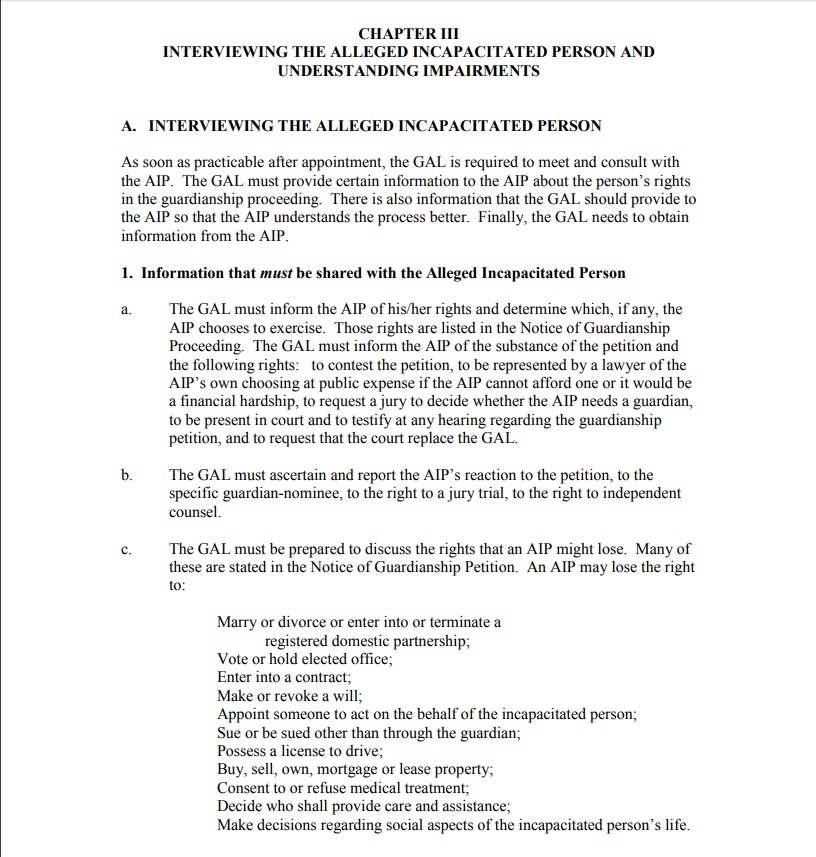 |
The
guardian ad litem interviews the alleged incapacitated person. In this
case, Jeanne says she was not told about the loss of her rights or the
option to an attorney. David S. Grossman was appointed by the court as
her guardian ad litem. Court documents state he informed her and she
declined representation. Link to image document:
https://goo.gl/ntNw4b |
When Jeanne was off her thyroid medication, she was incapacitated, meaning she couldn’t make decisions on her own. In legalese, incapacitated has a lower threshold of proof than incompetent. But she had a power of attorney in Catherine who could care for her, and she demonstrated a willingness to do so while Jeanne recovered.
Full Article & Source:
How A Washington Elder Fell Into Guardianship, And How It Can Happen To You

