Former Wasco County District Attorney Eric Nisley and his chief deputy, Leslie Wolf, may have violated state law and ethics rules prosecutors are required to follow, by withholding information for years about a city of The Dalles police officer disciplined for violating the department’s truthfulness policy, according to two detailed complaints filed with the Oregon State Bar.
The complaints were filed in the months since Nisley was voted out of office and began work as a prosecutor in Jefferson County. They make accusations of significant problems — ones that undermine the basic principles of the criminal justice system. The allegations are under investigation. If they result in a finding of misconduct, Nisley and Wolf could face reprimand, suspension or disbarment.
Nisley, who had his law license suspended before, and Wolf have asked the state bar to dismiss the complaints. The most detailed allegations were filed by their successors, Wasco County District Attorney Matthew Ellis and Chief Deputy District Attorney Kara Davis, as well as a former criminal defense attorney. Under bar rules, attorneys are ethically obligated to report potential violations or misconduct.
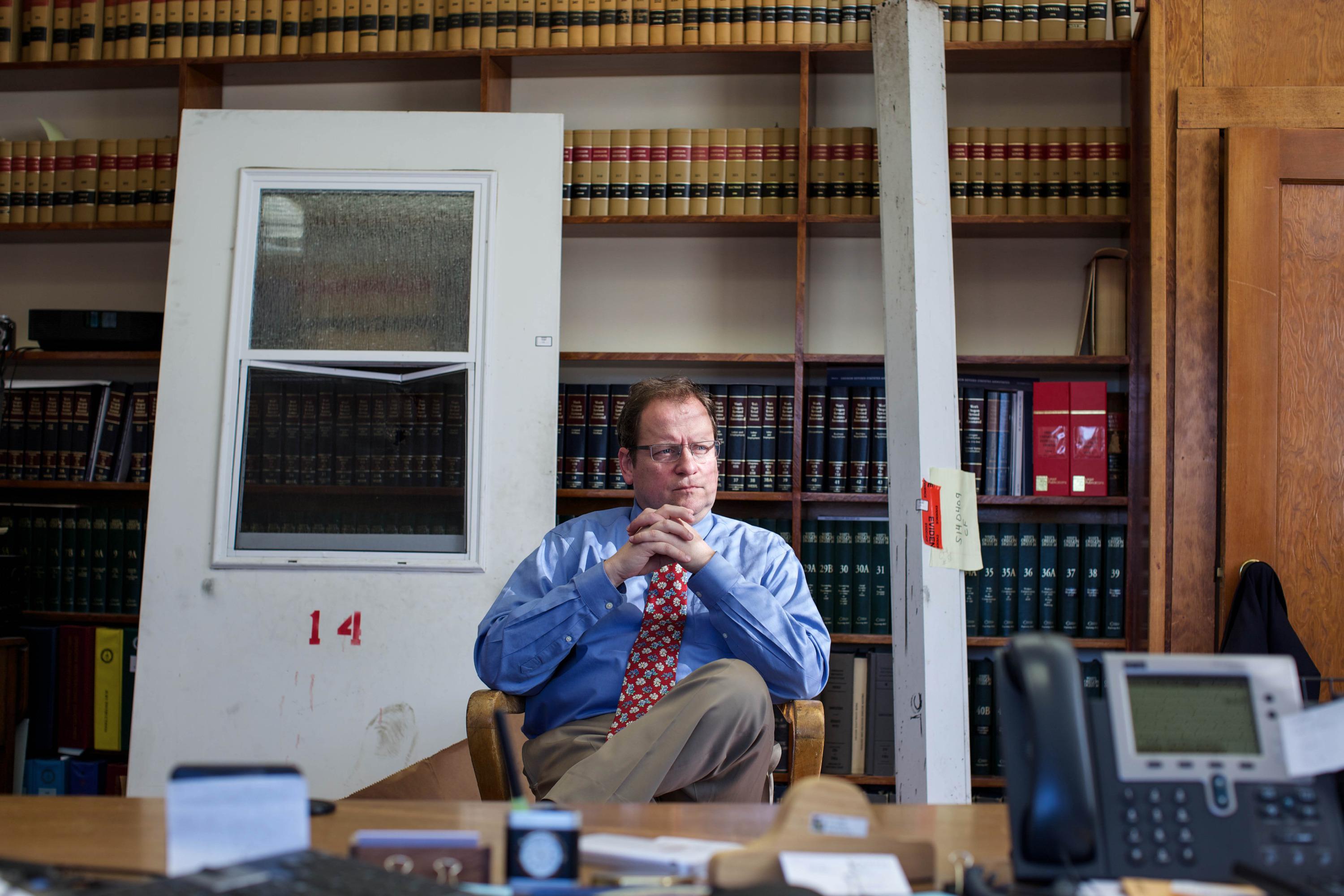
The Oregon’s Disciplinary Board ruled that District Attorney Eric Nisley lied when he claimed he hadn’t made Wasco County’s finance director the subject of an investigation into improper loans.
John Rosman / OPB
The complaints have called into question previous convictions and open cases investigated by former city of The Dalles police officer Jeff Kienlen, who was fired from The Dalles police department in March. His attorney recently told the city that Kienlen plans to file a civil lawsuit.
Bar ethics rules and a 1963 U.S. Supreme Court ruling, Brady v. Maryland, all require prosecutors to disclose information that could benefit a defendant in court.
Similarly, state law requires district attorneys to disclose to a defendant “any material or information that tends to “exculpate the defendant” or “impeach a person the district attorney intends to call as a witness at the trial.” The bar rules require prosecutors in criminal cases to “make timely disclosure to the defense of all evidence or information known to the prosecutor that tends to negate the guilt of the accused or mitigates the offense.”
At least one drug conviction from 2011 has been vacated because Nisley withheld what’s since been determined to be Brady material around Kienlen. Other open misdemeanor cases also were dismissed, according to Ellis.
Nisley and Wolf declined to comment. Like Nisley, Wolf still works as a deputy district attorney, though now in neighboring Hood River County.
The bar complaints raise concerns about more than a lack of disclosure, however. They also allege a personal relationship between Kienlen and Wolf could have prevented a fair trial for a criminal defendant convicted of rape. That case is currently being reviewed by the Multnomah County District Attorney’s Office for conviction integrity.
In May 2020, Nisley lost re-election to Ellis, a former defense attorney. Ellis said when he moved into Nisley’s old office, he discovered an undisclosed disciplinary notice for Kienlen. The notice was under papers in the bottom drawer of Nisley’s desk, according to Ellis.
The Feb. 17, 2011, “notice of discipline” stated that Kienlen was demoted from sergeant to police officer for violating the department’s truthfulness policy. While attending a training conference in Eugene, Kienlen misled the department’s leaders about his need to use a city vehicle, according to a transcript of a conversation Kienlen had with his superiors, which was filed with the state bar as part of the complaints.
Rather than staying with family near Eugene, as command staff and colleagues were led to believe, Kienlen drove from Eugene to Salem twice, where he stayed in Wolf’s hotel room.
“The integrity of police service is based on truthfulness,” then-Police Chief Jay Waterbury wrote in Kienlen’s notice of discipline. “If you are not truthful, you have no integrity. Without integrity you can’t be a good police officer.”
In 2011, Nisley determined Kienlen’s discipline notice was not Brady material and did not need to be disclosed to defense attorneys on cases Kienlen worked. After Ellis found it, he determined it was “unambiguously Brady material” that should’ve been disclosed for years, but had not been.
“Both Mr. Nisley and Ms. Wolf were aware that Officer Kienlen was sanctioned severely for lying,” Ellis and Davis wrote in their April 13 complaint.
“By any Brady standard, even if he was not placed on the Wasco Co DA Brady list, they had a duty to disclose the letter in any case where he could appear as a witness. Neither one disclosed this information,” the pair wrote. “They continued to use him as a witness without disclosing evidence regarding his credibility through 2020.”
In response to the complaints, Nisley’s attorney, Lawrence Matasar, told the bar in June that the former district attorney did not commit any violations, saying the “overstated assertions are far wrong — the undisclosed information is not Brady material at all, and Mr. Nisley’s carefully considered decision not to disclose it was completely appropriate.”
Matasar said the material wouldn’t be admissible evidence.
“Therefore, Mr. Nisley’s decision not to disclose the Kienlen information was correct, and the Bar Complaints should be dismissed,” Matasar wrote.
In a separate response to the bar complaints, attorney Wayne Mackeson wrote on behalf of Wolf last month that they “defer” to the analysis of Nisley and Matasar.
“As the District Attorney for Wasco County, Mr. Nisley made a reasoned decision on behalf of the office in 2011 that the Notice of Discipline did not constitute Brady material,” Mackeson wrote.
In a separate complaint filed with the bar, former criminal defense attorney Brian Aaron stated concerns he had involving a 2010 case prosecuted by Wolf with Nisley’s assistance.
In July 2010, Aaron was representing Gerardo Garcia Gonzalez, who was charged and later convicted of raping a child younger than 12. He was sentenced to 25 years in prison, where he remains. Kienlen was the lead investigator on the case. Leading up to trial, Aaron tried to introduce evidence of an alleged affair between Kienlen and Wolf, which he argued could have hurt his client’s right to a fair trial.
“I was deeply concerned that the relationship between Ms. Wolf and Officer Kienlen could cause a conflict of interest for the prosecution team and impact my client’s right to due process,” Aaron, who is now a prosecutor in Yakima County, Washington, wrote in his March 16 complaint to the Oregon State Bar.
During a July 2010 hearing before trial, several people, including law enforcement officers, testified about instances between Wolf and Kienlen they believed were inappropriate, beyond merely being close friends, according to a recording of the hearing OPB obtained through a records request.
After more than an hour of testimony, Wasco County Circuit Court Judge John Kelly ruled evidence of an affair amounted to “toxic gossip” that would not be allowed at trial and ruled the jury could determine if there was bias based on a friendship.
“I am making a determination that a jury can infer prejudice or bias by a witness, Officer Kienlen, in favor of the state because he has a close friendship with Ms. Wolf,” Kelly stated in July 2010.
Nisley helped Kienlen draft an affidavit that denied any affair but acknowledged a close friendship with Wolf that extended to their spouses.
In response to the bar complaints, Wolf said through her attorney there was never any affair — something Kienlen also told Waterbury, the police chief, years earlier.
“Ms. Wolf reports that at no time subsequent to July 6, 2010 did her relationship with Officer Kienlen ever develop into anything more than a close, personal friendship,” Mackeson wrote to the bar in response to the complaints. “The Wolf and Kienlen families have remained close, personal friends. Rumors that she and Officer Kienlen were having ‘a romantic extra-marital affair’ or that they were involved in ‘a romantic intimate relationship,’ etc., are false.”
The
bar investigation could take months. Ellis and others who filed a
complaint have until the end of August to respond to Wolf and Nisley’s
replies.