INDIANAPOLIS
– Tyler Christopher, a daytime soap actor once married to actress Eva
Longoria, fell in his bathroom as he withdrew from alcohol. Christopher
had fallen before. But this time, at home in Indiana, he hit his head on
the back of the bathtub, fracturing his skull and causing bleeding on
the brain.
Rushed to the hospital that day in November 2019, he
underwent life-saving craniotomy surgery, with doctors drilling holes in
his head to relieve pain and pressure.
While Christopher was recovering, his sister filed a petition in 2020 to put him under guardianship. And that, the veteran ‘General Hospital’ performer said, is when his troubles truly began.
“I
never thought in a million years that I would be taken advantage of by a
family member,” Christopher, 50, said in an interview.
While he
was under guardianship in Indiana, Christopher alleged in court papers,
his sister misspent or improperly received reimbursement for $40,000 to
pay down her own credit card debt, bankroll her move, even buy her son a
MacBook.
His sister, Susan Asmo Baker, has defended her stewardship and described her brother’s complaints as unproven “allegations.”
Baker
declined an interview request to discuss the case. But in court papers,
and in an email to Bloomberg Law, she said her actions protected her
brother.
“If I hadn’t been his Guardian he’d be DEAD!” she wrote to Bloomberg Law.
Shortly
before the guardianship ended in 2021, she emailed her brother, “I
would have never done you wrong, not before your injury, during or after
and for some reason you think I need your money … I DO NOT TYLER!” She
added, “Sad that you don’t even trust me. That’s what hurts the most.”
Their
tussle highlights the deep friction adult guardianships can cause
amongst families. The complications can ensnare everyone from nursing
home residents to young adults with disabilities to Daytime Emmy-winning
stars such as Christopher.
In April, the sister agreed to pay for
a forensic accountant to examine her spending under the guardianship.
If the review supports her brother’s contentions, Baker will be on the
hook to pay him back. If it clears her, Christopher would likely help
cover the cost of the forensic accounting.
Family Conflict
Bloomberg Law’s ongoing investigation
explores how guardianships deprive citizens of basic rights, often
requiring them to get approval for everything from where to shop to who
they can marry. All the while, probate courts typically provide a flimsy
safety net of protection for those under guardianship.
As in the
case of pop star Britney Spears, Christopher’s experience shows how
guardianships can become contentious even when family is involved. And
like that of artist Peter Max,
whose case has been engulfed in so many legal disputes a judge called
it “toxic,” Christopher’s guardianship escalated family legal
entanglements.
For families, entering into formal guardianships
can be tricky terrain. Family members, not always formally trained
before taking the role, must contend with the medical or mental health
impairments of their kin, but also write checks, manage their affairs,
and even buy or sell properties.
While large-scale fraud cases from Nevada to New Mexico to Florida
have exposed criminal guardians and lawyers, family members can also be
susceptible to problems, said Anthony Palmieri, former president of the
National Guardianship Association.
“So, we see just as many
issues with family and non-professional guardians as with professional
guardians,” said Palmieri, deputy inspector general of the Palm Beach
Clerk of the Circuit Court & Comptroller. Abuses are typically “a
lot more egregious” when professionals are involved, he said.
In
Palm Beach County, family members and non-professionals are guardians in
two-thirds to three-fourths of cases, said Palmieri. Studies
have found that family members serve as the majority of guardians in
other localities too; since detailed data on US guardianships is scant,
it’s not possible to pinpoint a national figure.
Yet some states
set less stringent training and oversight standards for family members
than professional guardians, said Morgan Whitlatch, a lawyer and
director with the Center for Public Representation public interest law
firm.
While many family members become guardians with best
intentions, Whitlatch said, they may not be fully prepared for the legal
process they are entering.
“I think there are more loopholes for
family guardians than for others,” she said. “There are different
requirements that would apply to them that would allow for more
opportunities for problems to go unnoticed.”
When Christopher was
placed under guardianship, he said, “I didn’t know what I was getting
myself into and I didn’t have a choice.”
Starry Roles
Christopher
made his name starring in ‘General Hospital,’ where the IMDb database
says he appeared in 1,150 episodes from 1996-2016, and ‘Days of Our
Lives,’ where he appeared in 155 shows from 2001-2019.
He was nominated for five Daytime Emmys on ‘General Hospital,’
winning the lead actor in a drama series prize in 2016 for his role as
Nikolas Cassadine. He was also nominated in 2019 as lead actor on ‘Days
of Our Lives’ for portraying the character Stefan DiMera.

Actor
Tyler Christopher accepts the award for outstanding lead actor at the
43rd Annual Daytime Emmy Awards in 2016. He was placed under a
guardianship after a serious fall in 2019 and later pressed to escape
the system.
Photographer: Earl Gibson III/Getty Images
Christopher also attracted paparazzi for his relationships with well-known actresses, most notably with Longoria. Their marriage was brief, lasting from 2002-2004.
The actor has told interviewers that his excessive alcohol use led to his departure from the shows that made him famous, saying “I threw it away.”
“When I looked in the mirror, there was only one person to point the finger at,” he said.
Between 2019-2022, the IMDb site
lists no acting credits for Christopher. It was during that time he
suffered the near-fatal fall, and began his trip into the world of adult
guardianships.
While his soap opera travails attracted tabloid
attention, his guardianship drama, playing off-screen, has not generated
similar headlines.
‘In the Dark’
Christopher’s case dates
to January 2020, when Asmo Baker filed a petition in Morgan County,
Indiana, to put her brother under guardianship. He was in a
rehabilitation hospital in Indianapolis at the time.
Baker
described him as a “flight risk,” saying he had “aggressively
verbalized” his wish to leave the hospital and was refusing a pending
move to a neurological center. She said he was unable to drive “or
otherwise make decisions for his care or care for himself.”
Living
in North Carolina at the time, she asked a judge to formally rule that
her brother was incapacitated and to appoint her as his temporary
guardian. A day later, a judge approved her request, deeming it an
emergency situation.
Two months later, Baker became his permanent
guardian, tasked with negotiating with Christopher’s creditors, hiring a
lawyer to represent her brother in his pending divorce from his second
wife, and selling his house.
Among other duties, she was to sell his personal property “and use the proceeds for Tyler’s sole benefit,” the court order says.
Oversight
of guardians is scant, Bloomberg Law found. In Indiana, for instance,
guardians are required only to file biennial reports, or once every two
years; Baker wasn’t her brother’s guardian long enough to even have to
file that.
As the case evolved, Christopher said, he was “completely in the dark about everything.”
“I was recovering from a brain injury so the choice for guardianship was made for me without my knowledge,” he said.
Once
he learned what was happening, he said, he began questioning his sister
about how she was spending his money. “And she really didn’t have an
answer for me,” he said.
In court papers, Christopher said he
“does not doubt” that his sister’s “initial motivation to become his
legal guardian was rooted at least in part in a genuine desire to help
her younger brother in his time of need.”
But once he and his lawyer began digging into his finances, he said their relationship became “fractured.”
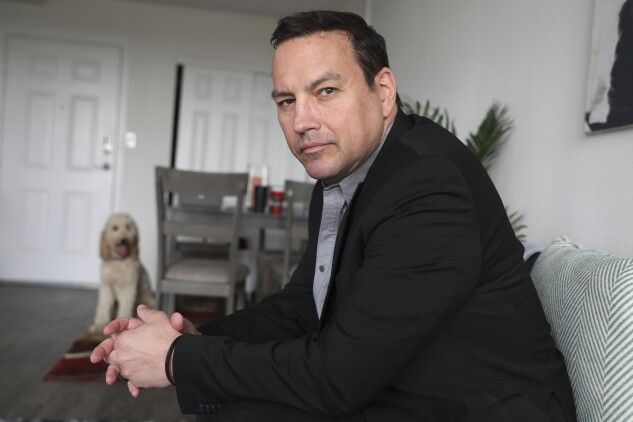
Tyler Christopher said he was “in the dark” during his guardianship; he’s now pressing for an accounting of his funds.
Photographer: Sandy Huffaker/Bloomberg
Questioned Spending
On
Feb. 12, 2021, the court transferred Christopher’s guardianship from
Indiana to Ohio, where he had relocated. While there, Christopher
successfully pushed to end the guardianship in September 2021. His
sister agreed to his request and an Ohio judge approved.
Then, he said, he discovered “various irregularities” in his sister’s handling of his accounts.
Under Indiana rules, Christopher had a year after the case closed in that state to challenge any actions by his guardian.
On
Feb. 10, 2022, on the eve of that one-year deadline in Indiana, his
lawyer Justin Schrock filed a motion challenging Baker’s spending.
As
the case closed in Indiana, the sister had to file a final accounting
of the guardianship in that state. Christopher and Schrock challenged
her final accounting and then a revised version.
In one court
filing, Schrock, senior attorney with Indiana Disability Rights, alleged
she “had engaged in significant commingling of funds with the
guardianship estate.”
He cited $40,000 in spending she “cannot
legitimately account for.” Among the questioned costs detailed in court
filings: More than $10,000 in her personal credit card debt paid after
she received thousands from her brother’s accounts, another $13,000 to
move herself and family from North Carolina to Ohio, and $5,000 for
furniture, electronics, and appliances.
During the time
Christopher was under guardianship in Indiana, he received more than
$75,000 in income, between acting residuals and disability insurance
following his brain injury. So, the questioned $40,000 exceeds more than
half that total.
Schrock cited thousands of dollars more she
spent “without evidence or legal support,” and said her actions
represented an “egregious abuse” of the authority a guardian holds.
“Petitioner treated his income as her personal slush fund,” Schrock wrote.
In
court papers, Baker said she and other family members paid expenses
“out of pocket” for her brother before the guardianship was formally
approved in March 2020. She also said she hadn’t been “availed the
opportunity to defend against said allegations in open Court.” Her
lawyer, Jerald L. Miller, could not be reached despite three interview
requests.
Forensic Accounting
In June 2022, Schrock filed a motion on Christopher’s behalf seeking a forensic accountant to examine Baker’s spending.
Initially, Baker asked the judge to deny her brother’s bid, saying the forensic accounting could cost $10,000.
Ten
months later, the siblings came to a rare pact: Baker agreed to submit
to a full forensic accounting that could cover all 20 months Christopher
was under guardianship, covering both Indiana and Ohio.
Baker has
hired an accountant to conduct the review. Under the agreement, she is
paying for the work. If the review finds misspending, the sides could
come to a financial settlement that would close the case.
Christopher
said he’s long looked for a full examination of what happened while he
was “in the dark.” The forensic accounting, he said, should finally
provide it.
“It’s long past due.”
Though she declined an
interview request about her management of his assets, Baker noted that
she became guardian in a bid to aid her brother. And while the siblings
are engaged in a legal skirmish whose final act is still playing out,
they have at times put that acrimony aside. “Love you Ty,” she wrote him
in 2021. “Keep pressing up!”
Christopher said the guardianship was deeply restrictive and that, “She controlled everything.”
Relapse and Recovery
Christopher
has openly discussed his fight with alcohol and said he remains in
recovery. Before his near-fatal bathroom collapse, he had fallen at
least twice while under the influence.
After his guardianship
formally ended, Christopher moved back to California. As he fought to
stay sober, he said he was initially homeless in Southern California
before landing acting work again. He has secured at least six acting
roles since 2022, often in TV movies.
This May, he was arrested at a California airport
on a misdemeanor charge of suspicion of public drunkenness. He was
asleep on the floor near American Airlines when police arrived, and he
“displayed the objective signs and symptoms of alcohol intoxication and
was unable to care for himself,” Burbank Police told The Los Angeles
Times.
Christopher acknowledged in an interview he had a “relapse” at the airport. “I’m back in recovery,” he said.
His
recent travails, he said, were not as dire as his experience under
guardianship. While relieved he was able to end the guardianship,
Christopher said, “that just opened up a whole can of worms.”
“Being homeless was a far better circumstance than being in the guardianship,” he said.


