Source:
Lawsuit filed against Santa Clara senior care facility

Showing posts with label nursing home death. Show all posts
Showing posts with label nursing home death. Show all posts
Friday, August 16, 2024


Friday, February 26, 2021
Woman whose father who died in nursing home says without answers 'there's really no closure'
By Daniella Genovese
His name is Anthony Rodriguez. He was an "amazing father" and most commonly seen as the "John Wayne" of the household before he died, his daughter, Joann Rodriguez, told Fox News.
Joann Rodriguez was one of his primary caretakers while he was in the nursing home. And her time with him was abruptly cut short earlier this year after more than 9,000 recovering coronavirus patients in New York state were released from hospitals into nursing homes.
The Cuomo administration’s March 25 directive barred nursing homes from refusing people just because they had COVID-19. It was intended to free up space in hospitals swamped in the early days of the pandemic.
Anthony Rodriguez was one of nearly 15,000 nursing home residents who died after the order was implemented.

Joann Rodriguez and her father Anthony Rodriguez (Joann Rodriguez)
"They allowed us FaceTime visits with my dad because we could not go in. And that happened twice, three times a week with me and my sister," Joann Rodriguez told Fox News. "At the very beginning of April that changed."
The Rodriguez family had tried to contact the nursing home several times by phone, email and text multiple times but couldn't get ahold of anyone.
It wasn't until later they found out about the order, which effectively "created a war zone inside the nursing home," she said.
Even before the pandemic, nursing homes had already faced insufficient staffing and did have not enough adequate care, Joann Rodriguez said.
"They relied on me and my sister to come in and help feed him, to help do the simple hygiene, things like clipping his nails," she said. "I mean, we actually did a lot in his care because they lacked sufficient staffing."
Knowing this, she said that it's impossible to fathom why the order was put in place, calling it a "very callous decision."
The last time she saw her father was on FaceTime from the emergency room. He died two days later on April 28.
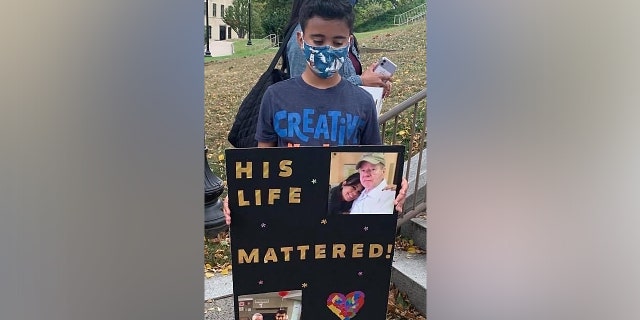
Anthony Rodriguez' grandson, Aiden. (Joann Rodriguez)
"I just felt so helpless, helpless towards him," she said. "He had a lot, a lot of life in him left."
She described her father as a warm and welcoming man who was quiet but "very, very strong-minded." In fact, he was to go-to in an emergency situation.
Even on FaceTime, he always smiled and finished every conversation with "I love you," she said.
It's been almost a year since Joann Rodriguez and her family lost him to the pandemic. However, they still struggle with being "denied the right to know what happened" and why.
"There's really no closure," she said. "When you finally find out about this mandate that potentially killed thousands ... it's incomprehensible that our government could do that."
Even after her father died, the nursing home didn't answer their questions, she said.
"In fact, they blew it off," she said. "And the only thing they had to tell us was 'when will you be able to pick up your father's belongings?'"
The decision was "irresponsible and it's unacceptable" Joann Rodriguez said. Her hope is that those who are responsible are finally held accountable.
"[It's] something that needs to be brought out into the open and people need to be held accountable," she said.
Full Article & Source:
Sunday, August 16, 2020
State investigates death at Harris Hill nursing home
by Mike McAndrew
The State Department of Health
is investigating a death at Harris Hill Nursing Facility in Lancaster, a
spokesman said Wednesday.
Full Article & Source:
State investigates death at Harris Hill nursing home
 |
| Harry Scull Jr. |
The death of the resident was reported by the nursing home staff to the Health Department.
“Protecting
people in nursing homes is a top priority of the Department of Health.
Immediately upon learning of this incident at Harris Hill, the
Department opened an investigation. As this is an ongoing investigation
we cannot comment further," said Jeffrey Hammond, the Health Department
spokesman.
A spokeswoman for the McGuire Group, which operates Harris Hill, declined to provide any details about the resident's death.
Full Article & Source:
State investigates death at Harris Hill nursing home
Friday, September 27, 2019
NJ Board of Nursing Temporarily Suspends Certification of Homemaker-Home Health Aide Charged with Reckless Manslaughter in Nursing Home Death

 |
|
|
|
|
|
| For Immediate Release: | For Further Information: | |
| September 26, 2019 Office of The Attorney General - Gurbir S. Grewal, Attorney General Division of Consumer Affairs - Paul R. Rodríguez, Acting Director Division of Law - Michelle Miller, Director |
Media Inquiries- Lisa Coryell 609-292-4791 Citizen Inquiries- 609-984-5828 | |
----------------------------------------------------------------------------------------------------------
NEWARK – Attorney General Gurbir S. Grewal and the Division of Consumer Affairs today announced that the State Board of Nursing (“the Board”) temporarily suspended the certification of a homemaker-home health aide (“CHHA”) charged with recklessly causing the death of an 85-year-old woman in her care at an Essex County nursing home.
Monique Beaucejour, 46, of Bloomfield, was working as Certified Nursing Assistant (“CNA”) at Genesis Waterview Center in Cedar Grove last month when she allegedly left an elderly woman, who required total assistance with care, sitting on her bed. The woman suffered a fall with serious head injuries, but instead of immediately summoning medical assistance, Beaucejour allegedly placed the woman back in bed, and left her there. Beaucejour later returned to the room and summoned help for the woman, pretending to have just discovered her lying injured in bed, according to the accusations. The woman was transported to the hospital and died later that day.
Police charged Beaucejour with reckless manslaughter, obstructing the administration of law, suppressing evidence to hinder prosecution, and abandonment/neglect of an elderly person in connection.
“Elderly patients in nursing homes are dependent upon caregivers who are duty-bound to ensure their wellbeing. When a caregiver recklessly disregards that duty, the results can be tragic,” said Attorney General Grewal. “Protecting this vulnerable population is paramount.”
Beaucejour, who was not working under her CHHA certification when the incident occurred, agreed to the temporary suspension of her CHHA certification pending the outcome of the criminal charges against her and pending further action by the Board.
“Any time a certified homemaker-home health aide is arrested, either on or off the job, it raises serious concerns about their ability to provide quality care,” said Paul R. Rodríguez, Acting Director of the Division of Consumer Affairs. “But when the charges involve the death of an elderly patient, the risk of harm is extreme and public protection demands that the licensee be removed from practice until the matter is resolved. We are pleased the Board took that step.”
Beaucejour was fired from her job immediately after the alleged incident, which occurred on August 13. The Department of Health, which regulates nursing assistants employed in health care facilities, suspended Beaucejour’s CNA certification.
Under the Interim Consent Order with the Board, Beaucejour cannot practice, identify herself, or be employed as a CHHA. She also must surrender all copies of her CHHA certificates to the Board of Nursing.
The suspension of Beaucejour’s CHHA certificate is temporary, pending the outcome of the charges against her. The Board of Nursing may take further disciplinary action after the disposition of the criminal charges. The surrender of her CHHA certificate is not considered an admission of liability.
The Board of Nursing is charged with regulating nursing and homemaker-home health aide services in the State of New Jersey, and making sure those who practice these professions are qualified and competent to do so.
Full Article & Source:
NJ Board of Nursing Temporarily Suspends Certification of Homemaker-Home Health Aide Charged with Reckless Manslaughter in Nursing Home Death
Monday, February 18, 2019
To ‘love, honor, and protect’: Man seeking answers in wife's nursing home death

The
longtime bachelor, then 39, had reunited with Patricia Misenti, then
40, a fellow member of the Francis T. Maloney High School Class of 1962
in Meriden. Bob and Pat rekindled their attraction to one another, dated
for two years, and decided to get married. It was on that first day of
spring in 1984 that Bob pledged to “love, honor, and protect” his wife.
Eight years later, Bob would have to make another vow to his wife.
 As
Pat’s condition deteriorated, Bob’s hawkish oversight of Pat’s care
grew. Having observed varying degrees of quality, attentiveness, and
understanding of his wife’s medical history in certain caregivers, he
started keeping a list of hospitals and nursing facilities that he
wouldn’t permit Pat to be transported to, leading to long stand-offs
with hospital administrators.
As
Pat’s condition deteriorated, Bob’s hawkish oversight of Pat’s care
grew. Having observed varying degrees of quality, attentiveness, and
understanding of his wife’s medical history in certain caregivers, he
started keeping a list of hospitals and nursing facilities that he
wouldn’t permit Pat to be transported to, leading to long stand-offs
with hospital administrators.
Though her condition was serious, Bob believed Pat would bounce back, as she always had. But the doctors believed she was at the end of her life.
In 1992, after experiencing episodes of
fatigue, imbalance, and inexplicably dropping things, Pat was diagnosed
with multiple sclerosis. For the couple, who hadn’t planned on having
kids but did plan on growing old together, it changed things
dramatically. After receiving the diagnosis, they drove to Hammonasset
Beach State Park, where they walked out onto the jetty and exchanged
promises to one another.
Bob
told Pat they were dealing with an “unknown,” but going forward Pat
would “never face MS alone on any given day.” However, Pat also had to
promise that she would tell Bob when she’d had enough, because it
wouldn’t be fair to either of them for him to continue fighting for
someone who no longer wanted to live. According to Bob, Pat saw it as an
“even exchange.”
“That was the
foundation — I wouldn’t let her face anything by herself in the future,
but when it came time that she had had enough because we don’t know
what we’re facing, she had to tell me, ‘This is it, Bob, I’ve had
enough,’” he said.
By 1995,
Pat’s illness started affecting her work as a senior pension specialist
at Aetna, but she qualified for early retirement, which included a
pension and health care benefits, and she took it. Bob was downsized
from Aetna the following year.
Over
the next decade, Bob cared for Pat in their townhouse-style condominium
in Meriden, which had been outfitted with durable medical fixtures that
included a special alternating air mattress to help with bedsores. Over
time, Bob learned everything he could about Pat’s illness and
increasing comorbidities, becoming well acquainted with the Merck Manual
Home Health Handbook, and picking the brains of Pat’s caregivers.
In
March 2006, Pat started having severe seizures, launching them on what
Bob calls the “institutionalization voyage.” Though the goal was always
to bring Pat back home, where Bob could care for her with the help of a
home health care aide, her stints in acute care, acute rehabilitation,
and skilled nursing facilities became more frequent.
In
2007, while Pat was recovering from a seizure at Yale-New Haven
Hospital, a group of caregivers, struck by the couple’s devotion to one
another, presented them with paperwork that would designate Bob as Pat’s
power of attorney.
They were
told it was the “gold standard” in health care protection, and, when it
was explained to Pat that she would giving him the right to make
decisions in her stead, she said something to the effect of “Well, I
signed the marriage certificate, so why not sign this?” Bob recalls.
The
power of attorney became increasingly important as the years passed,
and Pat’s medical troubles compounded to the point of leaving her
bed-bound, quadriplegic, and fitted with a feeding tube. Though her
speech was affected, making it harder for her to talk with people
unfamiliar to her, she and Bob continued to communicate on levels spoken
and unspoken.
Hawkish oversight

In
August 2017, an administrator from the Hospital of Central Connecticut
in New Britain petitioned the Berlin Probate Court to have a conservator
of the person appointed for Pat, saying she had been eligible for
discharge since April, but her discharge couldn’t be completed due to a
“lack of cooperation” from Bob.
Though
Judge Walter A. Clebowicz ruled that Bob was the most appropriate
person to be Pat’s conservator and appointed him as such, he ordered Bob
to cooperate with the hospital on a safe discharge, be it home, to a
skilled nursing facility, or to a skilled nursing facility and then
home.
Bob was unable to take
Pat home because her alternating air mattress, which promoted blood flow
to minimize the bedsores she was prone to, was broken. So the court
eventually ordered Pat’s release to Fresh River Healthcare in East
Windsor, one of the few skilled nursing facilities that offered to take
her.
Bob protested Pat’s
discharge to Fresh River on the grounds that the facility wasn’t
equipped to accommodate her needs, but the judge overruled him and Pat
was sent there in February 2018.
Through
the spring and summer, Pat was between Fresh River and St. Francis
Hospital and Medical Center in Hartford for treatment.
During
this time, Bob didn’t visit Pat at Fresh River. They’d agreed he should
focus on getting her out of there, and Bob also didn’t want to be
pressured to sign Pat’s admission documents to Fresh River, which,
according to him, contained a paragraph that would exculpate Fresh River
from being sued if anything were to happen to Pat.
In
July 2018, Pat was at St. Francis, and Bob was blocking her discharge
back to Fresh River. Jurisdiction at this point had shifted to the
Greater Windsor Probate Court, and on July 19, Judge Marianne Lassman
Fisher suspended the power of attorney that gave Bob power over Pat’s
health care decisions, appointing New Hartford lawyer David C. Shepard
conservator of the person for Pat. Shepard allowed Pat’s release back to
Fresh River.
On Nov. 12, Bob
got a call from Shepard saying that Pat had been admitted to St. Francis
for what they’d later find out were fractures in each of her
thighbones. In a Nov. 16 email to Judge Lassman Fisher, Shepard
described the injuries as “unexplained” bilateral femur fractures that
were causing “significant bleeding into her pelvis, dropping blood
pressure, infection, and significant pain.”
Alhough
Pat had osteoporosis, Bob was baffled as to how she could break both
thighbones. When he saw her in the hospital, he asked her if she knew
why she was there. She said she didn’t know. He told her about her legs,
and she was beside herself. Then he asked her about the level of care
she was receiving at Fresh River.
“All she kept saying was, ‘They don’t listen to me, and they’re too rough with me,’” he said.
Judge allowed code status change
Though her condition was serious, Bob believed Pat would bounce back, as she always had. But the doctors believed she was at the end of her life.
In
court documents, Shepard reported that the complexity of Pat’s medical
problems prohibited surgery to mend the fractures, and that doctors were
recommending only pain relief and comfort care be administered.
However
Pat was listed as “full code status,” which meant she wanted all
life-saving measures to be applied, and Shepard’s limited
conservatorship didn’t give him the authority to change it.
In
his Nov. 16 email to Lassman Fisher, Shepard requested an emergency
hearing to consider the request, as well as to consider whether
decision-making authority should be returned to Bob.
The
emergency hearing was held in the St. Francis intensive care unit on
Nov. 17, and Lassman Fisher ruled that Shepard could change Pat’s code
status from full code to comfort measures only.
Once the judge issued the decree, Bob was crushed.
“I knew it was a death sentence,” he said.
Bob
said Pat understood what the full code was, and that’s what she wanted.
Over the years, they had established code words and phrases to help him
determine whether she’d had enough, and there was one that she had yet
to say.
“If she told me she couldn’t pull another rabbit out of the hat, I’d know that was enough,” he said, “and she never said that.”
Seven days after the emergency hearing, Pat died at 74. Her official cause of death is listed as hypertension and hypoglycemia.
David
Skoczulek, a spokesman for the Manchester-based iCare Health Network,
which owns and operates Fresh River, said the company is bound by
privacy laws from commenting on the care of specific residents. He also
said he couldn’t confirm that Pat was even a resident of Fresh River.
Skoczulek
went on to say that it is Fresh River’s policy to “immediately and
thoroughly” investigate any reports or findings related to an accident
or injury suffered by a resident in its care, including findings related
to “underlying and pre-existing conditions.”
“We
do so whether an injury is reported by a resident, staff member, family
member, or guest, or if a finding is discovered during care that merits
further investigation,” he said.
Skoczulek
added that Fresh River “stands by the quality of care it delivers,”
and, like other nursing homes in the state, is subject to regular survey
and inspection by the state Department of Public Health.
DPH
wouldn’t answer specific questions about Pat Horozy. The Journal
Inquirer also submitted a freedom-of-information request seeking access
to documents related to any DPH investigation into injuries or
suspicious deaths of patients at Fresh River in the pertinent time
period.
An official with the
department’s Facility and Licensing Investigations section responded to
the request saying there was one such case, but it was still under
investigation and therefore no information would be released.
The
only call the East Windsor Police Department received from Fresh River
during the time in which Pat’s legs would have been broken and she would
have been hospitalized was a medical aid call on Nov. 11 requesting
assistance with an “unruly patient.” The call log says that one person
was transported to the hospital, though it is unclear whether it was
Pat.
Since Pat’s death, Bob,
now 74, has hired Cheshire lawyer Robert Santoro to help investigate
“any possible claims.” They declined to speculate what they think may or
may not have happened to Pat, acknowledging that they have yet to see
any record of how she suffered her injuries. Bob said Fresh River had
sent him a registered letter, but he declined to sign for it.
In
the meantime, Bob visits Pat every day at Sacred Heart Cemetery in
Meriden, except when the weather makes driving hazardous. He still
refers to her in the present tense, not only for the recency of her
death but also because he remains driven by the same vow he took almost
35 years ago.
“My holy mission is to bring dignity and justice to my wife,” he said.
Full Article & Source:
To ‘love, honor, and protect’: Man seeking answers in wife's nursing home death
Thursday, December 20, 2018
89-year-old woman's death at nursing home being investigated as homicide

An investigation found Nancy Young got into an "unwitnessed" fight with another resident of Pleasant Nursing Home in Springettsbury Township on Dec. 8. As a result of the fight, Young fell and broke her hip.
Young died of complications from the fall on Dec. 15.
"Because the fall was a result of the altercation with another resident, Young's death is ruled a homicide. The coroner's definition of homicide can be broad, referencing death that occurs at the hands of another. This does not mean that the ruling of homicide has legal merit - that may or may not be determined by police, the DA or a court," reads a statement from the York County Coroner's Office.
Springettsbury Township Police have been notified of the death. They are investigating.
Full Article & Source:
89-year-old woman's death at nursing home being investigated as homicide
Friday, June 30, 2017
Workers charged in Boardman nursing home death
BOARDMAN, Ohio (WKBN) –Prosecutors in Boardman say three nursing
home workers made a mistake with drugs and a patient died because of it.
The death at the center of the case happened in 2015 at Greenbriar Healthcare Center in Boardman.
It took the Ohio Attorney General’s Office the next two years to put together its case, and now investigators are charging those that they say are responsible.
Assistant Mahoning County Prosecutor Michael McBride said the Greenbriar patient died after the employees gave him the wrong drug and then tried to treat his overdose on their own.
“We believe, and actually the coroner’s report indicates, it actually caused the death of this gentleman,” McBride said.
Johonna Hull, 28, of East Liverpool, was arrested and charged with abuse of a patient and tampering with medical records.
Brenda Lamancusa is also charged with patient abuse. Another person, who hasn’t yet been arrested, also faces charges.
The victim’s identity is being protected under privacy laws.
Complaints from nursing home deaths are investigated by the Attorney General’s Office. McBride said this case involved extensive medical review.
In November of 2015, just after the death, Greenbriar Health Care was placed on a Medicaid “worst of the worst” watch list.
The state noted several problems with prescription protocols and other issues.
The facility improved enough to be taken off that watch list in February of this year.
McBride said this is the only criminal abuse case that he has handled from the nursing home over the past several years.
Editor’s note: This story is corrected to show that Hull is 28 years old, according to court records and the Licensing Bureau. A police report listed Hull’s age and birthdate, indicating she was 18.
Full Article & Source:
Workers charged in Boardman nursing home death
The death at the center of the case happened in 2015 at Greenbriar Healthcare Center in Boardman.
It took the Ohio Attorney General’s Office the next two years to put together its case, and now investigators are charging those that they say are responsible.
Assistant Mahoning County Prosecutor Michael McBride said the Greenbriar patient died after the employees gave him the wrong drug and then tried to treat his overdose on their own.
“We believe, and actually the coroner’s report indicates, it actually caused the death of this gentleman,” McBride said.
Johonna Hull, 28, of East Liverpool, was arrested and charged with abuse of a patient and tampering with medical records.
Brenda Lamancusa is also charged with patient abuse. Another person, who hasn’t yet been arrested, also faces charges.
The victim’s identity is being protected under privacy laws.
Complaints from nursing home deaths are investigated by the Attorney General’s Office. McBride said this case involved extensive medical review.
In November of 2015, just after the death, Greenbriar Health Care was placed on a Medicaid “worst of the worst” watch list.
The state noted several problems with prescription protocols and other issues.
The facility improved enough to be taken off that watch list in February of this year.
McBride said this is the only criminal abuse case that he has handled from the nursing home over the past several years.
Editor’s note: This story is corrected to show that Hull is 28 years old, according to court records and the Licensing Bureau. A police report listed Hull’s age and birthdate, indicating she was 18.
Full Article & Source:
Workers charged in Boardman nursing home death
Subscribe to:
Posts (Atom)