Sunday, May 7, 2017

8 Ways to Deal with False Dementia Accusations

Seniors with dementia falsely accuse family of terrible things


“You stole my wallet and all my money!” 
 
“You’re keeping me prisoner in my house!”
 
“You’re trying to poison me!”

Seniors with Alzheimer’s or dementia commonly accuse the people closest to them of theft, mistreatment, or other terrible things. While cases of true abuse do exist, oftentimes these accusations are completely untrue and are caused by delusions – strong beliefs in things that aren’t real.

It’s important to remember that your older adult isn’t creating these delusions to hurt you. Their brains are failing and the delusions and paranoia are symptoms of the disease.

We explain why this happens and share 8 ways to calm the situation and kindly deal with these dementia accusations.

Why seniors with dementia make false dementia accusations

Their accusations may sound crazy, but the situation is very real to your older adult. Their minds are trying to make sense of the world while their cognitive abilities are declining. 

People with dementia often feel anxiety, frustration, and a sense of loss. Those feelings, plus memory loss and confusion, can easily lead to paranoia. That’s why many seniors with dementia feel like people are stealing from them or mistreating them.

When they can’t find something they’ve misplaced, their brain leads them to believe that someone stole from them. When you prevent them from wandering and getting lost, they think they’re being kept prisoner.

These dementia accusations can be extremely hurtful to hear, but it’s important to remember that they’re not personal attacks against you. Their brain can’t make sense of what’s happening and has created an alternate version of reality to compensate.

8 ways to deal with false dementia accusations

1. Don’t take it personally
Remember that your older adult is only making these accusations because of their declining cognitive abilities. They’re trying to make sense of their reality as best they can. 

Do your best to stay calm and not to take these accusations personally. Focus on reassuring them and showing that you care about how they’re feeling.

2. Don’t argue or use logic to convince
It’s important not to argue or use logic to convince someone with dementia that they’re wrong. You simply can’t win an argument with someone whose brain no longer processes logic properly. And arguing will only make them upset and more insistent.

Instead, let them express their ideas, feelings, and opinions. It will be easier to calm and distract them if they feel heard and validated.

3. Use a calm, soothing tone and positive body language
When responding to someone who is worked up over something they strongly believe, it’s essential to stay calm. 

Bring the adrenaline level of the situation down by speaking in a gentle, calm tone of voice. You may also want to try reassuring them in non-verbal ways like a gentle touch or hug.

4. Create a calm environment
Creating a calm environment is another way to reduce the tension in the situation. 

Reduce noise and commotion by turning off the TV, asking other people to leave the room, or playing slow songs or classical music at a low volume. Aromatherapy is another way to create a soothing environment.

5. Stick to simple answers
When you respond to their accusations, keep your responses short and simple. Long explanations or reasoning may be overwhelming and cause more agitation and confusion.

6. Distract with a pleasant activity
The best way to stop them from obsessing about their accusation is to validate, then distract. Switch to a fun, engaging, or satisfying activity as soon as possible after sympathizing with how they feel. 

Maybe it’s a good time to offer a favorite snack or drink. Or you could ask for help with a no-fail task they enjoy, like folding “laundry” (aka lots of hand towels).

7. Keep duplicates of frequently misplaced items
If you notice a pattern where your older adult frequently hides and then loses a certain item, consider buying multiples of that item. 

For example, if they’re constantly misplacing their wallet, buy another of the same style so you can offer to help them “find” it.

8. Seek support and advice from people who understand
Being accused of stealing, abuse, or other terrible things can be devastating. Even if you can hide your true feelings to avoid further upsetting your older adult, it still hurts inside.

To help you cope, join a caregiver support group – either in person or online. You’ll be surprised and relieved to learn that many other people have been accused of similar untrue things. It truly helps to know you’re not the only one it’s happening to.

Full Article & Source:
8 Ways to Deal with False Dementia Accusations

Saturday, May 6, 2017

Guardian Corruption Finances Voter Fraud in the United States

This article exposes using embezzled funds from senior guardianship accounts as a primary financial tool to commit voter fraud. This is a national problem having several players including the American Bar Association, social workers, cooperative physicians, court systems, and attorneys who make a nice living by financing voter fraud.

The example I’ll use for this article, is based upon numerous documents of obtained evidence from Clark County, Nevada. I will expose how the money flows from law firms, trust accounts and unaccounted for property sales is used to force undocumented citizens to commit voter fraud. I will reveal the story of one undocumented citizen who uses the name Hector, who was recruited by a Clark County official to commit voter fraud. I will explain why Nevada is hiding this corruption.

Nevada makes money by protecting private guardians who have bragged about stealing hundreds of millions from unsuspecting families. Unfortunately, Clark County, along with the state of Nevada, is convicting citizens who never registered as professional guardians. These citizens are being convicted of elder exploitation to hide this corruption. The beneficiaries of this corrupt system are politically connected individuals. The facts will shock you.

I’m a retired Clark County, Nevada clerk who witnessed guardian abuse on a major scale. I observed how stolen funds were used to commit voter fraud in Las Vegas, Nevada. I have personally witnessed the establishment of fraudulent guardianships. Fraudulent guardianships are encouraged by the Clark County court system because the money from guardian confiscated accounts finances voter fraud.

Paying people to commit the crime of voter fraud requires large amounts of underground funding. My observations will expose the truth behind private guardian corruption and how the state Attorney General and Las Vegas District Attorney are protecting the true embezzlers.

Due to a serious illness, I’ve decided to share what I know about the private guardian for hire system, which has never been discussed in the news media.

Guardian Fraud Begins With a System That Tolerates Lack of Accounting
In order to finance an off the books operation, a source of undocumented money is needed. Missing funds in estate accounts controlled by private for hire guardians is the perfect source of capital for a voter fraud campaign. The missing money is either ignored by the court system or passed over as normal procedure by commissioners and judges charged with overseeing these accounts. A former Clark County hearing master said senior citizens losing money was simply a process of growing old.

Hearing Master, Jon Norheim, was the Guardianship Commissioner who made this statement. I was in Jon Norheim’s court when this statement was made on November 3, 2006 to a shocked audience of attorneys and families. In countless guardianship cases, embezzled funds were never found. Jon Norheim and his boss, Judge Charles Hoskin, have been banned from hearing adult guardianship cases. Sadly, Commissioner Norheim is being allowed to oversee juvenile guardianship cases. The banning’s occurred because Commissioner Norheim and Judge Hoskin became quite controversial and over exposed as a result of victim family complaints. Please review the links in this article to substantiate this statement. The cause for the system’s tolerance for missing money results because these funds are needed to operate a powerful organization which commits voter fraud. I witnessed undocumented individuals being recruited for this practice.

How the Voter Fraud Organization Operates
Votes can be purchased by local politicians who need to win a close election. One private Nevada guardian actually owns the largest election billboard sign company in Las Vegas. His name will be mentioned later along with substantiating links to back up my statements. The organization will force undocumented citizens to vote for a particular candidate or ballot proposition. If the undocumented citizen refuses, deportation will be the final consequence. Union officials and political Party operatives apply pressure on these undocumented citizens to ensure they vote in the ballot box on Election Day. Several unions and corrupt officials supply the voter fraud organization with a list of undocumented workers living in Las Vegas who are likely candidates for committing voter fraud. The undocumented citizens appear on the RADAR because they committed some crime. These crimes include unpaid parking tickets, driving without a license and driving under the influence. The fact major political parties are opposed to voters providing identification during an election is further proof such a system exists. If voters had to provide identification during the act of voting, it would be difficult for undocumented citizens to commit voter fraud.

One undocumented citizen named Hector was convicted of three counts of driving under the influence. Hector claimed that a deputy DA working in the Las Vegas District Attorney’s office had his record wiped clean because he could get ten other undocumented citizens to vote in the 2016 election for certain candidates and propositions. Hector worked hard to perform this task because three convictions meant permanent loss of his driver’s license. Hector alleges his record was sanitized by the DA’s office. Another interesting fact concerns Clark County’s former public guardian, Jared E. Shafer. Mr. Shafer owned and operated the largest election billboard sign company in Las Vegas, which is known as Signs of Nevada. Mr. Shafer served as public guardian in Clark County from 1979 through 2003. Shafer’s connection with Clark County departments granted this private for hire guardian special access to undocumented citizens who were vulnerable for recruitment for voter fraud. Many Las Vegas and Clark County officials obtained votes along with special sign pricing from Jared Shafer’s company, which is known to locals as Signs of Nevada. In return for legal and political favors cooperative officials received free signage from Mr. Shafer to finance their election campaign. Articles about Shafer’s signs are found online. I will discuss at a later point in this article how the votes of undocumented citizens influenced elections in Nevada.

Court Activity in Voter Fraud
Courts ignored corrupt guardian activity until 2013. Cracks in this voter fraud system first appeared with the arrest and conviction of Patience M. Bristol. I personally worked on this case. Bristol removed over $2 million from the court designated ward accounts she was charged with protecting.

The District Attorney charged Bristol with 20 counts of exploitation. The system allowed Ms. Bristol to plead guilty to only one count of elder exploitation. The DA had videos of Patience Bristol pawning stolen jewelry, which the system chose to ignore. Unfortunately, at Bristol’s sentencing, four victims appeared before the court to testify. Bristol was quoted as saying “I didn’t pay enough to the right people.” The voter fraud system resulted in Bristol’s crimes being swept under the carpet. The bulk of the missing money went toward recruiting and controlling the votes of undocumented citizens. The reference links in this article will provide additional details. Major political parties in Nevada received the bulk of senior citizen missing funds, which were used for the voter fraud campaign. These funds went to boost the vote count for local politicians running for office in Clark County, Nevada. I was present when Patience Bristol’s former boss and private guardian, Jared E. Shafer, said, “Bristol knew the right people to pay. She didn’t give enough.”

Full Article & Source:
Guardian Corruption Finances Voter Fraud in the United States

Flemington women indicted for forgery, impersonating a lawyer

Jessica L. Andrews, 29, of Flemington, was indicted on Thursday, April 20, by a Hunterdon County grand jury on charges of forgery, uttering a forged document and unauthorized practice of law, according to Hunterdon County Prosecutor Anthony P. Kearns III.

Andrews signed and sent correspondence to a Flemington resident on Jan. 25, posing as an attorney and demanding a monetary payment from the victim, Kearns said. The Flemington Borough Police Department and the Hunterdon County Prosecutor’s Office Investigation led to the identification and arrest of Andrews.

Full Article & Source:
Flemington women indicted for forgery, impersonating a lawyer

Elder Law Expo answers common seniors-related questions

Will we have to sell the house to qualify for Medicaid? Can she get her late husband's Veterans Affairs benefits? How can we financially prepare for the inevitable future?

These are just some of many questions attorneys at Heritage Law Group answer regularly.

"I want to help elderly citizens who need assistance, and their families and caregivers don't know all the resources available," said attorney Jake Mason.

The confusion is one reason the office is inviting the community — from senior citizens to caregivers, adults with older parents, even healthcare students — to its Elder Law Expo and Workshop.

REGISTER HERE

A free event, the community can hear workshops on legal and health issues seniors often face, plus get information from area vendors serving senior citizens, and even grab a free boxed lunch.

It will be especially beneficial for the "sandwich generation," or adults caring for both their parents and their children.

"They can see there's other people going through the exact same thing," Mason said.

Mason said the biggest legal hurdles regarding senior citizens are: 
  • navigating Medicaid
  • knowing about and receiving VA benefits
  • adult children obtaining power of attorney or a conservatorship to manage funds of the elderly parents suffering from severe dementia and Alzheimer's
Jake Mason, an attorney
at Heritage Law Group,
will speak

"The problem is it might be too late to get power of attorney when they're not on their bank accounts," he said.

Often, it means the adult children must get a conservatorship, a costly and lengthy process.
"You're basically taking away a U.S. citizen's rights."

Seniors are also more vulnerable to elder abuse, primarily fraud. In 2016, 1,178 persons 65 and older were victims of fraud under false pretenses in Sumner County. Another 465 were victims of fraud via impersonation.

Related: Tennessee lawmakers announce legislation to combat elderly abuse

Elder;law has some overlap with elderly abuse, although often those cases are handled by criminal defense attorneys.

Anyone who suspects abuse or neglect is legally obligated to report it to Adult Protective Services at 1-888-277-8366.

The expo coincides withNational Elder Law Month and Older Americans Month. According to the U.S. Census Bureau, more than 15 percent of Sumner County's population was 65 or older.

Mason often speaks at senior citizen centers in Sumner County about Medicaid and VA benefits. The office saw a huge need for the expo after the influx of referrals from assisted living and other senior-related facilities.

He and Jenna Hunter, director of business development at Heritage Law Group, saw the variety of resources available for seniors, yet citizens were still unaware of where to turn.

"They can relate to vendors (at the expo) and learn what's in their community and all over Middle Tennessee," she said. "It's not big corporations; it's local companies for the most part."

Workshop presentations include:

If you go

What:Heritage Law Group presents a free Elder Law Expo & Workshopat Volunteer State Community College. Family caregivers, healthcare professional, seniors and students of law and healthcare can attend a variety of workshops on health and law targeting seniors, health screenings, prizes, senior-related vendors and complimentary lunch.

When: 9 a.m.-3 p.m. May 11

Where: Volunteer State Community College, 1480 Nashville Pike

Register: www.HeritageLawTN.com

Full Article & Source:
Elder Law Expo answers common seniors-related questions

Friday, May 5, 2017

He Just Wants to Go Home

Roy Kotval just wants to go home.

But the 87-year-old Beloit man is a resident at Sanford Sheldon Senior Care, kept in a locked ward and, he said, being held against his will.

His friends, Jay Driesen of In­­wood and Ray Ehrman of Freeman, SD, agree and are willing to take care of him on a limited basis. They think Kotval is able to take care of himself with supervision at a duplex owned by Ehrman in Freeman.

“If I can’t go home, then I could go there,” Kotval said. “There is no valid reason for me to go there, but it is better than here.”

Still, there are questions. Kotval’s home is packed high with debris and residue, and there are concerns about his health if he returns there.

Kotval also said he relies on the as­­sistance of an extraterrestrial named Commander Ashtar who cured him of an injury following a vehicular crash. He was hospitalized earlier for an injury to a heel that was infected.

Is he capable of making valid choices for himself?

District Judge Carl Petersen is one of two judges who presided over the legal proceedings — three have been held — and ruled that while Driesen and Ehrman should be commended for wanting to help Kotval, he is in need of round-the-clock care and is determined

to be a flight risk from the nursing home. On April 12, the judge appointed Tyler Eason, director of the Office of Substitute Decision-Making, as the guardian of Kotval.

Kotval is not happy with the ruling, writing on a copy of the court document that many of the statements about him were falsehoods and lies.

“I was supposed to go home,” he said. “They put me in this place without my permission. They trumped up a pack of lies and put me in here. It is unorthodox and unauthorized.”

Kotval said he spends much of his time stewing over the fact that he cannot leave. He said he is “locked up like a criminal. This ain’t a normal life, being locked up like in a jail cell.”

Driesen is preparing another court document because he said Judge Petersen wrote a narrative rather than use the law to back his ruling and claims Petersen did not address many of the issues he and Ehrman brought up in court — mainly the issue as to whether or not Kotval was denied due process in the beginning.

If he was, Driesen said that means Kotval’s constitutional rights were violated and he should be free to go.

Full Article and Source:

ISOLATE, MEDICATE, LIQUIDATE: How to Fleece a Senior PART 2 – UPDATE NOTES

Warning to Seniors: Rich or Poor, You’re Worth a LOT to Lawyers, Courts, and Service Agencies!

by Lonnie Brennan

In our prior edition, we briefly outlined how retired Boxford attorney Marvin Siegel had established a plethora of detailed estate planning documentation with the intention of protecting his approximately $9 million estate from predators, interlopers and other nasties.

Mr. Siegel failed.

He specifically failed to consider one important fact: At any time, a gaggle of lawyers, with the aid of friendly Massachusetts judges, can almost seamlessly have an elderly gentleman declared a ward of the state, and swoop in and begin to draw off his assets.

We’ve collected quite a lot of documents since last month, with details on just some of the billings of Attorneys Brian Cuffe, Marsha Kazarosian, James Feld, and others. Billings of sometimes in excess of $200,000 per year, and collectively resulting in the draining of millions from the estate.

The beef: two of Mr. Siegel’s daughters – one a lawyer – were named by Mr. Siegel to take over the custody of his estate in the event of illness, but instead, were cast aside by the courts, and others were given full control.

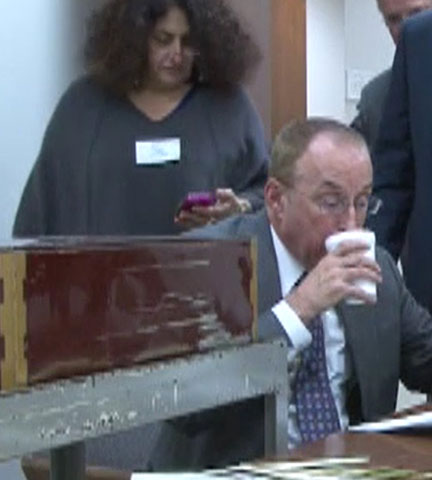
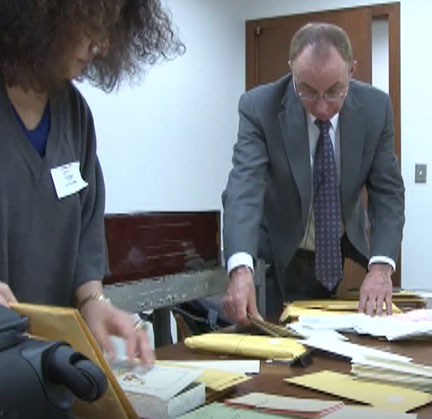
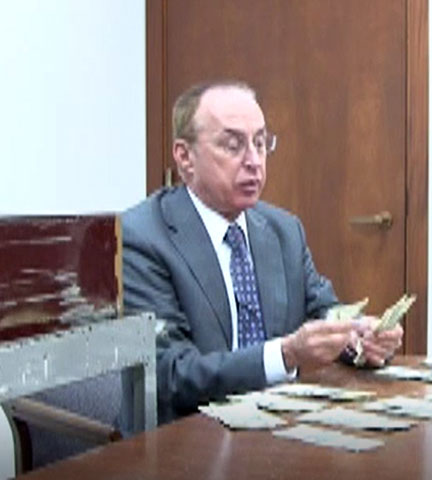
To the right, a few of the photographs printed here show the drilling of Mr. Siegel’s safety deposit box, Attorney Feld counting the content’s money, Feld and Kazarosian taking a break at approximately one-third of the way going through the cash and contents, then the pair packing things up after more than 4 hours and 30 minutes of documenting the valuables.

But this opening of the box and cataloguing of the contents was just one of many measures allowed by the courts to place the assets of Mr. Siegel in the control of court-appointed guardians for Mr. Siegel.

At press time, a further appeal by Mr. Siegel’s daughters on the draining of their father’s accounts by court-appointed lawyers and others, was denied.

Most interesting, Massachusetts Lawyers Weekly announced an award for Kazarosian, complete with a video of her, alongside an article terming the daughter’s appeals too confusing and wordy to comprehend.

The despicable actions inflicted on Mr. Siegel were not just directed to draining his lifetime of accumulated wealth. In an upcoming issue we’ll provide extensive details of how the state-appointees even terminated Mr. Siegel’s regular doctors and caregivers … stay tuned.  ¨

Full Article & Source:
ISOLATE, MEDICATE, LIQUIDATE: How to Fleece a Senior PART 2 – UPDATE NOTES

See Also:
ISOLATE, MEDICATE, LIQUIDATE: How to Fleece a Senior

AG suspends Macomb probate public administrator, leaders want law changed

(WXYZ) - 7 Investigator Heather Catallo first exposed a troubling pattern of certain public officials and real estate brokers taking over estates, often leaving rightful heirs with very little. Now, some top Oakland County leaders are taking bold steps to stop this practice.

The 7 Investigators also have a major update to our first probate court investigation that focused on Macomb County Public Administrator Cecil St Pierre.

After Catallo’s first story aired, the Michigan Attorney General’s office started their own investigation into St. Pierre, and confirm that several people filed complaints against the lawyer.

Now the Attorney General has suspended Cecil St. Pierre indefinitely from his Public Administrator duties.

St. Pierre says he “made a business decision not to do Probate Asset Recovery files prior to the suspension.  I have followed Best Practices and everything I have done has been approved by the Probate Judge and court.  I have been informed about the suspension.”

St. Pierre also told us in an e-mail that he “will investigate the issue with the Attorney General’s office and hopefully resolve any issue or complaints.”

“How can they lay their head down on their pillow at night, hurting people like that,” said Joanne Zaremba.

She’s one of several rightful heirs who say they were blindsided when someone else opened a probate estate in a deceased relatives name.  That meant Joanne could have lost her late mother’s home to a stranger. And she’s not alone.

“We were summoned to court – someone opened a probate estate in his name,” Kristin Rekowski told Catallo in November 2016.

Here’s what’s going on: Real Estate Broker Ralph Roberts has teamed up with some Attorney General-appointed lawyers called Public Administrators.  In Oakland County, court records show he regularly works with Kemp Klein attorney Barbara Andruccioli to open probate estates.  (Click to Continue)

Full Article & Source:
AG suspends Macomb probate public administrator, leaders want law changed

See Also:
Are Probate Court Claims Being Used to Take Homes From Rightful Heirs?

Families Say Local Realtors, Attorneys Cashing in on Estates of Their Recently Passed Loves Ones

Tips You Need to Know to Take a Loved Ones Estate Through Probate

Thursday, May 4, 2017

Lawyer Who Looted Slave Theater Owner's Estate Gets Prison Time: DA


BEDFORD-STUYVESANT — A disgraced Queens lawyer will spend at least a year in state prison for looting the estate of the late Judge John Phillips, a former civil judge and owner of the famed Slave Theater, according to prosecutors.

Frank Racano, of Howard Beach, was sentenced to between one and three years in state prison after pleading guilty earlier this year to siphoning more than half a million dollars from the sale of Phillips’ now-shuttered historic theater at 1215 Fulton St., which hosted civil rights leaders including Al Sharpton as well as performances in the 1980s and 1990s., according to acting Brooklyn District Attorney Eric Gonzalez.

Racano, 54, who was hired in 2010 to assist in the sale of Phillips’ properties, wrote and cashed more than 300 checks totaling $587,160.56, utterly depleting the account into which the proceeds were deposited, Gonzalez said. The theater had been locked in a legal battle between Phillips' former partner, Clarence Hardy Jr. and his nephew by marriage, Samuel Boykin, who successfully petitioned for control of his assets after his death.

The theater was sold for $18.5 million in 2015 and was demolished last month, reportedly to make way for apartments.

“This defendant disregarded his duty to his client, stealing nearly all of the proceeds due to the estate of the beloved Hon. Judge Phillips, including from the sale of the historic Slave Theater. He’s now been held accountable for his brazen theft and shameful conduct.”

In 2012, a buyer contracted to buy the theater and an adjacent lot for a total of $2.2 million, and paid the late judge’s estate a down payment of $220,000, payable to “Frank Racano, as attorney,” according to prosecutors. After a judge OK'd the sale, the buyer paid the net proceeds of the sale, $517,339.65, to Racano in two checks, Gonzalez said.

Between February 2013 and May 2015, Racano proceeded to pay himself the remainder of the cash in amounts ranging from $45 to $7,500 without authorization, prosecutors said. He was indicted in May, 2016 for grand larceny and pleaded guilty in January.

Phillips, who was known as the “Kung-Fu Judge,” was elected as a civil judge without the support of the Brooklyn political machine, and eventually found himself in the crosshairs of longtime District Attorney Charles Hynes, who had Phillips declared mentally incompetent and his assets placed in state receivership after Phillips announced a bid to unseat Hynes in 2001, friends and family said.

He died childless, unmarried, and without a will in 2008 at the troubled Prospect Park Residence, an assisted-living facility in Park Slope that has been the subject of extensive litigation and that a lawsuit brought by Phillips’ cousin blamed for the judge’s death.

John O’Hara, a close friend and fellow political outsider in Brooklyn, described the facility as a “Confederate prison.”

Boykin was not immediately available for comment.

Full Article & Source:
Lawyer Who Looted Slave Theater Owner's Estate Gets Prison Time: DA

How Do Cook County Judges Stack Up?


Two high-profile stories recently caught the eye of many Cook County residents. In one case, a judge was accused by federal prosecutors of mortgage fraud. The other involved a judge resigning after refusing his assignment to traffic court.

Even for those unfamiliar with the ins and outs of the court system, both stories raise questions about a judge's ethical responsibilities and about the quality of the county judiciary.

“Judges have a code of professional conduct they are obligated to uphold, and one essential tenet of the code is do not engage in any conduct that compromises the prestige and integrity of the judicial office,” said Samuel Jones, professor at John Marshall Law School. “They cannot engage in conduct to compromise impartiality or gives the public the appearance they are biased. They also have an obligation to maintain certain competencies. One thing about Judge Cooke is that traffic court is often used as a training ground for new judges, where the chief judge and presiding judges are able to gauge their temperament to handle more intricate cases.”

So how do Cook County judges stack up?

“As a presiding judge, the majority I saw were good judges,” said retired Cook County Judge Edmund Ponce de Leon. “But there are some that feel a sense of entitlement – I don’t want to do that, I don’t want to leave this assignment, because I’m entitled to it. … And that’s a problem, because you’re serving the public.”

“You can imagine, it’s sometimes difficult to supervise judges – there can be an ‘I was elected, there’s nothing you can do to me’ type of attitude,” said Ponce de Leon.

These two cases also raise the long-running question of whether the system for electing and retaining judges should be in the hands of voters at all. Since 1990, no Cook County judge has lost a retention election.

“It’s up to the public to take judicial elections as seriously as any other election,” said Marc Karlinsky, editor of the Chicago Law Bulletin. “Even though judges you don’t see every day, they don’t do constituent outreach like a senator, but in a time of need if you’re being accused of something, if you’re being sued, having a good judge can mean a lot of time and a lot of money. The whole system works when judges are good.”

And it’s not just important to have a quality judiciary says Jones, but one that reflects the people whose cases come before the court. “If you look at the [federal] judges in the U.S. District Court for the Northern District, you don’t find a judiciary that reflects the social, economic, racial, ethnic, religious diversity of the community,” Jones said. “In Cook County, we have that. We have a judiciary that reflects the diversity of the community.”

“I firmly believe that the vast majority of our judges do good work in and out of the courtroom,” Cook County Chief Judge Timothy Evans said in a statement. “They are public servants who are committed to the principles of fair and impartial justice. They also care about the communities where they live, work and raise families.

“Whenever allegations arise about improper conduct by a judge, I meet with the court’s Executive Committee to decide what action is appropriate. While we have no authority to discipline a judge or remove a judge from office, we can assign a judge to administrative duties while the legal or ethical matter is pending. We can also refer matters to the Judicial Inquiry Board, the state agency that prosecutes judicial misconduct. We have done that in the past and will do that in the future as necessary to maintain public confidence in the judiciary,” Evans said.

Full Article & Source:
How Do Cook County Judges Stack Up?