OLYMPIA, Wash. -- Nearly half of Americans in their 40s and 50s have
both a parent age 65 or older and a child. These middle-aged couples
often find themselves sandwiched in the middle, caring for both their
kids and their elder parents, financially and physically.
If you fall into this category, you're not alone. It's called "The
Sandwich Generation" and it's playing out in homes all around the
country.
Dinner at the Belz family home in Olympia ends with a little treat
and a cup of coffee. Trish Belz and her husband Aaron are both
psychologists living in Olympia. They have two children, a 5th grader
and a high school freshman.
But of all the plates at the dining table, the fullest by far belongs
to Trish. She’s caring for her kids and also her mom and dad, John and
Maureen. “This is my parenting time,” said Trish. “I want to give my
kids this time yet it’s completely pulled also towards my parents.”
Trish is not alone. Middle-aged Americans often find themselves
sandwiched in the middle, caring for both their kids and their parents,
financially and physically.
Maureen and Jack have been married for 54 years. They don’t drive
home after dinner with their daughter and grandchildren. They walk,
across a gravel road. With concerns for their health and safety, Trish
and Aaron build a home for her parents two years ago, just across the
street from their own house. This makes it easier for Trish to care for
her parents on a daily basis.
For the older generation relinquishing authority and independence to
their adult children can be rough. Jack admits it’s been a transition.
“I don’t know if everyone can do that,” he said.
Psychologist Jill Gross works with sandwich generation clients. She
says the number one issue for caregivers is burnout. “You have all the
duties and responsibilities associated with parenting,” said Gross. And
then you add to that if the elderly person you’re providing care for
lives in your area often there are doctor’s appointments prescriptions
to fill sometimes meals to prepare.”
The Belz family faces an additional hurdle. Maureen, age 81, has
Alzheimers. She now lives at a memory care facility nearby. “Its really
tough,” said Trish. “I’ve felt angry before and I’ve felt resentful.”
Trish picks her up most mornings so she can spend the day with her
husband and grandchildren. After cleaning the kitchen and helping her
kids with homework, Trish drives her mom back to the facility at night.
Gross says caregivers need to make self-care a top priority. She
encourages the older generation to start discussions about how they want
to live out their days. “The best gift you can give to your adult
children is to be the one to bring it up and talk about your values and
goals,” Gross said.
Gross encourages adult children to connect with other people in the
middle of that sandwich, and to find ways to share caregiving and
parenting responsibilities, whether it’s a helpful friend or a spouse.
Despite the juggling her time between her parents, her job, her
husband and kids, Trish says she’s happy for the wonderful quality time
she and her kids get with her parents. Her father Jack is grateful that
he continues to be able to spend his days with his wife Maureen.
Full Article & Source:
‘The Sandwich Generation’: Caring for an elder parent and adult child at same time

Sunday, December 17, 2017


Man charged with financial exploitation of elderly relative
 |
| Richard Cleveland |
Richard Cleveland, 58, of the 3000 block of Route 52, Minooka, has been charged with felony financial exploitation of the elderly.
According to the Sheriff's Office, deputies took a report on Oct. 13 alleging that Cleveland had "unlawfully used a large sum of money belonging to an elderly relative."
Detectives began an investigation, and Cleveland was charged on Dec. 6, according to police.
Bond was set for Cleveland at $75,000 with 10 percent to apply, and Cleveland is currently at the Kendall County jail on unrelated charges, police said.
According to Kendall County court records, Cleveland was charged in 2016 with felony aggravated sexual assault, aggravated battery, and domestic battery. Those cases are still pending in the county court system.
A hearing has been scheduled before Judge Timothy McCann on both the latest charges and the 2016 charges for Monday, Dec. 18 at 11 a.m. at the Kendall County Courthouse in Yorkville.
Full Article & Source:
Man charged with financial exploitation of elderly relative
Saturday, December 16, 2017
Easing the Burden on Caregivers
This week, Hawaii launched the Kupuna Caregivers Program to help support working family caregivers.
Eleanor Thommes and her sister have reorganized their schedules and finances to take care of their 93-year-old mother, Elising Roxas, who needs round-the-clock care.
Full Article & Source:
Easing the Burden on Caregivers
Eleanor Thommes and her sister have reorganized their schedules and finances to take care of their 93-year-old mother, Elising Roxas, who needs round-the-clock care.
“A lot of
women, especially single women, need to work,” said Ms. Thommes, 63, who
lives in Mililani, Hawaii. “But at the same time they have all these
responsibilities, to pay the bills, and to caregive. How can they
possibly do all of that the same time?”
A new program in Hawaii, the Kupuna Caregivers Act,
is designed to help lift some of the burden on people caring for an
elderly family member at home by paying them stipends of up to $70 a
day. The word Kupuna means elder in Hawaiian.
The
program, which went into effect this week, is limited to those who work
at least 30 hours per week. The money can be used for caregiving
supplies, to supplement lost wages or to hire help. The legislation
recognizes that many Hawaiian families prefer to have their parents and
grandparents age at home, rather than in a nursing home or assisted
living facility.
Long-term care continues to be a
complicated equation for many Americans. Private long-term care
insurance is a shrinking industry with premiums too expensive for many
people to afford. For low-income families, Medicaid offers some options.
At the state level, Maine and Washington are also considering their own
programs.
Washington has been a
leader in long-term care for many years. In 2017, it was ranked first in
the quality and execution of long-term care in a study
commissioned by AARP and several partner organizations. Representative
Laurie Jinkins, a Democrat, and Representative Norm Johnson, a
Republican, introduced a bill last winter called the Long-Term Care Trust Act,
which would provide universal long-term care in the state. Everyone
would contribute through a payroll deduction, and everyone would be
guaranteed a long-term benefit if needed. The program would provide $100
a day to support caregiving across a range of care situations including
at-home care, assisted living and nursing homes. Washingtonians have a
strong track record of passing legislation on a similar model, including
universal paid family leave in 2017 and universal paid sick leave in
2016. The bill is expected to be reintroduced in early 2018.
In Maine, 59 percent of the population
identifies as current or former caregivers. The Maine People’s Alliance
is collecting signatures for a ballot initiative calling for universal home care,
which would make home caregiving available to people over 65 or those
with disabilities. The proposed budget for this program would be funded
by a 1.9 percent Social Security tax on people making over $127,000.
“We’ve
gotten a more emotional reaction to this campaign than anything else
we’ve worked on,” said Ben Chin, the political engagement director of
the Maine People’s Alliance.
Health
care legislation in Maine has been hotly debated recently as Gov. Paul
LePage, a Republican, has vetoed Medicaid expansions five times, though a
recent ballot measure did push through that expansion. The Maine’s
People’s Alliance anticipates reaching its signature goal by the end of
January.
The proposed
legislation in Washington is limited to 365 days (consecutive or not) of
caregiving support and the Kupuna Caregivers program is starting with a
six-month trial period. With those limits, these programs aren’t meant
to be lifetime care. But they offer options for families that can’t
afford private insurance and don’t want to spend down retirement savings
to qualify for Medicaid.
The programs could provide relief for struggling families and serve as models for other states.
Full Article & Source:
Easing the Burden on Caregivers
68 Year Old Beverly Finnegan – Snatched from Condo by Court Order, Tossed in Nursing Home – Struggled to Get Released – Now on Life Support
A few names/agencies to remember:
Lawyer: Wendy K. Crawshaw, Framingham, Mass.
Lawyer: Lawrence K. Glick, Needham, Mass.
Judge: Maureen H. Monks, Middlesex County Probate and Family Court
Agency: Jewish Family and Children’s Services, Waltham, Mass.
Agency: Springwell, Inc., Waltham, Mass.
If you see any of their names, on any documents related to your loved ones, run. Run as fast as you can. That’s the hard lesson Janet Pidge says she has learned. Janet is the sister of Beverly Finnegan. Earlier this year, Janet and Beverly shared a condo unit in upscale Newton, Mass. All that changed when key individuals involved with Springwell, Inc., the Kathleen Daniel Nursing and Rehabilitation facility (Framingham), Jewish Family and Children’s Service, and others stepped into their lives.
Beverly Finnegan now “faces imminent death,” according to one court filing.
When Beverly was taken under force from her home – on an order of Middlesex County Probate and Family Court Judge Maureen H. Monks – Beverly could walk, talk, converse, argue, read newspapers, magazines, pay her bills, handle the sisters’ finances, and was able for months to plead for her release from involuntary commitment to a nursing home.
Flash forward five months and Beverly now clings onto her life. I spent hours in the Framingham hospital where Beverly is in the intensive care unit. She’s gone from one lock-down to another – locked doors again. To get in, you have to press a buzzer outside of wire-reinforced security windows on hard steel doors.
Beverly is now on life support, assisted breathing, and a feeding tube. She’s paper-thin. A photograph of her, provided by a friend from at the hospital is shown below:

[Now 69-year old Beverly Finnegan – December 2017. In September, she was begging for newspapers and magazines.]
How did Beverly become so emaciated? What drugs was she administered (hint: antipsychotics!)? Why was she taken, and what treatment did she receive or not receive?
We’re compiling court documents, filings, and statements from many individuals associated with Beverly. What we’ve discovered thus far is that Dr. Anne McKinley, a primary care physician filed a protective order with Springwell to force the taking of Beverly from her Newton condo. Why? Because McKinley wrote that Beverly had Mycrobocterium kansasii, a lung infection which required immediate and prolonged attention to cure, and that Beverly was refusing treatment.
That was October of 2016. Right, more than 13 months ago. Why is that significant? Because that ‘taking’ and the subsequent involuntary lockdown in a nursing home by a court-appointed guardian was based on Beverly refusing medical treatment. In short, Judge Monks supported the position that Beverly was obviously a mentally incapacitated person who wouldn’t help herself to a cure from the lung infection, and needed government protection.
Hey Doc: How About a Second Opinion?
It is now more than 13 months since that diagnosis. However, according to court filings, as of the day they placed Beverly on a feeding tube and life support approximately a week ago, she had never, ever, ever been treated for the mysterious lung infection.
You did read that, right? Beverly was assigned a court-appointed guardian, her finances locked down, her freedom eliminated, her health apparently destroyed, because she refused treatment for an infection which the State said she had, and for which they never, ever treated her.
Are We in the Twilight Zone?
Beverly’s sister, Janet Pidge is hysterically desperate: she’s fighting daily to get anyone to help. She’s spent her savings, she and Beverly have both lost their jobs. She’s knocked on every door, every lawyer, politician, every resource she could find. She said she’s been lied to along the way the same way her sister was lied to, she says. She’s called delusional and paranoid for not believing the State. Her money is gone, and she’s stuck asking for rides daily or help to pay for the trains to take her from Newton to Framingham each day where she prays at her sister’s side.
According to the first couple of hundred pages of court filings we’ve secured and reviewed (before they disappear mysteriously like others in Middlesex Probate Court – see Mary Frank article), we’ve noted a clear, delineated path where the powers-that-be managed to keep Beverly locked up on a section 12: mental order, claiming that she was “paranoid” and not trusting of the medical providers and others. Hmm, they tell her she has an ailment which they don’t treat her for, and she’s the paranoid one?
Beverly’s sister is fighting to keep Beverly alive, but her efforts may not succeed: apparently, while under the care of the nursing home she suffered a cardiac arrest, and apparently suffered from deprivation of oxygen, as noted by Dr. Aba Somers of Framingham hospital. On December 8, 2017, Dr. Somers wrote “The patient has severe brain injury. ICT brain shows swelling of the brain. EEG shows no cortical brain activity. Physical exam shows minimal brain stem reflexes. She has been off sedation for more than a week. She will require a tracheotomy by the end of next week.”
Dr. Somer’s notes conflict with Janet Pidge’s statements that just two weeks ago, that her sister was responding to stimuli, and squeezing her hand, apparently before sedation was heavy. Janet didn’t trust the diagnosis of a lung infection, and now she questions if this is true.
Full Article & Source:
68 Year Old Beverly Finnegan – Snatched from Condo by Court Order, Tossed in Nursing Home – Struggled to Get Released – Now on Life Support
Lawyer: Wendy K. Crawshaw, Framingham, Mass.
Lawyer: Lawrence K. Glick, Needham, Mass.
Judge: Maureen H. Monks, Middlesex County Probate and Family Court
Agency: Jewish Family and Children’s Services, Waltham, Mass.
Agency: Springwell, Inc., Waltham, Mass.
If you see any of their names, on any documents related to your loved ones, run. Run as fast as you can. That’s the hard lesson Janet Pidge says she has learned. Janet is the sister of Beverly Finnegan. Earlier this year, Janet and Beverly shared a condo unit in upscale Newton, Mass. All that changed when key individuals involved with Springwell, Inc., the Kathleen Daniel Nursing and Rehabilitation facility (Framingham), Jewish Family and Children’s Service, and others stepped into their lives.
Beverly Finnegan now “faces imminent death,” according to one court filing.
When Beverly was taken under force from her home – on an order of Middlesex County Probate and Family Court Judge Maureen H. Monks – Beverly could walk, talk, converse, argue, read newspapers, magazines, pay her bills, handle the sisters’ finances, and was able for months to plead for her release from involuntary commitment to a nursing home.
Flash forward five months and Beverly now clings onto her life. I spent hours in the Framingham hospital where Beverly is in the intensive care unit. She’s gone from one lock-down to another – locked doors again. To get in, you have to press a buzzer outside of wire-reinforced security windows on hard steel doors.
Beverly is now on life support, assisted breathing, and a feeding tube. She’s paper-thin. A photograph of her, provided by a friend from at the hospital is shown below:
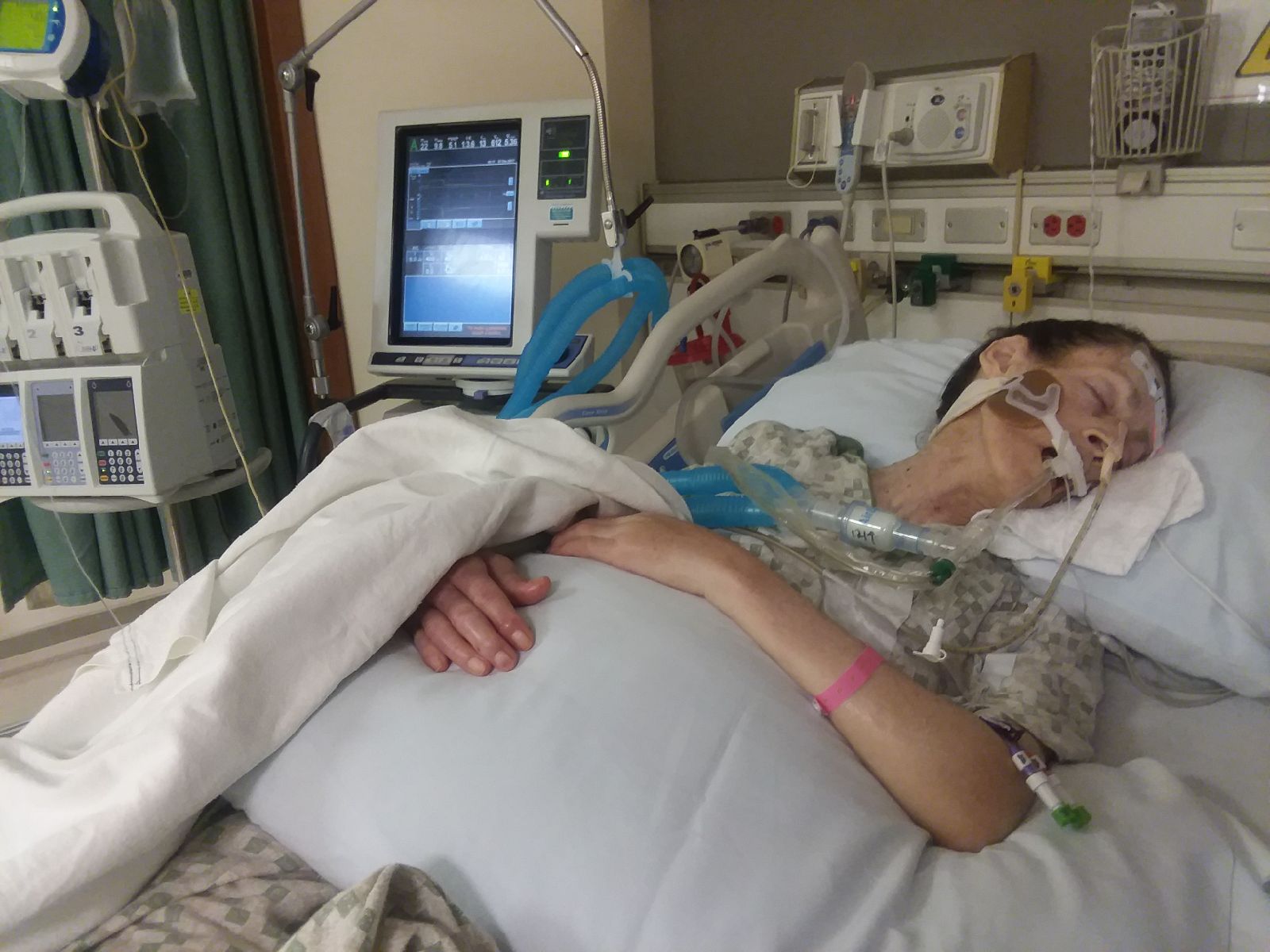
[Now 69-year old Beverly Finnegan – December 2017. In September, she was begging for newspapers and magazines.]
How did Beverly become so emaciated? What drugs was she administered (hint: antipsychotics!)? Why was she taken, and what treatment did she receive or not receive?
We’re compiling court documents, filings, and statements from many individuals associated with Beverly. What we’ve discovered thus far is that Dr. Anne McKinley, a primary care physician filed a protective order with Springwell to force the taking of Beverly from her Newton condo. Why? Because McKinley wrote that Beverly had Mycrobocterium kansasii, a lung infection which required immediate and prolonged attention to cure, and that Beverly was refusing treatment.
That was October of 2016. Right, more than 13 months ago. Why is that significant? Because that ‘taking’ and the subsequent involuntary lockdown in a nursing home by a court-appointed guardian was based on Beverly refusing medical treatment. In short, Judge Monks supported the position that Beverly was obviously a mentally incapacitated person who wouldn’t help herself to a cure from the lung infection, and needed government protection.
Hey Doc: How About a Second Opinion?
It is now more than 13 months since that diagnosis. However, according to court filings, as of the day they placed Beverly on a feeding tube and life support approximately a week ago, she had never, ever, ever been treated for the mysterious lung infection.
You did read that, right? Beverly was assigned a court-appointed guardian, her finances locked down, her freedom eliminated, her health apparently destroyed, because she refused treatment for an infection which the State said she had, and for which they never, ever treated her.
Are We in the Twilight Zone?
Beverly’s sister, Janet Pidge is hysterically desperate: she’s fighting daily to get anyone to help. She’s spent her savings, she and Beverly have both lost their jobs. She’s knocked on every door, every lawyer, politician, every resource she could find. She said she’s been lied to along the way the same way her sister was lied to, she says. She’s called delusional and paranoid for not believing the State. Her money is gone, and she’s stuck asking for rides daily or help to pay for the trains to take her from Newton to Framingham each day where she prays at her sister’s side.
According to the first couple of hundred pages of court filings we’ve secured and reviewed (before they disappear mysteriously like others in Middlesex Probate Court – see Mary Frank article), we’ve noted a clear, delineated path where the powers-that-be managed to keep Beverly locked up on a section 12: mental order, claiming that she was “paranoid” and not trusting of the medical providers and others. Hmm, they tell her she has an ailment which they don’t treat her for, and she’s the paranoid one?
Beverly’s sister is fighting to keep Beverly alive, but her efforts may not succeed: apparently, while under the care of the nursing home she suffered a cardiac arrest, and apparently suffered from deprivation of oxygen, as noted by Dr. Aba Somers of Framingham hospital. On December 8, 2017, Dr. Somers wrote “The patient has severe brain injury. ICT brain shows swelling of the brain. EEG shows no cortical brain activity. Physical exam shows minimal brain stem reflexes. She has been off sedation for more than a week. She will require a tracheotomy by the end of next week.”
Dr. Somer’s notes conflict with Janet Pidge’s statements that just two weeks ago, that her sister was responding to stimuli, and squeezing her hand, apparently before sedation was heavy. Janet didn’t trust the diagnosis of a lung infection, and now she questions if this is true.
Full Article & Source:
68 Year Old Beverly Finnegan – Snatched from Condo by Court Order, Tossed in Nursing Home – Struggled to Get Released – Now on Life Support
Wise Co. caregiver sentenced in financial exploitation case

Latricia
Rae Kiser, 40, previously pleaded guilty without a plea agreement to
six counts of felony uttering and five counts of felony forgery in
September. The Wise County Circuit Court heard evidence Tuesday at a
sentencing hearing.
Kiser
received a sentence of five years in the penitentiary with three years
and two months suspended. She will serve an active prison term of one
year and ten months within the custody of the Virginia Department of
Corrections. After her release, Kiser will be required to complete three
years of supervised probation and pay restitution to the victim, Slemp
said.
Between Oct. 2016 and
Jan. 2017, Kiser was hired to assist with taking care of a disabled
elderly adult, Slemp said in a news release. During the time Kiser
served as the victim’s home healthcare worker, Kiser stole checks from
the person, Slemp said.
Kiser then forged the person’s name and
without permission cashed six checks for various amounts totaling
$1,750, Slemp said. The fraud was discovered when the victim’s family
discovered inaccuracies in the checking account and called the police.
When Wise County Sheriff’s Office deputies investigated, Kiser confessed
her crimes, Slemp said.
"Financial
exploitation of the disabled and elderly is far too common in our
community," Slemp said. "Ms. Kiser was invited into a home, paid to care
for another person, and then stole that person. She was entrusted with
the care of a vulnerable individual and then betrayed that trust. A
crime of this nature should offend everyone in our community. We will
continue to fight to protect seniors and incapacitated adults from this
kind of abuse and exploitation.”
Slemp
expressed his appreciation for the diligent efforts made to investigate
and prosecute this case, specifically the Wise County Department of
Social Services, the Wise County Sheriff’s Department, and the Southwest
Virginia Joint Senior Abuse Task Force.
Full Article & Source:
Wise Co. caregiver sentenced in financial exploitation case
The Death of Democracy in Probate ‘Court’

The United States is a Democracy. Right?
I never questioned that until 2012. Someone that I loved very dearly was subjected to severe abuse by the Probate “Court.” I was also subjected to abuse. I survived. Gretchen did not.
The lasting damage done to me by this experience was the destruction of my belief that people do not have to fear abuse by government in the United States. It was not until 2016 that I finally realized the problem. The Probate Court is not a democratic institution. It is a dictatorship. It violates all the principles on which this country was founded.
The thing I find most frightening is that only a tiny fraction of the general population realizes the truth. I think the reason is that we are all blinded by our belief that the institutions of our government function in accordance with the principles of democracy. In fact, anyone who has been involved in a guardianship case has all the information needed to know that the Probate Court is not a democratic institution. It took me four years of study and research before I finally saw the truth that was sitting in plain sight.
This is not to say that all the institutions of government violate the principles of democracy. However, the Probate Court is a glaring exception. Somehow the judges and lawyers of the Probate Court have managed to eliminate all the protections of democracy designed to prevent abuse of power by government. The result is that the Probate Court has the ability to commit crimes with impunity. The reality is that no one is safe from abuse by the Probate Court. This is a very strong statement.
However, this statement is supported by extensive factual evidence. This evidence has been accumulated primarily by organizations outside the government.
Until recently, the government has passively or actively swept the problem under the rug. The Probate Court has the ability to prevent the evidence of abuse from becoming public. Other branches of government have also cooperated in concealing the evidence. Since this happened in 2012, I have filed complaints with all three branches of government with no effect. All my complaints have ended up in the hands of a lawyer who did nothing. One of the other parties in the case has also filed complaints with no effect.
The proof that the Probate Court is a dictatorship is lying in plain sight. It is a matter of seeing the obvious.
The foundations of democracy are the following:
- No one has absolute power. Power is distributed between three branches of government to provide checks and balances.
- Everyone is responsible for their actions. No one has immunity.
The “judge” has sole control of guardianship:
- The judge appoints the attorney for the incapacitated person.
- The judge appoints the guardian/conservator who manages the person’s affairs.
- The judge appoints the GAL (guardian ad litem) who investigates the facts of the case.
- The judge decides the case without the right to a jury trial.
- The judge is responsible for accountability of the GAL and guardian/conservator.
Marty Oakley, who runs an Internet talk radio show, has been pointing out for a long time that the Probate Court is not a court. It is an administrative tribunal whose authority is derived from the executive branch, not the judicial branch.
Because it is not a court, it is free to set its own rules as to how it operates. A person who goes before the Probate Court has no constitutional rights. The law is whatever the judge says it is. Responsibility for protecting a person’s constitutional rights rests with a court of law. The Probate Court is not a court of law.
The problem is that the Probate Court pretends to be a court and has usurped powers that can only be exercised by a court of law with due process. The Probate Court exercises the powers of both the executive and judicial branches of government. This is unconstitutional and violates separation of powers.
In December 2016, I met with my state senator, William Brownsberger, to discuss my complaints with the way guardianship is managed by the Probate Court. I pointed out that it violates separation of powers for a judge to be responsible for both appointment and accountability of guardians. His response was ,“Please trust me when I say: Your argument that the guardianship system is unconstitutional is not correct legally, however powerful it may seem theoretically.”
I said I was not willing to trust him. I asked him to prove it. He said, “You are asking a little too much of me.” He elaborated by saying, “Separation of powers is not just a philosophical idea, it is a technical legal construct.”
The issue is not whether the present system is legal. The extermination of the Jews was legal under German law. Slavery was legal in the United States. The issue is whether guardianship is consistent with basic principles of law, democracy, civil rights, human rights, and the Constitution. In my opinion, the present system of guardianship violates all of these basic principles. It is a stain on our democracy, as bad or worse than slavery. It is a danger to everyone whether or not they realize it.
I was taken totally by surprise by the way the Probate Court handled my guardianship case. I would not have trusted the Probate Court if I knew then what I know now. The problem is that there is no appropriate system for handling guardianship.
The way to stop this abuse is to take away the secrecy that protects those who are committing these crimes. That can only be done by the free press.
I wrote an article in October 2017 in the Boston Broadside, Issue #42
(Vol. 4, No. 9), describing what happened in my guardianship case. You can read it and decide for yourself whether this is the way you want guardianship to be handled.
The guardianship case is Docket Numbers 11P 2483, 11P 3682, 12R0085. The judge was Patricia Gorman. The professional guardian was Regina Bragdon. The GAL was Fern Frolin. My first attorney was Anthony Boczenowski. My second attorney was William Brisk. My first attorney developed cancer and had to withdraw from the case. My first attorney was a very honest person. In my opinion, he was the only professional involved in the case who did anything right.
Full Article & Source:
The Death of Democracy in Probate ‘Court’
Friday, December 15, 2017
Illinois' home health care industry rife with fraud, tainted by unscrupulous physicians

Fortunately, he lived in Illinois, where medical regulation has been so lax even the most desperate of doctors can find financial reward.
Koroma took refuge in home health care, a lucrative and growing industry rife with fraud and tainted by unscrupulous physicians who travel to patients' homes in search of profit, then bleed money from taxpayer-financed programs.
The down-on-his-luck doctor took advantage of this loosely regulated world to exploit his patients and command a central role in a multimillion-dollar taxpayer swindle that breached the homes of 15,600 older adults getting services from a Chicago company called Mobile Doctors.
For adults hobbled by disability or disease who want to stay out of nursing homes or hospitals, home health care services can be a godsend.
For criminals who want to tap into federal Medicare dollars, it can represent a loosely guarded bank vault.
A Tribune investigation reveals that Illinois public health regulators proved unprepared for a surge in new home health care companies, doling out too many home health licenses too fast and failing to provide meaningful oversight.
Even today, most anyone can own a home health care business for a $25 license fee — no criminal background check required.
Consequently, the Chicago metropolitan area is a hot spot for fraud, deemed among the most corrupt regions nationally. In the last five years, federal investigators estimate, area home-health agencies have improperly collected at least $104 million of public dollars.
Many home health companies operate lawfully and in the best interests of their customers. But fraud is so pervasive throughout the industry, federal officials say, that for every conviction like Koroma's, there are many other participants who are able to skate away.
As a result, already-vulnerable patients are put at risk.
Corrupt home health companies and complicit physicians as well as nurses secretly laced medical files with false diagnoses involving tens of thousands of Chicago-area patients, the Tribune found.
An analysis of federal court and enforcement files since 2012 shows that thousands of patients have been subjected to unwarranted procedures, therapies and tests; some were prescribed unneeded and powerful drugs.
Most victims were unaware that their medical histories were hijacked by swindlers — there is no legal requirement to notify or warn patients when fraud is uncovered, or when providers are convicted of crimes.
Case files show that a disabled man in his 80s was denied a wheelchair by a government insurance program because a Chicago-area business had falsely purchased one in the man's name and then illegally pocketed the reimbursement check, according to AgeOptions in Oak Park, a federally funded advocacy group.
In another case, a hospitalized man was denied a transfer to a Chicago rehabilitation center because a home health company had fraudulently billed the government for nonexistent convalescent care.
"These scammers are really smart," said Jason Echols, statewide director for a senior Medicare program at AgeOptions. "Anybody could be a victim." (Click to Continue)
Full Article & Source:
Illinois' home health care industry rife with fraud, tainted by unscrupulous physicians
Personal care home owner indicted on exploitation charge

According to the indictment, Donaldson is accused of obtaining access to an Alzheimer’s patient’s bank account and taking nearly $28,000 between Oct. 26, 2016, and July 24.
The victim lived at Shavonna’s Place of Care on Fairview Avenue. According to the Department of Community Health, the agency tasked with regulating personal care homes, the home was in operation and had no violations cited in its latest inspection in March. The state agency’s website which provides open access to inspection reports of personal care homes was not in operation Tuesday.
Shavonna’s Place was not licensed and had not been inspected by a fire marshal when the department inspected in March. The home was licensed by the city after an April story by The Augusta Chronicle.
Donaldson operates a second personal care home, Maxi Maxi on Damascus Road.
Full Article & Source:
Personal care home owner indicted on exploitation charge
The Five Most Common Ways Elder Financial Abuse Happens

Caregiver Abuse
When a Michigan trial judge dismissed a family’s lawsuit against a home care company for sending a caregiver with two felony criminal warrants to care for a man in his eighties, the national press erupted with questions about how this could happen.
In this particular case, the Kentucky-based home care company, ResCare, sent a woman to a retired Detroit-area businessman’s house to look after his ailing wife, who had dementia. It didn’t take long until the wife’s jewelry began to disappear—as well as the businessman’s fortune. Court filings estimated the losses to be as high as $1.5 million. The caregiver, if she could be called that, moved the businessman out of his bedroom into the basement of his lakefront home and moved her own mother into the home. The businessman’s wife died, and within a matter of months, the caretaker “married” the businessman.
When the businessman’s family members finally intervened and removed him from his home, his finances were in shambles. None of his bank accounts had positive balances, nor did he have any working credit cards. He had his monthly Social Security payment—that’s it.
The businessman and his family are sadly representative of the widespread abuse affecting our growing elderly population. I have handled a number of cases where predators, posing as legitimate caregivers, quickly took advantage of their elderly charges. This misconduct includes physical and medical neglect, and is often coupled with embezzlement and theft.
The Michigan case didn’t work out well. Then again, by their very nature, no abuse case can really ever work out well. Even with a partial financial recovery, the seismic emotional repercussions stemming from misplaced trust don’t easily recede.
Financial Exploitation
Financial exploitation takes many forms. Even though I have been counseling families for decades, I am regularly surprised by some new form of abuse. An incomplete list of malfeasance could include the sale of an elder’s medications; grocery bills more attributable to cash withdrawals taken by caregivers than bread and milk purchased for the elder; lawn services for a small yard being billed at $300 per week; money being used for gambling fees; medical care and dental care being neglected because of a theft of funds; and assignments of bank accounts into joint tenancy with a wrongdoer. (Click to Continue)
Full Article & Source:
The Five Most Common Ways Elder Financial Abuse Happens
Subscribe to:
Posts (Atom)