WAYMART
- The Wayne County Elder Abuse Task Force hosts an Elder Justice Day on
Wednesday, May 8, from 9am-1pm. This free event is open to all members
the community, to educate and raise awareness of issues of elder abuse
and the rights of older adults.
The
event will take place at the Ladore Performing Arts and Recreation
Center located at 287 Owego Turnpike in Waymart, PA. Lunch and
transportation, within the county, will be provided.
Rachael
Wydra of the PA Department of Health’s Northeast District Office in
Scranton will be discussing addiction and the opioid epidemic, including
the administration of overdose antidote, Naloxone, the state’s drug
monitoring program and the Standing Order for Naloxone. Long-time postal
inspector and seasoned investigator George P. Clark of the Philadelphia
Division will be discussing recent scams aimed at seniors and Wayne
County Emergency Management Coordinator Steve Price discusses emergency
preparedness.
The
Wayne County Elder Abuse task force was established in 2016 as a
collaboration of various professionals and members of the community
including: social service agencies, law enforcement, medical
professionals, financial institutions, and community members. The
mission of the Task Force is to educate concerned citizens and
professionals to be able to identify and report cases of potential
exploitation, fraud, neglect, and abuse of older adults.
To
register for this event, please call the Wayne County Area Agency on
Aging at 570-253-4262. Please make your reservation early, space is
limited.
For more information about the Wayne County Elder Abuse Task Force or this event, please call Maggie Hicks at 570-253-4262.
To
report abuse, neglect, exploitation or abandonment of an elderly
person, please call the Wayne County Area Agency on Aging at
570-253-4262 or 1-800-648-9620. Reports can be made 24 hours a day, 7
days a week. Reports can also be made to the state hotline at
1-800-490-8505.
Tesa Keith, a former employee at a Texas assisted living facility, has
allegedly admitted to kicking a female patient in the face.
A former employee at a Texas assisted living facility has admitted to kicking a female patient in the face “for the purpose of punishing her,” authorities said Thursday.
Tesa Keith, 37, was working as a direct service provider at the San Angelo State Supported Living Center in Carlsbad, a small community in Tom Green County, when the assault took place on June 13, 2017, according to the U.S. Department of Justice.
The state-run facility houses people with intellectual and developmental disabilities “who are medically fragile or who have behavioral problems,” the center’s website states.
U.S. Attorney Erin Nealy Cox, of the Northern District of Texas, said in a statement that the victim was targeted with no justification.
“Instead of the care and compassion she deserved, this victim suffered abuse and humiliation," she wrote. “One of the DOJ’s most sacred duties is seeking justice for our district’s most vulnerable. We will not tolerate this sort of terrible behavior.”
Keith pleaded guilty Wednesday to a civil rights violation charge and she will face up to 10 years in prison and a fine of up to $250,000 when she’s sentenced.
An Oklahoma couple has been arrested after they reportedly stole
$283,000 from a family member with early stages of Alzheimer's and left
her both "penniless and homeless," the Tulsa World reports.
Sheri
Stallings, 49, and Hezekiah Stallings, 27, have been charged with elder
abuse and exploitation months after Adult Protective Services
discovered Sheri Stallings' mother abandoned in a nearly vacant home.
The Stallings had been pretending to act as the woman's caregivers,
according to the Wagoner County Sheriff’s Office.
"True evil preys
on the elderly and children," said Sheriff Chris Elliott. "It’s bad
enough with all the scammers in the world, but it’s unfathomable when
your own children, fueled by greed and cloaked as a ‘caregiver,’ can do
this to their own defenseless mother."
In February, APS found
Sheri Stallings' mother in a house that had very little furniture,
including no bed and almost no food, a press release notes. The agency
took her into custody, investigated her situation and turned its
findings over to police.
A further investigation revealed that Sheri Stallings had taken over
her mother's checking account and retirement accounts, along with the
profits made from the sale of her mother's home in Tulsa, police said.
The couple allegedly used the money as a "personal slush fund" and
bought two 10-acre properties without the mother's knowledge.
“I am appalled at the blatant evidence my investigators have uncovered in this case,” Elliot said.
Sheri and Hezekiah Stallings are both being held at Wagoner County Detention Center on $20,000 bonds.
This is a story about the cruelest disease you have never heard of.
It's called frontotemporal dementia — or FTD. And given the devastating
toll it takes on its victims and their families, it ought to be much
better known than it is.
FTD is the number one form of dementia in
Americans under the age of 60. What causes it is unclear, but it
attacks the frontal and temporal lobes of the brain, which control
personality and speech, and it's always fatal. It is not Alzheimer's
disease, which degrades the part of the brain responsible for memory.
With
FTD, people either display such bizarre behavior that their loved ones
can hardly recognize them, or they lose the ability to recognize
themselves. That's what happened to Tracey Lind one day a few years ago
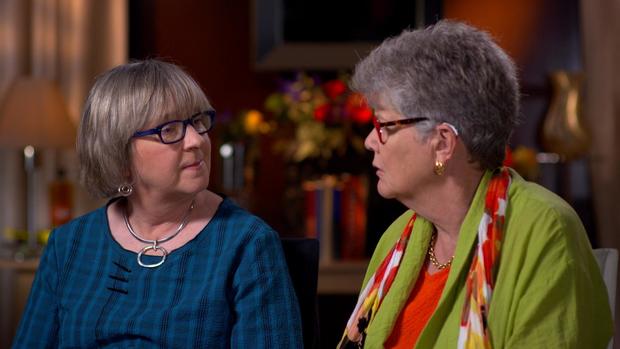
as she was standing in a public restroom. Emily Ingalls and Tracey LindTracey Lind: I was washing my hands and I looked in the mirror and I did not recognize my own face.
Bill Whitaker: Didn't recognize yourself.
Tracey
Lind: No. I looked in the mirror, and I kept looking, and I remember I
kept looking at this woman wondering "who was she?"
This is who
she was: the Very Reverend Tracey Lind, dean of the Episcopal Cathedral
in Cleveland, Ohio, one of the city's most prominent preachers and civic
leaders. She was 61 years old when both she and her spouse Emily
Ingalls began to notice trouble with things Tracey had always done very
well; like finding the right word, recognizing congregants and friends'
faces, and of course, her own.
Tracey Lind: That's when I said, "Oh, man. I gotta go see a doctor."
Bill Whitaker: When that happened, were you— were you scared?
Tracey Lind: Oh, I was scared to death.
Bill Whitaker: Emily, what did you think was happening?
Emily Ingalls: I thought there's something not right with her brain.
On
election day 2016, Tracey Lind got the diagnosis: frontotemporal
dementia. She has what's called the "speech variant" of the disease,
which, among other things, attacks the part of the brain where language
lives.
Tracey Lind: Sometimes you just— you're fine and you're
on. And then there are other times that the words just don't come out. I
mean, it— even if I know what the word is, somet— sometimes I feel like
I'm playing bingo. And when I find the word, it's— I— I shout it. I—
like I feel like an imbecile. You know. Apple. Oh, yeah! Apple. That's
it. And I get all excited.
This is acutely painful for Tracey, because being a powerful, effective speaker has always been at the core of her identity.
Bill Whitaker: One of the first things you did once you got this diagnosis was to resign from your job as dean at Trinity—
Tracey Lind: Right.
Bill Whitaker: —Cathedral. Why— why— why'd you take that action so quickly?
Tracey Lind: Mainly it was I knew I was starting to fail even though I was faking it pretty well.
Since stepping down, Tracey and Emily have
traveled around the country and the world, speaking and preaching about
her FTD. Or as Tracey puts it, "telling the story of dementia from the
inside out."
Tracey Lind in pulpit: I was determined to live what I had been preaching for over 30 years; that out of pain comes joy.
Tracey Lind: I'm gonna face this disease called FTD that I'd never heard of before, and I'm gonna see what I can do with it.
Bill
Whitaker: I don't know if you are aware of how unique this situation is
that you are in the middle of this decline from dementia and yet,
you're so able to articulate what that's like.
Tracey Lind: I am
aware of that. I think my curiosity is what's getting me through it.
'Cause otherwise, Bill, I— I— I'm— I'm just gonna lay down and—
and— and— and roll up in a ball.
Tracey says she has good
days and bad days. Just in our interview, there were moments when she
was completely in control and moments when she wasn't.
Tracey Lind: ... and I'm doing some— you know, I'm— I'm— I'm— I'm— I know there's no—
Emily Ingalls: Do you want help?
Tracey Lind: Can you help, please?
Emily Ingalls: Okay.
Dr. Bruce Miller: This is the way this very sad illness presents. Dr. Bruce MillerDr. Bruce Miller may be the
world's leading expert on frontotemporal dementia. He runs a lab at the
University of California San Francisco that's doing cutting-edge
research on the two main forms of FTD — the speech variant that Tracey
Lind has, and a behavioral variant that attacks personality, judgement
and empathy.
On the day we visited Dr. Miller's clinic, he and his
team met with FTD patient Thomas Cox and his wife Lori. At first
glance, Thomas seems fine, but he's not.
Thomas Cox: I've got FTD.
Dr. Bruce Miller: Okay. And has that affected you so far?
Thomas Cox: No.
In
fact, Lori Cox says that starting a few years ago, Thomas lost interest
in her, in their son, and in his work so much that he was fired from
his job. By now, he's pretty much reduced to looking at photos on his
phone.
Thomas Cox: That's Bugatti (PH).
Lori Cox: That's our dog. (LAUGH)
Dr. Bruce Miller: Ah. Your dog.
Lori Cox: I can blame the disease. I can say that the disease stole my— my husband.
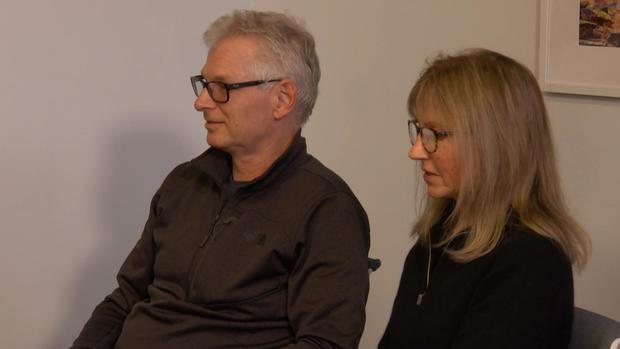
Dr. Bruce Miller: Yes. Thomas and Lori CoxDr. Bruce Miller: When a family
sees someone with this illness, they don't recognize them. This is not—
the person I married that I love. This is not my father or my mother.
Bill Whitaker: You have said that FTD attacks people at the very soul of their humanity.
Dr.
Bruce Miller: This is profound as anything that can happen to a human
being. It robs us of our very essence of our humanity, of who we are.
Bruce
Miller says because so many cases are first misdiagnosed as mental
illness, it takes an average of three years and several expensive brain
scans to get a correct diagnosis of FTD.
Dr. Bruce
Miller: So whether it's 20,000 new cases every year, 100,000, 200,000,
we still don't know. But in— young people with neuro degeneration,
frontotemporal dementia is a big one.
Bill Whitaker: So if you see someone who is suffering dementia at a younger age—
Dr. Bruce Miller: Very— strong— likelihood that it's FTD.
Dr. Miller showed us this composite image of two of the major degenerative brain diseases.
Dr.
Bruce Miller: Frontal Temporal Dementia, shown in blue, Alzheimer's
Disease— shown in red. So, very different geography, very different
clinical manifestations.
Bill Whitaker: What does the blue indicate?
Dr.
Bruce Miller: The blue indicates is that there's loss of tissue. When
we see loss of tissue in that brain region, we know people have lost
their interest in life, their drive. They do less, they care less about
other people.
That loss of empathy, Miller says, can produce
dangerous, impulsive, even criminal behavior. And those with behavioral
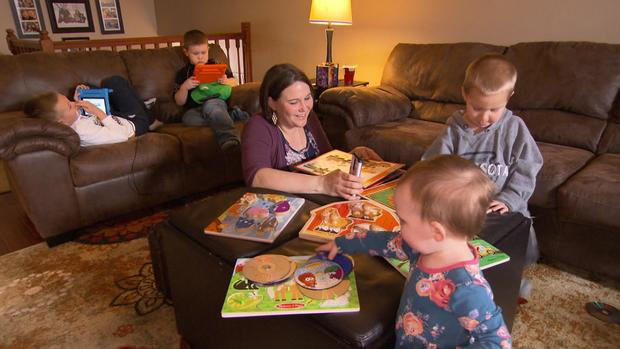
FTD are rarely aware that anything has changed. Amy Johnson with her childrenAmy Johnson: He went from being a
caring, doting father and husband and it just seemed like he flipped a
switch off. And he had no idea that he had changed. He had no idea.
Amy
Johnson and her husband Mark married in 2006, settled in the small
Minnesota town of Windom, and now have four young children - three boys
and a girl. Three years ago, Amy says Mark suddenly seemed to stop
caring about her and the kids.
Amy Johnson: That's the first time that I really remember thinking to myself, "What happened? Where did you go?"
Amy
recalls a day when she left Mark in charge of their sons, then three
and two, only to come home and find the boys playing outside, alone by a
busy street, while Mark sat inside watching TV, oblivious. On other
days, he began to display compulsive behavior she had never seen before.
Amy
Johnson: He couldn't stop eating. I started locking the food up. He
would walk down to the grocery store and buy more. I took his credit
card. He'd walk down to the grocery store and steal food.
Bill Whitaker: And these changes that you saw, did you ask him, "What's going on?"
Amy Johnson: Yeah. And he just said, "Oh, I don't think anything's different, is it?"
It
was. Mark began making inappropriate remarks to a female co-worker at
the company where he worked as a manufacturing engineer.
Bill Whitaker: He was fired?
Amy Johnson: Uh-huh (AFFIRM). And his reaction was, "Oh— oh, I guess okay. So what's for supper tonight?"
Bill Whitaker: What was your reaction?
Amy Johnson: I was just devastated. I was seven months pregnant at the time with our daughter.
Bill Whitaker: With your fourth child.
Amy Johnson: With my fourth child.
Bill Whitaker: So as this progresses, what's the eventual outcome?
Dr. Bruce Miller: Outcome of this is always death. They—
Bill Whitaker: Always death.
Dr. Bruce Miller: Always death. We have no way of intervening yet to slow the progression.
As
FTD corrodes the brain, it also eventually causes bodily functions to
shut down, that's what leads to death. But Bruce Miller is optimistic,
pointing to promising research both in his lab and funded by NIH grants
to scientists around the country.
Dr. Bruce Miller: Suddenly we have interventions and research that are going on that give me great hope.
Bill Whitaker: When might you expect a breakthrough?
Dr.
Bruce Miller: I'm hoping in the next five years that— we will have—
very powerful therapies in— certain variants of frontotemporal
dementia that— may stop it cold.
Tracey Lind and Emily Ingalls
have no idea whether any breakthrough will come in time to help them. If
not, Tracey will eventually lose the ability to speak at all, and then,
the ability to swallow.
Tracey Lind: The not being able to swallow part; that's what's really frightening. So I try to live in the present moment.
Emily Ingalls: I'm not very good at living in the moment, so I worry a lot about the future.
Tracey Lind: Do you worry about- taking care of me?
Emily Ingalls: Yeah. I worry about taking care of you. Sure.
Tracey Lind: What's going to be the hardest part?
Emily Ingalls: I think the hardest part is going to be the loss of the relationship.
Bill Whitaker: Has Emily told you this before?
Tracey Lind: No. I don't think so. (EMILY NODS HER HEAD INDICATING SHE HAS)
As
you can see, caregivers suffer as much as patients. For months, Amy
Johnson kept Mark at home, even as she mothered four small children andheld a full-time job. But his symptoms got worse and worse.
Bill Whitaker: When did it become clear to you that you— you had to put him in a facility?
Amy
Johnson: I went to an appointment with a psychiatric nurse
practitioner. And she said, "I think it's time for you to look for a
different place. Because now when he thinks of something, the part of
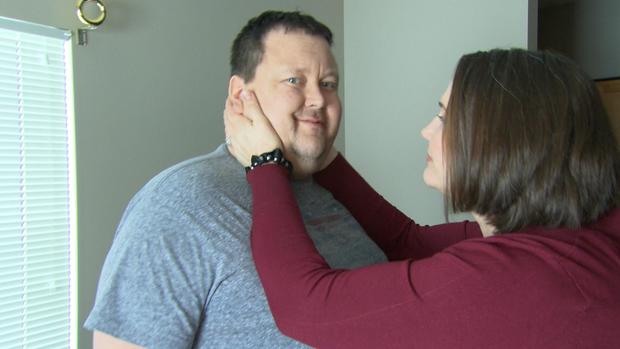
his brain that tells him 'that's a bad idea' doesn't work anymore." Mark and Amy JohnsonMark Johnson now lives in a
facility about an hour away from home. He's gained nearly a hundred
pounds due to compulsive eating; even walking into elderly residents'
rooms and taking their food. Amy says his care now costs her nearly
$7,000 a month.
Bill Whitaker: Out of pocket?
Amy Johnson:
Out of pocket. He would be devastated to know that that's where his
retirement savings are going and that they're not going to his family.
Crippling
costs are common for FTD families, and it's often tough to find a
facility to care for patients like Mark Johnson. The assisted living
industry is not set up for six-foot-three 40-year-olds.
Bill Whitaker: Hello, Mark.
Amy Johnson: How's it goin'? This—
Mark Johnson: Hi.
Amy Johnson: —is Bill.
Bill Whitaker: How are you? Very nice to meet you.
Amy visits Mark as often as she can, and invited us to come along one afternoon. He told us he'd just like to go home.
Bill Whitaker: Do you think you need help?
Mark Johnson: No.
Bill Whitaker: So you unders— you understand why you're here?
Mark Johnson: No.
Bill Whitaker: Think you'd be okay at home?
Mark Johnson: Yeah. (LAUGH)
Bill
Whitaker: I think Amy thinks— I don't wanna put (THROAT CLEARING)
words in her mouth, but I think she thinks this is the best place for
you right now.
Mark Johnson: Okay. (LAUGH)
After another minute, Mark said, "all right, see ya," and we left him.
It's clearly painful for amy to see what FTD has done to her husband, and to know what it will do.
Amy Johnson: And they gave him two to five years to live. And—
Bill Whitaker: Two to five years?
Amy Johnson: Two to five years.
Bill Whitaker: So how are you doing now?
Amy Johnson: It depends on the day. I miss him a lot.
Doug Young joins us from Australia for a comparison between US and Australian guardian systems.
Australia’s political/bureaucratic/judicial system appears superficially comparable to the US equivalent, however there are a number of significant differences which result in the Australian version of the guardianship racket being considerably more damaging to victims than is the case in the US. Unlike the US where guardians or conservators are private individuals and the functions of financial administration and personal decision-making are combined, the Australian racket involves almost exclusively state government entities like the Office of the Adult Guardian and the Office of the Public Trustee which enjoy total protection and immunity to prosecution.
As a member nation of the UN, Australia is duty-bound to observe international law, however this has never been recognized. Bottom line is that human rights simply do not exist in Australia. The Australian Human Rights Commission has never once addressed an human rights abuse issue involving any state or commonwealth entity, and IMO its director has a substantial history of protecting officialdom.
Chapter three of the Australian constitution defines the structure and function of courts. Guardianship matters are not heard by legitimate courts but rather by non constitutionally legitimate tribunals which have been endowed with native jurisdiction over guardianship matters. Native jurisdiction renders it effectively impossible to have a guardianship matter heard in a ‘proper’ court.
Legislation is produced by the bureaucracy / executive rather than the legislature, consequently it does not include any provision to bring corrupt bureaucrats / civil servants to account. They are effectively laws unto themselves and the legislature and judiciary are impotent to bring corrupt bureaucrats / civil servants to account even if they wanted to.
Surveillance video captured the deadly blow to the head of 91-year-old
James “Milt” Ferguson Sr. Specialists say it could have been prevented.
USA TODAY
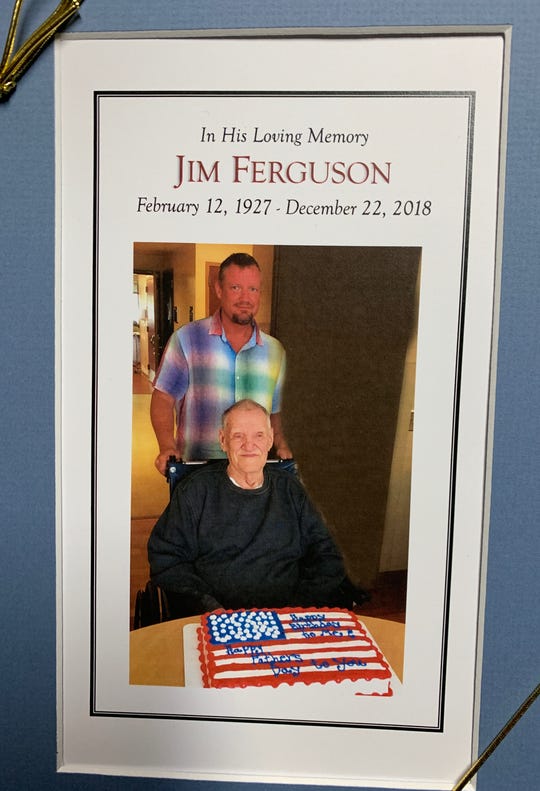
Jim Ferguson wanted answers.
How
was his 91-year-old father, who served in the U.S. Navy in World War
II, fatally injuredin a Veterans Affairs nursing home, the institution
Ferguson had entrusted to care for him?
Huddled
around a computer monitor with managers at the VA in Des Moines, Iowa,
Ferguson watched a hallway surveillance video that depicted a chilling
blow to his father's head.
“I lost it,” Ferguson told USA TODAY. “I broke down.”
In
the video, James “Milt” Ferguson Sr., who had dementia and was legally
blind, appears confused. He opens a hallway door, rolls his wheelchair
into another resident’s room, then wheels back out. No staff members are
visible. He circles around and heads back into the room.
Halfway through the door, his chair flips over backwards. Milt Ferguson crashes
to the floor, landing on the back of his head. Ferguson said he was
told the chair was pushed over by the resident in the room, who can't be
seen in the video. As staff members rush to assist him, Ferguson is
able to turn over and sit up, but the impact causes a massive brain
bleed that will kill him within days.
What later
would turn the son’s despair into outrage was what he learned about
events leading up to his father wheeling around unsupervised last
December, and what happened after he smashed into the floor.
“It’s like my dad died at their hands,” Ferguson said.
A surveillance camera captured footage of James Ferguson Sr.’s fatal
injury at a Veterans Affairs nursing home. Caution: footage may be
disturbing.
USA TODAY
Serious
problems with resident care have occurred in many VA nursing homes
across the nation, including the one where Ferguson was being cared for.
USA TODAY reported in March that inspections by a private contractor hired by the VA found deficiencies that caused "actual harm" to veterans at
more than half of the 99 VA nursing homes reviewed. The inspections
found inadequate supervision or hazardous conditions at 53 of them.
James “Milt” Ferguson Sr. remembrance. (Photo: Family Photo)
In
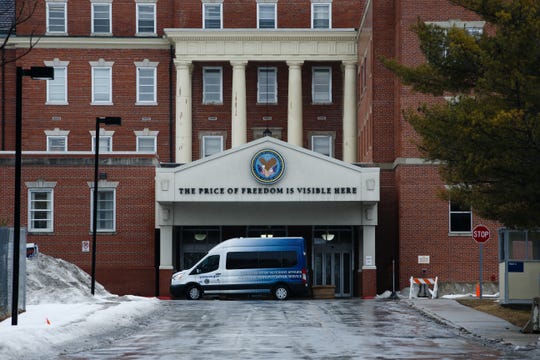
Des Moines – which received the lowest one star out of five in the VA's
own ratings, based on surprise inspections – inspectors found managers
did not ensure staff treated residents with dignity or followed
basic infection-control and prevention measures.
The
story of what happened to James Ferguson in Des Moines provides a
deeper picture of the care one elderly veteran received. Medical records
provided to USA TODAY by his son and legal guardian outline what
specialists say was a concerning series of decisions by VA staff, before
and after his deadly head injury.
Nine
days before, VA caregivers determined Ferguson was a danger to himself
and others because his dementia caused him to wander around, agitated.
They had him on continuous one-on-one observation with an aide, but took
him off the strict monitoring when he entered the VA nursing home.
There, staff didn't reinstate the heightened observation, despite his
repeatedly straying dangerously into other residents' rooms.
After
his injury, staff put him back in his wheelchair but did not report the
incident to a supervisor for 40 minutes, the records and surveillance
video indicate. Ferguson wasn't transported to an emergency room for two
hours after that. Then, it took 2½ hours more to send him to a trauma
hospital. The time stamp on the video showed the fall occurred at
3:49 p.m. and it wasn't until just before 9 p.m. that Ferguson was
transported to the trauma facility.
'A disaster waiting to happen'
Specialists who reviewed Ferguson's medical records at the request of USA TODAY expressed concern about the quality of his care.
"It
was definitely a disaster waiting to happen, and it did," said Robyn
Grant, director of public policy and advocacy at The National Consumer
Voice for Quality Long-Term Care, a Washington-based nonprofit advocacy
organization.
"I just am really struck by the
predictability with his repeated episodes of going into other people's
rooms," she said. "They should have had some intervention so they could
provide him with adequate supervision and address the wandering."
Grant
said the length of time it took afterward to adequately evaluate and
diagnose the severity of his injury and get him to a trauma
facility also raises questions. "What was happening there, in terms of
those delays?" she said.
Richard Mollot, executive director since 2005 of the
Long Term Care Community Coalition, a New York City-based nonprofit
advocate of nursing home care improvement, said the shortfalls indicate
there was "very likely" a lack of skilled or adequately trained staff to
meet his needs.
"The point of being in that environment is that you have skilled nursing care and monitoring," he said.
Mollot
said the reporting delay is particularly concerning. "How often does
this happen that no one's looking at? That's what is so upsetting."
'All staff acted properly'
A
spokesman for the Des Moines VA, Timothy Hippen, said in a statement
that a review after the "untimely death" concluded "all staff acted
properly."
"Any time an unexpected death occurs, VA
Central Iowa Health Care System reviews its policies and procedures to
see if changes are warranted," he said. "We did that here, finding that
all staff acted properly."
In
response to questions about the case, national VA spokesman Curt
Cashour accused USA TODAY of focusing on "isolated complaints" and
"cherry-picking the experiences of a handful of veterans to create the
impression of a broad problem."
Cashour maintained
that, overall, VA nursing homes "compare closely" with non-VA
facilities. More than 40,000 veterans rely on care at the agency’s 134
nursing facilities each year.
Hippen declined to respond to detailed questions about Ferguson's case.
"We
will not be addressing the specifics of this case publicly, but we have
been in direct contact with the veteran’s family to discuss their
concerns," he said.
Jim Ferguson said he remains
upset even though VA officials shared the surveillance video with him
and said they were sorry about what happened to his father.
He wants VA staff held accountable. He wants to make sure policies are in place so it doesn't happen to anyone else.
“No
one should live their life like that and have what happened to him in
the end,” he said. “I want this to be the last person this happens
to.”
A gambler called ‘booger’
Even as his dementia worsened, Milt Ferguson flashed glimmers of his younger self.
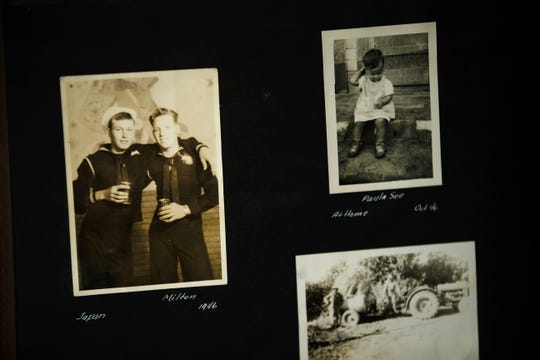
The former deckhand on the heavy cruiserU.S.S.
Pensacola was affectionately known as “booger” at the Des Moines
Register, where he worked bundling newspapers for 23 years before
retiring in 1995. He loved to play the slots and the horses.
A family album shows a photo of James "Milt" Ferguson Sr., second from right, during his days in the Navy. (Photo: Brian Powers, USA TODAY Network)
On
a note in his medical record, a nurse practitioner wrote: “Patient
laughs when his nickname is mentioned.” Jim Ferguson had come for a
visit that day, as he did most days. “He was smiling and appeared to be
enjoying his son’s company,” the medical record said.
The
decision to place him in a nursing home had been a gut-wrenching one,
Ferguson said. He had moved in with his parents and cared for them for
three years. But in April 2018 his mother died. He said a VA social
worker told him his father needed more intensive, round-the-clock care
and supervision.
“They made it sound like, well, if
he got hurt, I could be charged with a crime,” Ferguson said. “So
that’s when I decided to place him in a nursing home.”
‘His dementia was acting up’
Ferguson
moved his father to Bishop Drumm Retirement Center, a private facility
just outside Des Moines, where his mother worked as a nursing assistant
in the Alzheimer’s unit for more than 20 years before retiring.
The center took in Milt Ferguson last August. But three months later, his condition worsened.
"The day before Thanksgiving, I got a call from Bishop Drumm – his dementia was acting up," his son said.
He
hit two staff members, was “agitated all day” and was “wandering into
other residents room(s), causing distress,” a nurse later noted in
his medical record. “He is generally ‘sweet’ so this is a departure from
his usual behavior.”
Ferguson was taken by
ambulance to the Des Moines VA Medical Center, where he was admitted to
the acute psychiatry ward. He was put on one-on-one observation with a
sitter – an aide tasked with intervening if he lashed out or tried to
stray into other patients’ rooms.
They adjusted his
medications, and, after a few aggressive outbursts, he appeared calm
enough after three weeks to transfer into the VA nursing home on the
medical center’s campus.
But there was a catch, a psychiatric nurse wrote in his record: "Veterans are not put on sitter status over there."
‘Help me, help me’
After a 22-hour trial period without a sitter, Milt Ferguson moved in to the VA nursing home.
Problems began within hours.
He
hardly slept, he hallucinated, he called out "help me, help me" over
and over again. He was agitated and again, he "wandered into and out of
peers rooms" day after day, nursing staff wrote in his record.
They gave him medication. Sometimes he calmed down. Sometimes he didn’t.
A
psychiatrist was managing his case remotely. According to public
records, the doctor worked at a VA facility a few hours away in Lincoln,
Nebraska. Through virtual appointments, the psychiatrist advised
changes to Ferguson's medication.
On December 19, a
week after Ferguson moved in, nursing home staff noted he was still
restless and anxious, pacing and screaming and yelling. His care team –
psychiatrist, primary care doctor, nursing staff and social workers –
met to discuss the case.
The psychiatrist said a
review of his records showed "increased confusion with wandering" during
the past week. The doctor prescribed higher dosages of a
mood-stabilizing drug and a sedative. There was no discussion of closer
supervision or reinstatement of one-on-one observation, the records
show.
“Will ask RN to contact this MD in one week with update,” the psychiatrist wrote.
By then, Ferguson would be dead.
‘A golf ball-sized lump’
On
December 20, when two aides rushed to help Milt Ferguson, his head on
the floor and legs crumpled to the side, the time stamp on the hallway
surveillance video reads 3:49 p.m. But in a report filled out an hour
later, a nurse recorded the time of the accident as 4:30 p.m.
His
records do not indicate what the staff did with Ferguson during the
41 minutes in between, aside from putting him back in his wheelchair.
By
that time, he had a “golf ball-sized lump on the back of his head.” The
nurse notified the manager on duty, a nurse practitioner, who wrote at
5:06 p.m. that hehad ordered an immediate CT scan of his head.
That
didn’t happen until about 6:30 p.m., when Ferguson arrived in the
emergency department of the medical center on the Des Moines VA campus,
on a bed wheeled by a nursing home aide. The aide said Ferguson had
earlier been taken for a CT scan but was uncooperative.
An
emergency room doctor quickly had a sedative administered and the scan
was completed. By that point, the World War II veteran had a “large
bleed” in the back right side of his brain that was so acute, the CT
report says his brain had shifted to the left inside his skull.
Sent 'to scanning’
The
doctor notified MercyOne Des Moines Medical Center, a trauma hospital,
at 7 p.m. For nearly two hours, the doctor tried to keep Ferguson
comfortable and his blood pressure under control until an ambulance
arrived and took Ferguson to Mercy at 8:55 p.m.
The doctor also kept calling Ferguson’s son, leaving voicemails.
But
Jim Ferguson had himself been admitted to a hospital and had provided
the VA nursing home with a consent form authorizing staff to contact a
close friend if anything happened to his father. That form had been sent
"to scanning” that morning.
When Jim Ferguson retrieved all the voicemails, he rushed to Mercy the next morning.
"He
was not responsive. He was laying on his bed, making this horrible
noise as they sucked saliva out of his mouth," he said. "I never even
got to say any last words to my dad."
He died the next day.
Specialists
who reviewed the case at the request of USA TODAY singled out multiple
shortfalls in his care at the VA that may have affected the outcome.
Grant,
the policy director at The National Consumer Voice for Quality
Long-Term Care, said the 22-hour trial of having no sitter was "not
enough time to establish how he was doing."
When
he then acted out day after day, in agitation and confusion, they
should not have allowed him to wander into other residents' rooms, she
said. Such situations can cause the other residents to lash out in fear
or distress and "lead to an altercation or violence or striking out."
"One
would argue that could have been prevented," she said. "There should
have been somebody, somewhere who could have seen that this happened and
– particularly when he wheeled himself – to have gone in and
intervened, 'Let me help you, let's go to your room.'"
Mollot,
the executive director at the Long Term Care Community Coalition, said
meeting the standards of care means staff identifies risks and needs and
ways to meet them and mitigate them and then does so consistently.
"This is exactly the kind of thing that happens when those standards are not followed," he said.
'A safe place'
The
spokesman for the Des Moines VA, while declining to answer detailed
questions about what happened, said that in general, "caring for nursing
home residents involves balancing patients’ independence with the need
for supervision, as appropriate."
"While tight
scrutiny and strict limits on residents’ activities and freedom of
movement could possibly lower the risk for adverse events, it would also
severely degrade patients’ quality of life, which is precisely what we
are trying to preserve for as long as possible," he said.
Jim
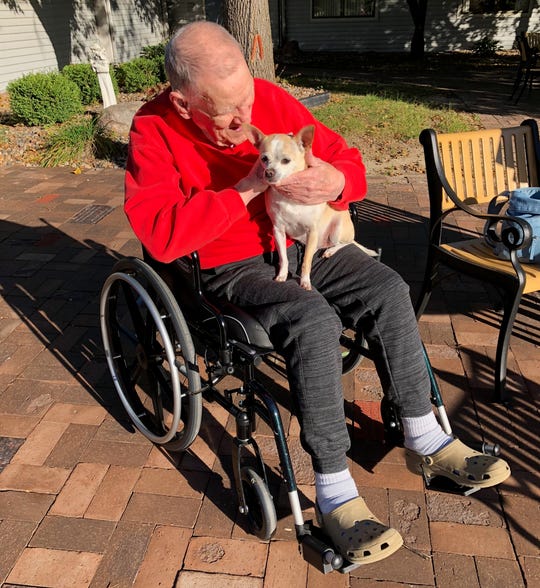
Ferguson still has his father’s wheelchair in the garage. He keeps the
sweatshirt his father was wearing when he last used the chair.Ferguson has retained a lawyer, Brad Biren, to help him figure out next steps and how to hold the VA accountable.
“Somebody didn’t watch my dad and let him die,” he said. “It’s supposed to be a safe place.”
Ohio swindlers posing as caregivers are rarely jailed for crimes
involving financial exploitation of the elderly, despite thousands of
complaints statewide, a 5 On Your Side investigation found.
Financial crimes against the elderly have increased. One in 5 elderly people are victims to the tune of $3 billion a year, according to a report
released last year by the National Conference of State Legislators.
County-operated offices of Adult Protective Services (APS)
are charged with protecting the elderly. They are mandated to
investigate complaints of abuse, neglect and financial exploitation
within three days of a complaint. They then decide on whether they will
refer a case to law enforcement, including county prosecutors and
police.
But we found an alarmingly low number of financial
exploitation cases are actually referred to law enforcement despite a
growing number of complaints.
Complaints mount, few referred
No
agency tracks the outcome of investigations by law enforcement, and
data is not kept on how many cases actually result in convictions.
But
Cuyahoga County data shows in 2017, there were 586 allegations of
financial exploitation there. This increased to 810 allegations last
year.
There could be even more incidents. A 2018 report
by the U.S. Securities and Exchange Commission revealed, “the
overwhelming majority of elder financial exploitation go unreported to
authorities.”
We reviewed statewide data filed with the Ohio Department of Jobs and Family Services
, collected from county-operated offices of APS, to find out how often complaints are made.
· In 2017, we found 2,955 complaints filed statewide alleging exploitation.
·
Last year, that increased to 4,442 complaints. Only 124 complaints were
referred to law enforcement for further investigation and prosecution.
One of those complaints involved 89-year-old Chuck Bauer.
Bauer,
who passed away in January, was recently widowed and befriended by
37-year-old Latasha Wisniewski who moved in and promised to take care of
him.
Instead, she’s charged with stealing hundreds of thousands
of dollars from Bauer’s accounts and even adding her name to the deed to
his home.
Wisniewski was indicted last November
and has pleaded not guilty in the case that is scheduled for trial on March 25in Cuyahoga County Common Pleas Court.
But
Bauer’s family insisted Cuyahoga County APS failed to investigate the
case despite repeated calls for help, allowing Bauer’s finances to be
wiped out.
Both Bauer’s daughter and granddaughter said they
quickly grew suspicious of the 37-year-old’s interest and turned to
protective services for help.
“We had to constantly contact them — they would never even contact us,” said Bauer’s granddaughter, Jennifer Bugnar.
Parma Heights Police launched its own investigation after the Bauer family reached out to an FBI agent for help.
“I
am grateful to the detectives that stepped in but not so much to Adult
Protective Services,” said Bauer’s daughter, Debbie Sheridan, “because I
don’t think they did their due diligence on this.”
Cuyahoga County APS denied it failed to act quickly and said it is limited in what it can do when the victim fails to cooperate.
Cuyahoga
County Prosecutor Brent Kirvel, who is prosecuting the case against
Wisniewski, said that even though family members were suspicious, Bauer
initially refused to cooperate, believing Wisniewski had his best
interests at heart.
In addition, county APS said Bauer was “found
to be competent,” and that finding makes it even more difficult to
investigate and prosecute “because the elderly have their own rights” to
self-determination.
Those limitations are echoed by the National Adult Protective Services Association in a 2018 report
that found, “APS cannot take action on behalf of adults who have cognitive capacity to make informed decisions.”
Bauer’s family finally convinced him he was being swindled, but only after his life savings was drained.
A lack of funds
We
found APS in Ohio is a fragmented system of underfunded and
understaffed agencies — each operated independently across the state.
“You have to understand,” said Marlene Robinson-Statler, Executive Director of Cuyahoga County’s Adult Senior Services
, “that we are limited based on funding and based on our state mandate of what we have to do.”
We also uncovered APS is not required to do criminal background checks.
This
is critical because our investigation found Bauer’s caregiver had a
long criminal history prior to becoming his caregiver, including two
prison sentences. One stemmed from a theft from a disabled victim.
Cuyahoga County officials admitted they never checked.
Poor funding and inadequate training have long been a concern to the Ohio Coalition for Adult Protective Services
(OCAPS), the state’s leading advocacy group for adult protection.
OCAPS
Executive Director Susan Marshall said she is “absolutely convinced”
cases of financial exploitation are going without investigation and
prosecution across Ohio.
“Some of it might be a misunderstanding
of just how much information law enforcement needs to progress in
something,” Marshall said.
We found those investigating financial exploitation also have limited training and resources.
“Are
they mandated to be licensed social workers? No, they are not,”
admitted Robinson-Statler, agreeing that investigators “essentially take
a couple of courses and go out.”
In addition, funding varies across the state and is barely enough to hire one staff member.
Unprotected
Last
year, Cuyahoga County received only $30,000 in state funding. The
remainder is up to county taxpayers through taxes raised by adult senior
levies.
Each county across Ohio is on their own, and we found 14
counties that have no APS at all — leaving nearly half a million seniors
in those counties unprotected from swindlers.
For example,
Cuyahoga County has the highest number of seniors over age 60 with
290,762 residents. The county’s senior tax levy raises $16 million
dollars that supports a wide range of programs offered by county APS,
including $4 million designated for adult protection.
Overall, the
county APS serves 30,722 clients in programs including protective
services, homes support, community social programs and options for
independent living.
But the funding levels vary dramatically from county to county, and according to a 2018 report
by the Center for Community Solutions
that analyzed senior tax levies, the inconsistencies result in “a
system where your address alone can determine what level of services is
available.”
Another report
, issued by the same group which functions as a non-partisan think tank,
found, 1 in 10 individuals ages 60 and older are living at home, and a
“growing number of Ohioans who choose to remain in their homes may
experience abuse, neglect or exploitation,” posing an increased risk of
financial exploitation and abuse.
Policy Matters
is another non-profit group stressing the need for increased funding for adult protection.
In a report
they released last year, they found “the state underfunds protective
services, leaving counties without enough to address growing needs.”
The Ohio Association of Area Agencies on Agingreports
Ohio has the sixth largest overall population age 65 and over in the
nation. The Association called on legislators to increase funding with a
base allocation of at least $65,000 per county per year, with
additional dollars allocated by formula.
Looking ahead
There have been some recent efforts to strengthen adult protective services on a state level.
The
Ohio Department of Jobs and Family Services is investing $1.3 million
to develop an online referral system for reporting suspected elder abuse
and develop online training for individuals required by law to report
suspicions of elder abuse that recently expanded to include bank
employees, financial planners and real estate agents.
64-year-old Catie Cassidy with lung cancer. Life Legal Defense Foundation / Youtube screen grab
May 2, 2019 (LifeSiteNews) – The 64-year-old woman at reported risk of being euthanized by a Minnesota hospital has received a reprieve after a pro-life legal non-profit intervened on her behalf.
Catie Cassidy is resting comfortably, according to Life Legal Defense
Foundation (LLDF), after the hospital agreed to abide by her wishes and
those of her healthcare proxy and not remove Catie’s oxygen.
“We received news today that Fairview Hospital in Edina is fully
cooperating with Catie’s health care proxy and that they will continue
to provide Catie with oxygen as needed,” the Foundation said in a
statement.
The hospital received a lot of calls and even visits from people
concerned about the case, LLDF Executive Director Alexandra Snyder told
LifeSiteNews.
“Thank you so much to all who showed up for Catie by getting the word
out and calling the hospital,” Snyder said. “You are amazing!”
LLDF attorneys had sent a demand letter informing the hospital of its
duties under Minnesota law after learning the hospital had planned to
remove Cassidy’s oxygen on Wednesday morning.
Cassidy is a lung cancer patient, and without supplemental oxygen, she would have suffocated to death.
She had communicated in no uncertain terms
in a video that went viral earlier this week that she did not want the
hospital to “pull the plug” on her oxygen, and that she wanted to live.
Cassidy recounted on the video
how she’d responded “no” and “no way” to the question of the hospital
pulling the plug on her oxygen, that she was not done fighting and she
wanted to live.
LLDF was contacted about Cassidy’s care by Not Dead Yet, a disability
rights group in New York that opposes assisted suicide and euthanasia.
The Foundation then heard from the daughter of Cassidy’s healthcare
proxy, who provided the video of Cassidy emphatically stating her wish
to live.
“Life Legal is pleased that Catie will receive the care she needs and
that her wish to fight for her life as long as she can will be
honored,” the legal non-profit said in its statement.
Snyder expressed gratitude to the non-profit’s Minnesota team,
including local attorneys Wayne Holstad and Craig Beuning, who
intervened immediately on Cassidy’s behalf.
Withdrawing Cassidy’s oxygen to cause her death would be active
euthanasia, Snyder had said Tuesday, which is illegal in Minnesota and
every other state.
The hospital released a statement saying that it does its best to honor the wishes of patients and does not practice euthanasia.
Because of privacy laws, we cannot comment on a specific patient’s
medical condition. We can share, however, how we address end-of-life
care. End-of-life care is focused on comfort care during the dying
process. We communicate closely with the patient or, if they are unable
to participate in conversation, with their designated decision-maker if
they have one. We do our best to honor the patient’s known wishes,
whether those wishes are to prolong life or to stop treatment.
Euthanasia is illegal in the State of Minnesota, and our health system does not practice it.
It is always our goal to provide medically appropriate and ethical
care and comfort to our patients with the utmost dignity and honor.
Snyder expressed confidence that the widespread attention brought to
Cassidy’s treatment would be instrumental in ensuring that Cassidy’s
wishes to live going forward are respected.
“It is time for us to have a larger conversation about the inherent
value of every human life and about our moral obligation to protect
those who are most vulnerable,” she remarked.
She said LLDF had heard from people who could not believe that
Cassidy could have her oxygen withdrawn, when it would clearly mean
ending her life.
“People need to wake up to the fact that this is happening,” Snyder
told LifeSiteNews. “And that they need to fight for themselves and for
their loved ones.”
State Sen. James Maroney speaks in favor of a bill that passed the
Senate April 26 to create a registry of offenders who have abused the
elderly or adults with disabilities. Contributed photo.
Legislation to create and publicize a public database of offenders
who have abused the elderly or adults with disabilities passed the State
Senate April 26 by a bipartisan, unanimous vote.
State Sen. James Maroney (D-Milford), who co-chairs the Aging
Committee, said this legislation will provide peace of mind to the
elderly and their families.
“Connecticut is the sixth oldest state in the nation, and as
investigations of elder abuse have doubled in the past several years in
our state, it is vital to our community to protect this populace and
this bill is a step in the right direction,” Maroney said. “I look
forward to continue working with all my colleagues to get this bill
signed into law.”
Senate Bill 832, “An Act Concerning Registries of Persons Found
Responsible For Assaults or Other Abuse, Neglect, Exploitation or
Abandonment of Elderly Persons or Persons with Disabilities,” will
create a public database combining existing registries of offenders who
have been convicted of assault or any form of abuse.
The Department of Emergency Services and Public Protection will
establish and maintain the database and the Department of Health will
publish the database on its website. The executive director of the
Commission on Women, Children and Seniors will also provide a portal on
its website which links to publicly available databases.
Twenty-six states are using elder abuse registries, according to the
National Adult Protective Services Association. Despite some estimates
ranging as high as five million elders being victims of abuse each year,
only one in 14 cases are reported to the authorities, according to the
National Council on Aging. Elders who have been victims of abuse have a
300 percent higher risk of death compared to elders who have not been
abused, according to the NCOA.
“Other states have taken this step in order to protect their elderly
community and we must do the same,” Maroney said. “This legislation will
ensure that everyone has the necessary information to keep their loved
ones safe from abuse, neglect or exploitation. These heartbreaking cases
of abuse are preventable, and I am pleased we are moving in the right
direction to ensure the elderly, adults with disabilities and their
families no longer have to suffer.”
Before Senate approval, SB 832 was successfully voted out of the
Aging Committee by a unanimous vote. The bill now awaits action the
House of Representatives. If enacted, the legislation will go into
effect on no later than Jan. 1, 2020.