Showing posts with label VA nursing homes. Show all posts

Monday, May 6, 2019

‘My dad died at their hands’: WWII vet fatally injured in VA nursing home


Surveillance video captured the deadly blow to the head of 91-year-old James “Milt” Ferguson Sr. Specialists say it could have been prevented. USA TODAY

Jim Ferguson wanted answers.

How was his 91-year-old father, who served in the U.S. Navy in World War II, fatally injuredin a Veterans Affairs nursing home, the institution Ferguson had entrusted to care for him?

Huddled around a computer monitor with managers at the VA in Des Moines, Iowa, Ferguson watched a hallway surveillance video that depicted a chilling blow to his father's head.

“I lost it,” Ferguson told USA TODAY. “I broke down.”

In the video, James “Milt” Ferguson Sr., who had dementia and was legally blind, appears confused. He opens a hallway door, rolls his wheelchair into another resident’s room, then wheels back out. No staff members are visible. He circles around and heads back into the room.

Halfway through the door, his chair flips over backwards. Milt Ferguson crashes to the floor, landing on the back of his head. Ferguson said he was told the chair was pushed over by the resident in the room, who can't be seen in the video. As staff members rush to assist him, Ferguson is able to turn over and sit up, but the impact causes a massive brain bleed that will kill him within days.

What later would turn the son’s despair into outrage was what he learned about events leading up to his father wheeling around unsupervised last December, and what happened after he smashed into the floor.

“It’s like my dad died at their hands,” Ferguson said.

A surveillance camera captured footage of James Ferguson Sr.’s fatal injury at a Veterans Affairs nursing home. Caution: footage may be disturbing. USA TODAY

Serious problems with resident care have occurred in many VA nursing homes across the nation, including the one where Ferguson was being cared for.

USA TODAY reported in March that inspections by a private contractor hired by the VA found deficiencies that caused "actual harm" to veterans at more than half of the 99 VA nursing homes reviewed. The inspections found inadequate supervision or hazardous conditions at 53 of them.
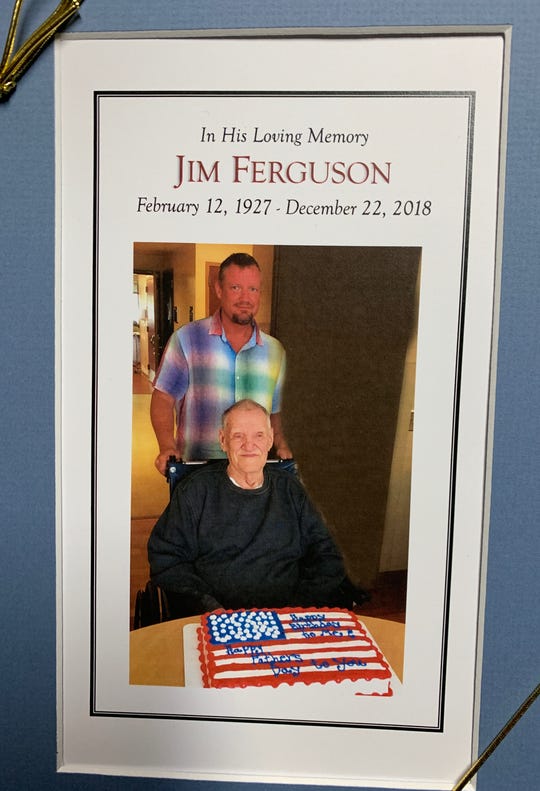
James “Milt” Ferguson Sr. remembrance.
(Photo: Family Photo)
In Des Moines – which received the lowest one star out of five in the VA's own ratings, based on surprise inspections – inspectors found managers did not ensure staff treated residents with dignity or followed basic infection-control and prevention measures.

The story of what happened to James Ferguson in Des Moines provides a deeper picture of the care one elderly veteran received. Medical records provided to USA TODAY by his son and legal guardian outline what specialists say was a concerning series of decisions by VA staff, before and after his deadly head injury.

Nine days before, VA caregivers determined Ferguson was a danger to himself and others because his dementia caused him to wander around, agitated. They had him on continuous one-on-one observation with an aide, but took him off the strict monitoring when he entered the VA nursing home. There, staff didn't reinstate the heightened observation, despite his repeatedly straying dangerously into other residents' rooms.

After his injury, staff put him back in his wheelchair but did not report the incident to a supervisor for 40 minutes, the records and surveillance video indicate. Ferguson wasn't transported to an emergency room for two hours after that. Then, it took 2½ hours more to send him to a trauma hospital. The time stamp on the video showed the fall occurred at 3:49 p.m. and it wasn't until just before 9 p.m. that Ferguson was transported to the trauma facility.

'A disaster waiting to happen'


Specialists who reviewed Ferguson's medical records at the request of USA TODAY expressed concern about the quality of his care.

"It was definitely a disaster waiting to happen, and it did," said Robyn Grant, director of public policy and advocacy at The National Consumer Voice for Quality Long-Term Care, a Washington-based nonprofit advocacy organization.

"I just am really struck by the predictability with his repeated episodes of going into other people's rooms," she said. "They should have had some intervention so they could provide him with adequate supervision and address the wandering."

Grant said the length of time it took afterward to adequately evaluate and diagnose the severity of his injury and get him to a trauma facility also raises questions. "What was happening there, in terms of those delays?" she said.

Richard Mollot, executive director since 2005 of the Long Term Care Community Coalition, a New York City-based nonprofit advocate of nursing home care improvement, said the shortfalls indicate there was "very likely" a lack of skilled or adequately trained staff to meet his needs.

"The point of being in that environment is that you have skilled nursing care and monitoring," he said.

Mollot said the reporting delay is particularly concerning. "How often does this happen that no one's looking at? That's what is so upsetting."

'All staff acted properly'


A spokesman for the Des Moines VA, Timothy Hippen, said in a statement that a review after the "untimely death" concluded "all staff acted properly."

"Any time an unexpected death occurs, VA Central Iowa Health Care System reviews its policies and procedures to see if changes are warranted," he said. "We did that here, finding that all staff acted properly."
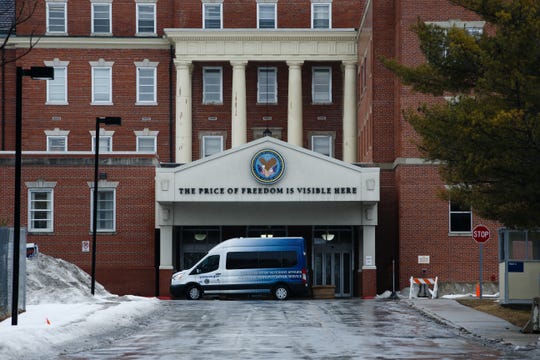


In response to questions about the case, national VA spokesman Curt Cashour accused USA TODAY of focusing on "isolated complaints" and "cherry-picking the experiences of a handful of veterans to create the impression of a broad problem."

Cashour maintained that, overall, VA nursing homes "compare closely" with non-VA facilities. More than 40,000 veterans rely on care at the agency’s 134 nursing facilities each year.

USA TODAY reported last year that about 70% of VA nursing homes scored worse than non-VA nursing homes on a majority of quality indicators tracked by the agency, which include rates of infection, serious pain and bed sores.

Hippen declined to respond to detailed questions about Ferguson's case.

"We will not be addressing the specifics of this case publicly, but we have been in direct contact with the veteran’s family to discuss their concerns," he said.

Jim Ferguson said he remains upset even though VA officials shared the surveillance video with him and said they were sorry about what happened to his father.

He wants VA staff held accountable. He wants to make sure policies are in place so it doesn't happen to anyone else.

“No one should live their life like that and have what happened to him in the end,” he said. “I want this to be the last person this happens to.”

A gambler called ‘booger’


Even as his dementia worsened, Milt Ferguson flashed glimmers of his younger self.

The former deckhand on the heavy cruiserU.S.S. Pensacola was affectionately known as “booger” at the Des Moines Register, where he worked bundling newspapers for 23 years before retiring in 1995. He loved to play the slots and the horses.
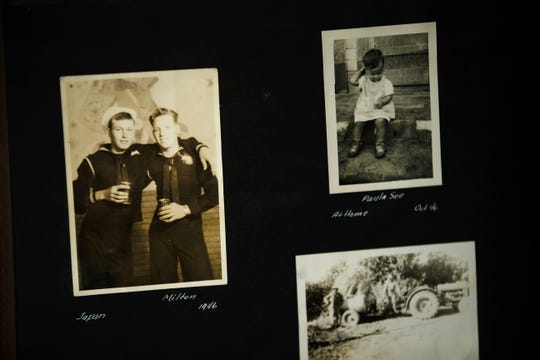
A family album shows a photo of James "Milt" Ferguson Sr., second from right, during his days in the Navy. (Photo: Brian Powers, USA TODAY Network)


On a note in his medical record, a nurse practitioner wrote: “Patient laughs when his nickname is mentioned.” Jim Ferguson had come for a visit that day, as he did most days. “He was smiling and appeared to be enjoying his son’s company,” the medical record said.

The decision to place him in a nursing home had been a gut-wrenching one, Ferguson said. He had moved in with his parents and cared for them for three years. But in April 2018 his mother died. He said a VA social worker told him his father needed more intensive, round-the-clock care and supervision.

“They made it sound like, well, if he got hurt, I could be charged with a crime,” Ferguson said. “So that’s when I decided to place him in a nursing home.”

‘His dementia was acting up’


Ferguson moved his father to Bishop Drumm Retirement Center, a private facility just outside Des Moines, where his mother worked as a nursing assistant in the Alzheimer’s unit for more than 20 years before retiring.

The center took in Milt Ferguson last August. But three months later, his condition worsened.
"The day before Thanksgiving, I got a call from Bishop Drumm – his dementia was acting up," his son said.
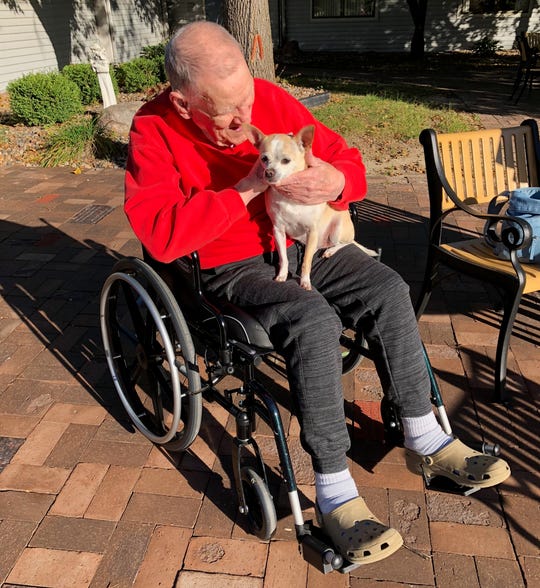


He hit two staff members, was “agitated all day” and was “wandering into other residents room(s), causing distress,” a nurse later noted in his medical record. “He is generally ‘sweet’ so this is a departure from his usual behavior.”

Ferguson was taken by ambulance to the Des Moines VA Medical Center, where he was admitted to the acute psychiatry ward. He was put on one-on-one observation with a sitter – an aide tasked with intervening if he lashed out or tried to stray into other patients’ rooms.

They adjusted his medications, and, after a few aggressive outbursts, he appeared calm enough after three weeks to transfer into the VA nursing home on the medical center’s campus.

But there was a catch, a psychiatric nurse wrote in his record: "Veterans are not put on sitter status over there."

‘Help me, help me’


After a 22-hour trial period without a sitter, Milt Ferguson moved in to the VA nursing home.

Problems began within hours.

He hardly slept, he hallucinated, he called out "help me, help me" over and over again. He was agitated and again, he "wandered into and out of peers rooms" day after day, nursing staff wrote in his record.

They gave him medication. Sometimes he calmed down. Sometimes he didn’t.

A psychiatrist was managing his case remotely. According to public records, the doctor worked at a VA facility a few hours away in Lincoln, Nebraska. Through virtual appointments, the psychiatrist advised changes to Ferguson's medication.

On December 19, a week after Ferguson moved in, nursing home staff noted he was still restless and anxious, pacing and screaming and yelling. His care team – psychiatrist, primary care doctor, nursing staff and social workers – met to discuss the case.

The psychiatrist said a review of his records showed "increased confusion with wandering" during the past week. The doctor prescribed higher dosages of a mood-stabilizing drug and a sedative. There was no discussion of closer supervision or reinstatement of one-on-one observation, the records show.

“Will ask RN to contact this MD in one week with update,” the psychiatrist wrote.

By then, Ferguson would be dead.

‘A golf ball-sized lump’


On December 20, when two aides rushed to help Milt Ferguson, his head on the floor and legs crumpled to the side, the time stamp on the hallway surveillance video reads 3:49 p.m. But in a report filled out an hour later, a nurse recorded the time of the accident as 4:30 p.m.

His records do not indicate what the staff did with Ferguson during the 41 minutes in between, aside from putting him back in his wheelchair.

By that time, he had a “golf ball-sized lump on the back of his head.” The nurse notified the manager on duty, a nurse practitioner, who wrote at 5:06 p.m. that he had ordered an immediate CT scan of his head.

That didn’t happen until about 6:30 p.m., when Ferguson arrived in the emergency department of the medical center on the Des Moines VA campus, on a bed wheeled by a nursing home aide. The aide said Ferguson had earlier been taken for a CT scan but was uncooperative.

An emergency room doctor quickly had a sedative administered and the scan was completed. By that point, the World War II veteran had a “large bleed” in the back right side of his brain that was so acute, the CT report says his brain had shifted to the left inside his skull.

Sent 'to scanning’


The doctor notified MercyOne Des Moines Medical Center, a trauma hospital, at 7 p.m. For nearly two hours, the doctor tried to keep Ferguson comfortable and his blood pressure under control until an ambulance arrived and took Ferguson to Mercy at 8:55 p.m.

The doctor also kept calling Ferguson’s son, leaving voicemails.
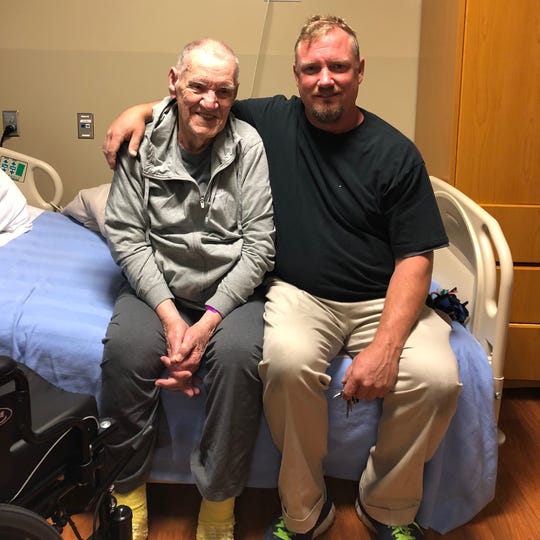


But Jim Ferguson had himself been admitted to a hospital and had provided the VA nursing home with a consent form authorizing staff to contact a close friend if anything happened to his father. That form had been sent "to scanning” that morning.

When Jim Ferguson retrieved all the voicemails, he rushed to Mercy the next morning.

"He was not responsive. He was laying on his bed, making this horrible noise as they sucked saliva out of his mouth," he said. "I never even got to say any last words to my dad."

He died the next day.

Specialists who reviewed the case at the request of USA TODAY singled out multiple shortfalls in his care at the VA that may have affected the outcome.

Grant, the policy director at The National Consumer Voice for Quality Long-Term Care, said the 22-hour trial of having no sitter was "not enough time to establish how he was doing."

When he then acted out day after day, in agitation and confusion, they should not have allowed him to wander into other residents' rooms, she said. Such situations can cause the other residents to lash out in fear or distress and "lead to an altercation or violence or striking out."

"One would argue that could have been prevented," she said. "There should have been somebody, somewhere who could have seen that this happened and – particularly when he wheeled himself – to have gone in and intervened, 'Let me help you, let's go to your room.'"

Mollot, the executive director at the Long Term Care Community Coalition, said meeting the standards of care means staff identifies risks and needs and ways to meet them and mitigate them and then does so consistently.

"This is exactly the kind of thing that happens when those standards are not followed," he said.

'A safe place'


The spokesman for the Des Moines VA, while declining to answer detailed questions about what happened, said that in general, "caring for nursing home residents involves balancing patients’ independence with the need for supervision, as appropriate."

"While tight scrutiny and strict limits on residents’ activities and freedom of movement could possibly lower the risk for adverse events, it would also severely degrade patients’ quality of life, which is precisely what we are trying to preserve for as long as possible," he said.

Jim Ferguson still has his father’s wheelchair in the garage. He keeps the sweatshirt his father was wearing when he last used the chair.Ferguson has retained a lawyer, Brad Biren, to help him figure out next steps and how to hold the VA accountable.

“Somebody didn’t watch my dad and let him die,” he said. “It’s supposed to be a safe place.”

Full Article & Source:
‘My dad died at their hands’: WWII vet fatally injured in VA nursing home

Sunday, March 31, 2019

Bed sores, smeared faces, helplessness: New reports paint dismal picture of care at VA nursing homes

A hall at the Edith Nourse Rogers Memorial Veterans Hospital in Bedford.
At the Veterans Affairs nursing home in Brockton, a severely impaired veteran with dementia sat trapped in his wheelchair for hours, his right foot stuck between the foot rests. Inspectors watched as staff walked past the struggling man without helping.

In the Cincinnati VA nursing home, one resident in six months developed five bedsores, tissue injuries that happen when frail people are left in the same position for too long. During their visit, inspectors said no one moved the man or put cushions under him for hours.

At the Bedford VA, meanwhile, inspectors watched elderly veterans smear their faces with food or drop much of their meals on the floor because they couldn’t feed themselves and staff didn’t help.

Nine months after USA Today and The Boston Globe reported that veterans received substandard care at many Department of Veterans Affairs nursing homes, newly released inspection reports paint a discouraging picture of the care that sick and frail veterans continued to receive at these federal nursing homes.

From April through December 2018, outside inspectors found deficiencies that caused “actual harm” to veterans at 52 out of the 99 VA nursing homes they reviewed. In three facilities, they found veterans’ health or safety in “immediate jeopardy.” In eight, inspectors found veterans both harmed and in jeopardy.

Non-VA nursing homes are rarely cited for causing actual harm to residents.

“That is really bad. It’s really bad,” said Richard Mollot, executive director of the Long Term Care Community Coalition, a New York-based nonprofit advocate of nursing home care improvement. He added that it’s difficult to compare VA findings with non-VA findings because those inspections may not be as rigorous.

Inspectors found that staff at more than two dozen VA nursing homes, including in Brockton, Bedford, and Cincinnati, failed to take steps to ensure existing bedsores healed or new ones didn’t develop.

Bedsores are “almost always preventable, and quickly treatable,” Mollot said. “So there’s just no excuse.”

In a statement issued when they released the inspection reports earlier this month, VA officials said residents in their nursing homes are more difficult to care for than residents in private facilities. They said 42 percent of residents last year had conditions related to military service, leaving them severely disabled.

“Overall, VA’s nursing home system compares closely with private sector nursing homes, though the department on average cares for sicker and more complex patients in its nursing homes than do private facilities,” VA Secretary Robert Wilkie said.

VA spokesman Curt Cashour said Wednesday that non-VA nursing homes also have problems. He said that, by publicly posting the VA reports for the first time, “we hope to drive improvements throughout the system.”

But Mollot said VA officials have no excuse for poor care.

“You don’t accept somebody in unless you have the ability to provide care for them, period,” he said. “It’s incredible to me that one has to even say that.”

The inspection results were made public nearly a year after the Globe and USA Today disclosed that the VA possessed the reports as well as the results of a star-based rating system for VA nursing homes. The reports’ release provides valuable information for the 41,000 elderly and infirm veterans who stay in the homes each year, as well as for their families.

“The results of these independent inspections show that serious deficiencies in care remain at VA nursing homes in Brockton and Bedford, among others,” said Senator Elizabeth Warren of Massachusetts. “We must keep conducting rigorous oversight until performance and quality of care issues are fully addressed and our veterans are receiving excellent care across the board.”

Widespread deficiencies


Across the country, inspectors found that VA nursing homes failed in one of their most fundamental duties: taking steps to prevent and control infection.

At two-thirds of VA nursing homes, they found staff often didn’t follow simple protocols, such as wearing sterile gowns and gloves when treating residents.

In Des Moines, inspectors found that managers didn’t ensure staff adequately cleaned a veteran, who contracted six urinary tract infections in seven months.

Reviewers found residents weren’t properly monitored or were subjected to hazardous conditions at more than 50 VA nursing homes.

Water used for washing hands and bathing was so dangerously hot at nursing homes in Carrollton, Ga., Martinsburg, W.Va., and St Cloud, Minn., that it could scald residents — particularly those with dementia or other conditions that make them less sensitive to pain or heat. The high temperatures — up to 128 degrees — were designed to kill legionella bacteria, but were too high to be safe, inspectors said.

In Bedford, inspectors concluded veterans were in “immediate jeopardy” because a resident with dementia who was physically unable to hold, light, or extinguish a cigarette was allowed to go outside to smoke by himself. And it wasn’t the first time. Previously, he had returned with burn holes in his clothing and on the seat cushion of his wheelchair.

In an e-mail to congressional aides earlier this month, Bedford VA director Joan Clifford said that the new findings were better than the last inspection in 2017 because inspectors identified only six problem areas compared to nine the previous year. However, the six remaining deficiencies were serious, including three that caused actual harm or immediate danger to residents.

In Chillicothe, Ohio, the VA allowed a family to hire a private aide to care for a patient with Parkinson’s disease. As the aide lay on the man’s bed looking at a cellphone, the veteran leaned dangerously forward. He had fallen four times in less than two months, once sustaining a head injury that the aide said required stitches.

The same aide was supposed to feed the man a semi-liquid diet because he had trouble swallowing, but the aide often fed him fast food. When confronted by inspectors, facility leaders agreed to immediately stop allowing untrained aides to feed residents.

The nursing home in Jackson, Miss., performed the worst of all the facilities, with failures cited in 12 areas. Residents suffered in serious pain. A veteran didn’t have a bowel movement for days, but staff didn’t tell doctors until his temperature spiked to more than 100 degrees. Veterans languished without staff-assisted exercise to help them gain or maintain muscle tone.

In just seven cases, VA nursing homes passed inspections with no identified problems. Those facilities are in Topeka and Wichita, Kan.; Orlando; Houston; Miles City, Mont.; Fargo, N.D.; and New Orleans.

Uneven transparency record


Despite the vast public investment in VA nursing homes — more than $3.6 billion in 2018 — the agency until recently had kept the findings of its annual inspections of its nursing homes confidential. The Globe and USA Today revealed last June that the VA had quietly tracked the quality of care at its nursing homes through inspection reports as well as star ratings.

Under pressure from the Globe and USA Today, the VA pledged to release the inspection reports. But that did not happen until this month, when the VA posted the reports for 99 of its nursing homes. The agency said in a release that it planned to post the remainder — 35 more reports — by October.

The news organizations reported that more than 100 VA nursing homes scored worse than private nursing homes in 2017 in quality ratings. At more than two-thirds of the homes, residents were more likely to have serious bedsores, as well as suffer serious pain.

The newly released inspection results add more depth to those findings and chronicle the misery of some veterans such as the Augusta, Maine, patient whose back wound had penetrated to the bone and who did not receive adequate medication.

“The resident moaned throughout the wound care and the moaning increased during wound cleansing and measuring,” noted an inspector who witnessed the episodes in July.

Experts say caregivers should be assessing and adjusting medications or trying other methods to make sure residents get pain relief.

“There’s very little quality of life” when you’re in constant pain, said Robyn Grant, director of public policy and advocacy at the National Consumer Voice for Quality Long-Term Care. “And veterans have gone through so much, the last thing that they should be facing is relentless pain, especially if it could be mitigated.”

Full Article & Source:
Bed sores, smeared faces, helplessness: New reports paint dismal picture of care at VA nursing homes

Saturday, November 24, 2018

‘Nothing short of horrifying:’ Veterans' groups demand fixes at VA nursing homes

WASHINGTON – Six veterans’ groups are calling on the Department of Veterans Affairs to improve the quality of care at its nursing homes following a story by USA TODAY and The Boston Globe detailing “blatant disregard for veteran safety” at a VA nursing home in Massachusetts.

“Anybody who respects veterans should be angered by this,” American Legion National Commander Brett Reistad said. “America’s veterans deserve better.”

The groups, who together represent nearly 5 million members, said veterans who risked their lives for our country shouldn’t have to risk their lives in VA nursing homes.

In Brockton, Massachusetts, investigators found two nurses asleep during their shifts, even though the facility knew it was under scrutiny and inspectors were coming to visit, looking for potential signs of patient neglect. A whistleblower had reported that nurses and aides did not empty the bedside urinals of frail veterans, they failed to provide clean water at night and didn’t check on the veterans regularly. The VA said the napping nurses no longer work at the facility.

The story was the latest in an investigation by USA TODAY and the Globe that revealed care at many VA nursing facilities was worse than at private nursing homes in the agency’s own internal ratings, kept secret from veterans for years.

The stories detailed disturbing examples of substandard care – a veteran with undiagnosed scabies for months, another struggling to eat in Bedford, Massachussetts; and a third sitting for hours in soiled sheets and another writhing in pain without medication in West Palm Beach, Florida.

A Navy veteran was declared dead after he walked out of a supposedly secure VA nursing home and was never found in Tuskegee, Alabama. An Army vet landed in intensive care suffering from malnutrition, septic shock and bed sores after a stay at a VA nursing home in Livermore, California.

“The stories being reported about the treatment of some individual veterans at these facilities are nothing short of horrifying,” said Rege Riley, national commander of American Veterans, known as AmVets. He called on VA Secretary Robert Wilkie to “take swift and transparent action to fix this.” 
   
Veterans of Foreign Wars, Disabled American Veterans, Paralyzed Veterans of America and Vietnam Veterans of America joined AmVets and the Legion in calling for action. Together, the groups are known as the “big six” and wield considerable clout in Washington.

“The VA must address and correct these issues,” said Garry Augustine, executive director of Disabled American Veterans.

VA 'striving to improve'


VA spokesman Curt Cashour said the residents the VA typically cares for are sicker than those in private nursing homes, making “achieving good quality ratings more challenging.” He said that overall, VA nursing homes “compare well” with the private sector.

“We look forward to briefing each of these groups in the near future regarding these crucial facts,” Cashour said, adding that the VA is “continuously striving to improve all of its health care facilities.”

The VA has 133 nursing homes across the country that serve 46,000 veterans annually.

Newly released VA data show that 95 of them – about 71 percent – scored worse than private nursing homes on a majority of quality indicators, such as rates of infection, serious pain and bed sores.

Roughly the same number, 93, received only one or two stars out of five for quality in the agency’s own ratings.

In a scathing statement declaring those facilities “failures,” VFW National Commander Vincent “B.J.” Lawrence said the VA “must improve its delivery of quality care at these facilities.”

"(Veterans') families deserve to know that their loved ones – their heroes – are not being abandoned or abused, and America needs to be reassured that the VA is honoring our nation's promise to those who have borne the battle," he said.


Call for transparency


Reistad, the Legion's commander, added, “We not only expect VA to fix these problems immediately, but we want transparency.” On Sunday, after his group met with VA officials, he said he is confident they will work with the Legion and the other groups to “institute needed improvements.”

The VA released the quality information on its nursing homes only after learning in June that USA TODAY and the Globe planned to publish it. The agency still has not released the results of inspections.

“Why not?” asked Rick Weidman, co-founder of Vietnam Veterans of America. He said his group often has to “fight like hell with VA in order to get information.”

The reports can include instances of neglect or poor conditions that can be a tip-off to current and prospective residents about problems at a facility.

“I don’t see how veterans are best served by the VA not being open about the level of care it’s providing,” AmVets spokesman John Hoellwarth said.

Cashour said the VA is working with an outside contractor who conducts the inspections, Wisconsin-based Long Term Care Institute, to remove patient information from its reports before they are released, maybe by the end of the year.

Private nursing homes have three years’ worth of inspection reports posted on a federal website, Nursing Home Compare.

Lawmakers demand answers


In September, Congress passed and President Donald Trump signed into law legislation requiring the VA to publish quality ratings going forward. The law does not mention inspection reports.

The Republican-led House VA Committee launched an investigation of VA nursing home care after the initial USA TODAY and Globe reports, but a spokeswoman, Molly Jenkins, said the probe won’t be finished in time to hold a hearing this year as anticipated. The Democrat poised to take over the committee in January, Rep. Mark Takano of California, said it is a “critical issue that will continue to be a priority.”

In Massachusetts, home to two, one-star VA nursing homes – in Bedford and Brockton – lawmakers are demanding to know what steps the VA has taken to improve patient care there and at other facilities around the country.

“The continued care lapses at VA facilities raise questions about whether concrete, lasting measures are being implemented to prevent misconduct from occurring again – or whether certain VA facilities are unable to institute changes necessary to provide our veterans with the care befitting their service to the country,” Sens. Ed Markey and Elizabeth Warren, both Democrats from Massachusetts, wrote in a letter to Wilkie.

They demanded the most recent report from the Long Term Care Institute inspection of the Brockton VA nursing home.

“The fact that we can’t treat Americans who put their lives on the line with dignity when their lives are on the line here at home later in life is disgusting,” said Rep. Seth Moulton, D-Mass, a veteran who receives his medical care at  the Bedford VA.

Full Article & Source:
‘Nothing short of horrifying:’ Veterans' groups demand fixes at VA nursing homes

Wednesday, September 5, 2018

Bedsores, neglect, alleged abuse: Inside low-rated VA nursing homes

Helga and Charles Amidon
BEDFORD, Mass. – The nurse’s aide was busy getting a patient ready for bed when she noticed a commotion behind a privacy curtain on the other side of the room. She heard Russ Bonanno, a 94-year-old veteran, shout, “Ow, ow, ow.”

“It sounded like fighting,” said Julee, who asked that her last name not be used out of fear of retaliation. When she went to check what was happening, she saw another aide trying to hoist Bonanno from his wheelchair to his bed, normally a two-person job.

Julee said she watched the other aide simply toss the elderly dementia patient onto the bed.
“Let me tell you how brutal that guy was with the veteran,” Julee wrote to her supervisor two days after the alleged incident May 18. “After he was done, (we) went and checked Mr. Bonanno. The guy was wet. Everything needed to be changed.”

The aide accused of roughly handling Bonanno quietly resigned, but Julee, the aide who blew the whistle, was fired two weeks later. She said her supervisor told her she had attendance problems.

Welcome to one of the lowest-rated nursing homes for veterans in the nation run by the U.S. Department of Veterans Affairs. The facility, at the VA hospital in Bedford, Massachusetts, is among 11 nationwide to earn the lowest-possible one-star rating from the agency based on both overall quality and the results of surprise inspections. The ratings are on a scale of one to five, with one being the lowest.

The others are scattered from Lyons, New Jersey, to Prescott, Arizona, and from Dayton and Chillicothe, Ohio, to Tampa, Florida. 

Full Article & Source:
Bedsores, neglect, alleged abuse: Inside low-rated VA nursing homes

Monday, June 18, 2018

Secret VA nursing home ratings hide poor quality care from the public

Don Ruch’s family thought round-the-clock care would help him recuperate, but he ended up in intensive care in septic shock, suffering from “severe” malnutrition, bedsores on his pelvis and back, a burn on his right thigh and a trauma wound. USA TODAY

World War II veteran Rosario "Russ" Bonanno was facing worsening dementia when his family brought him last year to the Department of Veterans Affairs nursing home in Bedford, Massachusetts. He had been in assisted living, but after six years, some family members thought he needed more specialized care.

Within days after Bonanno arrived, his son Nick said the 93-year-old was “dazed, confused, disheveled" as staff began medicating him. He wasn’t the only resident who looked drugged. "Everyone looks like a zombie," Nick said.

What Nick and his family didn’t know was that the Bedford facility ranked among the worst of 133 VA nursing homes across the country, in part for giving so many residents anti-psychotic drugs.

But the VA knew.

The agency has tracked detailed quality statistics on its nursing homes for years but has kept them from public view, depriving veterans of potentially crucial health care information. Nearly half of VA nursing homes nationwide – 60 – received the agency'slowest ranking of one out of five stars as of Dec. 31, 2017, according to documents obtained by USA TODAY and The Boston Globe.

The VA made some of its ratings public last week after receiving questions from the Globe and USA TODAY about all the secrecy. VA officials said President Donald Trump wanted to release the ratings all along and blamed the Obama administration for not making them public earlier.

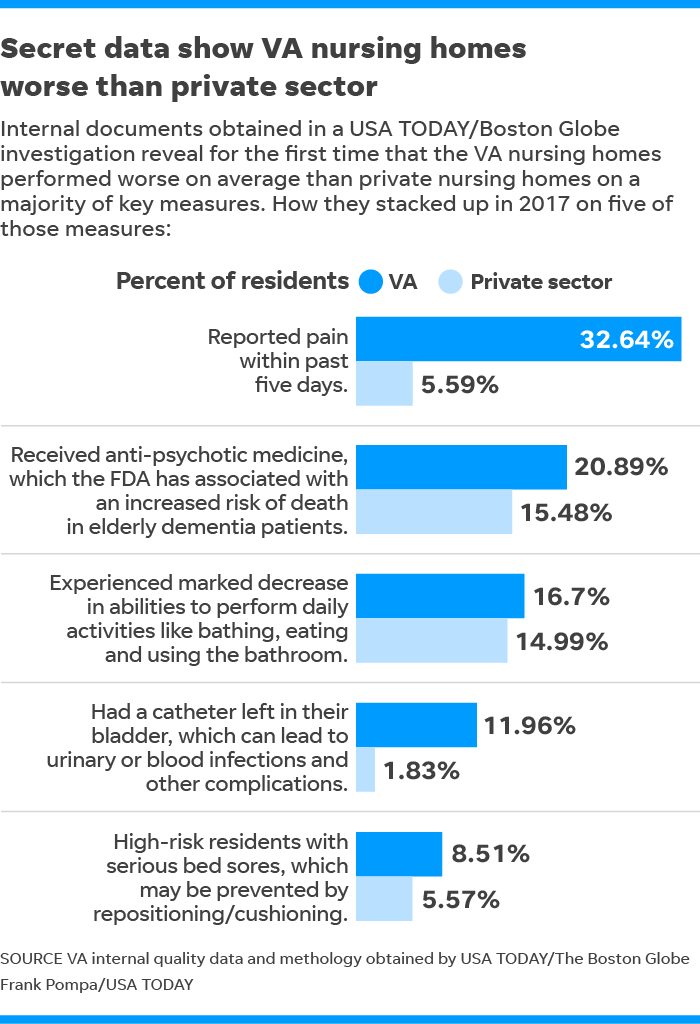
Statistics the VA has not released paint a picture of government nursing homes that scored worse on average than their private sector counterparts on nine of 11 key indicators last year, including rates of anti-psychotic drug prescription and residents’ deterioration. In some cases, the internal documents show, the VAratings were only slightly worse. In others, such as the number of residents who are in pain, the VA nursing homes scored dramatically worse.

The worst-performing VA nursing homes were scattered across 32 states, including Pennsylvania, which had five one-star facilities, as well as Texas and California, which had four each. The VA facility in Bedford and another in Brockton, Massachusetts, were the only one-star nursing homes in New England.


VA officials argued that the VA nursing home system, overall, “compares closely” with private nursing homes despite caring for typically sicker residents.

VA spokesman Curt Cashour called it “highly misleading” to compare pain levels at the VA with those at private nursing homes because VA residents have “more challenging” medical conditions. The VA's internal quality tracking found that VA nursing home residents were five times more likely to report being in pain than private nursing home residents.

Cashour said 60 VA nursing homes have seen improvements in their rating over the past year, while only one had a “meaningful” decline.

“We are committed to continuous improvement efforts in all of the (VA nursing homes) and demonstrating performance that is as good (as) or better than private sector facilities,” Cashour said.

The VA’s hospitals have drawn intense criticism for repeated scandals involving health care in recent years, including preventable deaths, but the agency largely has operated its nursing homes with scant public scrutiny. VA nursing homes serve 46,000 veterans annually in 46 states, the District of Columbia and Puerto Rico.

Internally, the agency has long monitored care at its nursing facilities through quality indicators and unannounced inspections and, since 2016, through star rankings based on the indicators. Until now, it has kept all of these quality measures from the public.

Under federal regulations, private nursing homes are required to disclose voluminous data on the care they provide. The federal government uses the data to calculate quality measures and posts them on a federal website, along with inspection results and staffing information. The regulations do not apply to the VA.

The VA has “got this whole sort of parallel world out there that’s hidden,” said Robyn Grant, director of public policy and advocacy at the National Consumer Voice for Quality Long-Term Care. “I still can’t get over that this information is not available to people who are looking for a veteran’s home. That’s just unacceptable.”

VA spokesman Cashour blamed the Obama administration for resisting making quality data public. “But under President Trump’s leadership,” he wrote in a statement June 12, “transparency and accountability have become hallmarks of VA.”

The VA’s decision to release the quality data came after first asking USA TODAY and the Globe for more time to answer questions about the secret ratings. Then the VA released the quality ratings while the reporters waited for answers.

The agency did not release the more detailed information that underlies the star ratings, such as rates of infection and injury.

Alex Howard, a longtime transparency advocate and former deputy director of the Sunlight Foundation, said the VA should release all of the data immediately – and on an ongoing basis. He said the underlying information is critical to understanding what the stars mean.

“There shouldn’t be a gap between the reality of how we’re treating people under the government’s care and public understanding of it,” Howard said. “This is not a situation where we’re concerned about some matter of national security, this is simply being honest about how well things are going.”

'I was told how good it is – by VA, of course'


After 38 years of marriage, Leslie Roe made the gut-wrenching decision to place her husband in a nursing home.

Earl James “Jim” Zook, 72, suffered from dementia and had taken to wandering away from their home in Coosada, Alabama, and she worried she would lose track of him.

Roe moved Zook, a Vietnam-era Navy veteran, into a VA home an hour away in a rural, wooded swath of Tuskegee, Alabama. She said VA staff put a bracelet on his wrist warning he was a flight risk and placed him in a secure ward.

Three months after Roe checked Zook into the Tuskegee facility, staff lost track of him. Zook simply walked out into the woods; Roe said she was told there was a faulty door.

She had no idea that the facility ranked among the worst VA nursing homes in the country last year, scoring only one out of five stars in the agency’s own quality rankings. She had to rely on what the VA said.

“I was told how good it is – by VA, of course,” Roe said.

The VA assigns stars based on 11 indicators that can be tipoffs to larger problems with overall quality. For example, high rates of falls or bed sores may indicate understaffing or neglect.

The Tuskegee nursing home scored worse than private nursing home averages on eight of the 11 criteria as of Dec. 31, 2017, including rates of residents being in pain, receiving anti-psychotic drugs and contracting urinary infections.

This year, the Tuskegee nursing home improved from one star to two stars. That was too late for Zook.

He hasn’t been seen since he walked out of the Tuskegee facility in January 2017. Searches by helicopter and with tracking dogs turned up nothing.

“We finally declared him legally dead,” Roe said this year, “because there was no way he could have lived without his medication.

“Anybody that deals with VA, I feel sorry for them,” she said.

Cashour said that after Zook’s disappearance, which he called an “unanticipated outcome,” the VA implemented more safety measures, including adding GPS to an alarm system that notifies staff if patients leave the facility.

‘They break their spirit’


The VA has relied for more than a decade on an outside company, Wisconsin-based Long Term Care Institute, to conduct inspections of VA nursing homes and report back to the agency.

The VA banned the public release of institute reports after the Pittsburgh Tribune-Review in 2009 published the findings from one report detailing “significant issues” at the VA nursing home in Philadelphia, including poor resident grooming and pest control. In one case, a patient’s leg had to be amputated after an infection in his foot went untreated for so long his toes turned black and attracted maggots.

The VA said the reports are internal quality assurance documents “protected” from disclosure under federal law. However, in their announcement last Tuesday releasing the nursing homes’ star ratings, VA officials said they would also release the long-term care reports. They didn’t say when.

Such reports might have been helpful to Bonanno, the WWII veteran whose family moved him from a private assisted-living facility to the Bedford VA last April as his dementia worsened.

An inspection report obtained by the Globe shows reviewers from the Long Term Care Institute found several instances of neglect at the nursing home in April 2017. They saw a veteran lying in bed covered only by a urine-and-feces-stained sheet. They saw another veteran struggling to eat, using his hands to shove food in his mouth after trying unsuccessfully to maneuver food onto a spoon. Staffers were nearby, the report said.

By then, inattentive patient care in Bedford had already proved fatal to one resident. Vietnam veteran Bill Nutter died in 2016 while an aide who was supposed to check on him hourly allegedly played video games on 
her computer and didn’t check on him at all. She later resigned, and Nutter’s family sent a letter to the VA seeking $10 million in damages.

Bonanno’s family would learn about the conditions the hard way.

His son said Bonanno, a happy-go-lucky retired mechanic, would always wake up early for breakfast. But for the first few months in the Bedford facility, he was fast asleep when his son arrived after 11 a.m. for a visit. According to Nick, the staff woke him up at 6 a.m. to put him back to sleep. They gave him an anti-psychotic drug and a sedative, Nick said.

“They medicate them until they break their spirit and make them passive. I guess it’s easier for the staff to deal with them,” Nick said. “In six years in assisted living, he’d never been medicated during the day.”

Nick Bonanno, right, talks with his father World War II veteran Rosario "Russ" Bonanno inside the VA nursing home in Bedford, Mass. (Photo: Kelsey Cronin for The Boston Globe)

Staff told Nick that his father was “agitated” and needed the medication — a contention Nick disputes.

Cashour said many of the veterans at Bedford live with “chronic mental illness” related to their military service and require psychotropic medication “to reduce distress and manage behavior.” After the veteran is stabilized, he said, the VA works to reduce the use of these drugs.

Nick’s brother, Russ, who lives in Indiana, said he and his sister, who also lives outside of Massachusetts, believe their father’s overall health has improved and he is properly medicated.

“My sister and I both agree he’s getting care that’s high quality and appropriate for his needs,” he said.

Nick said that as their father became more and more groggy, he participated in fewer activities; he went from walking with help to sitting in a chair for hours, doing nothing.

“There are ways to care for people with dignity and allow them to be themselves,” said Nick, who visits his father several times a week. “I was lucky to have Dad in a place that was pretty good for six years. It was a huge drop-off in the way they provide care at the VA versus a private facility.” 

‘I thought my heart was going to stop’


Even higher-ranking VA nursing homes scored below private nursing homes on individual quality measures last year, the internal documents show.

The VA assigned three stars to its nursing home in Livermore, California, even though the facility scored worse on average than private facilities on six of 11 criteria. Residents reported being in pain at dramatically higher rates and experienced general declines and developed sores at slightly higher rates.  

As a paraplegic, Livermore VA resident Don Ruch couldn’t feel the gaping wound festering on his leg. When the 71-year-old saw a picture of the hole, he went from trusting to terrified.

His family had moved him into the VA nursing home last year, hoping the round-the-clock care and rehabilitation services would help him recuperate from the aneurysm that caused his paralysis.

Within months, the onetime Army infantry radio operator ended up in the intensive care unit at a nearby private hospital, Stanford ValleyCare. Doctors found him in septic shock from a “significant” urinary tract infection, medical records show. He was suffering from “severe” malnutrition, bedsores on his pelvis and back, a burn on his right thigh and a trauma wound on the back of his right calf.

Ruch couldn’t lift his leg to see the wound, so he asked a caregiver to take a picture and show it to him.

“I saw a hole in my leg that I think I can stick a golf ball into,” he said. “I thought my heart was going to stop.”

Ruch, who said he was so depressed he didn’t realize he wasn’t eating enough, felt betrayed — by the nurses who had repeatedly changed his bandages without saying anything about how bad the wound had become and by the doctor who told his family it was nothing to worry about and from a “small bruise.” The same doctor told his niece he was malnourished because “we can’t make a veteran eat.”

Don Ruch served as Army infantry radio operator in Vietnam from August 1968 - May 1970.
 (Photo: Handout)

Cashour, the VA spokesman, said Ruch has a complex medical history and a review of his medical records “does not suggest that there was a delay in diagnosis, treatment or triage to the hospital in this case.”

The episode triggered Ruch’s post-traumatic stress disorder and his niece managed to get him transferred to a private nursing home — paid for by the VA — near her home in Omaha, Nebraska. It took three months to recover, but he’s better, his family said.

“Can you imagine the thousands and thousands and thousands of veterans who sit in these places and act compliant because they don’t have a choice,” his niece, Amy Leise, said. “This makes me want to cry.”

Full Article & Source:
Secret VA nursing home ratings hide poor quality care from the public