Saturday, September 2, 2023

25 Investigates: Audit finds MA Elder Affairs office failed to ensure abuse reported to DAs

By Kerry Kavanaugh and Marina Villeneuve


On its website, the Massachusetts Executive Office of Elder Affairs says it supports older adults and individuals with disabilities to ‘age in community’ so they can live well and be safe.

But a recent report from the Office of the State Auditor flagged some areas where Elder Affairs has come up short for years – despite promising to make fixes.

“There were gaps in the system and that elders were being put at risk due to a lack of oversight and a lack of controls,” State Auditor Diana DiZoglio said.

DiZoglio said those issues were first brought to the attention of the Executive Office of Elder Affairs years earlier in a previous audit report issued in October of 2018.

“Even though the Executive Office of Elder Affairs said that they had implemented the recommendations made from the previous audit, they hadn’t actually done so,” DiZoglio said.

Regional Protective Service Agencies are required to investigate information from reports of alleged abuse of elders.

Agencies must refer all substantiated reports of serious abuse to the local district attorney.

Agencies are required to make immediate referrals to district attorneys if an elderly person dies because of abuse. And agencies have 48 hours in other instances – including in case of brain damage or sexual assault.

The office had told the state auditor that it began monitoring the district attorney referral process as of February 2019.

But during the course of the current audit, the office told the auditor it wasn’t running monthly queries of its system to figure out whether all required incidents of elder abuse were referred to a district attorney.

“Unfortunately, it took us conducting an entirely new audit of the same things we had audited previously to uncover the fact that Elder Affairs had not done what they said they had done,” she added.

Among the concerns listed in the audit:

  • The office did not establish controls to ensure all applicable incidents of elder abuse are reported to district attorneys’ offices for investigations.
  • And the office wasn’t monitoring the use of certain tools to ensure they’re properly assessing the decisional capacity of elders.

“That’s unacceptable,” she said. “It puts elders at risk and it wastes taxpayer dollars.”

Her audit found that the office’s failure to monitor district attorney referrals “put elders at risk of continued abuse.”

In the initial audit, the report found seven instances in which the office did not properly report allegations of abuse to DAs.

25 Investigates reached out to the Executive Office of Elder Affairs and asked to speak with Secretary Elizabeth Chen.

They declined an interview but a spokesperson said in a statement: “We are actively taking steps to address the recommendations in the auditor’s report and to strengthen this process on behalf of the people we serve.”

The office launched a program to improve training and monitoring of regional agency staff.

The spokesperson also said the office has now implemented a monthly reporting system to monitor how regional Protective Services Agencies are reporting allegations of abuse to district attorney’s offices.

The office told the auditor that it’s working on an automated system to monitor DA referrals over the next year.

The issues raised in the audit are in line with a trend we’ve heard from Boston 25 News viewers.

“I’m just so glad someone is listening to my story,” Kathy Mcleod, who’s fighting for answers about the death of her brother following a fall at a nursing home, told Anchor and Investigative Reporter Kerry Kavanaugh. “Finally, for him. I just want justice for him.”

Family members have told us they reached out to various state and local agencies asking for help for loved ones in nursing homes – and got nowhere.

“We want our elderly population to be able to trust that they’re in good hands and that if there is potential abuse, that it’s going to be reported in an effective and efficient manner,” DiZoglio said.

Elder abuse includes physical, sexual, and emotional abuse, caretaker neglect, financial exploitation, and self-neglect.

Elder Abuse reports can be filed 24 hours a day either online or by phone at (800) 922-2275.

McLeod said she called that very number in February of 2023 to report what happened to her brother.

He had dementia, wandered into another patient’s room, fell, suffered a fracture and died as a result of his injury earlier that month.

She says she never even got a call back.

Full Article & Source:
25 Investigates: Audit finds MA Elder Affairs office failed to ensure abuse reported to DAs

Senator René García Leads the Charge as Chair of the Elder & Vulnerable Abuse (EVA) Work Group

By Senator Rene Garcia 

Elder abuse is a deeply concerning issue that plagues our South Florida community. The mistreatment of our senior citizens and most vulnerable populations is not only contained in physical abuse but can be emotional and, especially, financial in nature. Financial abuse is becoming a widespread issue, where some family members and caretakers exploit the trust placed in them by their elderly relatives. Oftentimes, this form of abuse goes entirely unnoticed. Many seniors suffer in silence and are ashamed or afraid to report the abuse, specifically when the abuser is a family member or a close friend.

I am a life-long champion for senior issues and continue to encourage our elders to seek assistance and protect themselves against exploitation. I partnered with State Attorney Katherine Fernandez Rundle and Miami-Dade County Mayor Daniella Levine Cava to create an Elder and Vulnerable Abuse (EVA) Work Group. The formation of this group is aimed at preventing incidents of abuse against the elderly and disabled in Miami-Dade County and providing resources to the most vulnerable population. As Chair of the Work Group, I hope to address the exploitation of these individuals by giving a voice to the voiceless.

This summer, charges were filed against two local women involved in the exploitation of a vulnerable, elder Miami-Dade resident with dementia. The two women, one of whom was working as a receptionist at a doctor’s office, stole money from the resident’s bank account and attempted to steal his home. Criminal charges were also filed against a home health services aide and an associate in the exploitation of a 97-year-old Miami-Dade resident. These forms of fraud and abuse are just a few examples of the many cases we are tackling through this Work Group.

Sadly, Florida ranks second in the nation for the number of victims of crime against those age 60 and older, while Miami-Dade County ranks number one in the state. The EVA Work Group creates a mechanism for people to report crimes or mistreatment by fostering an environment of trust and compassion. Our seniors are the pillars of our society, and they deserve our respect, care, and support.

If you have witnessed or have reason to believe someone is facing abuse, neglect, or exploitation, please contact the Elder and Vulnerable Adult Exploitation Unit at 786-804-6723. Unit staff and investigators will work closely with law enforcement agencies to ensure elderly victims receive the justice they deserve. 

My passion is to serve our community by providing them with access to resources. Please contact my office at (305) 820-8424 if I can ever be of service. We are always ready to serve. Most importantly, it’s all of our duty to protect our seniors because they are a glimpse into the future and a perfect example of who we will be one day. 

Please email me at District13@miamidade.gov.

Full Article & Source:
Senator René García Leads the Charge as Chair of the Elder & Vulnerable Abuse (EVA) Work Group

Greene County business owner charged with exploiting the elderly


by: Ben Gilbert

GREENE COUNTY, Mo. – A Greene County business owner has been charged by the Missouri Attorney General’s Office for exploiting the elderly and deceptive business practices.

Richard Gillette is charged with one count of financial exploitation of the elderly, three counts of deceptive business practices, and two counts of stealing.

According to a probable cause statement, Gillette owned and operated Premiere Exterior Solutions (PES). 

In three different incidents, consumers reported a total loss of $46,544.10.

August 2021

According to court documents, a consumer entered an agreement to remove old siding, replace rotting wood and replace the soffit at the residence. PES required a 50% deposit and said the project would be completed in six to eight weeks. A check was provided of $3,572.50 to be used for materials for the job. The state says the job was never started and the consumer contacted Gillette in September 2022 for a refund but it was never provided.

September 2021

Court documents say a consumer entered an agreement with PES to replace siding, a wood deck and pergola at the residence. An employee told the consumer the project would be completed within two weeks. PES required a 50% deposit up front before beginning the project, which resulted in a check for $24,410. The state says the consumer was given a variety of excuses for delays and the company failed to provide any work, materials or provide a refund.

May 2022

According to court documents, a consumer entered an agreement to replace the deck on the property. PES requested a 50% up-front deposit, which led to the consumer providing two checks. The total equaled $18,561.60. Over the following months, the state says the consumer was given excuses as to why the work never began. Gillette eventually stopped responding to the consumer’s phone calls and no refund was provided.

Online records indicate a warrant has been issued for Gillette’s arrest. He does not have a lawyer listed as representing him in this case.

Consumers who believe they may have been scammed by a contractor should file a complaint with the Missouri Attorney General’s Office by calling the Consumer Protection hotline at (800) 392-8222 or by submitting a complaint online at ago.mo.gov. 

Full Article & Source:
Greene County business owner charged with exploiting the elderly

Friday, September 1, 2023

Court approves class action status for assisted living staffing lawsuit

by Kimberly Bonvissuto


An appellate court has granted class certification to residents alleging that a senior living operator used deceptive practices by falsely promising to adequately staff its communities to meet resident care needs, putting residents at risk.

In an Aug. 2 opinion, the US 9th Circuit Court of Appeals affirmed a ruling by the US District Court for the Central District of California in Heredia vs. Sunrise Senior Living, finding against Sunrise’s motion to strike expert testimony and certify a class of Sunrise residents. 

The lawsuit is thought to be the first such case to be granted class certification and could affect similar pending litigation against other senior living operators.

The complaint, originally filed in 2018 by plaintfiff’s attorney Kathryn Stebner, accused Sunrise of engaging in a “scheme to defraud” residents and their families in a California assisted living community by falsely representing in its admission contracts that each resident would be provided care services as determined by a resident assessment.

The claim alleges that as a result of Sunrise’s corporate staffing policies and procedures, residents do not receive the services they need or pay for, and that residents are placed at “substantial risk.” 

Current and former residents are pursuing claims under California’s Consumers Legal Remedies Act, Unfair Competition Law and elder financial abuse statute. The class action represents those who are or were residents of a Sunrise California assisted living community from June 27, 2013, to the present.

Sunrise had challenged the inclusion of expert testimony supporting class certification in the case. The appellate court supported the district court’s finding that a staffing expert, a damage expert and a systems engineering expert provided “reliable and relevant” testimony regarding estimates for time required to provide services to residents.

The court also sided with the lower court in finding that all class members were exposed to substantially similar representations about Sunrise staffing levels through their residency agreements. The class certified by the district court consists of Sunrise residents who “contracted with and paid money to [Sunrise] pursuant to a residency agreement.” 

“Plaintiffs demonstrated a ‘nexus’ between their legal theory and facility-wide staffing shortfall percentages because they have shown that the service level fees that residents agreed to pay correlate with the level of staffing they expected to receive,” the opinion read.

Staffing lawsuits target senior living

The recent accidental deaths of three Atria Senior Living residents has sparked renewed interest in California’s staffing requirements for assisted living communities, with two lawsuits alleging insufficient staffing and training as contributing factors. California’s staffing-related regulations for assisted living communities have been called “vague” because they specify that stuffing be “sufficient” without defining “sufficient.”

Brookdale Senior Living has faced several lawsuits in recent years based on allegations related to the quality of its services and company representations of those services to the public. A class action lawsuit filed in 2020 accusing the company of “chronically insufficient staffing at its communities to meet financial benchmarks. The company also faces a shareholder lawsuit, which a court allowed to go forward earlier this year, alleging misconduct by company officials in trying to meet financial targets, causing the company to intentionally underestimate data used for staffing algorithms.

Additionally, a class action lawsuit filed last fall alleging chronic understaffing at six illinois skilled nursing facilities put other long-term care providers on notice. 

Last fall, Argentum, the American Seniors Housing Association and the California Assisted Living Association filed an amicus brief in the Sunrise case, arguing that class actions are “unnecessary and counterproductive” because assisted living communities are highly motivated to provide quality care to residents. The brief also argued that the expense and disruption of defending class action suits diverts resources from that care.

Argentum noted that because the decision is unpublished, it does not establish any binding precedent for other cases, but plaintiffs will be able to cite it in other cases, including in similar pending litigation against other senior living operators.

AARP and the California long-term care ombudsman also filed an amicus brief in the Sunrise case in February, citing a lack of oversight in US assisted living communities, leaving class actions as the only way for older adults to assert their rights. 

Full Article & Source:
Court approves class action status for assisted living staffing lawsuit

DHS report details elder abuse, response from Heritage Springs Memory Care in Lewisburg

By Justin Strawser


LEWISBURG — A Licensing Inspection Summary made public by the state Department of Health shows how Heritage Springs Memory Care in Lewisburg reacted to accusations of extensive elder abuse by members of its staff.

In a document on Aug. 4 detailing six violations, DHS reported that residents were sexually assaulted or harassed, verbally abused or teased and recorded on a cellphone in private moments at the facility located at 327 Farley Circle, Lewisburg. The actions were reported to “Staff Person D” — an unnamed fourth staff member — who failed to make mandatory abuse reports to the Area Agency on Aging or DHS, as required under state regulations.

In the state report in response to the violations, Heritage Springs wrote that all staff members received job counseling and additional training, policies were updated or changed and the three staff members accused were immediately suspended.

After an internal investigation and interviews with all staff, Heritage Springs wrote that no other staff members admitted to having any knowledge of the alleged actions described in the report.

Download PDF Heritage Springs
Two employees of Heritage Springs Memory Care were criminally accused last month of abusing elderly residents at the Union County facility between December and April. Madison Laine Cox, 18, of Pinchtown Road, Montgomery, and a 17-year-old male juvenile allegedly posed with patients in the shower or on the toilet, took pictures of patients who had defecated themselves or had fallen to the ground and took videos of themselves demeaning or harassing individuals, according to court documents filed by the Buffalo Valley Regional Police Department.

They allegedly sent those records to each other, shared them on the phone app SnapChat, and showed them to classmates at a school, police said.

The victims range in age from 72 to 100 years old. The majority of people residing at Heritage Springs are in various stages of Alzheimer’s disease or dementia, which limits or severely impedes their cognitive abilities, police said.

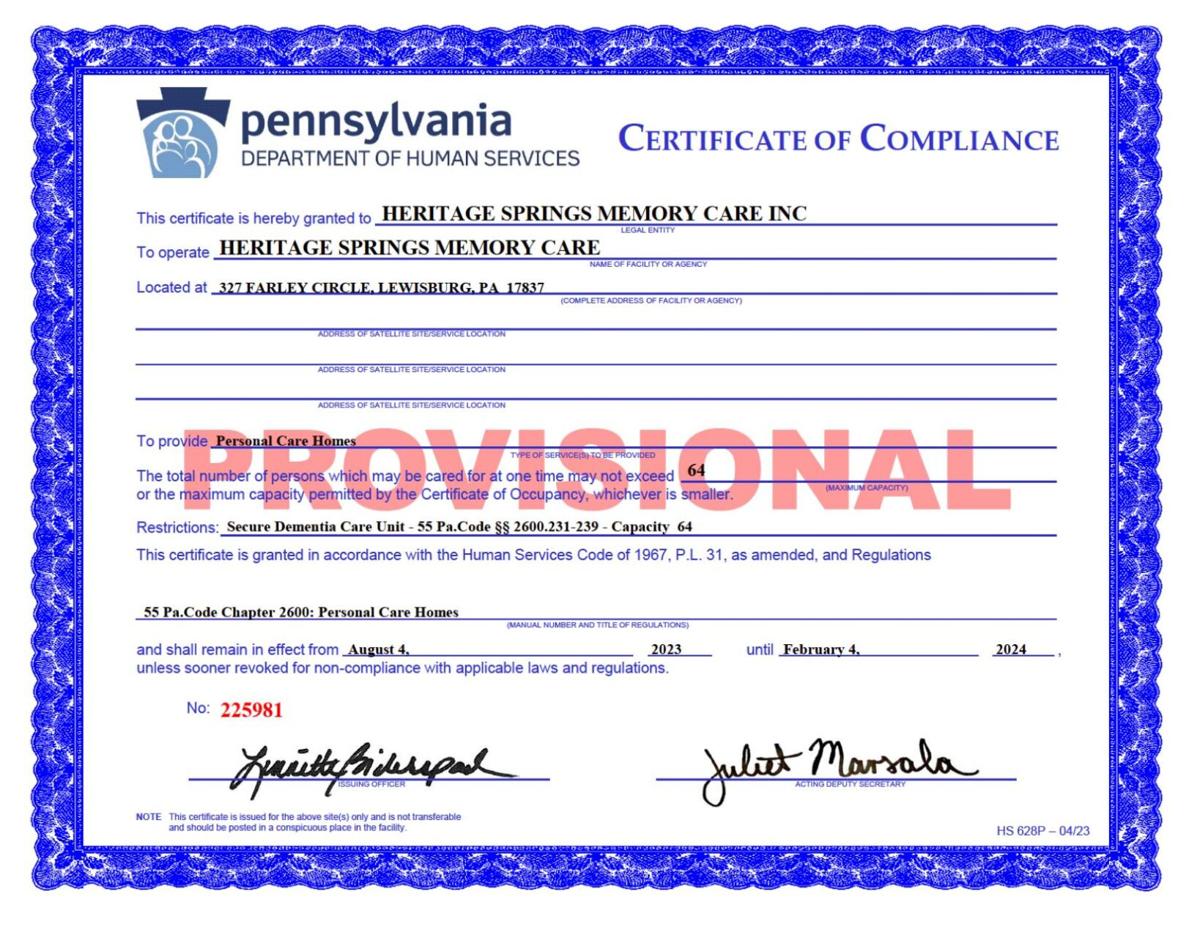
The state recently revoked the facility’s certificate of compliance and issued a provisional license, which is valid until Feb. 4, 2024. If the violations are not corrected within five calendar days of the receipt of the letter, the state intends to assess fines.

The Aug. 4 letter and report details a total of 30 violations stemming from licensing inspections on April 12, April 13, May 3, May 9, May 18, June 6, June 15 and June 27. Two additional inspection summary reports in February and December also showed a combined seven additional violations.

Heritage is licensed for a capacity of 64. At the time of its inspection, it was serving 30 residents ages 60 years and older and had a total daily staff of 60, according to the report.

Details in the report

The DHS report did not name any of the staff members or identify their age. The report lists the individuals as Staff Members A, B and C. DHS said “Staff Person A” is also an individual under 18 and “Staff Person B” still attends high school.

Staff Member A grabbed and patted a resident inappropriately on an unnamed body part and made “sexually inappropriate statements to a resident.” They would tease the resident until they became “very agitated and upset,” according to the report.

Interviews with staff also determined that Staff Members A, B and C were “making fun of residents and acting inappropriately toward them on multiple occasions,” the DHS reported. “Staff interviewers determined that these incidents were brought to the attention of Staff Person D, who failed to report them to the department, as required under this regulation.”

Staff Person A used their personal cellphone to take pictures and videos of 18 different residents at the home while working as a direct care staff person. These photos and videos were of residents in the nude and being showered/toileted. They also included a picture of a staff person pinching a resident’s nose, according to the DHS.

Staff Members A and B were “verbally abusive toward residents,” the DHS reported. “Residents were emotionally abused by Staff Person A and B through teasing and by Staff Person B by taking “a resident’s doll away, banging the doll’s head off a table and telling the resident, “You don’t think this is real, do you?”

Staff Person A also called a resident disgusting when they ate food. Staff Person A would also ignore residents when they were asked for things and would respond by saying “Bah, bah,” according to DHS.

That resident, according to Heritage, has a habit of spitting food out of their mouth when they are full or do not want to eat. This incident was not brought to the attention of management, according to Heritage.

Counseling and suspensions

According to Heritage’s response in the report, Staff Member A was counseled immediately when the resident care director learned third-hand about the patting of the resident. A discussion was held about the importance of being cautious with the way they talk and behave around residents as well as being mindful of taking jokes too far.

The three staff members have a “tendency to joke with residents to make them laugh,” according to Heritage. “A discussion was held with both staff members on (date redacted) stressing they must be cautious and there is a fine line that cannot be crossed. Behavior was addressed with both Staff Members A and B. At no time was any issue regarding Staff Member C brought to the attention of the Resident Care Director or Executive Director.”

Staff Person A was immediately suspended when the executive director was made aware of the incident with the cellphone by Buffalo Valley Regional Police Department, according to Heritage.

“An internal investigation was initiated by the executive director and supervisor, (and) business manager,” according to Heritage. “Interviews were conducted with all staff on (redacted date) and all were asked to write a statement as to any knowledge of inappropriate behavior or photos or videos being taken by any staff member. No staff member acknowledged that they were aware of behaviors or photos being taken. AAA and DHS were both notified immediately.”

Staff Persons B and C were also suspended. Staff Persons A and B will not be returning to Heritage Springs, according to Heritage.

All three staff persons denied any wrongdoing, according to Heritage.

Additional training

Additional training about residents’ rights, abuse training and mandatory reporting requirements was provided to employees. The importance of reporting alleged abuse was emphasized, according to Heritage.

One resident “is known for joking with staff and has been reminded multiple times to watch what they say and do to staff,” according to Heritage. “This resident is alert and orientated at times and has been redirected when” they make inappropriate comments to the staff.

Heritage claims that Staff Person D was never made aware of the comments that upset the resident.

“Immediately after we were notified, the executive director and business manager met with each staff member to see if any of them were aware of inappropriate behavior or photos/videos being taken and were asked to submit a written statement regarding any knowledge,” according to Heritage. “Not a single staff member acknowledged they were aware of any behaviors, photos or videos.”

Staff was also re-educated on the importance of reporting allegations to both their immediate supervisor and executive director immediately, residents’ rights, confidentiality and a revised cellphone policy. Staff each signed to acknowledge the fact they were reviewed, according to Heritage.

Under 18

A person who is 16 or 17 may not perform tasks related to medication administration, incontinence care, bathing or dressing residents without supervision, according to DHS.

“There is no direct supervisor from a qualified DCS (director care staff) person,” according to DHS.

Heritage claims that Staff Person A was “always under the direct supervision of a charge nurse or a med tech that was at least age 21. Staff Member A did partner with Staff Member B who was (redacted) years of age on occasions when performing care with residents under the knowledge of the shift supervisor.”

Policies changed

An internal decision was made to not hire those who have not graduated for any position other than dietary or activities, according to Heritage.

“Executive director will work alongside administrative assistant to ensure staff being hired as a caregiver are high school graduates or have their GED and are over the age of 18,” according to Heritage. “Executive director will audit all new employee files to ensure proper education was obtained and verified by receiving a high school diploma, GED or certificate of completion of certified nursing assistant programs.”

The cellphone policy was updated twice since the incident and all staff are now required to either keep their cellphone in their vehicles or in a locked storage cabinet near the time clock, according to Heritage.

A camera was placed in the time clock area to monitor use of cellphones and to ensure staff are following the revised policy.

The resident care director and executive director “conduct rounds to ensure cellphones are not in resident areas and policy is being enforced,” according to Heritage.

Heritage’s previous violations totaling nearly 30 included the following: Some staff members did not have up-to-date training or the required number of training hours; injuries resulting from residents falling were not reported in a timely manner; fire drill safety procedures were inadequate; numerous documents were missing key pieces of patient information; not having enough staff on specific shifts; paperwork was not properly completed; a new resident did not have a cognitive screening in a timely manner and a threat from one resident to another went unreported.

Upcoming court hearing

Cox has been charged with 17 misdemeanor counts of abuse of a care-dependent person.

The charges were filed by Buffalo Valley Regional Police Patrolman Gary V. Heckman in the Lewisburg office of District Judge Jeffrey Rowe.

Cox is scheduled for a preliminary hearing at 9 a.m. Aug. 24 in front of Rowe.

Attorney Erica C. Wilson, of Murray, Stone & Wilson, PLLC, in West Conshohocken, filed a lawsuit in Union County Court on behalf of patient Alice Longenberger and her family against the assisted living facility at 327 Farley Circle, Lewisburg, its management, building owners and two employees who were accused of abusing 17 residents. Those listed as defendants are Heritage Springs facility and corporation, administrator Tambra Speece, Business Manager Lennea Brown, employees Madison Laine Cox and a 17-year-old boy, property owner T-Ross Brothers, of Milton, and Todd and Tom Ross and Christopher Helmrich, of T-Ross.

The lawsuit alleges one count of negligence and one count of breach of fiduciary duty against the Heritage defendants; one count of negligence per se against all defendants; and one count of negligence and one count of battery against the two employees. A jury trial is demanded and judgment of at least $250,000 in damages is being sought, according to court documents.

Full Article & Source:
DHS report details elder abuse, response from Heritage Springs Memory Care in Lewisburg

Thursday, August 31, 2023

How Do I Protect My Assets When My Husband Has Dementia

by INVESTOR TIMES


How Do I Protect My Assets When My Husband Has Dementia

Dealing with a loved one’s dementia can be incredibly challenging, emotionally and financially. If your husband has been diagnosed with dementia, it becomes essential to take steps to protect your assets and ensure financial stability for both of you. Here are some strategies and frequently asked questions to guide you through this difficult process.

1. What legal documents should I have in place?

Having essential legal documents in place is crucial when it comes to protecting your assets. These include a durable power of attorney, healthcare proxy, and living will. A durable power of attorney allows you to make financial decisions on behalf of your husband, while a healthcare proxy gives you the authority to make medical decisions. A living will outlines your husband’s preferences for medical treatment if he becomes incapacitated.

2. Should I consult an attorney?

Yes, consulting with an attorney who specializes in elder law or estate planning can be immensely beneficial. They can guide you through the legal process, help you understand your rights and options, and ensure that all necessary documents are in order.

3. How can I protect our joint bank accounts?

Consider establishing separate bank accounts if you haven’t done so already. This can help protect your assets in case your husband incurs significant medical expenses or falls prey to financial exploitation. Consult with your attorney to determine the best course of action based on your specific circumstances.

4. Can I change beneficiary designations?

It is advisable to review and update beneficiary designations on life insurance policies, retirement accounts, and other assets. Ensure that the designated beneficiaries are still appropriate, as circumstances may have changed since these designations were initially made.

5. Is long-term care insurance necessary?

Long-term care insurance can help cover the cost of nursing home care or professional in-home assistance. It is worth considering, especially if your husband’s dementia is expected to progress rapidly or if you lack the financial resources to cover these expenses.

6. What about Medicaid planning?

Medicaid planning involves structuring your finances to qualify for Medicaid benefits while protecting your assets. Consulting with an attorney who specializes in Medicaid planning can help you navigate this complex process.

7. Can I transfer assets to protect them?

Transferring assets to protect them from being depleted by medical bills or nursing home costs can have legal and financial implications. It is crucial to consult with an attorney before making any asset transfers to ensure you comply with Medicaid rules and avoid potential penalties.

8. How can I prevent financial exploitation?

To protect your husband from financial exploitation, consider working with financial institutions to set up safeguards. This may include requiring joint authorization for large withdrawals or designating a trusted family member or friend as a co-signer on accounts.

9. What happens if my husband is unable to manage his finances?

If your husband reaches a point where he is no longer capable of managing his finances, you can utilize the durable power of attorney to take over these responsibilities. Consult with your attorney to ensure you have the necessary legal authority to manage his financial affairs.

10. Should I consider a living trust?

A living trust can be an effective tool for managing assets while your husband is alive and potentially avoiding probate after his passing. This trust allows you to transfer assets into it, with a designated trustee managing these assets on your husband’s behalf.

11. How can I plan for the future?

Planning for the future is essential, especially when dealing with a progressive disease like dementia. Consider discussing your options with a financial advisor who can help you create a long-term care plan, explore insurance options, and ensure your financial stability.

12. How can I take care of myself during this challenging time?

Caring for a loved one with dementia can be physically and emotionally draining. Prioritize self-care, seek support from family and friends, and consider joining a support group for caregivers. Taking care of yourself is crucial to ensure you can continue providing the best possible care for your husband.

In conclusion, protecting your assets when your husband has dementia requires careful planning, legal support, and financial expertise. Consulting with professionals who specialize in elder law, estate planning, and financial planning will help you navigate the complexities of this situation. By taking the necessary steps to protect your assets and ensure financial stability, you can ease some of the stress associated with caring for a loved one with dementia.

Full Article & Source:
How Do I Protect My Assets When My Husband Has Dementia

Defendant in exploitation case rearrested

By CJ Baker

While facing criminal allegations that she financially exploited an elderly woman, Victoria L. Hertz Ruelas was ordered to have no contact with the alleged victim. However, authorities say Hertz instead resumed living with the woman in Powell and took her on multiple trips out of state.

At a Friday hearing, a prosecutor asserted that Hertz had committed a “flagrant violation” of her prior bond conditions. Meanwhile, her defense attorney suggested it was a misunderstanding amid a complicated case that was previously dismissed.

Park County Circuit Court Judge Joey Darrah ultimately raised Hertz’s bond to $5,000 cash or surety, which was up from a signature bond. After spending roughly two days in jail, the 42-year-old made bail on Saturday and was released pending further proceedings.

The felony charge of exploitation of a vulnerable adult stems from Hertz’s time working as a CNA at an assisted living facility in Cody, where she helped care for the 88-year-old resident at the center of the case. The Park County Attorney’s Office alleges that Hertz abused her position to borrow $12,000 from the woman and ultimately have the resident move in with her.

While working night shifts at Absaroka Senior Living, the CNA reportedly spent extensive amounts of time with the woman. The woman’s son later told police that he believed Hertz had tugged at the woman’s heartstrings and crossed ethical lines to get the loans, which were indefinite.

Last spring, the woman announced her intention to move in with Hertz. Cody Police Detective Rick Tillery said the woman was set to pay Hertz $800 a month in rent while helping to cover the cost of some improvements and food.

Absaroka Senior Living fired Hertz for violating company policies and barred her from the facility in May, Tillery said. The detective and the woman’s son felt Hertz’s split-level home on Powell’s Eighth Street was ill-suited for her walker, but despite their opposition, she moved in with Hertz.

Prosecutors filed the exploitation charge in June, but Darrah dismissed it later that month. While indicating that he saw Hertz’s alleged conduct as concerning, the judge said he didn’t think it broke the law, as the elderly woman didn’t meet the definition of a vulnerable adult. In his view, the Wyoming statute only applies to adults who can’t manage their affairs as a result of a disability, and the alleged victim is fully competent.

Darrah added that he thought the Legislature probably meant to address situations like this and that dismissing the case was “not an easy decision.”

Deputy Park County Attorney Jack Hatfield quickly refiled the charge with the intent of making another attempt at clearing a preliminary hearing. At a July court appearance, Hertz was released on a $5,000 signature bond — meaning she wasn’t required to post any money — and given orders to have no contact with the elderly woman. 

During the July 7 hearing, Hertz mentioned that the woman wanted to speak to the judge, but given the no contact order, Darrah cautioned that, “I think you need to work through your attorney to get that accomplished.”

However, just 10 days later, Tillery received a report that Hertz had traveled to South Dakota. About a week later, Tillery received a third-hand report that a hairdresser believed the woman’s health was deteriorating. 

The detective and personnel from the Department of Family Services were unable to contact the woman over the next couple of weeks. Tillery ultimately pinged the woman’s phone on Aug. 9 and used the location data to find the woman living with Hertz at a multi-level rental on North Ingalls Street.

Hertz appeared to be “totally dependent on … the victim in this case, for complete and total financial support,” Tillery later reported in an affidavit, “which is precisely the core reason for this bond condition and the ability to provide additional protection of the victim in this case.”

Hatfield filed to revoke Hertz’s bond on Aug. 11, asking that she also be ordered to forfeit $5,000 to the state. Hertz was arrested Thursday and appeared in court Friday.

“Ms. Hertz is not even remotely complying with this court’s order,” Hatfield argued, expressing concern that Hertz’s home “is wholly unsuitable” for the elderly woman.

Hertz’s defense attorney, however, said “there may have been some confusion” about the bond conditions given that the initial charge was dismissed.

“I do know that this case has been somewhat complicated because [the elderly woman] has expressed the desire to have contact [with Hertz], and so I think that is sort of a complicating factor,” public defender Sarah Miles added. “But ultimately the bond condition is what it is and my client is not to have contact. And hopefully she understands that clearly at this point in time.”

A bond revocation hearing is tentatively scheduled for Thursday, with another preliminary hearing set for Sept. 29.

Full Article & Source:
Defendant in exploitation case rearrested

Family adopts elderly neighbor as honorary grandpa | Humankind

Watch this elderly widower become part of the family as his neighbors make sure he's always welcome at their house.

Source:
Family adopts elderly neighbor as honorary grandpa | Humankind

Wednesday, August 30, 2023

Upper West Side woman caught up in guardianship battle

Friends of an Upper West Side woman are making an unusual offer to try to prevent the 93-year-old from being removed from her rent controlled apartment. Sarah Wallace reports.


Source:
Upper West Side woman caught up in guardianship battle