Showing posts with label #FreeBritney movement. Show all posts

Monday, December 6, 2021

BJ Courville on the #FreeBritney movement, bodily autonomy and living with autism


Lawyer and #FreeBritney advocate BJ Courville sat down with Giddy's Marisa Sullivan to discuss conservatorships, the harmful intersection between discrimination against women and sexual health, and how her autism was an asset in her advocacy for Britney Spears.
 
A Conversation With BJ Courville

Lawyer and #FreeBritney advocate BJ Courville sat down with Giddy's Marisa Sullivan to discuss the legality of conservatorships, women's rights and sexual health. She also discussed her autism and how it was an asset in her advocacy to free Britney Spears from the conservatorship imposed on her. (Courville was not a member of Spears' legal team; her advocacy was essential but took place in an unofficial capacity.)

In this informative interview, Courville outlines what a conservatorship is, why the forced arrangement is harmful and what alternatives exist to support people with potential mental health struggles. Ultimately, Courville suggests, conservatorships are a violation of human rights and should not be implemented for anyone outside of a small subsection of the population: people who have severe dementia or are in a coma.

Additionally, Courville discusses the harmful overlap between discrimination against women and trying to control their sexual health. She highlights how women are often dismissed as "crazy," prompting others to hijack their autonomy. This especially plays out in the sexual health sphere: Women are not taken seriously with regard to their own bodies. While this occurs every day in small and big ways, Courville says this is seen at the extreme with the non-consensual implantation of an IUD into Spears' uterus—and the subsequent refusal to remove it.

Courville also reveals in this interview that she is on the autism spectrum. This diagnosis, she believes, has been crucial to her impact in the #FreeBritney movement. She says her neurodivergent brain allows her to hyperfocus on court documents for hours at a time, affording her the ability to become a better, more informed advocate for Spears.

This transcript has been lightly edited for brevity and clarity.
Marisa Sullivan (MS):

I'm your host, Marisa Sullivan, and I'm here with lawyer and #FreeBritney movement advocate BJ Courville.

So how does this feel? This amazing news for Britney Spears, and for the movement #FreeBritney, and everything you've been working for?

BJ Courville (BJC):

Well, this was my first time being part of a global, socio-political movement, so I'm very excited that what we set out to do, we did. The name of the movement is #FreeBritney, and we freed Britney. She is free. The important thing is that Britney has full restoration of what never should have been taken from her, which is her human and constitutional rights.

MS:

Britney, as most of the world knows, has been under a conservatorship for 13 years of her life, with her father, Jamie Spears, running the show and her family and other controllers. So that's what we're here to talk about. But before we get into it, I want to know what propelled you to get into it.

BJC:

How I got into the #FreeBritney space was that one day I saw this video—that I would’ve at the time described as a conspiracy theory video—saying "Britney Spears has no rights and she can't get in her car," and all of this stuff that just seemed impossible. It's Britney Spears.

I realized there was no one in the movement who was actually explaining the court documents. There were a lot of people on Instagram talking about yellow shirts and blink two times and a lot of other stuff.

MS:

Symbolism within her Instagram posts.

BJC:

I'm not even dismissing that. But that's not my area of expertise. As I started reading these documents, more and more and more documents were actually being filed in the case, faster and faster.

MS:

And you were explaining all of this to the public, correct?

BJC:

I started first on TikTok, and then I realized I needed a longer form than 60 seconds, so I went to Instagram. I started doing all these live streams on Instagram, just reading documents, doing investigations, finding different leads and clues. That's kind of where I fell into the movement.

I looked up actual court filings from Britney's conservatorship from February 2008, and one of the very first things I noticed was her family and lawyers lied to the court and said Britney, at 26 years old, had dementia. And this could happen to anyone! There wasn't even a doctor’s report that said that.

MS:

And they knew what they were doing because of what you're explaining.

BJC:

That's correct. She perhaps did have a bit of mental health troubles, maybe. It's speculated that it was postpartum. I'm not a doctor, so I don't want to get into too much speculation, but Britney Spears never met the criteria of a conservatorship.

MS:

We hear the word conservatorship all over the place. It's all over the news, especially right now. What is the definition of conservatorship?

BJC:

Essentially it is a re-assignment of certain rights from one human to another. And the reason that it started is to really protect people whenever they get into a vulnerable situation and they cannot take care of themselves. The most obvious examples of this would be someone who has dementia or someone who is in a coma.

As you can see, some states have applied the threshold a little loosely and put people into conservatorships who probably never should have been put into conservatorships. This isn't just Britney. These are older people, vulnerable people, people you've never heard of who are going to die alone and afraid—without their family around them—unless we all start to wake up to the fact that this is going on in every single state.

Conservatorship is supposed to be used as a last resort. So if the system were functioning how it purports to be functioning, then people would have had to come into the court and say, "These are all of the things that we've already tried," and one such thing could be something called "supported decision-making." That is something that many states do implement instead of conservatorships, which is legally taking away someone's rights. It's saying, "You are not good enough for your own human rights and your own constitutional rights. Give them to me, 'cause I know better than you."

MS:

Let's not fail to mention, they had an IUD inserted in her—an intrauterine device to prevent pregnancy. She's not allowed to have kids, she's not allowed to marry, she's not even allowed to drive a car.

If you were being controlled—told you couldn't have kids and your money was taken away—and you are literally feeling like an imprisoned slave in your own home, you'd feel pretty imbalanced yourself.

BJC:

Everything you just said, I completely agree with. Then add on top of that, when Britney did not cooperate with the people who were trying to control her, they intentionally psychologically manipulated her through the use of prescription drugs and with the help of doctors.

MS:

She said lithium, correct?

BJC:

Lithium.

MS:

I've had friends that became suicidal from taking certain drugs that maybe they shouldn't have been on in the first place.

BJC:

Yes. She said they determined that "I was being uncooperative or I wasn't cooperating in rehearsal" because she refused to do one dance move.

First of all, they immediately took her off all the medication she had been on for five years and the next day put her on lithium. So, anyone who has taken literally any medication every single day for five years and stops cold turkey, that alone has a really serious effect. Your entire body goes into shock and sometimes withdrawal.

MS:

The side effects are the same as when you needed it in the first place.

BJC:

And they did it at the same time: They took her off all her medications that she was on, and then they put her on lithium, which has horrendous side effects.

It is also supposed to be—from what I've read on the internet—a medication of last resort. You don't go immediately to lithium. You go to lithium after other things don't work.

MS:

So overall, what lessons have you learned from going through this? For women’s rights, sexual health rights. This is historical. This is going to be talked about for years and years and years.

BJC:

A big lesson I've learned from this case is that there's such a large intersection—I imagine it as a Venn diagram—with such a huge overlap with women's sexual health and women's mental health.

I noticed, even in my advocacy for Britney, that mental health is weaponized against me. "She's just crazy, look at the faces she makes. She's too loud." It's very easy for society to dismiss women whenever we're advocating for ourselves or for each other.

That extends very naturally into sexual health because it is unacceptable that anybody in 2021 thought they could bring Britney Spears to a doctor, put an IUD in her body, and then nobody wanted to take it out. It's absolutely unacceptable. But in that little group of people, someone had to bring that idea up. Somebody else had to agree. A doctor, nurses, people had to all come and get involved. The reason they were all comfortable doing that is either that they are corrupt and horrible people—which I think is too easy of an answer—or, most likely, they were convinced that she had a mental health problem that made it acceptable to take away her bodily autonomy. That is not acceptable.

MS:

What has this movement brought into the spotlight as far as women's health and women's rights? What are we going to learn from this?

BJC:

I think something we should learn from this is that even though we don't have the same type of asylums and things like we used to in the 1800s—the yellow wallpaper type of situations—we still have a terrible, terrible pattern, in at least our country, of people attempting to control women and control what we say, what we do, our bodies, our choices, our clothing, our words, everything. It all kind of comes down to control.

I think something we should all learn—I try to remind myself of this lesson—is that we don't actually have a right to control other people. We don't have a right to tell other people what to do.

She compared her situation to sex trafficking. She said all of this was going on and a couple of times she may have used a curse word. There were all these media stories about how she needs to be professional in the courtroom to be taken seriously. I'm like, "Hold on!" This woman just told you that she was sex trafficked, essentially—that she was abused. She has an IUD in her body that she can't get out. That is very invasive.

MS:

They're trying to delegitimize her.

BJC:

When I was practicing law, I felt that. Where it was like, "Why are you wearing that and why are you saying that and why are you doing that?" I'm autistic, so a lot of these little rules, I need to be told directly. "If you sign your email with 'best,' that's unprofessional." Come on, that's just too much.

MS:

Thank you for sharing that you are autistic.

BJC:

I would never have been able to do what I have done for Britney. I would never have been able to make the connections. I would never have been able to hyperfocus on this case for hundreds, thousands of hours over the course of the last year or two if it weren't for the fact that my brain is just wired a little differently.

You've just got to keep going. You've got to encourage your kids and your loved ones who may be on the spectrum to keep going and keep being themselves and not apologize for it and not feel bad for it. One day, you're going to do the exact thing that you were meant to do and that you want to do. You just have to keep going. You can't let these people get you down. You can't let people who want to control you get you down.

MS:

And that's what Miss Britney Spears is doing! 

Thank you so much for sharing. I think sharing about your personal life enhances everything you're saying so much more. Thank you for sharing about your work with the #FreeBritney movement. Any final thoughts about our girl Britney Spears?

BJC:

Oh, man, I'm just so proud of her for sticking through all this stuff when so many of us would have given up and not continued the fight. It worked out. It worked out for her. She got her message out, and there's an entire army of people across the globe fighting for her freedom and her rights now.

 
Full Article & Source:

Wednesday, November 17, 2021

He joined the movement to #FreeBritney — while fighting a guardianship battle of his own

Rio Hamilton stands by a courthouse in downtown Los Angeles on Friday, just after a judge officially ended Britney Spears’s conservatorship. (Philip Cheung for The Washington Post)

By Ashley Fetters Maloy

WEST HOLLYWOOD, Calif. — The second floor of the thumping, dimly lit Naughty Pig bar transformed into a dance floor almost immediately once the Freedom Party began Friday night. Speakers pumped out one Britney Spears hit after another, and boos briefly ensued at a song from ’N Sync, whose singer Justin Timberlake has apologized for the way he treated Spears when they were dating. Jubilant guests dressed in short shorts, light-wash denim and pink accessories in every shade bumped up against each other while shouting out the lyrics to “Gimme More” and “Piece of Me.”

On the outskirts of the rose-colored throng, bobbing his head happily in a “Free Britney” tee, was Rio Hamilton.

He had flown in just that day, arriving at the rally outside Stanley Mosk Courthouse in downtown Los Angeles just seconds before the good-news confetti cannons burst. A judge inside had finally ended the 13-year conservatorship that had controlled Spears’s finances, movements and other aspects of her life. Rio’s flight out would leave first thing the next morning. The celebration would be just the briefest of respites from his own guardianship ordeal back in Las Cruces, N.M., where his mother, 93-year-old Dorris Hamilton, has spent more than two years under a guardianship he said they hadn’t asked for.

Rio, 58, has seen Spears in concert three times. But he didn’t come all this way just for her. He wanted to show support for others fighting conservatorship abuse: “I wanted to show them I was completely, you know, on their side,” he said. “ ‘You need me here, I’m here for you.’ ”

It would be easy, given its brief but memorable bursts into the spotlight over the past few years, to mistake the #FreeBritney movement for simply a collection of vocal, die-hard Spears fans who supported her as she fought for her freedom in court. But a formidable contingent say they have experienced guardianship or conservatorship abuse in their own lives. Now that Rio and others like him are newly organized and inspired, the aftershocks of #FreeBritney could continue to rattle the American legal system long after Spears’s victory.

Conservatorships and guardianships are typically intended to protect vulnerable individuals. (The difference between the two varies by state.) But Rio and Dorris’s story is one of many allegations of the guardianship industry overstepping beyond what a family feels is necessary.

Dorris Hamilton was one of the first Black women to attend the University of Arkansas. She met Martin Luther King Jr. before he was famous, when he came to speak nearby. She married a mathematician, and when he took a job building missiles, she moved with him to New Mexico and took a teaching job.

They divorced, but she stayed, eventually serving as the principal of a middle school for more than 20 years. She was the first Black principal in the district, and according to a representative for the district, when it came time to rename another nearby middle school last year, “Dorris Hamilton” was a popular suggestion.

Rio Hamilton said of Spears’s case, “It just made everything so much easier for the rest of us to really explain what was going on.” (Philip Cheung for The Washington Post)

The Hamiltons’ guardianship battle was the subject of a February investigation by Searchlight New Mexico and a speech by Rio at a #FreeBritney rally in September. In July 2019, when Rio lived in New York, he visited his mother for his birthday and noted that the house she had lived in for a half-century had fallen into disarray. He decided he would hire a company to clean out her house on her behalf, and perhaps find some home caregiving help — so Rio and Dorris began proceedings to give Rio power of attorney.

Soon after Rio returned home, he learned that a lawyer he and Dorris had consulted about that process had “filed an emergency petition claiming my mother was incapacitated, and that I was the one who was claiming she was incapacitated,” Rio said. They were later informed that a court had approved the petition and appointed a company called Advocate Services as Dorris’s guardian, granting it control of her estate. “They had the legal authority to close all of my mother’s bank accounts, without her knowledge, transfer the money to a different account and then leave my mother going around every day to banks that she’s been banking with for more than 40 years, and having those people explain to her that she doesn’t have any control over what has happened.”

Within weeks, Rio said, Dorris had been escorted by a police officer to a hospital, then admitted to a facility that Rio describes as a home for incapacitated elderly people. Dorris, he noted, went to aerobics classes even at age 91; she can converse with almost no trouble hearing. With those kinds of abilities still intact, Rio wondered, “Why would you be in a unit where everybody who’s around you is either incapable of holding a conversation or can’t walk or talk?”

Dorris, in an interview, agreed. She hopes to move back to her house, she said, and wishes she could visit the last two living siblings of the nine she once had. “I miss being able to move about and greet people and attend meetings of various kinds,” she said. At the home where she lives now, “I’m almost locked in.”

The lawyer did not respond to The Washington Post’s request for comment but told Searchlight New Mexico that she had called Rio and had left a message informing him of the petition. (Rio says he is not aware of any attempt by the lawyer to contact him before Dorris’s assets were seized.) She also told Searchlight she was not separating elders from their relatives but protecting them.

Advocate Services maintained in a statement that “as guardian and conservator, it is our statutory responsibility to protect the persons self and assets. Ms. Hamilton was adjudicated to be an incapacitated person upon testimony and evidence entered. Her home was unsafe due to a 20-year infestation of mice and a hoarding situation. All evidence of which was presented to the Court.” The company has previously defended its work in an op-ed in the Las Cruces Sun News.

At first, trying to explain Dorris’s position to friends was a frustrating errand for Rio. “Even people who were genuinely interested, you could actually see when you were putting them to sleep,” Rio remembered, “because they just had no clue.” But once Spears’s case began generating national headlines earlier this year, “it just made everything so much easier for the rest of us to really explain what was going on.”

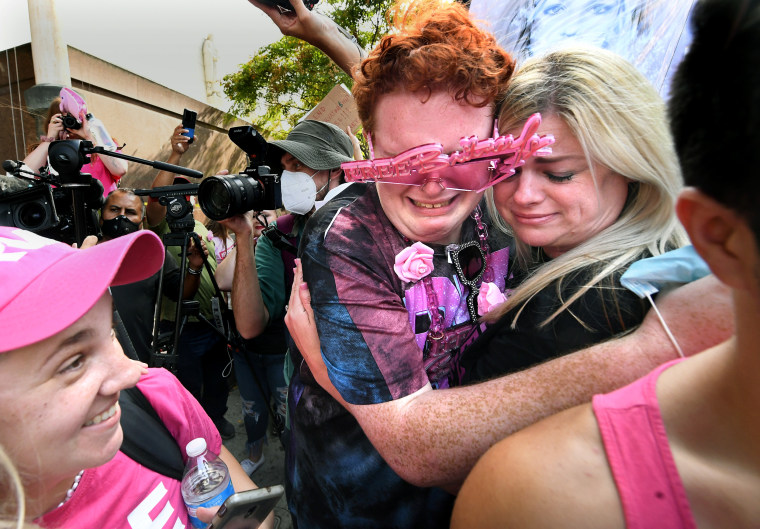
#FreeBritney supporters celebrate Friday in front of the courthouse in Los Angeles. (Philip Cheung for The Washington Post)

The #FreeBritney movement has also enjoyed mutually supportive relationships with other efforts to free conservatees. At a protest earlier this month in New York City, a crowd gathered outside the offices of the law firm representing the guardian of Peter Max, 84, an artist renowned for his psychedelic pop works in the 1960s. According to his daughter, Libra Max, for the past two years, Peter’s guardian has put restrictions on his children and friends’ access to him.

One of the protesters in the crowd was John Fernandes, the founder of the #FreeBritney-adjacent Touch of Rose Project. During the chants, a man walked by on his cellphone, saying, “I guess there’s, like, a Britney Spears-style thing happening to this guy.”

For Libra Max, 54, the media attention the Spears family saga has generated has been a godsend. The #FreeBritney movement was small at first, and “no one really took them seriously. But I’m actually in awe of them,” Max said. “They opened the door for stories like my father’s to be heard.”

At Friday night’s party in L.A., Max greeted Rio Hamilton with a hug, and the two posed together in a photo booth under metallic-pink Mylar balloons spelling out “#FreedBritney.”

(Peter’s personal needs guardian, Barbara H. Urbach Lissner, said in a statement to The Post that the guardianship, which began in 2016, is overseen by someone neutral “due to conflict” among his late wife and his children. She said that Peter is not isolated but receives visitors most days of the week, and that he is “well, safe, and happy.” She added, “I have done my best to help him.”)

The public’s new familiarity with conservatorships has also been a boon to Lisa MacCarley, a lawyer in Glendale, Calif., who has specialized in guardianship and conservatorship cases since 1990. Two years ago, she founded Bettys’ Hope, a charity to address abuses of these legal arrangements — and the Spears case is the kind that lawyers in her field pray to the heavens for.

In her 30 years in the legal system, MacCarley said, she has seen a lack of oversight in the probate court system lead to violation of individuals’ rights and families being financially drained while lawyers profit. “So, in my point of view, the #FreeBritney movement has been, like, literally the miracle that finally brought the whole problem, the systemic issues with our guardianship and conservatorship courts, to light.” In September, MacCarley filed an amicus brief in the Spears case, arguing that the singer’s right to her own counsel had been violated by the court.

Advocates for conservatorship reform have often called for clearer national standards around guardianships and firmer protections around conservatees’ rights to retain their own lawyers. And the Spears case has spurred action on both state and federal levels. After the singer’s emotional testimony in court over the summer, for example, Reps. Charlie Crist (D-Fla.) and Nancy Mace (R-S.C.) introduced the Free Act, which would give people like Spears the right to petition to have their private conservators or guardians replaced by a public one. (Some #FreeBritney activists, however, opposed empowering even them.)

Melanie Mandarano leads hundreds of #FreeBritney supporters on a march Friday in Los Angeles as they wait for the results of the hearing. (Philip Cheung for The Washington Post)

Rio Hamilton left Los Angeles on Saturday morning with an iPhone camera roll full of wide-grinning selfies against festive, fuchsia backgrounds (MacCarley is in one of them) and a feeling of renewed, cautious optimism. Earlier this year, Rio was granted temporary guardianship over his mother. He can now pick her up to take her to church and to some social outings. Advocate Services said it resigned from the arrangement when Rio was appointed guardian. Still, as Rio sees it, work remains to be done for his mother to live as she pleases.

Spending Friday with many people who had gathered to support Spears, he said, “I was thinking: Is this going to make any kind of difference in her life? You know, now that this one famous conservatorship, guardianship thing has been put on the right track?” He’s not certain. But he’s hopeful.

Full Article & Source:

Tuesday, November 16, 2021

Britney is finally free, but what about disabled people who aren’t famous?

by Melissa Parker
 
Supporters of the #FreeBritney movement celebrate following a court decision ending her conservatorship outside the Stanley Mosk courthouse in Los Angeles, California on 12 November (AFP via Getty Images)

Since 2008, Britney Spears has been under a conservatorship, a legal arrangement through which a third party is given the power to make decisions for those “who cannot care for himself or herself or manage his or her own finances”. On 12 November, that conservatorship finally ended.

Britney Spears recently stated that her father, Jamie Spears, who instigated the emergency conservatorship which lasted for 13 years, relished the arrangement. She said: “He loved the control to hurt his own daughter, 100,000 per cent. He loved it.”

Ever since it began, the nature of the conservatorship has been scrutinised. The #FreeBritney movement has developed and grown. I was, initially, amongst the people who did not believe Britney Spears could be treated in this way or that she could have her rights diminished. It seemed impossible that this could happen to someone with so much power. She’s Britney, after all – less a person, more an ideal.

But this mindset is part of the problem, because we don’t see the person. We just know the brand, and this is something I was reminded of when Britney stated that: “My precious body, who has worked for my dad for the past f***ing 13 years, trying to be so good and pretty... so perfect... when he works me so hard”.

It’s now clear that although Britney is a privileged member of the disabled community, that privilege didn’t protect her from ableism or sexism. Of course, she is a white woman who is conventionally attractive and has vast wealth. Still, she is not alone in the fact that she has had some of the most fundamental rights and privileges diminished or entirely removed.

In court, she outlined some of the cruel restrictions she’s been subjected to, explaining how she was forced to wear an IUD to prevent her from having a child, and her conservators won’t let her remove it. “I want to be able to get married and have a baby,” she said. “I was told with the conservatorship; I was not able to get married and have a baby.” Britney took the stand and talked about how she felt she wasn’t “heard on any level”.

It is a feeling that myself and many other disabled people are familiar with. We know that because of our disabilities, we are deemed to have less value. Our capabilities are called into question, we have medical and financial decisions made for us without consideration, and we are routinely infantilised.

The moment Britney was placed under that conservatorship, she was considered disabled by the law, allowing her to be dehumanised and commodified. Even when the conservatorship was in place, she was expected to work to an unrelenting schedule.

I hope, now Britney has been freed, that she can live the life she wants. It’s about her choice, as it always should have been. I also hope that it makes people think about those who don’t have her privilege, fame and influence. Those who don’t have an army of people ready to dissect messages and look for hidden clues, people who are prepared to fight until #FreeBritney becomes #FreedBritney.

This should teach us all a lesson about how certain celebrities, usually young women, are treated. There’s plenty of sympathy towards Britney now, but we can’t forget the events that led her to struggling so publicly.

Britney Spears is a powerful reminder of what can happen when a person’s control over their life is removed. We must keep fighting as a community to have our rights respected, and I hope we remember that as soon as Britney was viewed as disabled, she was stripped of her autonomy. If it can happen to Britney, it can happen to anyone. “She’s lying. She’s got everything. She’s Britney Spears.” No, she isn’t, and no, she hasn’t.

Full Article & Source:

Wednesday, October 6, 2021

Britney Spears thanks #FreeBritney movement for 'freeing' her from conservatorship

"I cried last night for two hours cause my fans are the best and I know it," the pop star said on social media.

Click to Watch Video

By Wilson Wong

Britney Spears thanked the #FreeBritney movement on Monday, saying fans were instrumental in last week's ruling to suspend her father as her conservator after 13 years under his control.

In a Twitter post, Britney Spears wrote: “#FreeBritney movement… I have no words… because of you guys and your constant resilience in freeing me from my conservatorship… my life is now in that direction !!!!!”

The #FreeBritney campaign gained momentum on social media in recent years as fans questioned whether the pop star was being taken advantage of through what was supposed to have been a temporary arrangement. Organizers shined a light on others who have been negatively affected by conservatorships, such as former "Star Trek" star Nichelle Nichols.

"I cried last night for two hours cause my fans are the best and I know it," Spears continued. "I feel your hearts and you feel mine … that much I know is true."

Britney Spears, who has been in a conservatorship since 2008 after a mental health crisis, spent the past year trying to remove her father James "Jamie" Spears from her case, telling the court that she feels traumatized over what she said was an abusive conservatorship.

Los Angeles County Superior Court Judge Brenda Penny ruled in her favor last week, describing the arrangement as "toxic." Britney Spears testified in June that her father ruined her life through his role in the conservatorship, alleging that he took pleasure in controlling her and in her pain.

Jamie Spears' attorney, Vivian Thoreen, said the ruling was a loss for his daughter in a statement Thursday. Thoreen said part of working in Britney Spears' best interests meant her client had to bite his tongue and not respond to the "false, speculative, and unsubstantiated attacks."

Britney Spears, Conservatorship, Jamie Spears
Britney Spears fans celebrate outside the courtroom after the announcement that her father, Jamie spears, is suspended from her conservatorship.Wally Skalij / Los Angeles Times via Getty Images

"Respectfully, the court was wrong to suspend Mr. Spears, put a stranger in his place to manage Britney's estate, and extend the very conservatorship that Britney begged the court to terminate earlier this summer," Thoreen said.

A hearing to formally remove Jamie Spears as conservator is set for Nov. 12, when Britney Spears' attorney, Mathew Rosengart, also intends to present Penny with a plan to end the conservatorship altogether.

He previously credited the #FreeBritney movement for its role in Wednesday's ruling.

"She's free today in a sense ... but there's a larger issue here," Rosengart said. "And the larger issue is now being looked into by state legislatures throughout the country, certainly in California, and by the U.S. Congress. To the extent we can shine a light on that issue, as well, that's something that's very important."

Full Article & Source:
 
See Also:

Friday, July 23, 2021

#FreeBritney movement inspires bill to end exploitation & abuse in guardianship and conservatorship

Bill proposes $260-million for oversight of conservators and guardians
 
Federal lawmakers are introducing a new bill called the FREE Act to protect Americans in guardianship and conservatorship from exploitation and abuse.
 
 By: Adam Walser

ST. PETERSBURG, FL — As rallying cries and social media posts calling for a judge to free Britney Spears from conservatorship grow louder, two members of Congress announced Tuesday they’re taking action against guardianship and conservatorship abuse.

Federal lawmakers are introducing a new bill called the FREE Act to protect Americans whose rights have been stripped away under guardianship. The court-appointed guardian (called a conservator in some states) can control every aspect of a person's life including their finances, where they live, and who they associate with or even communicate with. They also lose the right to vote.

The ABC Action News I-Team has been exposing issues with guardianship abuse in Florida for the past eight years.

The proposed law would, for the first time, provide federal protection for people under guardianship.

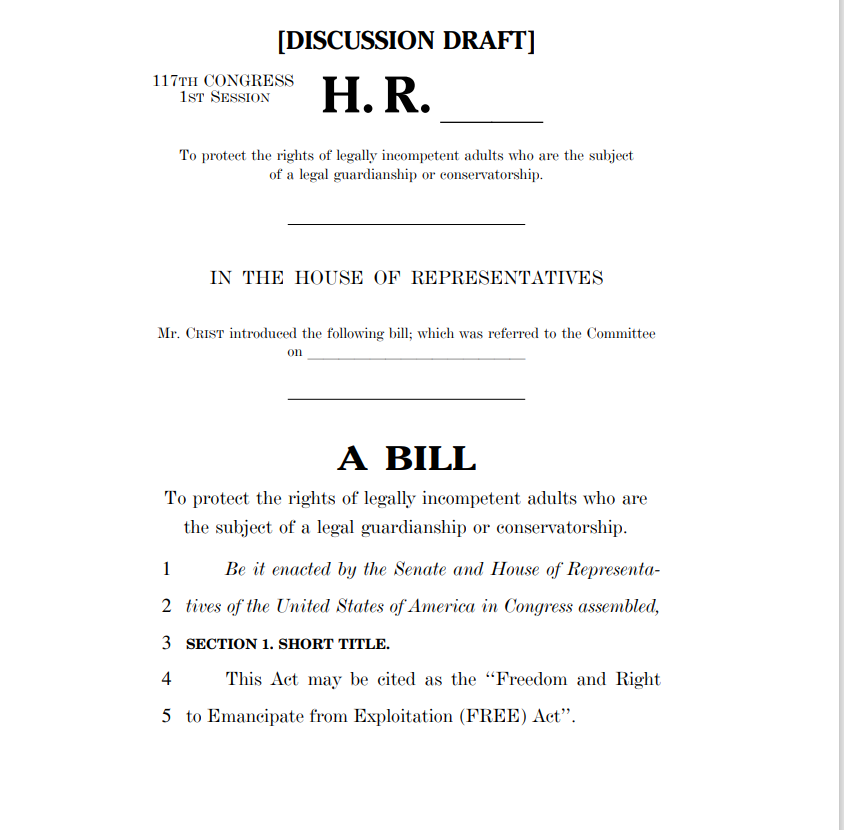
cover page of free bill.png

“It’s a right versus wrong issue”

In a virtual press conference, Democratic representative Charlie Crist of St. Petersburg and Republican Congresswoman Nancy Mace of South Carolina introduced the Freedom and Right to Emancipate from Exploitation (FREE) Act.

“This is not a right versus left issue. It’s a right versus wrong issue,” said Crist.

The proposed law would allow people in guardianships and conservatorships to petition a court to replace private or professional guardians with public guardians.

Public guardians are paid by taxpayers and would have no financial incentive to exploit people under their care.

“If it can happen to Britney, it can happen to anyone”

Crist introduced another guardianship reform bill in late 2019, after seeing ABC Action News reports on guardians accused of isolating, abusing and financially exploiting seniors here in Florida.

“After your great reporting, and thank you for that, the incidents of how often this is happening in Florida is very troubling,” Crist said at the time.

But that legislation was stuck in committee, as Congress turned its attention to COVID and the economic downturn.

New attention on the Britney Spears case is now opening the nation’s eyes.

“Her situation is a nightmare. If it can happen to Britney Spears, it can happen to anyone in this country,” Rep. Mace said.

“I think the timing is a big factor,” Crist said. “It has brought so much more light to what millions of people experience across the United States every day with a conservatorship or guardianship.”

zoom presser.jpg

Court monitors and more transparency

The new law would also appoint independent monitors in guardianship and conservatorship cases and would require states to file annual reports with the courts.

Crist is asking for $260 million to fund the reforms.

Congressman Crist believes the bill has strong bipartisan support and could be voted into law within the coming months.

If you have a story you’d like the I-Team to investigate, email us at adam@abcactionnews.com 
 
Full Article & Source:

Saturday, March 27, 2021

Webb: #FreeBritney movement big issue for Nichelle Nichols and many Americans

By David Webb

© Courtesy of Archangel Films LA (NV)

The #FreeBritney (Spears) movement raised the flag of the dubious issue of conservatorships on Capitol Hill and has the attention of minority members Matt Gaetz (R-Fla.) and Jim Jordan (R-Ohio) of the House Judiciary Committee.

Over the past few decades, conservatorships have been exposed as institutions rife with fraud, theft and abuse, all under the aegis of probate courts. Recently the stench of this legally sanctioned enterprise has reached the levels of a massive fish kill. In one instance, a court appointed conservator in Nevada was arrested with the bounty from dozens of pilfered estates, and nearly 30 urns of deceased conservatees housed in a public storage unit. Every day, unsuspecting citizens are taken against their will and denied their basic civil rights

But, what of Nichelle Nichols? The now 88-year-old African American actress and former NASA recruiter, best known as Lt. Uhura from the original “Star Trek” TV show, has become the unwitting pawn in a bitter battle between her estranged son, Kyle Johnson, who has been appointed conservator; and her former talent manager, Gilbert Bell, accused of enriching himself with Nichols’s public appearance fees.

Embroiled in this legal quagmire is Angelique Fawcette, a film industry CEO, producer and actress, who hired Nichols for her recent feature film “Unbelievable!!!!!” The two became close friends, with Nichols referring to Fawcette as “like a daughter” to her. Fawcette was granted legal standing by the court, a status she hoped would benefit Nichols, who suffers from early to mid-stage dementia.

I spoke with Fawcette at length and she stated, “Neither the son nor her former manager has Nichelle’s best interest at heart. Her son was absent from her life for six years. He missed Nichelle’s birthdays, Mother’s Days, Thanksgivings and Christmases. It was heart-breaking to watch.”

Fawcette has even less respect for the former manager and stated further, “Gil was the gatekeeper, fiercely controlling Nichelle’s financial affairs and her person. He allegedly used her money to upgrade the home he lived in on Nichelle’s property, and bought new cars while Nichelle’s house sat in decay.  He even contemplated marrying Nichelle, so that her son would be denied his inheritance.”

This revelation forced Johnson to act. He filed with the California District Court to have a conservator appointed to handle Nichols’s health and finances. Judge Barbara Johnson installed a conservator who was immediately exposed for unethical behavior when her attorney was caught on an audio tape trying to bribe Nichols’s caretaker to leave the property using Nichols’s money.

The court appointed a second conservator and professional fiduciary, B.J. Hawkins, tasked to help Nichols’s son with his mother’s conservatorship. In a later deposition requested by Fawcette, Hawkins stated that Kyle Johnson made “inappropriate personal demands for his mother’s money,” that he wanted Hawkins to work for him against his mother’s best interests and that the son was verbally harsh on multiple occasions, even threatening Hawkins and her female assistant. She stated that, in her professional opinion, Kyle Johnson was not “fit” to be his mother’s conservator given his anger management issues. Barbara Johnson completely ignored this admonition and installed Kyle Johnson as his mother’s conservator, after Fawcette had agreed to rescind her objection to the son’s petition for conservatorship and entered a nondisclosure agreement (NDA) with Kyle Johnson, according to court records.

In May 2019, a CBS-TV affiliate in Atlanta released a shocking abuse tape provided to them by Gilbert Bell. On the recording, an unsupervised Nichols wanders over to the former manager’s home and expresses dismay about Kyle Johnson being installed as conservator against her wishes. She becomes agitated about not being able to go to court and never having seen the judge. A few minutes later Kyle Johnson returns from a short, absent-minded errand and tries to force Nichols to leave with him, triggering several blood-curdling screams from the “Star Trek” icon. Terrified, she shouts at her son “get your hands off of me!”

Fawcette was contacted by news outlets for her reaction. Kyle Johnson’s attorney, Jeffrey Marvan, used the opportunity to falsely claim Fawcette violated their NDA. “I wouldn’t breach the agreement,” maintains Fawcette. “But there’s no document on Earth that will stop me from talking when a crime has been committed.”

Barbara Johnson sided with Kyle Johnson’s attorney and refused to allow further visitations from Fawcette until an evidentiary hearing into the matter of the son’s competency as conservator could be heard. Weeks turned into months as the court delayed the hearing. Marvan proposed allowing Kyle to remove Nichols from her California estate and relocate his mother to rural New Mexico. This motion was granted without the evidentiary hearing, and against the videotaped wishes of Nichols. After not following process, Barbara Johnson also retired from the court. The next judge, Ana Maria Luna, punted the entire matter to the state of New Mexico without further investigation. New Mexico is where Nichols lives today, ripped from the home she loved, surrounded by strangers, and with a conservator son who resides over 30 miles away.

Congress can play a role to rectify this outrageous “legal” practice. Gaetz and Jordan have the flag. What will our representatives in Congress, regardless of party, do next? 

Full Article & Source: