LANSING – Today,
Michigan Attorney General Dana Nessel is recognizing the sixth
anniversary of the Elder Abuse Task Force, applauding its efforts to
protect Michigan’s aging population. Since its launch in 2019, the Task
Force has united more than 55 different organizations in the public,
private and nonprofit sectors to combat elder abuse and reduce barriers
affecting seniors.
“Over the past six years, the Elder Abuse
Task Force has played a crucial role in raising public awareness about
equipping communities with the tools to identify and prevent elder
abuse,” Nessel said. “I am incredibly proud of the Task Force’s work,
from successfully advocating for stronger legal protections to
publishing best practices for investigating elder abuse allegations and
holding abusers accountable. But there is still more work to do. We will
continue to push for long-overdue reforms to ensure every Michigander
is treated with dignity and respect.”
“It is an honor to lead this team of
selfless, dedicated professionals whose sole mission is to speak for
those who can’t speak for themselves and fight for those who can’t fight
for themselves,” said Scott Teter, Division Chief of the Department of
Attorney General Financial Crimes Division and head of the Elder Abuse
Task Force. “The resistance from those vested and entrenched in a broken
system is regrettable and fails to recognize the common-sense reforms
that Michigan’s system has needed for 25 years. By 2030, Michigan is
projected to have 2 million residents 65 and up. Reform can’t wait and
we won’t stop working.”
The more than 100 individuals on the Task Force are divided into seven committees working diligently to accomplish nine initiatives (PDF), including more wholesale reforms, including requiring certification and training for professional guardians.
Achievements include the adoption of a Vulnerable Adult Incident Report form
for investigations by law enforcement across the state, including the
implementation of related trainings. The Task Force has trained hundreds
of police officers, prosecutors and Adult Protective Services workers.
The training videos have been viewed thousands of times. In addition to
the vulnerable adult incident report and associated trainings, the Financial Exploitation Prevention Act
was passed that ensures mandated reporting for financial institutions
on suspected fraud or exploitation. Financial advisors and securities
brokers were also added as mandatory reporters in a separate law. The Uniform Power of Attorney Act
was passed and became effective July 1, 2024, to make powers of
attorney more accessible with a standard form in the statute. Attorney
General Dana Nessel recently released a public service announcement explaining the new law.
More than 73,000 older adults in Michigan
are victims of elder abuse. They experience abuse, neglect, and
exploitation. Michigan residents seeking elder abuse resources are
encouraged to call 800-24-ABUSE (22873), or 855-444-3911 to report
suspected elder abuse.
LANSING – Today, Scott Teter, Division Chief of the Department of
Attorney General Financial Crimes Division and head of the Elder Abuse
Task Force, testified before the Senate Civil Rights, Judiciary, and
Public Safety Committee in support of House Bills 4909, 4910, 4911, and
4912. Michigan Attorney General Dana Nessel announced that this bill
package is a first step toward implementing reforms to Michigan’s
guardianship statutes.
“I’ve seen firsthand how Michigan’s guardianship and
conservatorship system has failed vulnerable adults in our state,”
Nessel said. “I am glad some improvements are being made, but we can’t
stop here. I will continue to push for the long-awaited reforms as
recommended by our Elder Abuse Task Force, which will help create a
system that truly treats all Michiganders with the dignity, compassion,
and autonomy they deserve.”
"A system that ignores the rights of vulnerable adults and
dehumanizes them and ignores the concerns of family members doesn’t do
justice and must be changed,” Teter said. “There are common-sense
reforms in these bills that are long overdue that will help fix a broken
system, but we are not done yet and have more work to do.”
Teter’s testimony highlighted specific concerns faced by the
Department, the Elder Abuse Task Force, and their partners under the
current system. The proposed legislation aims to address these issues
by:
- Requiring courts to make findings of fact if a person with
priority for appointment, such as a family member, is passed over in
favor of a professional guardian;
- Establishing a clear asset and income threshold above which the appointment of a conservator is required;
- Requiring guardian and conservator letters of authority to expire after 15 months;
- Clarifying and expanding the guardian ad litem’s responsibilities;
- Improving protections for wards when professional guardians seek to remove them from their homes;
- Requiring professional guardians to file petitions seeking court authority to move wards;
- Mandating courts appoint guardians ad litem or counsel for wards where appropriate before authorizing moves to new residences;
- Enhancing basic standards for medical reports used in guardianship and conservatorship hearings;
- Refining the process for emergency petitions for guardianship/conservatorship to ensure an actual emergency exists.
In his testimony, Teter also encouraged legislators to adopt
additional legislation creating family consent laws and Personal
Protection Orders (PPOs) for elder/vulnerable adults. He provided an
overview of the guardian certification initiative.
The Department expressed support for Senate Bill 656 which would
restrict investment types allowed by conservators managing estate
property. This bill requires conservators to invest according to the
Michigan prudent investor rule and mandates investments through
brokerage firms insured by the United States Securities Protection
Corporation. Additionally, it prohibits investments in cryptocurrency.
Michigan's Elder Abuse Task Force was launched in 2019 with more
than 55 organizations from public, private, and nonprofit sectors
collaborating against elder abuse. The task force comprises over 100
individuals divided into seven committees working on nine initiatives
including wholesale reforms like certification and training requirements
for professional guardians.
Achievements include adopting a Vulnerable Adult Incident Report
form used statewide by law enforcement along with related training
sessions. The Financial Exploitation Prevention Act was also passed
ensuring mandatory reporting from financial institutions on suspected
fraud or exploitation. Another law added financial advisors and
securities brokers as mandatory reporters. The Uniform Power of Attorney
Act becomes effective July 1, 2024 making powers of attorney more
accessible through standardized forms within statute.
More than 73,000 older adults in Michigan suffer from elder abuse
involving neglect or exploitation. Residents seeking elder abuse
resources can call 800-24-ABUSE (22873) or report suspected abuse at
855-444-3911.
It was supposed to be bi-partisan legislation that would help our state’s most vulnerable people. But instead of sailing through, several proposed guardianship reforms have stalled.
By: Heather Catallo
(WXYZ) — It was supposed to be bi-partisan legislation that would help our state’s most vulnerable people.
But instead of sailing through the state legislature, several proposed guardianship reforms have stalled.
In
Michigan, if a court declares you legally incapacitated, a judge can
appoint a guardian for you, which means you can no longer make your own
legal, medical or financial decisions.
Back in 2021, Attorney
General Dana Nessel’s Elder Abuse Task Force helped launch bi-partisan
bills designed to better protect people who are put under guardianship.
But those bills never got signed into law thanks in part to professional guardians who did not want the same changes.
For 5 years, the 7 Investigators have been exposing problems in Michigan’s guardianship system.
“It's disgusting. Our elderly people shouldn't be a commodity and
shouldn't be able to be trafficked by these people,” said Gretchen
Sommer.
A judge appointed a professional guardian instead of
family member for Sommer’s aunt, Barbara Delbridge, and her uncle, Bob
Mitchell, back in 2018.
“Kept them hostage, took them from their
families, locked them behind a six-and-a-half-foot privacy fence and
just drained their estate, researched how to sell off their property,”
said Sommer.
The guardian billed Bob and Barb’s estate for more than $376,000 in fees.
Our
investigations helped fuel new reforms crafted by Nessel’s Elder Abuse
Task Force, and in 2021, after years of work, they introduced four bills
to change the state law.
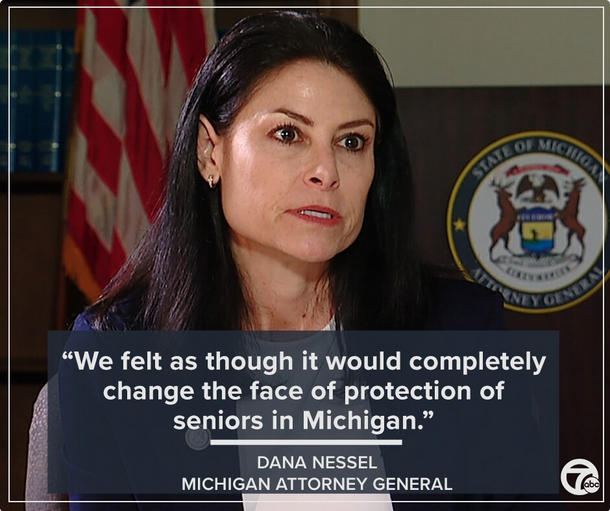
“We felt as though it would completely
change the face of protection of seniors in Michigan,” Nessel told 7
Investigator Heather Catallo.
Here are a few of the things the bills would have mandated:
- Certification for professional guardians
- Judges would have to better explain on the record why they’re appointing a professional guardian instead of a family member
- And they would have increased the number of times guardians have to visit their wards.
But the bills did not get signed into law.
One of the biggest opponents: the Michigan Guardianship Association, a non-profit advocacy group for professional guardians.
“The Guardianship Association especially kept moving the goalposts.
So, whenever they would bring up a point and it seemed like legitimate
point and that point would get addressed, they would say,’ well, that's
not good enough. What about this other thing,’” said Nessel.
Even
though members of the Michigan Guardianship Association (MGA) were on
the Elder Abuse Task Force, the 7 Investigators have discovered audio
recordings and photos that reveal just how hard the association was
working against the legislation.
Pictures taken of a PowerPoint
presentation at the MGA’s April 2022 conference reveal the MGA’s
lobbyist, Robert Kennedy, referring to Nessel’s task force as the
Attorney’s General’s Task Farce.
The 7 Investigators obtained video of a local judge at a recent
conference that raises questions about the relationship between judges
and professional guardians.
By: Heather Catallo
(WXYZ) — In Michigan, if a court declares you legally incapacitated, a
judge can appoint a guardian for you, which means you can no longer
make your own medical, financial or legal decisions.
For years, the 7 Investigators have been exposing problems in the guardianship system.
Now video taken of a local judge raises questions about the relationship between judges and professional guardians.
The
7 Investigators have been documenting examples of guardianships gone
wrong across Southeast Michigan since 2017. Probate judges can appoint a
guardian for anyone deemed legally incapacitated. When you become
someone’s ward, the guardian has total say over your life, including
medical and financial decisions.
Our reporting caught the attention of Attorney General Dana Nessel,
who formed the Elder Abuse Task Force and introduced legislation in the
hopes of improving the guardianship system.
“Don't we owe that to seniors in our state,” said Nessel.
But the bills did not get signed into law, in part because of pushback from some key players in the probate courts.
The Michigan Guardianship Association (MGA) battled against the bills, calling the AG’s task force a “task farce.”
“It's so incredibly demeaning,” said Nessel.
The MGA wasn’t alone. Oakland County Probate Judge Daniel A. O’Brien
wrote a letter to state legislators urging them not to pass the bills.
And
now the 7 Investigators have obtained video of Judge O’Brien at a
recent Michigan Guardianship Association conference, talking about the
legislation and giving advice to a room full of professional guardians
during a question and answer session.
Web Extra | Judge O'Brien at Michigan Guardianship Association conference
“The damage that has been done to this practice that you guys are all
in, by legislation, by publicity, from public servants supposedly,
politicians really – is just unfathomable,” said O’Brien in the video.
The video was taken by a conference attendee, and later provided to the 7 Investigators.
One
statement that’s raising questions centers on the sale of a ward’s
home. Guardians often ask the court for permission to sell property.
They say it’s to pay for the ward’s care, but the guardian can get paid
in the process.
“When you are having problems with your case, file a petition for
instruction, ok… for me to make the decision. If you've got family
members giving you a hard time, if you're concerned about how it might
look. I saw a question at one of the earlier sessions about selling a
house. Come to me, get authority, and what it does is it protects you
and it takes… you can blame me. Say 'what can I say? The judge gave me
an order. I just asked him what to do, and he said or she said to sell
it,'” said O’Brien in the video.
Web Extra | AG Nessel on Judge O'Brien's comments
“It's as though he's giving them permission to do something they know
that they shouldn't be doing. That's my take away from the way that that
was phrased,” said Nessel after she saw the video.
Judge O’Brien says that’s not what he meant and says he would tell family members to file a petition for instruction as well.
“The
appearance there is that you're giving the guardians cover to sell the
wards property,” asked 7 Investigator Heather Catallo.
“Yeah, I get that. But I might not let them sell it. It's really the
thing. And... I don't know how you want to put it. I was just cutting to
the chase,” said O’Brien about the video. “I tell everyone, not just
guardians, not just professional guardians, but any family member— you
have a problem, you try to work it out with your brother, your sister,
your parent, whatever it is. The professional guardian. If you're not
getting satisfaction, file a petition. Bring it to me. Let me make the
decision.”
In the video, O’Brien often praises the professional guardians in Oakland County, some of whom have hundreds of wards.
“The people of my county are wonderful people,” said O’Brien in the video.
Web Extra | Interview with Judge O’Brien
“I hear about Oakland County more than any of the 82 other counties,”
said Nessel. “When I was running for office in 2018, what I would get
more than anything else is people would call it 'the cabal.' That was
the phrasing. And, you know, I'm not saying that it's merited or it's
not. I'm saying that's the perception that people have in the Oakland
County Probate Court, is that there is this very cozy relationship
between the professional guardians and between the judges, and that
regular people are not going to get a fair shake.”
O’Brien is one
of four judges in Oakland County’s probate court. To be clear, not all
of the Oakland County complaints filed with the AG or reported to the 7
Investigator involve his courtroom.
“Are you as fair to family members as you are to the professional guardians in Oakland County,” Catallo asked O’Brien.
“I try to be. Yeah. You know, the thing is, is that if I have to cut
somebody off or if I have to rule against them, they're going to think
I'm being unfair. There's no way around it,” said O’Brien. “But I do my
best to remain impartial and just standpoint. And I do that by focusing
on the person whose name is on the case.
"The thing about the
professionals is they've been dealing with me all this time. And they
are professionals and they know what I'm going to be concerned about,
and what I'm not concerned about. They know the rules, so they know
where to direct their attention. I try to really try to be as fair as
possible with family members as humanly possible. Do I fail? I'm not
trying to be flippant about that.... I don't want to be unfair. But does
it happen? I handle thousands of hearings every year; 70, 80, 100 a
week, some weeks. Some are going to make mistakes and some of those —
somebody's going to have a chance to come back and get that mistake
corrected. There's all sorts of options. They can file a motion for re
hearings. They can appeal me to the Court of Appeals. They can try
again," said O'Brien.
Judge O’Brien did agree there are problems
in the probate system, but he does not agree with the proposed law
changes from the AG’s task force.
He also told us the most important thing you can do if your loved one winds up under guardianship is to speak up.
“If
you want something, ask me. Put it in writing if you can. If not, show
up at the hearing. I'll do my best to follow the law and apply it to the
facts,” said O’Brien.
The guardianship bills are expected to be introduced again in the new legislative session this year.
An Oakland County woman is accused of stealing more than $70,000 from an elderly veteran. (WWMT/File)
LANSING, Mich. — A Bloomfield Hills woman was accused of stealing more than $70,000 from an elderly veteran.
Margaret Risdon, 60, was arraigned Thursday, July 16, 2020, and faces charges of embezzlement from a vulnerable adult between $50,000 and $100,000, and two counts of failing to file taxes, according to a written statement from Michigan Attorney General Dana Nessel's office.
“My office is not only committed to enforcing the laws of this state, but to ensuring Michigan’s vulnerable populations are not taken advantage of,” Nessel said.
The statement said Risdon allegedly wrote checks from the victim's bank account to herself and her business between Nov. 6, 2016 and July 20, 2017. The checks totaled nearly $56,800. She also allegedly made ATM withdrawals totaling more than $16,000.
Nessel's office began investigating when the victim raised concerns someone was stealing from him. While he was unable to care for himself at the time of the theft, the statement said Risdon didn't act as his guardian or conservator, nor did she have power of attorney for him.
“Even before my time as Attorney General began, I understood the important role my office should play in protecting our senior populations," Nessel said. "That’s why I helped to create the Elder Abuse Task Force – to advance protections for our senior citizens and advocate for real change and meaningful legislation to improve their lives well into the twilight years.”
Risdon was expected to appear in court for a probably cause conference at 10 a.m. Thursday, July 30, followed by a preliminary hearing at 10 a.m. Thursday, Aug. 6.
To file a report of elder abuse, call the Michigan Department of Health and Human Services Adult Protective Services at 855-444-3911.
Michigan AG Dana Nessel and Michigan Supreme Court Justice Megan Cavanagh
By Mardi Link
TRAVERSE CITY — During a recent interview with Grand Traverse County
Probate Judge Melanie Stanton, she explained that “conservator” and
“guardian” are legal constructs, conveyed by the court, after someone
has been found incapacitated.
The reasons are many, from dementia
to Alzheimer’s disease to developmental disability, advanced aging and
even repeated substance abuse.
Conservators manage finances; guardians make medical and housing decisions.
“Before
I make an appointment, there has to be a finding that the person is
incapacitated,” Stanton said. “And when a petition is filed, I have to
have some form of documentation. Often that is a statement from a
physician.”
Professional guardians are allowed by law to bill for
their services. Wards whose only income is from Social Security pay a
flat fee — $83 per month — while wards with financial means are billed
at various, unregulated rates.
Critics like attorney Bradley
Geller, of the Michigan Center for Law and Aging, say the power probate
judges and adult protective services workers have over people’s lives
makes such appointments, especially to professionals, ripe for abuse.
“This for-profit business has been described by the mantra, ‘Litigate, isolate, sedate, and take the estate,’” Geller said.
He
said in many cases, an older adult may believe they’ve planned well by
setting up a living will and naming a power of attorney, but those
wishes can quickly be set aside by judges.
Once a probate judge
names a guardian or a conservator, there’s little oversight and no
timely way for the family to object. The argument of a “dysfunctional
family,” he said, is common.
One of the few rules probate courts
place on guardians and conservators is making regular reports.
Conservators must file an annual financial accounting for their wards,
and guardians must file an inventory of their ward’s assets, and must
meet in person with their wards at least every three months.
Laws regulating guardianship and conservatorship are either useless or non-existent, Geller said.
In 2017 he sued the State of Michigan and its 78 probate courts for
violating wards’ rights. The federal court case was dismissed in May,
and Magistrate Judge David R. Grand said Geller’s allegations weren’t
specific but rather, “sweeping in nature.”
Partly in response to
Geller’s lawsuit, Attorney General Dana Nessel in March created an Elder
Abuse Task Force and went on a statewide listening tour.
She developed a number of initiatives,
which included recommending conservators and guardians be certified,
and that the legislature pass laws limiting the number of wards a
guardian can serve.
Currently,
there is no such limit, though the Michigan Guardianship Association, a
trade group for professional guardians, recommends 25.
Similar
recommendations were made by Gov. John Engler’s and Chief Justice Conrad
Mallet, Jr.’s 1998 Supreme Court Task Force on Guardianships and
Conservatorships, and by Gov. Jennifer Granholm’s 2007 Governor’s Task
Force on Elder Abuse.
Geller, who served on the 1998 Supreme Court Task Force and wrote a guardianship handbook, said few recommendations from either task force were ever enacted.
Nessel
acknowledged as much in June, when her listening tour brought her to
the Traverse Area District Library and she said the studies had been
done and it was time for legislative action.
Stanton said she’d welcome some sort of oversight for professional guardians.
“I think it would be helpful,” she said. “I don’t understand why it isn’t already a requirement.”
Nessel’s
Communications Director Kelly McKinney-Rossman said the attorney
general’s office anticipated the introduction of elder abuse legislation
sometime in the next several weeks, though could not say whether it
would address guardianship and conservatorship.
National guardianship abuse awareness organization
applauds Michigan Lt. Governor’s decision to replace State Public Administrator
As both an advocate for victims of guardianship abuse and legislative change nationwide, the National Association to Stop Guardian Abuse (NASGA) commends Michigan Lieutenant Governor Garlin Gilchrist’s decision appointing Katharyn Barron as State Public Administrator as a hopeful step in the right direction in a state which has been plagued with horrific abuses of constitutional, statutory and human rights of individuals under guardianship and their families allegedly committed by County Public Administrators and Probate Court Judges for the past 30 years.
Although the November 22 announcement by Attorney General Dana Nessel curiously omitted any mention of former State Public Administrator Michael Moody, who held the position for over eight years, NASGA Community Outreach Coordinator Gretchen Rachel Hammond says the decision to replace him is long overdue.
Prior to joining NASGA, Hammond was an award-winning investigative journalist who published an August, 2019 groundbreaking five-part series detailing alleged abuses by now-former Oakland County Public Administrators in over 2,000 cases. The articles noted that Moody had been consistently unresponsive to complaints by desperate families who reached out to him stating that public administrators, acting as guardians and conservators, were isolating, abusing and stealing from the estates of seniors and developmentally disabled individuals placed under Oakland County Probate Court guardianship often after petitions filed by agencies such as Michigan’s Adult Protective Services which were not accompanied by any corroborating medical evidence.
“I collected dozens of emails from Moody to these family members,” Hammond says. “His consistent response was that there was nothing he could do and that these families should hire legal counsel. However, numerous attorneys told me that they would not take cases at Oakland County because fighting a public administrator who had been appointed as a guardian or conservator by any one of the four judges was a losing proposition that would end up in the threat or sanctions against the attorney or worse.”
“The uniform response was that public administrators who take guardianship and conservatorship cases are acting as private attorneys and, therefore, not under Moody’s jurisdiction,” Hammond adds. “But, with no one providing any oversight, these families go around in circles with no resolution. It has meant that these alleged abuses have continued unchecked, even after Nessel’s formation of an Elder Abuse Task Force.”
On the same day Hammond’s series was published, Nessel announced the removal of three of the four public administrators featured in her stories. As with Moody’s replacement, there was very little explanation as to why.
“The hope is that this second quiet move will finally help provide some degree of relief for alleged victims and their families,” Hammond says. “Michigan ranks highest in the states where we have seen massive corruption in probate courts. It is long past time for an out of control cycle to end and for thousands of victims and their families to have redress.”
For the past 11 years, NASGA has been a leading nationwide voice to curb abuses by professional guardians through legislative change and awareness. It has been an invaluable resource for researchers and journalists seeking to shed light on a topic which has received scant media attention.
CONTACT:
Elaine Renoire,
Director
info@StopGuardianAbuse.org
Gretchen Rachel Hammond,
Community Outreach Coordinator
gretchenrachelhammond@gmail.com
A Macomb County judge violated state law when she appointed a
guardian-and-conservator company that reaped financial benefits from the
appointment, according to Attorney General Dana Nessel.
State
Public Administrator Michael Moody, on Nessel’s behalf, argues in a
legal document Friday that Probate Judge Kathryn George created a law
violation by appointing Clinton township-based Caring Hearts of Michigan
Inc. as guardian and conservator for Robert Mitchell and Barbara
Delbridge last November, over a daughter and stepdaughter of the couple.
Caring
Hearts hired Executive Care to perform the care for the couple,
according to the state. Both companies are owned by Cathy Kirk. In
addition, Caring Hearts employed the firm of her husband Robert Kirk --
Kirk, Huth, Lange and Badalamenti -- for legal services. The trio of
companies share the same address on Hall Road, east of Romeo Plank Road.
Caring Hearts charged more than $250,000 for about six months of care.
George through a spokeswoman declined to comment Monday, referring the matter to court officials.
The
Attorney General in the filing Friday seeks to intervene in the Probate
case, saying that all prior transactions are “voidable” due to the
arrangement.
Michigan Attorney General Dana Nessel
The law in question says, the “Court shall not
appoint as guard an agency, public or private, that financially
benefits from directly providing housing, medical, mental health or
social services to the legally incapacitated individual.”
Moody comments in the brief, “The intention behind this provision is to prevent conflicts of interest.”
“All
of these financial transactions set forth in Caring Hearts’ Final
Account are presume to be affected by a conflict between personal and
fiduciary interests, and therefore voidable,” Moody adds.
Caring
Hearts attorney Edward Nahat disputed Nessel's claims Monday, saying
state attorneys misapplied the law and should not have sought to enter
the case.
"The Attorney General's petition ... misapplied the
statute to these circumstances and is over-reaching by trying to
intervene in a case she shouldn't be involved in," Nahat said.
He
said the law quoted by state lawyers applies to investments and housing
transactions, neither of which Caring Hearts and Executive Services were
involved.
He said George knew of the arrangement.
Nahat called Nessel's involvement "heavy handed," noting that it has drawn publicity.
He said Caring Hearts supports a review of the accounting and charges in the case.
"A
remedy is already available to the family," he said. "They can get
their own day in court. They don't need the Attorney General's help."
Probate
Court in September 2018 instituted a policy that requires a company or
fudiciary must reveal whether a person related to the company or
fudiciary is performing a service for the fudiciary or company,
according to John Brennan, deputy court administrator.
Brennan said he does not believe the relationships were disclosed in the Mitchell and Delbridge cases.
Expenditures will be reviewed over the next several months. A hearing in the case is scheduled for Jan. 10.
Nessel issued a news release on the matter Monday.
“It
is absolutely incumbent on the courts to ensure that the state’s
guardianship system is providing properly for the vulnerable and that
the court-appointed conservators fulfill their fiduciary
responsibilities to those in their custody,” she said. “That does not
appear to be happening in the case of Caring Hearts, which was appointed
by Judge Kathryn George as guardian and conservator for Robert Lee
Mitchell and Barbara Delbridge.”
Nessel added that the "Estates
and Protected Individuals Code specifically prohibits certain financial
self-dealing by the guardian with respect to the ward.”
State
Supreme Court Chief Justice Bridget McCormack and Macomb Chief Judge
James Biernat Jr. at that time of the announcement released a joint
statement in support of the probe.
Family members of the couple
said George should have appointed them as guardians and conservators to
watch over the care and finances of the couple, both 70 or older and in
declining health.
Robert Mitchell and Barbara Delbridge
Mitchell’s daughter, Marcie, and other family members complained
their visits were limited and that caregivers installed a 6-foot fence
around the property near Hall Road and Van Dyke Avenue that blocked the
vision of family members who resided next door. The said the couple were
virtual prisoners in their home.
They also raised questions about
the guardian and conservator company's spending from the couple's more
than $2.5 million in assets.
The pair on Friday also were named conservators, although each has to file a bond and paperwork in order to take over.
Attorney
Frank Cusumano said Monday he plans to file a legal action on Little's
behalf "to unwind the transactions" involving Caring Hearts, Executive
Services and the law firm.
"Anita Little wants to do her part to make sure that this activity does not occur and injure another family," Cusumano said.
The older couple are currently residing in a facility in Genesee County, closer Marcie Mitchell’s Clarkston home.
The
case developed as Nessel has been vowing to crack down on elder abuse.
She formed Michigan Elder Abuse Task Force earlier this year shortly
after she took office. This summer, she conducted a statewide “listening tour”
to hear complaints about elder abuse and complaints about Probate
Court, which oversees will and estates of incapacitated and deceased
individuals.
George
has served as a Macomb Probate Judge since 2003. More than a decade
ago, George came under the scrutiny of state officials and removed as
chief probate judge for her relationship with a now-defunct guardianship
company, conflict with the second probate judge and dysfunction at the
court.
Michigan Attorney General Dana Nessel. Courtesy Getty Images.
Ms. Nessel,
While you were running for Michigan Attorney General in 2018, I was
an award-winning investigative journalist, member of the LGBTQ community
and a Democrat.
Had I also been a resident of Michigan, I would have cast an
enthusiastic vote for both you and Governor Gretchen Whitmer. This was
not because of my political and social backgrounds.
I've interviewed politicians, lines of them. All of them parroted
whatever talking points they thought my newspaper’s readers wanted to
hear. The post-election reality was, as expected, entirely different.
You ran a campaign that seemed to be based on genuine sincerity rather than expedient politics.
“It’s just a basic belief that it’s never the wrong time to fight for justice,” you said. “It’s
never the wrong time to fight for what’s right, and that there are so
many people out there clamoring for representation, clamoring to have
their voices heard, clamoring for recognition of their rights and equal
dignity, just as human beings.”
Having spent my career, driven by the same ideology, your promises
resonated with me as much as they clearly did with Michigan’s voters who
included the voiceless.
But the post-election reality is that you have not only broken that
promise, but actively shielded the alleged perpetrators of some of the
most horrific and repugnant crimes and flagrant abuses of civil and
human rights in Michigan’s history.
In July last year, myself, a team of three Wayne State University
researchers and a forensic fraud examiner launched an investigation into
the systemic judicial removal of the civil, constitutional, statutory
and human rights of Michigan’s senior and developmentally disabled
communities as well as subsequent allegations of the abuse, exploitation
torture, isolation and robbery of them by public administrators and
judges at the Detroit-area Oakland County Probate Court.
On March 12, at the behest of your Communications Director Kelly
Rossman-McKinney, my team met with a contingent of your staff led by
Child, Elder, Family and Financial Crimes Division Chief Scott Teter.
Over the course of four hours, we presented evidence in the form of
court documents culled from 2,278 separate cases belonging to now-former
Oakland County Public Administrators Jennifer Carney, Jon B. Munger,
Thomas Brennan Fraser and John Yun who had been appointed as guardians
and/or conservators over allegedly “legally incapacitated” seniors and
developmentally disabled individuals by Oakland County Probate Court
Judges Jennifer Callaghan, Linda Hallmark, Daniel A. O’Brien, Kathleen
Ryan and former judge Elizabeth Pezetti.
Our findings, which also included data-driven research and interviews
with family members and whistleblowers in the legal and medical
communities, included:
Thomas Howard. Image taken shortly before his death after
two years of guardianship. Image courtesy of Dr. Bachard
Abuo-Rass
Guardian ad Litems (GALs) working in the interest of a
court appointed guardian rather than prospective wards by encouraging
them to accept a public administrator (sometimes name specific), while
discouraging them from attending a guardianship hearing and filing their
reports and recommendations as late as the day of a guardianship
hearing.
Public administrators appointed with no due process
afforded to the wards or rights guaranteed under Michigan Compiled Law
as well as the dismissal of family members in favor of a public
administrator.
The use by APS of legal representation by the Attorney
General’s office to ensure the guardianship of a ward, over their
objections and in cases where the GAL also felt no guardianship was
necessary.
Injuries sustained by 96-year-old ward Pauline while
under guardianship
and as a resident of Medilodge,
Southfield. Image courtesy of the
family.
The vacating of advance directives such as Durable Power of Attorney and Medical Advocacy forms without cause.
Families (husbands/wives, siblings, parent/child) put under guardianship at the same time and, in some cases separated.
Possible Medicaid fraud where Medicaid is applied for by a
public administrator prior to a spend-down and when the ward has over
$2,00 in non-exempt assets.
Fungus growth on leg of Nancy Haddock
after one year of guardianship. Image
courtesy of Catherine Haddock
Resale of homes by investors at full market value or higher.
Evidence of home mortgages owned by judges and attorneys paid off in three years or less.
Massive over-billing, breach of fiduciary duty, double and
triple dipping and hundreds of thousands of dollars in unaccounted for
money in estates belonging to wards who passed away while under
guardianship.
Guardian accounts of annual ward billing filed with no
corroborating evidence, such as receipts, to justify charges which were
approved by all four judges.
This evidence was just part of a systemic pattern and practice
established by this investigation, which has been unchecked since for at
least the past two decades.
However, in an email that evening, Mr. Teter requested I forward him
only the case number and alleged victim contact information in one case
where a home was sold under market value or a Durable Power of Attorney
ignored.
He did not ask for any further information regarding the use of
unlicensed group homes, Medicaid fraud, over-billing, judicial
misconduct or public administrator malfeasance.
This was a surprise, given the weight and breadth of the evidence we
presented to you. Where two cases can be dismissed as a
misfortunate error, 2,278 seems like more than carelessness.
Equally startling was your subsequent March 25 announcement of an
Elder Abuse Task Force, my attendance at which Ms. Rossman-McKinney
actively blocked by telling my then-Detroit Free Press editor the
conference would only address “high level elder care issues” and neither
guardianship nor Oakland County.
This was a lie.
During the announcement, you presented nine legislative reforms to
Michigan’s guardianship system. No criminal investigations into the
activities of public administrators, private guardianship companies,
probate attorneys or judges were ever mentioned.
The membership of your Task Force was also concerning as it included
pro-guardianship agencies and organizations such as the Michigan Probate
Judges and Guardianship Associations, the Michigan State Bar and the
State Court Administrator’s Office (SCAO) who successfully blocked
reform legislation proposed by the 1998 Supreme Court Guardianship and
2005 Governor Jennifer Granholm Task Forces.
Furthermore, the SCAO has actively and consistently shielded probate judges, such as Macomb County Probate Judge Kathryn George.
After an investigation by the Michigan Judicial Tenure Commission
however, no disciplinary action was taken. Indeed, since 1995 not a
single probate court judge engaged in misconduct has been removed from
the bench.
The same is true for disciplinary actions against probate attorneys
by the Michigan Attorney Grievance Commission. The one glaring exception
was the disciplinary action against attorney Steven G. Cohen after he
spoke out about the alleged collusion between a Wayne County Probate
Judge and two attorneys who drained the estate of civil rights activist Rosa Parks.
George remained on the Macomb County bench allowing history to allegedly repeat itself when a 2019 investigation by WXYZ
determined precisely the same behavior with guardianship company Caring
Hearts formed by an attorney who donated to George’s campaign.
Meanwhile George is still taking guardianship and conservatorship cases
in Macomb County begging the question as to why.
That isn’t the only thing which has not changed.
Family members who attended your Elder Abuse Task Force Listening Sessions and
presented horrific stories of abuse and neglect at the hands of probate
judges, public administrators and attorneys across Michigan have
reported back that there has been no action taken by your office to
investigate these cases.
We have letters to families, from your employee State Public
Administrator Michael Moody, who responded with a similar answer to
complaints, received long before and after the announcement of your Task
Force, by telling them that their best option to deal with allegations
of abuse and neglect by Michigan’s professional guardians and probate
attorneys is to “get an attorney.”
August 14, 2019 letter
from Michael Moody to complaining family concerning crimes allegedly
committed to Nancy Collins by Thomas Brennan Fraser. Image courtesy of
Jayne Collins.
Although Munger was fired as a public administrator in
2017, he still takes guardianship, conservatorship and deceased estate
cases in Oakland County the most prolific of which is the guardianship of Aretha Franklin’s eldest son Clarence. The
ongoing deceased estate case is presided over by Callaghan who used to
work for Munger’s former law partner Yun and whose Judicial Attorney
Christina Waid is also a former Munger employee.
At a September 16, 2019 Elder Abuse Awareness event you attended
alongside Michigan State Rep. John Cherry (D), numerous frustrated and
angry Michigan families, whose relatives have suffered horrific and
neglect abuse by probate attorneys and judges statewide, finally asked
the questions as to why these crimes have not been investigated.
They were questions my peers in the media have been unwilling to put to you.
Growing increasingly foul tempered and
unprofessional, you attack the audience: “You don’t know how to vote?”
and apportion blame for your office’s inaction to protect Michigan’s
vulnerable on Republican legislators who “Don’t care for me,” Governor
Gretchen Whitmer, the Secretary of State, budget cuts, every other
agency she oversees, lack of staffing and the amount of time she’s been
in office.
You responded to these families by telling them “I would rather ensure you don’t lose your money at all, than prosecute.”
You added that they should take their complaints concerning probate
judges to the Judicial Tenure Commission, the Michigan Supreme Court or
just “vote them out.”
“I guarantee you this is the only way anything will happen, “ you said.
You stated that you need more time.
While that is ticking on, court files indicate that neither they nor
the judges have modified their behavior in the slightest. Furthermore,
there is evidence that Munger and Fraser are disposing of their assets
and that court files such as guardian accounts and ex parte orders are
being deleted from the dockets or altered and refiled.
That this is happening under the nose of an Attorney General is
unacceptable, That thousands of vulnerable people are in danger while
they wait “for the system to work” is unacceptable.
Families in Oakland, Wayne County, Washtenaw and St. Clair counties are now turning to me for help.
Your September 6, 2019 announcement to “object to” over $200,000 in
billing by Caring Hearts in Macomb County. is more of a band-aid than a
solution. Accounts filed by a guardianship company with no
corroborating evidence should be investigated. The receipts should have
been filed upon demand from the family and the company should not have
been given until January next year to produce them.
We have found absolutely no evidence that you are investigating any other incidents of alleged probate court corruption.
Professional guardians are not immune from investigation when wrong doing is found. This was the case in Nevada and most recently in Florida.
After professional guardian Rebecca Fierle was found to have executed
Do Not Resuscitate (DNR) orders without the knowledge of her wards
or their families, Governor Ron DeSantis made the astute observation
that new or existing legislation is meaningless without consequences for
those who break it.
In contrast, your lack of commitment to any kind of criminal
investigation into alleged crimes in Michigan is astonishing and led my
team down a new line of inquiry as to why.
During your campaign, you pledged that “As AG, I will
increase resources to defend seniors from neglect, abuse, and
exploitation. I'll ensure that unsafe assisted living facilities and
in-home care providers are stripped of their licenses, issue scam
notifications for public awareness, and vigorously prosecute cases of
Medicaid fraud.”
It seems this particular promise came with conditions that did not
include anyone other than allegedly abusive family members, friends or
low-level nursing home employees such as CNAs. Your arrests of these
individuals, while laudable, fit the “majority of abusers” narrative
both yourself and the Michigan Guardianship Association have been
hammering home since March 25.
Nursing home executives, probate attorneys and judges have yet to become part of that narrative.
A politician who makes promises she has no intention of keeping is
expected. One who attempts to shield alleged criminals who are attacking
defenseless people with nothing more than a public relations campaign
designed to pull the wool over the eyes of the voters who placed you
into office is utterly despicable.
While you have forced me to question my own loyalties to party and
community, the real shame of it all is that those who will suffer the
most are the “people out there clamoring to have their voices heard,
clamoring for recognition of their rights and equal dignity, just as
human beings.”
Padlocked refrigerator at unstaffed unlicensed group home in Oak Park, Michigan. Image by Slone Terranella.
The seniors and developmentally disabled individuals who are being
terrorized by these courts are not just the people you swore to protect,
they are human beings.
They deserve better. They deserve justice. It is clear that we disagree on that.
However, for the rest of your tenure, if I have to fight you alone to
ensure these human beings are protected and that the attorneys and
judges who have allegedly committed some of the most unprecedented and
horrific crimes against them receive swift justice. you had better
believe I will.
Gretchen Rachel Hammond, investigative reporter, fills us in on the after shock of her expose' on Oakland county Probate Court, Michigan.
Gretchen's five part series, fully documented in tedious detail the corruption and abuses that have been on going for years! The number of lives destroyed while predators in the system were given ownership and control of vulnerable elderly an disabled individuals, allowing them to warehouse these people and help themselves to their assets is a national disgrace. All of it done within the full view of the state's attorney general, Dana Nessel.
She wasn't the only AG to turn a blind eye, just the last in a long line.
"It seems the guardians and judges at the Oakland County Probate Court have been doing a bit of house cleaning since August:
Elderly and developmentally disabled victims are getting moved out of unlicensed group homes.
Small refunds are being offered to victim family members on the proviso that they sign a form saying they received a refund for "accidental over billing."
Guardians are trying to close out cases and get rid of their own assets (such as half million dollar homes).
Files in case dockets are being altered or removed (such as accounts, change of address forms and ex parte orders).
As of last week, the court's only public access computer (the one my team and I used to research case files without paying $1-per-page) is gone."
Tune in as Gretchen fills us in on the recent activity in Michigan. Amazing what a top-notch investigative journalist can do!
Michigan Attorney General Dana Nessel following her elder abuse listening tour
stop at the Clinton Township offices of the Macomb Intermediate School District.
When Dawn Bartolomeo’s health began to suffer as she struggled to
care for her 73-year-old mother who was also in declining health, she
entrusted her care to a local private pay senior facility and it’s
something she quickly came to regret.
In a matter of weeks
Bartolomeo, of Washington Township, said she found her mother was being
isolated, her cell phone was destroyed after she called her daughter to
report neglect, her medications weren’t given and there were bedbugs
everywhere.
“I am her advocate and I will tell you the squeaky
wheel gets hurt not heard; if they speak or squeak, they get hurt,”
Bartolomeo said. “The workers were recording that she got her medication
but they were taking it themselves. I took her to Beaumont and they
verified through a blood test that none of her medications were in her
system.”
This
was just one of hundreds of stories people shared during the Michigan
Elder Abuse Task Force’s recent traveling listening tour which logged
more than 2,600 miles across the state this summer.
Michigan
Attorney General Dana Nessel along with Supreme Court Justices Megan
Cavanagh and Richard Bernstein, embarked on the 12-stop tour to better
focus and guide the efforts of the Task Force on the issues and concerns
that impact Michigan seniors.
“This listening tour was about
providing a voice to those who don’t often have a chance to speak up and
speak out,” Nessel said, in a recent press release.
In total,
nearly 1,000 seniors and advocates attended at least one tour stop and
more than 10,000 residents tuned in online via Facebook Live.
Macomb County stop well attended
The
tour was at the MISD in Clinton Township on July 22 and the two-hour
session had nearly two dozen people sharing their concerns with the
panel.
Nessel began by telling the audience that the Task Force
was formed to create real solutions to the challenges the elderly
population faces and very soon there will be nearly two million people
in Michigan over the age of 65.
“My office has the legal authority
to intervene in any case in the state and we can petition the court for
what we believe to be the right course of action,” Nessel said, noting
that anyone with an issue is encouraged to contact her office with the
case number and relevant information.
Guardianship was a recurring
topic as people stepped to the microphone to share their stories
regarding probate courts taking over and awarding guardianship, many
times to non-family members.
Adult licensing foster care was
another hot topic. One woman told the panel it seems there aren’t any
real regulations for those and even if they are closed down due to a
reported incident they just reopen somewhere else.
When asked if
hoarding is considered a form of elder abuse Nessel said yes, anything
that affects the health, welfare and well being of a senior constitutes
concern.
A woman from Macomb Township wondered who should be
contacted when elder abuse is suspected and Nessel said the local police
department is the first place to go.
When Bartolomeo took the
floor, she provided a strong voice for her mother and many others
stating she’s part of the sandwich generation, those who are dealing
with grandkids and elderly parents all at once.
“I’ve lived this, I’ve lived what I hear today and it’s very painful,” Bartolomeo said.
After
reporting her mother’s abuse including the theft of her medication to
the senior facility and asking to see the licenses for the nursing staff
Bartolomeo said they simply released her mother from the center.
Currently in a rehab facility after suffering a nervous breakdown,
Bartolomeo said her mother will be moving back to her house until she
can find a safe place for her.
At the conclusion of the session,
Judge Bernstein said the task force is “truly going to do our best to
make things better,” including addressing the guardianship issues.
When
contacted following the listening tour stop Bartolomeo said sharing the
truth in a public forum was something she needed to do because there
are no regulations on many of the senior living facilities when it comes
to medication distribution and care.
“They hire people off the
streets without certification; they use an LPN license to register with
the state of Michigan then allow anybody to use the license without
being licensed,” Bartolomeo said. “It’s a joke.”
Attorney General’s office to take action
Following
appearances across the state the officials involved seemed to be both
enlightened and determined to begin addressing the issues of elder abuse
in Michigan.
“I appreciate the courage of each and every person
who spoke and shared their stories of pain and loss,” Bernstein said.
“Your strength in speaking out is the inspiration for the next step—
turning words into action.”
“I sincerely believe that when we are
done with these initiatives, we will have made more progress in
protecting our seniors than we have in the last 30 years,” Nessel added.
Dan
Olsen, spokesman for the Attorney General, said the most challenging
aspect of the tour was ensuring that everyone had an opportunity to
speak. When time was short with the full panel the staff stayed after to
speak with all those who wanted to provide additional comments and ask
questions.
“We received a lot of valuable feedback from the communities we visited during our listening tours,” Olsen said.
The three top concerns shared by seniors and advocates alike included:
• Full-time and court-appointed guardianships
• Selling the personal property of a senior who has been declared a ward of the court
• Isolation from their families
“We
fully intend to incorporate these concerns as we prepare to properly
address the troubling issue of elder abuse here in the state,” Olsen
said.
For more information on Michigan’s Elder Abuse Task Force, visit Michigan.gov/ElderAbuse. To reach the hotline call 800-242-2873.
Signs of elder abuse:
• Fear of caregivers
• Left without care for long periods of time
• Misuse of funds or property
• Unexplained bruises
• Verbal abuse (threats, ridicule or cursing)