Showing posts with label guardianship reforms. Show all posts

Monday, April 17, 2023

AG Nessel on Elder Abuse Task Force Recommendations, Guardianship Reforms in State Senate

LANSING – This week, legislation was formally introduced to reform the states guardianship laws, many of the included policies being remedies prescribed by Attorney General Dana Nessel’s Elder Abuse Task Force, after introduction by several state Senators.

“I am encouraged to see, and obviously supportive of, legislation to bring about the specific policy recommendations of the Elder Abuse Task Force,” said Michigan Attorney General Dana Nessel. “Many of these proposed changes to the state's guardianship laws come directly from the incredible work of the Task Force, and we’ll be working with the legislature to enact those recommendations we see in these bills, as well as working to ensure the rest of the package reflects and respects the recommendations put forth by the experts.”

The specific recommendations of the Elder Abuse Task Force, proposed in Senate Bills 258 and 254, include:

  • Requiring a judge to justify on the record why a family member who is willing to serve as legal guardian is not suitable;
  • Eliminating a judge’s ability to preclude a challenge to the appointment of a guardianship/conservatorship for up to six months;
  • Creating a requirement for guardians and conservators to be certified and require monthly check-ins of their protected persons;
  • More thoroughly outlining guardian ad litem responsibilities;
  • Establishing a clear asset/income threshold for appointment of a conservator;
  • Improving the basic standards for medical testimony; and
  • Requiring guardians to identify and list protected person’s specific sentimental items and provide a list to an interested person upon request.

Michigan's Elder Abuse Task Force launched in 2019 and consists of more than 55 different organizations in the public, private and nonprofit sections - all working together to combat elder abuse. The more than 100 individuals on the Task Force are divided into seven committees working diligently to accomplish nine initiatives. Achievements include the adoption of a Vulnerable Adult Incident Report form for investigations by law enforcement across the state, including the implementation of related trainings. In addition to the vulnerable adult incident report and associated trainings, the Financial Exploitation Prevention Act was passed that ensures mandated reporting for financial institutions on suspected fraud or exploitation and was part of the Task Force’s First Set of Initiatives.

More than 73,000 older adults in Michigan are victims of elder abuse. They experience abuse, neglect, and exploitation. Michigan residents seeking elder abuse resources are encouraged to call 800-24-ABUSE (22873), or 855-444-3911 to report suspected elder abuse.

Full Article & Source:
AG Nessel on Elder Abuse Task Force Recommendations, Guardianship Reforms in State Senate

Saturday, January 7, 2023

This Michigan nonprofit helped derail guardianship reforms, called AG effort a 'task farce'

It was supposed to be bi-partisan legislation that would help our state’s most vulnerable people. But instead of sailing through, several proposed guardianship reforms have stalled.

By: Heather Catallo

(WXYZ) — It was supposed to be bi-partisan legislation that would help our state’s most vulnerable people.

But instead of sailing through the state legislature, several proposed guardianship reforms have stalled.

In Michigan, if a court declares you legally incapacitated, a judge can appoint a guardian for you, which means you can no longer make your own legal, medical or financial decisions.

Back in 2021, Attorney General Dana Nessel’s Elder Abuse Task Force helped launch bi-partisan bills designed to better protect people who are put under guardianship.

But those bills never got signed into law thanks in part to professional guardians who did not want the same changes.

For 5 years, the 7 Investigators have been exposing problems in Michigan’s guardianship system.


“It's disgusting. Our elderly people shouldn't be a commodity and shouldn't be able to be trafficked by these people,” said Gretchen Sommer.

A judge appointed a professional guardian instead of family member for Sommer’s aunt, Barbara Delbridge, and her uncle, Bob Mitchell, back in 2018.

“Kept them hostage, took them from their families, locked them behind a six-and-a-half-foot privacy fence and just drained their estate, researched how to sell off their property,” said Sommer.

The guardian billed Bob and Barb’s estate for more than $376,000 in fees.

Our investigations helped fuel new reforms crafted by Nessel’s Elder Abuse Task Force, and in 2021, after years of work, they introduced four bills to change the state law.

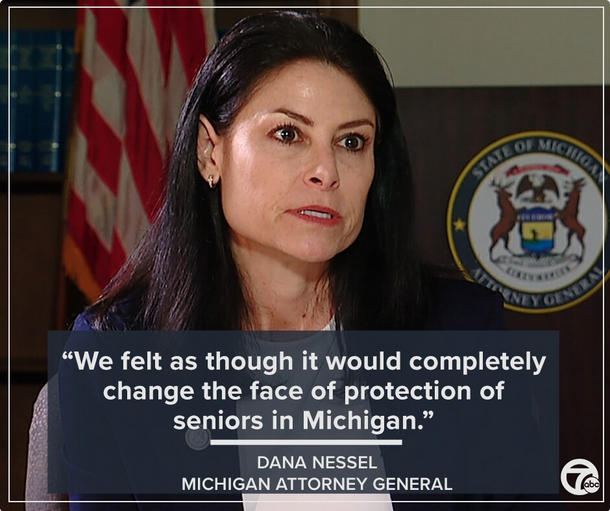
“We felt as though it would completely change the face of protection of seniors in Michigan,” Nessel told 7 Investigator Heather Catallo.

Full Article & Source:
This Michigan nonprofit helped derail guardianship reforms, called AG effort a 'task farce'

Saturday, July 14, 2018

NM guardianship reforms take effect

ALBUQUERQUE, N.M. — Multiple state agencies on Friday outlined the more stringent reporting requirements and oversight mechanisms meant to improve a New Mexico guardianship system rocked by recent scandals.

The changes come courtesy of a new law that took effect July 1.

Senate Bill 19 was designed to prevent abuse and exploitation of thousands of incapacitated people in the state who are under court-ordered guardianship or conservatorship. Guardians make personal and health decisions for those they oversee. Conservators manage finances and sometimes property of those under their charge.

The legislation opens guardianship hearings to the public — previously the law required those to be closed unless the incapacitated person requested an open hearing. It also restricts guardians’ ability to ban family members from visiting their incapacitated loved ones.

Recent changes also mean guardians and conservators must keep the protected person’s financial records for seven years and comply with requirements of any audit of the person’s account, inventory, report or property; and they must submit additional information about the person’s finances and health to district courts, according to a news release.

In addition, the Administrative Office of the Courts and the Office of the State Auditor will begin a pilot project to audit and review guardianship and conservatorship cases, the release said.

District courts can now refer conservatorship cases to the auditor’s office for review and evaluation of the person’s financial affairs. The auditor also can randomly conduct financial and compliance audits of guardians for those served by a publicly funded program through the New Mexico Developmental Disabilities Planning Council and Office of Guardianship.

“All three branches of government — Legislative, Executive and Judicial — came together and worked cooperatively on guardianship reforms to promote and protect the well-being of New Mexicans unable to manage their own affairs,” Supreme Court Justice Judith Nakamura said in a statement.

The Legislature allocated $1 million to the Administrative Office of the Courts for guardianship reform, and a steering committee representing all branches of government convened to help with the law’s implementation and make recommendations about how to use the money, the release said.

Full Article & Source:
NM guardianship reforms take effect

Friday, February 16, 2018

Guardianship reforms near finish line

Reps. Jim Dines, R-Albuquerque, left, and Daymon Ely, D-Corrales, discuss proposed guardianship changes in a House Judiciary Committee meeting in Santa Fe this week. (Eddie Moore/Albuquerque Journal)
SANTA FE – A package of remedies to try to fix the state’s ailing guardianship system cleared the House late Wednesday on a 63-0 vote, with the measure headed to the Senate for concurrence as the final hours waned in this year’s legislative session.

The bill, if approved, would provide more public and family access to the traditionally closed system for the hundreds of mentally or physically incapacitated adults in New Mexico who are placed under court-appointed guardianships or conservatorships each year.
If approved, the reforms would into effect July 1.

State Rep. Gail Chasey, D-Albuquerque, chairwoman of the House Judiciary Committee, before the vote Wednesday night said the bill is “manageable, measured and still addressed substantive reforms.”

Earlier in the day, Chasey said addressing the guardianship issue was a “huge priority in the session.”

Heavily amended in the committee process, the measure “is an excellent and substantial start, but it is by no means the end of the process,” said Rep. Daymon Ely, D-Corrales.

Ely led the move to lop off 200 pages of the original bill, which would have adopted a version of a new model Uniform Guardianship Act, which was considered too costly and in need of more study.

Before the House vote, Ely said that not all court-appointed guardians or conservators are “bad actors.”

“But this has become a tremendous problem,” Ely said. “There were some really doing horrendous things to very vulnerable people and their families.”

The bill relies on increased transparency, providing for open court hearings and more involvement of family members, to help deter abuses and exploitation that critics of the system have complained about publicly for months. The open hearings could still be closed at the court’s discretion, but an open hearing on the closure would have to be held first.

To salvage the reform bill, Chasey’s committee agreed to kill the section that would have implemented a national reform statute by July 2020.

The courts, which still can’t say exactly how many people are currently under guardianships or conservatorships, say New Mexico’s underfunded judicial system isn’t ready for such a dramatic and costly change.

Earlier in the week, Ely took the lead in proposing amendments to keep the implementation of the key provisions low-cost, within $1 million.

“This is a long-overdue reform,” Ely told the Journal. “There’s two ways that you get the crooks. One is you shine a light on them with transparency. The other is you make them accountable. You make them worry that somebody’s going to catch them.”

Nearly all the criticism of the system involves corporate guardians and conservators appointed by the courts in cases in which people are mentally or physically incapacitated. Over the past year, a major New Mexico corporate guardian, Ayudando Guardians, was closed by the U.S. Marshals Office after its top executives were indicted on federal charges related to the embezzlement of more than $4 million in client funds.

Primary opposition to the scaled-back version came from its original sponsor, state Sen. Jim White, R-Albuquerque, who proposed the state adopt a version of the newly released Uniform Guardianship Act, which provides for improved representation of those incapacitated people in guardianship and conservatorship proceedings. The comprehensive model law would also set out specific ways families could file grievances with the court about the appointed guardian or conservator.

“I’m so happy we’ve got this interest going, We didn’t have this a year ago,” White told the House Judiciary Committee before it scrapped the provision to implement the new model law by 2020. “But there’s a lot more that can be done. We need to make a commitment to bigger changes.”

White said that if someone would ask him whether they should get a guardian appointed, “I’d say, ‘Don’t do it.’ The system is so broken right now.”

He described the current closed process as “very, very scary.”

Ely, an attorney who said he has sued conservators in the past, told the Journal his amendments included a provision to outlaw the practice of some conservators, who oversee an incapacitated person’s finances, to require heirs to release them from all liability before they receive any distribution from an estate.

In addition, under the proposed legislation, “You can’t restrict visitors as much as you used to,” said Ely, who added that some “nefarious” guardians and conservators keep relatives away so they can “isolate the incapacitated person.”

Another feature of the bill is to require professional conservators to post bonds and file regular, extensive accountings with the courts on how they have handled an incapacitated person’s financial affairs. “I did hear this from one conservator that they couldn’t violate the confidentiality (of the closed process) to cooperate with the audit, and I thought that was unbelievable.” Ely said.

But Ely said the provisions aimed at accountability would be ineffective without the proposed $1 million in funding in House Bill 2 dedicated to guardianship reform. That money would help the courts research their case files to ascertain who is currently under guardianship and their status. The appropriation would help pay for independent auditors to perform spot checks.

Judges would also need to be educated on the reforms, he said.

“We’re depending on you to make it right for people who don’t have a voice” said Mary Darnell. The controversial guardianship/conservatorship case in 2010 of her mother, Blair Darnell, was featured in “Who’s Guarding the Guardians?,” a Journal investigative series, in late 2016.

Darnell asked the committee members to consider what would happen if they someday were placed under a court-appointed guardianship or conservatorship in New Mexico.

“If somebody walks into your home … puts down court papers and says they’re appointed by the court to take care of you and they have all your finances in their name … your family is going to be turned upside down. The courts are culpable, because they hire these people and they’re not overseeing them.”

Ely said the challenge of fixing all the problems with current law is daunting, considering that legislators had less than 30 days to achieve consensus.

“I think everybody, including Sen. White, are all motivated to do the right thing. Is it going to be perfect? No. But is this an incredibly significant reform to the process? Yes. And if we discover there are problems, we can come back during the next 60-day session and fix them.”


Full Article & Source:
Guardianship reforms near finish line

Tuesday, March 14, 2017

Guardianship reforms DOA in New Mexico

Efforts to reform New Mexico’s system of court-approved guardianships for the elderly have met with frustration and failure – to the chagrin of families caught up in a system many say leaves them as helpless bystanders when a loved one is declared a ward of the court with no say in his or her life.

No one knows that frustration better than former Rep. Conrad James, an Albuquerque Republican.
James, who did not seek re-election last year, carried legislation in 2016 that addressed a frequently heard complaint: that guardians or conservators who become annoyed with family members can – and do – arbitrarily bar (or sharply curtail) them from visiting an aging family member who has become a “protected person.”

James’ bill would have required judicial approval before visitation could be cut off – and only if a clear danger to the ward could be demonstrated.

Former Rep. Conrad James
Conrad’s colleagues in two house committees voted to approve the bill and it passed out of the full house toward the end of the 2016 session. It went no further as the Senate did not have time to consider it.”

“I have carried a number of controversial bills,” James told the Journal. “I have never received, or seen in a committee hearing, the kind of anger and blowback that I saw with this bill – one that I thought was a very commonsense, straightforward bill.”

James attributed the blowback to lawyer-lobbyists who work in the elder guardianship system or who have associates who do.

The legislation’s fate was particularly disheartening to reform advocates, who say the best safeguard against elder exploitation is to keep a trusted family member close to the protected person as an extra set of eyes. In the past, some elders who have been isolated from their families have died without being able to see their adult children for months or years.

James isn’t alone in watching a guardianship reform proposal killed. Other lawmakers who have sought to address complaints about the guardianship system in previous years have fared no better.

And lawmakers considering introduction of elder guardian reform measures this year threw in the towel before they even introduced the legislation, when leadership in the Democrat-controlled Legislature made it clear no legislative solutions would be entertained this session.

Can’t wait

The Albuquerque Journal published a six-part investigative series on the guardianship system late last year, detailing how it is administered and the devastating effects critics say it can have on an aging person who becomes a “ward of the court” and their families.

James, a Sandia National Laboratories scientist who has also served as a University of New Mexico regent, is among those who believe reform is urgently needed in a system that routinely declares mentally frail elders “incapacitated” and with that designation strips them of their civil rights. They no longer have the power to manage their own affairs – from health care to finances.

“I’m a scientist and engineer,” James said. “I’m perfectly willing to have a 60 percent solution to get the ball rolling on something. Some legislators want to get it to 80 or 85 percent.”

“We can’t sit around and wait for perfect.”

He worries that bad things could happen to good families while solutions to the problem are put off year after year.

Secrecy rules

Acting at the request of a lawyer – who often represents one family member who is aligned against others – judges typically appoint strangers recommended by that lawyer to take both personal and financial control of an elderly person’s life. In many cases, there is little subsequent court supervision or auditing of their actions.  (Click to Continue)

Full Article & Source:
Guardianship reforms DOA in New Mexico