Showing posts with label Americans with Disabilities Act. Show all posts

Thursday, June 27, 2024

Stuck in a hospital, hoping for a place of his own

A 29-year-old man with cerebral palsy has been in WakeMed for more than three months waiting for an affordable, safe and supported home.

Tylor Freeman in happier times. Credit: Tylor Freeman

by Rose Hoban

Tylor Freeman would like to go home.

His problem? There’s no home to go to. 

Instead, the 29-year-old has been cooling his heels at WakeMed hospital in Raleigh for more than 100 days.

Freeman’s odyssey began last fall when he needed to have a minor medical procedure. He has cerebral palsy, along with having a history of anxiety and depression. He was living in supported housing with a roommate in Burlington, a situation where he alleges that the caregiver working with him was abusing alcohol. 

So, after his procedure was completed at a hospital in Concord, he refused to return to where he had been living. His family’s dynamics preclude him living with any immediate family members.

Because he didn’t have a home to return to, he first tried living with friends out of state, but that became complicated for him and for his friends, given his extensive care needs and the limitations of what state Medicaid programs can pay for outside of North Carolina. Freeman uses a power wheelchair and needs assistance with everyday activities such as bathing, using the bathroom, dressing, preparing food and more.

“I can feed myself as long as it’s cut up. Soup, cereal, that’s kind of tough,” Freeman said. In the past, he said, he’s been able to use a urinary bag system, as long as it doesn’t leak. “So I could be left alone for a couple of hours, as long as I’m in my wheelchair.”

Freeman spent time in a South Carolina hospital, which eventually threatened to discharge him to a homeless shelter. That’s when friends in Raleigh suggested he make his way to the Triangle. On March 5, he got onto a Greyhound and made his way to WakeMed hospital, where he was admitted to be treated for bladder and body pain. 

That’s where he remains, even though his medical issues were taken care of long ago. 

Freeman’s not alone in his predicament.

For years, people with disabilities have been getting stuck in treatment facilities across North Carolina, even as they strive for the opportunity to live independently. 

The federal Americans With Disabilities Act, passed in 1990, and subsequent Supreme Court and state court rulings require the state to provide services and housing to people with mental health disabilities. One of those rulings is part of a 2012 lawsuit settlement with the U.S. Department of Justice and North Carolina to ensure that such populations are able to live in the least restrictive settings of their choice. The landmark U.S. Supreme Court Olmstead decision in 1999 laid the foundation for such a settlement by prohibiting the unnecessary segregation of people with disabilities and underscoring their right to receive services within their communities.

Bumping up against all those legal mandates is a profound lack of affordable housing in North Carolina, including in Wake County — where the median home cost $474,750 in April, and rent easily tops $1,200 a month (according to Zillow). Both hospital and state officials say that’s the primary reason they’ve had trouble finding a place for Freeman, on top of a shortage of direct service professionals to provide him with the help he needs to live independently. 

And though the state has made efforts to help Freeman and others in similar situations, it continues to be challenging for those who want to help him. Even if there is a physical place to go, given Freeman’s challenges, not every place is the right one. 

“I lived in several places that were not accessible …  you know, I couldn’t fit in the bathroom [with his motorized wheelchair],” he said.

So, Freeman sits at WakeMed, at a cost to taxpayers that’s easily running into the hundreds of thousands of dollars — sums approaching the price of building or buying him his own place.  

Court rulings and federal law 

North Carolina’s system of care for people with mental illness, intellectual and developmental disabilities has been in crisis for the past several decades. Part of the turmoil has been driven by the limited amount of appropriate housing available.

In the past, North Carolina relied on adult care homes, group homes and large state-run facilities to house people who weren’t relying on family members for care. That situation spurred the 2012 action by the U.S. Justice Department, which found that North Carolina had an “institutional bias” for providing care — something that contradicts the Americans with Disabilities Act and the Olmstead decision

Despite those rulings, North Carolina has continued to lag in creating housing opportunities for people with disabilities.

In 2022, a judge forced the state’s hand with the Samantha R ruling, saying that North Carolina needed to provide more in-home disability services over the coming decade. That ruling was reinforced by a settlement between North Carolina Disability Rights and DHHS this spring.

That means there’s money for Freeman. He’s eligible for services under the state’s Transitions to Community Living initiative, which came out of that 2012 Justice Department settlement. He’s also one of the fortunate recipients of a place in the coveted Medicaid Innovations Waiver program, which provides extended services for people with disabilities so they can live and thrive in their home communities. Finally, he’s eligible for funding under the state’s Money Follows the Person program, which provides funds for people like him to have a home and services to keep him there.

In theory, Freeman should have multiple avenues to get a place, but theory and reality often don’t match up. 

“We in the disability community want the same ability to make these choices as individuals who may not have a recognizable disability,” said Julia Adams, a lobbyist at the legislature for people with disabilities who also is someone with a disability. “The problem that we have is we do not have enough housing options that allow for choice.”

“Even for those lucky people with an Innovations Waiver slot, it’s no magic ticket,” said Corye Dunn, the policy lead for Disability Rights North Carolina. “Our community service system is thin and desperately in need of investment to ensure a waiver slot provides meaningful access to services and supports.” 

Inappropriate placements

WakeMed and Freeman’s state-supported managed care organization (known as an LME-MCO), Alliance Health, are the organizations that have the responsibility to find Freeman housing. And, to a certain extent, so is the state Department of Health and Human Services.

“The people at Alliance keep saying, you know, ‘Oh, we’re looking, we’re looking, we’re looking,’” Freeman said. “They are telling me because my case is so complex for [Transitions to Community Living], they are telling me now there is a barrier. The occupational therapist, the physical therapist have to look at my case, before we can move forward.”

Alliance declined to discuss Freeman’s case, telling NC Health News that the organization maintains “an organizational policy of not discussing the treatment of our members in the media even if a member formally authorizes us to do so.”

Freeman said he’s been offered group home placement or placement with a family that’s not his own — neither of which he wants. 

“Not every individual wants to live in a group home or an Innovation Waiver group home, because maybe that is not where they are at this point of their lives,” Adams said. “They have relationships. Some of them have boyfriends, girlfriends. That’s difficult in a group home setting.”

That’s the case for Freeman, who said he has a boyfriend in the Triangle area. He said they’re not at a place in their relationship where they could live together. 

Tylor Freeman has worked on statewide initiatives to reform North Carolina’s guardianship program, in addition to other
advocacy efforts. Now he’s advocating for himself. Credit: Rose Hoban
 
Housing shortage gums up other priorities

WakeMed Chief Medical Officer Charles Harr said they see situations like this too often, where the hospital has trouble finding a place for patients who are being discharged.  

“Some of them are from people who have physical disabilities and require differing levels of care, or they’re close to independent but not totally independent,” Harr said. 

Harr said he knows the hospital isn’t the right place for Freeman, but they’re not going to just turn him out. 

There are a “significant number of folks who come in who don’t have a medical need,” Harr said. “Maybe it’s behavioral, maybe it’s homelessness, whatever has brought them to the emergency room, people just don’t know what to do. 

“Those we do not admit to the hospital, we maintain them in the emergency department until we can get appropriate placement for them.”

But Harr said that this reality means that often people sick with medical issues end up waiting in the emergency department for a bed upstairs that’s occupied by someone who’s simply waiting for someplace to go.  

“That’s happening to us one to two to three times a week now,” Harr said. 

And he said he’s not sure how to undo this Gordian knot that’s tied his organization’s hands.

“We as a hospital can’t force the patient to take an option, on the other hand, we have no … we have no sway over who the LME-MCO is,” Harr said. “I mean, Alliance, they’re getting money from the state, they’re placing people. So we’re collateral damage, just like those patients are. Because we can’t make anybody do anything in that situation.”

Harr estimated that the cost for Freeman’s care had long ago passed the $150,000 mark. 

“A hospital’s an expensive setting for care, and it is the most restrictive setting for someone to be in,” Adams said. “A hospital is not supposed to be a housing option.”

Piecing it all together

“Housing is really complex,” Kelly Crosbie, head of the Division of Mental Health, Developmental Disabilities and Substance Use Services for the state health department, told NC Health News. 

Crosbie said her department has been able to get thousands of people with disabilities out of congregate settings and into their own housing — with supports — over the past decade.

“We’ve invested lots of money, not only in housing, but also the transitional supports to get folks housing, and then the supports to help people maintain their housing. And lots of people’s lives have been changed dramatically,” Crosbie said.

But there still are an untold number of people like Freeman, who still don’t have the right housing or direct support workers to help them once they’re there.

“For folks who are lucky enough to have an Innovations Waiver slot, we still have problems staffing those slots because of direct care workforce shortages,” Adams, the lobbyist, said. “An innovation waiver slot does not really, you know, does not provide the array of choice for the housing portion.”

Crosbie noted that the department is launching a program to encourage people to become part of the direct support professional workforce. The department has also developed other plans and resources that they’re putting in place to create options for people like Freeman. 

While she said that she can’t speak directly about Freeman’s case, she did say that she was aware of his situation. 

“Now we have to make sure that housing stock is available, people know their choices and we have enough workforce to support people in this kind of independent living situation,” Crosbie said. “We don’t do housing, per se, but we’re trying to work with housing people to make sure that we have safe stock for people that have accessibility issues.”

But all these future plans don’t address what Freeman needs now, which is a place to go.  

“Until we sit down and have a real conversation about how do we provide choice, and supports, we are going to have folks who have a waiver and still have limited options,” Adams said.

“The entire reason why we have an innovation waiver is to provide a robust home and community-based support setting for folks. But we’re still not meeting that,” Adams added.

Freeman said he’s hanging in there after being in the hospital for months, but the wait is wearing on him. Recently he found an agency that will provide him with a personal care aide. All he needs now is a place to go. 

“I’m just speechless,” Freeman said. “But I will continue fighting. I’m fighting not just for myself, I’m fighting for other people. Because this is ridiculous.”

Full Article & Source:
Stuck in a hospital, hoping for a place of his own

Sunday, December 22, 2019

Locked into Poverty

Anna Landre

Impossible choices
forced on the disabled


by S.I. Rosenbaum

Presented by Microsoft News in partnership
with Spotlight on Poverty and Opportunity

Anna Landre grew up believing she had a future as bright as any one of her classmates. A mutant quirk of her genome makes her muscles weak, and she gets around in a wheelchair. But she assumed she’d find a way around any obstacle.

“My mom was always determined that my disability would not at all limit my future in any way shape or form,” Landre said. “I could do anything anyone else would do, and it would be harder but we’d figure it out.”

Neither Landre nor her mother realized that Landre’s freedom — to work, to save money, even to get married — would be restricted by something much more complex and implacable than genetics: a government welfare policy meant to help people like her but which too often presents the real possibility of personal and financial catastrophe.

“People don’t completely understand how backwards and unjust these regulations are,” Landre said. “Every time I talk to someone who isn’t in the disabled community they’d be like, ‘You’re kidding me. That can’t be how it is, that can’t be the law, there must be a way to fix it.’”

The financial trap of disabilities programs


Nearly 30 years after the Americans with Disabilities Act first outlawed workplace discrimination on the basis of disability, more disabled people live in poverty than when the law was passed. It’s a complex problem with many factors, but in some cases the very program intended to help disabled people becomes a devastating financial trap.

Medicaid was established in 1965 — not as a program for people with disabilities, but as a last-ditch healthcare program for the poor. It’s federally funded, but administration is largely left up to the discretion of states, and local policies differ widely.

In the 1970s Medicaid was linked to a new program: Supplemental Security Income (SSI), a federally-funded income assistance program for disabled people. Back then there was no law against private health insurance companies turning away disabled customers, and so Medicaid became the default insurance option not just for the poor but also for most disabled people. And in the 1980s, as the nation moved to deinstitutionalize disabled people, Medicaid added home-care benefits that would allow people with disabilities to direct their own care in their own homes.

Today in most states, the same application is used to apply for SSI and Medicaid. And both programs come with austere income and asset limits. To qualify for SSI, an individual can’t earn more than $771 in a month — less than $10,000 a year. And they can’t have more than $2,000 in assets at any time, a number which counts most personal valuables as well as cash in the bank.
Medicaid income and asset limits vary from state to state. Many states use the same limits as SSI, though others allow for as much as $1,012 a month in income for an individual. Two states, Arkansas and North Carolina, allow up to $7,560 in assets, and Arizona has no asset limit. On the other hand, some states — such as Connecticut — have asset limits as low as $1,200.


No alternatives


The problem is that Landre and roughly 3 million other disabled Americans have no alternative. While the Affordable Care Act has made it illegal for private insurance companies to refuse her, Medicaid is still the only insurance program in America which covers personal care assistance — the benefit Landre needs to survive from day to day.

“My assistants help me with getting out of bed, getting dressed, showering, household chores like laundry, cooking, and cleaning; nebulizer treatments for my breathing; going to the bathroom during the day,” she said. At night, an assistant helps her turn over in bed.

Losing personal care “can literally result in deaths for people with disabilities,” said Rebecca Cokley, director of the Disability Justice Initiative at the Center for American Progress.

Without Medicaid, disabled people “could go from having their basic needs met and living in the community … to being forced into nursing homes, or even dying as a result of lack of care,” Cokley said.

So people who rely on home care have no choice but to stay poor. “This isn’t an inconvenience, it’s a death sentence,” Cokley said. “It forces families and individuals to make choices they shouldn’t have to make.”

Landre didn’t realize any of this when she first started using personal care assistants in high school. By the time she went off to college at Georgetown in 2017, Medicaid was providing her 112 hours of assistance a week — enough to live on own in the dorm.

She had to learn to handle timesheets, payroll and scheduling for a constantly rotating staff, but it was worth the freedom and security it gave her. She assumed that was how she’d manage her adult life.


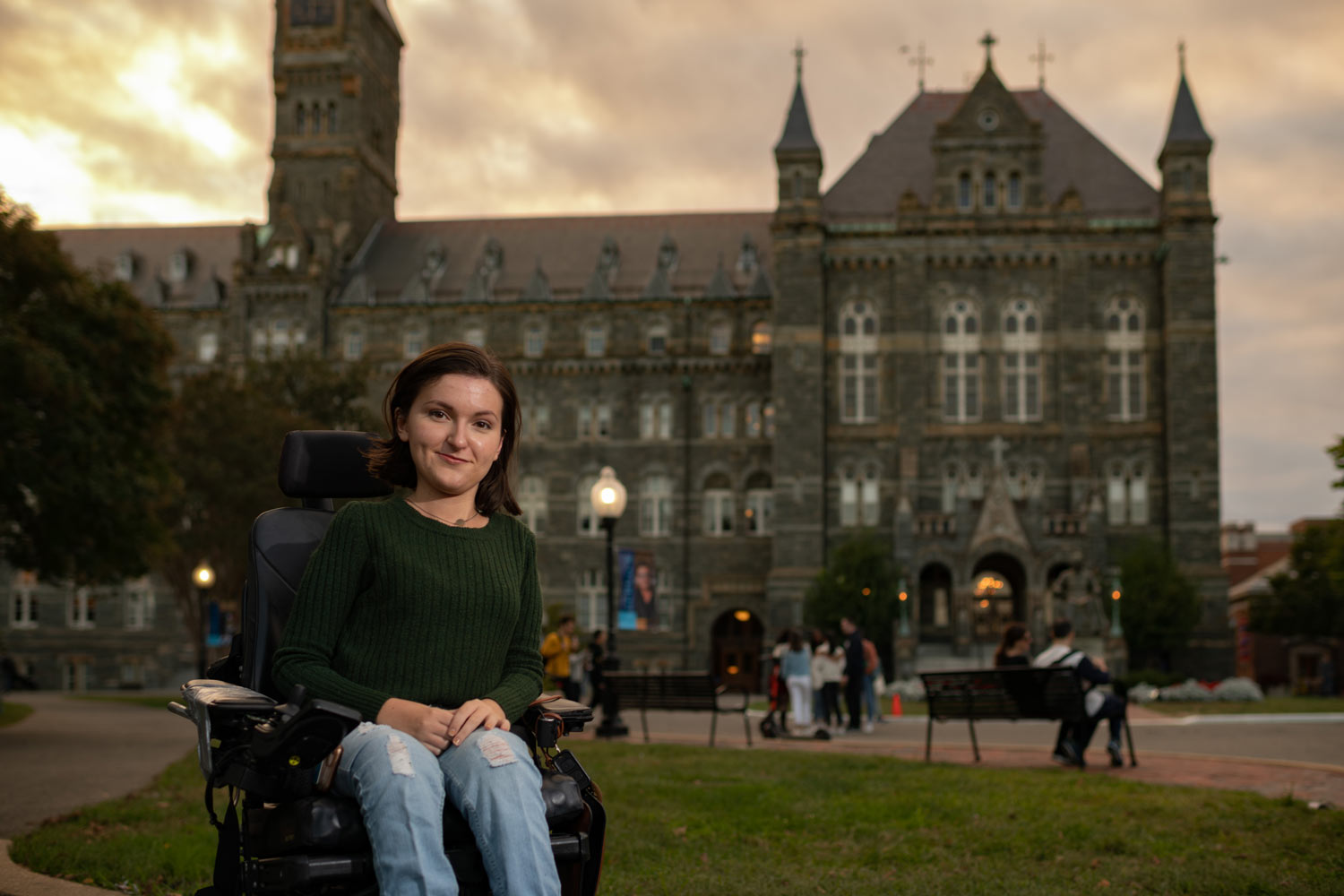
Woman in wheelchair in front an old brick building on a college campus.
Anna Landre, a Georgetown University junior year student, has been advocating to change Medicaid financial requirements after being told she wouldn't be able to work an internship because she would make too much money to qualify. Photography by John Shinkle for Freedman Consulting.

The penalty of income


Then, at the end of her freshman year, Landre landed a paid internship for the summer. She’d be making $14 an hour. When she mentioned the news to a social worker, she expected congratulations. Instead, Landre recalled, “She was like, ‘Oh, you’re not going to be eligible for Medicaid anymore — you’re making too much money.’”

Landre felt blindsided. Suddenly she was facing the choice of keeping the services that would make it possible for her work, or actually working. She couldn’t do both.

Medicaid policies seemed to have been written by people who could not imagine someone like Landre. “It’s this assumption that if you’re so disabled, you’re not going to be able to work,” she said. “And if you’re able to work, you must not be that disabled.”

The problem is that Medicaid and SSI aren’t designed to raise disabled people to equity with nondisabled people. Instead, they can border on the punitive, as MIT political science professor Andrea Louise Campbell noted in her 2014 book Trapped in America’s Safety Net: One Family’s Struggle.

“American social assistance programs are stingy and difficult to access because of an age-old suspicion of the poor,” she wrote. “They are so miserly as to be impossible to live on.” And while they are, in Campbell’s words, “designed to be less attractive than work,” the irony is that they ultimately penalize disabled people for working.

Facing down this dilemma, Landre went to the New Jersey Medicaid office looking for options that would allow her to take the internship and keep her benefits. Officials didn’t offer her any. Frustrated, she started calling reporters and connected with Jay Carino, a writer at her hometown newspaper Asbury Park Press.

But the same day Carino’s story ran, Landre received an email from Medicaid telling her they were arbitrarily cutting her coverage from 16 hours of assistance a day to just 10. This wasn’t a policy issue, and had nothing to do with her finances — it was just a random decision made by someone who had never met her.

Now Landre was fighting on two fronts: to be allowed to keep her benefits while working as an intern, and to appeal a vast and arbitrary reduction in care.

“There’s no preparation for this,” she said. “No one expects a 20-year-old to manage a staff of eight people and be fighting an entire state bureaucracy at every turn.”


A public forum


Much of Landre’s fight took place in public. She knew the optics were good: “People got really angry, because it’s that narrative of ‘Look, it’s a disabled person trying really hard to work and have a productive lifestyle and the horrible government won’t let her.’”

She reached out to her state legislators. She blitzed social media. She talked to reporters, and then more reporters.

As the story spread, she began to get emails from disabled people across the country. She heard from people like Daniel Florio, who has a Harvard MBA but can’t get a job in his home state of New Jersey without losing his benefits. Or Josh Basile, a Maryland malpractice lawyer with a spinal cord injury who was asked to choose between his job and his nursing care.
She even heard from people who wanted to marry but couldn’t, because their partner’s income would disqualify them from benefits.

All of them had scoured the conflicting Medicaid policies for solutions; none of them had found one.
In the end, Landre went off to her internship while appealing the cut in hours.

Eventually, the hours were reinstated — after a drawn-out court process, and only with relentless pressure from the media and legislators. Landre waited for a call ending her services because of the money she’d earned at her internship, but it never came. She thinks New Jersey Medicaid just decided they didn’t want more bad press.

It was a victory of sorts. But when she asked that state officials make changes to protect other disabled people from going through the same thing, they never followed up.

“Nothing changed at all,” she said.

Spotlight on Solutions


Corporations and businesses are increasingly focused on hiring and retaining those with disabilities, providing health care benefits and salaries worth considering.

The Disability Equality Index sought to identify companies who were committed to behaviors like hiring goals, leadership, benefits, accessibility, support services and community engagement supporting equity for those with disabilities. Over 100 companies were awarded top scores including Walmart, Sprint, Verizon, Starbucks, Delta Airlines, and others.

The Valuable 500 is a global movement, putting disability on the business leadership agenda. Companies involved with this movement ensure that disability is on their board agendas and they commit to a public tangible action each year.

While SS and Medicare policies do nothing to elevate the disabled to the nondisabled economic status, there are a few federal programs intended to ease the burden of relying on Medicaid and SSI:

ABLE Accounts: Created in 2014, these special accounts shield savings up to $100,000 from the SSI asset cap.
Section 1619(b): A federal work-incentive program established in 1987 that allows people with disabilities to continue receiving Medicaid benefits while working if their out-of-pocket care costs would exceed their income. The catch: they still can’t save more than the SSI asset limit.
Medicaid Buy-In: An optional program adopted by some states that allows some working people with disabilities to pay a premium to “buy in” on Medicaid benefits. Depending on the state, the program cuts off at a certain income level — for example, in New York an individual can have a gross income of up to $63,492 and keep Medicaid. But for a professional, that’s still pretty low: a raise or two could mean losing everything.


Full Article & Source:
Locked into Poverty

Sunday, May 20, 2018

16 Florida lawyers face wrath of Orlando judges over 'vague, boilerplate' ADA lawsuits

Federal judges in Orlando say they want to know why 16 attorneys have repeatedly ignored rules about filing lawsuits over wheelchair access to businesses in Central Florida.

And they are asking for ideas on how to discipline those attorneys. U.S. District Judge Roy B. Dalton recently opened a case ordering the 16 lawyers – mostly from the Miami area – to show why they shouldn’t be fined or banned from filing similar cases in the future.

Hundreds of lawsuits have been filed in Orlando federal courts alleging that local businesses violate the Americans with Disabilities Act – by not having wheelchair ramps or wheelchair accessible bathrooms, for example. Many of the attorneys filing such cases previously did the same in South Florida federal courts.

The lawsuits most often settle after businesses make a payment, and sometimes they agree to make changes to their facilities, but business owners have said the feel like they’re been extorted.

One of the attorneys in question, Thomas B. Bacon of Cooper City, ran a law firm that employed several attorneys on the list. The Sun-Sentinel newspaper wrote about him in 2014. He told the newspaper then that “the only people who enforce the ADA are these few plaintiffs and their attorneys."

But the paper also quoted a Delray Beach code enforcement officer saying that the lawsuits are purely a money-maker and the attorneys are not concerned about compliance.

Bacon couldn’t be reached for comment for this article. His phone number on the Florida Bar’s website was disconnected, and the email address he listed bounced back.

The Orlando judges who are handling the discipline case said they have tried to be patient and inform the attorneys about how to proceed, but they’ve become frustrated.

“Also disturbing is Counsel's repeated filing of vague, boiler-plate complaints — often improperly joining multiple defendants — that fail to comply with the Federal Rules of Civil Procedure,” wrote U.S. Magistrate Judge Daniel Irick, who is handling the matter.

Two of the attorneys involved responded to the Orlando Sentinel’s questions, Joshua Sheskin and Rafael Viego. Both said they had gone to work for law firms doing ADA cases, and were overwhelmed by the number of cases the firms tried to assign to them. Both said they quit as soon as they could.

According to the judges’ order, more than 200 “negative” orders have been filed against the 16 attorneys. Following is a list of the attorneys with the most negative orders, according to the case:

Thomas B. Bacon, Cooper City, 61 negative orders; Philip M. Cullen, III, Fort Lauderdale, 31 negative orders; Fort Lauderdale; Aaron Finesilver, Miami, 23 negative orders; Miami; Christine N. Failey, St. Petersburg, 7 negative orders; St. Petersburg; Barry S. Mittelberg, Coral Springs, 2 negative orders; Coral Springs; Ayesa Conger, Cutler Bay, 61 negative orders; Cutler Bay; Eric Matthew Rodriguez, Hollywood, 65 negative orders; Hollywood; Sheskin, Miami, 83 negative orders; Miami; Mario Elias Lopez, Miami, 63 negative orders; Miami; Viego, Miami, 56 negative orders; Nadine A. Brown, Winter Springs, 5 negative orders; Andrew C. Enfield, Miami, 7 negative orders; William T. Leveille, II, Miami, 23 negative orders; Michael Christine, Miami, 8 negative orders; Anthony J. Perez, Miami, 54 negative orders; Alfredo Miguel Garcia-Menocal, Miami, 35 negative orders.

Full Article & Source:
16 Florida lawyers face wrath of Orlando judges over 'vague, boilerplate' ADA lawsuits

Sunday, May 21, 2017

Disability Rights Ohio sues Gov. John Kasich, state officials

COLUMBUS, Ohio -- Advocates for disabled Ohioans filed a class-action lawsuit against Gov. John Kasich and the state of Ohio over what they say is illegal segregation of institutionalized people with disabilities.

Disability Rights Ohio filed the complaint Thursday in federal court on behalf of six Ohioans with disabilities and approximately 27,800 similarly situated Ohioans. The complaint alleges the state has not complied with the Americans with Disabilities Act and the U.S. Supreme Court decision Olmstead v. L.C. and E.W.

State officials pushed back on the claims, saying the state is working with providers.

Why are they suing?

The lawsuit alleges people with intellectual or developmental disabilities who want to live and work in their communities can't because of limited state funding.

Large intermediate care facilities have eight or more beds and are "highly regimented and controlled, with little privacy, independence, or personal autonomy," according to the complaint. Facility residents have few if any interactions with people other than paid staff. If they work, most facility residents work in sheltered workshops, which the organization says further segregates people with disabilities.

Of the 5,800 individuals living in those facilities, 2,500 are on a wait list for a Medicaid waiver to receive services at home. Another 22,000 people who are not institutionalized are on the wait list.

Last year's state budget allocated millions of dollars for additional waivers, but Disability Rights Ohio Executive Director Michael Kirkman said the money won't fix problems with how the waivers are awarded.

Ohio is unique in that developmental disability services are provided through each of the state's 88 counties. Medicaid waivers that cover services provided in homes and communities are partially funded with local dollars. Residency in an integrated care facility is covered by Medicaid, which Disability Rights Ohio says is a disincentive to move people out of the facilities.

"Where you receive services should not depend on where you live," Kirkman said at a Thursday press conference.

Disability Rights Ohio raised its concerns with the Kasich administration in 2014. Negotiations followed, Kirkman said, but didn't pan out. The lawsuit seeks a court order forcing the state to expand choices for people with disabilities.

What does the administration say?

In addition to Kasich, the lawsuit is suing the directors of the Department of Developmental Disabilities, Department of Medicaid and Opportunities for Ohioans with Disabilities.

Zach Haughawout, a deputy director with the state developmental disabilities department, said Disability Rights Ohio is not being truthful about its conversations with state officials to address their concerns. Haughawout said that department attorneys attempted to sit down with Disability Rights Ohio as recently as two weeks ago, ahead of the lawsuit. Disability Rights Ohio confirmed a meeting has been set up for next week.

Last year's state budget allocated $300 million to expand community-based options for individuals with developmental disabilities and their families. The budget created 3,000 new waivers to cover community-based options. Haughawout said 1,200 waivers will provide options for people who want to leave the facilities or would have no other choice but to go there.

"Rather than allow the Department of Developmental Disabilities the time to implement budget changes negotiated with providers, county boards of development disabilities, self-advocates, and family members, they've decided to subject Ohioans with developmental disabilities to their singular vision  of what is best for them," Haughawout said in an email.

Full Article & Source:
Disability Rights Ohio sues Gov. John Kasich, state officials

Saturday, August 6, 2016

My Son With a Disability Deserves the Same Opportunities as Everyone


Carol and Jacob Glazer in New York City in August 2015          
Our society should tell people with disabilities they can work and live equally

Twenty four years ago my son, Jacob, was born with hydrocephalus, or water on the brain. After several surgeries, doctors told us Jacob would be living with both physical and intellectual disabilities. They also told us not to expect much of Jacob in terms of his ability to participate in civic life, community life and in work. And they plunged us into what I now call the “The Tyranny of Low Expectations.”

All these years later when people speak to Jacob, they still infantilize him, speaking slowly, avoiding big words, as if he’s a toddler. It may not seem like a big deal, but for people with disabilities and their families, it is among the largest challenges we face. Like Jacob, it starts early in life for someone born with a disability, or after acquiring a disability for those who do so later in life. The bar on expectations for that person is often set so low by doctors, teachers, friends and even families that the person with a disability lives with artificially low ceilings.

The reasons for the tyranny of low expectations are rooted in our societal approach to disability, which has historically been viewed as a problem to be fixed (and in many cases feared or isolated), versus a natural part of the human condition that each of us is likely to encounter in our lives. In the past, people with intellectual disabilities were sent away from their families to institutions, where they would not be threats to public safety. I shudder when I think how, if Jacob had been born only 20 years earlier, he’d likely have been taken away from me.

We’ve also viewed disability as a problem whose responsibility to find solutions rests with the individual, not with the community or our collective society. The passage of the Americans with Disabilities Act 26 years ago this week effectively declared that people with disabilities had a right to participate in all aspects of life, in their community and the workplace. And our society—our builders, our bosses and our brethren—has to provide reasonable accommodations to enable people with disabilities to participate.

But we have not yet raised that low-set bar on expectations that means most Americans with a disability receive a continuous flood of signals—some intentional, some not—that tell us that we cannot really expect to work, or learn or participate equally.

How do these signals manifest themselves? As children, while the special education system teaches independent living or “life skills” (like cooking, personal hygiene and travel training), far too little attention is given to skills that can be used in the workforce. It’s no wonder then that only about one in five working-age Americans with disabilities is employed. The public benefits system—despite efforts at reform—reinforces the expectation that people with disabilities aren’t expected to work; and an outdated statute from 1938 means that people with disabilities can still be paid less than minimum wage to perform menial tasks in a segregated work setting. Proposed new federal legislation aims to remedy that problem, but it has yet to pass.

Every parent hopes that his or her child will become independent, contributing members of their communities, leading full and productive lives, using and being rewarded for their full talents and abilities. We set expectations for them and they rise to the occasion—but we must be mindful of the expectations that we are instilling.

Those who set the early expectations for people with disabilities—parents, school administrators, employers and neighbors—usually have the best of intentions. Nevertheless, many unwittingly engage in the tyranny of low expectations, seeing deficits, not strengths. Disability, not ability. And people with disabilities pick up those messages. When the world doesn’t expect much of you, it’s hard to expect much of yourself. It’s hard to believe in yourself when others don’t. I always tried to hold the bar high for Jacob—and still do—and today he proudly works a part-time job where he gets a paycheck and feels valued for his work.

Those of us with a personal experience of disability know that people with disabilities possess unique problem-solving skills, tenacity, resilience and creativity. Employers must understand the benefits of a diverse society that uses the talents of its citizens to full advantage. We must change attitudes and see strengths—not limitations. We must convert pity to high expectations and help corporate America to recognize promising talent.

More than ever before, people with disabilities are present throughout American society—carrying on our daily lives as workers, consumers, students, neighbors and volunteers—and contributing greatly to our national and community life. But America still has a long way to go to close the gaps in levels of participation between people with and without disabilities. We can start by raising our expectations.
 
Full Article & Source:
My Son With a Disability Deserves the Same Opportunities as Everyone