Showing posts with label Bribery. Show all posts

Monday, April 17, 2017

Philadelphia district attorney pleads not guilty to bribery, corruption charges

Seth Williams
Philadelphia district attorney Seth Williams pleaded not guilty Wednesday to federal bribery and corruption charges and signed a $50,000 bond, according to various reports.

He also handed over his passport, according to reports.

His plea comes a day after his indictment by a federal grand jury on charges related to what officials described as a five-year corruption spree that included accepting tens of thousands of dollars in concealed bribes, a trip to the Dominican Republic and a 1997 Jaguar.

The charges against Williams, 50, a Democrat, also included confiscating $20,000 money intended for a relative's nursing home care and using the funds to pay for his mortgate and electricity, according to official documents and the Philadelphia Inquirer. The news organization identified the relative as Williams' mother, Imelda Williams.

Williams' lawyer, Michael Diamondstein, spoke to reporters outside of court Wednesday and urged the public not to rush to judgment about his client.

"Seth Williams categorically denies ... that he's guilty of any crime," Diamondstein said. "This indictment is 24-hours old and yet too many politicians and commentators have already tried and convicted Seth Williams in the media. Simply because the government makes explosive allegations in a complaint doesn’t mean they’re going to be proven in a court of law."

Philadelphia Mayor Jim Kenney, who expressed disappointment over the developments, asked Williams to resign, the mayor's office confirmed Wednesday night.

The evidence surfaced in part via text messages in which Williams offers himself up to two business owners for assistance.

The U.S. Attorney for the Eastern District of Pennsylvania recused his office from the investigation.

The formal charges announced Tuesday by acting New Jersey U.S. Attorney William Fitzpatrick, who is overseeing the case, include bribery, extortion, honest services wire fraud, and also defrauding a nursing home and family friends by taking the funds earmarked for the relative's nursing home fees. Honest services fraud is when a public official denies someone his or her intangible right to honest services.

"The indictment alleges that as District Attorney, Mr. Williams compromised himself and his elected office by standing ready to help those who were willing to pay him with money, trips and cars," Fitzpatrick said in a statement. "Mr. Williams' alleged willingness to compromise his position of public trust in exchange for private financial gain is all the more unfortunate given that he was elected to protect the interests of the people of Philadelphia as their chief law enforcement officer."

Williams' office requested privacy on the matter.

"The Philadelphia District Attorney's Office does not have any comment at this time," the office said in an e-mail to USA TODAY. "The DA is not in the office today because he is spending time with his family. I ask that you respect his privacy and the privacy of the men and women of the office so all of us can continue to do our jobs without the distraction of additional media attention."

Williams' lawyer, identified by the Inquirer as Michael Diamondstein, told the news organization his client would fight the charges. Sources told the Inquirer that Williams rejected a plea deal earlier this week.

"Mr. Williams vehemently denies that he ever compromised any investigation, case, or law enforcement function," Diamondstein told the Inquirer.

FBI Special Agent in Charge Michael Harpster in a statement called the alleged misconduct "brazen and wide-ranging."

Kenney, the mayor, condemned the alleged behavior.

"It is deeply shameful that the city’s chief law enforcement officer has been implicated in such a flagrant violation of the law," Kenney said in a statement. "At a time when our citizens’ trust in government is at an all-time low, it is disheartening to see yet another elected official give the public a reason not to trust us. That this comes at the head of our justice system is even more troubling. We must all greatly raise the bar for our behavior and show the citizens of Philadelphia that we are capable of carrying out our most basic responsibilities as elected officials, upholding the law.”

The indictment comes during a period of alleged corruption and misspending in Philadelphia. The city controller has charged that a former aide to former Mayor Michael Nutter used a non-profit that operated under the mayor as a "slush fund" for the mayor's office. In December, former U.S. Rep. Chaka Fattah, a Democrat from Philadelphia, was sentenced to 10 years in prison on federal racketeering and bribery charges.

Williams took office in 2010, with much hoopla made over the fact that he was the first black district attorney in Philadelphia and the entire commonwealth of Pennsylvania. In his younger years, he showed much promise. At Penn State, he was president of the Undergraduate Student Government and the Student Black Caucus. He graduated from Georgetown University's law school as a Public Interest Law Scholar.

As an assistant district attorney for a decade with the city of Philadelphia, he launched and led a Repeat Offenders Unit. He was elected district attorney in 2009, attracting more then 75% of the vote. In 2011, his office brought charges against an abortionist who allegedly killed infants who survived the procedure and the abortionist was convicted and sentenced to life.

But things turned for Williams. In 2015, he was criticized for not going after prosecutors who were found to be sharing pornographic and racially derogatory e-mails on government computers. Last year, his a woman identified in the Philadelphia media as his girlfriend turned was sentenced to probation for slashing his tires in 2015. In January, Philadelphia's Board of Ethics fined him $62,000 for failing to disclose $160,000 in gifts. And last month, he announced he would not seek a third term as district attorney because he had "cast an unnecessary shadow" over his office.

The alleged misconduct cited in Tuesday's indictment took place from 2010 to 2015, according to the U.S. Department of Justice. Williams also attempted to conceal the bribes and gifts by filing misleading personal financial statements from 2012 through 2015, the Department of Justice said.

With one of the business owners, Williams accepted a vacation to the Dominican Republic, a custom sofa, a $502 dinner at a Philadelphia restaurant, a $7,000 check, $2,000 in cash, an iPad, Burberry watch and a Burberry purse for his girlfriend, according to the indictment. In return, the district attorney agreed to help the business owner with security screenings when he returned from foreign travel, and asked a police official to help the business owner avoid a screening.

Williams also agreed to help with an associate of the business owner with criminal charges. The business owner texted Williams that the associate would "take any punishment" but "just doesn't wanna do jail," according to the indictment. Williams responded, "I will look into it." Williams then asked about a second future trip to the Dominican Republic to be paid for by the business owner and texted, "I am merely a thankful beggar and don't want to overstep my bounds in asking ... but we will gladly go."

With another business owner, the owner of a bar, Williams accepted 16 round-trip airline tickets to Florida, San Diego, Calif., and Las Vegas for himself, his girlfriend and family members, the indictment alleges. He also asked for and accepted a 1997 Jaguar XK8 and at least $900 in cash, according to the indictment.

In exchange, Williams appointed the bar owner as a special advisor to his office, even though the bar owner was on federal probation resulting from a 2010 federal tax conviction, the indictment said.

Williams also sent a letter to California officials attempting to influence a hearing to revoke or suspend the bar owner's California liquor license.

Williams sent texts to the bar owner that read, "I wish I could help more," "Can I be a celebrity greeter or celebrity bartender to work off my debt ... ?" and "I was serious about just doing whatever I can to help you guys," according to the indictment.

Regarding the nursing home funds, the indictment alleges that Williams diverted pension and Social Security payments intended for one of his family members to pay for his own personal expenses. The funds were to pay for the relative's nursing home costs and Williams was under an agreement with the nursing home to make the payments. Williams also lied and told a nursing home employee that his family member spent the money, according to the indictment. In addition, Williams accepted $10,000 from friends of his relative to cover nursing home expenses and spent the money on himself, the indictment alleges.

The relative was Williams' mother and he used the funds to pay his mortgage and electricity bills, according to the Inquirer.

Williams is expected to surrender and be arraigned Wednesday afternoon, the Inquirer reported.

Also working on the case are the FBI, IRS and U.S. Immigration and Customs Enforcement.

Two prosecutors from the Eastern District of Pennsylvania will work on the case under the supervision of prosecutors from New Jersey.

Full Article & Source:
Philadelphia district attorney pleads not guilty to bribery, corruption charges

Thursday, April 13, 2017

Corrupt judge not enough for new trial

A man who was convicted of murder and sentenced to life before a corrupt judge did not provide enough evidence to prove his constitutional rights were violated, a state appeals panel held Friday.

After a jury trial in 1984, defendant Robert Gacho was convicted of murder, armed robbery and aggravated kidnapping for his part in killing Tullio Infelise and Aldo Fratto in 1982.

He was initially sentenced to death but later received a life sentence after the Illinois Supreme Court affirmed his conviction but remanded his case for resentencing.

His case was tried separately but simultaneously with co-defendant Dino Titone, who elected to have a bench trial before former Cook County judge Thomas Maloney. Maloney was later indicted on bribery charges in 1991 in connection with a state and federal investigation into claims that judges were “fixing” trials.

Maloney was convicted in April 1993 of “fixing” three murder cases for more than $100,000 in bribe money in the Operation Greylord scandal.

Gacho argued in an evidentiary hearing stage post-conviction petition that he should get a new trial because Maloney’s corruption, among other things, deprived him of initially receiving a fair trial. But a 1st District Appellate Court majority affirmed the trial court’s decision to dismiss his petition, finding Gacho failed to present evidence outside of affidavits citing hearsay to prove his case.

The defendant first filed a post-conviction petition with his corruption claim in February 1991 on behalf of himself.

After new post-conviction counsel was appointed, Gacho supplemented his petition in July 2008 to include an affidavit from Titone’s father, which described the scheme in which the father paid Maloney $10,000 to find his son not guilty.

He also supplemented his petition with an affidavit from himself, asserting his pretrial attorney had also suggested Gacho bribe Maloney.

Cook County Circuit Judge Diane Gordon Cannon dismissed Gacho’s petition without an evidentiary hearing in May 2009. In 2012, a unanimous 1st District panel affirmed Cannon’s dismissal of one claim but remanded Gacho’s case for an evidentiary hearing on other pleadings, including his judicial corruption claim.

During that hearing, Gacho testified he retained new counsel after his previous attorney, Daniel E. Radakovich, lost interest in his case once he learned Gacho couldn’t come up with the money to bribe Maloney. Radakovich denied Gacho’s statements when he later testified as a witness for the state.

The court also heard testimony from a Menard Correctional Center inmate, who testified Titone told him about paying the $10,000 bribe.

Cannon accepted into evidence the affidavit from Titone’s father as well as other affidavits that supported Gacho’s claims before her on remand.

However, Cannon found Gacho’s testimony unbelievable and dismissed his petition in October 2013, finding he failed to demonstrate that his constitutional rights had been violated.

Gacho contended on appeal that Cannon’s ruling was “manifestly erroneous” in the face of evidence that showed a connection between Maloney’s bribe corruption and his personal interest in the outcome of Gacho’s trial — where a $10,000 bribe to find one co-defendant not guilty meant finding Gacho and other defendants, who were indicted but being tried separately, guilty.

However, the appellate panel’s majority opinion held Gacho failed to present direct evidence that Maloney actually solicited, received or agreed to accept a bribe to influence the rulings in his case, since he eventually found Titone guilty of the crime for which his father allegedly paid the judge for a not guilty verdict.

The panel ruled the evidence upon which Gacho relied wasn’t enough to support a claim that warranted relief pursuant to the Illinois Post-Conviction Hearing Act.

“There is no question that, if Maloney possessed a pecuniary interest in the outcome of the defendant’s trial, the defendant would be entitled to relief under the [a]ct in the form of a new trial,” Justice Thomas E. Hoffman wrote in his 10-page majority opinion. “However, the defendant’s entire argument in this regard rests upon the affidavit of Titone’s father which consists of nothing more than hearsay.”

The fact that Titone’s father allegedly bribed Maloney for Titone’s trial did not inherently mean the judge wasn’t impartial during Gacho’s trial, the panel found.

It held Gacho would have been deprived of due process if Maloney harbored a compensatory bias against him during trial, but Gacho failed to prove a connection between Maloney’s corruption in other cases and any adverse findings in his. It also found Gacho failed to present evidence of any actual bias that resulted from Maloney’s conduct.

“Distilled to its finest, the record in this case establishes only that the defendant was tried simultaneously with a co-defendant who, as we have assumed for purposes of analysis, bribed a corrupt trial judge; thus giving rise to a claim of compensatory bias which we believe is governed by the holding in [People v.] Fair,” Hoffman wrote. “There can be little doubt as to Maloney’s pervasive corruption in other cases … but Maloney’s pattern of bribe taking … cannot alone support an inference that he engaged in compensatory bias to the defendant’s case.”

Justice Mary K. Rochford concurred in the panel’s majority opinion.

However, Justice Mathias W. Delort wrote in his six-page dissent that Gacho shouldn’t need direct evidence to receive a new trial.

“Criminal defendants have the right to an impartial judge no matter how compelling the evidence against them,” he wrote, noting the U.S. Supreme Court has previously held it is not necessary for a defendant claiming judicial bias to show their judge was actually biased.

“Accordingly, Gacho should prevail if the circumstances show that ‘the probability of actual bias on the part of the judge’ was ‘too high to be constitutionally tolerable,’” Delort wrote.

Cannon’s ruling, Delort held, should be reversed because Gacho “clearly” showed a connection between Maloney’s conduct and the outcome of his case as well as an actual bias that arose from the conduct.

He cited the 1st District’s first opinion on Gacho’s case — which Hoffman also authored — that found both Gacho’s and Titone’s trials were both presided over by a man who the state conceded had an interest in the proceedings.

“We cannot view Gacho’s case in isolation, but instead acknowledge that the taint of Titone’s case fatally infected the entire proceeding,” Delort wrote. “The egg, as it were, was irreversibly scrambled when Gacho’s and Titone’s cases were tried simultaneously using the same evidence and the same witnesses, and before the same judge, as a single judicial proceeding. It cannot now be unscrambled to sift Gacho’s case out from Titone’s case.”

Brett Zeeb, an assistant appellate defender in the 1st Judicial District Office who represents Gacho, said he and his client were disappointed in the majority’s ruling.

He said they agree with Delort’s dissent, which provides a good basis upon which they will “definitely” file a petition for leave to appeal before the Illinois Supreme Court.

Cook County Assistant State’s Attorneys Alan J. Spellberg and Jon J. Walters represented the state. A spokesperson in Cook County State’s Attorney Anita M. Alvarez’s office did not respond to a request for comment by time of publication.

The case is The People of the State of Illinois v. Robert Gacho, 2016 IL App (1st) 133492.

Full Article & Source:
Corrupt judge not enough for new trial

Thursday, October 27, 2016

Prosecutors oppose release of indicted Arkansas ex-judge

Federal prosecutors oppose the release of a former Arkansas judge until his trial on charges of giving lighter sentences to defendants in exchange for nude photos and sexual acts.

The motion filed Friday says former Cross County District Judge Joseph Boeckmann has tried to bribe or threaten witnesses against him by using third parties, showing he "has both the ability and the willingness" to try to tamper with witnesses without personally contacting them.

Boeckmann's attorney had asked that he be allowed to live with relatives until his November trial.

The 70-year-old Boeckmann resigned in May and has pleaded not guilty to fraud, bribery, witness tampering and other charges.

A U.S. magistrate judge on Wednesday denied bond, but said he will consider allowing Boeckmann to stay with a family member far from Cross County.

Full Article & Source:
Prosecutors oppose release of indicted Arkansas ex-judge

Thursday, July 14, 2016

Bribe-taking judge will get annual $120,000 pension


By pleading guilty to bribery-related felonies days ago, John A. Michalek did nothing to jeopardize his six-figure state pension as a former State Supreme Court Justice.

He will be paid approximately $120,500 annually through his golden years, The Buffalo News determined through payroll records and a years-of-service figure provided by the State Comptroller’s Office, which manages the state’s pension funds.

The payments could change slightly based on subtle variables that will be considered before the payments begin later this year, a spokeswoman for the comptroller’s office said after being told of The News’s calculation.

Michalek’s pension is safe, even though New York lawmakers and good-government groups have long argued that public officials should lose all or some portion of their pensions if convicted of a crime related to their official duties.

Full Article & Source:
Bribe-taking judge will get annual $120,000 pension

Friday, July 17, 2015

Former county judge, lawyer sentenced on bribery charges


Angus McGinty (right) outside federal court Wednesday

(Photo: Matthew Craig)
SAN ANTONIO -- A former state district judge and an attorney were both sentenced to prison Wednesday as part of a federal corruption probe inside the Bexar County Courthouse. Angus McGinty, who resigned his position in 144th District judge in 2014, was sentenced to two years in prison. Attorney Al Acevedo was sentenced to one year and one day in prison.

McGinty was indicted on 2014 on charges of conspiracy to commit federal bribery, one count of bribery, one count of extortion and 12 counts of honest services wire fraud. The indictment alleged that McGinty solicited and accepted bribes from San Antonio lawyer Alberto Acevedo Jr. over a nine-month period in 2013.
McGinty resigned on Feb. 14, 2014, a month before Acevedo plead guilty to bribery. In his plea, Acevedo admitted he engaged in corruption by influencing McGinty with things of value.

On Wednesday, a judge offered McGinty some time to spend with his family and serve his prison sentence after Christmas but McGinty didn't take it. He said he just wants to get his sentence over with. He said it's about moving forward now with his family.

"Forward. What we're enduring is nothing compared to what other families have endured. We'll be fine," said McGinty.McGinty thanked the people who supported him in the last year and a half. He also, thanked the judge who sentenced him and the remarks he made in federal court.

Full Article and Source:
Former Judge, Lawyer Sentenced on Bribery Charges

Monday, July 7, 2014

Former District Court Judge Angus McGinty Speaks for the First Time Since Indictment

A former district court judge is speaking for the first time since being indicted on 15 federal charges of corruption.

Angus McGinty had his first appearance today in federal court.

The charges against him stem from allegations made by former defense attorney Albert Acevedo.

Yami Virgin spoke to McGinty after his court hearing.

For those of us who have covered cases with Angus McGinty its a bit ironic to see the former judge on the other side of the bench.  Next to him other men charged of committing crimes against the United States of America.

In his suit instead of a robe, the former judge sat today in federal court next to three other shackled defendants.

McGinty faces 15 charges related to courthouse corruption stemming from allegations and recordings the FBI collected with the help of former defense attorney Albert Acevedo.

Charges of wire fraud, conspiracy to commit bribery, commission of bribery and extortion allegedly in exchange for more lenient sentences for Acevedos' clients.

Immediately following the court proceedings McGinty chose to make his first public statement since this case was made public earlier this year.

"I am not guilty.  Keep me and my family please in your prayers.  Thank you."

In May, Acevedo plead guilty and accepted a deal with the U.S. Attorney's office.

Full Article and Source:
Former Judge Speaks Out on Corruption Charges

See Also:
Former Bexar Co. Judge Indicted on Bribery, Extortion, Fraud Charges

Friday, June 20, 2014

Former Bexar Co. Judge Indicted on Bribery, Extortion, Fraud Charges

A 15-count indictment filed against a former Bexar County judge alleges the judge engaged in a scheme to defraud citizens of their right to his honest services.

The court document was filed Wednesday afternoon. It charges 50-year-old Angus Kelly McGinty with one count of conspiracy to commit federal bribery, one count of bribery, one count of extortion and 12 counts of honest services wire fraud.

The indictment alleges McGinty solicited and accepted bribes from San Antonio lawyer Alberto Acevedo, Jr. over a nine-month period in 2013.

In the scheme, McGinty reportedly received gifts, services and payments from Acevedo that totaled more than $6,655, according to the indictment. In exchange, McGinty would return favorable rulings for Acevedo’s clients, including "lenient sentences and less restrictive conditions of release."

Sources outside the courthouse said McGinty swapped with Acevedo, giving the attorney bond reductions on his cases in exchange for auto repair work on the judge’s vehicles.

Full Article and Source:
Former Bexar Co. Judge Indicted on Bribery, Extortion, Fraud Charges

Friday, May 2, 2014

El Paso lawyer Theresa Caballero wins in disciplinary matter before appeals court


AUSTIN - El Paso attorney Theresa Caballero's law license is headed for probation after she won a motion in the Eighth Court of Appeals.

A divided appellate panel on Wednesday granted Caballero's request for a writ of mandamus, which orders a judge to sign a disciplinary order he had refused to sign. The court ordered a visiting judge to sign an agreement putting Caballero's license on probation for nine months and charged her $1,000 in fees.

Two members of the three-justice panel ruled that the judge, George D. Gilles of Midland, did not have the discretion to reject a 2012 punishment agreement between Caballero and the State Bar of Texas' Commission for Lawyer Discipline.

Caballero and her co-counsel, Stuart Leeds, faced punishment stemming from their behavior in a 2011 trial in which their client, 448th District Judge Regina Arditti, was acquitted of bribery.

Caballero was accusing the judge, Steven Smith of College Station, of racism even before the trial started. In 2012, Caballero and Leeds were convicted of criminal contempt after a weeklong long trial of charges Smith filed against them.

During the Arditti trial, Caballero improperly accused the judge and the prosecutor of being in cahoots and she intentionally impeded the trial, the judge in the contempt case ruled. Caballero was fined $900, but the judge probated the fine.

Full Article & Source:
El Paso lawyer Theresa Caballero wins in disciplinary matter before appeals court

Wednesday, March 26, 2014

"Who Have I bribed? What judges? What Bull***!"

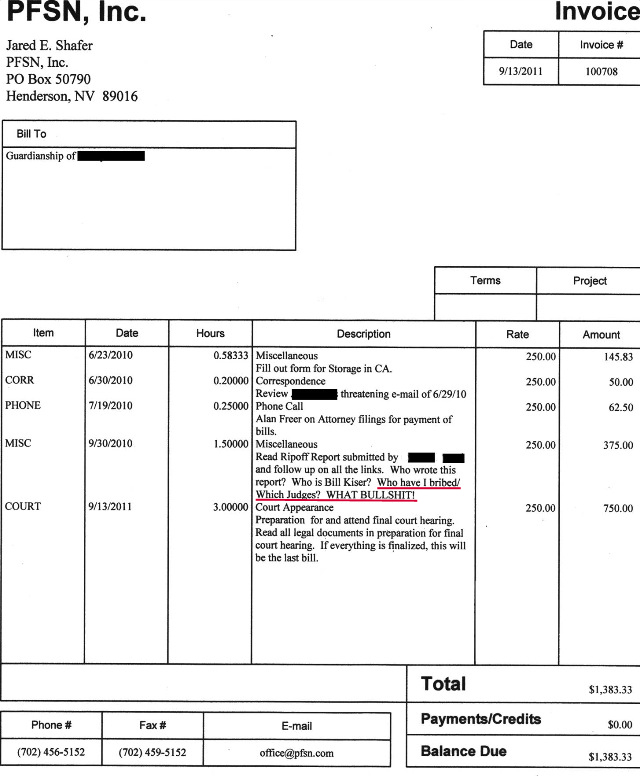
On September 30, 2010, private guardian Jared E. Shafer charged one of his elderly "wards" for 1.5 hours of his time to read Ripoff Reports that he felt disparaged his good name. After reading hundreds of complaints about himself and his crew, he wrote the statement "Who have I bribed? Which Judges? WHAT BULLSHIT!" on his PFSN, Inc. Invoice, and then charged the ward $375.00 for his aggravation.

On May 22, 2013, Shafer answered his own questions; "Who have I bribed? Which Judges?" through his actions as a private citizen ordering Clark County Family Court Judge Jon Norheim to close the public hearing when tough questions began to be asked about a deceased ward's missing $500,000.  Keep in mind that Shafer is not a public official or attorney. He's just a 1961 Las Vegas High School graduate with friends in high places. In a Family Court video record obtained by INSIDE VEGAS that Shafer and Norheim never wanted the public to see, Shafer stood up in the audience, and as a private citizen business owner, bullied Norheim into throwing the public out of the hearing after four attorneys asked the whereabouts of over $500,000 missing from one of Shafer's deceased ward's accounts. Just before he issued his "order," Shafer can be seen staring at his office manager/secretary/bookkeeper Amy Deittrick who was sitting to Shafer's right in the gallery. This 1:26 sec. video record, and Judge Jon Norheim's flaccid "Okay" in response to Shafer's demand for privacy, speaks a thousand words.

After viewing the video, most people ask why? This may be the answer:

 
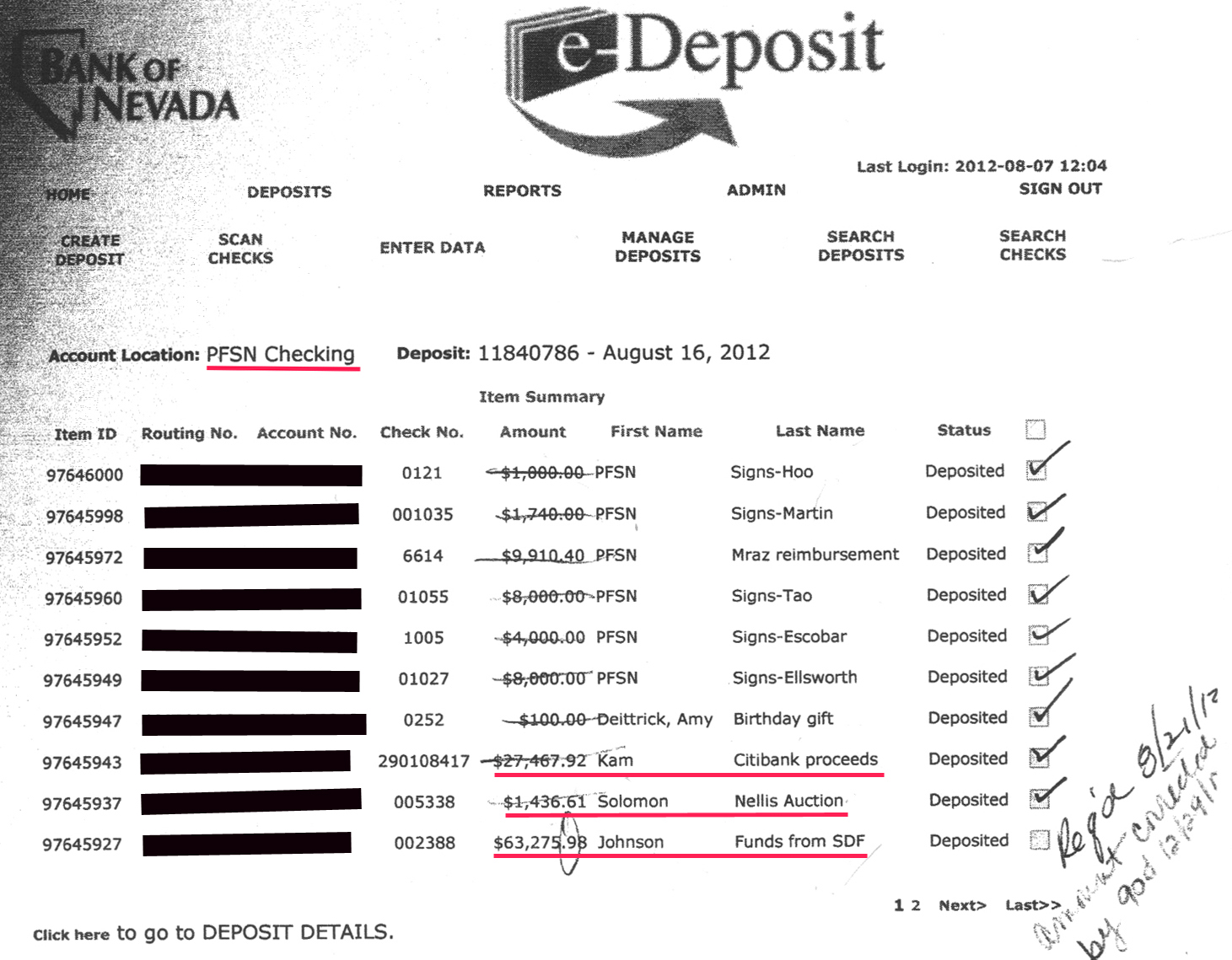
Jared Shafer illegally commingles funds from a company known as Signs of Nevada, LLC, with funds from his "wards" in his PFSN, Inc. bank account. Commingling of ward's funds is a violation of NRS 159.073 (III) (IV).
 
Hundreds of A-frame portable billboards are owned by two of Shafer's closest associates, guardianship attorneys Patricia Trent and Elyse Tyrell, who often represent Shafer in Family Court disputes. Shafer's PFSN office manager/secretary/bookkeeper, Amy Deittrick, is listed as their sign company's manager by the Secretary of State. Sign companies such as theirs have the ability to make or break a judicial campaign by discounting the 8' by 12' movable political signs to certain Judge, DA, and Attorney General candidates during election season. The majority of Trent and Tyrell's signs now appearing during this election season contain ads for Family Court and District Court incumbent Judges, selected candidates seeking to fill court vacancies, or attorneys wanting to replace less cooperative Judges.
 
Sources say that Shafer is the go-to guy when it comes to cheap political billboards - a sure fire way to endear himself to those with power over the lives and fortunes of his hapless wards and their heirs.
 
  
See Also:
Grave Robbery Under Color of Law

Saturday, March 15, 2014

Former Probate Judge Mark Belinky Answers Questions About His Resignation

Mahoning County Probate Judge Mark Belinky has resigned from the bench amid an investigation into suspected corruption.
 
21 News Reporter Michelle Nicks spoke with Judge Belinky after he issued his resignation.
 
She reports Belinky did return her phone call and answered some of her questions about his resignation.
 
Belinky said "I'm trying to approach my situation in the best interest of my family and myself. I am concerned about my staff and I am concerned about the court. I have spent 35 years working in Probate Court or being the judge of the court. It takes tremendous experience to run it. I thank the thousands of people who allowed me to help them there. It was an honor. The public overwhelmingly elected me to be the judge. I took that very seriously. I personally was proud to greet and wait on the public as they came to my office."
 
Belinky told Michelle Nicks that he will retain his law license for now and he's focused on supporting his family and getting through this.

He would not discuss the details of the Attorney General's investigation at this time, on the advice of his attorney.

There has been no indication that Belinky has been charged with any crime.

Last month agents from the Ohio Bureau of Criminal Investigation and sheriff's deputies searched Belinky's courthouse office and his home.

According to a search warrant, investigators were looking for bank records, campaign finance reports, lists of donations and donors, ledgers, and any documentation, computers electronic storage devices, and electronic media.
 
Court documents said that authorities were seeking evidence in criminal offenses including, engaging in a pattern of corrupt activity, tampering with records, bribery, money laundering, theft and theft in office.

Full Article and Source:
Mahong County Probate Judge Mark Responds After Resignation

See Also:
Ohio Mahong County Probate Judge Mark Belinky Resigns!

Ohio Mahong County Probate Judge Mark Belinky Resigns!

Mahoning County Probate Court Judge Mark Belinky resigned Friday evening amid a probe of his dealings by the Ohio Bureau of Criminal Investigation, the FBI and the Mahoning County Sheriff’s Office.

In a letter submitted to Ohio Gove. John Kasich Friday, Belinky said, “Please be advised that the undersigned is the Judge of the Mahoning County Probate Court. I hereby submit my resignation as Judge of the Court effective this date.”

Belinky would not go on camera, but in a phone interview, he said he made the decision in the best interest of his family and himself.

“I was overwhelmingly elected to be probate judge,” Belinky said. “I was honored to help the thousands of people who came to the court. I was honored to serve them, and I’m sorry I can no longer do that.”

Belinky also said he is very worried about the court and he hopes the governor would put a very qualified person in the position.

Political leaders are calling Belinky’s resignation another black eye for the Valley.

Full Article and Source:
Mahong County Judge Resigns

See Also:
Mahong County (OH) Probate Judge Mark Belinky's Campaign and Financial Records Seized

Wednesday, February 12, 2014

Mahong County (OH) Probate Judge Mark Belinky's Campaign and Financial Records Seized

Investigators seized campaign and financial records of Mahoning County Probate Judge Mark Belinky, looking for evidence to possibly file criminal charges, including engaging in a pattern of corrupt activity, tampering with records, bribery, money laundering, theft, and theft in office, according to a search warrant.

Documents taken from Judge Belinky’s court office in Youngstown include bank records, campaign finance reports, lists of campaign donors, computers and electronic media, according to the return of a search warrant signed by Youngstown Municipal Judge Elizabeth Kobly. A search warrant also was served at his Windsor Road home in Boardman.

The state Bureau of Criminal Investigation served warrants Friday with the assistance of the FBI and the Mahoning County Sheriff’s Office.

Judge Belinky’s attorney, J. Gerald Ingram, declined to comment.

Judge Belinky also declined to comment earlier in the day other than to release a statement saying that despite the search Friday, the court is open for business. Judge Belinky said he has been advised by his lawyer not to say anything.

Full Article and Source:
Belinky Search Warrant Returned

Tuesday, March 19, 2013

Attorney: Bencivengo’s depression incapacitated him

TRENTON — “The depression made him do it,” was the mitigating circumstance former Hamilton Township Mayor Bencivengo’s defense attorney offered, in the hopes of reducing the disgraced leader’s sentencing at a hearing held on Wednesday.

Defense lawyer, Jerome Ballarotto, initiated an importune examination of a criminal forensic psychologist, whose research into Bencivengo’s psyche deduced that the mayor was clinically depressed years before and severely depressed during his reign at the head of the township. “He was so severely depressed he was distracted and could not comprehend the ramifications of his actions,” said Criminal Forensic Psychologist Dr. Gerard Cooke while on the stand during the sentencing hearing.
 
The fallen politician, who was found guilty in November of accepting $12,400 worth of bribes in exchange for his official influence, was painted by his attorney as a victim who suffered from a debilitating disease.
According to the doctor’s testimony, Bencivengo was diagnosed by his primary care physician, in 2001, as depressed. His deep despair and symptoms worsened when he began to incur marital problems with his wife of over 30 years. The depression became even more severe when he began dating and then consequently broke up with a woman 30 years his junior.

Full Article & Source:
Attorney: Bencivengo’s depression incapacitated him

Wednesday, February 20, 2013

Attorney indicted for bribing witness

 
CINCINNATI, OH (FOX19)- A local attorney has been indicted on allegations that he bribed a witness.
 
Gregory A. Cohen has been indicted for obstructing justice and bribery.
 
According to the indictment, Cohen used cash to, "corrupt a witness, or improperly influence him with respect to his testimony in an official proceeding, either before or after he was subpoenaed or sworn, promised or offered, or gave him or another person a valuable thing or valuable benefit."
 
Cohen is the attorney for murder suspect Lamar Simmons, who was arrested in 2011 for the 2005 murder of Jose Vazquez. Simmons was also charged with retaliation against a witness in the case. Vazquez was found dead hours after he testified in the murder case of Johnathan D. White.
 
Full Article & Source: