Showing posts with label Doctor. Show all posts

Saturday, December 7, 2019

How a doctor learned to become a caregiver

Arthur Kleinman and his wife, Joan, who died at 71.

After his beloved wife was diagnosed with Alzheimer’s, Arthur Kleinman discovered that what he didn’t know was a lot


Arthur Kleinman’s wife, Joan, began to struggle with a rare form of early Alzheimer’s disease at 59. Eight years after losing her, the Esther and Sidney Rabb Professor of Anthropology in the Faculty of Arts and Sciences and professor of psychiatry and of medical anthropology at Harvard Medical School chronicles their journey in “The Soul of Care: The Moral Education of a Husband and a Doctor.” The book is part memoir, part examination of love and marriage, and an intimate look at how 40 years in the medical profession left him entirely unprepared to care for a loved one.

Q&A

Arthur Kleinman


GAZETTE: The book is so personal. Can you talk about the decision to write it and whether you talked to Joan about it?

KLEINMAN: I started writing a long time ago when she was just starting on her 10-year course of Alzheimer’s disease. She had a very particular kind of Alzheimer’s that affects only 5 percent of the people, and it began in her occipital lobes, which meant that she became blind first. To be both blind and have dementia is particularly trying, particularly for the person who has it, but also for the caregiver. Joan was 100 percent behind the idea of writing this. I came out of a background that was very unpromising for a caregiver. I was a very headstrong, heedless, and careless child. I was self-centered and incredibly ambitious and hard-driving. Those 10 years changed me almost entirely and made me realize how crucial the human aspect was. I was always good with patients and students, but I wasn’t like that generally, and taking care of her and seeing how sad and frustrating it was made me a different person, a better person.

GAZETTE: You were unprepared to be a caregiver. Can you elaborate?

KLEINMAN: My whole career was studying illness and caregiving, but it was the actual experience of being a family caregiver to someone I loved that I regard as a tremendous gift. I spent all of my time on things that I used to think were trivial, learning how to be vital about getting through it, rather than being matter-of-fact. The other thing I discovered was that no one had prepared me. If it weren’t for the neurologists, the diagnosis wouldn’t have been made for a year or two, but those doctors were hopeless when it comes to after-care. That whole field needs to change in terms of its understanding of after-care: how central families are, how essential it is to learn to work with then. What I really wanted to illustrate is that there are two health care systems in America. One is organized for trauma and acute disease. That’s a high-technology system that’s very powerful and functioning well. The other system is the chronic illness system. There, technology is doing very little, but it’s primarily the human interactions and that’s where it is failing. Most people don’t have long-term-care insurance. If we look at assisted living and our nursing homes, the system is tragic.
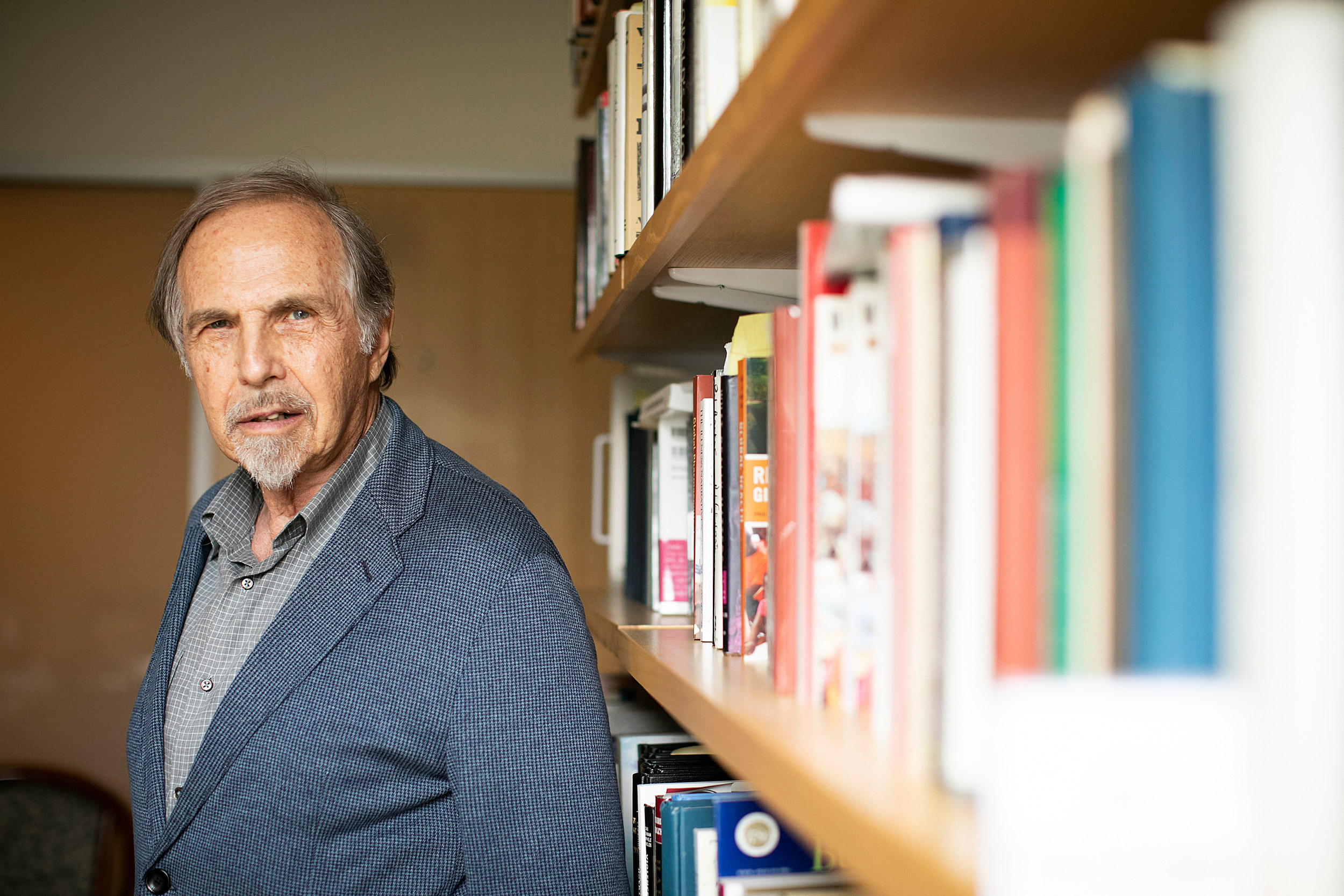
Arthur Kleinman
“If it weren’t for the neurologists, the [Alzheimer’s] 
diagnosis wouldn’t have been made for a year or two, 
but those doctors were hopeless when it comes to after-care. 
That whole field needs to change in terms of its 
understanding of after-care,” said Arthur Kleinman. 
Stephanie Mitchell/Harvard Staff Photographer
GAZETTE: You were fortunate to have the best doctors, connections, and access to care. How did the system fail you?

KLEINMAN: I felt that excellent doctors had missed what was most important, which is at the end of every engagement to ask the family member, “Well, you spend a lot of time with her. What do you think the problem is?” Think about this: No one at the beginning told me about a home health aide. We were three or four years into the disease before I realized I couldn’t keep doing what I was doing, and I needed help. My adult kids helped me. My mother helped me. But the best help I got was from a home health aide. I should have been told at the first meeting that at some point you’re going to need a home health aide. At some stage you realize, you can no longer be the caregiver. The burden is too great. For me, as Joan became weaker and weaker, and I was lifting her into the bath, out of the bath, into the bed, I was having trouble physically. I should have started to look earlier. I could have moved into assisted living with Joan, but no one told me about that. When we went to look for assisted living, it was so late in the course of her disease, they said, “You’ve made a mistake. You’ve taken care of her too long.”

GAZETTE: Joan brought the influence of the East, in particular China, to your life and your work. Can you talk about the part it played in the caregiving?

 KLEINMAN: What we learned the first time we lived in China and for 7½ years in total was the importance of family and the responsibility one has for each other, the interpersonal strengths one has to develop to be sensitive to others and moral commitments. That’s the insight of Chinese society. It provides that great genius of the power of relationships. It’s the defining thing in your life. There are a number of Chinese terms that I associated with Joan that helped us in this regard: renging guanxi, that relationships are moral, and qi, that each of us has a vital energy. And that’s what I meant in the book by presence. And it’s particularly presence that is critical in dementia or end of life because it’s so trying at times. And the idea of enduring, in the sense of how to live a family life of responsibility, guo ri zi. I think the American idea of resilience is overblown and not really relevant. Most of us endure. From the Chinese perspective, that’s your responsibility, to keep going. I found this kind of enduring the most difficult thing. Over 10 years, how to keep going. I believe it’s this human engagement. If you’re present, it’s this vitality that keeps you going. You feel, “I just barely survived.” Resilience doesn’t describe my experience. I barely survived, and it was a struggle all the time. And it was my sense I had learned as a clinical teacher that the suffering of a patient counts more than your suffering. I think if you get that balance right, doing the acts as a caregiver, that somehow also keeps you going.

GAZETTE: Since her death, you have started working on the Global Aging Initiative. What is the project about?

KLEINMAN: I had another topic when starting the book, which was trying to figure out elder care best practices. It was a comparison across China, Hong Kong, Seoul, Kyoto, Hanoi, and Bangkok. I was looking at how good care looks different in different environments. Now I’ve come to a much more specific topic, which is social technology for elder care. It’s an interdisciplinary project that involves engineers from the School of Engineering and Applied Sciences, Conor Walsh and Fawwaz Habbal; and Winnie Yip and David Bloom from the Chan School of Public Health; and Ann Forsyth from the Graduate School of Design; Tarun Khanna from Harvard Business School; and Hongtu Chen and myself from the Medical School. What we’re doing tries to put together social systems with particular technologies to help the frail elderly and the demented elderly in China.

GAZETTE: What does that look like exactly?

 KLEINMAN: To give you a sense of this project, I’ll tell you a story. There is this excellent exoskeleton for the legs. We took this idea to the many elderly women in Shanghai living in high-rise apartments. We showed them illustrations of how this works. They said, “Wow, fantastic, but I’d never use it.” We asked why. They said, “It’s so dangerous to cross the road here. Cars don’t stop. We wouldn’t trust it. But if you really want to help us, we have six friends, all in similar conditions in different apartment buildings here in Shanghai. We would like to twice a week get together and go to a tea house. Right now, we feel isolated. If you could figure out a way with social technology to get us there and back safely, that would change our lives.” We had it all backwards. That becomes an interesting issue for technology and anthropology. Maybe the exoskeleton would be useful in this instance, but if so, probably not the legs, but for the arms of a carer to get them from a 12th floor to a lobby of a building, and doing this for six people. How do you organize this? Is it a van? Who goes with them? How does the actual human experience come together with the technology? That’s the project we now have.

Interview was edited for clarity and trimmed for space. 

Full Article & Source:
How a doctor learned to become a caregiver

Sunday, November 26, 2017

Nothing stopped doctor from paying health care fraud fine, then buying a nursing home

Dr. Jack Michel (Courtesy)
When Florida regulators went to approve new ownership of a Hollywood nursing home in 2015, they had before them a Miami doctor trained in internal medicine who controlled a major hospital.

He also had been a key figure in a civil suit brought by the U.S. Department of Justice alleging massive health care fraud.

That, however, was not a deal breaker. The state allowed Dr. Jack Michel to take over the Rehabilitation Center at Hollywood Hills even though he’d been hit with a $15.4 million fine years earlier to settle claims that he and others swindled Medicare and Medicaid.

It’s a common practice in the health care industry, where people and institutions accused of fraud are allowed to write large checks to the U.S. government then continue operating.

Now the Hollywood Hills nursing home is the subject of a criminal investigation into the deaths of 12 people left for days without air conditioning after Hurricane Irma. The medical examiner has ruled them homicides caused by heat exposure. The deaths of two other nursing home patients, previously suspected as storm-related, are no longer part of the criminal investigation.

There’s no indication that Michel was at the nursing home during the crisis. Yet he is a main character in the matter because he owns the Hollywood Hills facility, through a limited liability company.

Why was he allowed to take over the nursing home after having been accused in federal court of bilking Medicare and Medicaid?

Had he been convicted of a crime, Michel would not have been able to own the nursing home. But the federal government brought a civil suit, not a criminal one, and then settled it with Michel and his colleagues.

“A civil settlement with no admission of wrongdoing does not preclude purchasing a nursing home. There is no law or statute that precludes it,” Michel’s lawyers, Julie W. Allison and Geoff Smith, said in a statement to the Sun Sentinel.

Also typical: Michel and his companies agreed to five years of special monitoring, but were never expelled from participating in Medicaid or Medicare -- a vital element to running a nursing home. Had Michel been banned from the programs, he would not have been able to operate the Rehabilitation Center at Hollywood Hills.

In fiscal 2007, the year of Michel’s settlement, the government barred more than 3,300 service providers from federal health insurance programs for misconduct, usually criminal, according to statistics from the U.S. Health Care Fraud and Abuse Control Program. That same year it collected $1.8 billion in civil settlements. By fiscal 2016, it was up to $2.5 billion.

Why some people are arrested and others aren’t, and why some are excluded from Medicare and others aren’t, isn’t always obvious. Lawyers who have handled such cases say the decisions can hinge on the scope and complexity of the fraud.

“It’s a case by case decision,” said Don White, spokesman for the U.S. Department of Health and Human Services’ Office of Inspector General.

The more money stolen and the greater the number of victims, the more likely the case will be filed criminally, experts said. Patient harm is also a key factor. In recent years, the government has made increased efforts, especially in South Florida, to bust organized criminal networks engaged in health care fraud.

Harvard health care Professor David Grabowski, who’s researched the economics of long-term care, said policy makers in Florida and other states should consider tightening the criteria for owning a nursing home, given the approval of Michel.

He had been accused by the government of taking kickbacks for hospitalizing elderly patients when they didn’t need to be hospitalized.

“Would any of us want to send a parent or grandparent to a nursing home owned by somebody like that?” Grabowski asked.

Elderly exploited


Now 52, Jack Jacobo Michel earned a medical degree in 1989 from the University of Miami and later developed a busy gerontology practice.

In a publicity video for the University he says he became close to the owners of Larkin Community Hospital in South Miami and was invited to become a minority owner, with a 10 percent interest, in the 1990s. By 1998, he had bought a majority stake in Larkin. And in 2004, the 146-bed hospital became the focus of a federal fraud case.

The Justice Department filed a civil case against Michel, his brother, and five other people for their roles in several “interlocking schemes” in the late 1990s to defraud Medicaid and Medicare.

The suit accused Larkin’s main owner, Dr. James Desnick, of paying Michel kickbacks for admitting patients to the hospital from his private practice and from Oceanside Extended Care Center, a Miami Beach nursing home where Michel was the medical director.

Once he became the majority owner of the hospital, Michel allegedly arranged with business partners Morris and Philip Esformes, father and son nursing home operators from Chicago, to buy numerous assisted living facilities in Florida and then transfer residents to Larkin for unnecessary treatment, court records state.

The legal drama continued until just before Thanksgiving 2006 when Larkin hospital, Michel and Desnick, and the Esformes men agreed to pay a $15.4 million penalty.

The attorneys for Michel told the Sun Sentinel that he “did not engage in any illegal conduct” but settled “rather than continue with the costs, expense and uncertainty of litigation.”

The lawyers said it is not uncommon for companies in today’s highly regulated health care environment to settle with the government over allegations of filing “false claims” against Medicaid or Medicare. They noted that Tenet Healthcare, HCA, Baptist Health System and Broward Health have all been subjects of civil settlements.

“Many health care professionals -- including those who have gone on to hold elective office -- have served in companies that have settled claims with DOJ,” the attorneys said in the statement released to the Sun Sentinel. They were referring to Florida Gov. Rick Scott, who founded HCA but left in 1997 in the midst of a federal investigation that led to a $1.7 billion health care fraud settlement.

When the government enters into such settlements, it expects the defendants will follow all laws and regulations in the future – and not fleece U.S. taxpayers. Officials commonly force greater monitoring, reporting and accountability requirements on the defendants and did so for Michel and Larkin Hospital. As of mid-November, the federal government had about 380 of these “Corporate Integrity Agreements” ongoing nationwide with hospitals, hospices, pharmaceutical firms, nursing homes, diagnostic imaging centers, doctors and others, according to the U.S. Health and Human Services Office of Inspector General’s web site.

Michel and Larkin were no longer on the monitoring list in the summer of 2015 when a company tied to Larkin bought the building housing the Hollywood nursing home in a bankruptcy auction.

Ironically, Michel and Larkin took over the nursing home after the building went into foreclosure when its owner went to prison for health care fraud. That case was egregious for endangering patients.

Karen Kallen-Zury and three other executives were imprisoned for defrauding Medicare of more than $70 million at a psych hospital in the same building. They were accused of paying bribes to recruiters to find Medicare beneficiaries, including drug addicts, from as far away as Maryland and bus them to the psych hospital, where they were forced to attend bogus “treatment sessions” or be evicted from nearby halfway houses where many stayed. The drug abusers desperately needed substance abuse help but instead got “day care sessions in which their life-threatening illness went untreated,” according to prosecution documents. Others who actually needed psychiatric treatment did not get it and “their lives were put at risk as a result,” the government argued.

As a result of the bankruptcy proceeding, the state awarded the nursing home’s operating license to a company owned by Michel.

He had hired Fort Lauderdale lobbyist William Rubin, a campaign supporter and former business associate of the governor, to facilitate the process, paying him at least $100,000, state records show.

Mallory McManus, communications director for the Florida Agency for Health Care Administration, said the change of ownership request from Michel went through the normal review practice, including background checks.

“There was no disqualifying offense based on Florida statutes,” she said.

Full Article & Source:
Nothing stopped doctor from paying health care fraud fine, then buying a nursing home

Tuesday, August 19, 2014

Korean Vietnam War Vet Inside VA System Held Against HIs Will

NOTE:  The journalist who wrote the article below, Michael Volpe, will be a guest tonight on a special episode of T.S. Radio with Marti Oakley (8:00 pm EST) and he will be speaking about this case. So we thought it appropriate to re-post the article so everyone can re-read and re-familiarize yourselves with it.

After the article was published, Mr. Hughes said hopefully, "Maybe now someone can help me...."

Norman Hughes Jr., 81, is a Korean and Vietnam War veteran who’s currently paying $7,000 per month to live in the Kirby Pines Retirement Home in Memphis even though he told The Daily Caller he wants to live with a caretaker named Debbie McCoy — at her home paying $2,700 per month — where she has run a VA-certified living assistance facility for fifteen years with no complaints until this case.

“I need somebody to help me get out of here,” said Hughes from his room.

In late 2012, Hughes was living with McCoy when he decided to remove his cousin, Mary Ann Phillips, from a bank account he held with nearly $150,000 in it because of a pattern of unpaid bills and missing money.

According to interviews with Hughes, his son Bernard, granddaughter Cavita, ex-wife Doris Jones, and McCoy, Phillips was enraged by the move and approached the VA with a series of unsubstantiated charges which were filed formally on December 29, 2012.

Philips claimed that Hughes was unshaven and dirty, that his room was a mess, and that he had developed a bed sore at McCoy’s home.

But Bernard and Cavita Hughes said they both visited Hughes regularly during this time period and would have noticed if it wasn’t clean and safe.

In early 2013, Norman Hughes went to the Memphis VA to get treated for a form of neuropathy. While in the hospital, Phillips told him he needed to take some tests with another doctor.

Phillips took Hughes to see Dr. Felicie Wyatt, who specialized in internal  and geriatric medicine, telling him he needed routine tests.

Instead, Dr. Wyatt tested Hughes for his mental competency.

Hughes, his son, and McCoy all insist he was tricked into seeing this doctor.

Buoyed by Dr. Wyatt’s competency determination, Phillips and the VA maneuvered the case into probate court where Memphis attorney Keith Dobbs was appointed VA guardian — he named Phillips conservator.

According to court records, Dobbs has been receiving 7% of Hughes monthly retirement income for more than a year.

Full Article and Source:
Korean, Vietnam War Vet Inside VA System Held Against His Will

See Also:

Wednesday, August 13, 2014

Doctor Accused of Vastly Overprescribing Antipsychotic to Nursing Home Residents Loses License

A Chicago psychiatrist has been stripped of his medical license over charges that he received kickbacks and overprescribed antipsychotic drug clozapine to nursing home residents.

An official with the Illinois Department of Financial and Professional Regulation on Friday signed the order to indefinitely suspend the license of 71-year-old Michael Reinstein, M.D. The revocation will last a minimum of three years, at which time he can apply for reinstatement.

Reinstein at one time was the nation's No. 1 prescriber of clozapine, according to investigative journalism organization ProPublica. In 2012, federal authorities brought a lawsuit against him, charging that he received kickbacks from pharmaceutical companies and submitted “at least 140,000 false claims to Medicare and Medicaid for antipsychotic medications he prescribed for thousands of mentally ill patients in [Chicago] area nursing homes.” The matter is still pending.

In response to a 2009 investigation by ProPublica and The Chicago Tribune, Reinstein defended his use of clozapine to treat patients with schizophrenia. The news organizations pointed out that the FDA has approved the risky drug only as a last resort for schizophrenics, and Reinstein at one point admitted to having 75% of the residents at a 400-bed nursing home on the medication. Three deaths have been linked to clozapine prescribed by Reinstein, according to  ProPublica and the Tribune.

In March, Teva Pharmaceuticals and IVAX LLC reached a $27.6 million settlement with the Department of Justice over the alleged kickbacks to Reinstein. IVAX, which makes clozapine, became a Teva subsidiary in 2006.

Source:
Doctor Accused of Vastly Overprescribing Antipsychotic to Nursing Home Resident Loses License

See Also:
In Chicago’s Nursing Homes, a Psychiatrist Delivers High-Risk Meds, Cut-Rate Care

Wednesday, May 7, 2014

Child euthanasia claims probed


Health officials are investigating claims that terminally ill children have been illegally euthanised by British doctors.

An official investigation has been launched by the Department of Health into the allegations, Health Secretary Jeremy Hunt said.

In February retired GP Michael Irwin claimed that medics have given sick children overdoses with painkillers.

At the time Mr Hunt said he would look into the issue and now he has confirmed that the Department of Health is investigating.

After being asked about the issue on LBC Radio, Mr Hunt said: "An investigation is now under way by my department.

"The police are not involved at the moment.

"I'm afraid I am not in a position to comment because it is highly sensitive."

Euthanasia is illegal in Britain but legal in other countries. In February Belgium became the first country in the world to allow the euthanasia of children.

Full Article & Source:
Child euthanasia claims probed