Showing posts with label Isolation. Show all posts

Wednesday, February 25, 2026

The Ventura Probate Machine: A Pattern of Isolation, Financial Control, and Medical Decline


by Cece Woods

When families enter probate court, they expect protection. They expect oversight. They expect a system designed to safeguard vulnerable adults who cannot protect themselves.

What many families say they do not expect, according to sworn filings now before California courts, is isolation, financial consolidation, rapid medical deterioration, and a wall of administrative opacity.

For some, the moment is unforgettable. A judge speaks. A ruling is made. And in an instant, a mother, a father, a son, or a daughter, a human being who has fought to survive, becomes a ward of the county. Families who reorganized their entire lives around caregiving are suddenly reduced to observers. The people who knew the conservatee’s medical triggers, emergency thresholds, daily rhythms, and hard won progress are deemed unfit, often without a meaningful opportunity to be heard.

Decision making authority over health care, living arrangements, doctors, and treatment shifts to court appointed professionals previously unknown to the family. Introductions are not required. Approval is not sought. Oversight is assumed. Families walk out of court stunned, disoriented, and often traumatized, grappling with how years of intimate, hands on care could be erased in minutes by a procedural ruling.

That experience forms the backdrop of what is now before the courts in Ventura County in the matter of Joshua Saeta, a medically fragile, wholly dependent adult.

Joshua did not enter the probate system because of age, dementia, or gradual decline. According to sworn filings and medical records submitted to the court, he became wholly dependent after suffering a catastrophic cardiac arrest in 2017 that resulted in a severe anoxic brain injury. His brain was deprived of oxygen long enough to cause permanent neurological impairment. He survived, but survival came at a cost.

From that point forward, Joshua required round the clock care, complex medical management, and constant monitoring to remain alive. He could not advocate for himself. He could not manage his medical needs independently. His survival depended entirely on the consistency, precision, and continuity of the care surrounding him.

In the years that followed, Joshua did not languish. According to physician letters and court filings, he achieved relative medical stability under a physician directed, home based care model. That model emphasized continuity, familiar caregivers, specialized nutrition protocols, carefully monitored therapies, and immediate response to subtle changes that could signal medical emergency.

Central to that care was his sister, Jennifer Saeta, who became his primary caregiver and medical advocate. For more than eight years, she lived beside him, learning his baseline condition, emergency warning signs, and recovery thresholds. Treating clinicians relied on her longitudinal knowledge to prevent life threatening decline. The stability Joshua achieved, according to the record, was not accidental. It was built deliberately, over years, through constant hands on care.
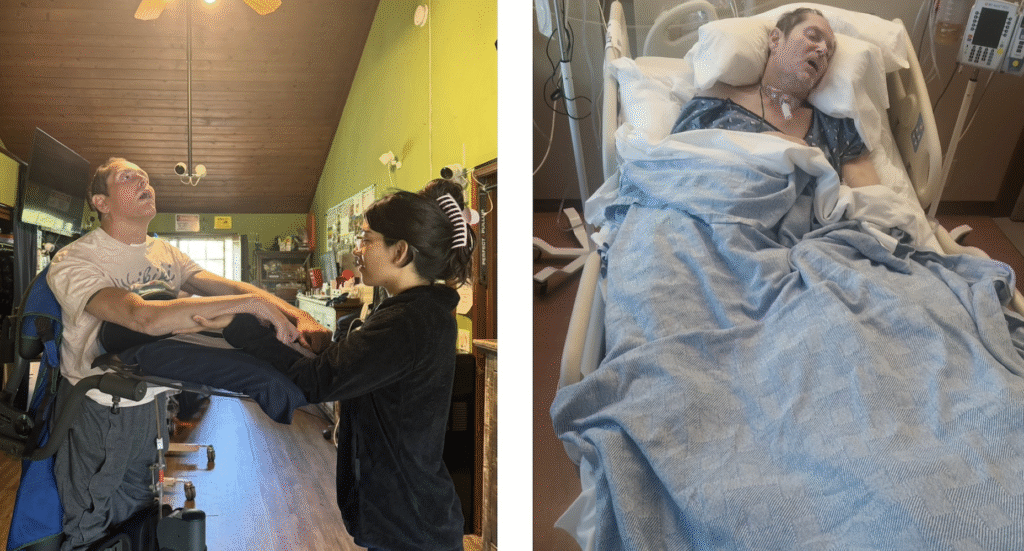
Left: Josh Saeta in August 2025 under his sister’s care. 
Right: Josh’s condition has significantly deteriorated under Ventura County Probate Care.

This is not a social media dispute or a family disagreement reframed as legal drama. What has been filed in Ventura County Superior Court under Case No. 201700495761PRCE, and in related appellate proceedings, is an extensive emergency record alleging a repeatable pattern within probate administration, one that according to the filings begins with caregiver removal and culminates in severe medical decline.

The allegations are not informal. They are sworn, structured, and supported by documentary exhibits.

According to Jennifer Saeta’s sworn filings, Joshua’s stability deteriorated after conservatorship authority shifted. The care structure was altered. Placement changed. Family access was restricted. She asserts that this sequence functioned as a divide and conquer process, first removing the individuals most knowledgeable about Joshua’s daily medical management, then isolating him from the continuity of care that had sustained him for years.

Jennifer further alleges that no meaningful investigation preceded her removal and that she was denied a full opportunity to advocate for her brother before decisions affecting his life and care were finalized. These assertions are presented as allegations, not adjudicated findings.

Families caught in this process often describe the same refrain. You may visit, but you may not intervene. Advocacy is reframed as obstruction. Objection is characterized as noncompliance. While families are told to support court appointed conservators, they allege they are instead forced to watch as quality of life diminishes under the control of strangers with no prior relationship to the conservatee.

The emergency petition in the Saeta matter does not accuse criminal conspiracy. It documents patterns.

On February 10, 2026, Andrew Rose submitted a sworn declaration in support of emergency appellate review. Under penalty of perjury, he describes recurring similarities he states he has observed across unrelated Ventura County probate matters. Long standing caregivers characterized as uncooperative. Sudden exclusion from medical decision making. Institutional placement. Rapid medical decline. Restricted communication. Difficulty obtaining records.

Attached to that declaration is a Unified Pattern Summary, which explicitly states that it does not allege criminal conduct or reach legal conclusions. It consolidates recurring factual similarities across cases and leaves questions of culpability to judicial or investigative review.

In the Saeta matter specifically, Jennifer Saeta alleges that a court appointed professional charged with safeguarding Joshua’s interests failed to function as an independent advocate. She does not allege explicit collusion or criminal coordination. Instead, she asserts that the professional’s actions and billing records reflected conduct inconsistent with independent advocacy, leading her to conclude that Joshua’s interests were not being meaningfully advanced. That distinction is central to the filings, which frame the issue as systemic misalignment rather than overt misconduct.

The financial dimension of the case is significant, though partially shielded by confidentiality provisions. Court exhibits confirm that Joshua is associated with a high value trust governed by a nondisclosure agreement. Jennifer Saeta alleges that while Joshua’s physical condition declined, substantial administrative and professional fees were drawn from the trust. She argues that the pattern reflects incentive rather than coincidence. These claims remain allegations and have not been adjudicated.

Additional exhibits include a certified Ventura County Clerk Recorder search documenting numerous estate related filings associated with a recurring fiduciary name. The filings themselves are not alleged to be unlawful. They are presented to demonstrate frequency, volume, and concentration of fiduciary activity within a limited professional ecosystem.

As the legal record expanded, the medical situation intensified.

While declarations were being prepared and exhibits compiled, Joshua’s medical condition deteriorated. According to physician letters submitted to the court, based on photographic review, longitudinal treatment history, and clinical assessment, he now exhibits extensive muscle wasting, depleted subcutaneous fat stores, and findings consistent with severe malnutrition.

The filings state that Joshua has declined to the point of requiring total parenteral nutrition, an intravenous intervention typically reserved for cases in which the gastrointestinal system can no longer sustain life through enteral feeding. The reviewing clinician characterized his condition as an imminent threat to life, citing aspiration risk, pressure ulcer risk, and medical instability associated with prolonged bed confinement.

Jennifer Saeta attributes this decline to the sequence of legal and medical decisions she is challenging. That attribution is presented as her allegation.

The filings cite statutory frameworks governing elder and dependent adult protection in California. Those statutes impose affirmative duties to prevent neglect, broadly defined, and to investigate when a dependent adult experiences unexplained decline. The filings do not assert that Ventura County or its officials have been criminally charged. They ask whether statutory obligations were fulfilled when a wholly dependent adult declined precipitously under court supervised care.

What began as a dispute over authority within a complex probate structure has, according to the petitioner, evolved into an urgent life safety matter. Jennifer Saeta states that after she sought independent legal counsel and challenged decisions affecting Joshua’s care, she was removed from participation in his daily medical oversight. She argues that what appears procedurally administrative on paper has, in practice, resulted in prolonged separation from the person most familiar with Joshua’s medical baseline.

One of the most consequential aspects of the emergency petition is procedural rather than financial. The Unified Pattern Summary notes that in multiple probate matters, conservatees allegedly declined beyond recovery before appellate review could occur. By the time higher courts addressed the issues, the medical outcomes rendered the legal questions effectively moot.

That is the urgency now before the courts.

Review the legal docs HERE.

DISCLAIMER: Investigative reporting in high-profile litigation cases published by The Current Report is non-commercial, fact-based journalism; any project fees compensate research and reporting labor only, sources participate solely in accuracy verification, and final publication is approved exclusively by The Current Report after fact-checking is confirmed. 

Full Article & Source:
The Ventura Probate Machine: A Pattern of Isolation, Financial Control, and Medical Decline 

Saturday, September 6, 2025

Blocked from seeing her son, a Missouri mother fights to change the state’s guardianship law to help others like him

A Missouri mother says her experience with the guardianship system has inspired her to push for changes in state law to protect families like hers.  

by Ceilidh Kern


When Twila Foley brought a Christmas gift for her son, Christopher, to his nursing facility in Plattsburg, Missouri, she was not allowed to enter the building’s lobby.

Instead, she watched him open his gift — a pillow with a picture of his dog, Oakley, printed on it — through a glass door.

Christopher asked the aide who accompanied him if he could go out to hug her. The aide said no. 

“So I watched as he opened his present alone in a skilled nursing facility, and I thought of the Christmas dinners that he used to have, filled with family and friends,” Twila said. “I thought about all the things that he is no longer allowed to do and how that must feel for him.”

Christopher, a 35-year-old with cerebral palsy, died Aug. 19, 2025, from cardiac arrest in the nursing facility where he lived the last several years of his life. He weighed 94 pounds.

The Beacon spoke with Twila on Aug. 6, before Christopher’s death. She hadn’t spoken with him for months after his father cut off communication. Now, she’s advocating for a law that seeks to combat isolation by centering the wishes of people under guardianship.

For most of his life, Christopher, who went by “Topher,” had lived at home. Raised in Osceola and Pleasant Hill by his mother, he underwent 19 surgeries over the course of his life, including the installation of an experimental pump that released medicine into his brain to loosen his muscles.

Between the medicine and physical therapy, Topher was able to walk in a walker and hold down a job at a nearby sheltered workshop. In his free time, he went parasailing, attended concerts and hung out with friends.

From the age of 18, Topher was under the guardianship of his mother, which gave her the legal power to make all of his decisions for him.

“I had no idea, when I obtained full guardianship of him … fully what that meant,” she said. “They said it had to be done so I can continue with his medical care. What they didn’t tell me was the full ramifications of total guardianship.”

Topher’s final years

In May 2020, Twila went out of town for a seasonal job in South Dakota, leaving Topher with a caretaker. 

That marked the beginning of an ongoing he-said, she-said dispute about the last years of Topher’s life and his wishes during that time. 

Twila said she was gone for two weeks to get herself settled before she planned to return to Missouri to get Topher and bring him to live with her there. Her ex-husband and Topher’s father, Robert Foley, said she was gone for over three years, but Twila said that’s not true.

“It hadn’t taken me three years to come back, but three years to find Christopher,” she said.

A week after Twila left, Robert took Topher out of the caretaker’s home and went to court, arguing that Twila had abandoned their son. He got temporary guardianship of Topher in July 2020 and obtained full guardianship by December. 

The abandonment charges were later dismissed, but Robert remained Topher’s guardian.

Topher lived with Robert for a little over a year before he moved into a nursing facility.

“We had been trying to get him into a group home. It was in the middle of COVID still, so that was not a possibility. He started acting up, having outbursts,” Robert said.

“We went to North Kansas City Hospital for a behavioral assessment,” he added. “To this day, I’m not sure what he told the nurses, but I was called in for him to bring his stuff (and told) that he would not be coming back (to my home), per his wishes.”

When Twila couldn’t get in touch with Topher and learned from family what had happened, she said she spent the next several years trying to find him. To do so, she tried to contact Robert, asked friends and family for any information they had and went to law enforcement. But she said the police were not willing to help her until the abandonment charges were later dropped.

“So I decided to go door to door until I found him, and I did just that,” she said. “I went door to door to every skilled nursing facility until I found him.”

But when she came back the next day, she was told by staff that she was not allowed to visit him.

“I requested no visitation because it was not good for his state of mind,” Robert said. “She put this young man through emotional distress multiple times.”

He said Topher had told therapists that Twila “messed with his head too much … promising him things and then not delivering.”

On several occasions since he became his guardian and as recently as April 2025, Topher asked Robert not to let Twila visit or contact him, Robert said.

“When I was asked by the ward not to allow her in his life, I was respecting his wishes,” he said.

Robert said he offered to set up monitored visits, but Twila said no.

Instead, she kept in touch with Topher over the phone. But his behavior started to change, Robert said.

“Outbursts, cursing, arguments with everyone. Mom — he wanted to be with mom. Mom was promising him who knows what,” Robert said. “She created a very hostile place for him, urged him and encouraged him to do whatever he could to get himself removed from the nursing home.”

Twila acknowledged that Topher was having outbursts at this time but said they weren’t the result of their contact.

“The outbursts were because Christopher didn’t belong there and Christopher himself was crying out and reaching out for help,” she said. “It was a manipulated situation where the guardian was trying to keep him in isolation to prevent people from seeing the real facts, taking the focus away from his declining health.”

Twila went to court multiple times, asking to regain guardianship as well as to be able to visit Topher in the nursing facility, but was denied both. 

When Robert became Topher’s guardian, he had his pump removed. According to court documents, it had stopped working. Twila said there had been issues with it before, given the experimental nature of the device.

According to Robert, when he took Topher in for a routine appointment to refill the medicine in the pump in 2022, the doctor told him that the tube connecting the pump to Topher’s brain was causing irritation to Topher’s nerves.

The doctor recommended the entire pump be removed, and Topher agreed, Robert said. When asked why a new pump wasn’t installed after, Robert said Topher had asked to not get a new one. 

With the pump gone, Twila said, “His condition deteriorated. He can’t stand up anymore.”

At the nursing facility, Topher was given medicine that Twila said made him vomit, but when he raised concerns, he was forced to take it by staff and his father. 

“I have so many phone calls and recordings of Topher — he would set his phone on speaker and hide it behind his pillow so I could hear what he was having to endure,” she said, adding that things were “so bad, he would call 911 or have me call 911 for an ambulance to come and help him and the ambulance would be refused at the door, per the guardian’s directions.”

Robert said the nursing facility had security camera footage of Topher making himself vomit after taking the medicine and that he’d been able to take the drugs without a problem before he got back in touch with his mother.

“The more communication Topher had with me, the less he was able to have his rights, such as using a cellphone,” Twila said. “His friends tried to go visit him and weren’t even allowed to take him an Easter basket.”

In a legal filing from May 2024, Robert told the court that Topher “has a cellular telephone and other communications devices available to him and is generally able to communicate with whomever he chooses.”

Robert later told The Beacon that he had taken away Topher’s devices “when his behaviors became too excessive, when he kept refusing his medicine.”

“I didn’t want to, but when the communication between her and him got to a point that he was going into the director’s office (at the nursing facility) and starting an argument with her on speakerphone, that’s a little excessive,” he said.

In 2024, Topher had a friend in the facility write several letters to his mother. On one envelope, mailed in July 2024, he had the envelope addressed to Lori Samples, a friend, from “Chris Samples.” He also had the friend mail it while they were at church so it wouldn’t go through the facility’s mail system.

“Thanks, mom, for being so good to me all through the hardships,” he wrote. “I have no phone. Dad called Roger and he took the phone. I guess he really doesn’t know how blessed I am having a mom like you to love me.”

Topher had a friend in the nursing facility write several letters to his mother in 2024, including a card. The envelope was addressed to Lori Samples, a friend, from “Chris Samples.” Topher used a different name and had his friend mail the card while they were at church to keep it from being intercepted, Twila said.

Twila said the isolation Topher experienced in the nursing facility contributed greatly to the decline in his mental and physical health. 

“Isolation can be so damaging to people with a guardian — it’s detrimental to their health. It’s been proven that it lowers life expectancy, and it’s taking away their fundamental right,” she said. “What man has a right to tell another man he can’t make a phone call?”

‘That’s what Topher’s Law is going to change’

Through her experience in court, Twila said, she learned that under Missouri law, “the guardian has all the rights.”

“Until that changes, the situation that’s happening to Topher and so many others in the state of Missouri is not going to end,” she said.

Her experience inspired Twila to push for a change in the law. Her proposal, called “Topher’s Law,” aims to combat isolation by requiring guardians to petition the court to block a person from seeing the ward. 

Under the current law, the order is reversed, and people who have been blocked from seeing a ward must themselves petition the court for access.

Topher’s Law would also codify several rights of wards, including:

  • The right to spend time with family.
  • The right to consent to calls and visits. 
  • The right to express their own wishes in court related to visitation and guardianship restrictions. 
  • The right to access an attorney at no cost to help with visitation challenges.
  • Protection from retaliation for asserting their rights under the law or maintaining relationships with family members. 

“I feel they should have the right to do these things as anybody would have the right to do these things,” Twila said.

While the proposed law was inspired by her own experience trying to visit Topher while he was under Robert’s guardianship, she said: “I’m not doing this to attack him. I’m doing this to attack a flawed system.”

As part of her effort to get Missouri’s law changed, Twila launched an online campaign — which has gathered more than 250 signatures — and reached out to local state lawmakers. 

Sen. Rick Brattin, a Republican from Harrisonville, said he’s heard from Twila and is interested in helping her either by carrying the legislation himself or helping her find someone who can.

“I think it’s terrible that somebody can be there for their child, and the way the system’s set up, they can be ripped out from underneath them. It’s really heart-wrenching,” Brattin told The Beacon. 

“It’s something that we definitely need to address,” he added. “If I’m not going to spearhead it and be the bill sponsor, (I want to) at least be part of the discussion.”

In a later conversation, Twila told The Beacon she’d also received support from Rep. Mike Steinmeyer, a Republican from Sugar Creek, and Sen. Adam Schnelting, a Republican from St. Charles.

Twila said that Topher’s Law focuses on preventing isolation because she believes it is “the most pressing piece,” but she said “there’s so much more that needs to change.”

Asked whether she will continue to advocate for changes to the guardianship law if Topher’s Law passes, Twila replied, “Absolutely.”

“I won’t stop until I fix this. I won’t. I can’t. I promised him,” she said. “We can’t stand here and let this happen to people. I won’t stop, and then I’ll push on. I’ll push for more rights, and I’ll push for it to go federal.”

Changing guardianship statute and culture

Twila’s efforts come after Missouri’s guardianship law was changed in 2018 to codify wards’ rights, including the right to communicate freely and privately with family and friends. 

While the law guarantees access to loved ones, it also clarifies that access can be limited by the guardian if they believe contact with a particular person could harm the ward.

Jennifer Hulme, co-founder of advocacy organization Alternatives to Guardianship, said cutting off visitation can often be the result of serious concerns, but sometimes “it can be out of convenience for the guardian.”

“We would like to think that’s not something that happens, but in reality, it does,” she said. “The guardian just has to say, ‘This person is causing the ward undue anxiety or undue stress,’ and they can block that communication.”

The decision can come after friends or family raise concerns about care, she said.

“If the family or friend steps in and starts to call the guardian and say … ‘They weren’t very clean, it didn’t look like they had changed their clothes for a few days,’ and they keep reporting those concerns, sometimes it’s seen as them rocking the boat,” she said. 

David English, a law professor at the University of Missouri in Columbia and co-chair of the Missouri Working Interdisciplinary Network of Guardianship Stakeholders, has helped to shape guardianship policy in Missouri and elsewhere.

“The idea behind all recent legislation is that guardianship should be the absolutely last resort, because you’re appointing someone who literally succeeds to all the individual’s rights,” he said.

He said guardianship is often seen as the only solution when alternative approaches might get a ward the care and support they need while also preserving their rights.

“My great concern for adults with developmental disabilities is that oftentimes, it’s automatic,” English said. “It’s been part of the culture for decades.”

There are currently more than 35,000 Missourians under guardianship, according to data from the Office of State Courts Administrator. That number includes older people, people with disabilities and others that courts across the state have decided need help making decisions.

According to English, an ideal system would allow for a complete evaluation of a person’s capacities and needs and an exploration of all possible solutions — like supported decision-making, a less restrictive alternative — before a guardianship is pursued.

He said that although progress has been made on guardianship, a 1988 report by the American Bar Association calling for reforms to the guardianship system included many recommendations that “are still current today.”

“These problems aren’t new,” he said. “Things are getting better, but slowly.” 

Full Article & Source:
Blocked from seeing her son, a Missouri mother fights to change the state’s guardianship law to help others like him 

Thursday, January 23, 2025

Senator Palumbo and Families Push for Guardianship Reform Urge Passage of Karilyn’s Law in 2025

by Anthony H. Palumbo


In the wake of several high profile guardianship abuse cases, including Wendy Williams speaking out about her forced conservatorship and New York Attorney General Letitia James investigation into guardianship providers, Senator Anthony Palumbo (R,C-New Suffolk) is renewing his efforts to reform New York’s Guardianship system through the passage of  Karilyn’s Law. The legislation provides a mechanism allowing family members and friends to visit loved ones under guardianship and conservatorship. The bill is named after Karilyn Montanti, a senior and victim of the guardianship system, whose loved ones had been denied visitation rights.

            Karilyn’s Law prevents a guardian, care manager, or power of attorney from arbitrarily terminating visitation rights and isolating vulnerable individuals who are being held in involuntary guardianship.  The bill provides for the ward or family members, who have been denied their due process rights, to be heard and have an evidentiary hearing before the court within 10 days of bringing an application. 

            “New York’s guardianship system needs to be overhauled to protect some of the State’s most vulnerable residents from forced isolation and provide them with the ability to see loved ones and friends,” said Senator Anthony Palumbo. “The denial of visitation rights is just one component of the guardianship abuse we are witnessing throughout New York, but it is the most inhumane and must be addressed in 2025.”

            Chrisine Montanti, daughter of Karilyn Montanti and a Guardianship Advocate said: “I have been living a complete nightmare for several years as my mother is in a constant state of torture and I am powerless to save her. My mother was blocked and denied access to her entire family, friends and only grandchild without having an evidentiary hearing and without due process.  I am grateful to Senator Palumbo for his continued efforts to pass Karilyn’s Law and as a champion of guardianship reform.  His work to safeguard New York State’s most vulnerable individuals will help prevent other families from having to endure the horrific ordeal that I have been facing for nearly a decade.”  

            “If this can happen to me and my family this can happen to anyone. We have been blocked from contacting my mother and aunt by phone, I personally have no visitation rights to my mother, and I have been threatened with jail time while trying to get my mother back to her home in New York. The guardianship system needs to be reformed, and I urge the legislature to pass Karilyn’s Law this year,” said Illana Musikar.

            “My mother screamed you are breaking my arm as she was dragged out of her home against her will and placed in a memory-care facility in Irondequoit New York.  No doctor or judge said she was mentally incompetent.   She was denied the right to make phone calls, have visitors of her choosing and was drugged against her will. If Karilyn’s Law had been in effect, I could have helped her and brought her home. Instead, she died alone on a narrow bed at the facility. We need to pass Karilyn’s Law and provide greater protection for vulnerable New Yorkers like my mom,” said Jonathan Farley.

            "New York’s guardianship system is in dire need of reform to protect our most vulnerable citizens from exploitation and abuse. Karilyn’s Law is a critical step forward in ensuring that families are not unjustly torn apart by guardianship decisions made without accountability or due process. Growing public awareness and attention to the abuses within the guardianship system highlight the urgency of addressing these failures. By passing Karilyn’s Law, we can prevent other families from enduring the heartbreak and injustice that so many have already faced under the current system." – Senator George Borrello, 57th District. 

            “Karilyn’s Law is long overdue and is a simple change to improve the State’s guardianship system. The legislation will help close a loophole that has allowed guardians with extreme power to deprive individuals of their visitation rights and will reunite family, friends and loved ones. It is the compassionate and right thing to do for the countless families navigating the guardianship system,” concluded Senator Anthony Palumbo. 

Full Article & Source:
Senator Palumbo and Families Push for Guardianship Reform Urge Passage of Karilyn’s Law in 2025

See Also:
Editorial: Guardianship under the microscope

Wendy Williams Guardianship Controversy Spurs N.Y. Lawmaker to Push Visitation Law

Wednesday, January 24, 2024

Woman Asks For Help After She's Charged $35 An Hour To Visit Her Elderly Mom In Assisted Living Facility That Costs $8K A Month

by Mary-Faith Martinez

How is this legal?

Caring for elderly family members is never easy. There are so many questions to consider, like what’s really best for the individual, and how accessible are resources.

One woman is discovering just how difficult it is to be there for her elderly mother thanks to some strange financial challenges.

A woman in Ohio shared that she has to pay to see her mother in an assisted living facility.

Las Vegas-based realtor Carrie Meyer recently went to visit her 90-year-old mother in an Ohio assisted living facility with her daughter, Chloe. She was shocked when she arrived at the facility and was asked to pay for her visit.

“$35 an hour,” said Meyer. “That’s what I had to pay to see my 90-year-old mother in an assisted living facility in Ohio.”

As if having to pay for the visit wasn’t bad enough, the facility insisted that Meyer pay before she actually had the visit. “Prepayment was required or I was denied visitation,” she said.

Of course, assisted living facilities aren’t free. Meyer’s mother is already paying to stay there each month. “The estate guardian is charging her $8,000 a month rent,” she explained.

It seems that there is more drama than just the price of the facility and the required prepayment. Meyer stated, “My sister, brother, and I are prohibited from taking her anywhere. She doesn’t want to be there and wants to live with my sister; however, a downstairs bathroom must be added and is not financially doable.”

Full Article and Source:
Woman Asks For Help After She's Charged $35 An Hour To Visit Her Elderly Mom In Assisted Living Facility That Costs $8K A Month

Monday, January 15, 2024

$100 Million Estate at the Center of Contentious Guardianship Case

by Adam Walser 

The I-Team has been covering Florida’s broken professional guardianship system for more than a decade, uncovering instances of isolation, exploitation and abuse of Florida’s most vulnerable seniors by court-appointed guardians in our ongoing series “The Price of Protection."

Now a Polk County woman is speaking out about how her longtime partner’s estate plan was overturned, taking away her right to care for him and even see him in his final days.

She is now supporting proposed changes to Florida’s guardianship law intended to protect other families.

Pete’s empire

Donald “Pete” Beaty was a simple man who lived an extraordinary life.

“He was such a millionaire and so successful,” Doris Beaty said.

Pete’s empire included a rock quarry, a cattle ranch and an orange grove.

He bought and sold thousands of acres, making millions and inspiring his stepson Rey Contreras along the way.

“Pete taught me that a man with a third-grade education can accomplish anything in this country,” Contreras said.

Pete also won $17.5 in the Florida Lottery in 1990.

But three years later, his first marriage ended, and his winnings went to his wife and children in the divorce settlement.

In 2002, Pete married his second wife, longtime business manager Doris, who immigrated to the US from Cuba in the 1980s.

Her son Contreras was from a previous marriage.

“My life was dedicated to Pete. 24/7 was Pete and the businesses,” Doris said.

But Doris and Pete divorced in 2007.

Doris kept the couple’s lakefront home, but Pete moved back months later.

He lived with Doris there for the next 12 years, even though they never remarried.

Doris named in estate planning documents

In 2016, Pete signed legal documents appointing Doris to manage his affairs and make medical decisions for him if he was no longer able to.

“I was to be trustee, guardian and health care surrogate,” Doris said.

“He hired a lawyer, he had notaries, he had witnesses. He did everything years ago,” Contreras said.

Pete gave $100,000 a year to the Mayo Clinic in Jacksonville and donated money to build a surgical wing at a Plant City hospital.

In his trust agreement, he planned to share his wealth.

“If a man wants to leave 40% of his trust like Pete did to give away to people, that’s his right. My mom was gonna help spread that 40% amongst various causes,” Contreras said.

Pete’s trust agreement said his sons “shall not receive any property” or serve as trustees “for any reason or under any circumstance.”

Pete’s arrest triggers guardianship process

In 2019, Pete showed signs of dementia.

When she tried to stop him from driving, a confused Pete pulled a gun on her.

She called the police.

“Pete was arrested, and I got him out of jail, and then I hired sitters to help me take care of Pete,” Doris said.

Doris petitioned to be his guardian, but his sons filed a counter-petition seeking guardianship.

They described themselves as sons, while Doris was referred to as Pete’s describing “ex-spouse."

A judge removed all of Pete's rights and appointed a professional guardian to oversee his vast estate.

“Pete was removed from the home, isolated, neglected, abandoned,” Doris said.

The guardian restricted Doris’ visitation and bought another house with Pete’s money, hiring round-the-clock caregivers.

She was paid more than $100,000 from his funds in just five months.

Full Article and Source:
$100 Million Estate at the Center of Contentious Guardianship Case

Wednesday, June 28, 2023

For the first time, it is projected there will be more senior citizens than children

by Stephanie Esquivel

For the first time, it is projected there will be more senior citizens than children (Getty Images)

For the first time, the U.S. Census Bureau is projecting that over the next decade, there will be more senior citizens than children. Adult Protective Services says that could be a source of concern because Bexar County has the second-highest number of elder abuse cases in the entire state. 

“Here in Bexar County, we receive the second highest number of incidents of neglect, abuse and exploitation in the state,” said Ann Cortez, a District Director for Adult Protective Services.

Cortez says elders become more susceptible to various crimes as they grow older.

“Older adults who are isolated in the community are much more susceptible to exploitation, to being taken advantage of, they are susceptible to neglect, self-neglect,” said Cortez.

Cortez said older adults can fall victims to scams but more often they are financially taken advantage of by people they know.

“Maybe relying on the wrong individual or you can run into situations where people that you trusted begin to take advantage of you both financially and also neglect you,” said Cortez.

She added that it’s a growing trend.

“We are also seeing a rise in financial exploitation cases where the elder is being taken advantage of by either a caregiver, a family member,” said Cortez.

Maria Lopez works at Texas Senator Jose Menendez’s office and oversees taking calls for elder abuse reports. She said in many cases, these older adults don’t realize they are being financially abused before it’s too late.

“A grandchild handed you some papers, took you to eat tacos and then took you to a layer to turn over your house to him or her,” said Lopez.

She said if you have a loved one who is getting older, you need to make sure their caretake has their best interest at heart and any red flags should prompt you to make a report to adult protective services.

“She would some over, go with him to cash his checks and then take off. He was filled with roaches it was filthy, it was not clean,” said Lopez.

Officials with adult protective services also said if you are close to any elders, you should be paying attention to any changes in their behavior or spending habits as these could be signs they are being abused.

Full Article & Source:
For the first time, it is projected there will be more senior citizens than children

Monday, October 3, 2022

Interlochen man beats the odds on guardianship

By Mardi Link


INTERLOCHEN — Cruise control, 82 mph, cut to black, then a fleeting image of a good Samaritan who stopped to help and called 911.

Dwight Lewis remembers these scant details from March 2019, when he was driving on US-31 near Ludington, suffered an epileptic seizure and crashed his truck.

Twenty minutes, four broken ribs, a broken collarbone and a traumatic brain injury later, Lewis regained consciousness.

“I came to, I knew things weren’t right and I vaguely remember people coming up to my window with the Jaws of Life,” Lewis said. “Then nothing after that.”

Since the accident, Lewis has lived with his mother, Chris Lewis, in a house filled with art in the woods near Interlochen State Park.

When he smiles, the expression comes on quickly and envelopes his whole face.

A loud high-pitched “cuk-cuk-cuk” sound interrupts an interview with a reporter, Dwight stops mid-sentence, holding up an index finger.

“Pileated woodpecker,” he says, and there’s that smile.

The brain injury from the crash was actually Lewis’ second — multiple skull fractures in a 2011 skateboard accident not only caused the epilepsy, but put him into court-ordered guardianship — and working his way back to health and autonomy hasn’t been easy.

Lewis, 40, who’d trained as a chef, not only had to learn how to cook again, he had to re-learn how to drive, use a cell phone, handle his finances and get along with other people, including his mother.

“My injuries have caused me to burn some bridges between both my friends and my family,” Lewis says in a text, sent days after the interview. “My goal and mission now is to rebuild those bridges.”

Dwight moved in with Chris, and she became her son’s court-appointed guardian after the skateboard accident, but a few months after the highway crash, both agreed the arrangement was no longer working.

Traumatic brain injuries can result in something neurologists call “flooding,” in which a healing brain is overloaded by outside stimuli, making it physically impossible for a person to regulate their emotions and behavior.

“We argued a lot then,” Chris said. “He was often angry, which I understood, but it got to the point where we needed outside help.”

Court-appointed guardianships and conservatorships are a protective measure often associated with older adults, when a judge decides because of illness or memory loss, someone can no longer make their own decisions.

Younger people also can be appointed guardians by the court, often as the result of a catastrophic injury like Dwight’s.

Regardless of age or the reason for the guardianship, a review of probate court records by the Record-Eagle in more than a dozen Michigan counties shows court oversight often becomes permanent by default.

“Generally speaking, there’s an attitude that cognitive impairments don’t get better,” said Sheila Englehardt, a professional guardian in Roscommon County who is not connected to the Lewis case.

“Once someone is in the system,” Englehardt said, “it’s like this continuing rotation.”

Dwight committed himself to years of hard work — occupational, speech and ocular therapy, an in-patient stay at a neurorestorative program, months in a residential setting learning to live companionably alongside roommates, plus regular appointments with a psychiatrist.

“When he sets his mind to something, that’s it,” Chris said, “that’s Dwight.”

Earlier this month, his efforts paid off.

On Sept. 12, Dwight stepped off the “continuing rotation” of court oversight, after successfully petitioning Grand Traverse County Probate Court Judge Jennifer Whitten to terminate his guardianship.

Lee Storch of Guardian Services of Northwest Michigan, who succeeded Chris Lewis as Dwight’s guardian, told the judge she supported Dwight’s decision and helped him file the petition.

Both say Dwight’s abilities improved under guardianship.

“As skeptical as I was, it helped me and it helped my mom,” Dwight Lewis said of the time he spent as a ward of the court. “I do know that has not been everyone’s experience.”

Record-Eagle reporters in August 2021 began examining records in Michigan’s probate courts and have since reported a steady stream of worrisome accounts ranging from family isolation to outright theft.

These previous stories involved people of means and those on fixed incomes, people who live independently and those who require residential care, those with close family members and those without, but all had one thing in common: They began with a judicial decision meant to protect them by appointing a guardian or conservator.

Decades of reform attempts by governors, attorneys general and legislators have so far failed to alter the Michigan judiciary, which controls guardianship procedures and calls for probate courts to collect paperwork and keep records, but gives probate judges little enforcement power when things go awry.

Some familial and professional guardians in recent months have faced criminal charges after being accused of embezzling from clients.

In one recent case, a Macomb County woman, Lisa Ludy, was charged with nine felonies and could face up to 20 years in prison after being accused by Michigan Attorney General Dana Nessel of using Community Guardian Care, Inc., to conduct a criminal enterprise.

Nessel said in a press release that Ludy’s company was appointed guardian and conservator for an unnamed victim, then stole more than $100,000 from Social Security checks, an inheritance and proceeds from the sale of the victim’s home.

Thousands of guardians and conservators — acting as fiduciaries — serve in their roles without running afoul of the law. Professional guardians like Storch say it is hard to find qualified people, when guardians who serve those on Medicaid are paid less than $100 a month per client.

Storch said she is researching ways to turn her company into a nonprofit organization to seek alternative funding and have support from an advisory board.

“What we do is not all about the money,” Storch said.

Storch has more than 30 guardianship clients at any one time; she and her partner, Tracy McCain, provide limited and temporary services to as many as 50 others, she said.

Dwight is the only client she’s worked with who has “graduated” from guardianship, she said.

Once he began making — and keeping — medical appointments, working a part-time job at Oryana West, maintaining a good relationship with his mom and his girlfriend, and got his driver’s license reinstated, Storch said the court didn’t need to be involved in his life.

Dwight agreed.

“When all this started for me with the court, I had no hope,” Dwight said. “Then I began making some goals.”

Dwight said after the hearing, he and his girlfriend, Annette Abraham, went to Colorado for the weekend.

They toured Red Rocks amphitheater, where Dwight asked Annette to marry him.

She said yes.

Full Article & Source:
Interlochen man beats the odds on guardianship

Monday, July 18, 2022

Janet Stevens: Isolation and loneliness are fertile ground for elder abuse

Janet Stevens
IT’S TIME to sound the alarm on the growing elder abuse crisis. Across the United States, our most vulnerable citizens are experiencing premature death, physical and psychological harm, and financial ruin due to malicious actors.

The U.S. Department of Justice has found that nearly 10% of adults over the age of 65 experience abuse of some kind. Yet, the number is likely even larger. The DOJ has determined that only 1 in 12 victims of psychological abuse, 1 in 20 victims of physical abuse, 1 in 44 victims of financial exploitation, and 1 in 57 victims of caregiver neglect will report their case. Underreporting is not just a national phenomenon, underreporting occurs in New Hampshire as well.

According to New Hampshire’s Bureau of Elderly & Adult Services, only 1 in 14 cases of abuse will be reported. According to the National Council on Aging, the reasons for underreporting are myriad — fear of retaliation by the offender, reluctance to disclose the incident because of shame or embarrassment, concern they will be institutionalized, dependency on the offender, and an inability to report because of physical limitations or cognitive impairments. An abuser may be a caregiver, someone that is trusted by the senior citizen, but studies indicate that 60 to 90% of elder abuse is committed by family.

Cleary, elder abuse is a pervasive issue. New Hampshire must afford greater protections to our most at risk citizens. Addressing this growing crisis is not without challenges, but there are solutions within our grasp. There are three actions we can take to address the growing elder abuse crisis:

First, we must help New Hampshire residents understand the issue. Elder abuse relative to other forms of intimate partner violence has lagged behind in dedicated research funding, national data collection, and federal legislation. The Elder Justice Act passed by Congress came 24 years after the passage of the Children’s Justice and Assistance Act and was not funded by appropriations. For every dollar spent by the federal government to address family violence, only a penny was spent to address elder abuse. The lack of allocated funding to study elder abuse has stymied awareness. Elder abuse is not a new phenomenon. It simply has not been discussed enough. More must be done to spread public awareness.

Second, we must prevent seclusion of the elderly. A University of Southern California study published in the Journal of Aging and Mental Health found that minimizing loneliness and social isolation can prevent elder abuse. Moreover, the research found that “individuals with a higher interpersonal dysfunction… (had) greater financial exploitation vulnerability.” Loneliness and social isolation make adults over 65 more likely to be victims of abuse. In New Hampshire, we must improve community support services. There are close to 40 senior day centers in the state — 14 of which are covered by Medicaid — that provide essential services while granting a home-based caregiver or family member a respite. These centers have done a lot of good but there must be greater access to them across New Hampshire.

Finally, we must improve reporting methods. A national survey of emergency department physicians found that 74% of doctors could not characterize or define instances of elder abuse and 58% of physicians could not say confidently whether they could identify when elder abuse has occurred. All too often, traits of abuse are similar to the most common medical conditions of those over 65. Burns are similar to contact dermatitis and bone fractures are a symptom of osteoporosis. Research, greater resources, and improved training must be a priority so that the medical expertise of frontline workers can be utilized effectively in the fight against elder abuse.

In 2020, one in five New Hampshire residents was over 60. By 2030, the over-60 population here is expected to top one in four. This is an estimated overall increase of 30% over the next decade. As New Hampshire ages, elder abuse will become more prolific, but we aren’t powerless. There are actions we can take immediately.

New Hampshire Adult Protective Services is staffed by 37 professionals charged with the responsibility for investigating and documenting abuse for a population of 370,000 elderly citizens in the state.

If we add just five more full-time APS professionals to lead investigations into abuse, the effect would be significant. Since 2019, the state has increased the APS budget by 11% to a total of $6.7 million. We are taking the right steps to combat elder abuse, but more must be done. If we do not spread awareness, prevent loneliness and isolation, and improve resources and training, then elder abuse will become widespread.

District 3 Executive Councilor Janet Stevens (R) lives in Rye. 
 
Full Article & Source:

Wednesday, May 25, 2022

Editorial: One guiding principle to untangle guardianship flaws

We wish for heroes and villains.

We need people to inspire us onward in a flawed world; we need people to blame for the flaws.

But our desire for clarity can create polarity. Our search for simplicity can miss the point.

The Record-Eagle’s nine-month dive into Michigan’s guardianship and conservator system found few heroes or villains, and fewer simple answers.

The more reporters investigated, the more tangles they found.

Many working in the system had both insight into its flaws and also reasons for them — changed policies, realities of funding and staffing, jurisdiction issues, delineation of duties, client privacy, fragmentation and more.

Those in the system juggle these, with the responsibility to decide what’s best for someone else, while walking a tightrope between ardent family members who disagree with each other on what “best” is. The difficulties are no doubt immense.

But we let one faction guide our reporting: The people for whom the system is built.

Vulnerable adults. The elderly. Those incapacitated by circumstance and illness. The guardian/conservator system is meant to serve them — not those orbiting around them.

But time, and time again, we found the system serving itself, the absence of the voices of the individuals in question creating both a vacuum and an opportunity for exploitation; a lack of accountability and transparency allowing repeated and unnecessary incompetence and abuse.

“Unguarded’s” findings bear repeating:

  • Probate courts aren’t built to audit and monitor what guardians do with their wards.
  • Protocol changes by the state judiciary, made in the name of reform, weakened state oversight.
  • Three employees in the Attorney General’s office are tasked with keeping a watchful eye on more than 1,600 vulnerable individuals who have no family members interested in their well-being.
  • Reform efforts have come and gone with little to show, the result of repeated efforts by judges and professional guardians to resist oversight changes. Those efforts are being revived today.
  • “Good” guardians are sorely needed, but the job often pays pennies and encourages professional guardians to oversee as many wards as possible.

Progress is possible, and long overdue.

Attorney General Dana Nessel’s Elder Abuse Task Force — a body of 100 officials, lawyers, elder advocates and politicians — put forward several fixes to improve life for the state’s elderly.

Of nine, two have been realized — banks must now report suspected fraud of vulnerable adults and there’s a new form for law enforcement to use when reporting that fraud.

The other seven stalled in the House, “revised” by special interest-influence to dilute caps on the number of wards a guardian can be appointed to serve, remove requirements for guardians to personally visit their wards and debate certifications for guardians and conservators, including requirements for minimum training and professional standards.

Lobby groups for those in the system, like for judges and guardians, opposed the initial recommendations.

This isn’t the end of the story, as all of us will be needed to fix what is broken.

We will continue our reporting on every side of this complicated problem.

But the answers can be simple if we let one principle guide us — who does the system serve and how does it serve them?

Full Article & Source:
 
See Also:


Saturday, November 20, 2021

Peter Max’s daughter fights against pop artist’s ‘abusive’ guardianship

By Cindy Adams

Edward Tricomi and Libra Max hold a picture of artist Peter Max. Stephen Yang

Pop artist Peter Max
, 84, father, animal advocate and Alzheimer’s victim.

Born Nazi Germany. Refugee, fled before the Holocaust. American immigrant. Now — finances dwindling — under New York City court-appointed guardianship.

I have reported this before. Now daughter Libra asks to help what she calls a seemingly “over-medicated Peter” and “involuntary daylong isolation” and “family members requiring formal written request even for time limited, surveilled visitation.” Phone’s removed. Pets removed. Health care proxy family members are allegedly no longer privy to his medical information.

Cited is camera surveillance 24 hours a day, no permission to visit his own art studio, lifelong friends needing to sign an NDA before addressing him.

Full Article & Source:

Tuesday, June 1, 2021

Exploitation case puts veteran’s wish for cremation, honor guard on hold

Retired Marine Peter "Chris" Christoff poses for a picture with his longtime friend Steve Miller in 2009. (Courtesy of Steve Miller).

By Briana Erickson

In the months before he died, Peter “Chris” Christoff began to decline.

The retired Marine had long been a feisty figure at local government meetings, where he sported a clenched fist and earned the nickname “Pissed off Christoff.”

But his mind started to fade in August when Veterans Affairs doctors diagnosed him with dementia and revoked his driving rights. Agitated by losing his freedom, Christoff cut off his longtime friends.

In November, he bequeathed his entire estate to his neighbor, Carolyn Richardson. He died less than three months later.

The decorated war veteran was “systematically isolated and exploited by” Richardson, according to the woman’s arrest report.

While she controlled his money, $30,000 and his car went missing.

Officers arrested Richardson on May 7 after a monthslong investigation by Adult Protective Services and the Metropolitan Police Department. She is charged with two counts of attempted theft, exploitation of an older or vulnerable person, neglect of an older or vulnerable person, isolation of an older or vulnerable person and theft.

Christoff, who served in both the Korean and Vietnam wars, didn’t have a family. He had named his longtime friend, former Las Vegas Councilman Steve Miller, as his fiduciary and gave him power of attorney before Richardson.

Although the Las Vegas police report only identified the victim as a military veteran, documents Miller provided to the Review-Journal identify the victim as Christoff.

With Memorial Day approaching, Miller said he is committed to carrying out his friends’ dying wishes. Christoff wanted to be cremated and have an honor guard ceremony at the Southern Nevada Veterans Memorial Cemetery.

But those plans are in limbo. Until the ongoing probate case is resolved, Christoff’s body will remain at La Paloma Funeral Services.

“This is so disrespectful for a man like him, a war hero,” Miller said. “Mr. Christoff would want people to know what happened to him so it wouldn’t happen to anyone else.”

A veteran’s final months

Christoff was discharged from the VA on Aug. 9, and his doctors recommended that he be placed in a 24-hour-care facility. Miller said he would find a facility for him.

The veteran stayed with Miller and his family for two days before he found his hidden car keys and angrily drove to his mobile home. He felt he was being held captive because he couldn’t drive, police said.

It was the last time Miller saw his friend of more than 30 years, despite attempts to reconnect with him.

Christoff was like family to the Millers. He was there when their daughter, Sarah Ann, was born. She called him grandfather. He spent every Thanksgiving at their home.

But last Thanksgiving, he was alone in his mobile home while Richardson traveled to Texas, according to the arrest report. He was dehydrated and malnourished.

On Dec. 17, Christoff checked himself into the hospital and later was transferred to a nursing home. On Jan. 29, he was placed in Nathan Adelson Hospice.

While he was at the hospital, he continually told doctors that he “didn’t do anything wrong,” according to the arrest report.

Christoff died Feb. 7 from senile degeneration of the brain.

When a detective interviewed Richardson, she said Christoff was of sound mind. But later, she told the detective that his dementia was worsening, according to her arrest report.

She told the detective that she started to care for Christoff because her husband had just died and Christoff lived two doors down.

“He just started coming over and we started talkin’,” Richardson said, according to the report. “I was in a bad way, and I guess he was too. And he kinda asked me if I would, you know, take care of him.”

Noted in the arrest report was that Christoff intended to leave tens of thousands of dollars to military and children’s charities.

A copy of the updated will shows that $130,000 meant for those charities was reduced to $19,000 and the rest of the estate was to go to Richardson.

Activism in the community

Christoff was a decorated war veteran and frequent character in the political theater of Las Vegas City Council and Clark County Commission meetings. He even filed lawsuits against the city to make himself heard.

He ran unsuccessfully against Michael McDonald, a former Las Vegas city councilman, to represent Ward 1. Though they battled it out in politics, McDonald said he connected with Christoff on veterans issues.

“We had some colorful times,” McDonald said. “It’s sad to lose someone like that for Nevada and for Las Vegas. He put a lot of energy into trying to make the city better.”

Christoff pushed officials to address dangerous and deadly bus shelters and to install cameras in cabs to deter armed robberies, and he fiercely supported the installation of the USO station at McCarran International Airport.

“He took on the whole town,” Miller recalled. “With so much goodwill, and always for the right reason and so much humor. He was so funny and so clever and so obnoxious.”

Whenever he was particularly heated, he would say, “The Marines have landed.”

“Whenever he told people that, I’d say, ‘Get out of his way,’” Miller said. “He was like a bull in a china shop.”

In 2010, the airport was the only major airline hub in the country with no designated rest area for military personnel, including those who have long layovers while en route to war zones.

At times, 200 service members would be sleeping on the floor in the airport, recalled Chuck Lombardo, an Air Force veteran who worked at the airport and teamed up with Christoff for the cause.

One time, Christoff ordered pizza and sodas for the hundreds of troops sleeping at the airport. He made billboards that drove up and down the Strip to call attention to the need for a USO station.

In a Review-Journal article from 2009, Christoff described himself as the “squeaky wheel” that kept bringing the issue before the commission.

“To really know him was to sit down with him,” Lombardo said. “I was gifted to be able to be a friend.”

Christoff also vehemently opposed the Crazy Horse Too gentlemen’s club and the violence that surrounded it.

City law prohibited a liquor license from being granted within 1,500 feet of a church. So after the Crazy Horse Too lost its liquor license, Christoff opened Little Church of Las Vegas, a 500-square-foot space in a rundown strip mall nearby. He became a deacon and installed a pulpit and a giant cross.

In a 2006 interview with the Review-Journal, Christoff denied opening the church to scuttle liquor license efforts.

“I didn’t find God. God found me,” Christoff said.

Brad Jerbic, who served as city attorney, disagreed and advised the council not to consider the church in making a decision on the Crazy Horse Too.

“He was never a person who was very shy. He was very vocal and very passionate,” Jerbic remembered recently. “I appreciated the fact that he brought that with him, even if we disagreed on some things.”

A Memorial Day tradition

Christoff grew up in Boston in a Greek family and had a sixth-grade education. He was a fantastic ballroom dancer and a confirmed bachelor. He worked in the restaurant and limousine business.

Miller said he met him while he was serving as a city councilman and Christoff had just moved to Las Vegas from Cupertino, California. The retired Marine staff sergeant approached him with a sharp-looking mustache and asked him to help put on the city’s first Veterans Day Parade.

Navy veteran Mike Christ, another longtime friend, said that was typical for Christoff.

“Chris was the epitome of an American patriot,” he said.

Every year on Memorial Day, Christoff would visit Nevada Veterans Memorial near the Sawyer Building. One aspect of the memorial always bothered him: It’s not etched with the names of the state’s fallen service members.

“I swear to God, he cried when he couldn’t get them to finish that wall,” Christ said.

In a 2018 interview with the Review-Journal, Christoff was emphatic about the names that had not been etched on the state memorial.

“When I pledge something, I do it. We need to fulfill our respects to our men and women,” he said. “Life is really rare and very precious.”

Full Article & Source:

Tuesday, April 13, 2021

Palm Beach County healthcare agency sees new demand for different type of home care

Click to Watch Video

By: Sabirah Rayford

BOCA RATON, Fla. — A Palm Beach County healthcare agency is seeing a new demand for a different type of home care: professional companions.

Henry and September are great pals.

“She’s got a very nice nature,” Henry said.

The 95-year-old Holocaust survivor says they have a lot in common.

“Jeopardy and Wheel of Fortune,” Henry said.

September is a professional companion.

“Companion care are services provided to seniors who are semi-independent, but they may need someone to be like a buddy or an assistant to them,” Marissa Gordon said.

Gordon is an administrator at JFS at Home, a licensed private duty home health agency serving Palm Beach County.

“We always knew there was a tremendous need for this, but families were reaching out to us expressing the need for someone to get their eyes on their loved one because they were unable to travel,” she said.

With 160 clients, she says seniors in isolation also increased the demand for companions.

"Increased loneliness and depression,” Gordon said. “I think that the pandemic opened the door a little wider for senior to accept help.”

Creating new bonds in a new world.

“We know each other, basically like we are best friends,” September said.

If you'd like to apply to be a professional companion, visit ralesjfs.org/

Full Article & Source:

Friday, April 9, 2021

Florida long-term care residents can enjoy family visits, complete with hugs

Federal and state restrictions loosened this month to allow more normal visitation after more than a year of pandemic-induced lockdowns  

On July 17, 2020, Margaret Choinacki, 87, who has no other family members left because her husband and daughter have died, blows kisses to her friend Frances Reaves during a drive-by visit at Miami Jewish Health in Miami. [ WILFREDO LEE | AP ]
By Bailey LeFever

The state Agency for Health Care Administration announced on Tuesday that it was removing restrictions on residents of long-term care who want to visit with their loved ones.

The move came more than a year after the coronavirus pandemic forced nursing homes and assisted-living facilities to close their doors to the outside world. The state restrictions were put in place in March 2020, with the goal of keeping the disease out of care centers, and were loosened later in the year to allow socially distant visits from loved ones.

For many residents and their families, this news means everything, said Louise Merrick, administrator of Gulf Shore Care Center, a nursing home in Pinellas Park. Residents had been making the best of the pandemic-induced lockdown with window visits, phone calls and FaceTime.

“None of that is the same as holding the hand of your loved one,” Merrick said.

Limiting visitation has helped keep residents safe, but isolation has left its toll on residents and their families, the state health care agency said in the release. “Moving forward, all long-term care facilities should strive to help alleviate the burden caused by separation of residents from their loved ones.”

Nursing homes must adhere to revised federal visitation guidelines and “core principles of infection prevention,” according to the release. Other long-term care centers must follow state and federal recommendations and “industry best practices for visitation, infection prevention and the screening and triage of everyone entering a facility for signs and symptoms of COVID-19.”

This week’s changes follow guidance issued March 10 by the U.S. Centers for Medicare and Medicaid Services that nursing homes should permit “responsible indoor visitation at all times for all residents,” the Tampa Bay Times previously reported. The move comes after millions of coronavirus vaccines have been administered to residents and staff of these facilities.

The federal guidance still limits visitation for the following nursing home residents: those who are unvaccinated and live in a county with a coronavirus positivity rate greater than 10 percent or in a home where less than 70 percent of residents are fully vaccinated; those who are infected with COVID-19, regardless of vaccination status; and those who are in quarantine, regardless of vaccination status.

The guidance also states that “compassionate care” visits for those whose health has declined should always be allowed, regardless of vaccination status.

The state Agency for Health Care Administration cited a 90 percent decline in coronavirus cases among residents and staff in the past 60 days. In addition, “current COVID-19 long-term care cases represent less than 1 percent of residents and staff,” according to the release.

Coronavirus cases have dropped in Florida’s long-term care centers since a peak in January, with 358 resident cases out of 138,806 residents as of March 23, down from 3,651 cases on Jan. 17, according to the Florida Department of Health.

Florida’s long-term care centers have been waiting to welcome residents’ families and friends back into facilities, said Kristen Knapp, spokeswoman for the Florida Health Care Association, an industry group representing nursing homes.

Rolling back visitation restrictions is a large step toward normalcy for facilities, said Brian Lee, director of Families for Better Care, which advocates for long-term care residents.

Full Article & Source: