Showing posts with label Study. Show all posts

Tuesday, May 12, 2026

Where Seniors Are Targeted by Scams — 2026 Study

Written by Toby Nelson

Millions of older Americans are targeted by financial scams each year. One analysis published by the U.S. Department of the Treasury found $27 billion in suspected elder financial exploitation in just a 12-month period. As digital banking, payments and communication become more common, scammers have more ways to reach victims and impersonate trusted institutions. Phishing scams, including business imposter and government imposter fraud, are among the most common methods used to target older Americans. 

SmartAsset analyzed fraud reports filed with the Federal Trade Commission by state and age group to determine which areas show the highest rate of reported scams involving residents age 60 and older. The analysis also identified the most common scam type targeting older Americans in each state. 

Key Findings 

  • This popular retirement state recorded the highest rate of reported scams involving older Americans. Arizona led the analysis with seven reports involving residents age 60 and older per 1,000 people in that age group. Delaware and Colorado followed in the rankings.
  • North Dakota recorded the lowest rate of reported scams involving older Americans. With just three reports involving residents age 60 and older for every 1,000 people in that age group, North Dakota had the fewest reported incidents in the analysis.
  • Business imposter scams were the most commonly reported scam type involving older Americans in most states. Among the 10 most common scam types, older Americans most often reported business imposter scams in every state except Alaska, Iowa, Maryland, South Dakota, Vermont and West Virginia. In those states, residents most often reported government imposter scams. 
  • Older Americans report job fraud and online shopping fraud less often than younger groups. Nationwide, reports involving older Americans were less likely than those involving younger age groups to cite either scam type.

States Where Older Americans are Targeted for Financial Fraud

  1. Arizona
    • Fraud reports involving victims ages 60 and older per 1,000: 7.0
    • Share of all fraud reports involving victims ages 60 and older: 12%
    • Top scam type affecting victims ages 60 and older: Business imposters
  2. Delaware
    • Fraud reports involving victims ages 60 and older per 1,000: 6.9
    • Share of all fraud reports involving victims ages 60 and older: 10%
    • Top scam type affecting victims ages 60 and older: Business imposters
  3. Colorado
    • Fraud reports involving victims ages 60 and older per 1,000: 6.8
    • Share of all fraud reports involving victims ages 60 and older: 13%
    • Top scam type affecting victims ages 60 and older: Business imposters
  4. Washington
    • Fraud reports involving victims ages 60 and older per 1,000: 6.4
    • Share of all fraud reports involving victims ages 60 and older: 14%
    • Top scam type affecting victims ages 60 and older: Business imposters
  5. New Mexico
    • Fraud reports involving victims ages 60 and older per 1,000: 6.3
    • Share of all fraud reports involving victims ages 60 and older: 16%
    • Top scam type affecting victims ages 60 and older: Business imposters
  6. Alaska
    • Fraud reports involving victims ages 60 and older per 1,000: 6.1
    • Share of all fraud reports involving victims ages 60 and older: 13%
    • Top scam type affecting victims ages 60 and older: Government imposters
  7. Maryland
    • Fraud reports involving victims ages 60 and older per 1,000: 5.9
    • Share of all fraud reports involving victims ages 60 and older: 8%
    • Top scam type affecting victims ages 60 and older: Government imposters
  8. Nevada
    • Fraud reports involving victims ages 60 and older per 1,000: 5.8
    • Share of all fraud reports involving victims ages 60 and older: 8%
    • Top scam type affecting victims ages 60 and older: Business imposters
  9. Oregon
    • Fraud reports involving victims ages 60 and older per 1,000: 5.7
    • Share of all fraud reports involving victims ages 60 and older: 14%
    • Top scam type affecting victims ages 60 and older: Business imposters
  10. Vermont
    • Fraud reports involving victims ages 60 and older per 1,000: 5.5
    • Share of all fraud reports involving victims ages 60 and older: 20%
    • Top scam type affecting victims ages 60 and older: Government imposters
  11. Utah
    • Fraud reports involving victims ages 60 and older per 1,000: 5.4
    • Share of all fraud reports involving victims ages 60 and older: 12%
    • Top scam type affecting victims ages 60 and older: Business imposters
  12. Florida
    • Fraud reports involving victims ages 60 and older per 1,000: 5.2
    • Share of all fraud reports involving victims ages 60 and older: 7%
    • Top scam type affecting victims ages 60 and older: Business imposters
  13. Hawaii
    • Fraud reports involving victims ages 60 and older per 1,000: 5.1
    • Share of all fraud reports involving victims ages 60 and older: 14%
    • Top scam type affecting victims ages 60 and older: Business imposters
  14. New Hampshire
    • Fraud reports involving victims ages 60 and older per 1,000: 5.1
    • Share of all fraud reports involving victims ages 60 and older: 15%
    • Top scam type affecting victims ages 60 and older: Business imposters
  15. South Carolina
    • Fraud reports involving victims ages 60 and older per 1,000: 5.1
    • Share of all fraud reports involving victims ages 60 and older: 9%
    • Top scam type affecting victims ages 60 and older: Business imposters
  16. Virginia
    • Fraud reports involving victims ages 60 and older per 1,000: 5.1
    • Share of all fraud reports involving victims ages 60 and older: 9%
    • Top scam type affecting victims ages 60 and older: Business imposters
  17. Montana
    • Fraud reports involving victims ages 60 and older per 1,000: 4.9
    • Share of all fraud reports involving victims ages 60 and older: 17%
    • Top scam type affecting victims ages 60 and older: Business imposters
  18. Wyoming
    • Fraud reports involving victims ages 60 and older per 1,000: 4.9
    • Share of all fraud reports involving victims ages 60 and older: 14%
    • Top scam type affecting victims ages 60 and older: Business imposters
  19. California
    • Fraud reports involving victims ages 60 and older per 1,000: 4.8
    • Share of all fraud reports involving victims ages 60 and older: 9%
    • Top scam type affecting victims ages 60 and older: Business imposters
  20. Georgia
    • Fraud reports involving victims ages 60 and older per 1,000: 4.8
    • Share of all fraud reports involving victims ages 60 and older: 5%
    • Top scam type affecting victims ages 60 and older: Business imposters
  21. Idaho
    • Fraud reports involving victims ages 60 and older per 1,000: 4.8
    • Share of all fraud reports involving victims ages 60 and older: 14%
    • Top scam type affecting victims ages 60 and older: Business imposters
  22. Alabama
    • Fraud reports involving victims ages 60 and older per 1,000: 4.6
    • Share of all fraud reports involving victims ages 60 and older: 8%
    • Top scam type affecting victims ages 60 and older: Business imposters
  23. Nebraska
    • Fraud reports involving victims ages 60 and older per 1,000: 4.6
    • Share of all fraud reports involving victims ages 60 and older: 13%
    • Top scam type affecting victims ages 60 and older: Business imposters
  24. Connecticut
    • Fraud reports involving victims ages 60 and older per 1,000: 4.5
    • Share of all fraud reports involving victims ages 60 and older: 9%
    • Top scam type affecting victims ages 60 and older: Business imposters
  25. Maine
    • Fraud reports involving victims ages 60 and older per 1,000: 4.5
    • Share of all fraud reports involving victims ages 60 and older: 16%
    • Top scam type affecting victims ages 60 and older: Business imposters
  26. North Carolina
    • Fraud reports involving victims ages 60 and older per 1,000: 4.5
    • Share of all fraud reports involving victims ages 60 and older: 8%
    • Top scam type affecting victims ages 60 and older: Business imposters
  27. Rhode Island
    • Fraud reports involving victims ages 60 and older per 1,000: 4.5
    • Share of all fraud reports involving victims ages 60 and older: 11%
    • Top scam type affecting victims ages 60 and older: Business imposters
  28. Indiana
    • Fraud reports involving victims ages 60 and older per 1,000: 4.4
    • Share of all fraud reports involving victims ages 60 and older: 10%
    • Top scam type affecting victims ages 60 and older: Business imposters
  29. Minnesota
    • Fraud reports involving victims ages 60 and older per 1,000: 4.4
    • Share of all fraud reports involving victims ages 60 and older: 13%
    • Top scam type affecting victims ages 60 and older: Business imposters
  30. Kansas
    • Fraud reports involving victims ages 60 and older per 1,000: 4.3
    • Share of all fraud reports involving victims ages 60 and older: 13%
    • Top scam type affecting victims ages 60 and older: Business imposters
  31. Massachusetts
    • Fraud reports involving victims ages 60 and older per 1,000: 4.3
    • Share of all fraud reports involving victims ages 60 and older: 10%
    • Top scam type affecting victims ages 60 and older: Business imposters
  32. New Jersey
    • Fraud reports involving victims ages 60 and older per 1,000: 4.3
    • Share of all fraud reports involving victims ages 60 and older: 7%
    • Top scam type affecting victims ages 60 and older: Business imposters
  33. Texas
    • Fraud reports involving victims ages 60 and older per 1,000: 4.3
    • Share of all fraud reports involving victims ages 60 and older: 6%
    • Top scam type affecting victims ages 60 and older: Business imposters
  34. Missouri
    • Fraud reports involving victims ages 60 and older per 1,000: 4.2
    • Share of all fraud reports involving victims ages 60 and older: 9%
    • Top scam type affecting victims ages 60 and older: Business imposters
  35. Tennessee
    • Fraud reports involving victims ages 60 and older per 1,000: 4.2
    • Share of all fraud reports involving victims ages 60 and older: 9%
    • Top scam type affecting victims ages 60 and older: Business imposters
  36. Wisconsin
    • Fraud reports involving victims ages 60 and older per 1,000: 4.2
    • Share of all fraud reports involving victims ages 60 and older: 13%
    • Top scam type affecting victims ages 60 and older: Business imposters
  37. Illinois
    • Fraud reports involving victims ages 60 and older per 1,000: 4.1
    • Share of all fraud reports involving victims ages 60 and older: 7%
    • Top scam type affecting victims ages 60 and older: Business imposters
  38. Michigan
    • Fraud reports involving victims ages 60 and older per 1,000: 4.1
    • Share of all fraud reports involving victims ages 60 and older: 9%
    • Top scam type affecting victims ages 60 and older: Business imposters
  39. Ohio
    • Fraud reports involving victims ages 60 and older per 1,000: 4.1
    • Share of all fraud reports involving victims ages 60 and older: 10%
    • Top scam type affecting victims ages 60 and older: Business imposters
  40. Pennsylvania
    • Fraud reports involving victims ages 60 and older per 1,000: 4.1
    • Share of all fraud reports involving victims ages 60 and older: 8%
    • Top scam type affecting victims ages 60 and older: Business imposters
  41. Arkansas
    • Fraud reports involving victims ages 60 and older per 1,000: 4.0
    • Share of all fraud reports involving victims ages 60 and older: 10%
    • Top scam type affecting victims ages 60 and older: Business imposters
  42. New York
    • Fraud reports involving victims ages 60 and older per 1,000: 4.0
    • Share of all fraud reports involving victims ages 60 and older: 7%
    • Top scam type affecting victims ages 60 and older: Business imposters
  43. Oklahoma
    • Fraud reports involving victims ages 60 and older per 1,000: 4.0
    • Share of all fraud reports involving victims ages 60 and older: 11%
    • Top scam type affecting victims ages 60 and older: Business imposters
  44. Kentucky
    • Fraud reports involving victims ages 60 and older per 1,000: 3.9
    • Share of all fraud reports involving victims ages 60 and older: 12%
    • Top scam type affecting victims ages 60 and older: Business imposters
  45. South Dakota
    • Fraud reports involving victims ages 60 and older per 1,000: 3.8
    • Share of all fraud reports involving victims ages 60 and older: 14%
    • Top scam type affecting victims ages 60 and older: Government imposters
  46. Mississippi
    • Fraud reports involving victims ages 60 and older per 1,000: 3.7
    • Share of all fraud reports involving victims ages 60 and older: 7%
    • Top scam type affecting victims ages 60 and older: Business imposters
  47. Louisiana
    • Fraud reports involving victims ages 60 and older per 1,000: 3.6
    • Share of all fraud reports involving victims ages 60 and older: 6%
    • Top scam type affecting victims ages 60 and older: Business imposters
  48. Iowa
    • Fraud reports involving victims ages 60 and older per 1,000: 3.5
    • Share of all fraud reports involving victims ages 60 and older: 13%
    • Top scam type affecting victims ages 60 and older: Government imposters
  49. West Virginia
    • Fraud reports involving victims ages 60 and older per 1,000: 3.1
    • Share of all fraud reports involving victims ages 60 and older: 13%
    • Top scam type affecting victims ages 60 and older: Government imposters
  50. North Dakota
    • Fraud reports involving victims ages 60 and older per 1,000: 3.0
    • Share of all fraud reports involving victims ages 60 and older: 10%
    • Top scam type affecting victims ages 60 and older: Business imposters

Methodology

This analysis examined fraud reports submitted to the Federal Trade Commission in 2024, the most recent year for which data was available. To evaluate where older Americans may be most frequently targeted, the number of fraud reports involving victims ages 60 and older per 1,000 residents in that age group in each of the 50 states was calculated. Population estimates for residents ages 60 and older were drawn from the U.S. Census Bureau’s 2024 state population estimates. In addition to this primary rate, the share of all fraud reports in each state involving victims age 60 and older was calculated to provide additional context. States were ranked based on the rate of reports per 1,000 residents age 60 and older, and the most commonly reported scam type affecting that age group in each state was identified using FTC complaint categorization data. Because FTC data reflects reported incidents rather than all instances of fraud, actual fraud levels may be higher than reported totals, and differences in reporting behavior may influence comparisons. Source data providers are not affiliated with, and do not endorse or sponsor, this study or its findings.

Photo credit: ©iStock.com/Butsaya 

Full Article & Source:
Where Seniors Are Targeted by Scams — 2026 Study 

Monday, March 10, 2025

Dementia’s Hidden Cost: How Cognitive Decline Compounds Banking Errors and Enables Fraud


A groundbreaking study reveals the devastating financial toll of undiagnosed dementia, showing household wealth can plummet by half in the eight years before official diagnosis. This critical window, marked by subtle cognitive decline and increased vulnerability to exploitation, often goes unnoticed by families until significant damage occurs.

By Garret Reich, Senior Project Manager at The Financial Brand

Source: MIT and AARP

Why we picked it: The World Health Organization in 2023 estimated there are some 55 million people globally that live with dementia, and that could nearly triple by 2050 — only a few decades later. This poses some massive strategic issues for financial institutions who want to build familial relationships with customers and members.

Executive Summary

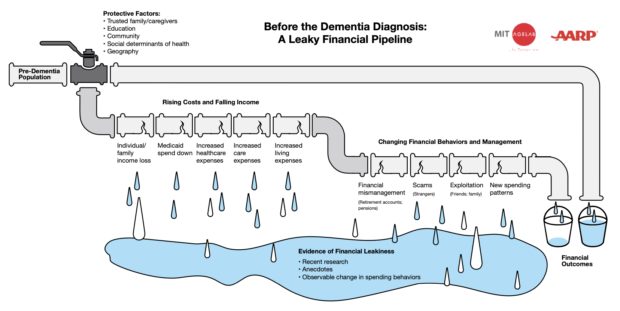
Money begins vanishing from bank accounts years before a dementia diagnosis, according to groundbreaking new research from MIT and AARP. A 2023 study found that households see their wealth plummet by more than half in the eight years leading up to a dementia diagnosis — from $217,000 down to just $104,000 — highlighting a devastating but largely invisible financial toll.

As cognitive decline subtly begins, individuals start making poor financial decisions and become more vulnerable to exploitation, while family members remain unaware of the growing crisis. This pre-diagnosis phase represents a critical window where intervention could help protect life savings, but most families miss the warning signs until significant damage is done.

Key Takeaways:

  • Financial impacts can begin up to six to eight years before an official dementia diagnosis, with missed payments and declining credit scores serving as early red flags.
  • Adult children often face severe financial strain trying to help parents, with many taking out personal loans or reducing work hours to provide care.
  • Artificial intelligence is making scams increasingly sophisticated, with new technology allowing fraudsters to mimic family members’ voices in elaborate schemes.
  • Early diagnosis appears to help prevent major wealth losses, suggesting that proactive screening could provide vital protection for family finances.

What we liked about the report: The consumer perspectives went a long way to provide additional context into why this is such a poignant issue. Lots of quotes and personal stories throughout.

What we didn’t: The stories were very helpful, but were also sometimes too much. The narrative was clear from the onset, but it doesn’t have to be as heavily emphasized throughout the rest of the report.

The Scale of the Crisis

Nearly one in 10 adults over age 65 have diagnosable dementia, with more than twice that number showing early signs of mild cognitive impairment (MCI). This creates a large vulnerable population at risk of financial exploitation and mismanagement.

Recent studies paint a stark picture of how cognitive decline erodes financial capability. A 2020 analysis found that individuals begin missing more payments and seeing credit scores drop up to six years before diagnosis. The financial impact appears unique to dementia — similar patterns don’t emerge with other health conditions like arthritis or heart disease.

"The financial services industry is very aware of this problem," says Lauren Hersch Nicholas, a health economist at the University of Colorado School of Medicine, noting that 84% of financial advisors report encountering cognitively impaired clients.

Just because they are aware of the issue, however, doesn’t mean that financial institutions are yet equipped with the processes and proactive measures needed to mitigate the problem before it becomes one.

The Impact on Families

For family members watching savings evaporate, the experience can be emotionally and financially devastating. Many adult children find themselves draining their own resources trying to help parents who don’t recognize they need assistance.

"I had to bail her out using my own finances," says Reagan, who took out $10,000-15,000 in personal loans to cover her mother’s expenses while also trying to put her own children through college. "My credit is really great, so I am able to take out some personal loans and help her."

The pre-diagnosis phase proves especially challenging because cognitive decline often coincides with individuals becoming more secretive about finances. Adult children describe frustrating battles trying to gain access to accounts or even basic information about their parents’ assets.

Visual chart with pipes illustrating the leaky financial pipeline of dementia's impact on family's lives.

"She was very secretive and kept her money separate," says Cathy about her mother. "She didn’t trust her children around her checking account." This isolation made it nearly impossible for family to intervene before significant losses occurred.

For some families, the financial strain extends beyond immediate household members. Londyn, caring for both her grandmother and infant daughter, had to postpone returning to work. "My plan was to go back to work, but my mother needed help," she explains. "I kind of took a hit in a sense… I have to budget a bit more. Entertainment money for my kids is a bit smaller."

New Threats in the Digital and Regulatory Ages

While traditional financial risks persist, emerging technologies create additional dangers. Artificial intelligence now allows scammers to create highly convincing fraud schemes, including the ability to clone voices of family members.

"Generative AI lets scammers be so good," warns Nicholas. "You can have voices of family members say ‘I’ve been kidnapped’ instead of some muffled voice in the background."

Jilenne Gunther, National Director of AARP’s BankSafe Initiative, notes that while their program has prevented over $300 million in elder fraud, this represents just "the tip of the iceberg" given annual losses of $28.3 billion to senior scams.

The legal system often struggles to balance protection with autonomy. Nina Kohn, Professor of Law at Syracuse University, explains that advance planning isn’t always effective: "Advance planning done when people are cognitively intact isn’t of much use when institutions are asking for new forms — new power of attorney — when dementia is now occurring."

Some states are experimenting with new approaches. Maine allows older adults to reverse financial transactions made with someone in a position of trust, while Illinois enables those over 60 to seek damages from people who use deception while acting in positions of confidence.

Mike Festa, State Director of AARP Massachusetts, emphasizes the delicate balance required: "If that person is competent, they have a right to make bad decisions." This creates challenges for protective services trying to prevent exploitation while respecting individual autonomy.

The Vicious Circle of Cognitive Decline and Financial Losses

Research suggests the relationship between cognitive decline and financial losses can be circular. While cognitive issues may trigger financial problems, severe financial setbacks — especially those involving loss of housing — can accelerate cognitive decline.

Lindsay Kobayashi, Professor of Epidemiology at the University of Michigan, describes this as a potential "vicious cycle" between financial and cognitive health losses. Her research indicates that major financial shocks can lead to cognitive impairment, particularly in countries with weaker social safety nets.

The research points to several promising avenues for protecting vulnerable seniors and their assets. Earlier screening and diagnosis appear to help prevent major wealth losses. Financial institutions are developing AI tools to flag suspicious patterns, while healthcare providers are working to improve early detection of cognitive decline.

Brain health maintenance through social engagement, cognitive stimulation, stress management, exercise and proper diet may help protect both cognitive and financial wellbeing. The financial services industry is also adapting, with initiatives to train advisors on recognizing signs of impairment and implementing protective measures.

Proactive Prescriptions

While the challenges are substantial, symposium participants emphasized reasons for hope. "I want to leave with a message of hope," says Brent Forester of Tufts University School of Medicine, urging a "focus on how there’s so much more that people with dementia can still do, that’s meaningful to them and their family members."

However, addressing these challenges requires coordinated effort across sectors. As MIT AgeLab founder Joseph Coughlin says, "this issue is too big and too important to say it’s a government issue or business issue alone. Before there is action, before you seek help, there needs to be awareness."

The study’s findings make clear that waiting until an official dementia diagnosis to take protective measures means missing a crucial intervention window. For families hoping to preserve hard-earned savings, understanding and acting on early warning signs could make all the difference.

Grace, an expert in public health policy who shared her family’s experience with exploitation, emphasizes the urgency: "We need to get to work now." With seventeen years typically required for research findings to become standard practice, there’s no time to waste in implementing protective measures for vulnerable seniors and their finances.

An Action Plan for Banks

Financial institutions stand at a critical intervention point in addressing dementia’s hidden financial toll. Banks witnessing these patterns firsthand can implement several protective measures:

  • Deploy AI-powered monitoring systems to detect unusual transaction patterns, missed payments, and potential exploitation
  • Train customer-facing staff to recognize subtle cognitive decline indicators and respond appropriately
  • Implement streamlined processes for trusted contact authorization that balance protection with privacy
  • Offer "view-only" account access options for family members concerned about declining financial management
  • Develop specialized financial advisory services addressing cognitive aging’s unique challenges
  • Create simplified account structures that minimize vulnerability while preserving customer autonomy
  • Establish clear intervention protocols when suspicious activity is detected
  • Partner with elder care and community organizations to build comprehensive support networks
  • Design educational programs for both customers and families about financial protection during cognitive aging

Editor’s note: This article was prepared with AI language software and edited for clarity and accuracy by The Financial Brand editorial team.

Full Article & Source:
Dementia’s Hidden Cost: How Cognitive Decline Compounds Banking Errors and Enables Fraud

Tuesday, March 4, 2025

Study: To Better Protect Elderly Rural Adults, Laws Need to Be Updated

According to research, the lack of definitional and legal clarity regarding instances of elderly abuse could be responsible for a large number of rural cases going unreported. 

by Liz Carey 


Experts say elder abuse in rural communities is a problem, but finding ways to solve it means clarifying how states define it and who should report it.

One in 10 older adults across the country reported experiencing some form of abuse during the previous year, according to a recent report from the National Center on Elder Abuse. For every single report of abuse, there are 24 incidents that may go unreported, the study claimed. 

Although research on elder abuse in rural communities is limited, there is some evidence that older adults living in rural and remote areas are at greater risk of abuse because of their geographic isolation, lack of support services, and poorer health.

Elder abuse encompasses physical, emotional/psychological, sexual, and financial abuse, as well as neglect and self-neglect,” a 2023 study by the RHRC stated. “There is some evidence that older adults living in rural and remote areas are at greater risk for abuse than their urban-dwelling counterparts. Some unique characteristics of rural America, including less densely populated communities, more geographic isolation, and scarce resources may conceal abuse, thereby inhibiting prevention and intervention. Rural older adults also tend to have less education and fewer financial resources, and are in poorer health than their urban counterparts, possibly creating barriers to leaving abusive situations.”

In order to protect older rural residents from elder abuse, the 2023 RHCR study argues, lawmakers first need to define what it is and who is responsible for reporting.

“These statutes also vary quite a bit by the age covered,” Alexis Swendener, a coauthor of the policy brief, said. “It’s not always the same. I saw anywhere from 50 to 70 (years old) defined as an older adult or senior adult. Some of the statutes were related to just any vulnerable adult, so a dependent adult would qualify and they weren’t age-defined. That was surprising to me that the protected population wasn’t necessarily based on age.”

The findings mean that policy makers need to be more clear on what elder abuse is and how state laws can and should protect older rural residents. Swendener said the differences make for difficult analysis and ineffective policymaking.

“As I was sifting through these statutes […] I was thinking about how the differences make it pretty difficult for us to know overall what the scope of the problem is,” she said in an interview with the Daily Yonder. 

“These state statutes – it’s not necessarily elder abuse that they’re talking about … and if we collected data on it, it’s not consistently about just older adults –  some of the laws are about vulnerable adults or dependent adults. Some of them have age defined in them and some of them don’t.”

The RHCR study initially aimed to find the differences between rural and urban elder abuse by looking at statistics of elder abuse across the country. What the researchers found was differences in every area, from who is mandated to report elder abuse to how elder abuse is defined.

The mere makeup of rural communities and their people may also affect how many victims of rural elder abuse there are reported, said Nels Holmgren, director of Aging and Adult Services in Utah. Speaking about what he sees in Utah, he noted that there may be more people in urban areas to report elder abuse, and there may be more older people in rural Utah who don’t want anyone to know they are being abused.

“I think, in some of our urban settings, there are more reporters, there are more people sometimes that have eyes on these situations. In our rural areas, there are simply fewer people to do that investigation,” Holmgren said in an interview with the Daily Yonder. “Certainly in rural communities, there’s a real sense of rugged independence, and people are less likely to ask for help because partly they value their independence and do things on their own.”

Rural elder abuse and neglect are relatively high in rural areas, and screening and prevention are needed to protect against elder abuse, according to the National Institutes of Health. In a 2022 study of more than 10,000 rural older adults, an estimated seven percent reported physical abuse, five percent reported financial abuse, 17% reported psychological and emotional abuse and 26% reported neglect.

Swendener said her study looked at six different kinds of elder abuse – emotional abuse, financial abuse, physical abuse, sexual abuse, neglect, and self-neglect. The study found that 72.2% of the most rural states, 55.6% of the somewhat rural states, and 66.7% of the least rural states clearly covered all six abuse types in their state statutes. Sexual abuse and self-neglect were the two areas of elder abuse least likely to be clearly mentioned, she said.

While about 1 in 10 older adults experiences some form of elder abuse nationwide, research on elder abuse in rural communities remains limited, according to researchers at the Rural Health Research Center at the University of Minnesota.

“The most common thing that we’re dealing with is self-neglect, but often if we can get to the people of self-neglect, those issues are often easier to resolve … and the person is usually in a better position afterward,” Holmgren said. “It’s disconcerting, the growth in financial exploitation. We’re also dealing with individuals closer to the person who are using the person’s funds inappropriately. I believe somewhere north of half of our cases are self-neglect.”

In July 2024, an elderly woman in Medina County, Ohio, was swindled out of $100,000. Marilyn Glauner, 81, said she got a phone call from someone who said they were with Publisher’s Clearinghouse and that she had won $8 million and a car. By the end of the phone call, she’d sent off three cashier’s checks totaling $100,000 and $3,000 in gift cards.

When her children found out that the money was missing, one of her sons called the police to help. Officials were able to stop two of the checks, but one of the checks had already been cashed.

Holmgren said one of the key elements in protecting rural seniors from elder abuse is reporting. The increased isolation some rural seniors experience can make that difficult. While senior services can get to older adults if they know there is a need, finding out that the adult needs help is the first step, he said.

”It’s harder for people that may not be on the radar of those agencies,” he said. “That’s the trickier part, especially in a rural area. There’s just fewer opportunities to interact. Once they know who they are and where they are and what they need, then I think (support agencies) are able to very effectively connect people.”

By defining the problem and how it is addressed, policy makers could increase awareness of elder abuse in rural communities and combat it at its source, Swendener said.

“Making folks aware of how to prevent elder abuse and keeping folks in contact with each other by increasing social support and reducing social isolation, especially for folks in rural areas, is a good start to addressing the problem,” she said.

Full Article & Source:
Study: To Better Protect Elderly Rural Adults, Laws Need to Be Updated

Thursday, February 13, 2025

Programs fight financial exploitation of senior citizens

by VICTORIA WITKE

This graphic shows that the number of cases referred to Michigan’s Adult Protective Services has risen substantially in recent years. (Graphic information courtesy of Michigan Department of Health & Human Services)

ISHPEMING — Recently, a man and woman were charged with financially exploiting an 87-year-old Rochester Hills man by fraudulently gaining his legal power of attorney.

Kirk Lanam of Hartland is accused by the state Attorney General’s Office of embezzling over $400,000 for himself and his nonprofit, while Shelley Letzer of West Bloomfield allegedly stole thousands by, among other means, writing herself checks. Both were arraigned in an Oakland County district court.

About two out of three older adults report someone attempting to scam them and are uncertain about their ability to identify fraud schemes, according to the Michigan Poll on Healthy Aging from the University of Michigan.

Michigan is a leading state in the number of residents 65 years and older, said Cynthia Farrell, the division director of adult services in the Department of Health & Human Services.

Referrals to Adult Protective Services have steadily increased since 2000, and there were over 4,000 financial exploitation referrals in the 2024 fiscal year.

A new Michigan State University study done in rural communities shows preventative training empowers family caregivers, service professionals and seniors to report and prevent financial exploitation of older adults with cognitive decline.

The study by social work professor Fei Sun divided participants into two test groups in Otsego, Crawford, Marquette and Alpena counties.

In the first and most effective test, caregivers and their elderly relatives were educated on financial abuse.

Then, caseworkers from the community, trained by the researchers, followed up with home and virtual visits to identify risks, goals and strategies to reduce fraud.

In the comparison group, family members and vulnerable seniors received one group lesson on exploitation at community centers.

Sun then surveyed the participants six and nine months later to test the program’s effectiveness.

Sun said even if communities lack the resources for caseworkers, the study shows that “simple community-based education, even just the one time, could be beneficial in raising people’s awareness and preventing financial abuse and fraud.”

Annie Hepburn is the director of the Alpena Senior Citizens Center and a participant in the study. Through a home visit, she found one of the center’s seniors was a victim of financial exploitation.

“Moving forward, I worked with him on plans on what would be real and what isn’t real,” Hepburn said. “You can’t just trust everybody. If people are requesting money, that is a red flag.”

Hepburn said every day the center has members saying they were caught in scams, but the program through Sun’s study has strengthened the trust between seniors and caseworkers.

Even after the study, the seniors ask for more programs and still reach out to staff with questions, she said.

“I’m very excited to know that they are confident enough to come to us,” Hepburn said.

The study’s training curriculum was based on a course by Peter Lichtenberg, a national expert on financial capacity assessment and financial exploitation of older adults.

Lichtenburg, the past director of the Institute of Gerontology at Wayne State University, said most agencies and organizations in the state, including Adult Protective Services, use his scale.

The first two chapters of Lichtenberg’s course are about assessing financial decision-making and patterns of exploitation. They break down how exploitation happens and include a vulnerability survey so seniors can recognize their risks.

According to Farrell, the director of adult services, a major risk factor for older rural Michigan residents is isolation because seniors have less access to resources in those communities and relatives often move away.

Lichtenberg said, “One of the things that happen with isolation is you tend to speed up your judgment and decision making and tend to be very receptive to anybody who is good at knowing how to present themselves as similar to you, having the same values, having the same beliefs you have.”

Farrell said scammers pretend to be lottery officials, romantic interests or grandchildren.

Schemes can pretend to fix fake bugs on computers, which she said are often seniors’ “ability to talk to other people and connect with the outside world if they are isolated.”

“We try to educate the public about those things,” Farrell said, “especially our seniors, who are usually the ones who have the cash, the assets that can be exploited.”

Free online resources for seniors, caregivers and professionals based on Lichtenberg’s course are provided at www.olderadultnestegg.com.

Full Article & Source:
Programs fight financial exploitation of senior citizens

Thursday, July 11, 2024

Study Links Credit Scores and Alzheimer’s Disease in Seniors

Missing numerous bill payments can damage a person’s credit score. But they could also signal a much bigger problem: damage to the brain from Alzheimer’s disease.

Families often miss the early warning signs of Alzheimer’s in a loved one. Symptoms may not start to show until the disease has progressed to later stages, at which point early intervention treatments are less effective and the financial consequences can be greater.

But a new study suggests that, for older adults, a credit score decline could signal cognitive decline. It adds to a growing body of research that links money problems to dementia.

Catching Alzheimer’s early is crucial from the standpoint of mental capacity, elder care, and estate planning.

Financial Deficits Mirror Memory Deficits in New Study

Credit scores start to go down and payment delinquencies start to go up in the years preceding a memory disorder diagnosis, according to new research published by the Federal Reserve Bank of New York.

Led by Georgetown University and supported by the National Institute on Aging, the study (“The Financial Consequences of Undiagnosed Memory Disorders”) found that, in the period leading up to a diagnosis of Alzheimer’s disease and related disorders (ADRD), credit outcomes noticeably deteriorate.

The researchers looked at credit card and mortgage payment histories from Equifax merged with Medicare data. Among patients diagnosed with ADRD, an increase in missed credit card payments began more than five years prior to diagnosis, while mortgage delinquency started three years prior.

Lead researcher Carole Roan Gresenz called the results “striking in their clarity and consistency.”

“Credit scores consistently decline, quarter by quarter, and probability of delinquency consistently increases as diagnosis approaches,” said Gresenz. “Our findings substantiate the possible utility of credit reporting data for facilitating early identification of those at risk for memory disorders.”

Finances Can Help to Catch Alzheimer’s Before It’s Too Late

It is becoming increasingly clear that financial missteps like missing routine bill payments could be an early predictor of Alzheimer’s that helps to detect the disease before major memory problems are apparent.

Georgetown’s Gresenz published research in 2019 that similarly showed compromised decision-making in money management can predict an Alzheimer’s diagnosis.

“Significant limitations and rapid declines in financial capacity are a hallmark of patients with early-stage Alzheimer's disease,” the abstract for that paper states.

In 2020, Johns Hopkins researchers released a study that discovered Medicare recipients later diagnosed with dementia are more likely to miss bill payments up to six years before a clinical diagnosis.

Alzheimer’s affects an estimated 6 million Americans, most of them age 65 or older. It remains the top cause of dementia in older adults and the seventh leading cause of death in the United States.

The results can be devastating as the disease progressively destroys memory and functional skills. But its exact cause is unknown, and diagnosis is notoriously challenging in the initial stages.

Money matters may be a leading indicator of Alzheimer’s because financial management is cognitively challenging, a specialist in geriatrics and memory care at UPenn told KFF Health News.

Even mild cognitive impairment can lead to financial issues when there are generally no other signs that a person is developing Alzheimer’s. In fact, financial problems are a common reason why loved ones are initially screened for dementia.

But by then, it might already be too late to avoid major money mistakes. For example, one Pennsylvania Alzheimer’s sufferer had her home foreclosed on due to missed mortgage payments. Her daughter only realized how bad her mother’s memory had gotten when she noticed abnormalities such as unpaid bills and strange cash withdrawals.

Unopened and unpaid bills, money missing from a bank account, difficulty balancing accounts, and new, unexpected purchases are some of the money-related signs that should be monitored in people who have dementia or may be developing Alzheimer’s, according to the National Institute on Aging.

Missed payments could be a sign that an older adult is developing Alzheimer’s. Stay on top of their credit reports and reach out to a local elder law attorney if you need legal advice about how to protect them.

The Importance of Early Alzheimer’s Detection

Many Alzheimer’s cases are not caught until they’re in the middle and late stages. But early detection, which may be easier if family members are paying close attention to an aging loved one’s bank statements and financial records, can help to stave off the worst consequences, both physical and financial, of the disease.

Although there is currently no cure for Alzheimer's, there are FDA-approved drugs that can help to slow its progression and lessen symptoms. However, these therapies work best when the disease is in its earliest stages, before permanent brain damage has occurred.

Early detection is also important for families caring for older adults with Alzheimer’s disease. It can help to set realistic expectations, plan together, and avoid potentially costly financial mistakes.

Georgetown researcher Gresenz notes in her 2019 paper that financial miscues during early-stage Alzheimer’s can reduce a patient’s net wealth. This can impact the ability to pay for care in the disease’s later stages.

One reason why Alzheimer’s may be linked to lower net wealth is financial exploitation. Cognitive changes associated with early-stage dementia has been shown to not only make individuals more susceptible to compromised financial decision-making on their own, but also make them more vulnerable to financial abuse and fraud.

Work With an Attorney

Estate planning for a loved one suffering from Alzheimer’s or dementia should include preparing for their long-term care and health needs, arranging to manage their finances and property, and naming another person to make financial decisions on their behalf using a power of attorney.

But executing estate planning documents requires having the mental capacity to do so. And if somebody has Alzheimer’s, they may lack the ability to give their consent. That’s why it’s crucial to have these documents in place before they’re needed — especially in cases where Alzheimer’s has been diagnosed or is suspected.

Many older adults living with early-stage Alzheimer’s still have the legal capacity to make their own decisions, but this might require a third-party assessment and attorney assistance.

Full Article & Source:
Study Links Credit Scores and Alzheimer’s Disease in Seniors

Tuesday, May 21, 2024

Many families take patients off life support too soon after traumatic brain injuries: study

By Melissa Rudy

Many patients who died after traumatic brain injuries may have survived and recovered if their families had waited to take them off life support, a new study has found. (iStock)

Many patients who died after traumatic brain injuries may have survived and recovered if their families had waited to take them off life support, a new study found.

Researchers from Massachusetts General Hospital, Harvard Medical School and other universities analyzed "potential clinical outcomes" for patients with traumatic brain injury (TBI) who were removed from life support, according to a press release.

The study included 1,392 patients who were treated in 18 trauma centers across the U.S. over a 7½-year period.

Using a mathematical model, the researchers compared patients for whom life support was withdrawn to similar patients who were kept on life support.

Among the group for whom life support was not withdrawn, more than 40% recovered at least some independence, according to a press release.

The researchers also discovered that the notion of remaining in a vegetative state was an "unlikely outcome" six months after injury.

When designing the study, the team didn’t know what to expect, according to study author Yelena Bodien, PhD, of the Department of Neurology’s Center for neurotechnology and neurorecovery at Massachusetts General Hospital. 

"Our anecdotal experience was that some families are told their loved ones had no chance for recovery, they would never walk, talk, work or have a meaningful relationship again — yet they chose not to discontinue life support and their loved one made a remarkable recovery," she told Fox News Digital.

"On the other hand, clinicians are under a lot of pressure to make early prognoses and do not want to commit someone to a life that would never be acceptable to them, so it could be that those patients who died after life support was withdrawn would have had very significant impairments otherwise."

"I think there are two stories here," said Bodien. 

"One is that some patients with traumatic brain injury who died because life support was withdrawn may have recovered, but the other is that many would have died even if life support was continued."

A patient’s prognosis after severe traumatic brain injury is highly uncertain, she noted. "Sometimes patients with the most devastating injuries survive and make meaningful recoveries."

"Families can advocate for delaying a decision to discontinue life support if this is aligned with what they believe their loved one would want."

The problem, Bodien said, is that health care providers lack the tools required to determine which patients with devastating injuries will recover, to what extent they will recover — and how long that will take.

‘Very important’ study

Dr. Marc Siegel, clinical professor of medicine at NYU Langone Medical Center and a Fox News medical contributor, was not involved in the research but said it was a "very important" study.

"Previous research shows a high-level recovery from mild TBI and a significant recovery percentage even with moderate to severe injury," Siegel told Fox News Digital.

"After head trauma, the brain may swell, and the use of mannitol and steroids and even sometimes surgery — where the top of the skull is removed — can be used to decrease pressure on the brain and increase chance of a full recovery," he continued. 

Rehabilitation is also crucial, Siegel added.

"All of these tools should be given a chance to work in most cases."

Based on the study findings, Bodien recommended that clinicians should be "very cautious" with "irreversible decisions" like withdrawing life support in the days following traumatic brain injury

"Families should also be aware of our results so that they can advocate for delaying a decision to discontinue life support if this is aligned with what they believe their loved one would want," she added. 

Limitations of the research

There were some limitations to the study, Bodien said.

"The sample size of the study was small, which made it difficult to find an adequate number of participants who did not have life support discontinued and were clinically similar, or ‘matched,’ to those who had life support discontinued," she told Fox News Digital.

Among the participants who did not have life support discontinued, the researchers were not able to follow all of them for a six-month period.

 Another limitation is that the researchers used clinical variables that were available on the day of, or the day after, hospitalization — but sometimes decisions to discontinue life support are made several days later.

"There are many considerations that may lead to a decision to discontinue life support after traumatic brain injury that we were unable to factor into our analyses," she continued. 

"For example, personal beliefs, religion and advanced directives could all affect decision-making but were not captured in our study."

Bodien also noted that the Harvard study was focused on traumatic brain injury and cannot be generalized to other injuries and illnesses.

Full Article & Source:
Many families take patients off life support too soon after traumatic brain injuries: study

Monday, March 25, 2024

Study finds treating self-neglect among older adults can prevent later abuse

By Rose Lundy

Researchers point to an advocacy program in Maine that works with Adult Protective Services as one solution to preventing exploitation. 

A new study found that almost 40 percent of elder mistreatment cases began with self-neglect. Photo by Jeremy Poland/iStock.

A few years ago, Adult Protective Services put Polly Madson Cox in touch with an older woman who was neglecting herself. She lived alone, struggled to meet her basic needs and was on the verge of eviction.

Madson Cox, who was an advocate with the Elder Abuse Institute of Maine, worked with the woman to try and find a way to stay in her apartment. During that time, the woman invited someone to live with her. Madson Cox soon learned this person was exploiting her, controlling her medications, ability to leave the house and her finances.

A recent study found this is a common problem. An analysis of Maine APS investigations published online last month by the Journal of the American Geriatrics Society found that older adults who neglect themselves often experience other mistreatment at the same time and are at risk of further abuse.

Addressing cases of self-neglect may prevent later abuse, said the study’s lead author, Dr. Stuart Lewis, an associate professor at Dartmouth’s Geisel School of Medicine.

Advocates in Maine said the study findings reinforce the work of a program that was piloted in 2019 under the Elder Abuse Institute of Maine.

“Self-neglect is a huge unmet need in elder mistreatment,” Lewis said. “It has been, historically, a very difficult circumstance to intervene in ways that provide benefit to the person.”

Despite Madson Cox’s efforts, her client was eventually evicted. She worked with the woman as she moved to a hospital, then later into an assisted living facility. She was evicted with only the clothes on her back, so Madson Cox helped her get more clothing and regain access to her finances.

“I think we are incredibly instrumental and a special program,” Madson Cox said. “To meet all those needs, to be able to be involved with her all those months. In that case she was in three different counties across the state of Maine — and I was the sole constant for her.”

Self-neglect, which makes up half of APS investigations nationally, occurs when someone no longer has the capacity for self-care.

Often this means failing to eat appropriately, care for their home, maintain good hygiene or manage their financial affairs, according to the 2021 Adult Maltreatment Report by the U.S. Department of Health and Human Services.

Madson Cox said some indicators of self-neglect could be unsafe housing, such as holes in the roof, rotted floorboards or an infestation; unpaid bills, disabled utilities or banking concerns; concerns about hygiene; and lack of access to medical care or trouble managing their medications.

Patricia Kimball, the study co-author and executive director of the Elder Abuse Institute of Maine, said it’s difficult to address self-neglect because clients often don’t see themselves as victims. Even the term “self-neglect” is stigmatizing, she said, because it blames the person for their situation when there may be factors out of their control.

To examine how self-neglect relates to other forms of mistreatment, researchers analyzed nearly 18,000 Maine APS investigations from July 2017 to October 2021, looking at cases in which the first substantiated allegation was self-neglect. 

The study found that about half of the individuals who were first reported for self-neglect also experienced other mistreatment at the same time. And almost 40 percent of elder mistreatment cases began with self-neglect. 

The study found that the time period between a report of self-neglect and another allegation is often less than a year, ranging from 215 to 388 days, much shorter than what was published in a previous study, Lewis said.

“What’s important about it is (self-neglect) often occurs at the same time as other forms of abuse; that it’s a risk factor for later abuse; and that by treating it, you may potentially prevent other abuse later on,” Lewis said.

Self-neglect shares risk factors with other elder mistreatment, such as physical disability, social isolation, cognitive impairment and lack of social support, according to the study. 

The study was conducted using Maine APS cases collected during a pilot program of the RISE model. This model — “Repair harm; Inspire change; Support connections; Empower choice” — is a new national approach designed to address elder abuse in a way that reduces harm while respecting the individual’s autonomy. Advocates refrain from pressuring clients to make certain decisions about their lifestyle and only provide the support the client seeks, Madson Cox said.

“We respect that clients have the right to make their own decisions and we understand that clients have that right even when their choices might make us or other people uncomfortable, or might make choices that are in opposition to those people around them,” Madson Cox said.

Two individuals hold each other's hands in a sign of comforting the other in this stock image.
The study found that about half of the individuals who were first reported for self-neglect also experienced other mistreatment at the same time. And almost 40 percent of elder mistreatment cases began with self-neglect. Photo by kitzcorner/iStock

Maine’s RISE pilot project, called Elder Service Connections, started in 2019 by pairing advocates from the Elder Abuse Institute of Maine with APS caseworkers to work on investigations in Aroostook and Cumberland counties.

The advocates were trained in motivational interviewing and supported decision-making, and were able to stay with clients long after APS might be required to close a case. Madson Cox said the time they work with clients can vary greatly, but is usually less than a year.

Data shows the RISE approach works: Clients are significantly less likely to end up back in the APS system after working with a RISE advocate.

To date, the program has received 752 referrals. It expanded in 2021 to include the entire state, and there are currently eight advocates. The budget Gov. Janet Mills signed last year dedicated $800,000 annually to the program. 

Madson Cox, who worked as a RISE advocate for about a year and a half and now oversees the program, said she has seen the findings of the self-neglect study mirrored in her work.

She mentioned the case of a woman in her 70s who was reported for self-neglect because her furnace wasn’t working. The woman had no hot water, struggled to get her snow plowed and was heating her home by using the oven and space heaters. She was paying an exorbitant electric bill, had trouble bathing without hot water and couldn’t get out of her home to access health care.

Advocates spent months working with her, and Madson Cox said as they got to know the client, she disclosed that a community member was financially exploiting her by charging an excessive price for snow removal, and a family member was being verbally abusive and stealing her medication. The advocates were able to fix the furnace, help with the utility bill, secure a new snow removal service and get her medication delivered directly.

“We have the luxury of being able to work with people for a much greater amount of time,” Madson Cox said. “Some of the (conditions) were known as the client became comfortable with us and began trusting us to disclose.”

The RISE system can also work with others in the client’s orbit, including someone who may be exploiting them, Kimball said.

This approach recognizes that often what the older adult wants more than anything is help for a loved one who may be struggling — with addiction, for instance — even if they are the ones exploiting them.

“Often in maltreatment and abuse situations, our clients want the alleged harmer to get help,” Madson Cox said. “They’re not in a place to make choices to sever the relationship or be estranged.”

This article was written with the support of a journalism fellowship from The Gerontological Society of America, The Journalists Network on Generations and The Silver Century Foundation.

Full Article & Source:
Study finds treating self-neglect among older adults can prevent later abuse

Thursday, March 21, 2024

Examining Financial Fraud Against Older Adults


March 20, 2024
By Rachel E. Morgan, Susannah N. Tapp

The population of older adults has expanded. The percentage of persons age 60 or older in the United States increased by 33% from 2010 to 2020 and is expected to continue to grow.[1]

The Better Business Bureau reports that older adults[2] lose more than $36 billion to financial fraud every year.[3] According to the FBI’s Internet Crime Complaint Center, 105,301 cases of fraud against persons age 60 or older were reported in 2020.[4] In 2021, 128,216 offenses against persons age 65 or older were reported through the National Incident-Based Reporting System.[5] The actual number of fraud cases is unknown as many people do not report their victimization, and underreporting is especially high for older adults.[6]

Despite these facts, there is a lack of research on fraud victimization of older adults. To date, studies that examine financial fraud have not been nationally representative, suffer from small sample sizes, or only include victims who make a formal report. Some studies use varying definitions of fraud, which may or may not include identity theft. Additionally, these studies may have other methodological limitations that lead to a wide range in prevalence estimates.

To help fill this gap in the literature, this article presents findings from a nationally representative sample of persons age 60 or older who experienced personal financial fraud. Data came from the 2017 National Crime Victimization Survey (NCVS) Supplemental Fraud Survey (SFS).

Review of the Literature

Financial exploitation of older adults — which generally includes improper use of funds, property, or resources of another individual — can be divided into two main categories: financial abuse and financial fraud. Individuals who know the victim and are in positions of trust (for example, family members or paid caregivers) commit financial abuse of older adults, which is also referred to as elder financial abuse. Strangers mainly commit financial fraud of older adults.[7] Most research to date has focused on financial abuse rather than financial fraud,[8] although some studies include both forms of financial exploitation. This article looks only at financial fraud.

Changes in the aging brain and declines in cognitive functioning (ranging from mild impairments to Alzheimer’s disease and dementia) make older adults more susceptible to scam and fraud.[9] Other risk factors include a lack of financial literacy,[10] social isolation, and loneliness.[11] Older adults also tend to be more trusting than younger adults and less able to recognize deceitful individuals.[12]

Research has consistently found that older adults are more likely to be targets of fraud than younger adults.[13] However, this does not necessarily mean a greater number of older adults are victims of financial fraud.[14] The 2016 Health and Retirement Study found that 34.8% of persons age 50 or older had been targeted by or had been the victim of a fraud or investment scam in the past five years.[15] Estimates of financial fraud victimization of older adults differ by the population studied, the definition of fraud used,[16] and the time frame considered; however, across studies, between 2.7% and 6.6% of older adults reported experiencing financial fraud in the past 12 months.[17]

The consequences of fraud victimization may be more severe for older adults than younger adults. Research found that they lose more money, on average, than younger victims.[18] Financial fraud of older adults is rarely handled through the criminal justice system. Older fraud victims are unlikely to report the incident to the police. Prosecutors and law enforcement may be less interested in pursuing legal action when the victim is an older adult, especially one who has cognitive difficulties.[19] Other correlates of financial victimization include poor psychological well-being,[20] depression, post-traumatic stress disorder, generalized anxiety disorder, poor overall health,[21] and lower quality of life,[22] although the directionality of these relationships is not always known. Although higher rates of fraud are correlated with mental and physical health problems, experiencing fraud does not necessarily cause negative health outcomes. However, issues with physical and mental health could make individuals more vulnerable to fraud victimization.

Data and Methods

This analysis used data from the Bureau of Justice Statistics’ (BJS) 2017 NCVS SFS. BJS is the nation’s primary source for criminal justice statistics, and the NCVS is the nation’s primary source of information on criminal victimization. Each year, the NCVS collects data from a nationally representative sample of approximately 240,000 persons in about 150,000 households. The NCVS collects information on nonfatal personal and property crimes reported and not reported to police, including data on the victim, the person who perpetrated the crime,[23] and incident characteristics.[24]

From October through December 2017, BJS administered the SFS to a nationally representative sample of persons age 18 or older in NCVS-sampled households. All NCVS and SFS interviews used computer-assisted personal interviewing, either by telephone or in person. Of the 66,200 NCVS-eligible respondents age 18 or older, approximately 51,200 completed the SFS questionnaire, representing a response rate of 77.3%.

The SFS collected individual-level data on the prevalence of seven types of fraud victimization: charity, consumer investment, consumer products and services, employment, phantom debt, prize and grant, and relationship and trust. Prevalence is defined as the number or percentage of unique persons who were victims of fraud at least once during the reference period. The SFS asked respondents whether they experienced the different types of fraud in the 12 months prior to the interview.[25]

The SFS instrument began with a series of questions on these seven types of fraud; these questions screened the respondent into the survey if they reported experiencing one or more eligible types of fraud victimization. Once a respondent screened in, the interviewer administered the SFS incident instrument to collect detailed information about the type of fraud victimization experienced. The incident instrument also collected data on the characteristics of victims and their patterns of reporting to the police and other authorities.

In addition to reporting a fraud victimization in the screener questions, respondents were classified as fraud victims if they reported that they did not get their money back in the transaction. This criterion fits the legal definition of fraud and provided sufficient sample sizes to produce statistical estimates.

If respondents reported experiencing more than one incident of the same type of fraud, the SFS asked them to think about the most recent incident that occurred in the last 12 months. This article defines older adults as persons age 60 or older, which is consistent with the Elder Abuse Prevention and Prosecution Act of 2017 and Older Americans Act of 1965.[26]

Results

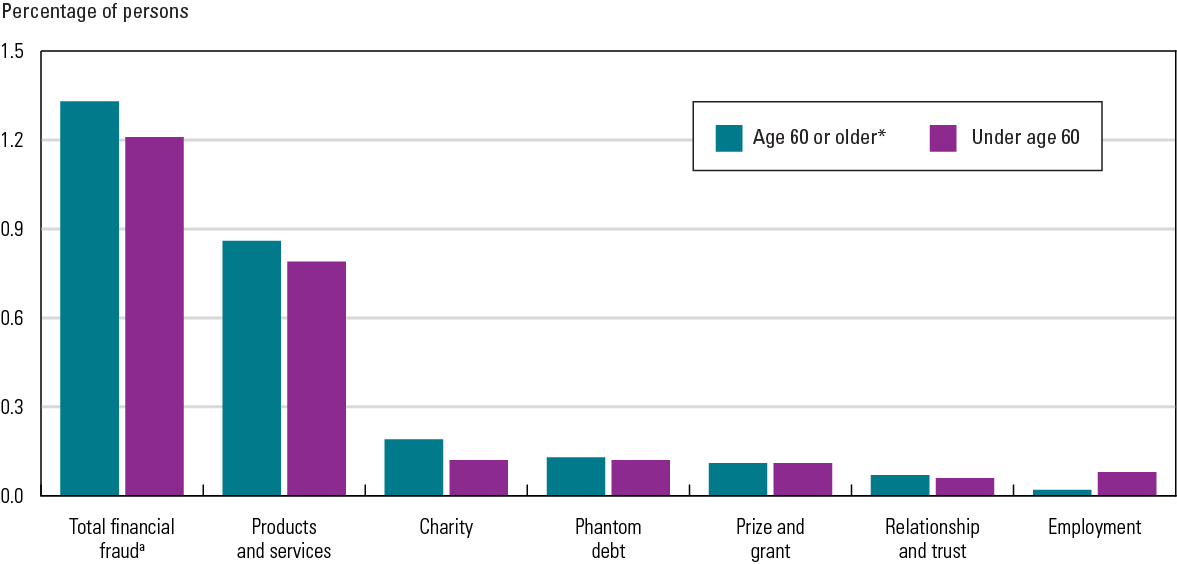
In 2017, about 1.33% (929,570) of persons age 60 or older experienced at least one incident of fraud (see exhibit 1). There were no statistically significant differences between the percentage of persons age 60 or older and persons age 59 or younger who experienced fraud. This pattern held when examining by fraud type both for persons age 60 or older and for persons age 59 or younger.

Exhibit 1. Percentage of persons who experienced at least one incident of personal financial fraud in the past 12 months, by type of fraud and age of person, 2017.

Source: Bureau of Justice Statistics, National Crime Victimization Survey, Supplemental Fraud Survey, 2017.

 Note: Estimates are based on the most recent incident for that fraud type.
* Comparison group.
a Consumer investment fraud is excluded due to too few sample cases, but it is included in total financial fraud. 

Source: Bureau of Justice Statistics, National Crime Victimization Survey, Supplemental Fraud Survey, 2017.

For estimates and standard errors, see appendix tables 1a and 1b.

Regardless of victim age, the most common type of fraud was consumer products and services fraud; about 65% of all fraud victims experienced it (see exhibit 2). Technology support scams, automotive repair scams, weight-loss product scams, and online marketplace scams are common examples of this fraud type.

Exhibit 2. Number and percentage of victims who experienced personal financial fraud, by type of fraud and age of victim, 2017.

 Number of victimsPercentage of victimsPercentage of all persons
Type of fraudAge 60 or older*Under age 60Age 60 or older*Under age 60Age 60 or older*Under age 60
Total financial frauda929,5702,109,630100.0100.01.331.21
Products and services604,2001,378,04065.065.30.860.79
Charity135,880206,07014.69.80.190.12
Phantom debt91,940204,6809.99.70.130.12
Prize and grant77,500186,1808.38.80.110.11
Relationship and trust48,600106,5805.25.10.070.06
Employment13,040!137,4201.4!6.50.02!0.08

Note: Estimates are based on the most recent incident for that fraud type. Numbers and percentages of victims do not sum to totals because persons could experience multiple types of fraud.
* Comparison group.
† Significant difference from comparison group at the 95% confidence level.
‡ Significant difference from comparison group at the 90% confidence level.
! Interpret estimate with caution. Estimate is based on 10 or fewer sample cases, or coefficient of variation is greater than 50%.
a Consumer investment fraud is excluded due to too few sample cases, but it is included in total financial fraud.

Source: Bureau of Justice Statistics, National Crime Victimization Survey, Supplemental Fraud Survey, 2017.

For standard errors, see appendix table 2.

Data from the 2017 SFS show that 79.7% of fraud victims age 60 or older were non-Hispanic white persons, a significantly higher percentage than the 62.0% of all fraud victims who were non-Hispanic white persons (see exhibit 3). The percentage of victims age 60 or older who were never married (8.1%) was lower than the percentage of all victims who were never married (31.1%). However, the percentage of victims age 60 or older who were widowed (22.0%) was significantly higher than the percentage of all victims who were widowed (8.0%). There were no statistically significant differences by victim sex, household income, or location of residence in the percentage of victims of financial fraud of any age and those age 60 or older.

Exhibit 3. Percentage of all victims and victims age 60 or older who experienced personal financial fraud, by demographic characteristics, 2017.

Demographic characteristicsPercentage of all
victims age 60 or older*
Percentage of all victims
  Total100100
Sex
  Male43.845.2
  Female56.254.8
Race/Hispanic origina
  Whiteb79.762.0
  Blackb7.815.6
  Hispanic9.514.8
  Otherb,c3.0!7.6
Marital status
  Never married8.131.1
  Married46.741.5
  Widowed22.08.0
  Divorced or separated22.219.0
Household income
  Less than $25,00017.723.5
  $25,000-$49,99931.127.4
  $50,000-$99,99929.627.7
  $100,000 or more21.621.4
Location of residence
  Urband34.039.3
  Suburbane52.848.5
  Ruralf13.212.2

Notes: Estimates are based on the most recent incident of fraud. Details may not sum to totals due to rounding.
* Comparison group.
† Significant difference from comparison group at the 95% confidence level.
‡ Significant difference from comparison group at the 90% confidence level.
a There were no victims of personal financial fraud age 60 or older who were American Indian or Alaska Native and Native Hawaiian or Other Pacific Islander.
b Excludes persons of Hispanic origin (e.g., “white” refers to non-Hispanic white persons and “Black” refers to non-Hispanic Black persons).
c Includes persons who were Asian; Native Hawaiian or Other Pacific Islander; American Indian or Alaska Native; and two or more races. Categories are not shown separately due to small numbers of sample cases.
d Within the principal city of a Metropolitan Statistical Area (MSA).
e Within an MSA but not in a principal city of the MSA.
f Not within an MSA.

Source: Bureau of Justice Statistics, National Crime Victimization Survey, Supplemental Fraud Survey, 2017.

For standard errors, see appendix table 3.

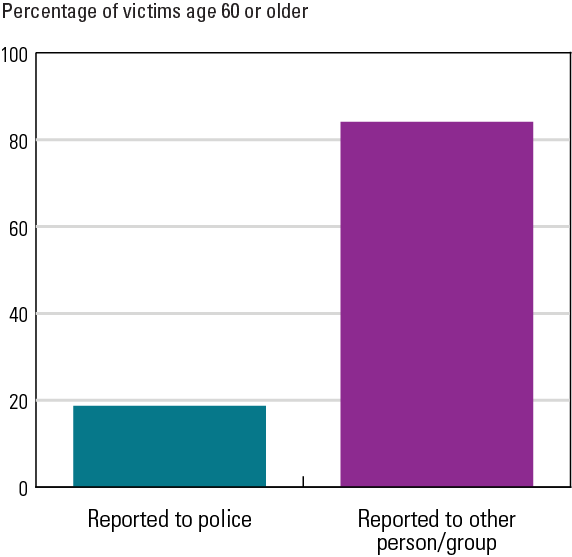
Victims may not report a crime for a variety of reasons, including fear of reprisal or getting the person who perpetrated the crime in trouble, believing that nothing could or would be done to help, and believing the crime to be a personal issue or too trivial to report. About 1 in 5 (19%) fraud victims age 60 or older reported the incident to the police, and 84% of victims age 60 or older reported the incident to another person or group (see exhibit 4). Other people or groups that the victim may report the incident to include their family or friends; a bank, credit card company, or other payment provider; a state or local consumer agency; a lawyer; or a federal consumer agency.

Exhibit 4. Percentage of financial fraud victims age 60 or older who reported to police or other persons or groups, 2017.

Exhibit 4. Percentage of financial fraud victims age 60 or older who reported to police or other persons or groups, 2017.
Source: Bureau of Justice Statistics, National Crime Victimization Survey, Supplemental Fraud Survey, 2017. (View larger image.)

For standard errors and confidence intervals, see appendix tables 4a and 4b.

In total, fraud victims age 60 or older lost nearly $1.2 billion in 2017, and they lost an average of $1,270 (see exhibit 5). More than half (65%) of the total losses resulted from consumer products and services fraud. On average, consumer products and services fraud victims age 60 or older lost about $1,190, which was significantly more money than the amount lost by victims of charity fraud ($60).

Exhibit 5. Financial losses among victims age 60 or older who experienced at least one incident of personal financial fraud in the past 12 months, by type of fraud, 2017.

Type of fraudMeanMedianTotal lossesa
Total financial fraudb,c$1,270$200$1,161,716,270
Products and services*$1,190$200$756,075,010
Phantom debt$1,050$400$103,808,460
Prize and grant$490$100$44,310,710
Charity$60$30$10,844,140

Note: Estimates are based on the most recent incident of that fraud type. Details may not sum to totals due to rounding.
* Comparison group.
† Significant difference from comparison group at the 95% confidence level.
a The percentage of victims who experienced one type of fraud multiple times during the reference period varied from 1% to 6%. To account for these losses, the average loss for each type of fraud was added to the amount lost by the victim in the most recent incident and then added to total losses.
b Total financial losses are expected to be greater than the amounts shown in this table due to top coding, a procedure used to protect respondents from disclosure risk.
c Employment and investment fraud are excluded due to too few sample cases, but they are included in total financial fraud. Relationship and trust fraud is excluded due to unreliability of the estimate, but it is included in total financial fraud.

Source: Bureau of Justice Statistics, National Crime Victimization Survey, Supplemental Fraud Survey, 2017.

For standard errors, see appendix table 5.

Those who lost the average amount of $1,270 or less were significantly less likely to report the incident to the police (13%) than those who lost more than $1,270 (47%). Victims who lost $1,270 or less were also significantly less likely to report the fraud to another person or group (82%) compared to victims who lost more than $1,270 (95%).

Fraud victims experience different socioemotional consequences. About a third (31%) of victims age 60 or older experienced moderate emotional distress (see exhibit 6). About 29% experienced mild distress and 27% experienced severe distress. One in 20 (5%) fraud victims age 60 or older reported experiencing relationship problems with friends or family because of the incident.

Exhibit 6. Percentage of victims age 60 or older who experienced socioemotional problems as a result of personal financial fraud, 2017.

Type of socioemotional problemPercentage of victims age 60 or older
Emotional distress
   None11.7
   Mild28.9
   Moderate30.6
   Severe26.6
Family/friend relationship problemsa4.6

Note: Details may not sum to total because victims could experience emotional distress and family/friend relationship problems. Excludes missing data, which accounted for 2% of fraud incidents.
a Includes experiencing significant problems with family or friends, such as having more arguments than before the victimization, an inability to trust, or not feeling as close after victimization.

Source: Bureau of Justice Statistics, National Crime Victimization Survey, Supplemental Fraud Survey, 2017.

For standard errors and confidence intervals, see appendix table 6.

Implications and Conclusions

Prior research and data on fraud are limited by issues such as small sample sizes, nonrepresentative samples, and variations in the definition of fraud and types of crimes included. To date, many of the data have relied on statistics collected by the FBI. Despite limitations, these data are a useful source of information because the FBI consistently collects them, which provides an opportunity to report on trends over time. The FBI also collects data on the severity of the problem and types of fraud targeting older adults. Data from the FBI Internet Crime Complaint Center, for example, show that financial fraud of older adults is a growing problem both in terms of number of incidents reported and total dollars lost.[27]

However, based on the SFS data analyzed in this article, we know that statistics collected by law enforcement do not capture the complete picture. The SFS aims to address the need for nationally representative estimates of fraud, both reported and not reported to the police. The SFS complements the FBI data sources by including victims who do not report to the police. Additionally, the SFS reveals that the demographic profile of financial fraud victims age 60 or older differs from the profile of fraud victims age 18 or older. Future research on older adults who do not report their victimizations will also provide a more comprehensive picture of fraud in the United States.

Additional areas of research offer opportunities to examine the evolving nature of fraud victimization, including the intersection of fraud and cybercrime, and types of fraud that target older adults. These gaps in knowledge about financial fraud of older adults should be addressed through research in the future.

The Bureau of Justice Statistics defines and measures financial fraud and identity theft separately and collects data on each crime through separate National Crime Victimization Survey supplemental surveys. The primary distinction between the two crimes is whether respondents willingly provided personal information to the person who perpetrated the crime.

In the case of identity theft, victims’ personal information (for example, bank account information or Social Security number) is obtained and used without permission. For an incident to be classified as identity theft, victims must experience the misuse of an existing account, opening of a new account, or the misuse of personal information. Identity theft is like other types of theft, whereby victims’ information is taken without their knowledge, consent, or control. For more information, see https://bjs.ojp.gov/data-collection/identity-theft-supplement-its.

For personal financial fraud — the focus of this article — victims willingly provide personal information but are deceived about what they will receive in return for that information. For an incident to be classified as a personal financial fraud, victims must be knowingly and intentionally deceived and lose money in the transaction. For more information, see https://bjs.ojp.gov/data-collection/supplemental-fraud-survey-sfs.

Return to text.

Appendix Tables


Full Article & Source:
Examining Financial Fraud Against Older Adults