Frozen nutritional shakes given to hospital patients and long-term
care residents have been recalled after they were linked to 11 deaths
and dozens of serious illnesses — with the outbreak dating back to 2018.
Food Service Company Lyons Magnus on Friday announced
a recall for 4 oz. Lyons ReadyCare and Sysco Imperial Frozen
Supplemental Shakes in response to a recall by manufacturer Prairie
Farms over a possible listeria contamination.
At least 38 people have been infected with listeria stemming from the outbreak, the FDA said, noting the infections spanned 21 states, including New York.
Of those infected, 37 were hospitalized and 11 people died from the illness, according to the FDA.
According to the FDA, 34 of those who became sick were living in
long-term care facilities or were hospitalized before becoming sick.
Records indicated the facilities the patients were in had the nutritional shakes available to residents.
The outbreak dates back to cases in 2018, but 20 of the cases
occurred in 2024 and 2025 and the outbreak remains ongoing, the CDC
said.
“The recalled products were distributed primarily to long-term care
facilities and were not available for retail sale,” Lyons Magnus said in
the statement.
“As soon as Lyons Magnus learned of the issue, we took immediate
action to halt the purchase of all products from the affected Prairie
Farms facility, notify customers, and ensure that impacted products were
removed from distribution nationally.”
Lyons Magnus voluntarily recalled the shakes but said the outbreak
stemmed from a third-party manufacturer and does not impact any other
products they produce.
The FDA’s investigation into the outbreak is ongoing.
The number
of patients awaiting state-appointed guardians to be discharged is up,
adding pressure to the health care system and raising difficult ethical
issues.
By LAUREL DEMKOVICH
The number of patients awaiting state-appointed guardians to be
discharged is up, adding pressure to the health care system and raising
difficult ethical issues. (iStock.com)
The state’s already stretched hospital system is facing added
strain from patients who could be discharged but are stuck waiting
because they lack a state-appointed guardian.
The Washington State Hospital Association estimates that roughly 10%
of the state’s hospital beds are occupied by patients who have barriers
to being discharged. Among them, a subset, often around 100 people, are
awaiting a guardian to make a decision on where they should go next,
such as a long-term care facility.
But that process is long and complicated, and there aren’t enough
people willing to take on the guardianship role for patients in these
circumstances, who can have conditions like Alzheimer’s disease, brain
injuries, or severe mental health disorders.
Appointing a guardian can often take between three to six months.
It’s time-consuming in part because it is highly sensitive, usurping an
individual’s decision-making power.
“People end up losing most, if not all, of their legal rights simply
to get discharged from the hospital,” Amy Spitzer, an attorney at Fox
Ballard in Seattle, said during a meeting where state lawmakers
discussed the issue this week.
The Legislature is trying to come up with improvements.
The state Department of Social and Health Services’ Aging and
Long-Term Support Administration gets about 200 referrals each week for
people who need to transition from hospitals to other types of settings.
About 175 of those are typically resolved within the week, said Bea
Rector, assistant secretary at the department.
Rector said an “overwhelming” number of people in these situations
can make decisions or express opinions on what they want, but a small
number do not have that ability and need an appointed guardian.
Spitzer, the attorney, said the number of guardianship cases her firm
has taken has increased by about 30% since 2020. In the first six
months of this year, she said her firm has dealt with 250 guardianship
cases.
Overall in Washington, there are between 11,100 and 12,300 hospital
beds available to the general public, the Washington State Hospital
Association estimates.
Looking for solutions
One solution to getting people out of hospitals faster could be reinterpreting the state’s surrogate decision-maker law, which dictates who can make decisions for patients who are unable to.
In the fall of 2020, the state Department of Social and Health
Services clarified that the law says patients’ family members, or others
who have designated powers of attorney, could only make choices about
health care for people unfit to make decisions on their own. But this
does not cover decisions about long-term care.
The effect is that for many patients in these difficult situations,
having a state-appointed guardian is the only option for getting
discharged from the hospital, said Zosia Stanley, vice president and
associate general counsel at the state hospital association.
Rector said the change in the interpretation of the law came from
federal regulations surrounding Medicaid, which are out of the state’s
control.
She added there are likely other reasons why there are so many
patients waiting to be discharged from Washington’s hospitals. The
pandemic, for example, made it more difficult for people to transition
directly into a nursing home from a hospital because the facilities were
closed or staffing was short, she said.
Another option that could help is to speed up the guardianship process.
A bill introduced by Wagoner last session would allow courts to order
patients to be discharged from hospitals and into the appropriate
long-term care setting while they are going through the guardianship
appointment process. It’s an attempt to get patients who are waiting to
be discharged out of the hospital sooner, he said.
The bill did not get a committee hearing, but Wagoner said it was mostly due to time constraints.
The process outlined in the bill would remove a requirement that a
patient must be an “immediate danger to themselves” before a guardian
can be appointed, which Rector said can be hard to prove if someone is
safe in a hospital.
But Amy Freeman, attorney at the Washington State Long-Term Care
Ombudsman program, said that standard is essential because guardianship
is an “extraordinary measure” often used with the state’s most
vulnerable people.
She described the bill as abandoning too many protections for people going through the process.
Freeman said the state needs to let new spending approved in
recent years take effect before lawmakers think about changing the
guardianship process.
The Legislature last year funded a pilot project
for people in hospitals who are unable to make informed decisions for
themselves. It allows the state to assist in assigning a guardian for
Medicaid patients who meet certain criteria.
The program serves a maximum of 60 people at a time. More than 81% of
the cases that were accepted into the pilot program have already
successfully been appointed a guardian, according to the department.
Rector said the pilot program has been good for the people who
qualify and who would otherwise be still in a hospital as opposed to a
long-term care facility, but she said it’s only a small portion of the
people who need help.
Panelists at the Law and Justice committee meeting gave lawmakers
other suggestions for addressing the problem, including expanding
funding for the Office of Public Guardianship, which is a state-run
program that offers surrogate decision-makers to low-income people,
expanding training and support for family members who take on a guardian
role, or increasing resources for professional guardians, who currently
don’t get paid more than $235 a month.
Much has been made of the "frequent flier" patients who return day
after day to the emergency room, but some hospitals have another
pressing problem: patients who they can't discharge long after their
needs are met.
Earlier
in 2015, the District of Columbia's George Washington University
Hospital admitted five patients in one month who could neither make
their own healthcare decisions nor get in touch with loved ones or
advocates, according to the Washington Business Journal.
While the average length of stay at the hospital is five days, GW
Hospital had no choice but to keep the five patients in the hospital for
a total of 300 days.
"We
became like a hotel, a boarding house," GW Hospital CEO Barry Wolfman
told the publication. "This person is taking up a bed that could be used
to care for someone else who needs it."
Wolfman reported the
issue to the D.C. Hospital Association and found GW was far from the
only hospital in the District with this problem. As a result, area
hospitals have formed a "Guardianship Task Force," seeking to address a
problem that, while not new, is escalating as the population ages and
the healthcare industry's mental health resources fray.
A variety
of factors can lead to patients being left in the lurch, from language
barriers to mental illness to simply being abandoned by family,
according to the article. The first step in such situations is to find
the patient's next of kin or, failing that, a court-assigned advocate,
which can take weeks. Even if the court assigns an advocate, the
appointed person often drags his or her feet to make decisions on behalf
of the patient, Patricia Dillard, head of GW's care management
department, told the publication.
An
average day of inpatient care at District of Columbia hospitals costs
$2,500, meaning such patients could be running up a multi-million dollar
price tag for providers. The prolonged hospitalizations are also
dangerous for the patients, posing unnecessary risks of falls or
hospital-acquired infections.
Since establishing the task force,
GW's care management team has created a toolkit to help hold guardians
accountable, providing information about expectations and
responsibilities. The task force meets monthly to collect data in search
of trends and improve hospital-court relations to streamline the
guardian appointment process.
MultiCare Deaconess Hospital in Spokane. Many hospitals statewide,
including most on the west side, are over 100% capacity. Although
hospitals in Eastern Washington have not reached the same levels yet,
hospital leaders say they could soon, with many currently around 95%
capacity. (DAN PELLE/THE SPOKESMAN-REVIEW)
By Laurel Demkovich
OLYMPIA – The Washington State Hospital Association is asking the
state for help in addressing “unprecedented” capacity issues at
hospitals.
Many hospitals statewide, including most on the west side, are over
100% capacity. Although hospitals in Eastern Washington have not reached
the same levels yet, hospital leaders say they could soon, with many
currently around 95% capacity.
The issue isn’t COVID, at least not directly. What’s causing the back
up is a mixture of lack of staff and available beds and the continued
challenge to transition patients into long-term care facilities. Current
guardianship law in Washington requires a family member with legal
guardianship to sign off before moving a patient out of a hospital. If
no family member is available, the patient can use a court-appointed
guardian, but that can take time as there are only so many guardians
available in the state.
“We have solutions that we know will decant the system, and we need
to make sure those strategies are being deployed as quickly as they can
be,” said Taya Briley, the association’s executive vice president.
The hospital association is again urging state leaders to change
guardianship requirements for those needing to move to long-term care,
fund bed readiness programs statewide, expand rapid response teams for
long-term care facilities and increase support for child and adult
respite services.
Briley said there are indications that progress may be made on the capacity issues “in the days and weeks ahead.”
Mike Faulk, spokesman for Gov. Jay Inslee’s office, said additional
steps to address capacity likely will take legislative action.
“The governor’s office has been working on a number of these issues for a long time,” Faulk wrote in an email.
He said the governor’s office is actively engaged with legislators on
the issue of bed readiness, incentives for discharging challenging
patients and rapid response teams. He said their data does not point to a
lack of guardianship as a significant barrier.
While the problem is not directly linked to COVID, already full
hospitals are not helped by an increase of COVID cases, said Dr. Steve
Mitchell, medical director of the Washington Medical Coordination
Center.
“Many of our hospitals, especially on the West Side, are more
strained today than really at any other point since the pandemic began,”
Mitchell said.
When large hospitals in the state experience overcapacity, it hurts
rural hospitals because their patients can’t be transferred to larger
hospitals, Mitchell said.
Though there is some COVID-19 element, Dr. David O’Brien, at
MultiCare South Sound Region, said it’s mostly caused by a demand for
general medical care and a lack of beds and staff for those people.
Many hospitals have patients they could discharge to long-term care
facilities or adult family homes but cannot because finding a guardian
for patients can take time.
Kristy Carrington, regional chief nursing officer at Providence
Swedish, said about 17% of their patients no longer require hospital
care but can’t be transferred to a long-term care facility.
The hospital association has continued to ask the state to change
its interpretation of the guardianship law to allow family members who
are not guardians to make decisions, which could make the process move
more quickly.
“We are unique in the nation in taking this position,” Briley said.
“And we are feeling that pain across our health care system.”
The change in the guardianship process could come from the state
reviewing legal briefings and changing its interpretation, or it could
mean a legislative change, which likely couldn’t happen until the
Legislature is back in session in January.
The hospital association supported a bill last session that would have eased the guardianship process some, but it did not pass.
In January, Inslee said he did not have the authority
alone to change the law. Instead, he brought in another 75 guardians to
help patients who may need someone to sign off to their moving to a
different facility.
In addition to the guardianship issue, both hospitals and long-term
care facilities are experiencing staffing shortages and a lack of
funding, making it harder to transition patients to those facilities.
The state hospital association is asking for funding to allow
hospitals and long-term care facilities to stand up programs to help
patients who need long-term care beds.
It helps the post-acute care facilities get a bit more reimbursement for patients that need a bit more help, Briley said.
The association is also asking the state to expand rapid response
teams to help provide extra staffing to long-term care facilities, which
Briley said have experienced significant staffing challenges
exacerbated by the COVID-19 pandemic.
Lastly, the association is asking the state to expand support for
child and adult respite services, which Briley said is a population that
can be challenging to care for and often needs additional staffing and
funding.
The requests from the hospital association are immediate fixes, said
Alyssa Odegaard, of LeadingAge Washington, which helps organizations
dedicated to aging individuals. But there are long-term solutions that
are needed as well, such as increasing wages and expanding training for
those at skilled nursing facilities.
LOUISVILLE, Ky. (WDRB) -- Indiana hospitals are hiring a large number of traveling nurses to keep up with staffing shortages, FOX59 reported Tuesday.
Hospitals
are spending millions of dollars to fill empty positions. And a company
who provides travel nurses said there's been a significant increase in
demand over the last few months.
"Measured by online applications,
last year at this time we were at five times higher than the year
before," said Lauren Pasquale Bartlett, senior vice president of
marketing at Fastaff Travel Nursing. "Right now, we're looking at double
the numbers, triple the numbers."
Bartlett said it's a direct correlation to the amount of hospital admissions that health care systems are seeing.
Riley Hospital in Indianapolis said staffing shortages aren't because of vaccine mandates for staff.
“Four
to six percent is what we expect in terms of vacancy rate,” said Gill
Peri, president of Riley Children’s Health. “It’s a little bit higher
than that.”
Franciscan Health in Indianapolis agreed, saying it's because nurses are leaving for other jobs or retiring.
Hospitals said the shortage does not put patient care at risk.
New
York Governor Andrew Cuomo discusses the state's vaccine distribution
plan at Riverside Church in New York City on Nov. 15, 2020.
Lev Radin—Getty/Pacific Press/LightRocket
By Simon Shuster
The state of New York has warned
hospitals that they cannot start giving COVID-19 vaccines to elderly
people until they finish vaccinating hospital staff members, according
to an email sent to hospitals across the state just before midnight on
Feb. 5 from the governor’s vaccination chief, and obtained by TIME this
week.
The memo from Larry Schwartz, an adviser to Governor Andrew Cuomo who is overseeing
the vaccination drive across the state, presents a dilemma for some New
York hospitals, which have faced widespread hesitancy among staff
members to take the vaccine. Schwartz’s email says that hospitals cannot
vaccinate other segments of the population—such as the elderly and
those with chronic diseases—until they are done vaccinating their
medical workers. “If, and only if, all phase 1a eligibility groups been
exhausted hospitals may vaccinate individuals in the 65+ category,”
Schwartz wrote in his email on Friday night, referring to the highest
priority group for vaccination, known as “Phase 1a,” which includes frontline health care workers.
In an interview on Thursday, Schwartz told TIME
that the memo was not intended as a threat to punish hospitals for
failing to vaccinate their staff. “In no way was the message about
penalizing anyone,” he says. If hospital workers later decide to get a
vaccine, they will still be able to receive one. They will also continue
getting doses to vaccinate other vulnerable populations, Schwartz said.
But in the coming days, he does expect a drop in the number of vaccines
sent to hospitals as New York moves on to vaccinating other priority
groups, such as the elderly, at other vaccination sites. “We are going
to reduce their overall allocation,” he said, referring to hospitals.
The
memo alarmed some New York hospital administrators, who fear that they
will not have enough vaccine doses to distribute in their community.
“These decisions are false choices,” says Ramon Rodriguez, the President
and CEO of Wyckoff Heights Medical Center, where slightly more than
half of employees have declined to take the vaccine. The doses meant for
those employees have instead gone to sick and elderly patients from the
parts of Brooklyn and Queens that Wyckoff serves, Rodriguez says. “We
get the doses and we use them,” he says. “Our vaccinations are more
targeted towards sick people who are chronically ill because this is the
place they know to go to. We are their health care provider.”
In a televised briefing on Monday morning,
Governor Cuomo lamented the fact that some New York hospitals had only
been able to vaccinate 40%-50% of their staff. The average rate, he
added, had reached 75%—a level that Cuomo called “the maximum rate that
these hospitals can get done.” He did not say that hospitals would face
any consequences for having a low rate of staff vaccinations. “Hospitals
can’t say to a nurse, ‘you must take the vaccine,'” the governor said.
“The nurse has the right to decline, but I want to make sure every nurse
had the option, every doctor had the option to take that vaccine. If
they don’t want to take it at one point we understand, and we’ll give it
to somebody else. So this is the last week for that.”
In his email to hospitals, Cuomo’s vaccination
chief appeared to take a tougher tone, suggesting that hospitals could
not move beyond the first phase of the vaccination rollout until they
schedule shots for their staff members. “You must schedule
those employees before you do any other eligible 1a populations,”
Schwartz wrote (emphasis his), noting that there are still about 24,000
medical workers who have not yet scheduled a vaccination at their
hospitals. “Only upon completion of vaccinating eligible hospital
employees, may your hospital move on to vaccinate” other high-priority
groups outside the hospital, he added.
The memo
does not explain how hospitals are expected to vaccinate workers who
refuse to get the shot. Under state and federal guidelines, hospitals
are not allowed to mandate vaccination among their staff. The U.S.
Centers for Disease Control and Prevention has recommended a strategy of “focused communication and outreach” in order to convince health care workers to be vaccinated.
That
strategy has not worked for some New York hospitals. At least 13 of
them across the state have not been able to vaccinate even half of their
staff, according to figures the governor released on Monday.
“I’ve begged people,” says Rodriguez, the hospital CEO. “Many have changed their minds, but others are waiting.”
ALBANY — Democratic state lawmakers are considering legislation this week that would partially rollback generous lawsuit liability protections for hospitals and nursing homes related to the coronavirus crisis, The Post has learned.
Legislative leaders in the state Senate and Assembly introduced a bill late Monday night that if passed, would remove immunity protections for healthcare facilities and personnel treating patients that haven’t been diagnosed with COVID-19.
Protections would remain however when treating patients diagnosed with and being treated for the virus.
The Legislature originally voted on and passed the measure within the state’s omnibus $177 billion state budget in April.
Drawing heavy support from the hospital and nursing home industry,
the “Emergency or Disaster Treatment Protection Act” granted immunity
protections for all healthcare facilities and medical professionals that
treated, or arranged for treatment of COVID-19 patients, and any other
individual who sought health care services during the COVID-19 emergency
declaration.
However, the provision came under the microscope in the light of the state’s massive death toll in nursing homes related to the virus — which have now skyrocketed to upwards of 6,300 lives lost per state records.
Family members that have loved ones who died in facilities cannot sue unless they can prove a high standard of gross negligence occurred.
Bill sponsor Assemblyman Ron Kim (D-Queens) — a nursing home advocate —
told The Post the legislation in its current form does not go far
enough, and is pushing for a full, retroactive repeal of immunity
protections going back to the pandemic’s start.
“I think it’s a good first step in admitting the original protections
passed were wrong, but if it doesn’t go retroactively then it doesn’t
provide justice for the people that are in the most pain right now,” he
said.
“We need to figure out how to provide retroactive justice.”
“There has to be some sort of victim compensation fund for the people who lost their loved ones,” he added.
But the Greater New York Hospital Association — the powerful hospital
lobbying arm directly involved in April’s negotiations with Gov. Andrew
Cuomo over the protections – issued a memo of opposition, arguing the
pandemic is far from over and the healthcare system is still facing
challenges.
“The bill would prospectively remove protections for non-COVID-19
patients whose care would be affected by the response to another
COVID-19 surge. This includes hospitals’ response to State orders by
discharging patients early to prepare for a surge; deploying volunteers,
staff, and medical students to alleviate severe staff shortages;
expedited triage of emergency room patients to make room for an influx
of COVID-19 patients; and the conversion of existing and creation of new
hospital spaces to care for patients,” GNYHA spokesman Brian Conway
said. He added that any retroactive provision would “make an already bad
bill much worse.”
“Health care workers should not have to look over their shoulder for
trying to save as many lives as possible during a horrific pandemic.”
“The pandemic isn’t over. The intent of passing these
protections was to allow hospitals, nursing homes and doctors to do
their job,” argued Tom Stebbins executive director of the Lawsuit Reform
Alliance of New York.
“The flip that we’ve made on our healthcare workers is alarming. This is not over, every expert would say this is not over.”
State Senate sponsor Luis Sepulveda (D-The Bronx) told The Post
Senate Democrats are still discussing the legislation, and would not
comment further.
Lawmakers are expected to be in Albany through the end of the week —
both physically and remotely — to pass a series of legislation backed up
by the COVID-19 emergency.
Gov. Andrew Cuomo could not be reached for immediate comment.
Deborah Ann Favorite sits in her Los Angeles apartment last month.
Favorite’s mother died after a lapse in communication about the need to
resume her thyroid medication. (Heidi de Marco/KHN)
“Oh my God, we dropped her!” Sandra Snipes said she heard the nursing
home aides yell as she fell to the floor. She landed on her right side
where her hip had recently been replaced.
She cried out in pain. A hospital clinician later discovered her hip was dislocated.
That was not the only injury Snipes, then 61, said she suffered in
2011 at Richmond Pines Healthcare Rehabilitation Center in Hamlet,
N.C. Nurses allegedly had been injecting her twice a day with a potent
blood thinner despite written instructions to stop.
“She said, ‘I just feel so tired,’” her daughter, Laura Clark, said
in an interview. “The nurses were saying she’s depressed and wasn’t
doing her exercises. I said no, something is wrong.”
Her children also discovered that Snipes’ surgical wound had become
infected and infested with insects. Just 11 days after she arrived at
the nursing home to heal from her hip surgery, she was back in the
hospital.
The fall and these other alleged lapses in care led Clark and the
family to file a lawsuit against the nursing home. Richmond Pines
declined to discuss the case beyond saying it disputed the allegations
at the time. The home agreed in 2017 to pay Snipes’ family $1.4 million
to settle their lawsuit.
While the confluence of complications in Snipes’ case was extreme,
return trips from nursing homes to hospitals are far from unusual.
With hospitals pushing patients out the door earlier, nursing homes
are deluged with increasingly frail patients. But many homes, with their
sometimes-skeletal medical staffing, often fail to handle post-hospital
complications — or create new problems by not heeding or receiving
accurate hospital and physician instructions.
Patients, caught in the middle, may suffer. One in 5 Medicare
patients sent from the hospital to a nursing home boomerang back within
30 days, often for potentially preventable conditions such as
dehydration, infections and medication errors, federal records show.
Such rehospitalizations occur 27 percent more frequently than for the
Medicare population at large.
Nursing homes have been unintentionally rewarded by decades of
colliding government payment policies, which gave both hospitals and
nursing homes financial incentives for the transfers. That has left the
most vulnerable patients often ping-ponging between institutions,
wreaking havoc with patients’ care.
“There’s this saying in nursing homes, and it’s really unfortunate: ‘When in doubt, ship them out,’” said David Grabowski,
a professor of health care policy at Harvard Medical School. “It’s a
short-run, cost-minimizing strategy, but it ends up costing the system
and the individual a lot more.”
In recent years, the government has begun to tackle the problem. In
2013, Medicare began fining hospitals for high readmission rates in an
attempt to curtail premature discharges and to encourage hospitals to
refer patients to nursing homes with good track records.
Starting this October, the government will address the other side of
the equation, giving nursing homes bonuses or penalties based on their
Medicare rehospitalization rates. The goal is to accelerate early signs
of progress: The rate of potentially avoidable readmissions dropped to
10.8 percent in 2016 from 12.4 percent in 2011, according to Congress’
Medicare Payment Advisory Commission.
“We’re better, but not well,” Grabowski said. “There’s still a high rate of inappropriate readmissions.”
The revolving door is an unintended byproduct of long-standing
payment policies. Medicare pays hospitals a set rate to care for a
patient depending on the average time it takes to treat a patient with a
given diagnosis. That means that hospitals effectively profit by
earlier discharge and lose money by keeping patients longer, even though
an elderly patient may require a few extra days.
But nursing homes have to hospitalize patients. For one thing,
keeping patients out of hospitals requires frequent examinations and
speedy laboratory tests — all of which add costs to nursing homes.
Plus, most nursing home residents are covered by Medicaid, the
state-federal program for the poor that is usually the lowest-paying
form of insurance. If a nursing home sends a Medicaid resident to the
hospital, she usually returns with up to 100 days covered by Medicare,
which pays more. On top of all that, in some states, Medicaid pays a
“bed-hold” fee when a patient is hospitalized.
None of this is good for the patients. Nursing home residents often
return from the hospital more confused or with a new infection, said Dr.
David Gifford, a senior vice president of quality and regulatory
affairs at the American Health Care Association, a nursing home trade
group.
“And they never quite get back to normal,” he said.
‘She Looked Like A Wet Washcloth’
Communication lapses between physicians and nursing homes is one
recurring cause of rehospitalizations. Elaine Essa had been taking
thyroid medication ever since that gland was removed when she was a
teenager. Essa, 82, was living at a nursing home in Lancaster, Calif.,
in 2013 when a bout of pneumonia sent her to the hospital.
When she returned to the nursing home — now named Wellsprings
Post-Acute Care Center — her doctor omitted a crucial instruction from
her admission order: to resume the thyroid medication, according to a
lawsuit filed by her family. The nursing home telephoned Essa’s doctor
to order the medication, but he never called them back, the suit said.
Deborah
Ann Favorite holds a photograph of her mother, Elaine Essa. The nursing
home
and Essa’s primary care practice settled a lawsuit brought by the
family. (Heidi de Marco/KHN)
Without the medication, Essa’s appetite diminished, her weight
increased and her energy vanished — all indications of a thyroid
imbalance, said the family’s attorney, Ben Yeroushalmi, discussing the
lawsuit. Her doctors from Garrison Family Medical Group never visited
her, sending instead their nurse practitioner. He, like the nursing home
employees, did not grasp the cause of her decline, although her thyroid
condition was prominently noted in her medical records, the lawsuit
said.
Three months after her return from the hospital, “she looked like a
wet washcloth. She had no color in her face,” said Donna Jo Duncan, a
daughter, in a deposition. Duncan said she demanded the home’s nurses
check her mother’s blood pressure. When they did, a supervisor ran over
and said, “Call an ambulance right away,” Duncan said in the deposition.
At the hospital, a physician said tests showed “zero” thyroid hormone
levels, Deborah Ann Favorite, a daughter, recalled in an interview. She
testified in her deposition that the doctor told her, “I can’t believe
that this woman is still alive.”
Essa died the next month. The nursing home and the medical practice
settled the case for confidential amounts. Cynthia Schein, an attorney
for the home, declined to discuss the case beyond saying it was “settled
to everyone’s satisfaction.” The suit is still ongoing against one
other doctor, who did not respond to requests for comment.
Dangers In Discouraging Hospitalization
Out of the nation’s 15,630 nursing homes, one-fifth send 25 percent
or more of their patients back to the hospital, according to a Kaiser
Health News analysis of data on Medicare’s Nursing Home Compare website.
On the other end of the spectrum, the fifth of homes with the lowest
readmission rates return fewer than 17 percent of residents to the
hospital.
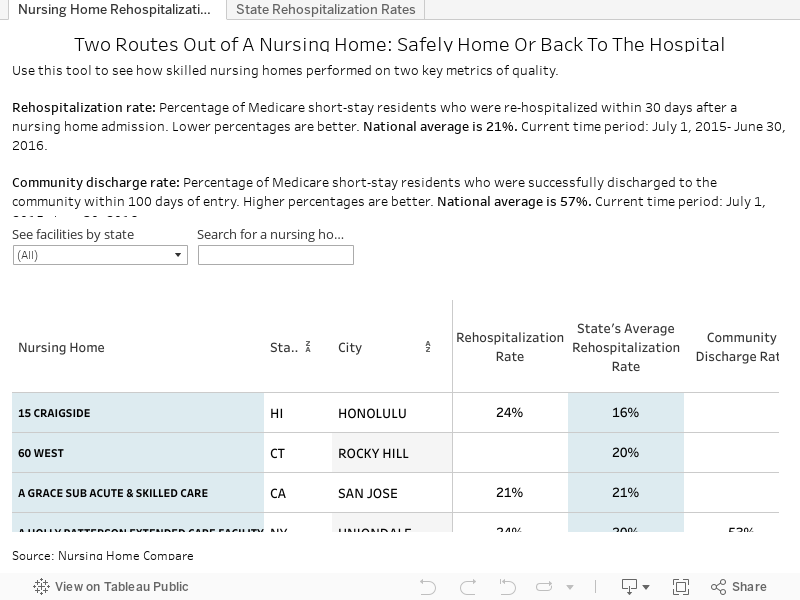
Get The Data
Safely Home Or Back To The Hospital?
Download the data to see how skilled nursing homes in the U.S. performed on two metrics of quality.
Many health policy experts say that spread shows how much improvement
is possible. But patient advocates fear the campaign against
hospitalizing nursing home patients may backfire, especially when
Medicare begins linking readmission rates to its payments.
“We’re always worried the bad nursing homes are going to get the
message ‘Don’t send anyone to the hospital,’” said Tony Chicotel, a
staff attorney at California Advocates for Nursing Home Reform, a
nonprofit based in San Francisco.
Richmond Pines, where Sandra Snipes stayed, has a higher-than-average
rehospitalization rate of 25 percent, according to federal records. But
the family’s lawyer, Kyle Nutt, said the lawsuit claimed the nurses
initially resisted sending Snipes back, insisting she was “just drowsy.”
After Snipes was rehospitalized, her blood thinner was discontinued,
her hip was reset, and she was discharged to a different nursing home,
according to the family’s lawsuit. But her hospital trips were not over:
When she showed signs of recurrent infection, the second home sent her
to yet another hospital, the lawsuit alleged.
Ultimately, the lawsuit claimed that doctors removed her prosthetic
hip and more than a liter of infected blood clots and tissues. Nutt said
if Richmond Pines’ nurses had “caught the over-administration of the
blood thinner right off the bat, we don’t think any of this would have
happened.”
Snipes returned home but was never able to walk again, according to
the lawsuit. Her husband, William, cared for her until she died in 2015,
her daughter, Clark, said.
“She didn’t want to go back into the nursing home,” Clark said. “She was terrified.”
What's not to like? Older adults with disabling conditions get easier access to medical care. Doctors get out of their stuffy offices to make new-age house calls. Nurses hit the road and see what patients really need. Medicare gets the promise of reduced hospital readmissions. Family members get more peace of mind. And most important, seniors get a chance to stay in their homes as long as possible. Home health care in the U.S. comes in many forms. Here are just a few:
Home Field Advantage With today's portable medical technology, physicians who make home visits can do as much or more for patients than primary care clinicians in offices, says Dr. Alan Kronhaus, co-founder and CEO of Doctors Making Housecalls, based in Durham, North Carolina.
His practice uses medical labs that can deploy a phlebotomist to a patient's home to draw blood and send the results electronically to the patient's chart. Imaging technicians can do ultrasounds or X-rays in the comfort of the patient's home.
These aren't everyday patients who get home visits. "For the most part, we're seeing frail, elderly, complex patients with multiple, chronic, active problems and often some degree of cognitive impairment," Kronhaus says.
Many clinical advantages come from seeing patients in their own environment, Kronhaus says, like the ability to manage medications more effectively when the doctor can see exactly what's inside the medicine cabinet. It's also a chance to spot nutritional supplements that patients wouldn't have thought to mention during an office visit.
And it's an opportunity to address diet concerns, Kronhaus adds. "You can look into the refrigerator and see how it's stocked – if you've got a diabetic patient who has banana cream pie." Doctors evaluate the environment as well, he says. "We look for things like steep steps without carpeting, area rugs without nonskid padding underneath, electrical cords that could represent a tripping hazard, poor lighting."
To compensate for the "opportunity costs" of the doctor's transit time, patients pay a direct travel fee of $95 per visit. But, Kronhaus says, other costs are avoided, such as paid time off at work taken by family members to escort patients to the doctor's office, the round-trip cost of a wheelchair-enabled van or, in the worst-case scenario, the cost of transport by ambulance.
Doctors Making Housecalls is participating in Independence at Home, a Medicare shared-savings demonstration project involving a handful of home-based primary health providers throughout the country. The project has been "an unabashed success," Kronhaus says. "We've achieved dramatic savings and very significant improvements in quality of care and patient satisfaction."
Piecing It Together Home health agencies fill a gaping need, but with economic and reimbursement pressures, many are struggling to survive, says Jane Kelly, executive director of the Kansas Home Care Association, a nonprofit trade organization. "There are four agencies out in western Kansas that are trying to serve literally hundreds and hundreds of miles of rural farmlands," she says. "And people can't get services because the agencies can't stay afloat."
With home health care, insurance coverage is often a hurdle. Patients who are not housebound may not be covered, even though getting to medical appointments can be physically challenging and transportation difficult to arrange. There's a high bar for reimbursement, and once a patient shows some improvement, he or she may no longer qualify for home visits. Yet access to skilled nursing, physical therapy and other services at home can prevent costly hospital readmissions and help patients avoid expensive long-term facilities, Kelly says. "Most people want to stay at home as long as they can," she says.
Family members do their best to support ailing parents by assembling a patchwork of skilled and personal services – such as help with toileting, bathing and dressing – through limited insurance coverage and government funding, or by paying out of pocket. "The options are, you piece it together," Kelly says.
On the Road There's a lot of "windshield time" for nurses providing home care in isolated rural areas, says Terri Wahle, a registered nurse and director of home care at Geary Community Hospital in Junction City, Kansas. Wahle's team works with retired farmers and many other patients with often limited means.
For the nurses, Wahle says, a 10-hour workday may include three hours spent on the road, meaning less time to provide much-needed care for chronic conditions such as diabetes, heart failure and chronic obstructive pulmonary disease. Some homebound patients have several conditions.
After a hospital stay, supports at home may be lacking, Wahle says, even though patients' discharge plans say otherwise. "Do they have a bathroom they can get into with the walker?" she asks. "Are they able to fix themselves a meal? Are they able to get any food at all? Are they taking their medications?" These are some of the signs home health nurses look for.
Without regular access to home health care, some elderly or disabled patients can soon find themselves back in the hospital. "One of the things I've taken pride in for the last 30 years in home care is that we try to keep people in their own home for as long as it's safe and it's possible," Wahle says.
Quality Time at Home When doctors or nurse practitioners go to patients' homes to make a thorough geriatric assessment, as part of a Medicare home-visit program, everybody wins, according to a recent study. The system saves money from lower hospital admission rates, and patients are less likely to enter long-term care facilities. With referrals to community providers and health plan resources, these patients tend to receive more follow-up care in the community and have a better chance of aging in place.
One problem with traditional health care, in which patients are only seen on providers' turf, is that health issues are dealt with in isolation, says study author Dr. Soeren Mattke, a senior scientist at RAND Corporation, a nonprofit research organization.
"When they go to the physician, they have maybe 10 minutes' face time," Mattke says. "So what often happens is the conversation focuses on what is the most pressing issue that day. But many other things that also have to be handled really never get any attention." Lingering problems from multiple conditions, while not immediately threatening, can worsen and accumulate, he says.
Comprehensive home assessments help uncover clues to frail seniors' health, Mattke says. Nutritional issues can emerge, for instance, like patients subsisting solely on canned beans. Like others, he remarks on the quantities of expired or discontinued medications patients typically have at home.
"After a while, they really don't know what's what anymore," he says. Invariably, he says, it's the most essential medications that patients stop taking first.
Safe Respite and Handy Help Adult day programs provide respite for family home caregivers so they can return to their responsibilities with energy and spirits restored. "Ninety percent of the people who call us, [it's because] they don't want to put their husband or wife or their mom or their dad in a nursing home or a long-term care facility," says Darlene Turner, director of the West Valley life enrichment program at Benevilla, a provider of adult social care and support services based in Surprise, Arizona.
The situation might be that the husband has dementia and the wife needs a short break. "She would maybe like to go do groceries without having to worry about him, or maybe go get her hair done," Turner says. "Or go have lunch with her friends."
For seniors who attend, these programs improve quality of life, Turner says: "Once they get here, everyone is given an opportunity to have an enriching day, to do things they wouldn't usually do if they were left alone at home." The daily fee for an independent senior is $75, and it's $80 for an individual who requires some staff assistance, Turner says.
Other services, like home-delivered meals, benefit older adults living alone in the community.
Volunteers with Benevilla provide handyman services when needed: changing lightbulbs, replacing air conditioner filters, fixing leaky faucets. "We're actually able to send volunteers to their homes to bring their groceries, to pick them up and take them to doctors' appointments; maybe pick up prescriptions," Turner says. "And that way, they're able to stay in their own environment."