The Maine Monitor spent a year reporting about the state’s probate court system. Here’s why and how we did so.
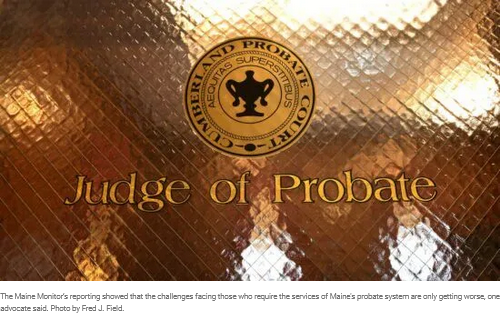
Photo by Fred J. Field.
We spent a year reporting and writing “Maine’s Part-Time Court” to
understand the lives and death of residents in probate court.
Maine’s
16 independent, county-run probate courts are not a part of the state
judicial branch. The probate courts are run by part-time, elected judges
responsible for monitoring the well-being and financial futures of adults and children under guardianship and conservatorship, as well as the estates of the deceased.
Our interest in the probate courts stemmed from two observations.
One, Maine voters passed a constitutional amendment 56 years ago
that would make probate judges full time, but in the five decades since
then, the legislature has not completed the steps necessary to
implement the will of the voters.
Two, we uncovered systemic
problems with other aspects of the state’s courts and justice system,
including the lack of a statewide public defenders office and the
recording of nearly 1,000 confidential attorney-client phone calls in
county jails.
The probate courts are a corner of the state’s
judicial system that has been long overlooked despite serving thousands
of Mainers.
In April, we sent a survey with 18 questions
about staffing levels, the number of guardianships being overseen by
the probate court, and financial reviews of conservators to each probate
court. The Maine Monitor received responses from 10 probate courts,
including Androscoggin, Cumberland, Kennebec, Knox, Lincoln,
Piscataquis, Sagadahoc, Waldo, Washington and York counties.
The survey revealed that many probate courts do not know how many adults are under guardianship, or if those people are alive or dead. And many probate courts do not audit conservators or have a method to detect attempted theft.
We
observed proceedings at the Cumberland County Probate Court in Portland
and Kennebec County Probate Court in Augusta. We also traveled to
Bangor and Brunswick to spend the day with
two women who shared their stories about being under guardianship, and
how the mandate for probate courts to consider a less restrictive
alternative to guardianship known as “supported decision-making”
affected their lives.
Our observations were supplemented with
interviews with 60 people, including probate judges, registers of
probate, guardians, adults under guardianship, lawyers, disability
advocates, family members, state officials, legislators and a former
state Supreme Court associate justice. We also spoke with fraud detection experts
in Florida and Minnesota court systems. We made multiple requests to
interview the leaders of Adult Protective Services in Maine and were
denied each time.
The
Maine Monitor’s reporting showed that the challenges facing those who
require the services of Maine’s probate system are only getting worse,
one advocate said. Photo by Fred J. Field.
To
broaden our understanding of the probate courts, we reviewed hundreds of
pages of online probate court records and dozens of attorney discipline
decisions where the probate court was mentioned. We also read state
studies about financial exploitation of adults, demographics and characteristics of adults who get exploited, and seven decades of government research on ways to overhaul the state’s probate court system.
The
Monitor also made public records requests to the Office of the Chief
Medical Examiner for data about the causes and circumstances of all adults who died under the state’s care of a public guardian between 2018 and May 2023.
We
received an anonymized dataset of more than 200 people. The vast
majority of deaths were deemed natural or accidental. The data revealed,
however, that medical examiners had rarely done examinations of the
deaths of people under public guardianship prior to 2021.
The
attorney general’s office also inadvertently sent the Monitor a
spreadsheet that contained the names of seven people the medical
examiner’s office deemed to have died in “undetermined” ways and one
death medical examiners labeled as a “homicide.”
We read 300 pages of probate court records about the eight individuals;
tracked down living relatives for interviews; contacted assisted living
facilities, veterans homes and private adult foster homes where the
eight had died; asked police about their investigations of the deaths —
often to be told there was none; and interviewed the leader of the
attorney general’s Healthcare Crimes Unit.
Unlike many states,
death certificates are confidential in Maine and can only be accessed by
family members. The attorney general’s office asked the Monitor not to
publish the eight names, but the Monitor decided to publish their full names and details about their deaths
to bring public attention to the state’s secretive system responsible
for the well-being of some of the state’s most vulnerable people.
In response to the Monitor’s reporting, state lawmakers held a
3½-hour public hearing on Oct. 25 about how the state’s guardianship
system operates.
Officials from the probate courts, Maine
Department of Health and Human Services, medical examiner’s office,
attorney general’s office and Disability Rights Maine were asked to come
and speak. The hearing concluded with calls from legislators for more oversight of guardians.
This series “Maine’s Part-Time Court” was supported by a grant from the Fund for Investigative Journalism. The investigation was also made possible by support from Report For America and the Investigative Editing Corps,
which allowed Alan Miller and Mike Wagner to join as project
editors. Samantha Hogan has been a reporter with The Maine Monitor since
June 2019.
Lawmakers and advocates are looking for ways to strengthen oversight within Maine’s probate courts.
State officials have expressed interest in strengthening the probate
courts’ oversight of vulnerable Mainers and preventing elder abuse,
after an investigation by The Maine Monitor this year revealed gaps in
how these courts monitor guardians, conservators and estates.
Some lawmakers and advocates for aging Mainers and people with disabilities reacted with alarm
this year when a Maine Monitor investigation uncovered systemic
problems with the state’s 16 independent, county-run probate courts.
The issues plaguing Maine’s probate courts have been studied for more than five decades.
“The
time for study is over and a lasting systemic solution is overdue,”
said Jaye Martin, executive director of a Maine legal aid nonprofit,
Legal Services for the Elderly. “This is a complex arena but it is vital
to the well-being of many, and we need to get it right.”
Martin said lawmakers should adopt the nearly unanimous recommendations of a state study group
— the Commission to Create a Plan to Incorporate the Probate Courts
into the Judicial Branch — that in 2021 proposed making the probate
courts a part of the state judicial branch, selecting probate judges
with the same standards as the rest of the state’s judges, and providing
money for lawyers, guardian ad litem (to represent those not capable of
representing themselves in lawsuits) and visitors throughout the court
process.
The probate courts are unique and have the state’s only
elected and part-time judges. They are also separate from the judicial
branch.
The Monitor’s reporting this year showed that “the
challenges facing those who require the services of our probate system
are only getting worse,” Martin said.
Gov. Janet Mills is open to
ideas that would strengthen protections for people served by the
probate courts, according to her spokesman, Ben Goodman. But Mills did
not commit to specific reforms.
Her most recent budget included
$4 million to reduce abuse, neglect and exploitation of older Mainers
and people with disabilities by adding employees to Adult Protective
Services, and supporting free legal aid services through Legal Services
for the Elderly, among other investments.
“The governor welcomes
collaboration with partners and the legislature to examine ways –
including through the budget — that we can continue to strengthen both
public and private efforts to prevent and effectively respond to elder
abuse,” Goodman wrote.
•
Probate courts only recently began keeping track of guardianships.
Several do not know how many people are under guardianship in their
county, or if these adults are alive or dead.
• Eight adults under public guardianship and in the state’s care died in unexplained ways
in the past three years. One woman’s death was deemed a homicide by
state medical examiners, but the attorney general’s office declined to
prosecute her case.
• The Maine Department of Health and Human Services has failed to follow
a state law for 26 years that requires it to report all deaths of
people under public guardianship to lawmakers on the Health and Human
Services Committee.
• No probate court or state entity tracks the probate courts’ use of a less restrictive alternative to guardianship, known as “supported decision-making,” and it is an option that probate judges infrequently use.
• Many probate courts do not audit the financial records submitted once a year by conservators, leaving these adults vulnerable to financial exploitation or theft.
• A constitutional amendment
was passed by Maine voters 56 years ago that said probate courts should
be overhauled and assigned full-time judges, but lawmakers did not take
action to make that happen.
No state lawmaker has announced an
intent in 2024 to push for the enactment of the mandate from voters to
make probate judges full-time.
Deirdre Smith, a University of
Maine professor of law, said overhauling the probate courts to create a
statewide probate system, rather than 16 independent county courts,
would be the most significant judicial reform the state could do.
And because voters passed the constitutional amendment, change is required, not optional, she said.
“The
people of Maine spoke in 1967 and I don’t think the legislature can
just disregard that. I think that is a total dereliction of their duty,”
Smith said. “The voters of Maine gave an order, a mandate, to the
legislature, which is to come up with a different probate court system
that has full-time judges.”
Smith said the best and most
efficient way to do that was outlined by the 2021 study commission,
which included input from probate judges, registers, advocates and
lawmakers.
“There’s room for the legislature to tighten things up
and make more sense out of the flaws that they may perceive with the
probate system,” Sagadahoc County Probate Judge David Paris told the
Monitor.
Paris said he is opposed to making the probate courts
part of the Maine judicial system, but that changes to state law would
set consistent standards across the 16 probate courts.
Legislators
could require the probate courts to complete criminal background checks
of prospective guardians and conservators, Paris said. They could also
change state law so that conservators are required to file an accounting
of assets twice a year, rather than annually, so the probate judges and
office staff can keep better track of how the money of a person under
conservatorship is being spent, he said.
The probate courts also
could consider expanding the role of court-appointed “visitors” to check
on people under guardianship more frequently, he said.
Paris said he did not think Maine needed to hire auditors like the Minnesota Judicial Branch, which more than a decade ago launched a conservator auditing team to do in-depth financial reviews.
“We
do take out our calculators. We do look through the expenses, and if
something raises a question we’ll pursue it,” Paris said.
Thomas
Marshall, 72, a Rockland resident who reached out after reading the
Monitor’s series, said volunteers may be another way for Maine to put
extra eyes on conservators and guardians.
Prior to moving to
Maine, Marshall lived in New Jersey and volunteered around six hours a
week reviewing financial statements and narratives submitted to the
court by guardians mostly for adults with intellectual or developmental
disabilities. He looked for changes in expenses or fees being charged by
lawyers or family members serving as guardians, and concerning cases
were sent to a court-employed investigator.
“It provided
consistency of oversight for everyone. Whether it was court-appointed
attorneys, family attorneys or family itself, the oversight of what was
happening to these people and their assets … was consistent across the
board,” Marshall said.
Calls to modernize guardianship
State
lawmakers and people with disabilities have said they would like to see
improvements in how probate courts will monitor guardians.
Cindy
Thielen, 31, was diagnosed with autism and under the guardianship of
her mother for 11 years before successfully petitioning the probate
court to terminate the arrangement, the Monitor reported.
Based
on her experience, Thielen said probate judges need to follow the law
and consider supported decision-making before guardianship.
“Supported
decision-making” is a nationally recognized tool used by those with
disabilities to help them assess the consequences of big and small
decisions. Maine laws that went into effect in late 2019 require probate
judges to consider this alternative before appointing a guardian.
“I’ve
known a couple people who are under guardianship where it was the best
thing to do at the time based on their disabilities, but I would love to
see them have the chance to thrive under supported decision-making
someday,” Thielen said.
Thielen said state lawmakers need to
modernize how the probate courts keep track of people under guardianship
and what is going on in their lives, she said.
Thielen was not
appointed an attorney to advocate for her when her mom filed a petition
for guardianship in the Hancock County Probate Court in 2011, when
Thielen was 19. Thielen was appointed a lawyer for the first time after
asking the probate court in 2015 to terminate the guardianship.
“Hiring more people and giving people representation right from the get-go would be a great start,” Thielen said.
Adults
subject to a guardianship petition are advised by the court that they
have the right to hire a lawyer to defend them in probate court, but
also are told that the cost of a lawyer may come out of their own
pockets. Probate judges can waive those fees, the Monitor reported.
All
10 probate courts that responded to a Monitor survey earlier this year
said judges will assign an attorney if the person opposes a
guardianship.
A state bill proposed in 2019 would have required
lawyers for all adult guardianship cases. Probate judges were among the
stakeholders to object, in part because of the added cost to county
budgets. The bill did not pass.
Thielen said Maine lawmakers
should also create a way for people to report if something has gone
wrong to a person under guardianship. She pointed to the audit and fraud
detection programs used by the courts in Florida and Minnesota that
were featured in a recent Monitor article.
Lacking prosecutorial manpower
In one example after another, the Monitor found
that the life savings of Mainers were spent down by conservators, taken
by family members, or sometimes redirected in wills to once-trusted
lawyers for their personal gain in the probate courts.
Financial exploitation of older Mainers is the third-most common allegation investigated by Adult Protective Services, a recent state study showed. But Maine has limited prosecutorial resources to pursue these kinds of theft cases.
The
state attorney general’s office employs one prosecutor and one
investigator for elder fraud. None of the eight district attorney
offices employ a prosecutor whose work is exclusively devoted to elder
fraud cases, according to Kathryn Slattery, the district attorney for
York County, in a statement on behalf of the Maine Prosecutors’
Association.
“Although we would like to do so, we simply do not
have the personnel or resources necessary to meet our current
obligations,” Slattery wrote.
Dedicated elder fraud prosecutors in each district attorney’s office was a top priority recommendation in a December 2021 report
about elder issues, which was supposed to be Maine’s “road map” to
preventing exploitation and abuse of the state’s aging population.
This year the prosecutors’ association asked the legislature
to fund 10 additional prosecutor positions across the state to keep up
with current workloads in the recovery courts, specialty dockets and
diversion programs. The request is sitting on the state’s appropriations
table.
R.
Christopher Almy, the district attorney for Penobscot and Piscataquis
counties, said even if an additional prosecutor was added to his office,
the prosecutor would not be dedicated to elder crimes. Instead,
prosecutors need to be jacks of all trades to work through the 5,000 to
6,000 cases the office manages each year with 10 or 11 people.
“There’s
no way we would be able to do that. We’re inundated with cases. We
don’t have enough people to take that sole responsibility. That would be
impossible. There aren’t that many cases anyway,” Almy said.
Police
departments report only a few cases to his office each year where an
older Mainer has been defrauded, Almy said. Often the charge would be
theft, which makes it difficult for the district attorney offices to say
how many elder fraud cases they pursue each year, he said.
Plus, prosecutors can only go to court when they have enough evidence to prove a crime beyond a reasonable doubt, Almy said.
“The
problem with it is we have to have witnesses. And if we don’t have
witnesses that are able to testify, you’ve got your foot in the bucket,”
Almy said.
The Maine attorney general’s office asked to add a
forensic auditor position in the last state budget, but lawmakers did
not approve funding, wrote agency spokeswoman Danna Hayes.
Since
2020, the attorney general’s office has filed charges in six cases
involving elder fraud. The cases run the gamut from home contractors who
scammed elderly clients for work that was never completed, all the way
up to manslaughter.
Jul. 23—PETOSKEY — A Harbor Springs man
defrauded in 2020 by a court-appointed conservator — who spent $14,000
on lingerie, electronic cigarettes and cash withdrawals — has lost faith
in a system he says missed opportunities to get his money back.
"She
outsmarted the court and she's still doing it," said George Pappas, 97,
a widower and World War II veteran. "I try to support the courts, but
they have done nothing for me."
Pappas in the fall of 2020
approached the Veterans Administration about getting temporary help to
get his car fixed, make dental appointments, and organize his finances,
after his wife, Geneva Pappas, died a few months prior.
An Emmet
County Probate Court judge appointed Elise Page, 42, as his conservator.
At that time, Pappas said, he wasn't sure what a conservator was — or
what authority that person would have over his money.
"I know what they are now," he said. "I know they can do whatever they want and nobody's watching 'em do it."
Michigan's
Estate and Protected Individuals Code provides for conservators to be
appointed when a court determines a person can no longer handle their
own finances; a guardian is similarly appointed to make medical and
housing decisions.
These judicial decisions are meant to protect a
person's money, health, home, or all three, and many guardians and
conservators — who can be family members or professionals — serve
without ever running afoul of the law.
But when things go awry, as
they did in Pappas' case, victims have little recourse and a criminal
prosecution is no guarantee they'll be made whole.
Record-Eagle
reporters in August 2021 first began examining records in a dozen
Michigan probate courts. They found a steady stream of worrisome stories
ranging from family isolation to outright theft.
In Pappas' case,
for example, records show Page told a police investigator on Dec. 14,
2020, that she had enough money in her personal checking account to pay
Pappas back.
"In that statement she wrote all charges to Pappas'
account were hers and she was going to provide two cashiers checks to
cover the amounts," Harbor Springs Police Chief Kyle Knight wrote in a
report.
That never happened.
Instead, Page stopped
responding to calls and texts from police and was charged by an Emmet
County prosecutor with felony embezzlement, embezzling from a vulnerable
adult and using a computer to commit a crime.
On July 26, 2021,
she pleaded guilty to a single count of embezzlement, served five months
in jail, sentenced to two years' probation and ordered to pay full
restitution to Pappas, plus court fees and costs.
Court records
and email correspondence show that, since then, Page has paid $300 in
court costs, a $130 crime-victim-rights fee, and is expected to pay the
$60 DNA specimen fee and the $68 in state minimum costs, prior to her
scheduled release from probation later this month.
The $2,500
Pappas was received from the Victim Rights Fund, however, and $13,400 of
the $14,300 restitution she still owes him, remains unpaid, court
records show.
Adding to Pappas' frustration, he said, is something
else he's since learned about Michigan laws surrounding probate court
procedure — judges have discretion over whether to require the
conservators they appoint to be bonded.
A surety bond ensures a
protected individual will receive compensation for financial harm if the
conservator steals their money or defrauds them out of valuables or
property.
When Judge Valerie Snyder appointed Page to be Pappas'
conservator, records show she hand-wrote a note on the petition: "Bond
will be considered after inventory is filed."
Conservators have 56 days to file an "inventory," which is essentially an accounting of a person's estate.
Bank
records show it took Page just 39 days to spend $13,915.47 of Pappas'
money — it was gone before any inventory was ever filed or required.
"I've
talked with the court, I've emailed the prosecutor's office, I've sent a
package of information about George to the attorney general's office
and I've called politicians," said Matthew Bush, the service coordinator
at The Village of Hillside, a low-income senior apartment where Pappas
lives.
"No one seems to know how to hold these people accountable."
Pappas
and Bush, an ally, have reached out to a variety of officials for help —
including an assistant prosecutor with the Emmet County Prosecutor's
office.
An email response shows they were told their best bet would be to hire a civil attorney who could garnish Page's wages.
"I
know this isn't a great answer for Mr. Pappas, but the courts are
prohibited from putting people in jail simply due to unpaid money and
the probation department intends to end her probation, at which time the
criminal case will be completely concluded," Mike Schuitema, an
assistant county prosecutor, said in a July 7 email to Bush.
"The
only avenues left will be through private attorneys putting garnishments
on her wages or liens on her property," Schuitema said.
Neither
state Attorney General Dana Nessel, who launched an Elder Abuse Task
Force in 2019, nor the state Legislature, where bills on reforming
portions of the conservatorship and guardianship system languish in
committee, have provided a solution.
Staff attorneys with Nessel's
office have actively prosecuted dozens of embezzlement cases where the
victim is elderly and the accused theft large.
For example, Lisa
Lundy, 52, of Macomb, was charged last year with more than a dozen
felonies, one of which was conducting a criminal enterprise, in the
theft of money from vulnerable adults her company, Community Guardian
Care, was appointed to serve.
On July 10, Constance Marie Roberts,
66, of Flint, was charged with four counts of embezzlement of $100,000
or more from a vulnerable adult, and four counts of failing to file
taxes. Roberts is accused of taking large sums of money and multiple
vehicles from her husband after he began showing signs of cognitive
decline.
And on June 7, David P. Sutherland, a Wayne County
attorney, was bound over for trial on accusations he embezzled millions
from the trust accounts of two elderly clients who had designated some
of their funds for charity.
But it remains unclear how much, if any, of these funds will be recovered for the victims or their families.
And
proposed legislation targeting reform in how conservators and guardians
are appointed and monitored so far does not address how to enforce
those collections.
Pappas said it has not been easy publicly
sharing the details of his finances and his court struggles, but he did
so in an effort to spare others from what he has experienced.
"I go to bed at night, and I can't clear my mind," Pappas said. "I've lost hope in the system."
Funny business in Florence County … and possibly beyond.
by Jenn Wood
Dana Hanna chuckled in 2017 when her mother-in-law, Georgia “Jo” Hanna,
asked her for $2.00 for a hot dog. Jo told Dana her debit card wasn’t
working, and Dana assumed she was using the wrong card as she was known
to do sometimes. Dana wasn’t concerned because Jo had substantial assets
and things like that happened from time to time. She told her husband, Craig Hanna, who hopped in his car and drove to Jo’s house to ease her mind.
Craig didn’t realize at the time that what he as about to uncover
would initiate a years-long legal battle to protect his mother – a
battle that continues to this day.
Jo had been married to Carlos M. Hanna
for 44 years when he died on December 14, 2010 — the same year the
estate tax briefly expired. Carlos and Jo had two sons — Brad and Craig
(Dana’s husband) — and a successful business in Florence County. Carlos
founded Coastal Sanitary Supply
in Florence in 1969. The business supplied half of South Carolina with
janitorial supplies and sanitation equipment – including public entities
such as jails, courts and school districts.
In 2004, Carlos underwent a successful heart transplant – after which
he recovered and returned to running his business. On December 14,
2010, Carlos took his medicines and started seizing, vomiting, and
having diarrhea. Jo called her son, Craig, and informed him he needed to
come over immediately as something was wrong.
When Craig arrived, his father died in his arms.
Carlos was a planner. He left behind detailed wills and trusts created byGary Crawford,
a Florence-based estate planning attorney. Crawford died by suicide on
March 19, 2023 – shooting himself in the head in his car, which was
parked outside of his law office. We’ll share more of Crawford’s story
in a moment, but first let’s get back to the Hannas.
Per Carlos Hanna’s instructions, Crawford prepared two documents …
A last will and testament which, at the time of his death, decreed
that everything he owned would go to his wife – Georgia “Jo” Hanna. It
listed her as the personal representative of his estate.
“Trust B,” which decreed that if Jo were unable to run the family
business in the same capacity as Carlos did when he was alive, it would
be placed into a trust to be managed by their sons, Craig and Bradley.
This trust would pay Jo’s living expenses through her sons – and with Jo
receiving Carlos’ salary. (Craig says his father knew that Jo – who
spent forty years as a nurse – had no interest in running the business,
so the trust was obviously the document to be followed).
The Hanna assets were significant. In addition to Coastal Sanitary
Supply, the estate included a Florence residence, a vacation home,
commercial properties, farm, timber, boats, vehicles, and commercial
leases which brought in rental income. Carlos also had stocks, bonds,
and life insurance. Dana wasn’t concerned on her drive over to Jo’s
house, but when she arrived and pulled up her mother-in-law’s accounts,
she quickly realized something was wrong.
Dana informed her husband, Craig, and when he began researching
further he discovered his brother, Brad, had allegedly taken Jo Hanna to
meet with Crawford – and had him transfer all of her assets to him for $5.00.
All of this happened without any notice to Craig …
In 2018, without Craig knowing, Jo Hanna was diagnosed with
Alzheimer’s and Brad Hanna petitioned the Florence County probate court
have her declared as incapacitated. That petition was approved by
Florence County probate judge, J. Munford Scott.
A sheriff’s deputy served Jo Hanna with a notice of the hearing to
declare her incapacitated. In an effort to protect her, Craig petitioned
to obtain guardianship of his mother to ensure her health and safety
were being monitored as his brother and his wife only saw her a couple
times a year.
When this petition was approved, he gained access to Jo Hanna’s
medical records. Upon reviewing those records, he discovered a 2017
document which revealed that Brad’s wife – Cassie Powers Hanna,
a pharmacy doctor – had taken Jo in for a neuropsychology evaluation
that same year. The evaluation indicated Cassie had concerns about Jo’s
cognitive skills going as far back as 2012 – prior to her signing her assets over to Brad for $5.00.
While Craig was relieved he could now ensure his mother’s health and
well-being, the guardianship didn’t give him any money for this purpose.
At same time Craig petitioned to be his mother’s guardian, he also
requested a third-party conservator be appointed to oversee what
remained of his mother’s finances. The judge immediately granted Craig’s
guardianship request, but held back on the decision regarding the
conservatorship for few months.
Florence County, S.C. court house (Will Folks/ FITSNews)
Shortly before he retired, judge Scott quietly appointed Bradley
Hanna to serve as the conservator for Jo Hanna. This decision placed one
brother in charge of Jo’s health and safety – and the other in charge
of her finances.
Upon learning his father’s probate estate was still open from 2010,
Craig sought to be appointed as a successor to the personal
representative of Carlos Hanna’s estate. That was done so he could
attempt to close the estate file which had remained open. On November
16, 2022, his petition to be appointed in this role was approved by
Florence County probate judge Jesse Cartrette.
Craig went to the Florence County probate court and pulled his
father’s file. It soon became readily apparent why he wasn’t receiving
any information concerning the estate. The address Crawford’s office
listed for him on the “notification to heirs and devisees” was
incorrect. When he dug deeper into this address, he realized it didn’t
even exist. For years every notification regarding his father’s estate
had been sent to an address that never existed — leaving him unaware
that everything in the estate was being fraudulently transferred,
allegedly, by Craig’s brother and his attorney, Gary Crawford.
On February 7, 2023 – four-and-a-half months ago – a letter was
submitted by judge Cartrette indicating his prior approval of Craig as
successor had been in error due to a conflict of interest. Cartrette
recused himself and recommended the case be transferred out of Florence
County owing to the conflict. Jo Hanna’s guardianship and
conservatorship case had already been transferred to Darlington County probate court under judge Marvin Lawson and Carlos’ estate was transferred by order of the S.C. Administrative Law Court (SCALC) and S.C. chief justice Donald Beatty to Georgetown County probate court.
Lawson made some interesting moves in Jo’s case – appointing Darlington County treasurer Jeff Robinson to serve as her conservator and S.C. state representative Cody Mitchell to
serve as her guardian. This removed her son and strongest advocate,
Craig Hanna, from his role. It also erected significant roadblocks for
Craig if he hoped to continue advocating for her and protecting her
assets moving forward.
As all of this was unfolding, Craig contacted Gary Crawford’s law
office to obtain the files for his father’s estate. When he learned of
Crawford’s death by suicide, he grew even more concerned. Crawford’s law
firm changed its online status to “permanently closed,” and his office
staff told Craig they would have to get back to him regarding his
request.
He has yet to receive a return call – or any of the files he requested.
Back to Crawford: Every licensed attorney in South Carolina is required by law to have a clear plan of succession
in place detailing what is to happen in the event of their death or
disability. Successor attorneys identified on each lawyer’s annual
license fee statement. Gary Crawford was no exception – listing Brown Johnson
of Florence as his successor. According to a notice on Facebook,
though, Johnson’s entire law firm resigned on May 18, 2023 – this past
Thursday – further complicating things for former clients of Gary
Crawford, many of whom are still trying to obtain their files from his
office.
Craig Hanna recently hired a new attorney – Tucker Player
of Columbia, S.C. Last week, Player issued subpoenas to Gary Crawford’s
office on behalf of a number of clients attempting to obtain their case
files. According to Player, his process server was surprised when
Crawford’s wife, Becky Crawford – his longtime office manager and paralegal – refused service.
Last week, Player filed a motion in Darlington County probate court
to vacate an order issued by judge Lawson allowing for the sale of Jo
Hanna’s primary residence. This motion detailed some aspects of what
many believe to be a broader scheme to defraud multiple victims. Jo’s
primary residence, a stately brick home in Florence on a beautiful
tree-lined street in a prestigious neighborhood, was approved for sale
by judge Lawson. According to Player’s motion, though, Lawson “issued an
unconstitutional and illegal order providing for the sale of the most
valuable tangible asset of (Jo) Hanna without providing any notice or
opportunity to be heard to the parties in this action.”
Attached to Player’s motion was a letter from Charles Ipock – an attorney with the Haynesworth Sinkler Boyd law firm – requesting judge Lawson’s order be issued “without notice, as allowed under the South Carolina Probate Court.”
Wait … what?Such lack of notification is permitted under state law?
When Player examined the statutes cited in the order, he realized one
did not exist and the other “specifically prohibits” such notices.
According to Player, without required notice to the parties in this case
the court had no legal right to issue its order.
Player noted Lawson’s order was issued on April 18, 2023 – just hours
after Craig Hanna appeared at a judicial reform press conference at the
S.C. State House with solicitor David Pascoe. While at the press conference, Hanna saw his former attorney – S.C. senator Gerald Malloy
– and his mother’s guardian, representative Cody Mitchell, numerous
times in passing. Neither made any attempt to speak with him or
acknowledge him, according to Craig, which he thought was bizarre.
According to Player, “the motion to sell Georgia Hanna’s real estate,
and its accompanying correspondence requesting the petition be granted
without notifying any other party, was mailed to this court on the exact
same day. Unless the United States Mail Service has developed
instantaneous transporters, the motion could not have reached this Court
until April 19, 2023. This court received the motion, considered the
motion, drafted an order granting the motion, and filed the Order within
24 hours of receipt.”
Lawson’s order allowed for the sale of Jo Hanna’s home with zero
notice to the parties with interests in that real estate. Player said in
his quarter century of practicing law, he has never seen an
order issued in this manner as even “first year law students are aware
of the Due Process clause of the United States Constitution and its
fundamental requirement of notice.”
Home of Jo Hanna. (Provided).
Player further noted there is nothing in the file to justify the
sales price of the home other than “an approved but an unsworn hearsay
statement from some realtor.”
“There is no appraisal, no repair estimate, no pictures, no
testimony, nothing that is required of an acting fiduciary to dispose of
property owned by another.”
The sale of this property leaves Jo Hanna with only one asset remaining in her name – her cemetery plot. To date, over $20 million worth of assets have reportedly been transferred from her estate.
Among the questions the Hannas and their attorneys are hoping to answer: Why
are motions and orders being issued with an ostensibly concerted effort
to avoid all parties knowing about the sale of these properties? Who is
benefiting from these property transfers? And was the sudden death by
suicide of Gary Crawford tied to any of these actions?
And perhaps the biggest question of them all: Are there other cases like this one?
This news outlet has been told to expect a motion early next week
which will answer many of these questions – and likely rock the already
scandal-scarred South Carolina legal community to its core.
In the meantime, I would remind everyone reading this article that
FITSNews has an open microphone policy – one which encourages any
individuals named in our reports to address our audience directly. (Click to continue reading)
Guardianship service boards allow probate courts to transition from an
individualized attorney-based system to a social services format shared
among community partners.
What started as an effort by one judge and one local court to help
some of the most vulnerable people in its jurisdiction has evolved into
a growing Ohio initiative.
Seven years after Franklin County Probate Court
– with the assistance of community partners – created a program to
address concerns about citizens unable to take care of or make
decisions for themselves, the idea has expanded to other counties.
“Having a fresh, new idea and seeing it put into place, it’s why you
get into public service,” said former probate Judge Robert Montgomery,
who used his pilot project to craft a state law for other courts to use as a model.
Franklin County – followed by Fairfield, Union, Lucas, Allen,
and Delaware counties – have created guardianship service boards.
These entities are comprised of partnerships among local courts; county
commissioners; alcohol, drug, and mental health (ADAMH) boards; boards
for the developmentally disabled; healthcare providers; and social
service organizations.
The idea was to create a centralized operation among all
stakeholders involved in these types of cases, transitioning from an
attorney-based system to a social services format.
Instead of a lawyer individually handling all legal and personal
affairs for a client – known as wards – the board acts collectively to
address issues.
Boards consist of multiple factions allowing each component to serve
to their strengths while assisting individuals in one streamlined way.
An operations side focuses on funding and fiscal responsibilities
while treatment teams handle the physical, mental, and emotional
well-being of wards. Legal representatives manage court-related
concerns.
Boards enable a larger network to identify people who can benefit
from the services and incorporate them earlier into a holistic program.
Rather than having a probate court determining who is a ward, any
person within the board can recognize someone in need of help and
nominate the at-risk person to the program.
“We had a little bit of discomfort with our old model. It had its limitations,” said Fairfield County Juvenile and Probate Magistrate Troy Sitzmann about the need for the guardianship service board, which he helped start two years ago.
Shortly after taking the bench in 2014, Judge Montgomery was
informed about the issues surrounding those with substantial mental
health impairments and the developmentally disabled.
Under the law at that time, unless there was a relative or loved
one capable of representing people who local courts deem incompetent,
these wards would be appointed an attorney.
Fewer and fewer lawyers were willing or able to bear the
responsibility, leading to the remaining practitioners caring for
hundreds of wards.
On top of legal matters, court-appointed attorneys also were
responsible for their clients’ daily life decisions – such as
residential and health care matters – akin to what a social worker
does.
“You don't necessarily go to law school to learn how to take care of or support people,” said Allen County Probate Judge Todd Kohlrieser.
Knowing the system needed changes, Judge Montgomery began drafting revisions to the statutes with the assistance of the Ohio Legislative Service Commission. The changes to establish guardianship service boards were enacted in 2019.
The idea was to give probate courts parameters to follow as part of a
standardized process in creating a county or multicounty guardianship
services fund.
Some of the specifications list how the programs are subsidized and
what boards can finance – staff, equipment, training. Other details
describe who can represent a board, including appointed representatives
from the probate court as well as local ADAMH and boards for the
developmentally disabled.
The expansion in guardianship programs pairs with the improved care that has resulted for the people they serve.
Fairfield County, which handles more than 100 guardianship cases at a
given time, has tripled the contact hours provided to its wards since
the inception of its board.
Sitzmann said the increase in time is surpassed by the “quality of time” that can now be devoted to their clients
Recently, Judge Montgomery’s modernization of this aspect of the
justice system resulted in recognition beyond Ohio’s borders. At last
month’s National College of Probate Judges winter conference, Montgomery was given the organization’s annual award, which honors a judge’s efforts to innovate guardianship laws.
“To me, the biggest reward is providing justice for those who have
trouble attaining it,” he said. “These service boards will benefit
wards and their families for many years to come.”
This came in July 2021 after her former court-appointed attorney, Samuel D. Ingham III, resigned.
He was one of many connected to the case who abruptly distanced
themselves amidst growing heat from a movement of fans as the "Free
Britney" movement garnered the spotlight of media attention.
Spears was quick to select Mathew S. Rosengart, a former federal
prosecutor turned prominent Los Angeles attorney. Since enlisting
Rosengart in her corner, Spears' life has changed drastically with her father's removal as conservator
of estate, an engagement to longtime boyfriend Sam Asghari and Spears'
increasingly using her own voice and denouncing the conservatorship.
It's something that seems like a basic right for anyone, let alone a
superstar, being able to choose your own legal counsel — someone who
will stand for you and you alone.
"Ethically and by law, you are supposed to advocate for the expressed
wishes of your client," said Thomas F. Coleman, an attorney as well as
Executive & Legal Director of Spectrum Institute, an organization dedicated to conservatorship reform.
The right to counsel is part of the United States Constitution, as
due process protects the right to choose your own attorney. It's also
written in California's probate code, the regulations that guide
conservatorship proceedings.
Yet, despite being a basic right, ABC10's nearly two-year and ongoing
investigation into conservatorships found that the right to choose your
counsel, and even have counsel, doesn't always happen in many
conservatorship cases across California.
"I think sometimes it happens because the attorney that the person
brings in to represent them isn't part of the 'good old boys' network...
isn't part of the system," Coleman said. "And so the judge is thinking,
'Oh boy, this attorney is going to make waves.'"
Making waves in court could mean a number of things, including
demanding hearings and/or demanding jury trials. All of those take time,
something that judges don't have.
Probate courts throughout California are overloaded. Conservatorship
petitions are often cycled through, being appointed and taking away
someone's rights, in just minutes.
"The best way to make them go away is to have the attorneys surrender
the rights, rubber stamp it, feed them into a conservatorship and go on
to the next case," Coleman said.
But on Jan. 1, 2022, this process should change.
"Governor Newsom has just signed AB 1194
[which] deals with conservatorship reform. Part of that deals with
attorney reform," Coleman said. "It requires judges to allow the person
to have the attorney of their choice. No ifs, ands or buts."
Some individuals who may be placed under a conservatorship sometimes
lack the money or mental capacity to hire their own attorney. AB 1194
would change that, too.
"The next thing it says (is) if the person doesn't have an attorney
of their choice, the court must appoint an attorney," Coleman said,
adding prior to this, it was "discretionary" courts appoint an attorney,
despite being written into the probate code.
It's one of the many things the conservatorship bill aims at
reforming. Other changes include creating communication between courts
and the Professional Fiduciary Bureau, the only state-agency entrusted
in overseeing fiduciaries — including ones that serve as conservators.
The bill will also require more transparency, like requiring more
specific data on the number of conservatorships statewide to be
reported. And more requirements will be demanded from court
investigators, like talking to first-degree family members prior to the
appointment of a conservatorship.
But it's not the first piece of legislation that has made an attempt
to create change in this multi-billion dollar industry that controls the
lives and money of others.
In 2007, a reform act was passed in California, and was nearly identical in many ways to AB 1194,
but failed to change anything. Additionally, multiple former court
investigators who spoke with ABC10 for our initial Price of Care
investigation said the reform act put too many additional
responsibilities on investigators making their jobs more difficult and
allowed conservatorship cases to slip through the cracks.
And changes haven't been attempted to this system only in California. In fact, the American Bar Association said since 2011, U.S. states have enacted approximately 343 adult guardianship bills.
But issues continue to arise, something that has been spotlighted by
Spears and the movement behind her, educating many for the first time on
what exactly conservatorships are and how powerful they can be.
"I must confess, this issue was put back onto our radar when the Free
Britney documentary was released," Assemblymember Evan Low said when
presenting his bill, AB 1194, to the California Assembly Business and
Professions Committee, a committee tasked with overseeing the
Professional Fiduciary Bureau.
Low went on to say after conducting their own research on
conservatorship laws, his office found the 2007 reform effort did not
create change due to the "toxic economic recession that started in
2008."
When asked how his bill, AB 1194, would implement the needed change
to this system, Low said, "As part of the legislative proposals that we
have too is ensuring we have the policies that are supported and making
sure the resources to empower local communities to implement the law."
For other activists, they believe it's a step in the right direction, but the first of many needed.
"There's no magic wand approach. It's not instant reform," Coleman
said. "AB 1194 is a tool that's going to help those of us that are
committed to this reform keep pushing, step by step."
A new law in Ohio is designed in part to protect people with guardians.
House Bill 595,
sponsored by state Reps. Robert Cupp and Jeff Rezabek and signed into
law Dec. 21 by outgoing Gov. John Kasich, among other things allows
county probate courts to establish adult guardianship services boards
and funds to provide for the oversight of services and care for those
under guardianship.
It unanimously passed in the Ohio House and Senate.
“Cutting red tape for county courts to work together to provide
services to individuals under guardianship could save time, money for
the individual, their families/caregivers, and the state,” AARP State
Director Barbara A. Sykes said in a statement. “Additionally, when state
courts work together on such cases, they could not only be more
efficient and effective, but they could also potentially detect signs of
abuse and exploitation earlier in the legal process.”
AUGUSTA — Fifty years ago, the voters of Maine approved a constitutional amendment that repealed their historic right to elect probate judges in each county.
But the referendum didn’t actually set a date for when that would happen. It was supposed to take place when the Legislature worked out how to create a new probate court system with full-time judges.
Since they never have, the system that’s been around since 1855 remains in place, a relic that puts a little extra income in the pocket of 16 part-time lawyers who serve as county judges, each in charge of probate cases within a single county.
It’s possible that lawmakers may get around to making the long-promised change before too much longer. Bills that would get the ball rolling are creeping ever closer to final passage.
They would create a commission that would offer a plan for the new court system next year and install judges who would devote all of their attention to probate cases.
To be fair, it’s not as if legislators never tried. They’ve eyed all sorts of possibilities in the past half-century that would do the job. They just haven’t actually endorsed any of them.
“Study after study has suggested we change the system. Let's finally give it the attention it deserves,” Sen. Roger Katz, R-Augusta, said.
While Maine dithered, the rest of New England, which once had the same kind of independent probate courts overseen by part-time judges who often practice law on the side, has pulled off the makeover.
“Maine remains an outlier, with no benefits to its citizens from maintaining such position. Each year that passes makes the need for comprehensive reform more urgent,” said Deirdre Smith, a faculty member of the University of Maine School of Law and the director of its legal aid clinic.
Probate courts, which don’t have juries, deal with estates, adoptions, name changes, guardianship issues and proceedings aimed at protecting minors. Much of what they do is out of the public’s eye and successful judges are often at least as adept at dealing with clashing personalities as they are at interpreting arcane legal points.
The proposal, which both the House and Senate have endorsed, would create a 15-member commission “to create a plan for a more efficient and effective probate court system” that “will ensure, timely, convenient and meaningful access to justice.”
Katz said Maine’s regular judiciary works fine.
“I don't think we can say the same thing about the probate court system,” he told colleagues. “It doesn't look good on paper and, although it usually works well, that is not always the case.”
“To me, the heart of the problem is twofold: First, we elect probate judges who serve only part time, and secondly, we allow them to appear as private attorneys in Maine courts and probate courts outside of their own county,” Katz said.
He also said that if the state designed a system from scratch, it would never have elections for judges. “It is a system absolutely ripe for abuse,” Katz said, with inevitable complications for both winners and losers in contested races.
Besides, he said, “The idea of a partisan probate judge makes little sense in the 21st century. What is the Republican position on how to handle a contested guardianship? I have no idea.”
Katz also called it “a lousy system” to allow probate judges to practice law on the side “and even appear in probate courts in other counties as a private attorney, arguing cases in front of their fellow judges.”
It’s not hard to come up with scenarios where conflicts of interest may abound as judges, who are also private attorneys, vie with one another in one court while sitting in judgment of each other in a different venue, Katz said.
Leo Delicata, an attorney with Legal Services for the Elderly, said that because each court is independent from the other probate courts, Mainers “are not likely to receive the same experience of justice in each of these courts.”
That, he said, “is not acceptable in a society where the rule of law defines who we are as a people.”
He said the system needs uniformity and full-time professionals steeped in the relevant law and following the same procedures as other probate judges statewide. In the end, Delicata said, it “comes down to the idea that being a judge is more than just a job.”
One of the few critics of the proposal is Louis Sigel of Gardiner, who said Katz “is not trying to fix the Maine probate court system, he is attempting to destroy it.”
Sigel said that if probate judges can’t work part-time as lawyers, only wealthy people will be able to afford the job. The bill, he said, would “totally impoverish most probate judges” since they could only rely on their salaries.
Kathleen Ayers, a second-generation register of probate for Kennebec County, said probate courts are part of county government, which sets their budgets and salaries — something the state’s overhaul would likely change. The bill includes a provision to figure out how to ensure proper pay for the judges.
Ayers said the Maine Association of Registers of Probate isn’t opposed to change but wants a say in what’s done.
She said the existing system is about more than simply litigation. Much of the work involves answering questions from people who are trying to figure out what to do with a child whose parent is sent to jail or how to deal with an estate for somebody who died without significant assets.
She said probate judges want to improve the system and make it better. The question, though, is whether there’s enough money for the overhaul Katz envisions.
“Luckily, that is a question you folks must answer,” Ayers told lawmakers.