Monday, August 3, 2020

Nursing home workers now have the most dangerous jobs in America. They deserve better.

A health worker arrives to take a nose swab sample as part of testing for the covid-19 at a nursing and rehabilitation facility in Seattle on April 17. (Ted S. Warren/AP)
by Brian E. McGarry, Lori Porter and David C. Grabowski

Brian E. McGarry is an assistant professor in the Department of Medicine at the University of Rochester. Lori Porter is the co-founder and chief executive officer of the National Association of Health Care Assistants. David C. Grabowski is a professor of health-care policy at Harvard Medical School.

As covid-19 has ravaged nursing homes, it has also made working in these facilities the most dangerous job in America. Since the start of the pandemic, facilities have reported 760 covid-19-related deaths among their staff.

If deaths continue at this pace over a full year, it will equate to more than 200 fatalities per 100,000 workers. This would more than double the rate of previous years’ deadliest occupations, such as logging and commercial fishing.

Nursing home workers, including nurses, nursing assistants and support staff, have quietly become the heroes of this pandemic. Under normal circumstances, they perform a physically and emotionally demanding job, providing an intimate level of care for some of our most vulnerable citizens often for low wages and limited benefits. The presence of covid-19 in more than half of the roughly 15,000 U.S. nursing homes, combined with the heartbreakingly inadequate response from federal and state governments, has made going to work an act of bravery and selflessness.

As a nation, we should be recognizing these individuals, much in the same way we lauded hospital workers in recent months and first responders in the aftermath of the 9/11 attacks. National hazard pay for nursing home workers is a clear and tangible way to acknowledge the exceptional nature of their work during these unprecedented times.

Congress has increased unemployment benefits to an extra $600 a week for individuals who lost their jobs due to covid-19. Certified nursing assistants working in nursing homes make on average $590 a week. Being out of work should not be more lucrative than being on the front lines of the pandemic.

But this is about more than just pay. We must also respect the value of these workers and the care they provide by ensuring that every nursing home has the resources it needs to allow staff to safely and effectively care for their residents.

Critical among these resources are basic personal protective equipment and testing. Direct care staff need full access to all equipment recommended by the Centers for Disease Control and Prevention, including N95 masks, eye protection and gowns, which are critical to preventing virus transmission to health-care workers. A recent survey found that many nursing homes have a severe shortage of supplies, and in some cases, federally provided supplies have been so low-quality that they are not usable.

Nursing home staff also need free access to coronavirus testing. Because the virus can be spread when carriers have no symptoms, frequent testing with timely results is the only way to ensure that staff are not bringing the virus into facilities. Testing is not cheap, and nursing home workers have often been caught in the middle of arguments among insurers, nursing homes and the government over who should foot the bill. The federal government recently announced that antigen testing would be made available for staff and residents at every nursing home in the country, but it is unclear how quickly this testing will be implemented and who will pay for the testing supplies for staff.

Finally, workers should be able to make safe choices regarding when to go to work and when to stay home if symptoms develop. For many direct care workers without paid leave, sick days mean lost income. This remains true even after the passage of the Families First Coronavirus Response Act as nursing home workers were typically exempt from its emergency sick-leave provisions. We should extend non-punitive sick leave to all nursing home workers.

Likewise, facilities need sufficient staff to meet the needs of their residents, including backup staff that can fill in when other workers stay home. The same bravery, compassion and loyalty to patients that have driven nursing home employees to keep working in the face of danger may also encourage them to ignore early covid-19 warning signs for fear of understaffing.

For the past four months, we have implicitly asked nursing home workers to risk their lives to care for our loved ones in nursing homes without acknowledging the gravity of this request. We failed to provide nursing home workers with the basic tools to do their jobs safely or even financially compensate them for the risks they are taking. This lack of support is a national source of shame that has directly contributed to the sobering death totals among both nursing home staff and residents.

As covid-19 cases continue to rise, we must correct these mistakes. Federal action to implement the reforms outlined here would do much to mitigate the risks facing nursing home workers while recognizing the incredible value they provide to society.

Full Article & Source:
Nursing home workers now have the most dangerous jobs in America. They deserve better.

Rapid City nursing homes with 13 coronavirus deaths have recent history of infection violations

Forty-five of 68 residents have had the virus, a rate of 66% - at Avantara Saint Cloud in Rapid City. Five have died.
Jeff Easton
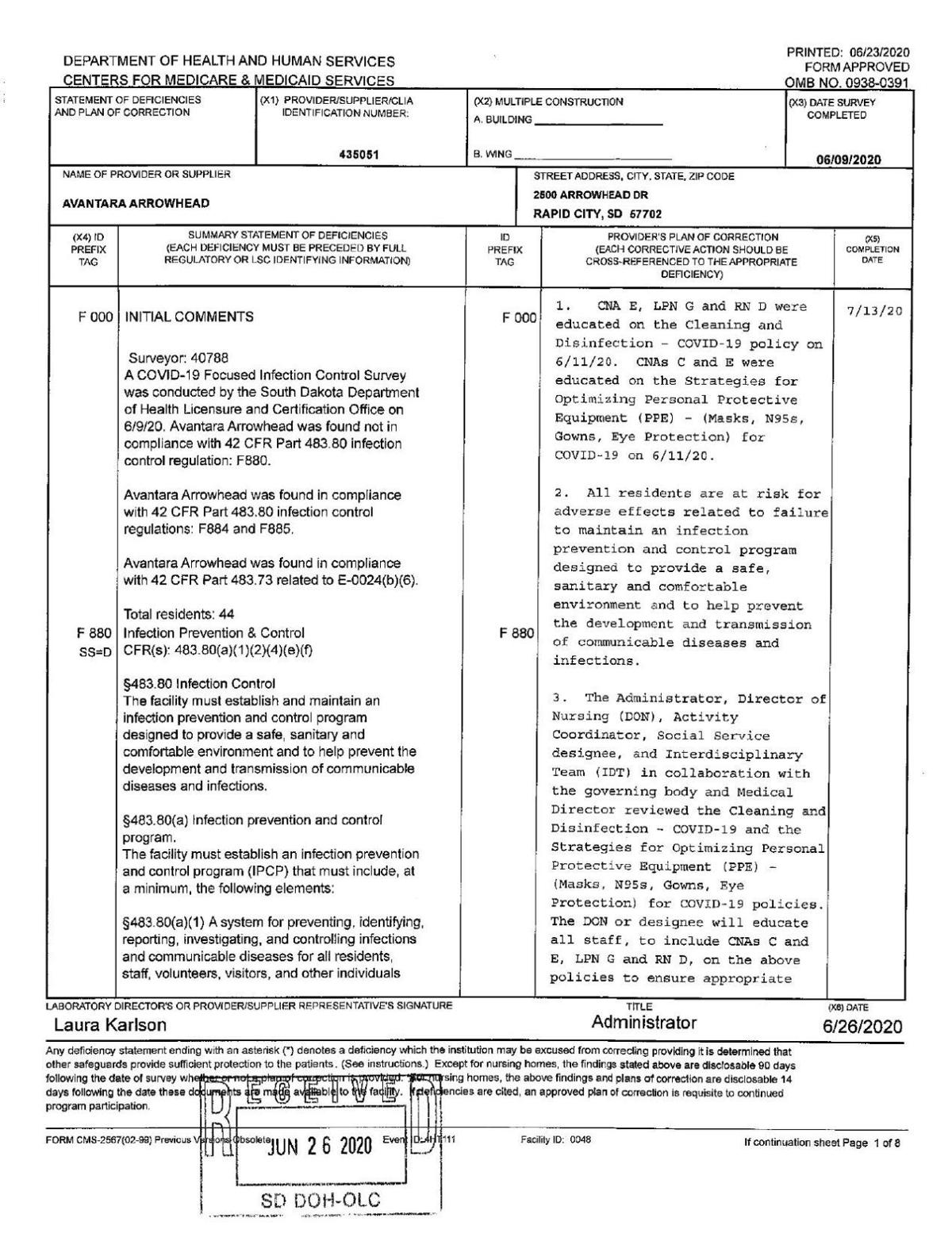
Two Rapid City nursing homes with significant COVID-19 outbreaks are some of the worst-ranked facilities in the state and have a history of infection control violations, public records show.

Avantara Arrowhead has seen 45 of 49 residents — or 92% — contract the virus as of Thursday, said Tatiana Johnson, regional director of operations at Legacy Healthcare, which operates the nursing homes. Eight of those residents have died while 32 have already recovered. Nineteen of 21 staff members infected with the virus have recovered.

At Avantara Saint Cloud, 45 of 68 residents, or 66%, have had the virus. Five have died while 19 are recovered. Twenty-four staff members tested positive for the virus and 10 have recovered.

Both facilities have a history of infection control violations related to staff not following proper procedures for cleaning, disinfecting, hand washing, glove wearing and making sure residents are cleaned properly.

The most recent violation was found when the Department of Health inspected Arrowhead on June 9, after 15 residents and nine employees had already contracted the virus.

The inspector found staff failed to properly clean and disinfect shared equipment, insulin injection devices and the unit for residents who tested positive for the virus or were exposed but tested negative. A logbook said the unit had been cleaned nine out of nine mornings, two out of eight afternoon shifts, and none of the evening shifts. Staff also wore their N-95 masks outside of the building and then stored them in a paper bag inside their cars, which would have exposed them to heat.

"All residents are at risk for adverse effects related to failure to maintain an infection prevention and control program," Arrowhead wrote in its plan of correction, which involved random audits and educating staff on proper cleaning, disinfecting and mask storage.

DOH spokesman Derrick Haskins said visits on July 14 and this week showed Arrowhead had addressed these issues.

An experienced certified nursing assistant who works at Saint Cloud says her facility could have better prepared for the pandemic.

“Things could have been done better from the beginning," said the woman, who contracted COVID-19 and passed it on to relatives.

Saint Cloud is the fourth-lowest ranked of South Dakota's 104 long-term care facilities that participate in Medicare and Medicaid. It also has Medicare’s lowest possible overall and health inspection ratings of “much below average.”

Arrowhead is the lowest-ranked facility in the state. It's also the only one labeled a Special Focus Facility, which means it's subject to frequent inspections and possible Medicare/Medicaid termination due to “a history of persistent poor quality of care.”

Arrowhead was designated a Special Focus Facility in August 2019 and is inspected every six months, Haskins said. Johnson said Arrowhead has graduated the program and is expected to be taken off the list.

"Avantara Saint Cloud and Avantara Arrowhead and their heroic staff have been on the front lines fighting against this unforgiving virus, protecting our residents, who are among some of the most vulnerable in our community," she said.

Johnson said the nursing homes are unsure how the virus first entered their facilities but have and continue to take "full precautionary measures" based on guidance from the DOH, CDC, and Centers for Medicare and Medicaid.

CNA speaks out 

The CNA was granted anonymity for this story because she fears retaliation for speaking out. The Journal has seen a photo of the woman in personal protective gear and a document confirming her job title and place of work.

The woman began working at Saint Cloud this year but has been a CNA for more than two decades. She said the nursing home has taken some steps to prevent the virus: no visitors are allowed, there have been at least four mass testings, and staff have their temperatures taken daily and wear personal protective equipment.

She said the first mass testing was in late May or early June and it took a week to learn the results. It turned out that one staff member — who was asymptomatic and continued to work — and two residents were positive. She said she’s not sure who provided the equipment but it was Saint Cloud's medical staff that did the testing.

Saint Cloud had a few cases at a time until late June or early July when “all of a sudden it was boom, boom, boom … it was all over the building," the CNA said.

She said staff wore loose-fitting surgical masks until N-95 masks arrived on July 6 after about 20 residents were already infected. She said the facility still needs more masks so they can change them more often.

Staff who clean and disinfect areas need to do a better job, the CNA said. For example, she said rooms aren’t properly disinfected when a resident is moved to a different area after contracting the virus.

The CNA said she knows three staff members who had high temperatures when they arrived at work, but instead of leaving they took their temperature again after 30 minutes and wrote down the new, lower one. She said staff who miss work because they develop symptoms or a confirmed case of the virus have to use their saved paid time off.

She said Saint Cloud’s residents are “very susceptible” to the virus and since they all have Alzheimer's or other forms of dementia many do not understand the pandemic and continue walking into the hallways and each other's rooms.

The CNA said she’s considering looking for work elsewhere even though she is well paid.

“Is that money worth my health? No.” ​

DOH, Legacy respond

Legacy Healthcare operates Arrowhead, Saint Cloud and 16 other long-term care facilities in South Dakota, according to its website. They are owned by Cascade Capital Group and both for-profit companies are based in a Chicago suburb. Legacy Healthcare operates 52 facilities, mostly in Illinois and South Dakota but also in Montana and Utah.

Cascade says it bought 16 of its South Dakota facilities in July 2019. The nursing homes were previously operated by Skyline Health Care.

Legacy took over "a struggling operator who had previous issues with clinical results and public health violations resulting in subpar Medicare ratings," Johnson said. "While this posed some challenges at first, our selfless staff have been instrumental in improving many different facets of the facilities, which has created many positive results in the last year."

Arrowhead was labeled a Special Focus Facility a month after Legacy took over and all but one of the inspections reviewed by the Journal occurred after Legacy became the operator. The company's South Dakota facilities range from low-ranking ones like Arrowhead and Saint Cloud to ones rated by Medicare as "much above average."

Johnson said Arrowhead and Saint Cloud have worked to prevent the virus by not allowing visitors, stopping group meals and activities, and following masking and social distancing when possible. She said staff are screened for symptoms each day and have proper Personal Protective Equipment. Both nursing homes voluntarily mass tested all residents and staff with help from local and state health departments, Johnson added.

Haskins said the department has been holding weekly calls, providing Personal Protective Equipment and conducted 18,598 mass tests of staff and residents at long-term care facilities. The facilities are also conducting random testing of staff and residents each week.

During the pandemic, the DOH has conducted 145 infection control inspections at all 104 South Dakota long-term care facilities that use Medicare and Medicaid, Haskins said. The department does an extra inspection and provides daily check-ins facilities after a resident develops the virus.

Saint Cloud inspections 

Nursing homes that are part of Medicare and Medicaid programs are inspected once a year for re-certification and more often if there is a complaint or they are a Special Focus Facility, according to Medicare's "Nursing Home Compare" website. The inspections are conducted by trained inspectors and at least one nurse with the South Dakota Department of Health on behalf of the federal government.

The inspectors note any violations and the facility must explain how they will correct them within a certain amount of time, Haskins said. Medicare then gives ratings for health inspections, staffing and quality of resident care by using a five-star system ranging from “much below average” to “much above average.” Those three ratings are used to determine the overall rating.

Medicare gave Saint Cloud its lowest ranking — one star or “much below average” — for its overall and health inspection ratings during its September 2019 annual inspection. It was ranked average for staffing and above average for quality of resident care.

Saint Cloud, which used to be called Bella Vista, was fined $19,321 after being cited for 14 health violations. South Dakota facilities have an average of 3.5 health deficiencies while U.S. ones have an average of 8.2, Medicare says.

One infection prevention issue was a dirty salon/spa area, including dirty toilets. Inspectors saw a staff member fail to properly clean a different shower area. Some staff members did not follow proper hand/glove hygiene for themselves and sanitation for residents while cleaning residents after they went to the bathroom.

Saint Cloud said it re-educated staff on disinfecting these areas, hand/glove hygiene, bathroom hygiene and infection control.

DOH staff inspected Saint Cloud in March 2020 after a complaint about resident safety related to falls and infection control but found the facility was following all rules. They inspected the facility in April and on June 17 and found it was following infection procedure and was prepared for the coronavirus pandemic.

Arrowhead inspections 

Arrowhead, which used to be called Meadowbrook, specializes in caring for people in need of medical and rehabilitative treatment. It has no Medicare rankings due to its Special Focus Facility status.

Inspections show that Arrowhead has yo-yoed in its preparedness for infections and the coronavirus since March.

DOH staff found Arrowhead was following infection and coronavirus protocols during a visit this week and on July 14, Haskins said. Those visits came after staff found the facility wasn't following infection rules during the June 9 visit.

Federal inspectors previously found the facility implemented COVID-19 practices and was following infection control regulations during an April 23 visit, Haskins said. But that visit came after a March 12 visit in which inspectors found the facility was not meeting professional or infection standards.

Inspectors found some staff failed to properly care for incontinent patients and follow medical procedures. They also found some staff failed to properly disinfect a whirlpool tub and follow hand hygiene and glove use rules, including while caring for a patient with a contagious infection.

The inspectors also found Arrowhead was violating a South Dakota law that says new employees must be evaluated for vaccines and contagious diseases within 14 days of being hired.

Arrowhead said it would remedy the problems in the April 23 and June 9 inspections by educating staff and conducting audits.

But those weren't the first time the facility had violations it said would be remedied through training and audits. DOH staff also found violations — including infection control ones related to hand/glove hygiene and disinfection — during inspections in January, September and December 2019.
Arrowhead was fined $6,805 in January 2019 after inspectors found 13 health deficiencies.

Full Article & Source:
Rapid City nursing homes with 13 coronavirus deaths have recent history of infection violations

Bloomfield Hills Woman Charged With Stealing $70K From Veteran

(WWJ) A Bloomfield Hills woman has been charged with embezzlement after allegedly taking more than $70,000 from a veteran.
 
The Michigan Attorney General's Office charged 60-year old Margaret Risdon after an investigation by the U.S. Department of Veterans Affairs Office of the Inspector General showed she wrote checks from the victim's bank account to herself and her business called Electronic Creations.

It's alleged that, between Nov. 6, 2016 and July 20, 2017, Risdon allegedly wrote checks from the victim’s bank account to herself and her business, Electronic Creations, totaling nearly $56,800 and made ATM withdrawals totaling more than $16,000. Risdon would then deposit the checks into her bank account and withdraw the money in cash.

The victim, who had been in a nursing home and the hospital, alerted Veterans Affairs that someone was stealing from him.

Risdon was released on a $5,000 personal bond and due back in court for a hearing Thursday.
Attorney General Dana Nessel says more than 73,000 older adults in Michigan are victims of elder abuse each year.

“My office is not only committed to enforcing the laws of this state, but to ensuring Michigan’s vulnerable populations are not taken advantage of,” said Nessel. in a statement. “Even before my time as Attorney General began, I understood the important role my office should play in protecting our senior populations. That’s why I helped to create the Elder Abuse Task Force – to advance protections for our senior citizens and advocate for real change and meaningful legislation to improve their lives well into the twilight years.”

To learn more about the Elder Abuse Task Force and its initiatives, visit this link.

To file a report of elder abuse, call the Michigan Department of Health and Human Services Adult Protective Services at 855-444-3911.
 
Full Article & Source:
Bloomfield Hills Woman Charged With Stealing $70K From Veteran

Sunday, August 2, 2020

Governor Whitmer extends Executive Order protecting people in long-term care facilities

LANSING, Mich. - Today, in order to protect Michigan’s most vulnerable populations living in congregate settings, Governor Gretchen Whitmer signed Executive Order 2020-156, which continues the limited and temporary restrictions on the entry of individuals into health care facilities, residential care facilities, congregate care facilities, and juvenile justice facilities previously imposed by Executive Order 2020-136. 

The Michigan Department of Health and Human Services remains empowered to specify exceptions to these restrictions.

“We must remain vigilant in our fight against COVID-19 and protect our most vulnerable citizens from the spread of this virus,” said Governor Whitmer. “This executive order protects more long-term care facility residents and staff, including the most vulnerable residents in our nursing homes. I know seniors and their families are making sacrifices every day during this crisis, and moving forward, I will work closely with the Michigan Nursing Homes COVID-19 Preparedness Task Force to protect our most vulnerable communities, the heroes on the front lines, and our families from this virus.”

Executive Order 2020-156 maintains restrictions on visitation to health care facilities, residential care facilities, congregate care facilities, and juvenile justice facilities, while authorizing the Department of Health and Human Services to gradually re-open visitation as circumstances permit.

This policy has been in place since March, and consistently prohibited entry into a nursing home by a person exhibiting symptoms of COVID-19.

The order is effective immediately and continues through August 31, 2020.

The health and safety of nursing home residents and staff remains a top priority for Governor Whitmer.

On June 26, she created the bipartisan Michigan Nursing Homes COVID-19 Preparedness Task Force within the Michigan Department of Health and Human Services (DHHS), which is charged with, among other things, analyzing relevant data on the threat of COVID-19 in nursing homes, and making recommendations to the governor on improving data quality, and releasing periodic reports to the governor on its findings and recommendations.

The task force must produce a recommendation to the governor for an action plan on how to prepare nursing homes for any future wave of COVID-19 cases by August 31, 2020.

To view Executive Order 2020-156, click the link below:

Full Article & Source:
Governor Whitmer extends Executive Order protecting people in long-term care facilities

Jacksonville lawyer loses license over not following through on clients' cases

Duval County Courthouse
by Steve Patterson

A Jacksonville attorney has been disbarred after clients complained he abandoned their cases despite being paid to represent them.

Kenneth L. Spears, 34, had already been suspended from practicing law before the Florida Supreme Court stripped him of his license in July.

Spears hadn’t contested a report from a judge, called a referee, who examined reports from the Florida Bar about three clients who complained in 2018 and last year that Spears stopped communicating with them about their cases.

Two of the clients – a man who hired Spears to defend his company from a lawsuit and another man who needed help on an immigration issue – had already paid Spears a combined total of $3,500, the referee’s report said.

A third client complained that Spears was supposed to represent his family in a probate dispute but ignored messages left by phone, text or email after the client refused a settlement offer. The man said he sent Spears a certified letter, but the lawyer didn’t respond.

The referee’s report said Spears also didn’t respond when Bar investigators asked about the complaints, even hand-delivering a letter, or when a Supreme Court hearing was held on finding him in contempt for not answering.

The Supreme Court’s order said that Spears, who had been an attorney since 2011, should return the $3,500 he was paid and that he owed the Bar $2,055 that was spent investigating the complaints.

Full Article & Source:
Jacksonville lawyer loses license over not following through on clients' cases

SENIOR LOOKOUT: Social isolation can lead to elder abuse

by Tracy Arabian

According to a study conducted by the National Institute of Justice, 11% of the 5,000 adults age 60 and over who were surveyed reported some form of mistreatment. Of those who reported physical mistreatment, only 31% had reported it to authorities.

Social isolation is a known risk factor for elder abuse. The social distancing measures enacted to combat COVID-19, and recommendations by the Centers for Disease Control and Prevention for adults over the age of 65 to not leave their homes, are creating new levels of social isolation. These limits on in-person contact greatly limit caregivers’ ability to provide care, and limit opportunities for elder abuse to be detected.

Older adults, who often have chronic health conditions, may now find it more difficult to access health care and supplies needed to manage their conditions and stay healthy. These issues can lead to increased depression and anxiety, which is also known to make older adults more susceptible to abuse.

While many older adults typically turn to their health care providers for treatment of mental health symptoms, cancellations of face-to-face visits and unfamiliarity with technologies needed to conduct remote health care visits may be preventing older adults from receiving the care they need and may be increasing their vulnerability to abuse.

What exactly is elder abuse? Below are different types of elder abuse and what they are, as defined by the Massachusetts Executive Office of Elder Affairs.

Physical — This is the nonaccidental infliction of serious physical harm or the threat to do so where it is believed the person has the intent and capacity to carry out the threat.

Emotional — This is the nonaccidental infliction of serious emotional injury. There must be a relationship between the action and the impact on the emotional state or functioning of the elder.

Sexual — This is sexual assault, rape, sexual misuse, sexual exploitation or the threat of sexual abuse where it is believed the person has the intent and capacity to carry out the threat.

Neglect — There is caretaker neglect and self-neglect. Caretaker neglect is the failure or refusal to provide one or more basic necessities essential for physical well-being, which has caused, or will immediately result in, serious physical harm. Self-neglect is the failure or refusal by an elder to meet one or more basic necessities essential for physical well-being, which has caused, or will immediately result in, physical harm.

Financial exploitation — This is a nonaccidental act or omission by another person, without the consent of the elder, which results in a substantial monetary or property loss to the elder or gain to another individual.

Did you know anyone can report elder abuse?

Recognizing potential elder abuse can be tricky, but if you know what to look for, it is easier. There are general warning signs, such as noticing frequent arguments or tension between the caregiver and the elderly person and/or a change in personality or behavior in the elder. However, each of these types of abuse have their own warning signs:

Physical — Unexplained signs of injury (bruises, welts or scars); broken bones; drug overdose or apparent failure to take medication regularly; broken eyeglasses or frames; or a caregiver’s refusal to allow you to see the elder alone may all be signs of abuse.

Emotional — Seeing threatening, belittling or controlling caregiver behavior or behavior that mimics dementia, such as rocking, sucking or mumbling to oneself, may be signs of abuse.

Sexual — Physicians or nurses would most likely be the ones to notice these signs, such as bruises around breasts or genitals; unexplained vaginal or anal bleeding; or torn, stained or bloody underclothing.

Neglect — Signs would include unusual weight loss, malnutrition or dehydration; untreated physical problems; unsanitary living conditions; being left dirty or unbathed; unsuitable clothing or covering for the weather; or desertion of the elder at a public place.

Financial exploitation — You might notice significant withdrawals from financial accounts; sudden change in financial situation; items or cash missing from household; suspicious changes in wills or power of attorney; addition of names to the senior’s signature card; unpaid bills; or financial activity the senior couldn’t have done, such as ATM withdrawals of a senior that is bedridden.

To report suspected elder abuse, call the statewide 24-hour hotline at 1-800-922-2275. These calls will go directly to the Massachusetts-based call center, regardless of the location of the reporter or the elder within Massachusetts, and are referred to local protective services agencies, such as SeniorCare. For more information on elder abuse, visit SeniorCare’s website at seniorcareinc.org/protective-services.

Tracy Arabian is the communications officer at SeniorCare Inc., a local agency on aging that serves Gloucester, Beverly, Essex, Hamilton, Ipswich, Manchester-by-the-Sea, Rockport, Topsfield and Wenham.

Full Article & Source: 
SENIOR LOOKOUT: Social isolation can lead to elder abuse

Saturday, August 1, 2020

Northern Nevada senior facility starts pen pal program

Click to Watch Video
By Elizabeth Rodil

RENO, Nev. (KOLO) - Carson Valley Senior Living started a Pen Pal program for its seniors during the pandemic. The program started with a simple social media post. Employees snapped photos of seniors and highlighted a few of their favorite things. 

Life Enrichment Director Adrianna Ward said, “I want to say we received over a hundred letters. We had about four care packages come in, between crossword puzzles, succulent plants, goodies, and the candies that they like.”

Ward didn’t expect the facility would get an overwhelming response. She said, “So we started the pen pal July 6th and the post went viral, within a week we had over 40,000 people reach out.”

Seniors Lorraine Strazi and Susan Rielley responded back to their new pen pals. Strazi said, “I apologized for my handwriting because it was yucky.” Rielley said, “I wrote back, she has to write back, you know, you have to wait, you know how mail is.”

According to Ward these new formed friendships have made a difference for these seniors. The facility scaled down on visitation hours since the pandemic. “With the window visits we are doing and now we are doing outdoor family visits for 30 minutes, it’s still not enough sometimes for them.” 

She continued, “To have that constant writing it keeps their mind going and they just love getting that attention and knowing that there are people out there during this pandemic that people do care.”
If you want to become a pen pal you can click here: https://www.facebook.com/CarsonValleySL

Employees at Carson Valley Senior Living started a pen pal program during the pandemic.
Employees at Carson Valley Senior Living started a pen pal program during the pandemic.(KOLO)
Full Article & Source:
Northern Nevada senior facility starts pen pal program

Glimpses of Isolation Part I


Virus restrictions have put long-term care facilities on lockdown. The isolation has devastating effects on those who are being "kept safe" from the virus. Find out how you can help by joining the Facebook group at facebook.com/groups/caregiversforcompromise.

Source:
Glimpses of Isolation Part I

People in long term care ‘dying of isolation,’ Georgia group tells governor

Georgia Caregivers for Compromise

Photo of Betty
Photo of Betty
Kristian Hugo can’t hide her love for her “granny,” Betty, who is in a long-term care facility in St. Marys.

“Words can’t do it justice,” Hugo said. “She’s always been a caregiver. She’s always taken of, even as a little girl, she would go take care of the elderly.”

Click to Watch Video
Hugo is frustrated and worried since the pandemic has locked her and others out of the facilities where their loved ones live.

“It’s hard when you’re hearing, you know, the talks of theme parks opening and sports and schools,” she said. “Where are we talking about our homes that, you know, our loved ones have been in for five months in isolation?”

Hugo and Maxine Williams, her aunt, are both with Georgia Caregivers for Compromise. Williams is the administrator. A letter the group wrote to Gov. Brian Kemp reads in part:

”Our loved ones are dying of isolation and loneliness and it has to stop. While we appreciate the efforts to save them from the virus, there comes a point when the effects of isolation are more deadly than the risk of contracting COVID-19.”

The organization is asking the state for:
  • A point of contact within the administration so they can make “informed decisions based on facts, not hopeful speculation”
  • A plan for reopening facilities “in a safe, smart, step-by-step way”
  • The implementation of an essential family caregiver designation program “that’s currently being implemented in Minnesota and Indiana”
Hugo says she misses the little things, like just “being there” for her granny. But she says speaking out is what she can do for her and others.

“They need us and they don’t have the voice,” Hugo said. “They don’t have the voice to tell everyone that they need us to be there and some of them, the ones with Alzheimer’s or they have dementia or are mentally incapacitated, they cannot look through a window at their loved one. They just don’t understand. It isn’t enough. They need their touch, and they need to hear their voice.”

The group is asking for Kemp to announce a plan by Aug. 3, but so far, the the group says it hasn’t received feedback from the governor.

Full Article & Source:
People in long term care ‘dying of isolation,’ Georgia group tells governor