Showing posts with label FBI. Show all posts

Tuesday, May 28, 2024

Elderly fraud increasing in Oregon

by Jeremy C. Ruark

This infographic shows how many complaints the FBI’s Internet Crime Complaint Center received about different types of elder fraud in 2023. (Image courtesy of the FBI)

Internet scams targeting elderly Oregonians are increasing. The latest Federal Bureau of investigation report shows that segment of the population lost $44 million to the scammers in 2023.

FBI Report

Elder fraud complaints to the FBI’s Internet Crime Complaint Center (or IC3) increased by 14 percent in 2023, and associated losses increased by about 11 percent, according to IC3’s 2023 Elder Fraud Report, released April 30.  

The annual publication provides statistics about incidents of elder fraud — or fraud that explicitly targets older Americans’ money or cryptocurrency — that are reported to IC3. The report aims to raise the public’s awareness of this issue and to prevent future and repeat incidents.

“Combatting the financial exploitation of those over 60 years of age continues to be a priority of the FBI,” FBI Assistant Director Michael D. Nordwall wrote in the report. “Along with our partners, we continually work to aid victims and to identify and investigate the individuals and criminal organizations that perpetrate these schemes and target the elderly.” 

And elder fraud is probably a more insidious threat than the report shows. Many of these crimes likely go unreported, and, as the report states, only about half of the fraud scam complaints submitted to IC3 in 2023 included victims’ ages.

Here are five key takeaways from the 2023 report:

1) Elder fraud is an expensive crime. Scams targeting individuals aged 60 and older caused over $3.4 billion in losses in 2023 — an increase of approximately 11 percent from the year prior. The average victim of elder fraud lost $33,915 due to these crimes in 2023. 

2) Older Americans seem to be disproportionately impacted by scams and fraud. More than 101,000 victims aged 60 and over reported this kind of crime to IC3 in 2023. On the flip side, victims under the age of 20 years old seemed to be the least-impacted demographic, with about 18,000 victims in this demographic reporting suspected scams or frauds to IC3 last year. 

3) Tech support scams were the most widely reported kind of elder fraud in 2023. Nearly 18,000 victims aged 60 and over reported such scams to IC3. Personal data breaches, confidence and romance scams, non-payment or non-delivery scams, and investment scams rounded out the top five most common types of elder fraud reported to IC3 last year.  

4) Investment scams were the costliest kind of elder fraud in 2023. These schemes cost victims more than $1.2 billion in losses last year. And tech support scams, business email compromise scams, confidence and romance scams, government impersonation scams, and personal data breaches all respectively cost victims hundreds of millions of dollars in 2023. 

5) Scammers are coming for people’s cryptocurrency. More than 12,000 victims aged 60 and over indicated that cryptocurrency was a medium or tool used to facilitate the scam or fraud that targeted them when reporting it to IC3. 

Local impact

The Lincoln County Leader reached out to Lincoln City Police Sgt. Erik Anderson to find out the local impact of elderly fraud.

The Leader: What have been the most significant elderly fraud cases seen by your agency over the past few years?

Erik Anderson: So we have seen quite a few over the last couple years unfortunately. Many of these come to our attention through our strong partnership with Adult Protective Services, and many others are brought to us by the victims themselves. One of the more heinous cases we have seen with elder fraud locally includes a case in which a couple defrauded a senior citizen out of their entire home. That case is still being adjudicated. Many of our other cases involve the thefts of large sums of retirement savings through online scams and identity theft.

The Leader: Why are the elderly targeted?

Anderson: The elderly are often targeted for several reasons. Out of all of us, elderly folks tend to have more savings, although in our area we have plenty of seniors living on very fixed incomes. Unfortunately, professional scammers around the world don’t really care about the livelihood of their victims. 

Senior citizens are also more likely to have had personal identity information leaked online through decades of breaches in government organizations, health care agencies, financial records holders and so on. Senior citizens tend to have lower levels of digital literacy than younger generations and in many cases don’t realize they have been victimized until long after the fact.

Romance scams, in which people pretend to fall for an unsuspecting victim met online and request money be sent for prolonged periods, are very common. Elders are often targeted by these scams as many live alone, and the chance at a strong emotional connection is enticing.

Elderly folks are also significantly more likely than others to suffer from conditions affecting their memory, and in some of the most heartbreaking cases, don’t even recognize that they have been victimized. In Oregon, crimes against seniors carry additional penalties under ORS 164.061, which mandates 16 to 45 months of incarceration if certain conditions are met.   

The Leader: Is it difficult to find and arrest the suspects involved, and if so, why?

Anderson: Bringing suspects to justice is often difficult in many of these cases. Memory issues hinder the ability to recall key details of crimes. In some of our fraud cases, suspects have had victims sign over power of attorney in less than scrupulous methods. In these cases, Oregon laws related to criminal mistreatment come into play but are often hard to prove. As far as online fraud goes, these criminals are often never brought to justice as most reside in other countries, which turn a blind eye or even promote the nefarious activity.

The Leader: What recommendations can the LCDP provide to help keep local senior citizens aware of the fraud dangers?

Anderson: I think all people are well served by the early life lesson of stranger danger. Be cautious when contacted by unsolicited marketers or friendly text messages from strangers bearing the gift of wonderful investment opportunities.

I recently looked through a great resource from AARP. They have a whole portal outlining different kinds of scams: www.aarp.org/money/scams-fraud This is a great read for seniors and their families who worry about them. Another resource for elderly citizens who have been victimized is to contact the Internet Crime Complaint Center (www.ic3.gov). This is the FBI’s portal for taking complaints about cyber crime and scams. They aggregate complaints to target the worst actors. If they recover or seize funds that they can attribute to specific individuals, they work with local law enforcement to return the funds.

Lastly, the protection of our most vulnerable populations, like senior citizens and children, are an important part of our mission at the Lincoln City Police Department. We strive to achieve justice when possible on these cases. We aim to do our best and hope when we are in their position, future Oregonians will look out for us.

If you or someone you know may have been a victim of elder fraud, contact your local FBI field office or submit a tip online at tips.fbi.gov. If the suspected fraud was internet-facilitated, you can also file a complaint with the FBI’s Internet Crime Complaint Center at ic3.gov.

Full Article & Source:
Elderly fraud increasing in Oregon

Tuesday, October 11, 2022

FBI raises flag on elder fraud after thousands of retirees are scammed out of $1.7 billion

By Andrew Keiper

America’s grandparents are increasingly online. They’re connecting with relatives digitally, shopping in the web’s endless aisles, and even finding online love in their golden years. 

However, with that wifi connection comes a darker side. Specifically, the danger of scams targeting the elderly population and their substantial life savings. 

The Federal Bureau of Investigation (FBI) has raised the flag on the precipitous rise in elder fraud scams in recent years. According to their 2021 Internet Crime Complaint Center (IC3) report, there were over 92,000 victims who lost $1.7 billion to elder fraud scams. The losses were a 74 percent increase over 2020’s. 

"Elder fraud is simply financial fraud that targets any individual, any citizen in the United States over the age of 60 years old," FBI Deputy Assistant Director of the Criminal Investigation Division Aaron Tapp told Fox News. "… It could be romance based. It could be technology based. But any type of fraud scheme that’s targeting our elderly population."

Tapp said the technological divide that separates sexagenarians from younger generations is at the heart of the rise in elder fraud. Scammers key in on individuals who are not digitally savvy to bilk them out of thousands of dollars. 

"The technology is just a modality for these scammers to commit fraud," he said. "And so as the technology develops, they’ll use that modality in any way they can to prey upon the elderly population." 

On average, victims lost over $18,000 and more than 3,000 victims lost over $100,000. The total among of money taken from victims has skyrocketed since 2017, when the FBI claims there was less than $400 million in total losses. The most common types of fraud in the report are tech support, non-payment/non-delivery, identity theft and romance scams.  

One such victim of a romance scam was the late Donald Griffith, whose daughter Angie Kennard shared his story with Fox News in hopes of warning other families of the dangers of fraudulent online romances. Grifftih ran a construction business in the Washington D.C. area and helped build the regions metro transportation system.

"I think, you know, just being lonely, he turned to the internet and started looking around on dating sites and, you know, built a relationship with this person, Mary, online," Kennard told Fox News. 

Kennard said this woman claimed she was working abroad in Europe and wound up trapped overseas. The scammers knew enough about her father to make "Mary" seem like she was keyed into Griffith’s interests and background as an owner of a construction firm. 

"They’re very manipulative," she said. "They just really fed into my father’s background and who he was. And they made him fall in love. … It got to a point where they basically started turning my father against me, against my uncle, against his own family, saying that we just wanted his money." 

he scammers targeted Griffith on a dating site and used his loneliness in his golden years against him. They started small and eventually drove him into debt after draining his life savings. 

"Over time, she started asking him for money, and it started in small increments and then eventually, you know, worked its way up to … $40,000 at a time," Kennard said. "From what I can add up and find in terms of receipts and notes and statements, it looks like [he sent] about $750,000." 

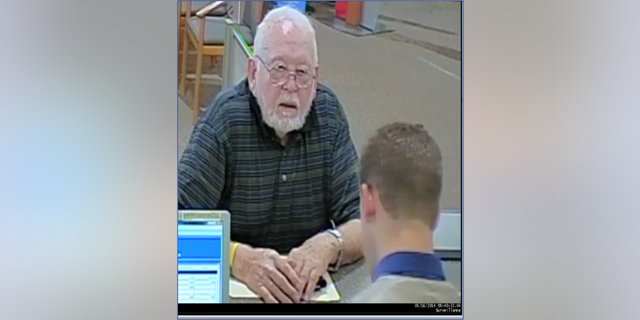
Donald Griffith depositing money to send to the scammers at a bank teller window. 
Donald Griffith depositing money to send to the scammers at a bank teller window.  (FBI)

Kennard said the relationship her father had with Mary occurred entirely over text messages and emails, they never once spoke on the phone. Right away, she was concerned he was being scammed. But her concerns were met with resistance and even distance from Griffith, who taught her to be financially responsible in her youth. She said those lessons are why she was so shocked when she discovered the scam. 

"It was finally when I went to go visit I ended up sneaking through his laptop and I went through his emails and financial statements and I saw the magnitude of what happened," Kennard said. "That’s when I contacted the FBI." 

The agent who investigated Griffith’s case told Fox News that the people who targeted him were part of a Nigerian ring of scammers who defrauded hundreds of other victims out of upwards of $20 million in losses. 

"We identified at least $22 million worth of money that flowed through all the financial accounts that we looked at," Special Supervisory Agent Keith Custer told Fox News. "So, hundreds of victims, hundreds of bank accounts and well over $20 million in losses."

Custer said elderly fraud is an international problem, with highly sophisticated and organized groups of scammers targeting America’s retirees from a number of foreign countries. He specifically named Ghana and Nigeria as hubs for high-tech swindles. The Nigerian ring that targeted Griffith was eventually tracked down and mostly apprehended. 

"We indicted ten people in the initial round of indictments," Custer said. "So nine of those were guilty either at trial or through a plea bargain. One remains at large in Nigeria."  (Continue reading)

Full Article & Source:
FBI raises flag on elder fraud after thousands of retirees are scammed out of $1.7 billion

Friday, July 30, 2021

FBI: Albuquerque Couple Sentenced To Prison For Crimes Committed In Connection With Ayudando Guardians Case

FBI News:

ALBUQUERQUE — Susan K. Harris, 74, and William S. Harris, 60, both of Albuquerque, were sentenced Friday in Federal Court for conspiracy to defraud the United States and other financial crimes committed in connection with the operation of Ayudando Guardians, Inc., a non-profit corporation that previously provided guardianship, conservatorship and financial management to hundreds of people with special needs.

Susan Harris was sentenced to 47 years in prison, followed by three years of supervised release. William Harris was sentenced to 15 years in prison, followed by three years of supervised release. Both will be required to pay the entire amount of stolen funds as restitution to the victims. 

A superseding indictment filed Dec. 5, 2017, charged Susan Harris, William Harris, Sharon A. Moore, 64, and Susan Harris’ son, Craig M. Young, 53, with various financial crimes, including conspiracy to defraud the United States, mail fraud, aggravated identity theft and money laundering.

Susan Harris pleaded guilty July 11, 2019, to conspiracy, mail fraud, aggravated identity theft, money laundering and conspiracy to commit money laundering. William Harris pleaded guilty June 25, 2019, to conspiracy to defraud the United States and to commit money laundering.

Both Susan Harris and William Harris were originally scheduled to be sentenced March 2, 2020, but failed to appear for their sentencing hearing. A bench warrant was issued for their arrest and the U.S. Marshals Service arrested them April 15, 2020, in Shawnee, Okla., after they fled New Mexico.

According to their plea agreements and other court records, Susan Harris acted as president and was the 95-percent owner of Ayudando, while Moore acted as chief financial officer and was a five-percent owner. They engaged in a pattern of criminal conduct from November 2006 to July 2017 that included unlawfully transferring money from client accounts to a comingled account without any client-based justification.  They wrote and endorsed numerous checks, often of more than $10,000, from these comingled accounts to themselves, family members, cash and other parties where payment would benefit their families.

Susan Harris took steps to maintain Ayudando’s appearance of legitimacy, including submitting a proposal to the New Mexico Office of Guardianship that contained numerous false representations, including a false claim that Young was a nationally certified guardian at the time of the submission.

William Harris, who worked as a guardian, admitted that he knew that Moore was siphoning payments to clients from the Department of Veterans Affairs and Social Security Administration and using the money to benefit herself, Harris, and their co-conspirators. Harris specifically admitted receiving, endorsing, and depositing dozens of checks drawn on Ayudando accounts for his own personal benefit. Harris admitted to his involvement in a money laundering scheme, using an Ayudando corporate credit card for personal expenses, knowing that it would be paid for with client money. He also admitted his role in a loan application for the stated purpose of expanding the Ayudando business with the actual intent of using the money to “pay back” clients whose money had been taken without authorization.

The stolen funds were used to fund an extravagant lifestyle, including the purchases of homes, vehicles, luxury RVs and cruises, as well as a private box at “the Pit” at the University of New Mexico. The stolen funds also were used to pay for more than $4.4 million in American Express charges incurred by the defendants and their families.

“The sentences that the defendants have received today are just, and the defendants are fully deserving of them,” said Fred J. Federici, Acting U.S. Attorney for the District of New Mexico. “The defendants’ conduct in preying upon individuals with special needs, who they were entrusted to protect, was both loathsome and contemptible. We hope that these sentences serve as a warning to others that we will seek to hold accountable anyone who chooses to violate federal law by abusing any similar position of trust for personal enrichment.”

“Taking advantage of disabled veterans and other vulnerable Americans deserves a harsh penalty, especially when those entrusted with their finances instead use the money for vacations and other expensive perks,” said Raul Bujanda, Special Agent in Charge of the FBI Albuquerque Field Office. “The FBI will never stop trying to hold such criminals accountable and making sure their victims get justice.”

“This final phase of the investigation will hopefully give some closure to the many victims who have suffered as a result of the selfish acts of the defendants,” said Sonya K. Chavez, United States Marshal for the District of New Mexico. “We at the United States Marshals Service will continue to work diligently with our partners to protect the citizens of New Mexico, particularly those who are most vulnerable.”

“The criminal actions by these defendants were truly brazen and egregious,” stated IRS – Criminal Investigation Special Agent in Charge Albert Childress. “Instead of helping people who placed their trust in them, the defendants were greedy and helped themselves to their clients’ money. They must now pay the consequences for their bad deeds.”

“Today’s sentencing reflects the egregious crimes committed by the defendants, who not only violated the public’s trust but also the trust of a vulnerable population who relied upon them to manage their benefits. We will continue to join our law enforcement partners in investigating organizations and individuals who misuse Social Security benefits that they agreed to manage on behalf of beneficiaries,” said Adam Schneider, Special Agent-in-Charge of the Social Security Administration Office of the Inspector General, Dallas Field Division. “I thank our law enforcement partners for their outstanding investigative work and the District of New Mexico U.S. Attorney’s Office for their efforts in bringing these individuals to justice.” 

“Criminal acts by would-be fiduciaries are most heinous because they violate veterans’ trust and put in jeopardy the benefits on which they are dependent,” said Special Agent in Charge Rebeccalynn Staples, Veterans Affairs, Office of Inspector General. “This sentence should send a clear message that the VA OIG will continue to work with our law enforcement partners to ferret out those who would defraud VA and steal the benefits of deserving veterans.”

Young pleaded guilty Nov. 12, 2019, and was sentenced June 11, 2020, to five years and 11 months in prison, followed by three years of supervised release. Young was ordered to pay approximately $6.8 million in restitution to the victims of the fraud scheme.

Moore pleaded guilty July 11, 2019, and was sentenced March 2, 2020, to 20 years in prison, followed by three years of supervised release. Moore was ordered to pay the entire amount of stolen funds as restitution to the victims. 

The Albuquerque Field Office of the FBI and the Phoenix Field Office of IRS Criminal Investigation conducted the investigation with the assistance of the Complex Assets Unit and the U.S. Marshals Service, the Criminal Investigations Division of the Department of Veterans Affairs Office of Inspector General, and the Dallas Field Division of the Social Security Administration Office of Inspector General. Assistant U.S. Attorneys Jeremy Peña and Brandon L. Fyffe prosecuted the case.

Full Article & Source:

Friday, February 19, 2021

Sen. Tedisco responds to news of FBI, U.S. Attorney investigation into nursing home deaths

NewsChannel 13 has confirmed the FBI and US Attorney’s Office in Brooklyn have opened an investigation into the governor’s COVID-19 Task Force and its handling of nursing homes during the pandemic, as first reported by the Times Union. 

Sen. Jim Tedisco is responding to the news. He released the following statement:

“This was never about politics as some things, like the deaths of 15,000 nursing home residents, rise above politics. Given this federal investigation into the Cuomo Administration, the legislature should revoke the Governor’s emergency powers as there’s bi-partisan agreement among Democrats and Republicans who believe we should restore the legislature’s role as an equal branch of government. This must be the top legislative priority when we reconvene on Monday afternoon as Cuomo can no longer be trusted with his ‘Emperor-like’ powers.”  

“Once we take Cuomo’s powers away, the legislature should send our own subpoenas to the Administration to begin a state investigation of the nursing home cover-up or pass my legislation with Assemblyman Ron Kim for a bi-partisan, independent investigation of the nursing home scandal.”

 “If the facts demonstrate a cover-up and obstruction of justice, and they certainly seem to with the drip, drip, drip of new information revealed on a daily basis, then Governor Cuomo must resign or face impeachment and removal from office.”

Full Article & Source:

The Fallout for Cuomo Over Nursing Home Deaths

By Troy Closson
 
Johannes Eisele/Agence France-Presse — Getty Images

Gov. Andrew M. Cuomo wrote a memoir on pandemic leadership last year. But questions around New York’s incomplete count of coronavirus-related deaths in nursing homes have undercut his national image.

Now, the Democratic leaders of the State Senate are in the final stages of crafting a bill that would strip him of emergency powers granted during the pandemic.

“I believe they should be taken away, hopefully sooner than later,” State Senator Gustavo Rivera said on Wednesday, adding that “we need to remind them that state government is not one big branch: There’s three of them.”

[Read more about the move by lawmakers.]

Here’s what you need to know:

Nearly a year ago, Mr. Cuomo was granted far-reaching authority to supersede state laws to combat the pandemic. He has signed dozens of executive orders since then, mandating shutdowns and instituting quarantine requirements for travelers, among other actions.

The bill’s passage, which could occur as soon as next week, would limit those powers and would be a remarkable rebuke in the aftermath of Mr. Cuomo’s admission that he withheld nursing home data from the Legislature, according to my colleagues Jesse McKinley and Luis Ferré-Sadurní. It would also establish a 10-person commission to evaluate his future pandemic-related directives.

It remains unclear if the State Assembly would follow the Senate’s lead, and any bill passed would also need to be signed by the governor himself — though Democrats could override a veto with supermajorities in both chambers.

The governor also faces a federal inquiry by the F.B.I. and the U.S. attorney for the Eastern District over his handling of nursing homes during the pandemic.

Critiques of the governor’s nursing home policies have been raised for months, and Mr. Cuomo had long dismissed them as partisan attacks. But on Wednesday, he lashed out at a critic from his own party, Assemblyman Ron Kim, a Queens Democrat who had said the governor had threatened him earlier.

After a report from the state attorney general and a court order, the official count of deaths of nursing home residents nearly doubled from about 8,500 to more than 15,000. Those who died in hospitals had not been initially included.

Mr. Cuomo’s top aide, Melissa DeRosa, also privately told some lawmakers last week that officials had withheld data because they worried about a possible Trump Justice Department investigation, sparking further allegations of a cover-up. The governor has since said that his administration’s lack of transparency was “a mistake,” but has stopped short of a full apology.

“That void of information caused the families who lost a loved one tremendous pain,” he said on Wednesday. “My administration created the void — and that I feel bad about. Not illegal, not unethical. But just failed people in that moment.”

Full Article & Source:

Saturday, March 23, 2019

A caller tried to scam a 90-year-old man. The former FBI and CIA director orchestrated a reverse sting

The Jamaican man didn't know that William Webster would call him back the next day with the FBI listening in

Former FBI Director William Webster at Federal Bureau of Investigation Headquarters in Washington, DC, October 28, 2013.SAUL LOEB/AFP/Getty Images
WASHINGTON – The caller with the Jamaican accent told the 90-year-old Washington man he had won $72 million and a new Mercedes Benz in the Mega Millions lottery, but the man needed to send $50,000 in taxes and fees to get his money. He also told the Washington man he’d done his research on the top winner.

“You’re a great man,” the Jamaican man cajoled. “You was a judge, you was an attorney, you was a basketball player, you were in the U.S. Navy, homeland security. I know everything about you. I even seen your photograph, and I seen your precious wife.”

The Jamaican’s research didn’t research everything. He didn’t learn that the man he was calling was the former director of the FBI and the CIA, the only person ever to hold both jobs. And he didn’t know that William Webster would call him back the next day with the FBI listening in. In that reverse sting, Webster obtained the man’s real name and email address, while stringing him along and never quite committing to sending the $50,000.

“It’s going to take me a few weeks to come up with it,” said Webster, also a former federal district and appeals court judge. “I’m as anxious as you are to get the money, but it’s going to take me a while to do it.”

“You can pay a part in the meantime,” parried the caller, later identified as Keniel Thomas.

“How much is a part?” asked Webster.

“You can come with about $20,000 in the meantime,” Thomas said in the recorded call that is part of the court record.

The conversation was one of many calls that Thomas made to Webster or his wife, Lynda, in 2014, including one in which he promised a bullet “straight to the head” of Lynda. Thomas was then charged in 2014 with attempted extortion. But Thomas wasn’t arrested until late 2017, after he landed in New York on a flight from Jamaica. He pleaded guilty in October and faced a prison term of 33 to 41 months under federal sentencing guidelines. But with Webster and his wife in the courtroom, U.S. District Judge Beryl Howell on Friday added another two and a half years to Thomas’ sentence, giving him nearly six years to serve. Howell said that the scam qualified as “organized criminal activity” and that Thomas posed “a threat to a family member of the victim.”

“The threat of death to another person is a most serious crime,” Webster told the judge, “for which Mr. Thomas is about to pay. . . . We truly hope that word has spread into the criminal community of scammers that our Federal Bureau of Investigation and other law enforcement agencies are clamping down on such predatory behaviors.”


Jamaican-based telephone scams have mushroomed in recent years, often targeting older or vulnerable Americans and sometimes destroying victims’ lives. Inevitably, the caller promises large winnings in exchange for a payment of taxes or fees by the American. In Alexandria, Virginia, an 85-year-old man lost his home and his life savings. A woman in North Dakota lost more than $300,000. A man in Knoxville, Tennessee, committed suicide after sending thousands to a Jamaican group, according to CNN, which first reported Webster’s role in the Thomas case. Federal authorities pursue the scammers when they can, but extradition from other countries is difficult and prosecution can take years.

The FBI was able to document that Thomas, 29, from St. James Parish in the Montego Bay area, collected at least $300,000 with his scam from about three dozen victims, according to court records. One victim estimated that he sent Thomas more than $600,000. In order to cover his tracks, Thomas sometimes laundered money through different victims, having one American send money to a second American before it was sent to him in Jamaica. He provided Webster with the name and address of a man in California to whom Thomas wanted Webster to send the money, according to the recorded call Webster made.

The scammers often pass around or sell “lead lists” of potential targets in America, prosecutors told The Washington Post last year, and Lynda Webster said they have continued to receive calls even after Thomas’ arrest. The Websters were unlikely to fall for such fraud, “but it’s frightening when they talk about putting a bullet in your head,” she said Monday.

The calls to the Webster home started in March 2014, with various men calling to tell William Webster he had won the lottery. In June, Thomas began calling, identifying himself as “David Morgan,” a manager with Mega Millions. However, Webster saw that he had an email address of keniel.thomas@outlook.com. He asked “Morgan” to stop calling, but Thomas not only continued to call but also sent more than 20 emails to Webster. At one point in July 2014, Thomas called Lynda Webster and told her that he knew no one was at her home the previous night. In another call, Thomas told Lynda Webster, “So easy that we go set your house ablaze, how is that? . . . You can be taken care of that easy.”

The FBI was able to link the Websters to other victims who had reported sending funds to Thomas or interacting with “David Morgan,” or who had sent funds to American middlemen who were also victims. Agents tracked payments through Western Union and MoneyGram to Thomas or members of his family, court records show. One California man reported receiving certified checks in exchange for sending “fees” to Jamaica, and wound up sending $85,000 to the scammers even though the certified checks all bounced.

Franz Jobson, Thomas’ attorney, said Thomas was disappointed that Howell had added 30 months to the sentence reached in the plea agreement with the government, and is considering an appeal.

Anyone who thinks they may be a victim of a similar scam may contact the FBI’s Internet Crime Complaint Center at ic3.gov.

Full Article & Source:
A caller tried to scam a 90-year-old man. The former FBI and CIA director orchestrated a reverse sting

Tuesday, January 29, 2019

Former Judge Casey Moreland sentenced to 44 months in prison

Casey Moreland mug photo

Former Nashville Judge Casey Moreland received a 44-month prison sentence Friday.

Moreland pleaded guilty to five counts of relating to obstruction of justice, witness tampering, and stealing money from an organization receiving federal funds in late May.

According to Acting Assistant Attorney General John Cochran, the FBI began investigating back in Jan. 2017 whether or not Moreland offered sexual favors for favorable treatment as a General Sessions Judge.

Moreland later admitted that he actively took steps to obstruct the investigation in Feb. 2017 by paying a witness to sign a false affidavit to recant her previous statements. The Department of Justice also said Moreland planted drugs in the witness's car so she would be arrested and her credibility would be destroyed.

He used a burned phone registered to Raul Rodriguez to carry out these plans, working with someone who would become in an information for the FBI.

Back in March, Moreland faced more charges of tampering with a witness, victim, or informant and destruction, alteration, or falsification of records in a Federal investigation.

Moreland resigned in March 2017 amid an FBI investigation charging him with public corruption.

Full Article & Source:
Former Judge Casey Moreland sentenced to 44 months in prison

See Also:
Casey Moreland to stay in jail after second round of obstruction charges

Undercover Recordings At Center Of Moreland Case

Nashville judge faces federal criminal charges

Casey Moreland to take leave from bench

Judge dismissed tickets, fines for female friend

Metro General Sessions Judge Casey Moreland resigns as presiding judge

Ethics Complaint Levels Charges Against Two Judges, Lewis

Investigation underway into inmate/deputy relationship in judge’s court  

Monday, January 28, 2019

Retirement home raided by the FBI for running elderly fight club, 7 arrests

****UPDATE**** We were alerted by a concerned reader that this article was fake news --- so we checked it out and it turned out to be fake news, just as we were told.  We don't know the purpose of publishing this kind of fake news, but there must be a purpose.  Beware! 

 Seven employees of a nursing home for elderly people were arrested by the FBI this morning in Charlottesville, Virginia, for forcing the elders under their care to fight each other.


According to investigators, the 124 residents of the Retirement Village were forced to fight each other in order to obtain basic things such as food and medical treatments.

The fights were filmed and relayed online on a specialized website, where they often attracted several thousand viewers and astounding amounts of money in bets.

FBI spokesman, Bill Donovan, says the most popular fights were the ones in which contenders were “armed” with canes or walkers.

“The older and more handicapped the fighters were, the larger was the crowd the fight attracted. Some were so weak they used mobility scooters to try and roll on each other.”

Officer Donovan says the staff used several different methods to force the residents to fight, either by through rewards or punishment.

“The nursing home’s staff forced the elders to beat each other up very badly, offering ridiculous rewards such as Jell-O or extra mashed potatoes. Some residents who refused to fight had their dentures or glasses confiscated until they complied.”

According to the FBI, the organizers of this illegal combat ring may have pocketed over $125 million over the 3 years it was in operation, mostly from online bets.

The FBI confirmed it has seized a lot of computer hardware in the Retirement Village as well as several other pieces of evidence like video cameras blood-covered walkers.

The two owners of the retirement home and five other employees were arrested for the role they played in the organization.

The five employees each face numerous criminal charges and could face sentences going from 45 to 85 years in jail if found guilty on all charges.

The owners of the retirement home, Terence and Michelle Aniston, respectively face 37 and 31 accusations and could face over 300 years in prison.

Their trial is expected to begin at the end of June and should draw a lot of media attention.

Full Article & Source:
Retirement home raided by the FBI for running elderly fight club, 7 arrests

Monday, November 5, 2018

Sovereign Citizen Lured FBI Into Home With ‘Indiana Jones’ Booby Traps

Gregory Rodvelt’s real-estate lawyer called police when he saw the signs on Rodvelt’s property, which warned that the home was full of homemade booby traps.

The warnings proved true when an FBI agent investigated the home in September and was shot by a booby-trapped wheelchair.

Rodvelt, a 66-year-old alleged sovereign citizen, has been been inside Oregon and Arizona courts for years on various charges of domestic violence and last year for an armed standoff on a highway. After his 90-year-old mother filed and won a $2.1 million elder abuse case against him in 2016, Rodvelt was ordered to sell his home. Instead, he rigged it with bizarre booby traps, federal authorities claim in a criminal complaint that likens his residence to Raiders of the Lost Ark.

In 2017, Rodvelt made headlines for barricading himself inside an SUV with a gun and refusing to leave an Arizona highway. He was charged with unlawful possession of explosives.

"He continued to yell that he was not going to comply with officers' commands and that he was not going to exit the vehicle," Surprise, Arizona police officer Tom Klarkowski told local news.

JJ McNab, a researcher on anti-government extremism, classified Rodvelt as a so-called sovereign citizen in a March 2018 report on extremist plots. The loosely affiliated sovereign citizen movement claims its members are not United States citizens, but independent of the U.S. and its laws. Adherents might preach any number of anti-government conspiracy theories, such as the idea that they don’t have to pay taxes because the IRS spells citizens’ names in capital letters. Sovereign citizens have been linked to a number of violent attacks on law enforcement.

In 2016, Rodvelt’s mother filed a lawsuit against Rodvelt, the Oregonian first reported. His mother won a $2.1 million judgement, the paper reported. In August, a local judge ordered Rodvelt to forfeit his home, and appointed real estate attorney Joseph Charter “as the receiver of the property and authorizing Charter to take possession of the property, clean the property and ultimately sell the property,” according to court records.

Rodvelt had been jailed awaiting trial for his 2017 standoff with Arizona police, but was briefly released to help turn over his Oregon home. Shortly after Rodvelt’s release, Charter stopped by the 15-acre property, “he noted a sign warning that the property was protected by improvised devices,” the criminal complaint reads.

Charter called police. Rodvelt has been involved in a series of violent incidents, and was convicted of misdemeanor domestic abuse in 2000. In 2016, one of Rodvelt’s friends accused Rodvelt of punching him in the eye for driving too slowly, leading the friend to shoot Rodvelt until Rodvelt hid behind a refrigerator.

Police noted Rodvelt’s pending explosives case and called an FBI bomb squad.

When the bomb squad approached Rodvelt’s home on September 7, “they noted a minivan parked in a manner as to prevent vehicles from driving past the front gate.”

The vans were rigged with steel-tooth traps, the kind “commonly used to trap wild animals.” The group pressed on until the reached a gate, which was attached to a trigger switch, which was attached to a precariously balanced hot tub.

“Upon closer examination, the technicians discovered that the spa was rigged in such a manner that when the gate was opened it would activate a mechanical trigger that would cause the spa to roll towards the person at the gate much like a scene from the movie ‘Indiana Jones - Raiders of the Lost Ark’ in which actor Harrison Ford is forced to outrun a giant stone boulder that he inadvertently triggered by a booby trap switch,” the complaint reads.

The garage contained rat traps that could fire bullets when the garage door opened. The group exploded Rodvelt’s front door, and found tripwire immediately inside. None of the agents are sure what triggered a wheelchair to start rolling toward them. Before they could respond, the chair exploded, firing a pellet into one FBI agent’s leg.

But Rodvelt wasn’t on the property. Police in Surprise, Arizona, the same town where he’d been involved in an armed standoff against police, arrested him at a grocery store later that day on charges of assaulting a federal officer.

Asked about the booby traps in his home, Rodvelt cited Indiana Jones as the inspiration for his hot tub trap, and referenced other booby traps (more tripwires, a spike strip that would destroy car tires) that investigators hadn’t discovered on their first sweep of the property.

When investigators asked whether they should be aware of any remaining booby traps, Rodvelt hesitated.

“I would not race right in,” he answered.

Full Article & Source:
Sovereign Citizen Lured FBI Into Home With ‘Indiana Jones’ Booby Traps

Sunday, August 26, 2018

FBI says funeral home may have given son fake cremains of his father, sold body

CLEVELAND, Ohio - Ivan Markovic thought the death of his ailing, elderly father meant the hardest part of their ordeal was over. Then the FBI called. 

Out of the blue, on July 1, the FBI called to tell him that his father's body had not been cremated by a Colorado funeral home as he had thought, he said. Instead, they told him that it may have been sold by "body broker" and shipped to an undisclosed location.

They asked him to turn over the ashes that the funeral home had given him for testing to determine if they were from something other than human.

The FBI confirmed that it is testing what Markovic believed were his father's cremains, along with those from about 50 others as a part of an investigation into the Sunset Mesa funeral home. The same people own and operate Donor Services and a crematory, all on the same piece of property in Montrose, Colo. All the businesses are now closed.

The FBI offered little other information.

It is not illegal to sell body parts, though such sales could only be done with the permission of the family of the person, or by the person before death, according to a spokesman for the National Funeral Director's Association. 

Markovic said the FBI told him Donor Services sold body parts for medical and educational research. A single body could yield thousands of dollars if sold in pieces, according to numerous sources, including Angela McArthur, director of body donations at the University of Minnesota Medical School.

"I just can't believe this is happening," said Markovic, 58, who lived in Northeast Ohio most of his life, as did his parents. "Anyone who would do this to people is a monster that we need to be protected from. I don't know how to prevent people from being bad, but if they are caught they should be punished criminally.

Gojko "George" Markovic was 87 when he died on March 11, 2016. He had been living at the Colorow Nursing Home in Olathe, Colo., along with his wife, Slavka "Sylvia" Markovic, 92. She died on July 5, shortly after Ivan Markovic arrived in Colorado with the ashes that he had believed were his father's.

Markovic and his parents emigrated to the United States from the former Yugoslavia in 1969. All three became naturalized citizens of the United States in 1974.

FBI testing cremains

FBI began investigating after several people came forward with suspicions that ashes they were given by the Sunset Mesa funeral home were not the cremains of their loved ones, according to Reuters, The Denver Post and other news reports.

One woman told the Colorado Office of Funeral Home and Crematory Registration she was suspicious when the cremated remains of a loved one seemed light for the persons size and weight. She had the cremains analyzed and the analysis found pieces of a watch, rivets and parts of a metal zipper. She said when the body was turned over, it wore only pajamas and had no metal of it, according to a complaint filed by the state office of funeral home and crematory registration.

The news of the case was broken by Reuters News Service and the Denver Post newspaper.

Reuters, which wrote a series on body selling, reported that Donor Services offered a price list to medical training laboratories for body parts: torsos for $1,000 each, heads for $500 and a foot for $125. The news service said the prices were listed on the company's website, which has since been taken down.

It is highly unusual to have a donor service operations run together by funeral home owners, according to the National Funeral Director's Association. But, the association says, it is not illegal.
No charges have been filed in the case against the owner of the funeral home and crematory, Megan Hess. Hess could not be reached for comment.

In addition to the 50 sets of ashes that included Markovic's, Colorado Mesa University told The Plain Dealer it is testing another 109 cremains to "ease the concerns" of people who used Sunset Mesa for funeral services.

The university tests will only determine if the ashes came from bones or some other material; it cannot distinguish if the bones are from a human or an animal. Testing to determine DNA of the ashes would be very difficult and expensive.

State suspends funeral home license

The Sunset Funeral Home's license to operate was suspended in February by the Colorado Division of Professions and Occupations based on their findings that included providing false cremains to families, who had the cremains tested and found they were not human.

According to a filing at the Colorado Office of Administrative Courts, in 2014 a family became suspicious of cremains of a loved one handled by Sunset Mesa. According to the report of the suspension, the family had the cremains analyzed and was told the ashes were concrete. A year later a second family had cremains of a loved one analyzed and were also found to be concrete, the report said.

The report noted other reasons for the suspension of the funeral home and crematorium's licenses included the information that five people were cremated  without a permit.

Also, the state report said the funeral home did not have a registered, qualified person in charge. When Hess purchased the funeral home and crematory in 2011, former owner Greg Huffer was listed as the person registered by the state to perform funeral home and crematory operation.

Since the sale to Hess, there was no qualified person designated by the state to run the funeral home and crematory, according to the complaint filed by the state.

A complaint against the funeral home and the crematory filed by the Colorado Office of Administrative Court, said the owners "engaged in numerous incidents of willfully dishonest conduct or committed negligence in the practice of embalming, funeral directing, or providing for final disposition that defrauds or causes injury."

Reeves and Baskerville funeral home owner Matt Baskerville owner of the Reeves and Baskerville funeral home in Wilmington, Ill., speaking on behalf of the National Funeral Directors Association, said he was shocked at the story.

"It's disheartening to hear this, it puts a black mark on all of us," he said. "Most organizations that deal with this kind of donations are not for profit, making enough just to keep it going. I've never heard of anything like this."

Markovic didn't know his father had died

Markovic said he was not contacted about his father's death and only learned of it when a friend saw the obituary in a newspaper."There was not even a funeral," Marcovic said. "They (the Sunset Mesa funeral home) did not even want to give me my father's ashes. I insisted, and they finally allowed me to pick them up."

For much of the past two years, Markovic has been moving back and forth from Ohio to Colorado, he lived in Bath and Hinckley during that time. He and his family lived in the Cleveland area, including Lakewood, North Olmsted and Hinckley, for 38 years.

He said once he was given the ashes, he kept them in his truck so he could feel close to his father while on the road in his job setting up computer systems for businesses.

"Of course, I assumed they were my father's remains," he said. "One day, I took them to a cemetery in Mansfield where my father's mother is buried. I buried some of the ashes on her grave and kept the rest with me."

Full Article & Source:
FBI says funeral home may have given son fake cremains of his father, sold body

Monday, May 28, 2018

Former Judge Casey Moreland Pleads Guilty To Federal Charges

NASHVILLE, Tenn. - Former Davidson County General Sessions Judge Casey Moreland is a convicted felon.

He pleaded guilty in federal court to five felony counts.

Moreland did not want to take his case to trial which was scheduled for next month.

He stood in front of a judge and admitted to crimes that will send him to prison for years.

Moreland came into the courtroom looking older than his sixty years.

He wore a green jail outfit and had a full gray beard.

He spoke softly as he admitted to obstruction of justice, witness tampering, stealing money from an organization that receives federal funds, destroying documents and conspiracy to retaliate against a witness.

U. S. Attorney Don Cochran said after the guilty plea that Moreland's behavior violated the public's trust.

"He was sworn to uphold the law instead of doing that he violated the oath and dishonored the robe he wore," Cochran said.

Prosecutors initially charged Moreland with ten criminal counts but he pleaded guilty to five.

One charge stemmed from undercover video taken by an FBI informant inside Moreland's home last year.

It captured Moreland talking about planting drugs on his former mistress in an attempt to discredit her.

Moreland's defense attorney Peter Strianse said with the evidence against Moreland it was the right decision not to go to trial.

Moreland also pleaded guilty to stealing cash from the Drug Court Foundation which he helped start.

Nan Casey who worked along side Moreland has already pleaded guilty in the case and provided undercover audio of Moreland talking about taking cash from self paying clients at Drug Court.

Federal sentencing guidelines suggest Moreland could get up to four years in prison, but his attorney will argue for less.

He says Moreland has been kept in solitary confinement for his protection and his time in jail has taken a toll.

"Make no mistake Judge Moreland has felt the full force of this prosecution," Strianse said.

Prosecutors say they will push for a tough sentence, but it will be up to U.S. District Judge Waverly Crenshaw.

Sentencing is set for August 31.


Full Article & Source:
Former Judge Casey Moreland Pleads Guilty To Federal Charges

Wednesday, March 21, 2018

Former Nashville judge indicted on obstruction charges in embezzlement case

A federal grand jury in Tennessee has returned a superseding indictment against a former Nashville judge on obstruction charges stemming from an alleged scheme to embezzle cash from a nonprofit drug treatment facility, the Department of Justice said.

Cason “Casey” Moreland, 60, was originally indicted in April 2017 on five counts of obstruction of justice.

The superseding indictment returned Wednesday adds five new counts, including two additional obstruction of justice counts, including witness tampering and destruction of documents, two counts related to theft from a program receiving federal funds and one one count of committing an offense while on pretrial release.

Mr. Moreland was a judge for the General Sessions Court of Metropolitan Nashville and Davidson County. He heard civil, criminal and traffic cases as well as presided over the General Sessions Drug Treatment Court, a specialized court designed to provide alternatives to incarceration for low-level defendants.

The Drug Treatment Court is supported by the nonprofit Davidson County Drug Court Foundation. Prosecutors allege Mr. Moreland began embezzling cash from the foundation in the spring of 2016. Mr. Moreland is alleged to have directed to the Drug Court Foundation’s director to deliver envelopes with the organization’s cash to him in exchange for allowing the director her compensation according to court documents.

The superseding indictment alleges that after learning of the investigation, Mr. Moreland took steps to interfere with the investigation. He is accused of ordering the Drug Court Foundation’s director to destroy documents that would show the amount of cash that had been paid to the Foundation and ultimately stolen by Moreland.

He is also alleged to have attempted to tamper with a witness by suggesting that she lie to the grand jury investigating his conduct, according to court documents.

This case was investigated by the FBI and is being prosecuted by trial attorneys Lauren Bell and Andrew Laing of the Department of Justice Criminal Division’s Public Integrity Section and Assistant U.S. Attorney Cecil VanDevender of the Middle District of Tennessee.

Full Article & Source:
Former Nashville judge indicted on obstruction charges in embezzlement case

See Also:
Casey Moreland to stay in jail after second round of obstruction charges

Undercover Recordings At Center Of Moreland Case

Nashville judge faces federal criminal charges

Casey Moreland to take leave from bench

Judge dismissed tickets, fines for female friend

Metro General Sessions Judge Casey Moreland resigns as presiding judge

Ethics Complaint Levels Charges Against Two Judges, Lewis

Investigation underway into inmate/deputy relationship in judge’s court  

Tuesday, March 13, 2018

Casey Moreland to stay in jail after second round of obstruction charges


Former Nashville judge Casey Moreland will stay in jail while he awaits a trial on obstruction of justice charges, a federal judge said Tuesday.

The decision came days after authorities accused Moreland of making a second attempt to throttle their ongoing corruption investigation.

Moreland was first charged with interfering in that investigation last March, when investigators say he bribed a woman who had made allegations against him.

His trial was set for June 2018, but he was allowed to stay at home in the meantime, wearing an ankle monitor. The terms of his release forbid him from talking to any potential witnesses in the case against him.

Then, on Thursday, the  FBI released a stunning new criminal complaint that included new allegations that Moreland had tampered with a witness as recently as Feb. 13.

The complaint said he worked with a woman, identified as "CS-1," to siphon thousands of dollars away from the Davidson County Drug Court Foundation over the course of years. After the FBI launched its investigation, the complaint said, Moreland asked her to destroy evidence of the crime.

This year, Moreland suggested ways the accomplice — who was working with the FBI — could lie to a grand jury investigating the theft, according to the complaint. Prosecutors worked with the woman to tape several conversations with Moreland.

At a hearing on the new charges, Moreland's defense attorney argued that U.S. Magistrate Judge Joe Brown could allow Moreland to remain free on bail with stricter rules

Assistant U.S. Attorney Cecil W. VanDevender balked.

"You only get so many chances to have the benefit of the doubt," he said.

Brown ultimately sided with prosecutors, although he left the door open to reconsider of Moreland's mental health deteriorates. Moreland's wife testified that he had battled depression and had been forgetful in recent months, possibly showing signs of Alzheimer's Disease.

"You can always ask for a reconsideration," Brown said. "It still remains a very close case, it's just that I came down on the other side this time."

Moreland is being held in Grayson County Detention Center in Kentucky. He came to court Tuesday in a teal jumpsuit with his legs in shackles and his hands cuffed behind his back.

Moreland's attorney Peter Strianse said Brown's decision was disappointing if predictable. But he used Tuesday's hearing, which ran about three hours, to lay out the framework of a legal theory against the theft allegations in the latest criminal complaint.

Authorities say "CS-1" and Moreland pocketed thousands of dollars in payments from patients the foundation's treatment center.

Strianse said federal authorities do not have jurisdiction to prosecute theft from the foundation.

"That money is in no way federal money," Strianse said. "There is no federal ownership of that money."

VanDevender argued the federal investigation was valid because of a U.S. law against theft from an organization that receives federal funds. Federal grants go to the foundation, he said.

Full Article & Source:
Casey Moreland to stay in jail after second round of obstruction charges

See Also:
Undercover Recordings At Center Of Moreland Case

Nashville judge faces federal criminal charges

Casey Moreland to take leave from bench

Judge dismissed tickets, fines for female friend

Metro General Sessions Judge Casey Moreland resigns as presiding judge

Ethics Complaint Levels Charges Against Two Judges, Lewis

Investigation underway into inmate/deputy relationship in judge’s court 

Sunday, February 25, 2018

Justice Department Coordinates Nationwide Elder Fraud Sweep of More Than 250 Defendants

Attorney General Jeff Sessions and law enforcement partners announced today the largest coordinated sweep of elder fraud cases in history.   The cases involve more than two hundred and fifty defendants from around the globe who victimized more than a million Americans, most of whom were elderly.  The cases include criminal, civil, and forfeiture actions across more than 50 federal districts.  Of the defendants, 200 were charged criminally.  In each case, offenders engaged in financial schemes that targeted or largely affected seniors.  In total, the charged elder fraud schemes caused losses of more than half a billion dollars.  The Department coordinated its announcement with the FTC and state Attorneys General, who independently filed numerous cases targeting elder frauds within the sweep period.

“The Justice Department and its partners are taking unprecedented, coordinated action to protect elderly Americans from financial threats, both foreign and domestic,” said Attorney General Sessions.  “Today’s actions send a clear message:  we will hold perpetrators of elder fraud schemes accountable wherever they are.  When criminals steal the hard-earned life savings of older Americans, we will respond with all the tools at the Department’s disposal – criminal prosecutions to punish offenders, civil injunctions to shut the schemes down, and asset forfeiture to take back ill-gotten gains.  Today is only the beginning.  I have directed Department prosecutors to coordinate with both domestic law enforcement partners and foreign counterparts to stop these criminals from exploiting our seniors.”

The actions charged a variety of fraud schemes, ranging from mass mailing, telemarketing and investment frauds to individual incidences of identity theft and theft by guardians.  A number of cases involved transnational criminal organizations that defrauded hundreds of thousands of elderly victims, while others involved a single relative or fiduciary who took advantage of an individual victim.  The schemes charged in these cases caused losses to more than a million victims.

"Winners. That’s what so many of the people who received these solicitations in the mail thought they were. But they’re not. They are victims (link is external) of scams that Postal Inspectors have seen and investigated for decades. In fact, some of the same operators we encountered 20 years ago are back. But so are we. Yesterday, Postal Inspectors around the country executed search warrants on 12 locations that some of these same operators used to run their scams. We’re letting the American public know – and especially our vulnerable older Americans – that Postal Inspectors are working hard to protect them and ensure their confidence in the U.S. Mail,” said Chief Postal Inspector Cottrell.

“Over the last year, the FBI has initiated more than 200 financial crimes cases involving elderly victims who were devastated financially, emotionally, mentally and physically. Picking up the pieces of these fraud schemes can be equally as traumatizing for the caregivers of these elderly victims,” said Acting Deputy Director Bowdich.  “The FBI reminds seniors and their caregivers to be vigilant. If any person believes they are the victim of, or have knowledge of fraud involving an elderly person, regardless of the loss amount, they should report it to the FBI.”

Actions against mass-mailing fraud industry
As part of the initiative, the Department’s Consumer Protection Branch, working with the U.S. Attorney’s Office for the Eastern District of New York and others, brought numerous cases this past week in a coordinated strike against more than 43 mass-mailing fraud operators, including criminal charges against six individuals.  In addition, law enforcement agents executed 14 premises search warrants from Las Vegas to south Florida, served numerous asset seizure warrants, and coordinated with the Vancouver Police in Canada, who executed over 20 warrants, including search warrants on business premises.

“The defendants targeted elderly and vulnerable consumers both in the United States and abroad, using U.S. addresses and the U.S. mails to try to legitimize their fraudulent schemes,” said U.S. Attorney for the Eastern District of New York Richard P. Donoghue.  “They sold false promises of life-changing prizes that never came true.  We will pursue the perpetrators of these mail schemes wherever they are located, and hold them accountable.”

These recently filed cases particularly targeted transnational criminal actors who collectively defrauded at least a million victims out of hundreds of millions of dollars.  Indeed, just one of the schemes prosecuted criminally by the Consumer Protection Branch operated from 14 foreign countries to cost American victims more than $30 million.  Click here for map showing a transnational, single fraud scheme.

Mass-mailing fraud inflicts hundreds of millions of dollars in losses to elderly U.S. victims each year.  Department prosecutors and U.S. Postal Inspectors have taken a comprehensive approach to combatting this fraud, disrupting and prosecuting individuals who manage the schemes, artists who draft the fraudulent solicitations, list brokers who supply victim lists, and individuals who collect victim payments. Click here for fact-sheet with cases on mass-mailing fraud.

Actions against other elder fraud schemes
Prosecutors across the country from the Criminal Division’s Fraud Section, the Consumer Protection Branch and the U.S. Attorney’s Offices have heeded the call to focus resources on elder fraud cases.  Over 50 U.S. Attorney’s Offices and Department Components filed elder fraud cases in the last year.  A list of Elder Fraud cases is provided on this interactive map.
Some examples of the elder financial exploitation prosecuted by the Department include:
  • “Lottery phone scams,” in which callers convince seniors that a large fee or taxes must be paid before one can receive lottery winnings;
  • “Grandparent scams,” which convince seniors that their grandchildren have been arrested and need bail money;
  • “Romance scams,” which lull victims to believe that their online paramour needs funds for a U.S. visit or some other purpose;
  • “IRS imposter schemes,” which defraud victims by posing as IRS agents and claiming that victims owe back taxes;
  • “Guardianship schemes,” which siphon seniors’ financial resources into the bank accounts of deceitful relatives or guardians.
Many of these cases illustrate how an elderly American can lose his or her life savings to a duplicitous relative, guardian, or stranger who gains the victim’s trust.  The devastating effects these cases have on victims and their families, both financially and psychologically, make prosecuting elder fraud a key Department priority.

Public education
The Department has partnered with Senior Corps, a national service program administered by the federal agency the Corporation for National and Community Service, to educate seniors and prevent further victimization. The Senior Corps program engages more than 245,000 older adults in intensive service each year, who in turn, serve more than 840,000 additional seniors, including 332,000 veterans.

Using its vast network operating in more than 30,000 locations, Senior Corps volunteers will communicate about elder fraud to potential victims across the country and will use their skills, knowledge and experience to educate their peers and caregivers about the most prolific types of schemes and how to avoid them. Click here for information on Senior Corps’ efforts to reduce elder fraud.

Coordination with foreign law enforcement
Exceptional assistance from foreign law enforcement partners amplified the effectiveness of the Department’s initiative.  The sweep announced today benefited greatly from the work of the International Mass-Marketing Fraud Working Group (IMMFWG), a network of civil and criminal law enforcement agencies from Australia, Belgium, Canada, Europol, the Netherlands, Nigeria, Norway, Spain, the United Kingdom and the United States.  The IMMFWG is co-chaired by the U.S. Department of Justice and FTC, and law enforcement in the United Kingdom, and serves as a model for international cooperation against specific threats that endanger the financial well-being of each member country’s residents.  Attorney General Sessions expressed gratitude for the outstanding efforts of the working group, including law enforcement action taken as part of the sweep by the Vancouver Police Department in Canada to halt mass mailing schemes that defrauded hundreds of thousands of elderly victims worldwide.

Elder fraud complaints
Elder fraud complaints may be filed with the FTC at www.ftccomplaintassistant.gov or at 877-FTC-HELP.  The Department of Justice provides a variety of resources relating to elder fraud victimization through its Office of Victims of Crime, which can be reached at www.ovc.gov.

Source:
Justice Department Coordinates Nationwide Elder Fraud Sweep of More Than 250 Defendants