Showing posts with label Hospice. Show all posts

Sunday, April 6, 2025

Hard choice for a comfortable death: Sedation

NYT: Inducing sleep with drugs near the end of life, a practice called terminal sedation, is a widely used treatment, but it often frustrates families and doctors. 


By ANEMONA HARTOCOLLIS

In almost every room people were sleeping, but not like babies. This was not the carefree sleep that would restore them to rise and shine for another day. It was the sleep before — and sometimes until — death.

In some of the rooms in the hospice unit at Franklin Hospital, in Valley Stream on Long Island, the patients were sleeping because their organs were shutting down, the natural process of death by disease. But at least one patient had been rendered unconscious by strong drugs.

The patient, Leo Oltzik, an 88-year-old man with dementia, congestive heart failure and kidney problems, was brought from home by his wife and son, who were distressed to see him agitated, jumping out of bed and ripping off his clothes. Now he was sleeping soundly with his mouth wide open.

“Obviously, he’s much different than he was when he came in,” Dr. Edward Halbridge, the hospice medical director, told Mr. Oltzik’s wife. “He’s calm, he’s quiet.”


Mr. Oltzik’s life would end not with a bang, but with the drip, drip, drip of an IV drug that put him into a slumber from which he would never awaken. That drug, lorazepam, is a strong sedative. Mr. Oltzik was also receiving morphine, to kill pain. This combination can slow breathing and heart rate, and may make it impossible for the patient to eat or drink. In so doing, it can hasten death.

Mr. Oltzik received what some doctors call palliative sedation and others less euphemistically call terminal sedation. While the national health coverage debate has been roiled by questions of whether the government should be paying for end-of-life counseling, physicians like Dr. Halbridge, in consultations with patients or their families, are routinely making tough decisions about the best way to die.

Among those choices is terminal sedation, a treatment that is already widely used, even as it vexes families and a profession whose paramount rule is to do no harm.

Doctors who perform it say it is based on carefully thought-out ethical principles in which the goal is never to end someone’s life, but only to make the patient more comfortable.

But the possibility that the process might speed death has some experts contending that the practice is, in the words of one much-debated paper, a form of “slow euthanasia,” and that doctors who say otherwise are fooling themselves and their patients.

There is little information about how many patients are terminally sedated, and under what circumstances — estimates have ranged from 2 percent of terminal patients to more than 50 percent. (Doctors are often reluctant to discuss particular cases out of fear that their intentions will be misunderstood.)

While there are universally accepted protocols for treating conditions like flu and diabetes, this is not as true for the management of people’s last weeks, days and hours. Indeed, a review of a decade of medical literature on terminal sedation and interviews with palliative care doctors suggest that there is less than unanimity on which drugs are appropriate to use or even on the precise definition of terminal sedation.

Discussions between doctors and dying patients’ families can be spare, even cryptic. In half a dozen end-of-life consultations attended by a reporter over the last year, even the most forthright doctors and nurses did little more than hint at what the drugs could do. Afterward, some families said they were surprised their loved ones died so quickly, and wondered if the drugs had played a role.

Whether the patients would have lived a few days longer is one of the more prickly unknowns in palliative medicine. Still, most families felt they and the doctors had done the right thing.

Mr. Oltzik died after eight days at the hospice. Asked whether the sedation that rendered Mr. Oltzik unconscious could have accelerated his death, Dr. Halbridge said, “I don’t know.”

“He could have just been ready at that moment,” he said.

With their families’ permission, Dr. Halbridge agreed to talk about patients, including Mr. Oltzik and Frank Foster, a 60-year-old security guard dying of cancer. He said he had come to terms with the moral issues surrounding sedation.

“Do I consider myself a Dr. Death who is bumping people off on a regular basis?” he asked. “I don’t think so. In my own head I’ve sort of come to the realization that these people deserve to pass comfortably.”

An Uncomfortable Topic
For every one like Dr. Halbridge, there were other doctors who, when asked about their experiences, would speak only in abstract and general terms, as if giving a medical school lecture, and declined requests to arrange interviews with families who had been through the process. It is a difficult subject to discuss.

The medical profession still treats its role as an art as much as a science, relying on philosophical principles like the rule of double effect. Under this rule, attributed to the 13th century Roman Catholic philosopher Thomas Aquinas, even if there is a foreseeable bad outcome, like death, it is acceptable if it is unintended and outweighed by an intentional good outcome — the relief of unyielding suffering before death. The principle has been applied to ethical dilemmas in realms from medicine to war, and it is one of the few universal standards on how end-of-life sedation should be carried out.

At Metropolitan Hospital Center, a city-run hospital in East Harlem, Dr. Lauren Shaiova, the chief of pain medicine and palliative care, has issued 20 pages of guidelines for palliative sedation. The guidelines include definitions, criteria, what to discuss with family and hospital workers and a list of drugs to induce sleep, control agitation and relieve pain.

The checklist of topics to be discussed with the family includes whether to offer intravenous food and water. Another checklist anticipates that some hospital workers may be upset by the process, and recommends a discussion with questions like: “Were you comfortable with the sedation of this patient? If not, what were your concerns?”

But clarity, doctors say, is hardly the rule. In 2003, Dr. Paul Rousseau, then a Veterans Affairs geriatrician in Phoenix, wrote an editorial in the Journal of Palliative Medicine calling for more explicit guidelines and research. He noted that some researchers include intermittent deep sleep in the category of palliative sedation, while others limit it to continuous sedation, which he said might explain some of the variance in estimates of how often it occurs.

And he proposed more systematic research into the types of medications used, how long it takes for patients to die, and the feelings of family and medical staff.

Doctors at two prominent New York City , and NewYork-Presbyterian Hospital, freely discussed their policies on terminal sedation, but were reluctant to allow a reporter to talk to patients or families. The policy adopted by Beth Israel’s hospice endorses palliative sedation to “carefully selected patients” at the end of life. The three-page policy reviews legal, ethical and clinical considerations in broad strokes, but refrains from providing names of drugs and checklists.

Dr. Russell Portenoy, chairman of , said the policy reflected the perceived perils of too much specificity. The hospice ethics committee decided that every patient was different, he said, and that “it was better to present a policy at this 10,000-foot level.”

The Metropolitan guidelines authorize certain drugs to induce palliative sedation, or in conjunction with sedation for pain, and agitation. The sedation drugs are lorazepam, midazolam, phenobarbital and, in the intensive care unit only, sodium thiopental.

For pain, the guidelines list opioid drugs, including morphine, methadone and fentanyl.

Doctors say that other drugs used for sedation are ketamine, an anesthetic and sedative popular at rave parties, and propofol, an anesthetic, which was ruled, with lorazepam, to have caused Michael Jackson’s death. In very high doses, sodium thiopental is used as a sedative in the three-drug combination used for lethal injections.

There is one ethical guidepost for all the protocols: Terminal sedation should not become so routine that the end of life is scheduled like elective surgery, for the convenience of the doctor or the family, or because the patient’s care is no longer economically viable.

Physicians occasionally feel pressure to turn up the medication, said Dr. Pauline Lesage, Beth Israel’s hospice medical director. The pressure may come from weary relatives, who say, in effect, “Now it’s enough; I just want him to disappear.”

Sometimes the pressure is institutional. “You may be tempted to jump over because, oh well, ‘I need the bed,’ or ‘That’s enough, I don’t see what we are doing here,’ ” she explained.

The doctors resist pressure to deliberately hasten death, she said. “Otherwise you see that you are jumping into a different field.”

The Conversation
Leo Oltzik was a lanky man with a piercing gaze, a draftsman who, among many of his projects, worked on plans for the Second Avenue subway. In 57 years of marriage, he and his wife, Eleanor, had a son and a daughter and hardly ever argued.

They slept in the same bed, even after a railing had to be installed on one side to keep Mr. Oltzik from jumping out. But around Thanksgiving, Mr. Oltzik became too agitated for his wife and son to continue caring for him at home. “He was fighting death,” Mrs. Oltzik said.

After three days of efforts to calm Mr. Oltzik in the hospice failed, Dr. Halbridge told the family that he was going to try an IV drip. Mr. Oltzik was connected to an intravenous bag of Ativan, a brand name of lorazepam, and he was given Roxanol, a liquid morphine, for pain and . He lay in a large room where the December sun washed over flowered curtain ruffs, plush carpeting and lavender chairs. He looked as if he was sleeping, except to his wife.

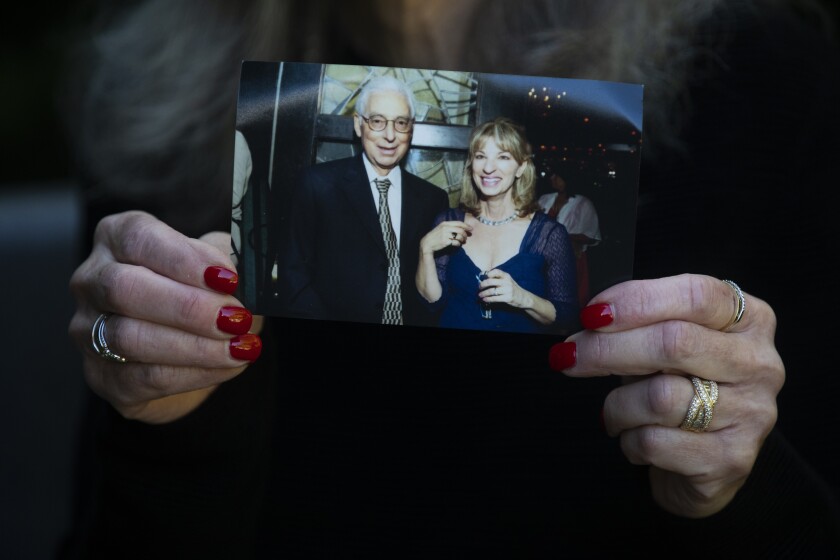
“That’s not him,” she said, pulling out a photograph from better times.

On the sixth day, the staff invited Mrs. Oltzik and their son into a cozy meeting room, equipped with an overstuffed couch and chairs. They were joined by Dr. Halbridge; Barbara Walsh, a nurse managing the hospice team; and Lynne Kiesel, a medical social worker, who called the Oltziks’ daughter, Barbara Ladin, in Florida, and put her on a speakerphone.

“We have these meetings to talk about how you’re doing, how he’s doing, and to give you a chance to ask us questions,” Ms. Walsh began, then turned to Dr. Halbridge, who signaled his profession with the stethoscope wrapped over his dark blazer like a shawl.

“Our biggest challenge was to try to get him not to be so agitated,” Dr. Halbridge began.

The staff had tried to calm him with various medications by mouth, without success. “So we put him on an IV medication, which is dripping in at a continuous rate,” he said.

The doctor pressed ahead, in a cheerful, upbeat voice, tinged with regret, saying that the staff had to decide what was better for Mr. Oltzik in the long run and wanted the family’s opinion. His was falling, “which implies that his body is slowing down, but he’s comfortable, and that’s what we’re looking for,” Dr. Halbridge continued. (Low blood pressure can be a side effect of Ativan and Roxanol, according to the drug manufacturers, as well as a consequence of the dying process.)

Ms. Walsh added consolingly, “He really looks like he’s sleeping.”

She said, apologetically, that the hospice had tried to find a balance between controlling Mr. Oltzik’s agitation and making him too sleepy.

“We did go to this IV as kind of a last measure, because we know that people do get sleepy and may not be as responsive, and we know how hard that is for the family to see,” she said.

Mr. Oltzik’s daughter zeroed in on the question that had been hanging over the discussion: “This is the end?”

“Yes, pretty much,” Dr. Halbridge said, “because what we’re seeing is a man who had a rather significant blood pressure on admission, and over the past day now, and today again, his blood pressure is even lower. So we’re talking about a poor prognosis and a shorter time.”

Mr. Oltzik’s son detected an almost imperceptible change in his mother. “Stay calm,” he urged her.

Moments later, the social worker gently entered the discussion, saying, “You’ve given him excellent care at home.”

“I worked very hard,” Mrs. Oltzik said.

Although throughout the half-hour meeting the staff had never explicitly asked to continue sedating Mr. Oltzik, his daughter now gave them tacit permission: “We understand that the inevitable is here, but we wish him to go in peace and to find solace in that,” Ms. Ladin said.

When the conference was over, Mrs. Oltzik still seemed to be ruminating. As many relatives do, she had hesitated over whether her husband should be given and water through tubes, now that he could not feed himself. The thought of someone dehydrating or starving is one of the most difficult emotional burdens for families, and was the crux of the famous fight over , a vegetative Florida woman whose husband wanted to let her die, but whose parents did not.

Palliative care doctors generally agree that sedated patients do not feel pain from or starvation, and that food and water may only prolong agony by feeding the fatal disease.

Mrs. Oltzik had done some research, and decided that nutrition and water would only burden her husband’s system. “The idea is now not to make him work harder, but to be as peaceful and calm as he can,” she said. “Common sense dictates that that would be the way to go.”

Much of the conversation had proceeded not in black and white like a legal document, but in shades of gray. By the end, they all seemed to understand one another, though ultimately Mrs. Oltzik would express some sadness at being unable to interact with her husband.

The Family’s Dilemma
From Karen Foster’s perspective, watching her husband, Frank, die while sedated was the least in a series of cruel blows. Mr. Foster, who arrived at the Franklin hospice about the same time as Mr. Oltzik, had stoically hidden his from his family for years. As recently as October, he was still driving, Mrs. Foster said; then he suddenly went downhill.

The night before Thanksgiving, her husband was acting bizarrely, and soon he was admitted to the hospice, Mrs. Foster said. Dr. Halbridge put him on morphine for pain and Ativan to calm his shortness of breath and . It was terminal sedation, Dr. Halbridge said, but Mr. Foster’s liver was failing so rapidly that no medication could have hastened his death.

Mrs. Foster sat stiffly at his bedside in a cloche hat and long coat, as if she expected him to go any second. She said she was relieved that her husband was no longer suffering. The sight of him sedated, his mouth open in a premonition of death that some doctors call “the O sign,” was less shocking than the disease he kept secret, she said.

But families sometimes push back. Marguerite Calixte, a day care worker, asked Dr. Halbridge to wake her husband out of deep sedation — begun the day before because he had trouble breathing — so she could say goodbye.

Her husband, Alix, who was 53, had trained as a nurse and had told her that if he was going to die of his , he wanted to die at home, with his wife and their two teenage children.

On a Thursday night, Dr. Halbridge began decreasing the morphine drip, and by the next morning, Mr. Calixte’s eyes fluttered open. “I’ve been talking to him,” his wife said on Saturday, in Haitian cadences. “I say, ‘If you want to go home, squeeze my hand tight.’ He keep doing it over and over.”

Ms. Walsh, the team manager, patiently gave Mrs. Calixte a lesson in how to take care of her husband, but doubted that he would be able to go home on Monday, and she was right.

He died that Saturday night, when his wife went home to have dinner with their children.

Mrs. Calixte believed the morphine was to blame. “He died quicker,” she said. “I don’t know when it was going to be, but it wasn’t going to be now. The thing is, he was going to suffer. I know that. But he wasn’t going to die so quick.”

Dr. Halbridge said there was “no way of knowing which would have taken him sooner,” the medication or the disease. He said the conflict between his desire to make Mr. Calixte comfortable and Mrs. Calixte’s wishes made the case “a tough one, I admit.”

Teaching a Difficult Subject
The has endorsed “palliative sedation to ” and in 2008, the issued a policy statement supporting palliative sedation, except when it is used primarily for emotional distress. Even the , while rejecting a constitutional right to physician-assisted , has opened the door to palliative sedation.

There is general agreement that “a patient who is suffering from a terminal illness and who is experiencing great pain has no legal barriers to obtaining medication, from qualified physicians, to alleviate that suffering, even to the point of causing unconsciousness and hastening death,” Justice wrote in a 1997 case, .

One provision of the House health care bill, which passed in November, recognizes that palliative care may include treatment “furnished for the purpose of alleviating pain or discomfort, even if such use may increase the risk of death.” The bill — but not the Senate version, passed on Thursday — also allows doctors to be reimbursed for discussions with patients about what treatments they would want or decline. This gave rise to charges by some Republicans that “death panels” would be convened to decide who deserves life-saving treatment.

Amid the furor, the bill was revised to make clear that patients would not be forced to forgo treatment.

Terminal sedation remains touchy enough that last month, Dr. Lyla Correoso, Bronx medical director of the Visiting Nurse Service of New York, and Dr. Shaiova spoke with doctors, nurses, administrators and social workers at Metropolitan Hospital about how to explain the process to families and colleagues, so no one would feel guilty or betrayed.

The title of the lecture, projected on a giant PowerPoint screen, conveyed the crux of the dilemma: “The Double Effect: Is it the Drug or the Disease?”

“Some people speculate that people are really covering up the fact that this is really perhaps a type of euthanasia or maybe something else that’s really afoot,” Dr. Correoso said. “You have to have good overall intent, and most physicians, that’s what we’re here for — we’re here to do something good.”

She advocated setting “goalposts” in advance, by asking patients to stipulate “the farthest line I’m not going to cross” — including sedation.

The most pointed questions came from a chaplain, Rabbi Isaac H. Mann. Was it possible, he asked, that a person under deep sedation could still be feeling pain, and how would the staff know?

“Yes,” Dr. Shaiova replied. But they often expressed pain through agitation or grimacing, she said, adding, “Err on the side of treating them” with pain-controlling drugs.

The chaplain pressed for more clarity, even after the meeting had broken up. Was she trying to say, he asked Dr. Correoso, that if morphine killed a patient, “you wouldn’t mind?”

“Then you’ve already broken the principle of double effect,” Dr. Correoso replied.

“The doctor knows that this can kill the patient,” Rabbi Mann insisted.

“The doctor doesn’t know,” Dr. Correoso said. Then she repeated a refrain often heard in the world of palliative medicine: “It’s not easy to kill a patient. People think it’s easy, but it’s really not. That’s why Dr. Kevorkian had to use all that” combination of drugs.

The Gray Zone
On the day Dr. Shaiova and Dr. Correoso lectured on terminal sedation, they were also consulting with a patient at Metropolitan Hospital who was dying of lung cancer. The patient, Gloria Scott, 50, had learned of her cancer in June.

End-of-life treatment often has a kind of studied ambiguity to it, and such was the case with Ms. Scott.

After she was moved to the hospice wing of in Jamaica, Queens, she received fentanyl, a synthetic opioid pain reliever, through an IV line that gave her the drug continuously, and allowed her or a nurse or doctor to push a pump for more when she had “breakthrough” pain. Under her right ear, she wore a scopolamine patch, used to reduce secretions. Scopolamine has sedative and mood-altering properties, and was once combined with morphine to induce “twilight sleep” for women giving birth. Ms. Scott also had standing orders for Ativan, the sedative, and Haldol, for delirium, two more drugs in the palliative sedation arsenal.

At first, though in pain, she was lively. She sat on the bed in the lotus position, which eased her pain, and in her Betty Boop voice, punctuated by an infectious giggle, she talked about her favorite Motown music and her plans to get a business degree.

She fiercely resisted signing a “” order, although she would later change her mind. “I don’t know when is my last day,” she said. “I might outlive one of you all.”

She asked her doctor at the hospice agency, Erik Carrasco, to keep the fentanyl, which she had begun taking at the hospital, turned down low. Otherwise, she said, “you sit here and you nod. I don’t want to be like that.”

Two weeks later, the change in Ms. Scott was marked. She was still alive but dessicated and barely responded to visitors. Her companion, Milton Cruz, was troubled by her “semi-dreamland” state, as he put it, but was shy about asking questions.

In her last days, she lost the desire to eat or drink, though nurses continued offering food and water, Dr. Carrasco said. The textbook survival time for patients who stop eating and drinking is two weeks, Dr. Carrasco said, but he said he had seen people last longer — elderly people who had survived the Holocaust and “people who are waiting for someone, like a son.”

She died after 22 days. Dr. Shaiova said she did not consider Ms. Scott’s sedation to be palliative or terminal sedation, because that was not her doctor’s intention. Her body had sedated itself as a defense against the disease, Dr. Shaiova said, and she had been on fentanyl long enough to develop some tolerance, making it unlikely to have hastened her death.

“When you’re sick, you’re sick, and everything else is somewhere in the gray zone, and that’s the problem,” Dr. Shaiova said.

Dr. Carrasco said that while the medication might have contributed to her , he believed she had died a natural death. “What I’ve been seeing sometimes is you release the pain,” he said, “and even though you are using very small amounts of morphine or narcotic, they relax and pass away.”

The Semantics
Even when everybody agrees that terminal sedation is a humane response to unyielding suffering, many doctors seem to feel a prick of conscience.

“There should be ambivalence,” said Dr. Joseph J. Fins, chief of medical ethics at Weill Cornell Medical College. “If it became too easy and you weren’t ambivalent, then I would really start worrying about it. But the fact that you’re worrying about it doesn’t mean you’ve done something wrong.”

In a 1996 paper in the Journal of Palliative Care that is still debated within that community, Dr. J. Andrew Billings, a Harvard professor and palliative care doctor at , and Dr. Susan D. Block, a psychiatrist, took on the moral ambiguity surrounding terminal sedation. They argued that the main distinction between terminal sedation and euthanasia was time.

Terminal sedation would lead inexorably to death, but “not too quickly,” they said. They derided the rule of double effect in this context as a rationalization, a subtle cover-up, of what they called “slow euthanasia.”

Even a simple morphine drip, they said, could put patients into a stupor at the right dose or when combined with other drugs or when concentrated by the inefficiency of a damaged liver or kidneys.

“If the morphine drip becomes a code word for slow euthanasia,” they wrote, “laypersons may be increasingly wary of the other uses of opioids.”

Both Dr. Billings, who is still at Harvard, and Dr. Block declined requests to be interviewed.

The authors did not endorse euthanasia, but their arguments have been used by others looking to make the case for public acceptance of euthanasia, to the dismay of some doctors who defend terminal sedation.

People who adopt this argument say, “We know what you’re really doing, it’s crypto-euthanasia,” Dr. Fins said. “Polemics really have no place at the bedside.”

Dr. Fins said he sometimes told families that terminal sedation was altruistic, because they might be giving up an extra day or two “of communication with the person you love in the service of that love.”

As for the argument that double effect is overly scholarly, Dr. Fins said: “I can’t imagine a world at the end of life without double effect. We’d be highly impoverished without it, and patients would suffer needlessly without it. We do need our philosophical contrivances in order to be pragmatic physicians and caregivers.”

Ambivalent, Then Accepting
Mr. Oltzik died two days after the meeting between Dr. Halbridge and his family, and Dr. Halbridge was frank in describing his treatment.

Asked if he would call it palliative sedation, Dr. Halbridge said, “This would be called terminal sedation, almost.” He said he hesitated only because the word “terminal” sounded negative and might make the family feel bad, when “it’s really comfort care.” The terms “palliative” and “terminal” were interchangeable, he said.

Speaking with considerable passion, he said he saw himself as the doctor who would not “forsake” patients by telling them he could do nothing for them. If there was no cure, he could at least offer comfort. “We are not gods who can cure everything, and I think at some point in time you have to accept that,” he said, “and to me, it’s the mark of an honest doctor who understands when that time has come.”

The decision to administer terminal sedation was based on a review of the patient’s history that convinced him that Mr. Oltzik was “terminally agitated,” he said. “It means that he is entering the dying process and for whatever reason — whether it’s physical, spiritual — something is interrupting the peaceful passing, and to me, because it’s so uncomfortable for the family and for the patient, that’s the time to medicate the patient and make them comfortable, because no matter what you do, he’s not going to go back to the old Leo that he was.”

He then told a self-deprecating joke about a doctor who gets to the gates of heaven and demands to jump to the head of the line, only to be turned back by St. Peter. But St. Peter opens the gates to someone else carrying a doctor’s bag. “That’s God,” St. Peter explains. “He just thinks he’s a doctor.”

Young residents often challenge him, saying things like, “If I’m 105 years old, I want to be fed, no matter what,” Dr. Halbridge said. His response is, “O.K., but did you ask your patient what he wants?”

Some patients are getting “multimillion-dollar workups” in the intensive care unit, he said, but make their wishes known by pulling out tubes. “I think a light bulb should go off in somebody’s head after the third time he pulls it out. Am I going to change the outcome of this, and if I’m not, why am I doing it?”

At one point, however, Mrs. Oltzik changed her mind.

“She was having second thoughts on that, and then she was saying, ‘I wonder if we should cut back on his medication,’ ” Dr. Halbridge said.

She hoped for a last chance to communicate with her husband, but Dr. Halbridge said he warned her that Mr. Oltzik was more likely to wake up agitated and suffering. Dr. Halbridge did not want to feel like he was experimenting. “I have a little bit of a problem with using the patient as kind of a guinea pig and saying, ‘Well, the medication worked nicely, now we’ll take it away and see if they bounce back the other way,’ ” he said.

Did he wake Mr. Oltzik? There was no need, Dr. Halbridge said: “He passed away within a couple of minutes.”

A couple of weeks later, Mrs. Oltzik still felt a bit uneasy. “They had him so heavily sedated that he was in a stupor,” she said. “I didn’t say goodbye to him, which hurts me.”

But she did not fault the hospice team’s judgment. She could not think of any other way to handle her husband’s agitation. As to whether his death had been speeded up, even a tiny bit, she said philosophically, “There was no way of knowing.”

This article, Hard Choice for a Comfortable Death: Sedation, first appeared in The New York Times.

Full Article & Source:
Hard choice for a comfortable death: Sedation

Friday, August 9, 2024

Home health aide caught snooping around Fayette County home, family says

By Erika Stanish


PITTSBURGH (KDKA) — A Fayette County family is waiting for answers after their home health aide was caught on camera snooping through their things. 

That aide is under investigation by her employer, Caring Mission Home Care, after videos show her with a flashlight apparently going through the family's things while she was supposed to be caring for her hospice patient. 

"It went on for hours," said Terry Christopher, the patient's daughter. "She would pace around the kitchen looking at different things in my home. And then she started going through my cabinets, my drawers."

Christopher said her father, Roger Porter, was approved by the VA for 40 hours a week of home health care after going to hospice. That is when the family hired the home health aide, who started on July 29, to care for her father overnight. 

KDKA-TV blurred her face and has chosen not to release her identity as charges have yet to be filed. 

"When she got here initially, I told her I have a camera," Christopher said. "They record all the time. There's one right here in the kitchen, which I showed her, and then I showed her the one in his room also." 

While Christopher and Porter were sleeping, she said her cameras caught the aide going through their things on her first night on the job. 

"In the video, you can hear a knock something over and then she looks to see if she woke him up. And she did not. So, she continued to search," Christopher said. 

The family said they feel violated and believe the aide should no longer have a job in home health. 

"I don't want anyone else to have to go through this," Christopher said. "I don't want anyone to have to feel violated like I feel."

Caring Mission Home Care released a statement and said it has seen the videos and is concerned about the circumstances. 

"Caring Mission Home Care is currently investigating the incident. It's a personnel issue and we cannot discuss that publicly at this time," the statement said, in part. 

Full Article & Source:
Home health aide caught snooping around Fayette County home, family says

Thursday, June 6, 2024

Woman Found Breathing at Funeral Home Has Died

Story by Evann Gastaldo


 A woman in Nebraska who was pronounced dead at her nursing home only to be discovered breathing by a funeral home employee two hours later has died, reports the New York Times. The woman died Monday afternoon, after being transported from the funeral home to a hospital in Lincoln. An investigation into what happened is underway.

A 74-year-old woman who was in hospice care at a Nebraska nursing home was pronounced dead Monday morning and transported to a funeral home—where she was discovered to actually be alive. A funeral home employee noticed her breathing about two hours after she'd been pronounced dead, and called 911 immediately, ABC News reports. Funeral home staffers performed CPR on the woman, and she was taken to a local hospital. She was still alive as of Monday afternoon, Fox News reports.

"It's a very unusual case," the Lancaster County Sheriff's Office chief deputy told reporters. "Been doing this 31 years and nothing like this has ever gotten to this point before." No criminal charges are currently pending, he said. "We have not been able to find any criminal intent by the nursing home but the investigation is ongoing," he added. Since the woman's death was anticipated and not suspicious, the nursing home was not under an obligation to notify local authorities or the coroner's office after her death. 

Full Article & Source:
Woman Found Breathing at Funeral Home Has Died

Tuesday, June 4, 2024

Former resident, families question care at Garretson nursing home

Several families are speaking up about their concerns for their loved ones in a Minnehaha County nursing home.

By Beth Warden

GARRETSON, S.D. (Dakota News Now) - Several families are speaking up about their concerns for their loved ones in a Minnehaha County nursing home.

In her cozy apartment, a woman who wished to remain anonymous is grateful for every day she can wake up in her own bed.

When she had to move into a nursing home herself, she never dreamed how bad it would be. In 2021, she was placed at Palisade Healthcare Center in Garretson.

“I had a huge bedsore while I’d only been there for two weeks. It took a long time, of healing, a lot. It was horrible,” the woman recounted.

Meanwhile in Texas, her daughter, who also worked in a nursing home for 18 years, had concerns.

“She didn’t go there to get worse. She went there to get better,” the daughter expressed.

When learning of the bedsore, she called the state.

Her mother eventually recovered and never wants to see the inside of Palisade again.

“I just love life because I do remember how horrible my experience was. Horrible. It’s a miracle I actually got to come home,” the woman said.

Sheri Rokusek’s experience ended with a broken heart. She always had a soft spot for her brother Jerry Erhart.

“[He had a] political science degree, wanted to be a teacher, joined the National Guard. And unfortunately in his 30s, he began to show signs of schizophrenia.” Sheri explained.

While living in the Yankton Human Services Center with his health declining, a state-appointed guardian looked for a nursing home for Jerry. Last November there was an opening at Palisade.

“And I had concerns right away. I did bring those to her attention. And her answer was that she hadn’t had any problems with them,” Sheri recalled.

Sheri hoped to visit her brother in the spring, but that ended with a phone call.

“He passed away at 2:30 in the morning. And I didn’t get a call until almost 10:00 a.m.,” Sheri said.

That’s when the family learned for the first time, that Jerry had been in hospice and had never been notified.

“Hospice versus saying Garretson should have contacted us and Garretson is saying hospice should have contacted us,” Sheri recalled.

Our team spoke with Lordes Parker, the Executive Director at Palisade Healthcare, offering to interview her and any satisfied patients. We have not received a return call.

Parker said that all of the Department of Health’s reports on the home, like an 86-page list of deficiencies in 2021, are in a notebook on-site for all to review. The Department of Health said those reports are unavailable online.

The 2021 reports found health, safety and care deficiencies, such as bedsores, not properly clothing residents, staff not using proper hygiene, overdue fire sprinkler certifications, and undelivered mail.

If you have a loved one in need of nursing home care, these families offered advice from their experience.

“Have the care plan. Go over the care plan, you know, really get involved in their care. And if they know that you’re there for your loved one. They’re more likely to follow the rules and regulations,” the daughter said.

“If you are not getting the information you need, go find somebody that will give you the information. So you can have the opportunity to say goodbye to your loved one,” Sheri said.

Full Article & Source:
Former resident, families question care at Garretson nursing home

Friday, November 26, 2021

Bobby Schindler: Health Care's March Toward Death


On September 6th, 2021, Jean-Pierre Adams died at the age of 73. You would have never heard of Adams if not that he was a former French professional soccer player. However, what made Adams’ death newsworthy was that his extraordinary wife Bernadette dedicated her life to caring for Jean-Pierre when he sustained a brain injury after knee surgery complications.

Jean-Pierre never regained full consciousness and for 39 years he was dependent on his wife for care. From the day Bernadette brought Jean-Pierre home she was at his bedside, never at any time contemplating ending his life by removing his feeding tube. She taught the world a lesson of unconditional love.

Sadly, we don’t hear enough of these stories. Certainly, there are families who are caring for the “Jean-Pierre’s”, but the reality is that the media – and more troubling – our health care systems, are inculcating the public into their earthly worldview, fostering a culture that accepts the denial of life-affirming care, even if the “care” is ordinary – food and water – based on a person’s utility, as was in the case of my sister, Terri Schiavo.

In fact, it was 18 years ago on October 21st, 2003, when the Florida Legislature passed a bill granting the governor, Jeb Bush, the power to reinsert Terri’s feeding tube after it had been removed for six days. That day marked the beginning of my family’s experience with corporate media and how they would launder the truth of Terri’s situation and condition with “right to die” propaganda.

Full Article and Source:
Health Care's March Toward Death

Friday, July 2, 2021

Elderly man charged with murder is in hospice care

YOUNGSTOWN — An arrest warrant is in effect for an elderly man charged in the 2019 death of a fellow nursing home resident, but it’s unlikely he will see the inside of a courtroom.

During arraignments Tuesday in Mahoning County Common Pleas Court, defense attorney Frank Cassese told Magistrate Dominic DeLaurentis that Horace A. Landers of High Street is in hospice care.

Assistant prosecutor Rob Andrews said he does not believe law enforcement will pick up Landers, apparently because of Landers’ medical status. Landers was scheduled for an arraignment last Tuesday and again this Tuesday in the murder case.

An arrest warrant was issued for Landers when he was indicted, and that warrant is still in effect, Andrews said. The magistrate said the warrant will remain in effect.

Landers is charged with murder and felonious assault, accused of causing the death of Watson R. Wilcox Jr., 89, in Windsor House Guardian Healthcare Center, 1735 Belmont Ave., July 24, 2019.

Wilcox’s death certificate in January 2020 listed his manner of death as undetermined. But after a follow-up investigation by the state, Mahoning County Coroner D. David Kennedy changed the ruling to homicide early his month.

Wilcox died Aug. 6, 2019, after he was found on the floor of his room at the nursing home with a head injury. A Youngstown police report states that officers were called to the nursing home at 3:32 a.m.

Wilcox was found on the floor with a swollen eye and nose with bleeding from the mouth. He had bruising on his right shoulder.

Full Article & Source:

Saturday, May 22, 2021

Pinellas hospice collected millions from flawed Medicare claims, audit says

The Hospice of the Florida Suncoast disputes many of the findings. The federal government says much of the money should be refunded.

During a federal audit, investigators reviewed a sample of 100 Medicare claims from The Hospice of Florida Suncoast Inc. and concluded that 49 did not comply with requirements. Suncoast disagreed with all but two of the questioned claims. [ Times (2006) ]

A Clearwater-based hospice provider received $47.4 million in Medicare reimbursements that did not comply with requirements over a two-year period, according to a federal audit released Monday.

The inspector general of the U.S. Department of Health and Human Services recommended that Suncoast Hospice — which operates three hospice care centers — refund to the federal government the portion of the $47,363,971 that is within a four-year “claims reopening period.”

Also, the inspector general’s office recommended that the hospice, formally known as The Hospice of the Florida Suncoast, Inc., strengthen policies and procedures to ensure that services comply with Medicare requirements.

According to the audit, the hospice provided services to about 12,400 beneficiaries and received Medicare reimbursement of almost $149 million from July 1, 2015, to June 30, 2017. Investigators reviewed a sample of 100 claims and concluded that 51 complied with requirements but 49 did not.

Of those 49 claims, clinical records did not support patients’ terminal prognosis in 30 cases. Also, in 20 claims, the clinical record did not support the level of care claimed for Medicare reimbursement.

In two cases, Suncoast claimed “service intensity add on” payment for services that were not provided, according to the report. In three claims, more than one error was found. Medicare provides health insurance coverage to people ages 65 and older, people with disabilities and people with end-stage renal disease.

To qualify for Medicare hospice care, patients must be eligible for what is known as Medicare Part A and be certified by a physician as being terminally ill or having a life expectancy of six months or less. Suncoast Hospice disputed the audit’s findings.

“Specifically, Suncoast disagreed with all but two of the 49 sample claims questioned in our draft report,” the audit said. “Accordingly, Suncoast does not believe it was overpaid for hospice services except for the two claims it agreed were in error.”

Suncoast Hospice is part of the non-profit Empath Health. It has two satellite offices along with three inpatient units in Pinellas County.

Full Article & Source:

Monday, April 12, 2021

Woman Who Loves Horses Gets The Sweetest Surprise In Her Final Days

By Stephen Messenger

When Rita Meredith was younger, she had earned the distinction of being the first woman to serve as a mounted police officer in the United Kingdom. But clearly, working alongside horses was something far more than just a job.

And decades later, her love for those animals never faded. And it showed.

Posted by Emily Sykes on Tuesday, March 9, 2021

Meredith, who later moved to Australia, passed away earlier this month at a New South Wales hospice facility. But her final days were among her most joyous, thanks to a very special surprise visit she received.

"Her main wish before she passed was to smell/see a horse for one more time," Sykes wrote.

Meredith's final wish was fulfilled.

Posted by Emily Sykes on Monday, March 8, 2021

Learning of Meredith's desire to be in the company of horses one last time, members of the NSW mounted police decided to drop by the hospice facility for a meet and greet.

"They travelled all the way to Newcastle today to see Rita and make her wish come true," Sykes wrote. "Police officers Graham and Nicole were accompanied by the very handsome Hollywood and Don, and they sure made Rita’s day."

Posted by Emily Sykes on Monday, March 8, 2021

According to Sykes, Meredith gave the horses apples and plenty of pets. It was a chance for her to reconnect with animals she'd long held dear.

Posted by Emily Sykes on Monday, March 8, 2021

"There were plenty of tears shed and beautiful memories made," Sykes wrote.

Posted by Emily Sykes on Monday, March 8, 2021

Meredith reportedly passed away two days after that special surprise. The legacy of her lifetime of love for horses, however, lives on in the hearts of all who knew her. And to see her final with fulfilled is something Meredith's family won't soon forget.

"I cannot thank the NSW police for making this happen," Sykes wrote. "You have made this lovely lady's wish come true, and did it with such professionalism, respect and grace. On behalf of Rita’s family and friends, THANK YOU!"


Full Article & Source:

Monday, January 4, 2021

End-of-life care has boomed in California. So has fraud targeting older Americans

Ellie Craig Goldstein holds a pouch containing sentimental items from her brother, Peter Craig. Three years after Peter’s death, his sisters Ellie and Joyce Craig are haunted by the memory of his final hours.
(Francine Orr / Los Angeles Times)

By Kim Christensen, Ben Poston

Martin Huff was 67 when he fell off his bicycle, banged up his knee and spent a couple of hours in a Riverside County emergency room before walking out under his own power.

Ten days later he was in hospice care, diagnosed as terminally ill by a small Covina provider of end-of-life services that said he was weak and wasting away, with six months or less to live.

Five years after that grim prognosis, however, Huff was still very much alive. He testified in federal court that no one from California Hospice Care had ever given him a medical exam before claiming he was dying.

“I really never knew exactly what the deal was on the hospice,” he said.

Huff is among a legion of mostly older Americans targeted for audacious, widespread fraud in an industry meant to provide comforting care in their final days, a Los Angeles Times investigation found.

Like Huff, many are unwitting recruits by unscrupulous providers who bill Medicare for hospice services and equipment for “terminally ill” patients who aren’t dying.

Intense competition for new patients — who generate $154 to $1,432 a day each in Medicare payments — has spawned a cottage industry of illegal practices, including kickbacks to crooked doctors and recruiters who zero in on prospective patients at retirement homes and other venues, The Times found.

The exponential boom in providers has transformed end-of-life care that was once the realm of charities and religious groups into a multibillion-dollar business dominated by profit-driven operators.

Nowhere has that growth been more explosive, and its harmful side effects more evident, than in Los Angeles County.

The county’s hospices have multiplied sixfold in the last decade and now account for more than half of the state’s roughly 1,200 Medicare-certified providers, according to a Times analysis of federal healthcare data.

Scores of providers have sprung up along a corridor stretching west from the San Gabriel Valley, where California Hospice Care was located, through the San Fernando Valley, which now has the highest concentration of hospices in the nation.

“There are too many providers in L.A. County, and too many providers who are in it for the wrong reasons,” said Edo Banach, who heads the National Hospice and Palliative Care Organization, the largest U.S. trade group for hospices. “Folks who go into this for the wrong reason generally do not do a good job.”

Much more than money is at stake.

Some patients who unknowingly enrolled in hospice later discovered they had signed away their rights to lifesaving emergency medical treatment, state inspection records show. Others endured excruciating pain in their final days when providers failed to deliver the comforting care they desperately needed.

Still others suffered the consequences of neglected, festering sores that developed maggots or resulted in hospitalizations.

Privacy laws and government reports that keep the names of patients, doctors and hospice administrators confidential make it difficult to quantify and humanize many of the cases.

But The Times found that since 2008, regulators have cited hospices in California more often than anywhere else in the country for the most serious types of violations, four times as many as states such as Texas and Georgia, which also have large numbers of providers.

Despite those citations, California and federal regulators have rarely fined, suspended or shut down deficient hospices, state reports show. Oversight has been weakened further during the COVID-19 pandemic, as regulators suspended requirements for most hospice inspections and limited the types of complaints they investigate.

California, which has among the lowest barriers to setting up a new hospice, also leads the nation in violations for enrolling patients without medical proof they were terminally ill.

The Times’ analysis revealed that Los Angeles County hospices discharged patients 80% more often than providers nationwide, highlighting a rate that federal authorities say is a red flag for Medicare fraud.

California Hospice Care claimed that Jesse Staten suffered from terminal heart failure when it signed him up for end-of-life treatment. His predicted six months to live expired in 2012, but he didn’t: When The Times contacted him eight years later, he was still going strong.

“I’m hanging in,” said Staten, 75. “I’ve got a lot of issues in my blood and I have other issues, but I can’t complain.”

Federal prosecutors accused California Hospice Care of bilking taxpayers of $7.5 million in illegal payments in connection with Staten, Huff and scores of other ineligible Medicare recipients. The hospice owner and two doctors were sentenced to prison, and several others were convicted or pleaded guilty in the scheme.

Many of the hospice’s patients were addicts lured by the promise of free narcotic painkillers, prosecutors said.

Some were enlisted by a doctor who collected a bounty from the hospice on each, according to his indictment.

One was a 47-year-old woman who lost her place on a waiting list for a liver transplant when she signed up for hospice, which prohibits curative care. It took her months to get reinstated, and she died not long after finally receiving a new organ.

“That’s the last hope, and having that person removed from the liver donor list by placing them in the program is conduct that is hard to understand,” U.S. District Judge S. James Otero said when sentencing a hospice nurse to 18 months in prison. “That’s callous.”

::

Conceived as an end-of-life option for terminally ill patients, hospice care properly delivered has been a godsend for millions of dying Americans and their families. It provides palliative care and prescription drugs, nursing services, medical equipment, supplies and spiritual counseling for those given a prognosis of six months or less to live.

The U.S. hospice industry took root in the mid-1970s but flourished only after Medicare began covering its services in 1983. For-profit providers sprang up to meet a growing need that outstripped the capabilities of charities and religious institutions that pioneered end-of-life care.

In the last 20 years, the number of U.S. providers has roughly doubled, while Medicare spending on hospice has grown sixfold, to $19.2 billion a year. More than 1.5 million Medicare beneficiaries now receive care from some 5,000 hospices, nearly a quarter of them in California.

“Virtually all of the growth is of for-profit providers, which appear to be crowding out the local nonprofits that established the hospice model and had a desire to maintain its integrity,” said Michael Connors, a long-term care advocate with California Advocates for Nursing Home Reform.

For-profit operators now make up 70% of all hospices certified by the Centers for Medicare and Medicaid Services and 91% of those in California. In Los Angeles County, they account for 97%.

Many provide excellent care.

Satisfaction surveys reported by hospices nationwide show that more than 80% of respondents rate their hospice as a 9 or 10 out of 10, but in L.A. County that figure drops to 74%. Respondents in L.A. also were less likely to report that hospices always gave them the help they needed.

Most hospice care is provided in patients’ homes, but services also are rendered at stand-alone facilities, nursing homes and assisted-living centers. Regulatory inspections and financial audits are infrequent, making the system a soft target for scammers.

Complaints about shady operators began lighting up the California Senior Medicare Patrol hotline in mid-2017 and have not let up, said Sandy Morales, who oversees the federally funded statewide hotline whose mission is to help Medicare beneficiaries prevent, detect and report fraud.

“It’s all over Southern California: Riverside County, Hemet, Indio, Long Beach, Los Angeles, Bakersfield,” she said. “Right now, it’s huge.”

Since January 2019, her agency has forwarded more than 100 cases of suspected hospice fraud to federal investigators, Morales said. One doctor’s office in Los Angeles County recently reported that 10 patients appeared to have been fraudulently enrolled by a hospice.

Fraudsters stick to a familiar script, enticing or duping Medicare recipients into signing up for services they don’t need, she said. They send recruiters door to door and to churches, food banks, senior centers and apartment complexes, often misrepresenting hospice as an “extra” Medicare benefit that pays for nursing visits, hospital beds or other needs.

‘It makes no sense. I can’t imagine there are 60 hospices in Burbank that are doing it the right way. There can’t be enough people for 60 hospices there.’

Jan Jones, recently retired CEO of the California Hospice Network

The pandemic has spun off new schemes, she said, with unscrupulous recruiters now enticing prospects with hand sanitizer, gloves and promises of other COVID-19 “freebies.”

Many who sign up don’t even realize they are in hospice care.

“They’ll say, ‘No, I’m not dying. I wanted help with housekeeping and cooking, and that’s what I signed up for,’” Morales said.

In May 2017, the daughter of an Alzheimer’s patient told a state investigator that a marketer for All Seasons Hospice in Paramount signed up her mother with a promise of 24-hour nursing care. When no one showed up, she called the hospice and was told the only 24-hour service was by phone.

The hospice administrator acknowledged the bogus sales pitch but mostly shrugged it off.

“It is a dog-eat-dog situation out there, very competitive,” the administrator told inspectors, according to a state report that did not name the employee. “I have no control over what these marketers say or do. They do what they want and promise anything to get the patient.”

The Centers for Medicare and Medicaid Services did not respond to specific questions about the extent of hospice fraud but said in a statement that the agency aggressively seeks to ferret it out.

“CMS identifies fraud, waste and abuse in hospice services utilizing cutting-edge data analytics, medical review and program integrity investigations,” it said. “In instances of potential fraud, CMS refers those providers to law enforcement for further criminal investigation and for appropriate administrative actions.”

The U.S. Department of Health and Human Services’ Office of Inspector General reported in July 2018 that inappropriate billing and fraud by hospice providers cost taxpayers “hundreds of millions of dollars,” but the full extent is unknown.

The watchdog agency declined to comment on the scope of hospice fraud and said it could not provide a count of cases it has investigated. The Department of Justice did not respond to repeated requests for its prosecution numbers.

But according to interviews with hospice providers and industry experts, and a review of law enforcement releases on individual cases, state licensing reports, lawsuits and federal data, fraud is widespread.

“Hospice fraud remains absolutely rampant in the United States,” said Mark Schlein, an attorney with the Los Angeles firm Baum Hedlund who specializes in hospice whistleblower lawsuits. He links the fraud in large part to the industry’s unfettered growth.

“That translates into much more money being paid to hospice companies by federal healthcare programs,” he said. “When Willie Sutton was asked, ‘Why do you rob banks?’ he said, ‘Because that’s where the money is.’”

::

More than two dozen hospices pepper a mile-long stretch of Victory Boulevard, an east-west artery in the San Fernando Valley. One well-worn office building in the 13600 block in Van Nuys is home to 15 providers.

“Hospices have been growing like mushrooms around here,” said one of the other tenants, who declined to give his name for fear of alienating his neighbors in the complex, where monthly rents start at an enticingly low $399.

Scores of others are in neighboring Valley communities, all part of a sprawling regional hotbed of for-profit hospices. Many are small operations, some purchased as investments by people with little or no healthcare experience.

Since 2010, the number of providers in Los Angeles County has skyrocketed from 100 to 618, federal data show.

North Hollywood is home to 35 hospices, while Glendale has 60, Burbank has 61 and Van Nuys 63.

By comparison, New York state and Florida both have fewer than 50.

With a population of 103,000, Burbank has a per capita rate of hospices that is nearly 40 times the national average, according to The Times’ analysis.

“It makes no sense,” said Jan Jones, recently retired chief executive officer of the California Hospice Network, a coalition of nonprofit providers. “I can’t imagine there are 60 hospices in Burbank that are doing it the right way. There can’t be enough people for 60 hospices there.”

New York, Florida and dozens of other states require prospective hospice owners to obtain a “certificate of need” to justify the demand for additional providers before they can get licensed.

California providers must be free of felony convictions, but there are few other qualifications for starting or operating a hospice beyond getting licensed by the state and certified by Medicare, a process that costs only a few thousand dollars.

“There is not a high-cost entry point to start a hospice program, unlike a hospital or a nursing home,” Jones said. “I think a lot of people think it is an easy business, which frankly I think is wrong. It is very complicated and complex, and very important to the people we serve.”

::

With the explosive growth have come serious quality-of-care issues.

The Times’ review of more than 800 state licensing and inspection reports revealed instance after instance in which patients were deprived of comforting care because of the actions — or inaction — of hospice providers.

Mismanaged pain medications, neglected infections, missed nursing visits, incompetent or dishonest home health aides — all were cited among hundreds of violations that required hospices to draw up plans to correct the problems but resulted in little or no disciplinary action.

A close-up of a woman's hands holding a photo of her brother and sister
Ellie Craig Goldstein holds a photo of her brother, Peter Craig, and sister, Joyce Craig. The sisters say they were traumatized when no one from hospice came during his final hours.
(Francine Orr / Los Angeles Times)

Patients suffered for lack of pain medication or had maggots crawling out of festering foot sores and head wounds, state inspection records show. Others died alone or without the help they needed because no one from the hospice showed up in their final hours.

“We will never heal from that devastation,” Joyce Craig said of the final moments of her brother, Peter Craig, 74, a partner in a Los Angeles accounting firm who died of cancer in 2017.

The California Department of Public Health licenses and regulates hospices to ensure they meet state and federal standards but has limited ability to punish offenders. The only fines it can impose are for breaches of patient confidentiality.

To qualify for hospice, patients must be certified as terminally ill by their attending physicians, if they have them, and by a hospice doctor. The certification process is ripe for fraud.

The Times’ analysis of federal data showed that California hospices led the nation in violations for enrolling nonterminal patients, logging 57 such deficiencies since 2008, nearly three-fourths of them in L.A. County.

The next closest states were Georgia and Louisiana with 22 each. But the actual numbers in California and elsewhere are probably much higher because of variations in how improper terminal diagnoses are coded and categorized by state inspectors.

At Eleos Hospice in Van Nuys, state officials who sampled five patients’ records in December 2016 discovered no evidence that any were terminally ill. The agency was “claiming or attempting to claim reimbursement for patients who did not need hospice care and services,” a licensing report noted.

All five were promptly discharged, but records show no action was taken against the doctor or hospice. The hospice has changed hands twice since then, according to a new owner who took over in August and said he was unaware of those deficiencies.

Inspectors found a similar scenario when they examined the records of two patients of Orion Hospice Care Services in Valley Village in November 2018.

The hospice’s medical director, in recertifying a patient as terminally ill, wrote that she was experiencing a steady decline in health and appetite and was losing weight. But that’s not what the patient told a state investigator.

“I did not have pain and my appetite is OK,” she said, “and I did not lose any weight.”

In fact, records kept at the board-and-care home where the woman lived showed she had gained 7 pounds over the preceding three months.

The hospice administrator declined to comment when asked by inspectors to explain, and the medical director admitted he’d never put the woman on a scale, describing a method akin to a guess-your-weight booth at a county fair.

“I assessed her weight by my own clinical measurement and judgment, not by any actual documented measurement,” the doctor said, according to a state inspection report.

State inspectors found no records to support either terminal diagnosis, nor do inspection reports reflect any disciplinary action against the doctor or hospice beyond requiring a corrective action plan.

For a patient at Guiding Light Hospice in Sun Valley, the assessment could not have been bleaker.

The woman was easily fatigued; needed help with feeding, dressing, bathing, toileting, walking, handling money and taking medications; and could speak “less than six intelligible words per day,” a state inspection record noted. She also was incontinent, had a history of falls and was forgetful, disoriented and confused, “with imminence of death.”

When interviewed by state inspectors, however, the woman, identified in a state licensing report only as Patient 1, said her only infirmity was some back pain from arthritis.

“Patient 1 stated she knew she was not ready to die, and laughed while denying she had a terminal diagnosis, and a life expectancy of six months or less,” according to the report.

The nurse who made the dire, detailed assessments insisted they were accurate, despite all evidence to the contrary. No disciplinary action was taken, but when inspectors returned for a follow-up 16 months later, Guiding Light had closed its office.

::

A pedestrian walks on a sidewalk outside a low-slung office building in the San Fernando Valley
This office building in the San Fernando Valley is home to several hospice providers. Since 2010, the number of providers in Los Angeles County has skyrocketed from 100 to 618, Medicare data show.
(Francine Orr / Los Angeles Times)

Karen Alvarez at first gave little thought to the visitors from Ace of Hearts Hospice who showed up at Lancaster’s Sierra Retirement Village with armloads of fast food. After all, the apartment manager said, many of her low-income tenants were grateful for a complimentary meal.

But Alvarez was soon struck by the aggressive tactics of the Ace of Hearts personnel, who took over the lobby every Wednesday and trailed residents back to their units to pitch them on “free” hospice care, hospital beds and motorized scooters, all billable to taxpayers.

“You know, hospice people are gentle and talk to you nice. They are understanding and kind,” she said. “They don’t come in swarming like bees, like these people did.”

Few hospices better epitomize the most serious problems that afflict the industry — or underscore the failure of regulators to address them — than Ace of Hearts.

More than a dozen patients were not terminally ill and should never have been enrolled, according to a felony criminal complaint and state reports that detail a litany of deficiencies.

Based in a small office on Foothill Boulevard in Tujunga, the hospice racked up at least 115 regulatory violations from 2014 to 2016, second most among the 1,200 California providers over the last decade, federal records show.

Details of the violations fill nearly 200 pages of state inspection reports chronicling mishandled medications, neglected sores and repeated missed visits by nurses and home health aides.

In one patient’s case, aides failed to show up for 18 straight visits over a span of several months.

“It must have been a computer glitch,” was how the Ace of Hearts administrator explained it to state inspectors, who found dozens of other missed patient visits.

Ace of Hearts owner Rozanna Avetyan, 42, who signed the inspection reports as the administrator, did not respond to requests for interviews left with a person at her Stevenson Ranch home and with a woman who answered her cellphone but would not identify herself.

Her attorney, Donald Marks, did not respond to repeated phone and email messages.

In 2016, the government paid the hospice about $450,000 for 29 patients, nearly two-thirds of whom were discharged alive, Medicare data show. Although hospice patients may be recertified to receive care for more than six months, federal officials say that very long stays and high “live discharge” rates are potential indicators of fraud.

Ace of Hearts’ 62% live discharge rate in 2016 was nearly six times the national rate that year, according to The Times’ analysis of Medicare data.

That October, state inspectors could find no evidence of terminal illness for three of 11 patients sampled. Some had been admitted by the hospice medical director, who signed certifications electronically, state inspection records show.

The unidentified doctor, whose office was in Palm Springs, more than 100 miles from Tujunga, told state officials he did not recall some of the patients and didn’t know how his signature wound up on their certifications.

“I do not like computers so I do not use them,” he said, according to a state licensing report. “I did not sign anything electronically.”

The improper certifications had serious ramifications: Some nonterminal patients who signed up were stunned to learn they had forfeited their existing medical coverage in the process, the report states.

At least two lost their HMO coverage when they were enrolled in hospice without being told they could refuse. One was signed up while in an assisted-living facility, the state licensing records show, and the other while residing in a board-and-care home.

“The HMO won’t even see him in the emergency room, and he does not understand it,” the board-and-care owner told state investigators, according to a state report.

When pressed for an explanation, the report said, the Ace of Hearts administrator blamed the board-and-care owner for referring the man, who developed serious bed sores while in hospice care.

“I had nothing but trouble with the board-and-care owner,” the administrator said. “Now the patient has multiple wounds. I told [his] caregiver that we don’t do wounds here.”

Poor wound care was nowhere more evident than in the case of one patient treated by an Ace of Hearts nurse who lacked enough clean gauze to dress a serious foot sore.

“She picked up the dirty discarded Kerlix dressing that was removed from the wounds that was soiled with a few spots of old red colored discharge and she re-used the old dressing on top of the clean dressing,” wrote a state inspector who witnessed the violation of infection-control protocols.

It was but one of a long list of serious deficiencies over the years.

“The cumulative effect of these systemic practices resulted in the failure of the hospice agency to ensure the provision of quality healthcare in a safe environment,” a 2016 inspection report said.

Despite that finding, however, Ace of Hearts continued to operate for three years. It eventually was undone not by state regulators but by its own weekly free-breakfast sales-pitch visits to Sierra Retirement Village and the nearby Aurora Village Retirement Center.

Alvarez, the Sierra complex manager, told The Times that two federal agents dropped by one day to grill her about the visits and kickback offers of up to $300 per patient by Avetyan, who also owned Team Hospice in Lancaster.

“I wasn’t interested in that at all,” Alvarez, who was not accused of wrongdoing, said of the kickbacks. “I said, ‘No, I have a job, I don’t need that.’”

Authorities had been tipped off by a county social worker who was surprised that a resident she was visiting had been given a “hospice bed” when she was not ill, Alvarez said.

In 2018, the California attorney general’s office filed fraud charges against Avetyan and four others, alleging that her hospices had billed Medicare and Medi-Cal for $1.2 million for ineligible patients.

Avetyan had paid more than $180,000 in kickbacks for illegal referrals, some of them by a woman who worked in a doctor’s office and gleaned names from the patient roster, prosecutors alleged in a criminal complaint.

A different physician, Dr. Blanca Galapon, now 80, was accused of falsely certifying a dozen patients as terminally ill in exchange for unspecified payments from Avetyan, according to the complaint.

Avetyan pleaded guilty in April 2019 to one count of conspiracy to pay and accept insurance kickbacks and was given a suspended six-month jail sentence and placed on four years’ probation.

Galapon and other defendants cut plea deals for deferred prosecution or probation.

In January, Avetyan was barred from all federal healthcare programs, including Medicare and Medicaid, for at least five years. By early this spring, both Ace of Hearts and Team Hospice had closed their offices.

But court documents and other public records indicate that Avetyan sought continued involvement in the hospice industry.

At least five hospices based at one Van Nuys office building appear to have been spun off directly from Ace of Hearts or have significant links to it, The Times found. Online biographies that list two young women as chief executives of the five hospices describe both as former Ace of Hearts employees.

One of them, Arpine Melikyan, is a 2019 graduate of Cal State L.A. who was an Ace of Hearts accountant and now heads up two other providers, Life Hospice and High Care Hospice.

In a 2019 lawsuit, Avetyan alleged that she agreed to pay Melikyan $5,000 a month and provide staffing and other resources in exchange for a 30% stake in the two hospices. Melikyan declined to comment on the lawsuit, which accuses her of reneging on the deal.

Avetyan is due back in court Dec. 16, accused of violating her probation.

Prosecutors would not provide details but said in an email to The Times that she continued to bill Medi-Cal for hospice services after being barred from the program.

Full Article & Source:

Friday, December 18, 2020

After lying about thousands of patients’ life expectancy, hospice care owner sentenced to prison, $120M fine

by Kate Winkle


AUSTIN (KXAN) — A hospice care owner told thousands of people they had less than six months to live, enrolled them in hospice programs and even sent chaplains to some of them to receive last rites. He lied, a federal jury in McAllen determined in November 2019. He was sentenced to 20 years in prison and ordered to pay $120 million in restitution on Wednesday.

The people Rodney Mesquias, 48, of San Antonio, defrauded included patients with Alzheimer’s and dementia, according to a release from the Department of Justice. Mesquias was CEO of the Merida Group, a health care company that had dozens of locations throughout Texas.

“Mesquias funded his lavish lifestyle by exploiting patients with long-term, incurable diseases by enrolling them in expensive but unnecessary hospice services,” said Acting Assistant Attorney General Brian C. Rabbitt of the Justice Department’s Criminal Division. According to a DOJ release, he used the money to buy a Porsche, expensive jewelry and luxury clothing, real estate and tickets for sporting events. It said he held “lavish parties” at Las Vegas night clubs and invited doctors who later gave him “medically unnecessary patient referrals.”

Mesquias was convicted of one count of conspiracy to commit health care fraud, conspiracy to commit money laundering, conspiracy to obstruct justice, six counts of health care fraud and one count of conspiracy to pay and receive kickbacks. A man officials describe as a “co-conspirator,” Henry McInnis, 48, was convicted on all but the kickbacks charges.

According to Special Agent in Charge Miranda L. Bennett, Mesquias paid kickbacks to physicians, falsified medical records and enrolled patients in “hospice care that prevented them from accessing curative care.” Bennett works for the U.S. Department of Health and Human Services Office of Inspector General’s Dallas Region.

Officials say the scheme involved $150 million in false claims between 2009 and 2018.

“Hospice services require patients to be suffering from a terminal illness expected to result in death within six months. Not only were patients not in such circumstances, they were walking, driving, working and even coaching athletic sporting events in some instances,” a DOJ release said. “However, Mesquias and others kept patients on services for multiple years in order to increase revenue.”

The DOJ says his case was one of the first criminal hospice fraud prosecutions it had brought to a federal jury. McInnis will be sentenced at a later date, according to a release, and two other co-conspirators have pleaded guilty and are waiting to be sentenced. Francisco Peña, 82, of Laredo, acted as a medical director for Merida Group and was mayor of Rio Bravo when he also pleaded guilty to charges, according to KXAN sister station KVEO. He died in November 2019.

Full Article & Source: