Showing posts with label Nichelle Nichols. Show all posts

Tuesday, April 16, 2024

Three Years After Britney, Wendy Williams Shows Celebrity Conservatorships May Still Be Toxic to Women

Amanda Bynes, Britney Spears, Wendy Williams and Nichelle Nichols. (Chris Smith/TheWrap)

Such court-ordered financial oversight arrangements “adversely and disproportionately impact women,” a lawyer told TheWrap 

by  Andi Ortiz

In 2022, Wells Fargo successfully petitioned a judge to put talk show host Wendy Williams under what was said to be a temporary financial guardianship. The judge froze her accounts and set a hearing to determine if a guardianship was needed, all while the talk show host disputed the decision and accused a Wells Fargo financial advisor of lying to get access to her accounts.

The guardianship became the subject of a documentary on Lifetime this year, and has drawn criticism from her family, who say they have struggled to get access to her for even a phone call as she languishes in a private facility to treat her cognitive issues. They, along with fans, are worried, especially in the wake of her aphasia diagnosis.

It’s not an unfamiliar story. Celebrity conservatorships have entered the mainstream over the last several years, largely in relation to a few famous women. The issue hit a boiling point with Britney Spears, whose 13-year involuntary conservatorship ended in 2021 following a movement fans dubbed #FreeBritney, culminating in multiple documentaries and emotional testimony from the pop star about her life under conservatorship.

Now, fans everywhere are locked on Williams, 59, hoping things don’t go south yet again.

Experts TheWrap consulted — including lawyers and professional therapists experienced in the area — said that while roughly the same number of women and men are put under conservatorships, female celebrities are often subject to adverse conditions. Men like Charlie Sheen have public meltdowns and are able to maintain control over their lives, while women like Spears are deemed unable to take care of themselves — or their wealth.

Conservatorships of celebrity women have become “almost a perverse financial incentive” for members of their families in some cases, Benazeer “Benny” Roshan, a partner at law firm Greenberg Glusker and chair of the Trust and Probate Litigation Practice Group, told TheWrap.

“They adversely and disproportionately impact women,” she said. “Look at the women that are under conservatorship that have regained their cognition and are still conserved. And then you see male examples.

“Did you ever wonder, why wasn’t Charlie Sheen conserved when he was dealing with bowls of coke, and hookers and whatnot? Why wasn’t Kanye West conserved?” Roshan continued. “It’s because, I think on some level, they’re men, and somebody’s like ‘We need to conserve you’ and he’s like, ‘No! I’m fine!’ … The inquiry stops there.”

Wendy Williams attends the world premiere of the Apple TV+ series “The Morning Show.” (Photo by Astrid Stawiarz/Getty Images)

​Indeed, Sheen ​suffered almost no career consequences for his public  meltdown in 2011, though he lost his sitcom, for which he was paid $1.8 million an episode in his last season. (He later received $25 million in a settlement with Warner Bros. Television and Chuck Lorre over his firing.) Quotes from the interviews that got him fired from “Two and a Half Men” became catch phrases (“Tiger Blood,” “Winning!”). In 2010, he pled guilty to misdemeanor assault and was removed from a hotel after causing $7,000 in damage during a bender.

At the 2011 Television Critics Association press tour, just prior to Sheen’s many drug-addled interviews, CBS’ then-entertainment chief Nina Tassler noted about the actor: “On a professional level, he does his job and he does it well and the show’s a hit, and that’s all I have to say.”

Within a month of losing “Two and a Half Men,” Sheen launched a sold-out comedy tour. That September he was the star of a Comedy Central roast​. And by 2012 he ​had a new sitcom, “Anger Management,” and new movie roles.

Spears, meanwhile, went from publicly shaving her head in February 2007 to an involuntary conservatorship in February 2008. She later testified that she was forced to continue working during that time, saying, “It was very threatening and scary,” and that she only went ahead with another tour “out of fear.”

Charlie Sheen in “Two and a Half Men” (CBS)

The singer also revealed she was forced to have an implanted IUD, preventing her from having more children. That imposed birth control appears to be a struggle unique to women under conservatorship as well. Tom Stenson, the deputy legal director of Disability Rights Oregon, told The Nation in 2021 that he’d never seen a case involving a man’s family seeking to sterilize a man.

“I’m sure somewhere out there, there’s somebody trying to get their son or brother with a disability sterilized,” he said at the time. “But I’ve had a number of these cases arise, and they are, in my experience and so far, all women.”

Differing perceptions of mental health

A conservatorship is put in place when it’s determined that someone cannot make necessary, safe decisions about their well being — physical, financial, or otherwise. Once that is proven to a judge, that person’s rights and decision-making are transferred to someone else, usually a family member or friend.

Those decisions are often subjective, as “every person operating within the larger guardianship system possesses some level of implicit bias,” according to the Justice in Aging organization.

Spears was 26 when she first was conserved. Former Nickelodeon star Amanda Bynes was 27. Lindsay Lohan’s father attempted, but failed, to get his daughter into a conservatorship at 26. Each of these came at a time when the young women were having public mental health crises.

In stark contrast, conservatorships of celebrity men have been largely due to cognitive decline from old age: Mickey Rooney (90), Casey Kasem (81), Randy Meisner (69) and, most recently, Brian Wilson (81). 

[Conservatorships] adversely and disproportionately impact women. Look at the women that are under conservatorship that have regained their cognition and are still conserved.

Benazeer “Benny” Roshan, lawyer

That’s nothing new to mental health professionals. Patrice Le Goy, a psychologist and adjunct professor at the Chicago School of Professional Psychology, told TheWrap that mental health struggles often get “more connected to the ‘fragility’ of women, and with men it is sometimes chalked up to them simply going through a difficult period.”

Both singer Joni Mitchell and actress Nichelle Nichols were placed under a conservatorship due to neurological problems in 2015 and 2018, respectively. Mitchell suffered an aneurysm that hospitalized her, and Nichols was diagnosed with dementia. (That said, Nichols’ situation also drew protestors prior to her death, many of whom worked in the Free Britney movement).

For her part, Wendy Williams was diagnosed with the same aphasia condition as Bruce Willis — which impacts language and communication abilities, as well as behavior and cognitive functions — but Willis remains independent. (Roshan suspects that’s because the “Sixth Sense” actor had done proper estate planning, making a conservatorship unnecessary.)

It’s unclear exactly what kind of conservatorship Williams is under, but she has a court-appointed guardian in Sabrina Morrissey. Even her family does not have many details. According to Williams’ niece who spoke to People magazine, under the rules of the conservatorship, Williams is allowed to call her family, but they cannot call her.

In his 30 years of practicing conservatorship law, David A. Esquibias, who served as Bynes’ lawyer when she ended her conservatorship in 2022, said he’s never noticed a “demonstrable” gender bias. He noted that a conservatorship only comes when “there is a perception” that someone specifically needs outside help, but an exact agreement cannot be reached privately.

“I would assume that you would never go through a conservatorship if you’re able to take care of matters,” he said.

Of course, perception of women’s mental health tends to differ from the perception of men’s. The National Institute of Mental Health notes that some mental disorders are “diagnosed at comparable rates for men and women or at higher rates for men,” but that “men are less likely to have received mental health treatment than women in the past year.”

“In general, it seems that the mental health of women is more up for public debate than that of men,” Le Goy said. “When women have mental health issues, it also seems to live in the public domain for longer than it does for men.”

The money

According to Esquibias, “family dynamic is everything” and will dictate how smoothly the process of conserving someone will go. But mental health experts note conservatorships change and twist family dynamics in particularly detrimental ways for young conservatees. When that conservatee is a celebrity worth millions of dollars, it gets tricky fast.

“When the breadwinner is the child, there is already a dynamic shift that they may have power over their parents,” Le Goy said. “In a way, a conservatorship can almost adjust this power, but not always in a healthy way.”

In her 2020 memoir, Mariah Carey revealed that she was nearly put into a conservatorship as a young adult by her own family, writing that “to my family, I’d been an ‘ATM machine with a wig on.’”

In the case of Britney Spears, it was revealed in 2022 that her father and lawyers took more than $36 million from her estate throughout the course of her conservatorship. 

“It really can be an unnatural and unhealthy family dynamic if not approached with the ultimate care, and with the individual’s mental health as the key priority,” Le Goy added.

Britney Spears (Getty Images)

Wendy Williams was making $10 million annually for her talk show, and in 2015 she got a seven-year contract extension. But in the trailer for her documentary, she declared, “I have no money.”

Having money — or not having it — can certainly impact how a conservatorship goes, particularly for people of color, experts said.

“Wealth and skin color are positively correlated to how one fares when going through the conveyor belt of conservatorship and guardianships,” Roshan said.

Developmental impact

Experts say there’s an additional detriment to putting someone under a conservatorship at a young age, as most female celebrities are: stalling the “natural development” processes.

“Part of our development and growth is the need to take on challenges and fail or succeed, but learn from the experience either way,” Le Goy explained. “When we don’t have the opportunity to make our own mistakes, a crucial part of the development process is missed and this can leave us ‘stuck’ at a younger emotional age than we should be.”

Conservatorships must be terminated by mutual agreement, and with a lot of proof. As Esquibias detailed, the person under conservatorship must demonstrate he or she is able to manage their finances, make their own medical decisions and resist fraud or “the undue influence of others.”

And the burden of proof can have its own effects on a person’s mental health, especially when they’ve been made to doubt their decision-making abilities.

Amanda Bynes attends an appearance at Manhattan Criminal Court in 2013, the year her mother was granted a conservatorship over her. (Getty Images)

“It’s very important to mental and social development to integrate into society with self-trust and the ability to think for yourself,” Asha Tarry, a psychotherapist and CEO of Behavioral Health Consulting Services, told TheWrap. “But, when that’s removed from you, there are all sorts of ramifications … that may make one vulnerable to exploitation.”

These days, Bynes mostly stays out of the public eye, save for a TikTok account, and is headed back to school. In July 2023, she checked herself into a new inpatient mental facility, just a month after she called police on her own behalf, reporting she felt she was a danger to herself.

For Spears, the end of her conservatorship didn’t mean the end of her struggles. She had a very public divorce, an equally public falling out with her younger sister when Jamie Lynn Spears released a book called “Things I Should’ve Said,” and, even still, has had her well being speculated about. She was sent a welfare check at the end of last year after a social media post showed her dancing with kitchen knives (something she did not appreciate).

Still, Spears’ situation and the Free Britney movement helped change things in the system. It led to legislative measures that tightened rules and regulations surrounding conservatorships. Law practitioners have come to refer to them colloquially as “The Britney Spears Rules.” 

TheWrap reached out Spears’ lawyer for comment on this story.

Roshan concedes there is “a double-edged sword” element that comes into play with conservatorships, particularly in celebrity circumstances. Her advice for those who might be facing one: “Get educated, as knowledge is power.”

Full Article & Source:
Three Years After Britney, Wendy Williams Shows Celebrity Conservatorships May Still Be Toxic to Women

Friday, September 9, 2022

'Star Trek' icon Nichelle Nichols' ashes to launch into space, son Kyle calls Enterprise mission 'great honor'

By Tracy Wright

Nichelle Nichols will rest among the stars when her ashes are launched into deep space later this year on an Enterprise Flight with a few of her late "Star Trek" colleagues.

Nichols, who was known for playing the iconic Lieutenant Nyota Uhura on all three seasons of the original show from 1966-1969, died on July 30. She was 89. Thursday, Sept. 8, marks the 56th anniversary of the first episode of the show and is now known as "Star Trek Day."

Her son, Kyle Johnson, exclusively told Fox News Digital that his mother had been "in pretty good health" before she passed away, and he was "expecting that she would be around a bit longer," so her sudden death threw him in a bit of turmoil.

Nichols boldly went where few had gone before and broke barriers for Black women in Hollywood, and she was an incredible advocate for space flight programs as NASA’s recruiter-in-chief.

"Star Trek" legend Nichelle Nichols will make a historic final flight aboard the Enterprise as her ashes will be launched into deep space. (Getty Images)

"As I was thinking about it in the aftermath of arrangements and so forth, what would be essentially family and very close friends service," Johnson said. "But there's also her larger base of fans, supporters, those whom she has affected and inspired. I was trying to think of what might be an appropriate way to acknowledge that."

He recalled an interesting phone call from a scientist that was like a "bolt from the blue room" and an opportunity he knew his mother would not want to miss.

Charles Chafer, Celestis Inc. CEO and co-founder, proposed honoring Nichols in the most unique way by including her remains in a memorial space flight mission aboard the Enterprise Flight.

Johnson said the mere opportunity is "a great honor" for his late trailblazing mother.

"They will include a portion of her remains to go up on the mission and also her DNA along with mine, which I very much appreciate," he said. "I thought there would be no more fitting and lasting tribute to her than this mission."

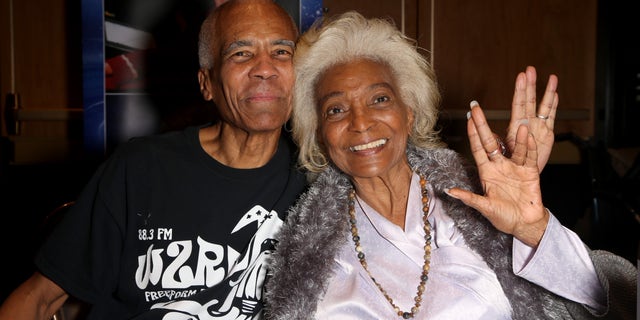
Kyle Johnson often attended "Star Trek" conventions with mother Nichelle Nichols (seen in 2019). He said her final deep-space mission would be a true honor.

Kyle Johnson often attended "Star Trek" conventions with mother Nichelle Nichols (seen in 2019). He said her final deep-space mission would be a true honor. (Gabe Ginsberg)

 "I thought there would be no more fitting and lasting tribute to her than this mission."

— Kyle Johnson

Launching later this year on board United Launch Alliance’s aptly named Vulcan rocket, Nichols' remains will also be included with late "Star Trek" creator Gene Roddenberry, who died in 1991, and his deceased wife and "First Lady of 'Star Trek'" Majel Barrett-Roddenberry, who passed in 2008.

The cremated remains of late "Star Trek" actor James Doohan, who played Montgomery "Scotty" Scott and died in 2005, and visual effects pioneer Douglas Trumbull, who died in February, will also be included in the mission to mark the unique "Star Trek" reunion flight.

Celestis has conducted 18 memorial space flights to date and has five more in the works.

They’ve since put close to "1,500 folks in space," which Chafer said is "more than all the governments combined."

Each flight is a unique experience, and the company offers seven different destinations. The "Earth Rise" suborbital mission launches a flight capsule with cremated remains and DNA into space before returning to planet Earth via parachute.

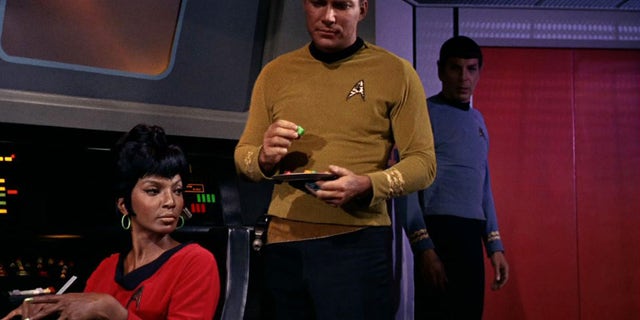
Nichelle Nichols (as Lieutenant Nyota Uhura) and William Shatner (as Captain James T. Kirk) are shown in a scene from "The Man Trap," the premiere episode of "Star Trek" that aired on Sept. 8, 1966.

Nichelle Nichols (as Lieutenant Nyota Uhura) and William Shatner (as Captain James T. Kirk) are shown in a scene from "The Man Trap," the premiere episode of "Star Trek" that aired on Sept. 8, 1966. (CBS Photo Archive)

Another option offered allows a capsule to orbit Earth on satellites or rockets that can circle for anywhere up to 200 years, and depending upon the altitude of the mission, they may re-enter the Earth’s atmosphere like a shooting star.

Celestis even offers flights to the moon.

"We first went to the moon at NASA’s request with their eminent scientist, Dr. Eugene Shoemaker. That flight was in 1999," Chafer said. To date, Shoemaker is still the only person buried on the moon, a mission carried out by the Lunar Prospector in honor of Shoemaker’s contributions to planetary sciences.

"It’s been a while, but our second mission will go this year, and we’ll put 90 folks on the surface of the moon as a memorial where people can step out at night, look up to the moon and say, ‘Hey Pops!'"

Nichols and a few of her late "Star Trek" colleagues will be part of the first deep-space mission, which will launch from Cape Canaveral, Florida, later this year and into a "forever orbit around the sun, about 300 million kilometers from Earth." Chafer noted her place among the stars is "an infinite voyage."

Clockwise from top left: Nichelle Nichols, DeForest Kelley, William Shatner and Leonard Nimoy in the television series "Star Trek" circa 1969.

Clockwise from top left: Nichelle Nichols, DeForest Kelley, William Shatner and Leonard Nimoy in the television series "Star Trek" circa 1969. (CBS Photo Archive)

"It’s been a while, but our second mission will go this year, and we’ll put 90 folks on the surface of the moon as a memorial where people can step out at night, look up to the moon and say, ‘Hey Pops!’"

— Charles Chafer, CEO of Celestis, Inc.

An important element of Nichols' voyage was including her fans in memorial efforts and making sure the people who have always been a guiding force in her career had the chance to stay with her forever, too.

Fans from around the world can send their names, tributes, drawings and images to include in the mission with Nichols for free through Celestis MindFiles, which will be digitized and sent aboard the Enterprise Flight.

Chafer added that for each space mission Celestis donates to two charities who "embody the commitment to space exploration and planetary preservation."

Johnson, who shares just as much of a passion for interplanetary sciences as his mother did, explained how Nichols was invested in science and education for the future.

He noted how early space programs, which were severely lacking in suitable candidates, were positively affected by Nichols’ involvement in recruiting new astronauts into the field.

"Her vision adhered to what the show represented and was coincident with what NASA was feeling but didn’t know quite how to implement it," he said. "Yet all of a sudden, and I’m sure that many of them were to this day, they are big fans of ‘Star Trek.’"

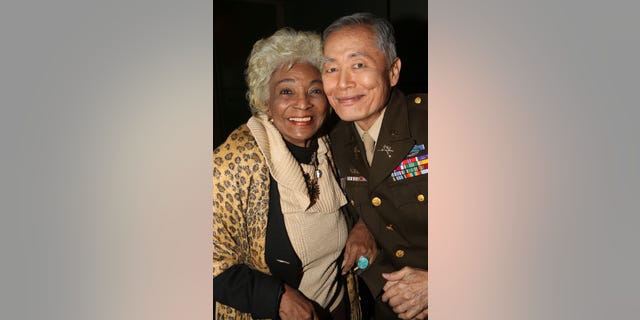
Nichelle Nichols and "Star Trek" co-star George Takei (pictured in 2015) worked together on dozens of episodes of the futuristic series.

Nichelle Nichols and "Star Trek" co-star George Takei (pictured in 2015) worked together on dozens of episodes of the futuristic series. (Bruce Gilkas/FilmMagic)

Johnson, who will be attending the send-off later this year, will also carry on his mother’s legacy of inspiring the future generations through the Nichelle Nichols Foundation, which launches on Dec. 28 and what would have been her 90th birthday.

"The number of supportive messages and letters and emails and phone calls that came in throughout the last 30 days are more valuable than I ever would have thought," he said. "The kindness and the thoughtfulness of so many people made it possible for me to get through this."

When asked if he had any final words to remember his mother, Johnson simply said, "Live long and prosper."

Full Article & Source:

Monday, August 1, 2022

'Star Trek' actress Nichelle Nichols dead at 89

'Star Trek' actress Nichelle Nichols dead at 89

By Tracy Wright

"Star Trek" actress Nichelle Nichols died on Sunday, according to a post shared by her son Kyle on her official Facebook page. She was 89.

"I regret to inform you that a great light in the firmament no longer shines for us as it has for so many years," he wrote. 

"Last night, my mother, Nichelle Nichols, succumbed to natural causes and passed away. Her light however, like the ancient galaxies now being seen for the first time, will remain for us and future generations to enjoy, learn from, and draw inspiration."

Nichols was known for playing Lieutenant Nyota Uhura on all three seasons of the original show, which ran from 1966-69. She also starred in each of the six "Star Trek" films from 1971 through 1991.

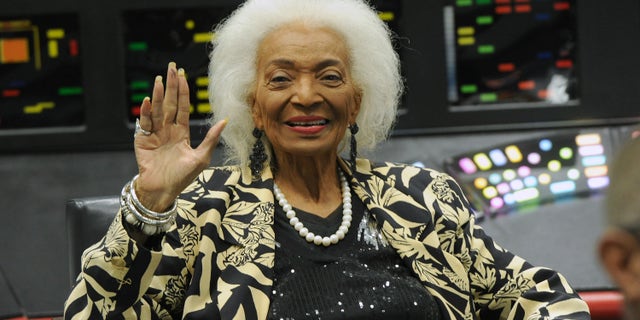
"Star Trek" acterss Nichelle Nichols died at the age of 89. The star was pictured at Day Three of the 2021 Los Angeles Comic Con held at Los Angeles Convention Center on December 5, 2021.

"Star Trek" acterss Nichelle Nichols died at the age of 89. The star was pictured at Day Three of the 2021 Los Angeles Comic Con held at Los Angeles Convention Center on December 5, 2021. (Albert L. Ortega)

She earned accolades for breaking stereotypes for black actresses, with the Rev. Martin Luther King Jr. personally encouraging her to stay with the series. She met him at a civil rights gathering in 1967, at a point when she had decided not to return for the show's second season.

He said, 'You cannot do that,'" Nichols recalled. "You've changed the face of television forever, and therefore, you've changed the minds of people," she said the civil rights leader told her.

Full Article & Source:

Sunday, July 10, 2022

‘Star Trek’ Actress Nichelle Nichols Struggling With Dementia, Trapped in Conservatorship Battle: Report

by Lawrence Ukenye

Mike Coppola/Getty

Nichelle Nichols, the actress who played the beloved Nyota Uhura in Star Trek, is caught at the center of a years-long conservatorship battle made worse by her bout with dementia, the Los Angeles Times reports.

Kyle Johnson, her only child, claimed his mother could be exploited due to her dementia and sought a petition for her conservatorship, which he won, in 2018. Johnson alleges that Gilbert Bell, Nichols’ former manager, has used his used his influence to take control of Nichols’ assets and personal affairs. Bell, in turn, has filed a lawsuit against Johnson claiming he is orchestrating an “aggressive” attempt to remove him from Nichols’ guest home. (In a countersuit, Johnson accuses Nichols of taking “control over Ms. Nichols’ assets and personal affairs” as her dementia worsened.)

Angelique Fawcette, a friend of Nichols whom the actress named as her successor, claims that Bell left the home in a state of “disrepair” even as he took care of Nichols’ meals and medical appointments—and that Bell proposed that he marry Nichols, prompting concern from her family and friends. However, Fawcette objected to Johnson’s petition for conservatorship as she believes the former actress can manage her own affairs. 

Read it at Los Angeles Times

Full Article & Source:

Sunday, October 3, 2021

Is ‘Star Trek’ Actress Nichelle Nichols Experiencing Conservator Abuse?

Click to Watch

Is former "Star Trek" star Nichelle Nichols experiencing conservator abuse?

The actress, best known for playing Lieutenant Uhura on the TV series and in films, has been under conservatorship since 2018 and her son Kyle has been her conservator. People close to the actress are concerned and claim she has been stripped of the things she has worked for, including her friend and producer Angelique who has come to The Doctors.

Angelique says the actress asked her to make a video of her expressing what she wanted in her final years and claims the actress was angry at her son for putting her in a rest home. Angelique also claims she noticed that items in Nichelle's home were disappearing, including the entire contents of her closet.

"She did not like the way that [Kyle] would treat her," Angelique says of the actress, noting a video surfaced of Nichelle and her son, that Angelique describes as an "abuse video" where her son allegedly "manhandles" and "curses her out," Angelique says after she made public comments about the video, Kyle blocked her from seeing the "Star Trek" actress. Additionally, the actress' home was sold in 2020 and Angelique says Kyle has moved her to New Mexico, without giving her the opportunity to appear in court and express what she wants and where she would like to live.

"I have not seen my friend Nichelle Nichols in several years. I love her and I just want her to be safe," Angelique tells The Doctors, claiming Nichelle's wishes have not been honored regarding her living situation.

Attorney Ann-Margeret Carrozza says in Nichelle's case -- where there was a report of a dementia diagnosis -- selling her home and moving her to a new state is very concerning. She says it is incumbent for the court to ensure that as little as possible changes when someone with dementia is under a conservatorship, including their living arrangement and social interactions. She questions how it is in Nichelle's best interest to be cut off from people in her social network like Angelique.

"The question for the court is, 'Does [Nichelle] need a conservator?" Ann-Margeret says, explaining that question is usually answered by the court deciding if someone is capable of making good decisions. 

Psychiatrist Dr. Domenick Sportelli shares what occurs in a traditional capacity evaluation and says it includes taking these steps and answering the following questions:

  • Full mental status evaluation should be performed
  • Does someone understand their current medical problems and treatment?
  • Is there an underlying mood disorder?

"I just want Nichelle to get her rights and have the ability... to enjoy the rest of her life at least close to the manner in which she wanted," Angelique tells The Doctors

Nichelle's former manager told The Doctors in a statement, "The story about Nichelle being removed from her home against her will is true. From the day I met Nichelle, the first thing out of her mouth was, she never wanted to be moved out of her home under any circumstances. She wanted to pass away there and she made me promise that could be her dying wish." 

The actress' son Kyle did not respond to our request for comment.

Full Article & Source:
 
See Also:

Thursday, August 19, 2021

‘Star Trek’ actress Nichelle Nichols caught in conservatorship battle

by Biba Adams

Nichols’ son, her former manager and a good friend appear to be waging a fight to oversee the finances of the aging actress.

Legendary actress Nichelle Nichols, best known for her role as Lieutenant Uhura on Star Trek, is caught in the middle of what has been a years-long conservatorship battle.

Nichols’ only child Kyle Johnson won a petition for conservatorship of the actress — who is suffering from dementia — in 2018. He alleged that her former manager, Gilbert Bell, had been living in Nichols’ guest home taking advantage of her finances and personal affairs.

Legendary “Star Trek” actress Nichelle Nichols is shown accepting an Inkpot Award onstage at the “From The Bridge” panel during Comic-Con International 2018 in San Diego. (Photo by Mike Coppola/Getty Images)

A third party is involved in the case, a close friend whom Nichols named as her successor, Angelique Fawcette. She is pushing back against the conservatorship, saying that Nichols can manage her affairs.

The 88-year-old no longer lives in Los Angeles, where the case is playing out and where the actual home in question is located. She moved to New Mexico with her son and his wife amid the coronavirus pandemic.

A recent exploration in The Los Angeles Times compared Nichols’ case to that of singer Britney Spears, who remains under conservatorship, although her father, Jamie Spears, who was her estate’s previous conservator, has stepped down.

The #FreeBritney movement has raised awareness about conservatorship, which has long been used in cases like Nichols’ of those who are elderly and struggling with health problems.

Nichols was one of the first Black women on television to play a non-stereotypical role. Lt. Nyota Uhura was beautiful, well-spoken and a knowledgeable communications officer on Star Trek. Nichols appeared in the series and a string of feature films, plus lent her voice to an animated show.

Her character was beloved by Star Trek fans, and for years, Nichols traveled and attended conventions greeting admirers. She was able to book such events with the support of Bell, who helped grow her income.

In 2013, after a pancreatitis diagnosis due to heavy alcohol use, Nichols was admitted to a hospital. She later moved to a nursing facility, where she signed an advance health care directive and a general power of attorney naming Bell as her primary agent and Fawcette as her successor.

According to Fawcette, Johnson and Nichols’ other family members rarely engaged in her life.

All three parties — Johnson, Bell and Fawcette — may ultimately meet in court to decide Nichol’s fate, but for now, the pioneering actress remains in New Mexico with her kin, where her son says she lives in a rental home, and he is her primary caregiver.

A $200,000 GoFundMe effort has been established to help support the star, one started by her sister, Marian Nichols Smothers. It has raised just over $148,000.

Full Article & Source:

Tuesday, August 17, 2021

Nichelle Nichols, Star Trek’s Lt. Uhura, faces heartbreaking conservatorship fight

MANHATTAN BEACH, CA - MARCH 05: Actress and Original Star Trek cast member Nichelle Nichols films her final performance for "Renegades: Ominara" at Northrop Grumman on March 5, 2021 in Manhattan Beach, California. (Photo by Albert L. Ortega/Getty Images)Getty Images

By Makeda Easter
 
Tucked away at the end of a secluded cul-de-sac, Nichelle Nichols’ Woodland Hills home was a testament to her boundary-breaking career spanning more than 70 years. Nichols lined walls and shelves with photos of herself as Lt. Uhura on the original “Star Trek” series, memorabilia from her legions of fans and documentation of her contributions to NASA’s recruitment of women and people of color in the 1970s.

The home was Nichols’ pride and joy, say those close to the star. She purchased it in 1982 for $12,000 and meticulously planned its details, from her plush, oversize furniture to the garden where she planted roses to the neighboring property she purchased in 1994 to use as a guesthouse and workspace for projects.

Questions around the fate of Nichols’ home — who lives in it and what happens to it — have been central to an ongoing, years-long legal battle over the finances and care of the beloved TV star, who friends and family say is financially drained and struggling with dementia.

A three-way fight over Nichols’ fate involves her only child, Kyle Johnson, who is also her conservator; her former manager Gilbert Bell; and a concerned friend, Angelique Fawcette.

In 2018, Johnson filed a petition for conservatorship, arguing that his mother’s dementia made her susceptible to exploitation. In 2019, Bell filed a lawsuit against Johnson, alleging attempts to remove him from Nichols’ guest home, where he has lived since 2010, and “aggressive and combative behavior.”

Bell says that while living in close proximity to Nichols, he helped to restore her career and financial well-being. According to Johnson, who filed a countersuit against Bell in 2020, Nichols’ home was the place where her former manager “exerted his undue influence and took control over Ms. Nichols’ assets and personal affairs,” misappropriating the star’s income as her health deteriorated and memory faded.

Fawcette, a producer and actress who met Nichols in 2012, entered the legal fight opposing Johnson’s conservatorship petition. Fawcette pushed for visitation rights to spend time with her friend, and she argued for Nichols to stay in Woodland Hills — a scenario that has looked increasingly improbable.

At 88, Nichols no longer occupies the house. Last year, Johnson moved her to New Mexico, where he and his wife live. Johnson declined The Times’ requests to speak with Nichols directly.

Against the backdrop of the #FreeBritney movement around Britney Spears raising public consciousness about conservatorships, Nichols’ former agent and friend have launched court battles to intervene, they said in interviews. Their fear: Nichols is being denied a chance to live out her remaining years as she wants.

° ° °

Born in Robbins, Ill., Grace Nichols was renamed Nichelle as a teenager moving into the world of professional entertainment. She sang and danced through the Chicago club circuit in the 1940s and 1950s, and after her brief marriage to fellow dancer Foster Johnson and the birth of son Kyle, she moved to L.A. to focus on film and television.

In 1959, Nichols had a small role in the Samuel Goldwyn production of “Porgy and Bess,” which brought her together with some of the most successful Black stars of the day, including Sammy Davis Jr. and Dorothy Dandridge. Nichols met “Star Trek” creator Gene Roddenberry in 1963 after being cast in an episode of his TV series “The Lieutenant,” and in 1966 she made her debut as communications officer Lt. Nyota Uhura in “Star Trek.”

Frustrated with the lack of depth in her role, Nichols considered leaving “Star Trek” during the first season. A chance encounter with Martin Luther King Jr., a Trekker, changed her mind. He told her she was a trailblazer — a Black woman on TV in a nonstereotypical role. Although the original “Star Trek” series was short-lived, running three years until 1969, Nichols became an icon, appearing in the many manifestations of the “Star Trek” franchise, including the animated show and a string of feature films.

In 1970, Nichols attended her first “Star Trek” convention, and at a 1975 event, NASA representative Jesco von Puttkamer sparked her relationship with the space agency. In 1977, NASA hired Nichols to help recruit astronauts for its space shuttle program.

Over four months, she appeared in TV public service announcements and traveled the country to speak at universities and professional science organizations to encourage women and people of color to apply. NASA credited Nichols for helping to attract astronauts including Sally Ride and Frederick Gregory.

But for many years, conventions provided Nichols’ primary connection to the public. In her 1994 autobiography, she writes, “Star Trek” conventions “are unlike any other fan gathering, perhaps because a Trekker is unlike any other fan in the world. One would be hard-pressed to find such a large group of intelligent, sensitive, aware people.”

And fans loved Nichols, says Adam Malin, co-founder of Creation Entertainment, which has staged traveling fan conventions since 1971. Malin considers her “the ultimate ambassador for what we hope the future could be.”

The fan gatherings were a major source of income for Nichols, who commanded top dollar for her signature and photos. She drew lines that would last all day long, says Chase Masterson, a “Star Trek: Deep Space Nine” actor who appeared with Nichols at conventions.

But by the time Bell began working with Nichols — in 2009, according to court documents — the convention appearances had dried up, and Nichols was struggling financially, says Bell, 82.

The two had met earlier that year, hitting it off over lunch at P.F. Chang’s. Bell became Nichols’ manager, helping her book conventions, other appearances, films and TV projects.

After he sold his home in Studio City, Bell says, Nichols encouraged him to move into her guesthouse for free in 2010. (He began paying rent, $300 a month, after two years of living in the guesthouse.) Bell recalls her saying, “We’re only across the driveway from each other, and we’ll be able to develop these projects much faster.”

Under his guidance, Nichols began to recover financially, going from one or two convention bookings a year to at least three a month, Bell says. Nichols could earn $10,000 to $15,000 for attending a small convention and $40,000 to $50,000 participating in major conventions, he says.

While Bell was her manager, her annual income reached several hundred thousand dollars, he claimed, although her son Johnson disputes that number and characterizes Bell’s accounting records as “extremely deficient.”

In January 2013, Nichols collapsed in her living room and was taken to the hospital, where she was diagnosed with pancreatitis — attributed to alcohol, Johnson says. Johnson, 70, says he and other family members noticed an increase in her drinking over the years. Bell attributes Nichols’ struggles with convention bookings at the time to alcohol.

“She denied it,” Johnson says, “and did not want to do any kind of [ Alcoholics Anonymous], Betty Ford [Center] or any such alcohol treatment.”

While Nichols recovered in the hospital, Bell, Johnson and Fawcette crossed paths. Fawcette and her husband, writer-director Steven Fawcette, met Nichols while casting their “Star Trek” parody film “Unbelievable!!!!!” They describe Nichols at the time as gravely ill.

On a low point during her recovery, the couple say, they were the only two people by Nichols’ side.

“She was definitely gasping for breath,” Angelique Fawcette, 51, says. “She was calling out to her people who had passed away.”

After weeks in the hospital, Nichols moved into a nursing and rehabilitation facility. Nichols tried to leave the facility twice on her own, Bell says, so he took her home — against medical advice and without the consent of her family.

On the day Bell helped Nichols leave the rehabilitation facility, she signed an advance health care directive and a general power of attorney naming Bell as primary agent, allowing him to make healthcare decisions and to manage finances for her. Angelique Fawcette was named as a successor.

That night, Fawcette says, Nichols asked her to record a video about what she wanted in her later years. In the interview, titled “Nichelle’s Own Words,” Nichols responds to questions about her career and desire to work.

During an edited, hourlong interview posted over three videos, Nichols — then 80 — appears coherent at times but repeats herself at others. She says relatives, including Johnson, tried to convince her to work less.

“My son thinks that I should be letting up, you know. I say to him, ‘Kyle, when you pay my bills you’ll be able to tell me what to do.’”

Fawcette says Nichols told her that she would know when to release the video. And five years later, in 2018, Fawcette published it to YouTube during the conservatorship proceedings.

After the hospitalization, Nichols continued working, making the convention rounds and appearing in film and on TV, including on “The Young and the Restless” in 2016.

“It was because I got her off alcohol and turned her career around professionally that she was working,” Bell says.

With Bell and Nichols, the line blurred between manager, caregiver and friend, he says. Bell cooked meals every day. After Nichols had a mild stroke in 2015, she required more intense care. Bell arranged for physical therapists, caregivers and assistants.

“It was very, very close, as it often happens between managers and their clients in Los Angeles, because it’s intensely personal work,” says Bell’s attorney, William Bowen.

Fawcette says her bond with Nichols also deepened, as she came to view the star as a family member. She describes Bell as Nichols’ “gatekeeper,” controlling who had access to the performer. “I never really liked the guy. ... I had to deal with him in order to see my friend.”

Fawcette says Nichols’ home fell into a state of disrepair. Before Nichols’ 85th birthday celebration, she found the performer’s closet empty. At one point, she reached out to Nichols’ younger sister, Marian Nichols Smothers, for help.

“It was just getting to be too much, where the family was not intervening in the manner in which they should,” Fawcette says.

Johnson says he came to L.A. intermittently to help Nichols with tasks around the home, but Bell and Fawcette say Johnson was a rare presence in Nichols’ life in the years leading up to the conservatorship.

Then Bell reached out to Steven Fawcette with a surprise: Bell wanted to marry Nichols. Bell says he and Nichols talked about marriage as a business partnership, a way to ensure that she was protected financially.

The Fawcettes called Smothers and Johnson in a state of panic. That was around early 2018.

In May 2018, Johnson petitioned for conservatorship, known in other states as a legal guardianship, nominating a team of licensed professional fiduciaries to temporarily control Nichols’ person — including healthcare, food, clothing and housing — as well as her estate, the financial assets. In the petition, Johnson claimed Nichols has “severe short-term memory loss impacting her executive functioning. ... Certain individuals have unduly exerted themselves into Ms. Nichols’ life to her detriment.”

Johnson says the trigger for filing a conservatorship petition was learning that Bell in 2017 had transferred Nichols’ home into his name as power of attorney. The petition kicked off three years of legal proceedings — with objections and battles over the cost of legal representation.

In 2019 court documents, Johnson indicated that for one 144-day period, Nichols’ temporary conservator had requested nearly $115,000 to cover fiduciary and attorney fees. Fighting over conservatorship can be so costly it often hurts the conservatee, says Kurt Eggert, director of the Elder Law Center at Chapman University’s Dale E. Fowler School of Law. “It’s a tragedy if fighting over who gets to control the estate chews up too much of that estate; the conservatee is powerless to stop that.”

After filing the petition, the probate court suspended Bell’s power of attorney, and Nichols’ home was transferred back into her name. Johnson moved to L.A. to serve as Nichols’ sole caregiver and mapped out appearances at conventions, “which allowed us to pull her back from the brink, financially,” he says. “She was completely underwater at her own bank.”

In August 2018, Fawcette went to court to object to Johnson’s petition for conservatorship, arguing that Nichols was able to manage her personal and financial affairs with limited help from a caregiver or assistant. Fawcette accused Johnson of primarily wanting access to Nichols’ income and personal property. In a court response he filed to Fawcette’s petition to enforce visitation rights, Johnson accused the producer of wanting to profit from Nichols’ fame.

In January 2019, Johnson was appointed conservator of Nichols’ person and estate, but the battle continued.

In a video Bell recorded in April of that year, Nichols reads conservatorship documents in her guesthouse. “I didn’t give permission to have conservatorship over me,” she says to Bell. When Johnson enters and leads her back to her main house, she shrieks, “You get your hands off of me.”

The video, first reported by a CBS station in Atlanta, cast doubt not only on Johnson but also on Bell, criticized for releasing upsetting footage of a dementia patient who might not have had the capacity to approve of its public release.

People with dementia often “object to somebody else making decisions for them. Even if it’s necessary, even if they are no longer able to make their own decisions,” Eggert says. “You can imagine how frustrating it is to feel like your decision-making power is being taken away from you.”

A 2020 deposition of the former court-appointed temporary conservator of the estate, licensed professional fiduciary BJ Hawkins, shed additional light on the substantial financial difficulties Nichols faced. In an analysis, Hawkins cited money that couldn’t be accounted for, poorly written contracts and a significant amount of debt.

“It was clear that other people had handled her financial affairs and that there was no evidence that they handled them in a way that was to her best benefit,” Hawkins told The Times, echoing her court testimony.

In the deposition, Hawkins also said that in her experience with Johnson, he was prone to explosive outbursts of anger and that she had “areas of deep and grave concern that he would not be able to act in the best interest of the conservatee, despite the fact that it was his mother and despite the fact that it is my general position that a member of the family is in the best position to act in the role of conservatorship of the person.”

° ° °

What is Nichols’ condition these days? How exactly does the “Star Trek” legend want to live out her final years? And if her wish was to be cared for at home in Woodland Hills, as friends suggest, would that even be an option, given her financial problems and the high cost of in-home care?

The answers remain unclear. After initially talking with The Times, Johnson largely declined to respond to subsequent requests for comment.

For many people struggling with dementia — financially, logistically, emotionally — moving in with family or even into a care facility sometimes is the best choice, especially as needs increase. But while Johnson says the isolation in New Mexico protects Nichols from exploitation, others say she’s being deprived of the love and support of friends. Sci-fi magazine founder Kerry O’Quinn, who has been close with Nichols since they met 40 years ago at a “Star Trek” convention, hasn’t seen his friend in more than two years.

Fawcette, who last saw Nichols in mid-2019, is working with an attorney to win the right to visit in New Mexico.

Meanwhile the progression of Nichols’ dementia is unclear. Smothers says her sister has had considerable memory loss.

“I feel like I’ve already lost my sister in so many ways,” Smothers says. “She’s not the person she used to be, the vibrant, in-charge, take care of everything person.”

“Star Trek: Deep Space Nine” actor Nana Visitor, who last saw Nichols two years ago at a Las Vegas convention, says Nichols appeared frightened and confused at times. Even though they had appeared at conventions together for more than 20 years, Nichols didn’t recognize Visitor. “I would say something, and then she would ask immediately,” Visitor says. “It was as if I had not said it.”

What some are calling a farewell tour, organized by Johnson and agent Sky Conway, is moving forward despite Nichols’ condition. In March, Nichols visited L.A. to shoot a scene for the pilot “Renegades: Ominara,” billed on Kickstarter as her final performance. While shooting, Nichols needed a teleprompter to recite her lines.

“She likes attention, so when she was on set, she was fine,” producer Frank Zanca says.

Nichols was scheduled to sign autographs at a Creation Entertainment “Star Trek” convention running this weekend, along with fellow headliners William Shatner, George Takei and Walter Koenig, but she canceled her appearance for unknown reasons. The Times reached out to the original “Star Trek” actors for comment, but none responded.

Nichols was scheduled for a visit in September to the Ohio headquarters of the International Federation of Trekkers, a “Star Trek” fan club created in 1984. The live event, recently canceled because of the nationwide surge in COVID-19, was described as Nichols’ “last public appearance east of Los Angeles before she enters retirement.”

One year ago Smothers launched a GoFundMe campaign to support Johnson on behalf of Nichols’ family — including her sister Diane Robinson and older brother Samuel Nichols. The campaign has raised about $146,000.

Bell continued to live in Nichols’ neighboring property and last saw her about two years ago. In his lawsuit, Johnson alleges that in 2015, Bell “induced” Nichols to procure a reverse mortgage on the property for more than $400,000. Bell says that he had nothing to do with the reverse mortgage and that Nichols pursued it independently.

He denies the allegations that he mishandled Nichols’ income. And he says he misses her “tremendously.”

Fawcette is upset that Nichols is not in her own house.

“She’s not getting the life that she wished for,” Fawcette says. “She’s getting the life that other people have chosen for her.”

The quest to bring Nichols home to Woodland Hills appears to be futile, however. Property records show that her house and guesthouse were sold last week for nearly $2.2 million to Baron Construction & Remodeling Co. On Friday, Bell confirmed that he moved out two weeks prior; in a brief email Saturday, Johnson says proceeds from the sale were placed in his mother’s conservatorship account to ensure her continued care.

Johnson says Nichols is living in a rental house in an undisclosed New Mexico location, where he serves as the primary caregiver.

“There’s still some sensitive issues,” Johnson says, explaining why he is declining The Times’ request to speak with Nichols. He’s just trying to protect his mother’s privacy, he says.

“We have moved here, and we’re going to remain here,” Johnson says from New Mexico. Nichols still has “financial issues that need to be settled.”

In the meantime, he says, Nichols’ home in New Mexico is “a nice place. Smaller, a little more modest than being in Los Angeles, but meeting our needs.”

This story originally appeared in Los Angeles Times.

Full Article & Source: