Showing posts with label passed away. Show all posts

Friday, September 9, 2022

'Star Trek' icon Nichelle Nichols' ashes to launch into space, son Kyle calls Enterprise mission 'great honor'

By Tracy Wright

Nichelle Nichols will rest among the stars when her ashes are launched into deep space later this year on an Enterprise Flight with a few of her late "Star Trek" colleagues.

Nichols, who was known for playing the iconic Lieutenant Nyota Uhura on all three seasons of the original show from 1966-1969, died on July 30. She was 89. Thursday, Sept. 8, marks the 56th anniversary of the first episode of the show and is now known as "Star Trek Day."

Her son, Kyle Johnson, exclusively told Fox News Digital that his mother had been "in pretty good health" before she passed away, and he was "expecting that she would be around a bit longer," so her sudden death threw him in a bit of turmoil.

Nichols boldly went where few had gone before and broke barriers for Black women in Hollywood, and she was an incredible advocate for space flight programs as NASA’s recruiter-in-chief.

"Star Trek" legend Nichelle Nichols will make a historic final flight aboard the Enterprise as her ashes will be launched into deep space. (Getty Images)

"As I was thinking about it in the aftermath of arrangements and so forth, what would be essentially family and very close friends service," Johnson said. "But there's also her larger base of fans, supporters, those whom she has affected and inspired. I was trying to think of what might be an appropriate way to acknowledge that."

He recalled an interesting phone call from a scientist that was like a "bolt from the blue room" and an opportunity he knew his mother would not want to miss.

Charles Chafer, Celestis Inc. CEO and co-founder, proposed honoring Nichols in the most unique way by including her remains in a memorial space flight mission aboard the Enterprise Flight.

Johnson said the mere opportunity is "a great honor" for his late trailblazing mother.

"They will include a portion of her remains to go up on the mission and also her DNA along with mine, which I very much appreciate," he said. "I thought there would be no more fitting and lasting tribute to her than this mission."
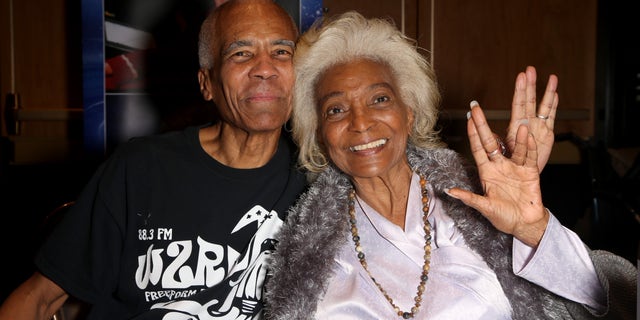
Kyle Johnson often attended "Star Trek" conventions with mother Nichelle Nichols (seen in 2019). He said her final deep-space mission would be a true honor.

Kyle Johnson often attended "Star Trek" conventions with mother Nichelle Nichols (seen in 2019). He said her final deep-space mission would be a true honor. (Gabe Ginsberg)

 "I thought there would be no more fitting and lasting tribute to her than this mission."

— Kyle Johnson

Launching later this year on board United Launch Alliance’s aptly named Vulcan rocket, Nichols' remains will also be included with late "Star Trek" creator Gene Roddenberry, who died in 1991, and his deceased wife and "First Lady of 'Star Trek'" Majel Barrett-Roddenberry, who passed in 2008.

The cremated remains of late "Star Trek" actor James Doohan, who played Montgomery "Scotty" Scott and died in 2005, and visual effects pioneer Douglas Trumbull, who died in February, will also be included in the mission to mark the unique "Star Trek" reunion flight.

Celestis has conducted 18 memorial space flights to date and has five more in the works.

They’ve since put close to "1,500 folks in space," which Chafer said is "more than all the governments combined."

Each flight is a unique experience, and the company offers seven different destinations. The "Earth Rise" suborbital mission launches a flight capsule with cremated remains and DNA into space before returning to planet Earth via parachute.

Nichelle Nichols (as Lieutenant Nyota Uhura) and William Shatner (as Captain James T. Kirk) are shown in a scene from "The Man Trap," the premiere episode of "Star Trek" that aired on Sept. 8, 1966.

Nichelle Nichols (as Lieutenant Nyota Uhura) and William Shatner (as Captain James T. Kirk) are shown in a scene from "The Man Trap," the premiere episode of "Star Trek" that aired on Sept. 8, 1966. (CBS Photo Archive)

Another option offered allows a capsule to orbit Earth on satellites or rockets that can circle for anywhere up to 200 years, and depending upon the altitude of the mission, they may re-enter the Earth’s atmosphere like a shooting star.

Celestis even offers flights to the moon.

"We first went to the moon at NASA’s request with their eminent scientist, Dr. Eugene Shoemaker. That flight was in 1999," Chafer said. To date, Shoemaker is still the only person buried on the moon, a mission carried out by the Lunar Prospector in honor of Shoemaker’s contributions to planetary sciences.

"It’s been a while, but our second mission will go this year, and we’ll put 90 folks on the surface of the moon as a memorial where people can step out at night, look up to the moon and say, ‘Hey Pops!'"

Nichols and a few of her late "Star Trek" colleagues will be part of the first deep-space mission, which will launch from Cape Canaveral, Florida, later this year and into a "forever orbit around the sun, about 300 million kilometers from Earth." Chafer noted her place among the stars is "an infinite voyage."

Clockwise from top left: Nichelle Nichols, DeForest Kelley, William Shatner and Leonard Nimoy in the television series "Star Trek" circa 1969.

Clockwise from top left: Nichelle Nichols, DeForest Kelley, William Shatner and Leonard Nimoy in the television series "Star Trek" circa 1969. (CBS Photo Archive)

"It’s been a while, but our second mission will go this year, and we’ll put 90 folks on the surface of the moon as a memorial where people can step out at night, look up to the moon and say, ‘Hey Pops!’"

— Charles Chafer, CEO of Celestis, Inc.

An important element of Nichols' voyage was including her fans in memorial efforts and making sure the people who have always been a guiding force in her career had the chance to stay with her forever, too.

Fans from around the world can send their names, tributes, drawings and images to include in the mission with Nichols for free through Celestis MindFiles, which will be digitized and sent aboard the Enterprise Flight.

Chafer added that for each space mission Celestis donates to two charities who "embody the commitment to space exploration and planetary preservation."

Johnson, who shares just as much of a passion for interplanetary sciences as his mother did, explained how Nichols was invested in science and education for the future.

He noted how early space programs, which were severely lacking in suitable candidates, were positively affected by Nichols’ involvement in recruiting new astronauts into the field.

"Her vision adhered to what the show represented and was coincident with what NASA was feeling but didn’t know quite how to implement it," he said. "Yet all of a sudden, and I’m sure that many of them were to this day, they are big fans of ‘Star Trek.’"
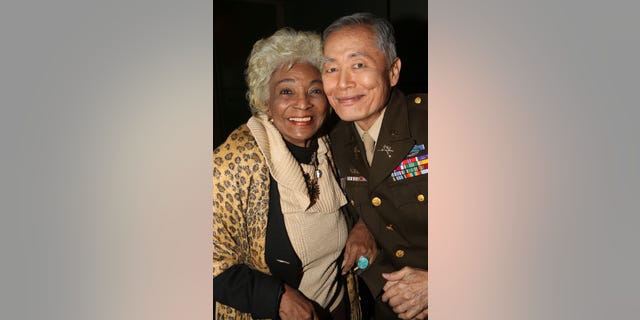
Nichelle Nichols and "Star Trek" co-star George Takei (pictured in 2015) worked together on dozens of episodes of the futuristic series.

Nichelle Nichols and "Star Trek" co-star George Takei (pictured in 2015) worked together on dozens of episodes of the futuristic series. (Bruce Gilkas/FilmMagic)

Johnson, who will be attending the send-off later this year, will also carry on his mother’s legacy of inspiring the future generations through the Nichelle Nichols Foundation, which launches on Dec. 28 and what would have been her 90th birthday.

"The number of supportive messages and letters and emails and phone calls that came in throughout the last 30 days are more valuable than I ever would have thought," he said. "The kindness and the thoughtfulness of so many people made it possible for me to get through this."

When asked if he had any final words to remember his mother, Johnson simply said, "Live long and prosper."

Full Article & Source:

Saturday, July 11, 2020

Forced Assistance

by Rachel M. Cohen

In the summer of 2018, then-84-year-old Genyte Dirse was removed from her home — a motel she had owned and lived in for decades — and placed in an assisted living facility in St. Petersburg, Florida. This followed a relatively fast and bewildering legal fight between Dirse and a local real estate agent who argued that she wasn’t in her right mind to live independently. Ever since then, her closest living relative in the U.S., her great-nephew Gedi Pakalnis, had fought a losing legal battle to bring her back home.

Pakalnis’s fight to bring Dirse home ramped up this spring, as the coronavirus pandemic ravaged the globe. In the United States, residents of nursing homes and assisted living facilities have been particularly vulnerable, with more than 51,000 deaths reported nationally from those institutions so far. In Florida, like elsewhere in the country, the number of Covid-19 deaths at senior living facilities has grown at a much faster rate than the broader population and, by early May, accounted for more than a third of the state’s pandemic fatalities.

In late April, the virus struck Patrick Manor, where Dirse lived. For weeks prior, Pakalnis had been trying to reach his great-aunt’s legal guardian to get information about her health, raising concerns about the fast-spreading disease. After weeks of no news, Pakalnis finally learned that Dirse had been hospitalized with Covid-19 symptoms. Dirse’s guardian told Pakalnis that he could potentially visit her once the pandemic calmed down.

He never got the opportunity. On May 5, Dirse died of Covid-19, alone at St. Anthony’s Hospital. She was not the first Patrick Manor resident to be hospitalized with the coronavirus, and by mid-May, 11 Patrick Manor residents and two staff had tested positive with the disease.

The frequent deaths of elderly people in nursing homes and assisted living facilities has become a horrifying reality throughout the pandemic. But something was also different about Dirse’s death; according to her great-nephew and others who were involved in the guardianship process, she was confined against her will to Patrick Manor, where she faced a greater likelihood of getting sick — despite having family willing and able to take care of her.

For decades, adult guardianship has been a legally thorny issue, with independent watchdogs and journalists repeatedly finding that senior citizens are stripped of their rights and often financially exploited — with little government oversight. The cases often involve complex family drama and disagreements among siblings, but sometimes, as in Dirse’s case, it’s an outsider who gets involved, over the objections of the elderly person’s relatives. A court’s decision to appoint a guardian is usually final, as appeals are costly and complex, and appellate courts are highly deferential to the lower court’s initial findings.

The issue has taken on new relevance amid the pandemic. In a Covid-19 resource compiled by the National Guardianship Association, the American Bar Association, and the National Center for State Courts, advocates acknowledge the pandemic “will make it more difficult” for seniors to exercise the remaining rights they do have.

“In this pandemic we’re going to see abusive guardianships started over Zoom, with the virus facilitating the racket that’s already in place,” warned Dr. Sam Sugar, founder of Americans Against Abusive Probate Guardianship, a national advocacy group. “The difference with Covid-19 is we’re going to see wards dying in nursing homes faster, in weeks, rather than months, and a further decrease of any monitoring.”

Like many legal guardianship cases, the story of how Dirse ended up at Patrick Manor is fraught with allegations of ulterior motives and complex family dynamics. It all started after a local real estate agent accused Pakalnis of exploiting his great-aunt.

Pakalnis, who is 37, is the great-great grandson of Dirse’s maternal grandmother. In the early 1990s, Dirse visited her relatives in Lithuania, where Pakalnis was being raised by his dad. Dirse invited him to come live with her in the U.S. He took her up on the offer in 2003, living with Dirse throughout high school, college, and graduate school. “My aunt has always been like my mother,” he said. “We were a happy family for 15 years, lived together, and loved each other.”

For several decades, Dirse managed her small motel business, Dirse Apartments and Motel. In 2017, in front of witnesses and a notary, she sold one of her three properties to Pakalnis for $50,000. Diana Sames, a local real estate agent who visited Dirse annually to pass out calendars and broach selling her property, was aghast at the transaction, which was for well below market-value.

Sames petitioned a court to appoint a guardian for Dirse, citing the property sale as evidence that she was not in her right mind. Though Sames denied doing so out of self-interest, she did tell local reporters that she “would have no problem” taking a commission from the sale of Dirse’s property if it were listed on the market. As the guardianship case proceeded, tenants said in sworn affidavits they repeatedly heard Dirse tell Sames that she had no intention of listing and had long planned to sell one building to her family. One recalled Dirse mentioning that she was “well prepared for retirement” and would “have more than enough for herself,” even with one less property. Pakalnis meanwhile scrambled to hire attorneys to provide evidence to the court and file complaints with local institutions.

But a few months later, a judge and a panel of professionals declared Dirse “incapacitated” and appointed an adult legal guardian to take over her affairs. The guardian, Traci Samuel, had no prior relationship with Dirse and was proposed to the court by Sames, the petitioner.

Samuel quickly filed a lawsuit to reverse the sale of Dirse’s property and moved Dirse against her will to an assisted living facility, Inspired Living in St. Petersburg. At first, Pakalnis was able to visit her there. After a visit on November 10, 2018, he filed an affidavit with the court saying that his great-aunt looked weaker, less healthy, had complained of untreated leg pain, and told him she wanted to go home. The guardian then barred Pakalnis from seeing Dirse again, claiming that Dirse didn’t want to hear from her great-nephew anymore.

Romualdas Pakalnis, Genyte Dirse, Gedi, and Gedi’s brother Tom Pakalanis in December 2016. Romualdas and Tom were visiting Florida from Lithuania for Christmas.
Photo: Courtesy of Gediminas Pakalnis

Samuel, who later changed her name to Traci Hudson, was soon engulfed in scandal. In November 2019, she was charged with felony exploitation by the Pinellas County Sheriff’s Office and accused of stealing more than $500,000 from a 92-year-old man who she was also caring for. Investigators found that she had transferred nearly all his money to her bank accounts and used the funds to buy NFL tickets, new clothes and jewelry, and even a new house. She did not return requests for comment.

The court appointed a new legal guardian for Dirse in late November: Jean Farnan. In March, at the outset of the pandemic, Pakalnis contacted Farnan through a court filing, requesting information about his aunt’s well-being and said he was concerned “since nursing homes and assisted living facilities are vulnerable to fast-spreading Coronavirus.”

But he got no response. A month later, he learned via Farnan’s attorney, Hamden Baskin, that Dirse had been taken to the hospital. Farnan and Baskin declined to comment for this article.

Pakalnis filed another court petition on April 29 asking for more information about Dirse’s whereabouts and lamented to Farnan that he could have been caring for his great-aunt at home. “My aunt has educated family who never committed any crime and we have healthy environment and people who love her and can take care of her at any time at no cost,” he wrote in a court filing. He begged for his great-aunt to at least receive video and phone calls, stressing that she needed the emotional support.

The next day, Farnan wrote back claiming that she hadn’t received his earlier court correspondence. Attaching a photo of Dirse from January, Farnan wrote that Dirse is a “very pleasant lady” and said, “I am sure she is not feeling that well, and being in the hospital is always stressful.” Farnan ended her email by saying when the Covid-19 situation is under control, she’d like to allow Dirse to see whoever she wants.

Pakalnis wrote back on May 1, urging again for the opportunity to talk with his great-aunt on the phone and reiterating that Dirse could stay with him. “[P]lease remember that she has her home near the beach in ecological environment with her family that misses her,” he wrote. “[Not] being able to hear and see her for many months is unhealthy for both of us.”

Four days later, Baskin filed a brief asking the court to deny Pakalnis’s emergency petitions and prohibit any further communication from him. Dirse died later that day. Diana Sames, the realtor who started this whole process, defended her decision to petition for guardianship for Dirse. “She’s in heaven now. Why is there so much drama around this poor lady?” she asked The Intercept. “I don’t need to make money; I own my car, own my home, I have my own conscience.”

Adult legal guardianship is a process that has existed in the United States since colonial times, imported from a 14th century English legal principle known as parens patriae. The idea entails giving full rights and obligations to the state if an adult is deemed too vulnerable or “incapacitated” to care for themselves. A judge can appoint a guardian — often it’s a family member, sometimes it’s a third-party professional like Traci Hudson or Jean Farnan — and they have full legal authority to manage the individual’s health care decisions, their financial assets, or both. Many people can petition a court for guardianship if they believe an elderly person needs it: relatives, hospitals, government agencies, and even acquaintances like the realtor Diana Sames.

Adult legal guardianship varies by state, even sometimes county by county. However, in most places anyone 18 or older can nominate themselves to be a guardian, and few states require any sort of registration or licensing for the role. No good data even exists on how many seniors are currently living under guardianship. The National Center for State Courts estimated that based on the average of active pending cases in four states in 2008, there were 1.3 million cases nationwide, in control of roughly $50 billion in assets. This could be a low estimate, and as baby boomers get older, experts anticipate the numbers to rise considerably.

Though guardianship can at times be beneficial for the elderly, particularly if they really are at risk of being swindled or do need assistance, a growing movement over the last few decades has raised staggering examples of how mentally sound seniors lose their rights through this process, becoming totally isolated and forced to live in ways wholly contrary to how they want. In the worst cases, it’s the guardians themselves who exploit the senior, draining their assets, cutting off contact with friends and family, and confining them to expensive facilities when they just want to remain in their homes. Seniors have described the experience as living a “civil death” or being a “legal ghost.”

Patrick Manor, the assisted living facility where Genyte Dirse resided, sits in St. Petersburg, Fla., on June 6, 2020.
Photo: Tailyr Irvine for The Intercept
How widespread guardian abuse is remains unclear, but following a yearlong investigation, the U.S. Senate Special Committee on Aging said in a 2018 report that they “identified persistent and widespread challenges that require a nationwide focus” to ensure  that guardianship “works on behalf of the individuals it is intended to protect.” The committee acknowledged that in some cases, “more rights than necessary” may be taken from an individual and that with such minimal oversight “once a guardianship is imposed, there are few safeguards in place to protect against individuals who choose to abuse the system.”

Issues around guardianship have existed for decades, and efforts at reform really took off in 1987, following a six-part Associated Press exposé. The investigative series prompted a flurry of new state legislation and the formation of the National Guardianship Association to establish new standards.

Yet despite modest improvements, lasting and widespread change remains elusive, and media reports detailing guardian abuse have continued to emerge. The U.S. Government Accountability Office looked at guardianship in 2004, 2010, 2011, and 2016, each time identifying major issues and a lack of clear information to guide policy. In its 2010 report, the GAO “identified hundreds of allegations of physical abuse, neglect and financial exploitation by guardians in 45 states and the District of Columbia” since 1990.  (Click to Continue)

Full Article & Source:
Forced Assistance

See Also:
Hotel owner placed in guardianship by St. Pete Beach realtor dies from COVID-19

Realtor seeks court-ordered guardianship to take away rights of elderly beach hotel owner

Saturday, May 16, 2020

Hotel owner placed in guardianship by St. Pete Beach realtor dies from COVID-19

Genyte Dirse infected at assisted living facility


By: Adam Walser

ST. PETE BEACH, Fla. — Last year, the I-Team first reported about a small St. Pete Beach hotel and how it was at the center of a guardianship case.

At the time, we reported how a local realtor who barely knew the elderly owner took her to court to have her placed into guardianship.

That elderly woman, Genyte Dirse, died after she acquired COVID-19 at an assisted living facility.

Dirse was honored last Friday by a small memorial service, held beside a bench where she used to sit and watch passers-by and listen to the pounding waves.

The spot is just a short walk from the small hotel which Dirse owned and where she lived for decades.

Friends and family gathered on the beach, while social distancing and wearing masks to protect themselves against the deadly virus that killed Dirse.

Genyte Dirse
“Genyte will be sorely missed both by her family and her many friends who she inspired,” said her great-nephew Gediminas Pakalnis during the memorial.

The short tribute included the reading of poems and scripture, as well as the recitation of the Lord’s Prayer.

Pakalnis tells the I-Team Dirse was a devout Catholic who attended mass regularly before she was placed in guardianship.

Genyte Dirse died May 5 of COVID-19.

She turned 86 on May 1.

The medical examiner reported her medical history included end-stage dementia, hypertension and anemia.

In 2018, Dirse's court-appointed guardian moved her into an assisted living facility, where she was one of a dozen residents infected with COVID-19.

She ended up in guardianship after St. Pete Beach realtor Diana Sames -- who barely knew her -- asked a judge to put Dirse into guardianship, alleging her great-nephew Gedminas Pakalnis exploited her.

In December 2017, Dirse sold one of her three hotel buildings to Pakalnis for a below-market price.

We tried to reach Sames by phone and email, but she didn’t return our messages.

But when we talked to her last year, she defended her actions.

This is our original story from February 2019: https://wfts.tv/3fQS2oU

“I'm happy with the attorney that helped me file a guardianship so that Miss Genyte could have her interest taken care of,” Sames said at the time.

The case took an unexpected turn in November when Dirse's court-appointed guardian Traci Hudson was arrested and charged with a felony count of exploitation of an elderly person.

Court papers allege Hudson stole more than $500,000 from another senior under her care.

Before her arrest, Hudson had filed a lawsuit on behalf of Dirse, against her great-nephew, asking the court to reverse the hotel sale.

Because of that court battle, Hudson and Dirse's new guardian would not let her great-nephew speak with Dirse, even after she was diagnosed with COVID-19 in late April.

He tells the I-Team he believes guardianship could have impacted her health.

“You can’t be 100% sure about things, of course, but being in a healthy environment, near the beach, fresh air, a lot of sun, being outside, she loved being outside. She was a strong woman,” Pakalnis said.

Even though Dirse has passed away, the hotel is still at the center of that civil lawsuit against the great-nephew.

That trial has been delayed because of the coronavirus pandemic.

Full Article & Source:
Hotel owner placed in guardianship by St. Pete Beach realtor dies from COVID-19

See Also:
Realtor seeks court-ordered guardianship to take away rights of elderly beach hotel owner

Friday, August 5, 2016

A Disability Rights Hero Lost


August 1, 2016—Berkeley, CA—Disability Rights Advocate’s (DRA) Co-Founder and Executive Director, Larry Paradis, passed away last week.  DRA’s Co-Founder and Supervising Attorney Sid Wolinsky will continue with Director of Litigation Mary-Lee Smith to direct the work of the nonprofit legal center, started in 1993 to advance equal rights and opportunity for people with all types of disabilities nationwide.

Linda Dardarian, Chair of DRA’s Board of Directors, said of Larry: “It has been my honor and privilege to have Larry as a friend, colleague, and mentor.  Larry was an amazingly talented, brilliant, and accomplished disability rights trailblazer, and a deeply good, caring, decent, and giving person.

Larry broke down barriers all across this nation.  If you use a wheelchair or scooter and can freely travel because the corners have curb ramps, Larry did that.  If you are blind and can access websites to shop or read books, Larry did that.  If you are deaf and can watch captioned movies at your local theater, Larry did that.  If you have a disability and can enter your polling place and use the voting machine privately, Larry did that.  Larry spent his life working tirelessly so that people with disabilities would be fully included in all aspects of American life.  That is his legacy, and he will be loved and admired forever for it.”

Larry became disabled as a young adult while attending Harvard Law School. He devoted his life to protecting the civil rights of people with disabilities.

As the Executive Director of DRA, Larry never stopped litigating cases.  Larry took on and won hundreds of high impact, precedent-setting cases—achieving dramatic improvements for people with disabilities seeking access to health care, employment, transportation, education, disaster preparedness planning, voting and housing.

Larry’s legal work was of the highest order—through three decades of work, he almost never lost a case.  He was named by California Lawyer magazine one of California’s Attorneys of the Year (CLAY) in 2011 and 2003.  In 2004, Larry was voted Trial Lawyer of the Year by the San Francisco Trial Lawyers Association.  He was a member of the President’s Committee on Employment of People with Disabilities and served on the boards of many advocacy organizations including the Berkeley Center for Independent Living, Disability Rights Bar Association, National Council on Disability: International Watch Committee, American Civil Liberties Union of Northern California, Berkeley Commission on Disability, Disability Statistics Center at UCSF, and the UCSF Center for Personal Assistance Services.

Sid Wolinsky said: “I’ve lost a dear friend, comrade and brother.  Larry touched the lives of millions of people and made the world a better place.  The work which Larry so brilliantly and tirelessly executed is not finished.  DRA will continue to honor his legacy by pursuing the goal about which he was most passionate—advancing the rights of men, women and children with disabilities.”

Larry will be remembered as a hero for the disability community, a skilled and dedicated lawyer, and a devoted father and husband.  Larry is survived by his wife and two sons.

More information about a celebration of Larry’s life and a legacy fund to be established in Larry’s honor can be found here: http://dralegal.org/larry-paradis-legacy/

Full Article & Source:
A Disability Rights Hero Lost