A disciplinary hearing for a former B.C. practical nurse accused of
financial exploitation has been scheduled for December 2022. (Credit:
Pixabay)
Disciplinary hearing for Mateaki Hammond to begin Dec. 8
by Jane Skrypnek
A former B.C. practical nurse will face a 10-day disciplinary hearing
in December over accusations that they exploited a woman out of
$25,000.
The British Columbia College of Nurses and Midwives accuses Mateaki
Hammond of fostering a relationship with a woman known as “BB,”
alienating her from her friends and family and then exploiting her out
of thousands of dollars over a four-year period.
Between Aug. 1, 2014 and July 22, 2016, Hammond received six deposits
or bank drafts from BB’s bank accounts, each ranging between $1,000 and
$12,000, according to the college. Four came from BB’s line of credit,
one came from her Visa account and one came from her chequing account,
the college alleges. In total, they amounted to $25,000.
In October 2016, Hammond then attended BB’s bank with her to seek a
$100,000 increase to BB’s line of credit, the college says. Finally, on
June 29, 2017, the college says Hammond returned to BB’s bank with her,
seeking to withdraw BB’s personal funds.
In each instance, the college says Hammond failed to properly regard
BB’s best interests and contravened professional standards of ethical
practice and conflict of interest.
The college says the alleged misconduct occurred while Hammond was a
registrant with a predecessor college known as the College of Licensed
Practical Nurses of B.C. Hammond, who goes by “Matty” according the B.C.
College of Nurses and Midwives’ online registry, hasn’t been allowed to
practise since Jan. 1, 2019, when their license was cancelled.
The hearing is set to run from Dec. 8-9, Dec. 12-16 and Dec. 19-21, beginning at 10 a.m. each day.
Tracy Green didn't trust the legal system before
she was elected to serve Wayne County as a judge in 2018 — and in less
than three months on the job she gave the rest of us a reason not to
trust it, either.
The Michigan Judicial Tenure
Commission wants the state Supreme Court to throw Green off the bench
for lying about nine separate matters related to her son's abuse of her
grandchildren. If they want to make it an even 10, they could include
lying to me about whether the rest of us could trust her to protect our children.
Green
began her litany of lies as a witness in the very courthouse where she
demanded that other witnesses give the truth, the whole truth and
nothing but that truth.
That's what you and I
call irony. And it leads to what legal eagles call obloquy, which is a
fancy word I had to look up that essentially means "make people so mad
that they will say very bad things about the justice system," because
some malignant magistrate engaged in conduct "that is contrary to
justice, ethics, honesty, or good morals."
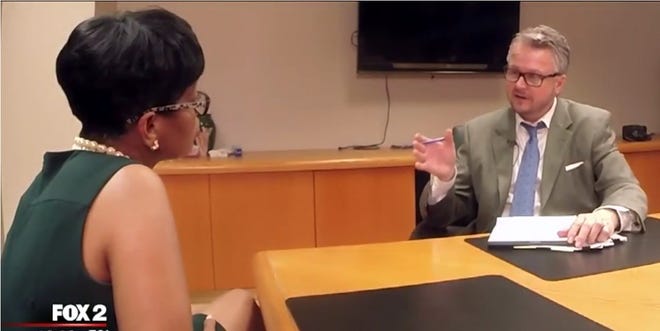
M.L. Elrick asks Wayne County Judge Tracy Green in 2019 if people can trust her to protect their children. Fox2 Detroit
But
trying, and failing, to get her son off the hook for beating her
grandchildren is just one of the reasons Green isn't fit to serve. Her
poor judgment exposed other children to danger and even forced a parent
whose daughter was beaten to death to relive the ordeal a decade after
the killer was convicted of murder and torture.
Green's
conduct during her brief career as a judge has been so poor that Wayne
County has twice had to hire retired judges to take over her caseloads —
at a cost to taxpayers of $160,000 per judge, per year.
Now Green sits at home waiting for the state
Supreme Court to decide whether to put her out of her misery ... or
prolong our own.
Two witnesses, one liar
Journalists
will do almost anything to avoid taking the witness stand. But I was a
candidate for Detroit City Council in 2021 when the Michigan Judicial
Tenure Commission called me to testify in Green's disciplinary hearing,
so I complied. At issue was an investigation I did in 2019 while working for Fox 2 News that included allegations Green helped conceal how her son Gary Davis-Headd beat her grandchildren.
Green
had published articles asserting that the deck was stacked against
parents before she was elected to the Wayne County Circuit Court in
2018. Her expertise in family law may be why she started her judicial
career in juvenile court.
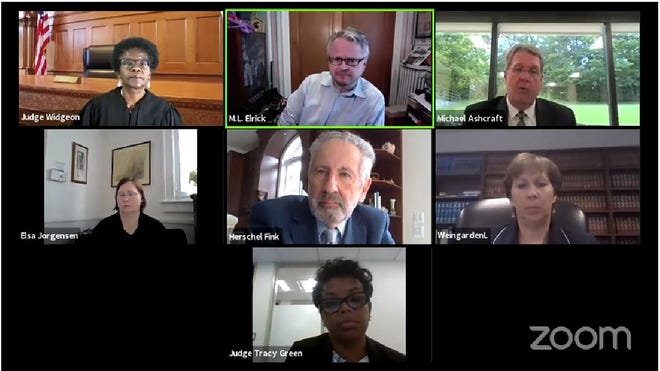
M.L. Elrick testifies on May 27, 2021 in the Michigan
Judicial Tenure Commission prosecution of Wayne County Circuit Judge
Tracy Green, who was accused of misconduct Michigan Judicial Tenure Commission
In
March 2019, after less than three months on the job, Green was a
witness in her own courthouse in a case that would determine whether her
son would lose custody of his children.
Green
testified that she was unaware her son was beating his children and said
she did not use makeup to cover up one of her grandson's bruises.
Behind the scenes, Green helped her son's attorney craft his defense.
But the judge in the case nevertheless ruled that Davis-Headd had abused
his children and terminated his parental rights. Four months later, a
criminal court judge found Davis-Headd guilty of child abuse and
sentenced him to four to 10 years in prison.
In the meantime, I began investigating allegations
that Green lied on the witness stand in her son's child custody case.
We met in May 2019 for an interview in which I asked her: "If you, a
family court judge, can’t protect your own grandkids, can the people of
Wayne County count on you to protect our kids?"
Green,
on camera, replied: "I am certainly capable of protecting children from
my perch as a Third Circuit Court judge. There is nothing that I have
done or would ever do to jeopardize the safety of any child,
particularly a child that I love. And what I’m saying to you Mr. Elrick
is that I’ve done nothing wrong, I’ve not failed to do something that I
should have done, and that’s the bottom line." (Wayne County is also
known as the Third Circuit Court.)
A family court judge didn't believe Green. And her
grandsons knew she was lying. But her real problem was the Judicial
Tenure Commission, which investigates judges. They filed a formal
complaint against Green and my Fox 2 report became evidence in the case.
During cross-examination, Green's lawyer, Michael Ashcraft, was
determined to use me to create a crack Green could slip through.
Ashcraft
zeroed in on a 6-second clip in which Green told me that she did not
"put makeup on any bruises to conceal any abuse." He tried to get me to
agree that "Tracy Green did not say that she did not put makeup on the
boy's face."
After scrutinizing video of my
testimony, and based on a review of the Judicial Tenure Commission's
findings, I believe Ashcraft was trying to establish that Green did put makeup on her grandson's face, but not "to conceal any abuse."
If
so, it was a fine point that wasn't fine enough to buffalo Betty
Widgeon, the judge presiding over Green's disciplinary hearing. Widgeon,
who heard from many witnesses, found that Green's "careful use of
language show[ed] an attempt to avoid admitting any knowledge that would
lead to liability." She also wrote that Green used vague and evasive
language to avoid answering investigators' questions and used her legal
training and a “sophisticated mastery of language to mislead or
misinform CPS (Child Protective Services), the Juvenile Court, and the
Commission about her knowledge of [her son’s] treatment of [her
grandsons] while still attempting to preserve plausible deniability
concerning false statements.”
Commissioners were more direct: They called Green a liar.
Other adjectives they used to describe Green included, "not credible," "not plausible," "deceit," and "untruthful."
On July 18, commissioners voted unanimously to
recommend that the Michigan Supreme Court remove Green from the bench.
They noted that if Green's only transgression had been covering up her
son's abuse before she became a judge, they would not call for an end to
her judicial career.
"But the maxim 'the cover
up is worse than the crime' plays itself out in a variety of contexts
and legal proceedings," commissioners wrote, noting that the crime
itself was pretty bad when you consider that "the misconduct involved
jeopardizing the welfare of minors by an attorney who purports to
advocate for children."
Ultimately,
commissioners wrote, Green's "cover up at very least unquestionably
triggers the harshest discipline of removal" because the state Supreme
Court has established a precedent of removing judges who lie under oath.
It's
worth noting that commissioners also were not impressed that Green
tried to save her skin by claiming that the grandson she purported to
love — but failed to protect — was "a confirmed liar."
Fruit of the poisonous tree
Earlier in this column, I mentioned "irony." For those still unclear on the concept, try this: After I reported that Davis-Headd was convicted of felony child abuse, he sued Fox 2 and me for defamation of character for reporting that he had been … wait for it … accused of child abuse.
The
lawsuit was almost certainly filed in the hope of leveraging a nuisance
settlement. You could call it a slap suit, which would be appropriate,
because Davis-Headd seems to think a slap is the best way to resolve
problems. This time, however, he wasn't going up against little kids.
And when it comes to the law, no one slaps around Herschel Fink.
Fink is a preeminent media and First Amendment
attorney. His client list includes the Free Press and luminaries
including Dr. Dre who, like me, drops phat beats and dope rhymes — or is
it dope beats and phat rhymes? A panel of three lawyers who reviewed
Fink and Davis-Headd's legal arguments unanimously ruled that the case
had a value of $0 and labeled it "frivolous." Fink essentially scored a
first-round knockout when Wayne County Judge David Groner promptly
dismissed the case, ruling that Davis-Headd was, as high falutin' legal
scholars say, full of baloney.
Groner wrote
that I provided "an accurate report of public and official proceedings
concerning (Davis-Headd's) crimes and convictions," adding that
Davis-Headd's "felony convictions on child abuse and domestic violence
charges … shock the conscience."
I haven't
heard from Davis-Headd since the lawsuit was dismissed. Of course, that
may just be because I don't accept collect calls.
Needless suffering
There
are few things stronger than a mother's love, as Green demonstrated by
risking her judicial career in a failed attempt to save her son. But
Green showed little concern for another mother who lost her child in a
brutal murder.
Peter Dabish was convicted in
2010 of first-degree murder and torture for beating his girlfriend to
death. Prosecutors said the 6-foot-3 Dabish, whose father was a
co-founder of the Powerhouse Gym franchise, hit 5-foot Diana DeMayo or
slammed her into something hard nearly two dozen times. There was so
much blood in Dabish's downtown apartment that even DeMayo's dog was
covered.
Three medical examiners and the neurologist who examined DeMayo's body said she died from the brutal beating.
A jury convicted Dabish.
A Wayne County judge sentenced him to life in prison.
The Michigan Court of Appeals rejected Dabish's appeal.
The Michigan Supreme Court declined to review the case.
None
of that was enough for Green, who, with less than two years experience
as a criminal court judge, decided to put DeMayo's family through hell.
Again.
In 2020, Green granted Dabish's request for an evidentiary hearing
after his lawyers hired an expert who said emergency medical
technicians caused DeMayo's death. The expert said they improperly
intubated her while trying to save her life. Dabish's lawyers had
unsuccessfully floated a similar theory in 2010, raising questions about
why Green would reopen old wounds by entertaining an already rejected
legal theory. Green did not respond to my message seeking comment, and
Ashcraft told me she would not discuss the case.
I also called Linda DeMayo, Diana's mother, who still can't understand why Green essentially reopened the case.
"The
trial was a month long, and it was horrific," Linda DeMayo told me. "I
spent 10 years getting through this and was in a good place with
post-traumatic stress disorder. … This opened up the wounds majorly."
During
the 2010 trial, Linda DeMayo was in the courtroom and did not look at
the gruesome photos from the crime scene or autopsy.
The 2020 hearings were virtual, and she found she could not look away.
“I lost it. I lost it," she told me, pausing to
compose herself. "I never realized what they had to do to do the
autopsy. … That was hard.”
Linda DeMayo said
she wrote Green a long letter “begging her to please end this, because
I’d been through enough.” She said Green's staff acknowledged receiving
the letter, but said the judge couldn’t respond.
In
the end, Green reached the same conclusion as everyone who had looked
at the case before her: Dabish did not deserve a new trial.
Linda
DeMayo, who tutors students preparing for college entrance exams,
acknowledged that Green was fairly new on the job when she decided to
hear Dabish's arguments.
"I like giving people
an opportunity to improve," Linda DeMayo said. "However, I think this is
too important a position, a job, a career, to make that many mistakes
on."
From her home in Florida, she follows Green's own troubles with the law.
"And, no, I don’t think she should ever be a judge."
Children at risk
After
reporting on Green's testimony in her son's custody case, I began
examining the abuse and neglect cases that Green presided over in family
court. Because she had not been on the bench for very long, there were
not a ton of cases to review. And, after Wayne County Circuit Court
Chief Judge Timothy Kenny watched my Fox 2 report, he reviewed a
transcript of the trial at which Green and her grandson testified and told Green she would not handle any abuse and neglect cases until her son's legal matters are resolved.
Still,
the cases I reviewed indicated that Green was reluctant to take
children out of dangerous homes, and inclined to send children back to
homes that other judges had deemed unsafe.
One
case I have kept tabs on started in March 2018. Child Protective
Services asked a judge to remove toddlers from the home of a mother who
was still just a kid herself. She was 15 years old, couldn't care for
her three children and was living with her mother and grandfather. The
grandfather had a criminal history, was suspected of sexually abusing
his daughter, and years earlier had his parental rights terminated. A
judge ordered the children removed and taken into protective custody.
Eight
months later, a judge reviewing the case ruled that the three babies
should not be returned to their young mother because doing so would
expose them to "substantial risk of harm to the children's life,
physical health or mental well-being."
After that judge retired at the end of 2018, the case was transferred to Green's docket.
The
Department of Health and Human Services argued in 2019 that the
children's mother should not regain custody because residents in the
home where she was staying were under investigation for criminal sexual
conduct. One of the children allegedly told Child Protective Services
workers that an uncle touched her private parts.
Nevertheless,
Green ordered the children returned to their mother, who was now 16. In
an apparent acknowledgment that they faced some danger, Green ruled
that their uncle and grandfather should stay away from them.
By
July 2019, Green had been removed from family court and the case went
to another judge. He ruled that the children should not be returned to
their mother because it would put them at risk.
Justice in the balance
We conclude with a classic "good news, bad news" situation.
For
the second time in three years, Wayne County's chief judge brought in a
retired judge to take over Green's caseload. That means the public
won't be at the mercy of a judge with bad judgment. It also means
taxpayers are on the hook for Green's $160,000 salary and another 160
large for the retired judge called in to do her job.
Kenny told me he felt he had no choice after the Judicial Tenure Commission labeled Green a liar and recommended her removal.
"It
was most appropriate for public confidence in the judiciary here in
Wayne County that she not hear cases until her matter is resolved with
the (state) Supreme Court," he said, adding that he did not have the
authority to stop paying Green while she is essentially suspended.
Now it's up to the Michigan Supreme Court to decide Green's fate.
As
the justices consider whether to accept the Judicial Tenure
Commission's recommendation, they may find the Supreme Court's own
guidance in such matters useful:
"When a judge
lies under oath, he or she has failed to internalize one of the central
standards of justice and becomes unfit to sit in judgment of others.”
The plaintiffs lawyer has also failed to
respond in writing to allegations that he misappropriated hundreds of
thousands of dollars in settlement money from victims he represented in
litigation.
By Cheryl Miller
Thomas Girardi. Photo: Christine Jegan
Tom Girardi did not appear at a state bar court conference held
Monday to review disciplinary charges against the fallen Southern
California trial lawyer.
Girardi has also failed to respond in writing to
allegations, filed by state bar attorneys in March, that he
misappropriated hundreds of thousands of dollars in settlement money
from victims he represented in litigation. Bar attorneys have filed a
motion for entry of default.
TALLAHASSEE – The Florida Supreme Court has disbarred Coral Gables
attorney Timothy J. Chuilli over allegations arising from a single
client matter, The Florida Bar said in a recent release.
"After receiving notice from The Florida Bar, Chuilli failed to
appear at a final disciplinary hearing and did not participate
throughout the proceedings," the state bar said in its Feb. 28 announcement
of the discipline and the Supreme Court's order. "In addition, he
failed to provide competent representation, failed to communicate and
failed to expedite litigation in a civil matter."
Chuilli's disbarment was effective immediately, according to the announcement.
Florida court orders are not final until time to file a rehearing
motion expires. Filing such a motion does not alter the effective date
of Chuilli's disbarment.
Attorneys disbarred in Florida generally cannot reapply for
admission for five years and must pass an extensive process that
includes a rigorous background check and retaking the bar exam.
Chuilli was admitted to the bar in Florida on May 2, 1992, according to his profile on the state bar website.
Chuilli was suspended in May, according to information on his state bar profile. In July, Chuilli was also suspended from the U.S. District Court for Florida's Southern District.
His suspension followed a state bar complaint filed
in April that alleged Chuilli represented a client in a civil matter
after he became delinquent in his continuing legal education
requirements in 2016 and his state bar fees the following year. Chuilli,
who has since been ineligible to practice law in Florida, ultimately
stopped communicating with his client, who subsequently had to represent
herself in her case, according to the complaint.
Chuilli did not appear for a hearing in August in the state bar's
disciplinary proceedings against him and the referee assigned to the
matter recommended
Chuilli be found guilty of violating profession conduct rules regarding
competence, communication and expediting litigation. The referee also
recommended that Chuilli be "appropriately disciplined."
COLORADO SPRINGS, Colo. (KKTV) -
El Paso County Judge Jonathan Walker has chosen to retire instead of
face disciplinary proceeding for alleged misconduct according to the
Colorado Judicial Department.
Because Judge Walker has agreed to retire from the bench
effective Feb. 15, the Commission requested the dismissal of the
proceedings pending against him. On Feb. 9, the Colorado Supreme Court
approved the recommendation of the Colorado Commission on Judicial
Discipline for the termination of disciplinary proceedings involving
Judge Walker.
Judge Walker was suspended on Nov. 8, a reason
for his suspension wasn't given. A statement of charges was filed on
Nov. 23. The statement of charges and answers contained multiple claims
and defenses.
The first claim was that Judge Walker engaged in
undignified and disrespectful conduct, including harassment, toward
three female Judicial employees. Judge Walker denied the allegations.
Another claim stated Judge Walker retaliated
against another Judicial staff member once he learned that the staff
member had been interviewed as part of an investigation into his conduct
in violation.
Judge Walker again denied the allegations and stated he
and the staff member didn't get along and the staff member was a poor
performer.
The third claim, Judge Walker improperly modified plea agreements in a
number of cases without informing the parties, violating his duty to
promote confidence in the judiciary and avoid the appearance of
impropriety and unfairness. Judge Walker admitted that he modified plea
agreements but stated that his modification was lawful.
The final claim, Judge Walker failed to
disqualify himself from cases where his personal attorney was
representing a litigant. Judge Walker asserted that he acted in
conformance with his duty to disqualify himself.
COLORADO SPRINGS, Colo. (The Gazette) - A nine-year El Paso County judge has been suspended with pay pending a disciplinary hearing before a state judicial commission.
Judge Jonathan Walker was suspended Nov. 8 by the
Colorado Commission on Judicial Discipline, a copy of the commission's
order shows.
Grounds for the suspension weren't disclosed. Rob
McCallum, a Colorado State Judicial Branch spokesman, said he didn't
know the cause, and 4th Judicial District Administrator Danny Davis
couldn't be reached for comment.
A phone message left on the commission's voice mail wasn't returned.
Walker, who previously practiced as a deputy
state public defender and as a private defense attorney, was appointed
to the county bench in 2007. He served with the Army Special Forces in
Southeast Asia "in the Vietnam era," according to his biography on the
state judicial branch website.
The winner of a judicial election may not get to serve — because she once allegedly impersonated a judge. Rhonda Crawford is currently facing an indictment and a suspended law license for pretending to be a judge and hearing cases.
Illinois’ highest court had already blocked Crawford from being sworn in before the election took place, but that didn’t stop her from getting more votes than her opponent, sitting judge Maryam Ahmad, who staged a write-in campaign. Ahmad was not pleased with the results. “She’s not the winner,” she told The Chicago Sun-Times. “She can’t take the bench. She’s just the person who got the most votes.”
Crawford’s scandalous misdeed took place last August, when she was clerking for Circuit Judge Valarie Turner. Turner gave her robe to Crawford, and allegedly let her preside over three traffic cases. When it was discovered that Crawford wasn’t the real judge, the cases had to be dismissed.
Chief Judge Timonty Evans, who hired Crawford for her position with the 1st Judicial Subcircuit, which includes Chicago’s South Side, fired her immediately. Judge Turner was relegated to administrative duty, but went on medical leave soon after.
Crawford said at a September press conference that she did not decide any cases or make any judgments. “I did not tell anyone I was the judge,” she claimed, saying she had been shadowing Turner, who instructed her to take the bench.
Despite winning, Crawford will not be able to serve as a judge if she permanently loses her law license or is convicted of a felony, according to the Sun-Times. She is scheduled to face a disciplinary hearing that will determine the fate of her bar status, and has been charged with one felony count of official misconduct and one misdemeanor count of false impersonation. If Crawford is disqualified from serving, the state Supreme Court can fill the position with someone else, who would serve until the 2018 election.