Monday, September 25, 2017

Guardianship reform advocates turn up the heat with town hall, protest

Palm Beach Circuit Judge Martin Colin announced he would not run for re-election
Despite legislative and policy strides, advocates for guardianship reform says little has changed in the courtroom: Incapacitated seniors and their families are still being taken advantage of by lawyers and court-appointed professionals while judges turn a blind eye.

So in an effort to bring further attention to the issue, an advocacy group that brought about some of those changes plans a town hall on Tuesday in West Palm Beach, followed by a protest in St. Petersburg on Thursday.

“It’s an attitudinal shift we are looking for in the judges,” said Sam Sugar, co-founder of American Against Abusive Probate Guardianship, who organized all three events. “Somehow these judges shifted position — from implementing laws designed to help vulnerable people and their families to a position of exploiting them instead.”

In Palm Beach County, the chief judge last year handed down reforms after The Palm Beach Post reported on conflict of interest, favoritism and complaints concerning former Circuit Judge Martin Colin and his wife, Elizabeth “Betsy” Savitt, who works as a professional guardian.

And Florida Supreme Court Chief Justice Jorge Labarga has a task force looking into the issue.

On Tuesday in West Palm Beach, Sugar will give a lecture to inform seniors and families about how to protect themselves from unethical guardians and their attorneys, followed by a town hall. On Thursday, he will lead a protest march in St. Petersburg that culminates at a meeting of the Pinellas Guardianship Association.

“We are going to have a very raucous crowd because a lot of victims are coming,” Sugar said of the town hall in West Palm Beach.

“This is directed toward the general public to educate, to talk about the risks families face simply by the virtue of their address in Palm Beach County and how the probate courts operate,” he said.

Then on Thursday in St. Petersburg, the group will march to the Yacht Club where professional guardians are meeting to put pressure on the association to rid itself of what the group believes are bad actors depleting the life savings of incapacitated seniors.

“We want to demand that Pinellas Guardianship Association start protecting people,” he said.

Guardianship town hall
 
Where: Embassy Suites, 1601 Belvedere Road, West Palm Beach
When: Tuesday 5 p.m. lecture, 6:15 panel
Who: Sam Sugar and panel, including state Rep. Emily Slosberg, D-Delray Beach; attorney Greg Coleman, past president of the Florida Bar; and Anthony Palmieri, deputy inspector general and chief guardianship investigator for Palm Beach County's Clerk & Comptroller. The Palm Beach Post’s John Pacenti will also be on the panel to speak about work on The Post’s series, Guardianships: A Broken Trust.

Full Article & Source:
Guardianship reform advocates turn up the heat with town hall, protest

Sunday, September 24, 2017

Largest Assisted Living Chain In U.S. Sued For Poor Care Of Elderly

Twenty residents of an assisted living complex in Palm Springs, Calif., missed their medications in a single day because no medical technician was on duty. A woman in a Paso Robles home for seniors pushed her emergency call button after falling in her room and waited 22 hours on the floor with broken bones until staff members responded.

A class-action lawsuit filed last month in a federal district court in Northern California details those incidents and other similar ones, which allegedly occurred in facilities owned by Brookdale Senior Living, the nation’s largest assisted living provider.

The complaint alleges that inadequate staffing, poor worker training and rising fees are part of a “callous and profit-driven approach” that has had “devastating” consequences for Californians living in Brookdale assisted living homes. Residents, it claims, “are left without assistance for hours after falling, they are given the wrong medications, they are denied clean clothing, showers, and nutritious food, and they are left in their own waste for long periods of time.”

Relatives of the seniors involved in the lawsuit declined to comment. The California Assisted Living Association, an industry group, also declined to comment.

Brookdale spokeswoman Heather Hunter said in an email that the lawsuit is “without merit” and the company will defend itself “vigorously.”

Tennessee-based Brookdale, which operates 1,121 facilities serving about 100,000 patients in 47 states, has encountered similar complaints elsewhere in the country. A class-action lawsuit filed earlier this year in federal court in Fort Lauderdale, Fla., alleges that the company does not adequately staff its assisted living facilities and is not providing the care it promises residents.

The plaintiff in that lawsuit, Gloria Runton, claimed the Brookdale home where she lives had assured her she would get personal care services based on an assessment of her individual needs, but that as those needs grew over time, the level of her care did not increase. At the same time, Brookdale nearly tripled her fees, she alleges.

The California lawsuit, believed to be the first class-action claim against an assisted living company under the Americans with Disabilities Act (ADA), was filed on behalf of four people currently residing in assisted living homes that Brookdale operates in the state. If the judge certifies the case as a class-action suit, the outcome could affect all residents of Brookdale assisted living facilities in California.

The lawsuit cites not only the federal disabilities law but also several California statutes, including ones that protect against unfair business practices and financial abuse of elders.

Because the goal is to win the case, good lawyers often file a number of claims, said Stephen Rosenbaum, a lecturer at the University of California-Berkeley’s law school and a directing attorney for California Rural Legal Assistance, which is not involved in the lawsuit. “Whether the ADA is the strongest claim is unclear from a strategic standpoint,” he said.

Rosenbaum said case law has not established exactly how the federal disability law applies to assisted living facilities. It is “ironic” that the attorneys in this case are using the disability law to sue Brookdale, given that the company by definition serves people with some kind of disability, he said.

The California lawsuit alleges that some of Brookdale’s facilities don’t meet federal and state accessibility standards. Some of their bathrooms can’t accommodate wheelchairs, and the company doesn’t have an evacuation or emergency plan for disabled residents, the suit claims. Of the four plaintiffs named in the complaint, three require wheelchairs.

If the case is certified as a class-action lawsuit under the ADA, that would be “big news,” said William Goren, a Decatur, Ga.-based attorney and consultant who helps clients comply with the law. That’s because of the nature of the law itself, he said.

The ADA is designed to address the disabled as individuals whose disabilities can be accommodated in different ways, Goren said. But a class-action lawsuit requires the “class” of plaintiffs to show that they’ve been injured in the same way.

“It’s very, very unusual that you could go in and get a class-action certified under the ADA,” Goren said. “It can happen, but not often.”

In California, Brookdale Senior Living runs 89 homes and serves up to 5,000 patients, offering various combinations of independent living, assisted living and skilled nursing.

In 2014, the company acquired another large assisted living provider, Emeritus, which expanded its presence in California. But the $2.8 billion deal left publicly traded Brookdale with significant staff turnover, declining occupancy and a shaky stock price. A Chinese real estate conglomerate’s recent bid to buy the company reportedly has stalled, creating more uncertainty for Brookdale and the people living in its senior homes.

Residents of Brookdale’s assisted living facilities don’t require the kind of specialized medical care provided in skilled nursing facilities, but they may need help bathing, using the toilet, taking medications, eating or walking. Some residents need walkers or wheelchairs, while others have mild cognitive impairments or dementia. Seniors who require less care and can cook their own meals often choose independent living homes, which Brookdale also operates.

Like many assisted living companies, Brookdale typically charges monthly room and board fees, plus separate charges for additional care, such as help with medications. Its average monthly rate for assisted living, including rent, food and some personal care services, is about $4,000, according to the company’s website.

Both the California and Florida lawsuits claim that to keep its occupancy levels up, Brookdale accepted assisted living residents who might have required higher levels of care, then failed to provide enough staff to meet their needs.

The consequences of leaving residents unsupervised can be severe. In one case, a wheelchair-bound resident of the Brookdale assisted living facility in Elk Grove, Calif., rolled herself out an open door and fell off a curb, breaking her neck, according to an investigation by the California Department of Social Services, which regulates assisted living facilities. The April 2 incident merited a civil penalty, still to be determined, according to the agency’s investigator. That episode was not mentioned in the lawsuit.

Tony Chicotel, a staff attorney at California Advocates for Nursing Home Reform, which is not involved in the suit, said inadequate staffing is a problem at many assisted living facilities.

Assisted living salespeople tell seniors they can meet all their current and future needs, Chicotel said. “But … the facility will only staff based on revenue they’re getting … at least at the big facilities.” The bottom line, he said, is that residents “don’t get the care they need.”

Full Article & Source:
Largest Assisted Living Chain In U.S. Sued For Poor Care Of Elderly

Legislature to consider bill to allow removal of mentally incapacitated elected officials

Gary Ott
SALT LAKE CITY — A bill that would allow the removal of mentally incapacitated elected officials and address troubling situations such as what happened with former Salt Lake County Recorder Gary Ott will have a new chance to become law next year.

But it's quite different from proposed legislation that failed to pass in the Utah Legislature earlier this year. And it would only apply to six counties — that is, if they choose to adopt it.

The bill has not yet been publicly filed, but its sponsor, Sen. Daniel Thatcher, R-West Valley City, described it as setting the "highest bar possible" to remove an elected official with a permanent mental incapacity in order to gather as much support possible from those who fear it could be used as a political weapon.

Though situations like what happened with Ott — whose health became the subject of more than a year and a half of public questioning and controversy following a Deseret News investigation — are rare, Thatcher said the issue is too important to ignore.

Thatcher has said he once knew Ott as a mentor as a friend, before his health began declining.

"Sometimes doing nothing is the best possible thing you can do," he said. "This is not one of those cases."

Thatcher urged lawmakers to support the bill so it could be considered by the House and Senate in January, giving it the highest possible chance of passing so counties have a way to address such situations.

Salt Lake County leaders were able to work with Ott's family to craft the recorder's resignation effective Aug. 1, which was approved by a judge. But that came after more than a year of grappling with how to address the situation, while Ott continued to collect about $190,000 in taxpayer-paid salary and benefits.

"At the end of the day, this is what I care about," Thatcher said. "I care that (Ott's) condition was hidden from the public. I care that Salt Lake County came to us and specifically said, 'Please give us a tool to address this in the future and make sure nothing like this ever happens again.' This is the best option I could come up with."

The Legislature's Political Subdivisions Interim Committee voted Wednesday to pass a draft of Thatcher's bill so it can be considered during the 2018 Legislature.

The bill alters a previous proposal from Rep. Rebecca Chavez-Houck, D-Salt Lake City, that would have implemented a three-tiered process to remove an elected official — requiring a voter petition, a unanimous vote from the applicable governing body, and a court proceeding where a judge could order a medical evaluation of the public officer in question.

Thatcher's bill would not include a voter petition — which lawmakers previously feared could be used to attack a person's political career — but would require a unanimous vote of the elected body (excluding the elected official in question) and would only be applicable to counties that have at least five elected officials on their council or commission.

"A unanimous vote is much more compelling than a unanimous vote of two," Thatcher said, noting that many counties in Utah have only three commissioners.

That would leave only six counties — Salt Lake, Summit, Grand, Cache, Morgan and Wasatch — where the new law would apply, but only if those counties choose to adopt the measure, he said.

A unanimous vote would then only refer the question of the elected official's removal to a judge, who would then decide whether to order a competency evaluation. That competency evaluation would be carried out by a medical professional who would then report one of only three findings to protect the individual's privacy: "competent, competent with reasonable accommodations, or not competent," Thatcher said.

He also noted that if the judge orders a competency evaluation, the county would be required to pay for it. If the judge doesn't order a competency evaluation, the county would then pay the elected official's legal fees.

The court could also rule whether the council "acted in bad faith" when voting to refer the matter to court, Thatcher said.

"So the county has an incentive not to use it unless for reasons as obvious and as egregious as in Salt Lake County (with Ott)," he said.

If the competency review finds the person incompetent, the legislative body could then vote whether to remove the person from office.

"I know it's complicated," Thatcher said, "but we've tried to keep it as simple as possible while still making sure there is absolutely no window through which this process can be abused."

Though Thatcher urged the interim committee for unanimous support, Rep. Karen Kwan, D-Murray, voted against it — not because she didn't support it, she said, but so it's not rushed through.

"We still have questions in the air about this," Kwan said, echoing a concern raised by Rep. Craig Hall, R-West Valley City, about whether an incompetence ruling from a judge might impact an elected official's political future if he or she eventually recovers from the condition.

"Is this like the death penalty for this person's political career?" Hall questioned.

Thatcher said lawmakers could consider "a million hypotheticals, but at the end of the day, my concern isn't a hypothetical."

"Well, we write statutes off of hypotheticals all the time," Hall said.

"Actually, I wrote this for a friend," Thatcher rebuked.

Because the vote on the bill wasn't unanimous, it will first be considered in a Senate committee during the 2018 legislative session. That panel will then decide whether to send the bill to the full Senate for further debate.

Full Article & Source:
Legislature to consider bill to allow removal of mentally incapacitated elected officials

UK: Judge Rules Doctors Can Starve Disabled Patients to Death Without a Court Order

A judge has ruled that Court permission will not be needed to remove food and fluids from severely brain damaged patients, a move which has caused concern among opponents of euthanasia.

Legal safeguard
Unlike other forms of medical care, the decision to withdraw food and fluids from patients in a “permanent vegetative state” (the term “unresponsive wakefulness syndrome” is now generally preferred) has until now been referred to the Court of Protection, even if doctors and relatives are in agreement.

Landmark ruling
Now, the decision by Mr Justice Jackson means those cases will no longer have to come to court. He made his ruling in a case concerning a 50-year-old woman who suffered from a degenerative illness for 14 years. The patient, known in court as M, had Huntington’s disease and was bed-ridden in hospital and fed by a tube. The Court heard that she had shown no sign of awareness for 18 months.

Mr Justice Jackson agreed with her family and doctors that withdrawing nutrition from her would be in her best interests. The tube was removed and she died in August. Mr Justice Jackson said in his view the case should not have come to court.

Passive euthanasia
The ruling was welcomed by pro-euthanasia group Dignity in Dying. Chief Executive Sarah Wootton said the ruling was “a helpful step towards a clearer, more person-centred view of end-of-life care”.

“When all parties – family, the hospital and treating doctors – are agreed on what someone would have wanted for their care, it seems absurd to require a costly court process to confirm this.”

Dangerous precedent
However, the news has been greeted with great concern by patients rights groups. Dr Peter Saunders of the Care Not Killing Alliance said: “This court decision sets a dangerous precedent and should be appealed. Taking these decisions away from the court of protection removes an important layer of legislative scrutiny and accountability and effectively weakens the law.

“It will now be more likely that severely brain damaged patients will be starved or dehydrated to death in their supposed best interests and that these decisions will be more influenced by those who have ideological or financial vested interests in this course of action.”

The official solicitor, appointed by the state to act for such patients, is likely to appeal against the ruling.

Recently, a British doctor wrote on his findings that many patients in a “vegetative” state, are in fact aware and can be communicated with.

LifeNews Note: Courtesy of SPUC. The Society for the Protection of Unborn Children is a leading pro-life organization in the United Kingdom.

Full Article & Source:
Judge Rules Doctors Can Starve Disabled Patients to Death Without a Court Order

Saturday, September 23, 2017

Mental Hospital Being Investigated After Abuse Allegations Surface

Image Courtesy of Hans Eiskonen
Thirty-one staff members at Connecticut’s only maximum-security psychiatric hospital, Whiting Forensic Division hospital in Middletown, have been suspended and nine have been arrested in connection with abuse allegations.  More arrests are expected to be made shortly as the facility continues to be investigated, according to police.  Whiting is part of Connecticut Valley Hospital, which is maintained by the state Department of Mental Health and Addiction Services.  There are 106 beds at the facility in the maximum-security area and an additional 141 beds in “enhanced security”.

“It’s really incomprehensible that this could happen in this day and age,” said Senator Heather Somers, a Republican. “It’s like something out of a Stephen King novel. I think it’s very important that we, as legislators, get to the bottom of this. If you are put in the state’s care, you should be cared for. You shouldn’t be tormented.”
Whiting Forensic Division hospital
Image Courtesy of NBC Connecticut
Alleged incidents include placing a diaper over a patient’s head, throwing food at him, placing a mop on his head and pouring water over him, adding salt in his coffee, and kicking him.  And, current and former staff members and patients’ relatives are coming forward with many other accounts.

Somers said some of their allegations include staff abusing patients, disobeying doctors’ orders and forging of doctors’ signatures.  The nine arrested were charged with cruelty to persons and disorderly conduct.  The other 31 suspended either took part in the abuse or knew about it and failed to report it.  They face the possibility of being terminated from their positions and losing their licenses.

The abuse came to the forefront after the state Department of Public Health found one of the residents, a 62-year-old male, to have been kicked, jabbed, poked at and taunted by staff members over a significant period of time.  The federal Centers for Medicare & Medicaid Services asked that Whiting be investigated following a whistleblower complaint.  Some of the abuse was later found to have been recorded by surveillance cameras.
Mental Hospital Being Investigated After Abuse Allegations Surface
Image Courtesy of NBC Connecticut
The 62-year-old patient was committed to the hospital back in 1995 after being acquitted by reason of mental disease in the murder of his father, according to his court-appointed co-conservator, Karen Kangas. The man was diagnosed with schizoaffective disorder and autism spectrum disorder.  “He’s been traumatized,” Kangas said. “That’s not how we should be treated when we have cancer, and it should not be how we’re treated when we have mental illnesses. I just couldn’t imagine that this all went on.”

The Department of Mental Health and Addiction Services said it would “do whatever is necessary to prevent future incidents” in a statement.  District 1199 of the Service Employees International Union, the Whiting’s workers’ labor union, released a statement of its own indicating patient abuse is unacceptable. The union is calling for new management, better training, and more staff as the hospital’s services continue to be investigated.

Brian Woolf, attorney for one of the staff members who was arrested, forensic head nurse Mark Cusson, said, “We have information from a variety of sources that this patient was an extremely difficult patient and some of the actions they took were justified.”  His client is shocked by his arrest and they plan to defend their position.

Full Article & Source:
Mental Hospital Being Investigated After Abuse Allegations Surface

Volunteer guardian for the elderly shares experiences

Sue Warren & Roger Harraman
MANSFIELD – “Pepsi?” asks 71-year-old Michael Beck when Roger Harraman walks in the room.

Harraman, who serves as Beck’s legal guardian, knows the Oak Grove Manor resident loves Pepsi, and even though he didn’t bring a bottle along this time, he promises he will for the next visit and instead presents Beck with several new T-shirts.

Harraman is one of 17 local volunteers through the Catholic Charities Diocese of Toledo’s Adult Advocacy Services program. They provide legal guardianship services for those 55 and older suffering from dementia or other illnesses that limit their decision-making capacity. They also keep an eye out for those with no appropriate family to make decisions for their medical care and estate.

Essentially, a volunteer guardian’s role is to advocate for this person’s care. They become the voice for people who may have trouble sharing what they want or need. The guardians have no say over financial matters and instead are asked to focus the well-being of the people they serve.

A previous Richland Source story details why the program is important and how people can get involved.

The reasons that these elders need representation vary, but Sue Warren of Catholic Charities says, “too often” it’s a result of elder abuse, which can be in the form of intentional or negligent acts by a caregiver or trusted individual that causes harm to a vulnerable elder. Warren also serves as a volunteer guardian for several individuals.

An estimated 1 in 10 older Americans experience abuse. Locally, the Richland County Adult Protective Services, which investigates abuse, neglect and exploitation of people 60 and over, made 245 referrals between July 1, 2015 and June 30, 2016, but elder abuse often goes unreported.

Harraman advocates on behalf of three people through Catholic Charities: Michael Beck, Michael McMahon and Diane Pahlow. As far as he knows, they don’t have local family members to otherwise care for them.

“It’s rewarding, every visit. I probably get more out of it than they do,” he said. “I like getting to know them and joking around with them.”

Before meeting any of these individuals, Harraman represented another man who passed away about eight years ago. Harraman recalls that was a hard day, but the benefits of this job far outweigh the negatives. Though saddened, the retired educator decided to represent another elder, Beck, through the Catholic Charities’ program. That was more than seven years ago.

When Harraman came to visit him recently, Beck was watching “Gunsmoke.” But he seemed happy to take a break and chat. Beck informed Harraman that someone had promised him Pepsi and hadn’t brought it yet.

When Harraman later talked to the nursing home staff, he asked about Beck’s health, but he also mentioned the Pepsi situation and learned that the beverage would soon be delivered to Beck’s room.

Harraman began serving as legal guardian to Michael McMahon and Diane Pahlow this past summer when he heard that Catholic Charities knew of more people in need of representation. Harraman decided to take on the additional responsibility this past July.

So far, Harraman has only made three visits with these two, but he’s already made an noticeable impression with McMahon.

“Do you remember me?” Harraman asked this Oak Grove resident in August.

“Yes,” McMahon answered.

On this occasion, Harraman sat on the edge of the bed, listening as the 66-year-old man told a few stories. McMahon explained that he always enjoyed bowling, golf and watching Indians games.

After Harraman visited Beck and before he visited McMahon, he talked to a staff member in what’s called a “care conference.”

This is a formal process that doesn’t occur on every visit, but it keeps a guardian updated with the details of the nursing home resident’s condition. Harraman hears about McMahon and Beck’s care plan, discussing in detail everything from what they’ve been eating to if they need therapy.

Harraman is alerted more regularly via phone calls about changes in medication, health complications and other time-sensitive topics. As a guardian, he needs to be available 24/7 to respond to inquiries when needed from nursing home or medical staff. This means that even in the middle of the night, Harraman might have to take a phone call about one of the people he represents.

Both McMahon and Beck live at Oak Grove Manor, but once he’s done there, he drives down the road to another nursing home to visit Diane Pahlow, 59.

She had been sleeping when Harraman previously visited, but she still vaguely remembers him. Awake on this occasion, she asks him more about himself and his role as her guardian. He assures her that he’ll make sure she’s taken care of correctly.

In turn, Pahlow shares a little about herself. She likes singing, dancing and listening to music, especially gospel. The Iowa native moved to Mansfield where her husband lived.

"But now, I don't have family in Ohio anymore," Pahlow said.

Harraman and other Catholic Charities volunteers are appointed to be legal guardians by the probate court. And if an elder needs someone to speak on their behalf, the guardians step in and look out for the elder's best interest.

Anyone interested in becoming a volunteer guardian can learn more by calling 419-524-0733.

Full Article & Source:
Volunteer guardian for the elderly shares experiences

Bonnie Kraham: Guiding principles of an elder-law estate plan

There are many goals to consider in elder-law estate planning. They include transferring assets to beneficiaries on death with the least amount of costs, taxes and legal fees, while avoiding family conflicts and possible legal battles. Another possible concern is keeping assets in your own bloodline, protected from children’s divorces, lawsuits and creditors. Planning also allows people you choose to be in charge of your affairs if you’re incapacitated, avoids a costly guardianship proceeding that allows a judge to appoint a legal guardian for you, and protects assets from nursing home costs.

Trusts are often preferable to wills to avoid a court proceeding on death called probate, save time and money and reduce the chance of family conflict over the inheritance. Wills are used in probate court.

Basic principles guide the process of creating an elder-law estate plan.

First, understanding family dynamics is key. Standard questions reveal necessary information. How old are you? How is your health? How many children do you have? Are you married? If you are not married and have no children, are your parents alive, or do you have any siblings, nieces or nephews?

Who will receive the inheritance and how? Do you have disabled beneficiaries on government benefits? Are you disinheriting anyone? Do you want to leave outright distributions of assets to your beneficiaries, or do you want them to receive assets over time?

Second, a review of current estate-planning documents reveals whether your current goals are being met. Maybe your current plan is adequate, or maybe it needs to be tweaked, or maybe it would be better to start anew. Are you expecting to receive an inheritance that would change your goals or create estate tax issues? Do you have long-term care insurance, and if so, what are the details of your benefits? If you don’t have long-term care insurance, a Medicaid asset protection trust may be needed to protect assets from nursing home costs after five years.

Third comes a review of the assets. The asset list includes each asset you own, how each asset is titled and its value. Possible asset categories include real estate, vehicles, bank accounts, retirement funds, other investments, life insurance, annuities, business interests and anything else of value.

Fourth is the development of the elder-law estate plan. Who will make medical decisions for you in case of incapacity? Who will be your trustee, executor and power of attorney? Who will serve as backups in these different roles in case the first choices are unavailable? You choose people you trust who will make a smooth transition on disability or death.

Fifth, review the plan at least every three years to see if changes in the law or your life mean the plan needs adjusting. You want the plan to work not only when you create it but years later when you need it.

Bonnie Kraham is an attorney practicing elder law estate planning with Ettinger Law Firm, 75 Crystal Run Road in the Town of Wallkill. She can be reached at 845-692-8700, ext. 119 or bkraham@trustlaw.com. This column is intended to provide general information, not legal advice.

Full Article & Source:
Bonnie Kraham: Guiding principles of an elder-law estate plan

Friday, September 22, 2017

The Horrors of Court-Appointed Guardianship – Gretchen’s Shortened Life

Someone I loved very deeply was the victim of abuse by the Probate Court, which destroyed her whole life and precipitated her premature death.

The judge has sole control of guardianship. Guardianship is a dictatorship.

I met Gretchen in the mid 1980s. We started dating in 1998. Around 2000 she developed Parkinson’s disease. By the end of 2008 she also had dementia. I took care of her at home so she would not have to go into a nursing home.

I filed a petition for guardianship in 2011. Since it was a contested case, the court appointed a Guardian ad Litem (GAL) and temporary professional guardian as “disinterested” parties.

My first attorney negotiated a temporary agreement signed by all parties under which I would continue to manage Gretchen’s daily care and finances.

All of Gretchen’s doctors said she should stay at home under my care. In July 2012 the guardian put Gretchen into a nursing home while I was away on vacation, without prior notice.

I should explain: I was planning on going to dance camp with Gretchen as we had done every year for many years. The professional guardian refused to allow Gretchen to go, on the grounds that it would not be safe because of her Parkinson’s and the rustic nature of the camp. She demanded that I go by myself. I have a letter from the camp manager saying that the camp is handicapped accessible. People no longer able to dance are welcome to come to be with their long-time friends.


Gretchen’s daughter had wanted to put Gretchen into a nursing home so she could live in her house. That was what triggered the petition for guardianship. Gretchen did not have a lawyer at the time.

Gretchen’s son did not want her in a nursing home. However, he supported the plan to put Gretchen into a nursing home “temporarily” so I could be removed from Gretchen’s house with a restraining order. That’s what happended while I was away. Then the guardian double crossed Gretchen’s son by keeping her in the nursing home permanently.

When I returned from vacation, the GAL and professional guardian got a restraining order preventing me from visiting Gretchen in the nursing home. Without court authority, the guardian removed Gretchen from my care.

At the hearing on the restraining order I testified that none of the complaints in the affidavit for the restraining order were correct. The judge allowed the restraining order that was based entirely on hearsay and double hearsay.

In the nursing home Gretchen was required to sit in a chair all day. This went directly against the advice of Gretchen’s neurologists who said she needed to stay as physically and socially active as possible or she would go downhill.

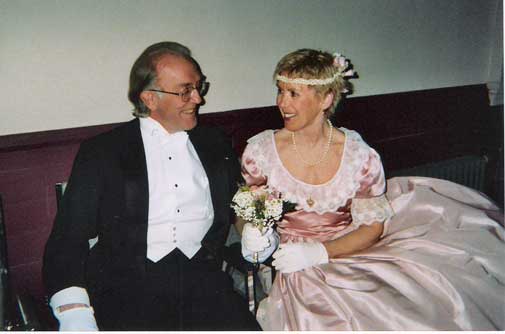
Despite her Parkinson’s, Gretchen was very physically active. She loved all kinds of dancing. The picture on page one is from a vintage dance.

We went ballroom dancing a few nights a week. Gretchen went for daily walks (weather permitting), especially around the lake near her house. She went to the movies, visited with friends and relatives, worked out at the health club, went to dance events and dance camps. Her doctors said her condition was approximately stable.

Within weeks after being placed in the nursing home, Gretchen had lost the ability to walk on her own. Gretchen’s son and his wife filed strong complaints with the guardian regarding Gretchen’s inactivity and rapid decline. The guardian hired an attorney (paid for out of Gretchen’s estate) and instructed them not to communicate with her except through her attorney.

My first attorney was being treated for cancer and unable to continue on the case. I hired a high-level Elder Law attorney. I asked him to file a complaint with the court regarding Gretchen’s lack of proper care. He told me we had to work through the GAL and the temporary professional guardian. The guardian ignored the complaints by my attorney.

Gretchen’s daughter-in-law (Reference 1) says Gretchen was being drugged in the nursing home. This was unnecessary, harmful, and can be fatal. Gretchen’s condition continued to deteriorate. In December 2012, Gretchen’s son and his wife filed a blistering complaint with the court asking for the removal of the guardian. The judge did nothing.

In late December 2012 Gretchen suffered an unexplained incident in the nursing home. Her left wrist and left angle were swollen. Gretchen’s doctor at Lahey Clinic recommended physical therapy for her ankle. The guardian denied treatment, citing the DNR [Do Not Resuscitate] and other statements in Gretchen’s HCP [Health Care Proxy].

The swelling in her wrist healed fairly quickly. The ankle never healed. Gretchen spent the rest of her life in a wheelchair. The total lack of activity accelerated her decline.

By the time of the trial in February 2013, Gretchen was terminal. At a special session during the trial I testified that there was no valid evidence in the affidavit for the restraining order. The GAL and guardian offered no evidence to support the restraining order. The judge ordered the records of the restraining order sealed to protect my reputation.

The judge did nothing about the misconduct by the GAL and professional guardian. The guardian put Gretchen on hospice care about a week after the trial without notice to the parties. Gretchen died a few months after the trial.

I requested recordings of all the hearings in order to file a complaint. My testimony regarding the false restraining order and misconduct by the GAL and guardian was missing. According to the Office of the Chief Justice of the Probate Court, there is no evidence this testimony was ever given.

Reference 1.

http://www.blogtalkradio.com/marti-oakley/2017/06/13/professional-predatory-guardians-the-perfect-job-for-psychopaths

PENDING BILL BEFORE THE
MASS. LEGISLATURE

The Office of the Chief Justice told me there is a bill (S.1177/H.3027) before the Massachusetts Legislature proposed by advocates for the elderly. The purpose of the bill is to provide guardianship services to “unbefriended” people.

Unbefriended people are very vulnerable. They have no one to complain to if they are subjected to abuse. Any system for providing guardianship services to the unbefriended needs to have ironclad protections against abuse.

This bill gives immunity to guardians. Guardians are already given immunity by judges of the Probate Court. Regardless of the intent of immunity, the result has been to create a system of legalized crime where guardians commit crimes with impunity.

Other health care providers have to carry liability insurance. Conservators have to be bonded. Guardians should have liability insurance, not immunity.

A careful reading of the bill shows that the Executive Director of the Office of the Adult Guardianship and Decisional Support Services is the only entity given any authority. It is a dictatorship.

 I have attempted to rewrite the bill in a way that makes maximum use of the principles of democracy such as separation of powers (no one has sole control), checks and balances, accountability (no immunity), avoiding conflict of interest by putting authority in the hands of disinterested parties, etc., to prevent the abuse of power (Reference 2).

Reference 2.

https://ppjg.me/2017/08/09/massachusetts-legislature-poised-to-give-immunity-to-guardians/

MESSAGE FROM
GRETCHEN’S
DAUGHTER-IN-LAW

by Patti Burke Plante

Gretchen was definitely drugged at the nursing home immediately.

This experience was terrible and made our family lose trust in the system. It was unbelievable what the courts get away with. They make you feel guilty for fighting for your loved one’s care.

They “say” they are here to help, but feed on the family that are not getting along and pit family members against each other.

The guardian in our case was terrible and there was no recourse. When we complained or brought up concerns about Gretchen’s care, she got her own lawyer (paid for by Gretchen’s estate) and we could only communicate with the guardian through her lawyer.

This was a long battle and at the last day of court we were told that it was not about Gretchen’s best interest, it was about the law.

 I could go on and on, but the bottom line is that this system is definitely broken and something needs to be done.

A bill or act to give these people more power is just ridiculous!

Full Article & Source:
The Horrors of Court-Appointed Guardianship – Gretchen’s Shortened Life

Chief judge names acting public guardian for Cook County

A longtime attorney with the Cook County public guardian's office will take over as acting public guardian, Chief Judge Timothy Evans announced Wednesday.

Charles Golbert has been an attorney for the public guardian's office for nearly 26 years and succeeds Robert Harris, who is stepping down after his appointment to a Circuit Court judgeship by the Illinois Supreme Court. Harris is to be sworn in as a judge Friday.

Harris started his career as a staff attorney with the office and took the public guardian's job in 2004. He has been an outspoken critic of shortfalls in Illinois' state child welfare agency and in the juvenile court system.

Golbert will oversee the office's 206 employees and a $21.9 million annual budget. The office acts as attorney and guardian for about 6,000 state wards in abuse and neglect proceedings as well as custody and divorce proceedings.

The public guardian also acts as the court-appointed guardian of adults with disabilities or their estates. The division manages about $100 million in estate assets and recovers stolen assets for clients.

"The public guardian and the attorneys in the office play a very important role for some of our most vulnerable residents — adults with disabilities and abused or neglected children," Evans said in a statement Wednesday. "They speak for those who cannot speak for themselves, and they are dedicated advocates in the justice system."

Starting Monday, Evans will begin accepting applications for a permanent replacement for the position.

"While I will seek a permanent leader for the office, I am pleased to name Charles Golbert as the acting public guardian," Evans said. "I also want to thank Robert Harris for his service. I certainly welcome Robert to the judicial ranks, but his leadership and advocacy will be missed."

Full Article & Source:
Chief judge names acting public guardian for Cook County