Showing posts with label Protest. Show all posts

Saturday, June 11, 2022

PA ADAPT protests 'predatory' guardianship practices in Pennsylvania

by NCPA Staff


Harrisburg, Pa. — PA ADAPT, an activist group for disabled people’s rights, is demanding that Governor Tom Wolf make reforms and stop what they call “predatory” guardianship practices.

PA Adapt held a protest at the state capitol on June 8 to push for their demands.

Pennsylvania currently has ten Area Agencies on Aging that oversee the guardianship of individuals ordered by the court. These guardianship agencies then have control over an individual’s assets and can place them inside of an institution.

“Money flows from the estate of the ward or government entitlements making guardianship a lucrative industry," states a PA ADAPT press release.

The organization presented the following demands:

  • We demand Governor Wolf direct Secretary of Aging, Robert Torres to come speak with us NOW!
  • We demand Secretary Torres schedule and facilitate a meeting with Huntingdon County Area Agency on Aging, David Italiano and the Roads to Freedom Center for Independent Living to create a care plan designed for David, with his input.
  • We demand Governor Wolf instructs Secretary Torres and PA Area Agencies on Aging work collaborate with Centers for Independent Living (CILs) to address the many guardianship issues present in PA
  • We demand Governor Wolf convene a task force of persons currently at risk of or formerly subject to guardianship, CILs, Area Agencies on Aging, Adult Protection Services, Ombudsman, Protection & Advocacy, family and professional guardians to develop an enforceable bill of rights

“Even the American Bar Association thinks that guardianship is a ‘drastic intervention,’ and that less restrictive options are preferred,” said Mike Grier of Pennsylvania Council of Independent Living (PCIL).

“That drastic intervention by aging organizations and courts here in Pennsylvania has stripped David Italiano and countless others of their dignity, independence, privacy rights, personal & real property and their fundamental right to choose where they live and with whom they associate. The current situation is simply untenable and must be changed.” 

David Italiano is a disabled person that is currently being institutionalized against his wishes. An Amicus Brief was filed on April 18 with the Supreme Court regarding his case, in an attempt to overturn guardianship laws. 

PA ADAPT said they'd like to see the state follow the Uniform Guardianship, Conservatorship, and Other Protective Arrangements Act (Uniform Act).

Key provisions within the act are to prohibit guardianships where less restrictive alternatives would meet an adult's functional needs; require specific court findings before certain critical rights (e.g., to marry, vote, choose visitors) are abridged; require petitioners to state whether less restrictive alternatives have been tried and justify any failure to do so; create mechanisms that adults subject to guardianship and others can use to trigger modification or termination of an order.

Full Article & Source:

Wednesday, October 6, 2021

Britney Spears' father removed as her guardian

Fans of Britney Spears protest in front of the Stanley Mosk Courthouse during Britney's hearing to end her father's controversial guardianship, in Los Angeles, California on Wednesday (AFP photo by Valerie Macon)

(MENAFN- Jordan Times) LOS ANGELES — Britney Spears' father was removed from his controversial role as his daughter's guardian on Wednesday by a Los Angeles judge, ending a long and bitter legal battle by the pop princess.

Jamie Spears was suspended with immediate effect and replaced with a temporary conservator "in the best interests" of the singer, said Judge Brenda Penny, calling the present arrangement "untenable."

"Mr Spears is ordered to turn over all the conservatorship assets," said Penny.

Spears' father has controlled her life for the past 13 years, under a legal arrangement the 39-year-old US singer has slammed as "abusive."

Wednesday's move came after a years-long campaign that played out in public, and after the emergence in the last week of two new powerful documentaries featuring allegations that Jamie Spears had bugged his daughter's phone calls.

Spears' lawyer Mathew Rosengart described her father as a "cruel, toxic and abusive man."

"Britney deserves to wake up tomorrow without her father as her conservator," Rosengart said. "It is what my client wants, it is what my client needs, it is what my client deserves."

Dozens of supporters gathered outside the courtroom cheered and wept as news of the ruling emerged.

Spears' fiance Sam Asghari took to Instagram to post "FREE BRITNEY! CONGRATULATIONS!!!!!!!!!" along with a photo of what appeared to be him handing the singer a rose.

In their motion filed this week, Spears' lawyers said: "Every day that goes by with him as conservator — every day and every hour — is one in which he causes his daughter anguish and pain."


'Kafka-esque nightmare'


Those claims were seemingly bolstered by a New York Times documentary released Friday that alleged Jamie Spears had surveillance devices secretly installed in his daughter's bedroom to record her conversations.

"It really reminded me of somebody that was in prison," a former security firm employee told the "Controlling Britney Spears" filmmakers.

The pop star's lawyers said the Times' allegations about her father showed "horrifying and unconscionable invasions of his adult daughter's privacy."

Jamie Spears denies any illegal surveillance took place.

Another new documentary — Netflix's "Britney vs Spears," released on Tuesday — claims the singer twice tried to hire her own lawyer in the early years of the conservatorship, but was denied.

In July, Spears was finally successful in appointing her own lawyer — Rosengart — and last month, her father filed a petition for the conservatorship to be ended.

The judge appointed accountant John Zabel as a temporary conservator of Spears' estate, in an arrangement she said can last until the end of the year.

Jamie Spears' lawyers repeatedly objected to his suspension, disputing the Times' allegations and questioning the veracity of his daughter's testimony that the conservatorship amounted to "abuse."

"There is not a shred of evidence to support suspension," said Vivian Thoreen, via video call.

Jamie Spears' 13-year record as guardian had been "impeccable" and he should not be temporarily replaced but instead the entire guardianship should be terminated immediately, they argued.

Rosengart insisted that this was simply a tactic and said Jamie Spears was afraid he would have to turn over "evidence of his corruption and worse."

Jamie Spears' immediate suspension is "what my client Britney Spears — who has been abused by this man not only for the past decade but since her childhood — wants and deserves," said Rosengart.

"Please hear the plea of my client" to "end this Kafka-esque nightmare," he added.


'Never fit to serve'


Spears' representatives and fans have long accused her father of profiting from the guardianship, which was set up after a highly public 2007 breakdown when the shaven-headed star attacked a paparazzo's car at a gas station.

The lawyers have said her father was "never fit to serve," citing in their petition allegations of his "reported alcoholism" and "trauma he caused his daughter since her childhood."

A hearing expected to formally dissolve the conservatorship will be held on November 12.

Full Article & Source:

Wednesday, November 18, 2020

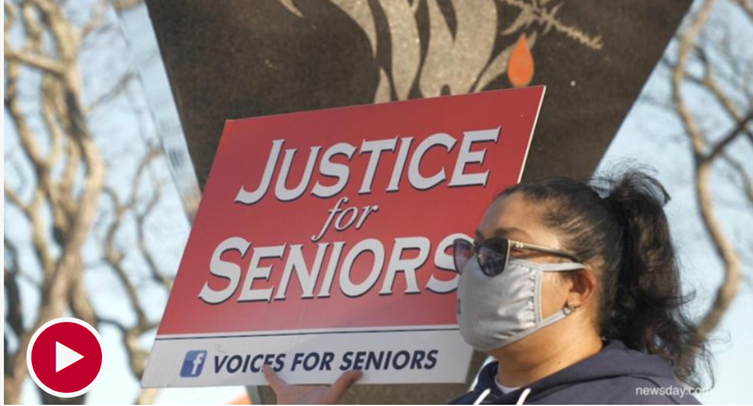
Protesters in Long Beach call for nursing home reforms

Voices for Seniors held a rally at Kennedy Plaza in Long Beach on Saturday to demand answers and reform regarding the way their loved ones were treated in nursing homes during the pandemic. Credit: Kendall Rodriguez - CLICK TO WATCH VIDEO
  

By John Asbury

More than a dozen protesters stood in front of Long Beach City Hall on Saturday seeking nursing home reforms on visitation policies, admission of COVID-19 patients and proper care and treatment of elderly patients during the pandemic.

Demonstrators with the nonprofit group, Voices for Seniors, called on Gov. Andrew M. Cuomo and state legislators to take additional measures to protect seniors from COVID-19, monitor their care and allow family members access to visit their loved ones in nursing homes and adult rehabilitation facilities.

"Maybe some people think we’ll go away but we’re still speaking up because our seniors deserve it," Voices for Seniors co-founder Vivian Zayas of Deer Park, said.

Zayas said she lost her mother April 1 after she tested positive at a West Islip facility. She said her mother was undergoing physical therapy when she was infected with the virus and died after she was transferred to the ICU.

Organizers criticized a March 25 state directive that allowed nursing homes to accept COVID-19 patients if they had adequate care, personal protective equipment and staffing. The guidance stated, "no resident shall be denied admission solely because of COVID positive status," but did not require those patients to be admitted.

Protesters held a banner that said, "Cuomo, how many seniors died?"

State officials said the state Health Department was following CDC guidance and a report in July indicated COVID-19 was already present in more than 300 facilities, or 98% of nursing facilities from community spread or asymptomatic staff members before COVID-19 patients were admitted.

"This pandemic, while sadly still being politicized, is far from over. The Department continues to assist facilities statewide that are currently managing COVID-19 clusters and preparing for a second wave," Health Department spokesman Gary Holmes said in an email Saturday. "Our decisions will continue to be driven by data and science, and now is not the time for anybody to let their guard down. While we understand the challenges this pandemic has caused nursing home residents and their families, the state remains committed to protecting nursing home residents and front line workers from this unforgiving virus."

Assemb. Missy Miller (R-Atlantic Beach) attended the rally and said she is concerned about neglect and abuse in nursing homes where seniors and special need adults are not being monitored or only allowed limited visits from family members.

The state resumed visitation at nursing homes in July at facilities that have been COVID-19 free for 14 days and visitors can show a negative test in the past seven days. Some visitations have been restricted in facilities outside Long Island where clusters of cases have been reported.

Miller said she is sponsoring a bill to assign essential care workers access for each patient. She said some patients are dying from failure of oversight leading to neglect and loneliness.

"They’ve given up. They lost their families and they don’t understand it," Miller said.

Full Article & Source:

Tuesday, November 3, 2020

It has the highest death rate of any nursing home in the US. Families want to know why


As numbers climbed at a facility for veterans in New Jersey, the rights of grieving family members fell away


by Ann Neumann
 
By noon on 16 September, more than 100 people had gathered at the end of the long drive that leads to the Menlo Park Veterans’ Memorial Home in New Jersey. Eighteen-inch letters – red, white, and blue – spelling “THANK YOU HEROES” were pushed into the sod beneath a semi-permanent sign that reads “Now accepting job applications” and “SERVING THOSE WHO SERVED”.

Staff members – mostly Black, mostly female – stood to the right of a podium. To the left stood family members holding framed photos of their loved ones, former residents of Menlo Park who had died over the past several hellish months, either in the facility or in a nearby hospital.

Gary White, the no-nonsense, cigar-chewing commandant of the local Marine Corps League – an 80-year-old federal organization and advocacy group for marine veterans – organized the event. White told the crowd that Menlo Park’s residents had, as service members, “given America a blank check payable up to and including their lives”, but that during the pandemic, “veterans died who never should have”. A week before the protest, White had received calls and emails from family members who were shocked by their loved one’s deaths, who had never even been told their father or grandfather was sick. “They asked me to do something,” he said.

Left to right: Nancy Pike holds a photograph of her father Alois Franko; Susan Vella holds a photograph of her father Frank Vella; and Keith Prendergrast holds a photograph of his father William Prendergrast. Photograph: Victor J Blue/The Guardian

By late May, there were only 177 residents at Menlo Park, down from 300 in early March. A recent Wall Street Journal investigation shows that many of the dead were never tested for Covid-19, their official cause of death recorded as pneumonia or sepsis. Though the facility’s management maintains that the official death count from Covid-19 is 62, the investigation concluded that 101 residents had died of Covid-19 at Menlo Park since March, the highest single death rate of any nursing home in the country.

At the protest, families and staff cited a gross lack of communication about what was happening inside the facility, a senseless ban of mask-wearing in the early weeks of the pandemic, and a continued effort to cover up the total number of deaths at Menlo Park, as the cause of their attendance. “Negligence is Murder,” read one sign, held by a grieving family member, “Where was their PPE?” Outraged by the mass deaths, at least 35 families and 22 employees have retained lawyers.

The protest was brief, but one family member, White told me, said it was the only memorial they’d had for their grandfather. As people in the crowd wiped their eyes and began to wander back to their cars, staff members gathered around Shirley Suddoth-Lewis, the president of their local union who has worked at Menlo Park since 1984, as she handed out white balloons. When they released them into the air they said in unison the name of their colleague, Monemise Romelus. She had contracted Covid-19 before she was given access to PPE and died in May.

They want accountability. They want transparency. They want justice. But in April, New Jersey passed an immunity law intended to protect nursing home owners from responsibility for Covid-19 deaths, a law that nursing home operators hope will stand in the way of what the bereaved most desire. Despite the fact that nationally more than 50,000 nursing home residents and 750 staff members have died so far from Covid-19, at least 26 states have passed some form of immunity law that shields long-term care facilities and healthcare providers from Covid-19-related civil negligence lawsuits. A recent article in ABA Journal, a publication of the American Bar Association, states: “Those measures generally bar claims for standard negligence, only allowing claims for harder-to-prove gross negligence, willful misconduct or fraud.”

Immunity laws are often passed by state and federal governments in the event of a crisis. But the decision to protect the nursing home industry, betrays legislators’ – and perhaps society’s – erroneous assumption that elders’ deaths were inevitable, that their lives were worth little or too frail to be saved. Clinicians and advocates alike have countered that proper infection control, long a systemic problem in nursing home care, could have largely mitigated the number of deaths.

Tanya Montuore cries as her husband Robert Montuore comforts her. Photograph: Victor J Blue/The Guardian

“This is simple,” Robert Montuore told me, “if they had just followed standard protocol.” His wife, Tanya stood next to him, holding a photo of her father, former marine Howard H Cognac Sr, who died at Menlo Park in April.

“Pop” lived with the Montuores and their daughter, Samantha, for 12 years after the death of his wife, Celeste. But when he began to use a mobility chair, the Montuores moved him into room 511 on Eagle wing at Menlo Park in February. The Montuores spoke with him daily, with Tanya joining her father for lunch at Buddy’s, the restaurant in Menlo Park’s “town hall”, almost every day. The last lunch she had with him was on 11 March; the following day the facility notified the Montuores that Menlo Park was closed to visitors. As staff and family gathered for the protest, the Montuores told me about the horror of the next four weeks, as they struggled to get Pop on the phone or to receive reliable updates from Menlo Park staff.

According to a letter the Montuores wrote to their local senator, assemblywoman and Gary White (who shared it with me, with permission) Pop called them a last time a little after 8pm on 5 April, “hysterical” because management had taken away his mobility chair and put him in a bed without a call button. “His final words were, ‘I’m not going to make it out alive,’” the Montuores wrote. “That was the last conversation we had with him.” Two days later they were told that Cognac was having trouble breathing and had an elevated heart rate, two signs of Covid-19 infection. They begged for a test. “No fever, no test,” they were told repeatedly by staff over the next few days. At one point, a staff member used her personal phone to help Pop speak to his family. Then on 11 April the facility’s nurse practitioner called to tell them that Pop was failing; when they asked if he had Covid, she said no, heart failure.

On the 16th, they called again for an update on Pop’s status. An hour later the nurse practitioner called back to tell them that he was dead.

A few days before the protest, the Montuores found out that Pop’s roommate, Daniel Bartus, had died of Covid-19 on 5 April. At the protest, Gary White called Tanya Montuore up to the microphone to speak. “They were devalued as human beings,” she said of the Menlo Park residents, “and there were countless unnecessary deaths, of my dad and so many others. Why?” She paused to wipe tears from her face. The next day the Montuores sent me two last telephone messages they received from Cognac, found after his death as they put together information for a case against Menlo Park for their lawyer. “Hi T,” Cognac says, explaining that he can’t use the phone very much because his wing is on lockdown. And then his voice breaks. “I’m worried, Honey” he says, and in a whisper, “I think I have one of the [symptoms]. I love you, Honey. If anything happens … ” A sob. “I miss you so much.”

The Montuores are only one of dozens of Menlo Park families who are seeking legal accountability for the loss of their loved ones. They fear that state and non-profit defendants will successfully leverage immunity laws to escape legal repercussions; but knowing the pain and suffering of their loss, they can’t imagine the courts won’t also want to know why helpless elders were left to die. Several attorneys I spoke with believe that Menlo Park’s lawsuits are the first in a wave that will sweep the country.

Daria Lisco, left, and Liz Vigren, right, hold photographs of their father Charles VanderPyle. Photograph: Victor J Blue/The Guardian

State and federal long-term care advocates loudly opposed immunity laws and claim that the firestorm of Covid-19 that has ravaged long-term care facilities was only made possible by decades of poor management, gross understaffing, debilitating cost cutting, systemic Medicare and Medicaid fraud, poor infection control and the lack of meaningful federal or state oversight of residents’ care. “Legal liability has always functioned as a safeguard for nursing home residents by incentivizing nursing homes to provide quality care and comply with laws and regulations,” advocates wrote in a letter to the Senate judiciary committee on 11 May.

Nonetheless, in New York, a provision was included in the annual budget, passed in April, that provided broad immunity to long-term care facilities. Governor Andrew Cuomo has drawn criticism for organizing the transfer of elderly Covid-positive patients from overwhelmed hospitals to nursing facilities. In August, the law was amended and significantly narrowed, removing protections for non-Covid patients.

On 6 May, the Pennsylvania governor, Tom Wolf, passed an executive order granting immunity. Still, several lawsuits have already been filed in Pennsylvania, including one by the family of Elizabeth Wiley, a housekeeper who had worked at Brighton Rehabilitation and Wellness in Pittsburgh for three decades and died of Covid-19 on 10 May.

Robert Sachs Jr, an attorney in Pennsylvania, where the nursing home deaths have made up between 60 and 70% of Covid-19 deaths so far, has learned from case inquiries, that many facilities “had the ability and the knowledge of what was coming to protect their populations and didn’t take any steps”. He added that the department of health “did an absolutely abysmal job” of helping facilities to prepare for the pandemic.

On 1 April, the New Jersey governor, Phil Murphy, enacted an executive order that granted broad immunity to nursing homes and healthcare providers and little more than a week later, he also signed a law. But there’s also a federal law, the Prep Act, a pandemic readiness plan passed in 2005 by the George W Bush administration in the wake of the avian influenza, that some facilities hope will provide them with immunity protections.

Yet, some attorneys, like Paul da Costa in New Jersey, who is representing dozens of Menlo Park staff and family members, believe that some claims may not be confined to the Prep Act laws (which address use of medical countermeasures) because they address absence of measures, namely the lack of proper infection control, and the now common accounts of management preventing mask and other PPE use.

In perhaps the first post-Covid decision of its kind, Estate of Maglioli v Andover Subacute Rehab, the courts have shown a willingness to see such cases go ahead. Plaintiffs asked the federal court to remand the case back to the state, against the defendants’ argument that the Prep Act prevented the case’s continuation. The court agreed with the plaintiffs, leaving the decision up to the state court.

Shari Davis cries as she holds a photo of her mother, Joan
Williams, who died at age 86 of Covid-19 at the New Jersey
Veterans Memorial Home at Menlo Park.
Photograph: Victor J Blue/The Guardian


Gary White, a members of the Marine Corps League Cpl. Kevin J.
Reinhard Detachment 189, speaks during the protest.
Photograph: Victor J Blue/The Guardian

 Glenn Osborne watched the protest from inside Menlo Park. “What a privilege that was to witness,” he told me by email. I’d met him in person the week before by taking advantage of Menlo Park’s new visitation program, “Operation Rocking Chair”, which allows residents and visitors to spend 15 minutes together, masked, outside, six feet apart. I saw a steady stream of grateful sons and daughters file through the registration pavilion (reservations must be made in advance) the day I visited Osborne. I was his first visitor in six months.

Osborne is a former marine with service-induced ALS. He speaks in a breathy, halting voice because the disease has restricted his breathing. Osborne, who is kind-faced, laser-focused and tireless, is the president of the resident’s association. If anything is on the minds of residents at the facility, they call on him. For that reason, staff members told me they worried about Osborne; he’d been writing letters to the facility’s administration and related agencies with various concerns for years. They feared management retaliation against him.

Shirley Suddoth-Lewis, who worked at Menlo Park for more than 30 years, knew from experience; she also feared retaliation from the CEO, Elizabeth Schiff-Heedles, who called an all-staff meeting on 16 March to announce there was no Covid in the building. “She told us, ‘We don’t want anyone to wear masks, the masks will scare the residents,’” Suddoth-Lewis said. “Everybody was in the lunchroom and you could tell people wanted to ask questions, but they were afraid because they might go after you.”

Let’s be candid, we know this is what we call our final mission

Glenn Osborne

But Osborne felt a strong sense of responsibility to his fellow residents and refused to be quiet. In a single-spaced, three-page letter to the department of health in August, Osborne addressed the toll that isolation has taken on the residents, leaving them to feel forgotten, disregarded, alone. He asked when outside time will resume, when residents, whose personal belongings were boxed up by the national guard during the height of the pandemic and stored in the basement, will be returned. And he asked questions regarding management’s actions in April and May. “Why did our CEO purposely prevent employees from wearing PPE?” he wrote.

Osborne told me residents try not to talk about the losses. “Many of the residents were longtime friends before they ever entered the facility. The people who lived at Menlo Park were vibrant, leading rich lives as artists, writers and storytellers,” Osborne said. “You know, this is our home, this was our life. And we knew what we’re here for. Let’s be candid, we know this is what we call our final mission.”

Shirley Suddoth-Lewis,
head of the local AFSCME
 union, worked at Menlo
 Park for more than
30 years. Photograph:
Victor J Blue/The Guardian
Like several others I spoke with, including Suddoth-Lewis, Osborne witnessed PPE being removed from staff members’ access. Osborne, Suddoth-Lewis, and others also questioned management’s decision to move patients around the facility. Covid-19 positive and Covid-suspicious residents were often moved downstairs, to the dementia ward. One resident of a shared room would be taken downstairs to quarantine while his or her roommate remained. Or patients would be returned to shared rooms when they came back from the hospital. These accounts – and the methodology behind them – bewildered Osborne and many staff members who were unable to ask questions but only follow orders. And if there was a plan to management’s mitigation efforts, the veterans and staff were never informed of it. “Transparency in communication in all areas of operations, especially those that pertain directly to us Veterans, is exceedingly rare,” Osborne wrote.

Perhaps the most chilling part of Osborne’s account is his suspicion that he will be retaliated against. “I know he’s going to be a target. I know it,” Suddoth-Lewis told me on the phone, “Because this administration is so brutal. I mean they have no remorse.” Management has remained opaque and unwilling to consider the input of residents in their care—or even the professional staff employed to provide it. “We continue to feel our lives are at risk and our patient’s rights and dignities are ignored,” Osborne wrote in the letter to the department of health.

During my “Operation Rocking Chair” visit a week before the protest, I left some snacks and toiletries for Osborne on the patio for him. For this, management punished Osborne with a citation. Should he receive a second citation, he will altogether lose the ability to see visitors.

For his dogged outspokenness and commitment to bringing residents’ concerns forward, attorney Da Costa has called Osborne a hero. To the staff of Menlo Park, Shirley Suddoth-Lewis is a hero too. She had planned to retire in December, but when she started thinking about a second wave of the pandemic, she retired early, a few weeks before the protest. She told me, “It was my anxiety from working there because certain things to me weren’t done as they should have been.”

In August, state senator Joseph Vitale, chairman of the senate health committee, hosted an online hearing. Gary White, Paul da Costa, and Glenn Osborne all testified about their experiences with Menlo Park. Vitale called for the resignation of the Menlo Park CEO, Elizabeth Schiff-Heedles (who did not return multiple requests for comment). But the spokesman for the New Jersey department of military and veterans affairs, Kryn Westhoven, publicly expressed support for Schiff-Heedles – and the CEOs of the other two veterans’ nursing homes in New Jersey, Paramus, where the official death count is at 81, and Vineland, where the count is three. A total of at least five thousand nursing home residents (veterans’ and civilian combined) have died in New Jersey.

Veterans and family members release balloons in honor of those they lost. For some, this was the only memorial they’d have for their loved ones. Photograph: Victor J Blue/The Guardian

For now it seems little has been done to address the actions of the Menlo Park administration during the height of the pandemic’s first wave – nor to prepare for the potential second wave. Suddoth-Lewis may have retired, but her responsibilities to her fellow union members are not over. As we spoke on the phone one afternoon, three of her great-grandchildren playing in the background, texts continued to come in, texts from staff members at Menlo Park. We said goodbye so she could check each one.

This story was supported by the journalism non-profit the Economic Hardship Reporting Project

 
Full Article & Source:

Wednesday, September 23, 2020

Family protests outside Watrous Nursing Center to have say in care of grandmother

By Sarah Page Kyrcz


MADISON — Some 20 family members held placards and protested just outside Watrous Nursing Center to bring to light what they consider ill treatment of the matriarch of their family for several hours on Sept. 12. The distressed family also called 911 at one point.

The Baldoz family’s concerns include the family being denied visitation rights to the resident due to COVID, who they say has been taken off her medications, while at the same time is not being properly fed or cared for on a day to day basis, they claim.

For some five hours, the protesters held signs with messages such as “Respect Not Neglect,” Save Our Grandma,” “Whatever Happened to Humanity,” as cars drove by the Neck Road facility beeping and stopping in traffic to talk. The family members stood on the property line of the facility.

Early in the protest the family placed a 911 call to the Madison Police Department to get the grandmother transferred to an emergency room for an independent medical evaluation. An ambulance arrived, along with a Madison police officer, but left empty because the nursing home would not release her, according to her son, Al Baldoz. The family does not have conservatorship rights, he noted.

Al Baldoz said he and his wife, Cherie, had an early afternoon meeting with the director of nursing and a social worker to discuss his mother’s care but that meeting abruptly ended when family members began protesting outside the facility.

“I pleaded with her not to do so (end the meeting) and knowing we weren’t going to get anywhere I had to call the police department, via 911, and ask for independent confirmation of my mom’s health because I wanted a second medical opinion, from an independent doctor, because I don’t think she’s in the condition that she (nursing home staff) is stating she is in,” Al Baldoz said.

Apple-Rehab, the parent corporation for Watrous Nursing Center, commented via email.

“Watrous Nursing Center rejects the allegations that were asserted against our staff that work tirelessly to protect and care for all of its residents,” wrote Karen Donorfio, vice president of operations for Apple-Rehab.

“The facility has followed all appropriate protocols regarding resident care and visitation and has been in contact with the Dept. of Public Health regarding these concerns,” she added. “We continue to work with and abide by the wishes of the court appointed conservator.”

Al Baldoz said he has sent messages to various state agencies including Department of Health Services and the long term assisted living ombudsman for the region and had not heard back from them.

However, later Al Baldoz, and Cherie Baldoz, were allowed to visit the 70-year-old resident.

After the visit Al Baldoz said his mother was sleepy, but he was glad to be able to see her.

“It was a poor visit and it was very quick,” the resident’s eldest son said. “We said, ‘We’ll only make it 15 minutes.’”

Al Baldoz explained his sister had been his mother’s conservator after it was discovered his mother was making “bad decisions living on her own, wandering off and those kinds of things.”

He added that after his sister “pushed some of her treatment and some of her caregivers pretty hard and they pushed back by having her removed legally because she was putting too many demands on them and they said she was being irrational.”

Al Baldoz plans to begin legal proceedings “to at least get co-conservatorship so my family has some say” and said he is currently working with his court appointed lawyer to get her discharged and have her come home.

He added, after seeing his mother and talking with the facility administrator, “We’ve run out of options, but the legal recourse, really.

“I’m just a little let down because I thought our discussions were going to go somewhere earlier,” he added.

Baldoz said his mother does have health issues, but he is concerned about the care she is receiving.

“We don’t think that she’s receiving enough attention that she could be receiving,” he said.

“Mostly it’s just the quality of the last few days,” he added, saying that she is currently on hospice care. “It makes it easier on the family when we come to visit her and she’s the best she can be at that moment and we sort of rest when the time comes.”

Editor’s note: This story has been updated.

Full Article & Source:

Monday, September 25, 2017

Guardianship reform advocates turn up the heat with town hall, protest

Palm Beach Circuit Judge Martin Colin announced he would not run for re-election
Despite legislative and policy strides, advocates for guardianship reform says little has changed in the courtroom: Incapacitated seniors and their families are still being taken advantage of by lawyers and court-appointed professionals while judges turn a blind eye.

So in an effort to bring further attention to the issue, an advocacy group that brought about some of those changes plans a town hall on Tuesday in West Palm Beach, followed by a protest in St. Petersburg on Thursday.

“It’s an attitudinal shift we are looking for in the judges,” said Sam Sugar, co-founder of American Against Abusive Probate Guardianship, who organized all three events. “Somehow these judges shifted position — from implementing laws designed to help vulnerable people and their families to a position of exploiting them instead.”

In Palm Beach County, the chief judge last year handed down reforms after The Palm Beach Post reported on conflict of interest, favoritism and complaints concerning former Circuit Judge Martin Colin and his wife, Elizabeth “Betsy” Savitt, who works as a professional guardian.

And Florida Supreme Court Chief Justice Jorge Labarga has a task force looking into the issue.

On Tuesday in West Palm Beach, Sugar will give a lecture to inform seniors and families about how to protect themselves from unethical guardians and their attorneys, followed by a town hall. On Thursday, he will lead a protest march in St. Petersburg that culminates at a meeting of the Pinellas Guardianship Association.

“We are going to have a very raucous crowd because a lot of victims are coming,” Sugar said of the town hall in West Palm Beach.

“This is directed toward the general public to educate, to talk about the risks families face simply by the virtue of their address in Palm Beach County and how the probate courts operate,” he said.

Then on Thursday in St. Petersburg, the group will march to the Yacht Club where professional guardians are meeting to put pressure on the association to rid itself of what the group believes are bad actors depleting the life savings of incapacitated seniors.

“We want to demand that Pinellas Guardianship Association start protecting people,” he said.

Guardianship town hall
 
Where: Embassy Suites, 1601 Belvedere Road, West Palm Beach
When: Tuesday 5 p.m. lecture, 6:15 panel
Who: Sam Sugar and panel, including state Rep. Emily Slosberg, D-Delray Beach; attorney Greg Coleman, past president of the Florida Bar; and Anthony Palmieri, deputy inspector general and chief guardianship investigator for Palm Beach County's Clerk & Comptroller. The Palm Beach Post’s John Pacenti will also be on the panel to speak about work on The Post’s series, Guardianships: A Broken Trust.

Full Article & Source:
Guardianship reform advocates turn up the heat with town hall, protest

Thursday, November 3, 2016

Hundreds protest electro-shock therapy at Judge Rotenberg Center

CANTON, Mass. - A large protest has ended at a local facility which uses a controversial form of electro-shock therapy.

At one point 200 demonstrators, many in wheelchairs, were at the Judge Rotenberg Educational center in Canton.

The protest was organized by a group called ADAPT, and those who attended held signs and blocked access to the facility.

“You see things like this in a Halloween House of Horrors, but they are the reality in JRC all year long,” said Nancy Hyson-Houghton, an organizer with ADAPT’s Massachusetts chapter. “Disabled people shouldn't be locked away in the JRC and similar institutions because they can’t get the services and supports they need to stay at home.  Disabled people don’t deserve to be tormented.  It’s time to stop the torture and free our people!”

Back in April, the food and drug administration proposed a ban on the use of electric stimulation devices to treat patients who have aggressive behavior or who injure themselves.

The Judge Rotenberg Center is the only place in the country that uses the treatment.

"We were dismayed by the tactics taken by these protestors. They aggressively tried to enter our school buildings and for several hours made it impossible to transport the students we serve home so they could relax after their classes and enjoy their dinner together in the homes they live in, in area neighborhoods,” a statement from the center said.

Full Article & Source:
Hundreds protest electro-shock therapy at Judge Rotenberg Center

Wednesday, November 2, 2016

Protest for the disabled: 200 people roll through the streets

Credit: Christopher Evans
About 200 people in wheelchairs rolled through the Seaport District to City Hall Plaza to protest nursing home conditions for the disabled yesterday.

“We’re here in Massachusetts to help the citizens of Massachusetts to live in the community and try to get people out of institutions,” said Marilee Adamski-Smith of the advocacy group ADAPT.

Joseph Adamski-Smith said more Medicaid funding in Massachusetts goes toward institutions rather than home- and community-based services.

“We would like those funds to be sent to integrated community living. A lot of people are stuck in nursing homes,” he said.

The protesters included both adults and children, and people with mental and physical disabilities.
The crowd chanted, “We have tasted freedom and we won’t turn back.”

Several people told stories of neglect, abuse and triumph amid the struggles they face.

“I understood from my doctors that I had no choice but a nursing home … it was so much worse than I ever imagined,” said Anne Johansen, 65, who suffers from a progressive neuromuscular disease.

“Nurses get into this meaningless cruelty for no reason … to take away every last shred of dignity.”

Johansen has lived in four different nursing homes.

She described being intimidated while showering, being chased, patients being ignored and neglected and being denied access to the outdoors.

“Eventually I decided I couldn’t live like that and I attempted suicide,” ­Johansen said.

The Boston Center for Independent Living eventually helped Johansen receive Section 8 housing and she now lives in her own apartment in Quincy.

“When you’ve lived in a prison and then you’re free again, boy you know what it’s like,” Johansen said.

“It’s like steak after a famine.”

Full Article & Source:
Protest for the disabled: 200 people roll through the streets

Tuesday, August 23, 2016

Disability rights activists protest against aid-in-dying measure

By Allen Tian

More than 20 activists for disability rights marched to the Secretary of State’s office to protest an aid-in-dying measure likely to end up on Colorado’s November ballot.

Holding signs that read: “Death does not cure anything,” “Give me liberty, Don’t give me death,” and “It’s not compassion, it’s contempt,” the protesters marched about 2.5 miles from the Atlantis Community Center to the Secretary of the State’s office. The march was led by a protester dressed as the ghost character from the movie, Scream.

The Colorado End-of-Life Options Act would allow mentally competent adult Colorado residents with a prognosis of six months or less to live to take life-ending drugs. Doctors would have to confirm the diagnosis and give such patients multiple opportunities to decline the drugs, which patients must self-administer.

Proponents of the measure last week delivered more than 160,000 signatures — well more than the number necessary to get on ballot — to the Secretary of State’s office. The office has 30 days to ensure that at least 98,492 signatures are valid. 

Disability rights groups ADAPT and Not Dead Yet, which led the protest, say the measure is too broad, lacks adequate safeguards, and risks exploiting the vulnerabilities of the disabled in a state that already has one of the highest suicide rates in the nation. 

Protester Carrie Lucas, holding a sign reading, “Not Dead Yet,” joined the group in her electric wheelchair. “They have really put our lives at risk, ”she told The Independent.

Lucas, who has progressive muscular dystrophy, says she is particularly concerned with the definition of “terminally ill” in the measure. She says it could conceivably include someone with her condition. 

While she would have to request the life-ending drugs, she says the measure underscores her belief that while suicide is discouraged for most Americans, the disabled are somehow encouraged to view it as an option.

“That’s discriminatory because we deserve equal protection under the law,” she said.   

Full Article & Source:
Disability rights activists protest against aid-in-dying measure

Thursday, April 14, 2016

Disabled Protesters in DC: “Our Homes, Not Nursing Homes”


Imagine being sequestered in a nursing home from a young age because the resources that would allow you to live integrated into larger society were unavailable. Would you call that a violation of your civil rights?

About two hundred activists in wheelchairs lined up yesterday along the bike racks in front of the White House fence, chanting, “our homes, not nursing homes” and “disability rights are human rights.” This is the second year that ADAPT, a group of activists with disabilities, staged a protest including civil disobedience to call attention to what it sees as the Obama administration’s relative inattention to the civil rights of this population.

ADAPT wants the president to actively advocate for and back legislation that supports people with disabilities living as an integrated part of the community. In particular, it is calling for Obama’s support for the Disability Integration Act (S.2427) proposed by Senator Chuck Schumer. As an overview, the group was demanding the White House do the following:
  • Issue an executive order that acknowledges the inhumane warehousing of people in nursing facilities and other institutions, and implements specific steps to end this practice.
  • Designate Vice President Biden as an “Ambassador for Community Living,” send him on a tour of ten model programs for transitioning people with disabilities into the community, and convene round-tables in ten states to support them in developing effective systems for truly integrating people with disabilities.
  • Issue a statement that the president supports the development of legislation clarifying and strengthening the ADA’s integration mandate.
“It is clear that the Obama administration doesn’t recognize that people with disabilities are an oppressed but resilient community with our own civil rights movement,” said Bruce Darling, an ADAPT organizer from Rochester, New York. “Every day under the watch of this president, disabled Americans are denied their most fundamental and inalienable rights when they are locked away in nursing facilities and other institutions. We are urging to the president to defend our civil rights instead of looking the other way.”

The group later moved to the Department of Justice, where it emphasized the need for attention to the violation of civil and human rights.

“Research has shown that people who forced into nursing facilities have their lives cut short, and younger people are being institutionalized in greater and greater numbers. How can the DOJ not see this as a civil rights issue?” said German Parodi from Philadelphia. “Disabled lives matter too.”

ADAPT wants Attorney General Loretta Lynch to recognize publicly that “community integration of Americans with Disabilities is a civil rights imperative, and that she will personally oversee efforts to assure that DOJ addresses this injustice.”—Ruth McCambridge

Full Article & Source:
Disabled Protesters in DC: “Our Homes, Not Nursing Homes”

Sunday, July 26, 2015

Tonight on T.S. Radio: Deirdre Gilbert: What does it take to get you on your feet?


Deirdre Gilbert of the National Medical Malpractice Advocacy Association (NMMAA). www.nmmaa.org

This issue is particularly important to those of us fighting the abuse and neglect of our elderly, especially those in nursing homes and hospitals, whose doctors seem unaware or unaffected by the deteriorating state of their patients, often times resulting in death.

According to the Journal of the American Medical Association (JAMA), medical negligence is the third leading cause of death in the U.S.—right behind heart disease and cancer.

In 2012, over $3 billion was spent in medical malpractice payouts, averaging one payout every 43 minutes. (Forbes)

Deirdre is so fed up with doctors who have criminal history’s, including drug abuse, alcohol abuse, and lethal malpractice still being allowed to practice medicine and endangering more lives, and those doctors who just don't seem to care, along with the accompanying excuses and cover-ups, she wants to take her message to the streets.

4:00 pm PST … 5:00 pm MST … 6:00 pm CST … 7:00 pm EST

What does it take to get you on your feet??

LISTEN LIVE or listen to the archive later

Thursday, August 28, 2014

In Retaliation for a Downtown Protest, Cook County Public Guardian's Office Evicts Senior Citizen, Sets Family's Belongings on the Curb

As employees with the Cook County Public Guardian's office remove Mildred Willis' belongings from her Calumet Park home, her neighbors and supporters from across the city are currently rallying to keep the Willis family in their home. These efforts to stop the Willis family's eviction come one week after they rallied downtown outside the offices of the Public Guardians office, calling for Mildred Willis to be released from the Renaissance nursing home and allowed to return home.

"I can't believe they are doing this," exclaimed Stacy Willis, Mildred Willis' daughter. "My mother is still in the nursing home. Where am I supposed to put her things? Where are my son and I supposed to go?"

On August 25th, Stacy Willis and other family members rallied outside of the Cook County Public Guardians office to deliver more than three thousand petitions calling on the Public Guardians to halt their efforts to evict the Willis family and to return Mildred Willis to her home. In response to this demonstration, the head of the Public Guardians office, Robert F. Harris offered to meet with Mildred Harris' family and after meeting, to look into their complaints.

However, instead of working with the Willis family, the Public Guardians directed the Cook County Sheriff's office to evict them at gunpoint. While changing the locks on their Calumet Park home, the Public Guardians office promised that Mildred Willis' belongings would not be set out on the street and that they would have an opportunity to arrange to have their belongings picked up by a moving truck. 

Rather than following through on this agreement, the Public Guardians office began removing all of the Willis family belongings this morning, the day after their eviction. When Mildred's daughter inquired as to why this would be the case, the Public Guardian's office informed them that even though they had no way of moving their belongings that "this is the way it was going to be."

For the Willis family, this doubles the pain of having to deal with being forcibly evicted from their home. Not only is the family in a situation where they had to sleep in a police station because they had no place to go, now they face the prospect of having all of their possessions stolen or ruined by the rain simply because the Cook County Public Guardians office would not allow them to make arrangements to collect their belongings.

Source:
In Retaliation for a Downtown Protest, Cook County Public Guardians Office Evicts Senior Citizen, Sets Family's Belongings on the Curb

Wednesday, August 24, 2011

PA September Protests to “Out” Local Abusers

PRESS RELEASE
For immediate release

Pittsburgh, PA – August 16, 2011 – Well-known local activist Mike Ference will stage a series of protests beginning September 11, the 10th anniversary of 911 and targeting local institutions and individuals associated with the abuse of children and young adults.

“For two decades I have called on certain institutions and individuals to come forward and take responsibility for their roles — active or passive — in child sex abuse,” Ference explains. “This is the last call — if they don’t do the right thing in the next couple weeks, then I will ‘out’ them at a series of protests where I will publicize incriminating details from my 22-year investigation of such cases. Abusers who have harmed children and individuals who knowingly covered up the crimes will be named — I want everyone in our community to know who the bad guys are.”

Ference began his investigation in 1989 after his son was shot on a school bus by a boy who then committed suicide. Although grateful that his son survived, Ference was disturbed that an investigation into the shooting was quashed or botched at every turn. Agreeing that the case had been prematurely closed by the McKeesport police, William Scully, then Public Safety Director in Clairton, gave Ference notes on the case and encouraged him to continue investigating on his own. A central starting point was the possibility that the shooter had been sexually abused by a local Catholic priest.

Ference’s initial investigation has inspired a lifetime of activism against child sexual abuse and cover-ups. He has written extensively on the sex abuse scandal within the Catholic church, amd has consistently emphasized that such abuse can’t happen without a lot of other community stakeholders “looking the other way.”

The first protest is scheduled for noon, September 9, on the steps of St. Paul ’s Cathedral in the Oakland section of Pittsburgh. Ference believes that Oakland , Shadyside and the surrounding areas have been prominent spots for Pittsburgh Catholic clergy to abuse children and teenagers.

Additional protests are in the planning stage. Ference says UPMC Hospital in Oakland is a likely site because of its handling of a clerical abuse case involving Greg Witkowski. He is also considering the police departments and municipal buildings of McKeesport , Clairton, and West Mifflin , which were all central in his initial investigation. District Attorney Stephen Zappala’s office and the Pittsburgh Post-Gazette were also mentioned as stakeholders who have been more interested in protecting the church hierarchy than punishing abusers and defending children.

For more information on the September 11 protest or other upcoming events, call Mike Ference at 412-233-5491, or email mike@ferencemarketing.com.

Saturday, June 20, 2009

"Disruption of Congress"

2005 - Activist Elena Sassower annoyed congress, her trial judge, and defenders of free speech—all the way to jail

Two days before Christmas, Elena Sassower walked out of the Washington, D.C., jail where she'd just finished serving a sentence that should frighten anyone inclined to protest in the halls of power.

For reading a 24-word request to testify at a judicial appointment hearing on Capitol Hill, an act that qualified as "disruption of Congress," Sassower was hit with six months' incarceration—the maximum allowed by law. Despite the grave constitutional implications of her case, not one of the dozen civil rights organizations she'd asked for help came to her assistance: not the ACLU, not Public Citizen, not People for the American Way, not Common Cause.

Her real crime, it seems, was her penchant for being a pest. Reached by the Voice, attorneys from three such organizations refused to comment or spoke only off the record. One attorney privately told the Voice that his group's unwillingness to lend Sassower a hand had "nothing to do with the merits of her claims" and "everything to do with her being a very difficult person." Sassower ended up acting as her own lawyer, doing herself no favors in the trial.

Full Article and Source:
The Scourge of Her Conviction

Friday, May 29, 2009

Senior Protest Against Gov. Cuts

With Gov. Pat Quinn threatening to cut millions from agencies and services across Illinois, area seniors are worried that at-home care will be slashed beyond repair.

About 100 seniors gathered at the Thompson Center this morning to protest the cuts, which would slice the Community Care program by half, eliminating home care service for about 25,000 seniors. Standing in front of a mock “Wheel of Fortune” wheel, members of the Jane Addams Senior Caucus railed against Quinn’s plan, and poked fun at Illinois House Speaker Rep. Michael Madigan.

Mimi Harris, 77, of Edgewater: “The cuts are going to be really bad for seniors. I understand we’re in a financial crisis, but this is not the time.”

The protesters are worried that many seniors would lose their caregivers and be forced to move into nursing homes.

Full Article and Source:
Seniors rally to keep at-home care funding

Sunday, May 17, 2009

D.A. Resigns in Protest

Assistant District Attorney Lynn Peach, whose allegations of fraud against another prosecutor and a San Marcos police detective set off a firestorm, has resigned from her position.

Peach told The Mercury, “I have found that the profound philosophical differences that exist between office policy and myself is unworkable. Regardless of the circumstances or what happens in the future, I know that I did the right thing and will continue to do so.”

Mark Kennedy, the district attorney’s civil division chief, confirmed that Peach had resigned but declined further comment.

Full Article and Source:
Assistant district attorney resigns her post in protest

Wednesday, March 25, 2009

Protest Against Budget Cuts


250 petitions demand state restore funds for kin caregivers


Grandparents and other family members raising children took to the streets to protest state budget cuts they say are hurting their kids.

Participants chanted as they marched: "Fight, fight, fight for grandparents' rights."

Carrying signs that read, "Not on the backs of children,'' "No more budget cuts'' and "Old people rock,'' dozens marched the seven blocks from Armory Park, where they held a rally, to the State of Arizona Administration Building, 400 W. Congress St.

About 100 caregivers and children delivered 250 petitions, demanding that legislators restore 20 percent cuts in aid to families caring for the children of relatives. The cuts, made by state legislators last month, impact more than 10,000 Arizona children, according to organizers.

Full Article and Source:
Grandparents, family members protest cuts to state assistance

Friday, March 13, 2009

Children Taken Away From Mother

Protest by Suffolk County New York residents against order issued by Judge Bivona who ordered that two girls be taken from their home against their will to live with their father.

The protesters fear that the children will be subjected to drugging and indoctrination by a company called the Rachel Foundation in Texas.

During the proceedings, Judge Bivona had issued a gag order which prevented anyone from telling the girls anything about what was going to happen to them. When the final order was issued, two detectives went to their home and took them away without prior warning. The girls are 9 and 10 years old.

Protesters believe that there is corruption in the courts and that the father of the children is a wealthy attorney who has familiar relationships with attorneys and judges in the courthouse. Protesters state that children need to be heard and that cameras need to be in the court rooms in New York and that behind door conferences lead to deals made by attorneys that benefit themselves and that are not in the best interest of the children.

They also believe that all court proceedings must be open to the public to prevent corruption. and cases should not be sealed.

Sunday, January 25, 2009

"Ashland County Needs Heartland"

People gathered to protest the closing of Ashland County's Heartland Home.

The Ashland County Commissioners voted to close the home due to budget cuts in the county's general fund. But, some area residents aren't going down without a fight.

Trudy Bays is one protester who has guardianship over her cousin who is a resident of Heartland Home. Bays says many residents do not have family outside of Heartland Home.

Source:
People Protest For Heartland Home

More information:
Heartland Home closing / Struggling with finances, commissioners decide to shut down facility

County commissioners announce Heartland Home will close

Heartland employees question county / Workers ask commissioners about future of home

Heartland Home Braces For Possible Cuts