Showing posts with label Developmental disabilities. Show all posts

Sunday, March 16, 2025

Bill addresses decision-making for Ohioans with developmental disabilities


by: Ava Boldizar

COLUMBUS, Ohio (WCMH) – A bill in the Ohio Statehouse seeks to establish a presumption that all adults with developmental disabilities are capable of making their own decisions unless otherwise determined by a court. 

Senate Bill 35, sponsored by Sens. Michele Reynolds (R-Franklin County) and Jerry Cirino (R-Kirtland), was introduced in January. Along with declaring that adults with developmental disabilities should be presumed capable of managing their affairs, the bill would legally establish a “less restrictive” alternative to guardianship, called “supported decision making” (SDM), according to Reynolds. 

SDM allows individuals with developmental disabilities to retain their legal decision making authority while receiving support from chosen advisers who can help them understand, make and communicate their decisions. The bill would allow the advisors to be formally chosen through a written plan, or chosen informally.

In a guardianship, a family member or other entity is in charge of an individual’s affairs and ultimately makes decisions for them, when a court finds that person is incapable of making their own decisions due to a mental disability, according to the nonprofit Disability Rights Ohio.

“This legislation addresses a significant need in our current system,” Reynolds said at the bill’s first hearing in February. “Many adults with developmental disabilities find that full guardianship is more restrictive than necessary, while complete independence may not provide adequate support.”

Under the bill, entering into a SDM plan could not be used as grounds for a court to find that an adult is incapable of managing their own affairs. Adults with developmental disabilities who use a SDM plan would be allowed to act independently of their advisors and end the plan at any time. The bill additionally clarifies that adults with developmental disabilities could not be forced into a SDM plan.

Reynolds said that the approach recognizes that “disability exists on a spectrum” and that many adults with developmental disabilities are capable of making their own decisions. Twenty-three states have enacted similar legislation, according to the lawmakers.

“Supported decision making protects adults with developmental disabilities from exploitation because they maintain control over their own lives and decisions,” Cirino said.

If the bill were to pass, the Ohio Department of Developmental Disabilities would develop example SDM plans and educational materials. 

The bill had its second hearing earlier this month, where 13 entities testified in support of the legislation, including the Down Syndrome Association of Central Ohio and the Ohio Association of County Boards of Developmental Disabilities (OACB).

“Unfortunately, in many instances, guardianship represents an all-or-nothing decision for the courts to make when they are asked to balance a person’s health and safety with their ability to make decisions about their own future,” said Jake Dowling, a legislative affairs manager with OACB. “Supported decision making offers a middle path that preserves both.”

Greg Carter, the parent and legal guardian of an adult with developmental disabilities, told NBC4 he questions how the legislation would affect those currently under a guardianship arrangement.

“A parent who has been a part of their child’s life all along should not have to jump through any hoops to continue in the role of decision maker for their loved one simply because the calendar turns a page,” Carter said. “I question the motivation and need for a [policy] such as this.”

While a hearing for opponent testimony has not yet been held for the legislation, some critics of the concept have come out against a recently introduced budget bill including language that would codify SDM in Ohio law.

Caroline Lahrmann, an Ohio mother, testified against the budget bill (HB 96) saying those with developmental disabilities can already have friends and family assist them with decision making without new legislation. Harris Capps, a parent and legal guardian, echoed the same sentiment, calling sections of the bill addressing SDM “unnecessary” and “redundant.”

“SDM as policy could result in a degradation of Ohio’s guardianship system while providing more opportunities for frivolous lawsuits,” Capps said.

Current Ohio law requires those with developmental disabilities to be able to manage their financial affairs if they are able, participate in decisions that affect their lives, and select a parent or advocate to act on their behalf.

Cirino introduced a similar bill in the last General Assembly that did not pass before the end of the legislative session. SB 35 was assigned to the Senate Judiciary Committee and currently has one Republican cosponsor. 

Full Article & Source:
Bill addresses decision-making for Ohioans with developmental disabilities

Sunday, March 10, 2024

‘Supported decision making’ bill for people with developmental disabilities clears the legislature

Rep. Allison Tant
The Legislature has signed off on a measure, crafted with the help of the Elder Law Section and the Real Property, Probate & Trust Law Section, that would create a guardianship alternative for people with developmental disabilities.

The Senate voted 40-0 on Monday to approve HB 73 by Rep. Allison Tant, D-Tallahassee. Sen. Corey Simon, R-Tallahassee, sponsored the companion, SB 446.

Sen. Corey Simon
“Big smiles, this feels really good,” said Elder Law Section Chair Victoria Heuler, a Tallahassee attorney, moments after the vote.

Heuler said she and other Elder Law Section attorneys worked with the sponsors, Real Property, Probate & Trust Law Section representatives, and Disability Rights Florida advocates on the measure.

Moments before the final vote, Simon credited Tant, a champion for disability rights, with crafting the proposal.

“She has done an amazing job, she has worked the last four years to make sure we got all the stakeholders at the table,” Simon said.

The bill simply states that when weighing the appointment of a guardian, a court would be required to consider the person’s “ability to independently exercise his or her rights with appropriate assistance.”

The bill defines supported decision making as “an agreement in which the power of attorney grants an agent the authority to receive information and to communicate on behalf of the principal without granting the agent the authority to bind or act on behalf of the principal in any subject matter.”

The bill makes it clear that a supported decision-making agreement is “not a durable power of attorney.”

According to a staff analysis, the measure has the potential to “reduce costs to the court system for guardianship and guardian advocate proceedings to the extent that those proceedings are replaced by supported decision-making agreements.”

It’s designed to help people who can live and work independently, but who may need help navigating some challenges, she said.

Assisted decision-making agreements are a type of “assistive” or “communicative” tool, Heuler said.

“It’s a legally recognized way, an elevated, legally recognized way, to get someone to go to meetings, communicate wishes, be that assistant,” she said. “But now it’s codified in law.”

Source:
‘Supported decision making’ bill for people with developmental disabilities clears the legislature

Friday, January 6, 2023

Florida caretaker arrested after video shows her shoving, hitting disabled man, deputies say

by  Penny De La Cruz

Chelsey Payne, 30 (Courtesy of Flagler County Sheriff's Office. Copyright 2022 by WKMG ClickOrlando - All rights reserved.)

PALM COAST, Fla.
– A Florida caretaker was arrested on Dec. 2 after being caught on camera abusing a disabled man in her care last month.

On Nov. 22, Flagler County deputies responded to reports about a woman physically abusing a disabled man at the Palm Coast Community Center a day prior, the sheriff’s office said.

The community center provided investigators with surveillance footage showing 30-year-old Chelsey Payne pushing the man, as well as hitting him in the face several times with both an open hand and a closed fist.

Deputies said Payne, who was identified via the footage, was an employee of East Coast Habilitation Options, Inc., a company that provides service for those with developmental disabilities. According to a news release, Payne was fired by the company after they were made aware of the incident.

“This supposed ‘caretaker’ clearly did not show any care of compassion was she was abusing a disabled person,” Flagler County Sheriff Rick Staly said in a statement. “We send our deepest sympathies to the victim and their family.”

Payne was arrested in her home in Putnam County and was taken to the Flagler County jail, where she was later released on bond.

She is facing a charge for the abuse of a disabled adult, whose identity is not being released at this time.

Full Article & Source:
Florida caretaker arrested after video shows her shoving, hitting disabled man, deputies say

Friday, October 21, 2022

Trapping people with disabilities legally

By Kristin Booth Glen and Jennifer J. Raab


For 80 years, Hunter College has felt a special responsibility to people with disabilities. At our Roosevelt House Public Policy Institute — once Franklin and Eleanor Roosevelt’s home — the future president recovered from polio a century ago. It is here he learned to stand on crutches and steel braces, and to propel himself in a wheelchair, making it possible for him to re-enter public life. Eventually, he lifted himself up so he could lift the entire nation from the depths of the Great Depression.

But FDR would doubtless be shocked to learn that New Yorkers with developmental disabilities are still routinely denied their basic human rights, including the right to make their own decisions — rights that Eleanor Roosevelt championed in her own admirable career.

Although they have done nothing wrong, people with developmental disabilities are routinely placed under guardianship, stripping them of all their legal and civil rights. They can no longer make decisions about their own lives; only their court-appointed guardian has that power. Deprived of the autonomy we all take for granted, the National Council on Disability reports that guardianship negatively impacts their functional abilities, physical and mental health and general well-being.

Even if they are not put under guardianship, their capacity to make important decisions such as giving informed consent to obtain health care, choose to marry — or merely rent an apartment — can be challenged by public and private entities that arbitrarily refuse to recognize their ability to make contracts on their own.

To combat this problem, a groundbreaking project at Hunter College had been working for six years to enable people with both intellectual and developmental disabilities to make their own decisions with the support of trusted people in their lives.

The project, Supported Decision-Making New York (SDMNY), has proven transformative. Its effectiveness was recognized in legislation signed by Gov. Hochul on July 26 — not coincidentally the anniversary of the Federal Americans with Disabilities Act.

Now there is no more turning people with developmental disabilities aside just because someone — out of bias or ignorance — decides they don’t know what they’re doing. Again, New York and Hunter are standing at the forefront of protecting human rights.

But there is more to do. We not only need to spread the word that there is an alternative to guardianships for those who choose to utilize support in making their decisions — but also ensure that those affected learn how to make decisions on their own.

The state Office for People With Developmental Disabilities recently awarded SDMNY a three-year, $4 million grant to design and pilot a model that will make the process developed by SDMNY available to everyone in New York who wants it.

Meanwhile, SDMNY and Hunter’s School of Education have been developing a transformative curriculum that will ensure that all students — those with disabilities and without — learn how to make decisions, realize when they need support, and learn how to obtain it. With these tools in place, young people with intellectual and developmental disabilities can make guardianship a thing of the past. Drawing on this work, Hunter has just been awarded an $800,000, four-year grant to develop decision-making curriculums for early learners, middle schoolers and transition-age students.

Older people with cognitive decline, Alzheimer’s and the like are also negatively impacted by guardianship and the deprivation of their right to make decisions about their lives. Again drawing on SDMNY’s work, Hunter’s Brookdale Center on Healthy Aging is partnering with other aging organizations to identify and develop the supports that will enable older people to live out their lives with dignity and respect.

We need to confront these realities now. For one thing, America’s population is graying — fast. More than 16 million are 75 or older — which is 700% higher than the number in 1900. And according to the CDC, nearly seven million Americans live with intellectual disabilities.

The struggle to advance human rights continues, but New Yorkers can take pride in the fact that, thanks to the new law signed by our governor, their state is leading in an area that has received scant attention in the past. Hunter will continue to solicit support and ideas, not only because of the FDR connection but because it is the birthplace of the Universal Declaration of Human Rights, the United Nations document drafted on Hunter’s Bronx campus in 1946 by an international team led by Eleanor Roosevelt.

In that spirit, it’s time we fully protect individuals with developmental disabilities — and treat them as valued members of society, not as if they were less than fully human.

Glen is former surrogate court judge for New York County and the director of Supported Decision-Making New York located at Hunter College. Raab is the president of Hunter College.

Full Article & Source:
Trapping people with disabilities legally

Saturday, August 20, 2022

'I want to live at home' | The battle of a conservatorship funded by tax dollars

Garth Schutte, 40, is under a conservatorship. His family isn't allowed to know where he is or speak to him. What's funding this is your tax dollars.

SACRAMENTO, Calif — Garth Schutte, 40, has been taken by the state.

His mother, Jill, and older brothers, Ian and Russell, aren't allowed to speak to or see Garth. They don't know where he lives.

That's because Garth has been placed under a limited conservatorship.

In California, a conservatorship is a legal tool approved through the probate court which takes away the rights of someone who is unable to care for themselves and gives them to another person.

While general conservatorships strip someone of their civil rights entirely, limited conservatorships have seven separate powers that can be taken and given to another person depending on the conserved person’s unique needs and ability to handle certain aspects of their lives.

But Garth has not been conserved by just anyone; he is under the custody of a $12 billion state agency: The Department of Developmental Services (DDS).

DDS serves hundreds of thousands of Californians with disabilities and their families with services and support. The Schutte family shared their story with us in hopes it will shine a light for others who receive these services — especially those considering conservatorship.

“360,000 people could potentially be subject to this system,” said Ian.

360,000 is the number of people the Department of Developmental Services serves as of our interview. In 2023, that number is expected to increase to over 400,000.

“I want to help as many of those 360,000 people as I can because even it just happening to one person is awful,” said Ian.

“We never expected anything like this,” said Jill. “If I could’ve predicted this... we would’ve left the state of California.”

Credit: Jill Schutte
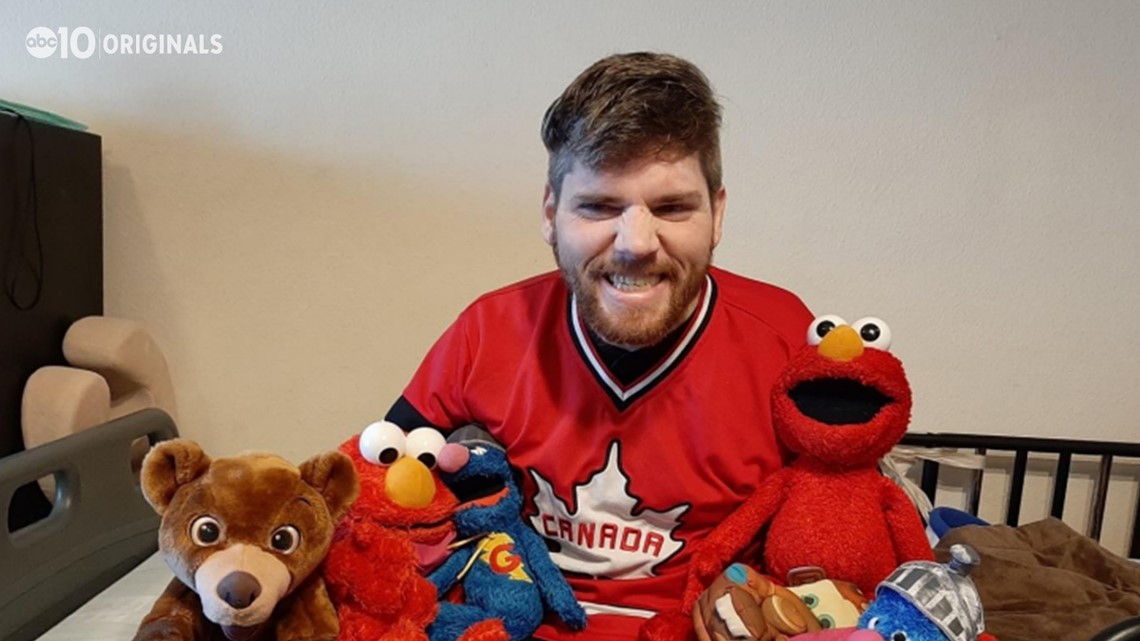
Garth Schutte, 40, smiles with his favorite stuffed animals in his room at his mother's house in Sacramento.

Garth has developmental disabilities; autism and obsessive-compulsive disorder, court and medical records show. For the first 39 years of his life, he relied on his mother to assist him with everyday things like showering, shaving and even using a catheter because of a diagnosis of catatonia.

“He was catheterized in the home and I was trained by three different medical staff,” said Jill. “Kaiser was providing all his medicine and his catheter, which was being mailed to the house. You can’t buy catheters — they’re prescription only.”

The catheter is part of how Garth’s conservatorship began.

In Aug. 2020, record-breaking heat hit Sacramento. Jill noticed Garth wasn't eating or drinking quite as much and took him to the doctor.

“Garth says things differently and he mentioned to one of the nurses, ‘My mom puts a red plastic straw in my private part,'" Jill said.

Hospital staff are mandatory reporters. By law they have to report any sign of potential abuse – Jill said Garth was trying to explain how he needed to be catheterized and it sent an abuse alert to Sacramento Adult Protective Services (APS) as well as Alta Regional Center — the state-run facility under DDS providing services and support directly to people with disabilities as well as their families.

“When we look at California state law regarding mandated reporters, the reporters only report suspicions. It’s the sheriff and police that do the investigation,” said Jill. “Adult Protective Services expand the investigation, not the regional center.”

Yet court records show Alta Regional Center took Garth and placed him in a state-funded care facility.

Jill, Ian and Russell were not notified, despite Jill having Kaiser’s model of power of attorney over Garth.

For three months, no one told their family where Garth was.

“We had absolutely no idea. They would not even say, is he in Sacramento?” Jill said. “We did not know.”

This wasn’t unfamiliar territory to the Schutte family.

Fifteen years prior, Garth had been taken by an Alta Regional Center employee who was helping watch Garth in Jill’s home. In court records, the regional center wrote Jill was unable to care for Garth, but a court investigator’s report later said Garth was taken in a “deceptive” manner.

The first time Garth was taken, it took Jill nine months and an attorney to get him back. 15 years later, in 2020, they were at a loss, which is why the Schutte family decided to get conservatorship over Garth, despite not doing so for Garth’s 39 years of life to help maintain his independence.

As they began the lengthy legal process, Garth was suddenly dropped off at Jill’s home by medical technicians after three months with no knowledge of his whereabouts.

“I was shocked. I was thrilled,” said Jill.

Less than 24 hours later, three Sacramento sheriff’s deputies arrived saying Garth had been returned to Jill due to a “clerical error.”

The deputies took Garth outside and spoke with him alone. Ian recorded all 47 minutes the deputies were there; throughout the recording, Garth expressed his desire to remain at home with his mother to the deputies several times.

After Garth made his wishes clear and the deputies did a home inspection, their concern vanished.

“We’re glad he’s got such a good home here,” a deputy said.

The deputies updated Adult Protective Services and Alta Regional Center on their welfare check. Before leaving, one deputy offered the Schutte’s advice: “The most important thing you can do is go get that conservatorship as quickly as you can because that’ll prevent them from pulling all this.”

The Schutte family took it to heart and moved forward with the legal conservatorship process.

By petitioning the probate court for conservatorship, several things are instigated, including the court appointing an attorney for the potential conserved person.

The court appointed attorney Dewey Harpainter to represent Garth. Harpainter’s office is in Auburn.

As Garth’s attorney, Harpainter is legally required to advocate and represent what Garth wants. Jill says Harpainter refused to meet in person with Garth.

“At one point I said, ‘If you’d like I can drive Garth up to Auburn. I will sit in the car so you can have private questioning with him,'” Jill said. “He denied that at least five times.”

When the Schutte family attorney brought this up in court and requested a new attorney be appointed for Garth, the judge refused, Jill said and court records show.

At the time of our interview with the Schutte family in early June 2022, Harpainter had yet to meet with Garth.

That changed less than a month later after we reached out for an interview. Court records show Harpainter eventually met in person with Garth after we began investigating. The meeting took place just six days after our initial interview request to Harpainter.

Harpainter did not respond to repeated requests for an interview.

When a conservatorship is requested – the court also appoints an investigator to interview the conservatee, assess the family dynamic, and write a report that goes directly to the judge.

“The court investigator called me and we talked over many, many things,” said Jill. “I (also) encouraged him to talk to Garth privately.”

After the investigator spoke with Garth in a one-on-one phone call, he wrote that Garth “expressed a very strong desire to remain at home” and told the investigator, “(I) don’t wanna go to a group home. I would like to live at home.”

Criminal background checks were done on Jill and Russell — who were petitioning for shared conservatorship custody. The investigator’s report also went through Adult Protective Services records and past abuse referrals, which “were deemed inconclusive.”

It means they didn’t have evidence to confirm or deny Garth was abused, APS told us.

The court investigator recommended to the judge that his family care for Garth, and the conservatorship “should be granted.”

But the state regional center, Alta, told the judge a different story — it claimed a number of allegations of abuse by the family from medical professionals in their written assessment of Garth.

Jill said she’s had years of experience with Garth — as well as a 22-year career as a disability expert for the California State of Rehabilitation —  and that, “at no time did any doctor or professional advise me that anything being done was abusive.”

The assessment also alleged Jill locked Garth in a windowless room, which Jill admits to, for Garth’s own protection. Because of his OCD, Garth often tries to break through the window glass in his room so he can pick up litter at all times of the day and night.

“I mentioned that to a doctor… the doctor said, ‘Can you put a plywood or something based on the size of the window?’” Jill recalled.

She did, but not before she said she consulted with the fire department about it.

“It’s always putting Garth first,” Jill said. “His needs and wants but above his needs and wants... his safety.”

The assessment also said Garth spoke directly to Roseville police after a lieutenant contacted Garth and the regional center following the Schutte's filing a missing persons report when Garth was taken in 2020. The assessment said Garth told the lieutenant he didn't want to return to his mother’s house as well as recounted “physical and sexual abuse by his mother and brother.”

We reached out to the Roseville Police Department. They said they have “no records” of the call and therefore couldn’t confirm it.

The regional center told the judge just because APS reports of abuse were “inconclusive,” it “does not mean the claims are unfounded” and that Jill and Russell would be inappropriate conservators.

Instead, they recommended the Department of Developmental Services be appointed as conservator. They also said DDS should ask for a power the family didn’t: control over who Garth sees.

Ultimately, the judge listened to the regional center. He gave temporary conservatorship of Garth to DDS... not to the family as recommended by the court investigator.

With the conservatorship appointed, DDS decided Garth should move out of his mother’s home and into one of their care facilities — what they call a “vendor.”

After 39 years of living with Garth, Jill moved Garth into the new facility.

“We did not want him to see our tears as we drove away,” Jill recalled.

But the DDS care home struggled with Garth.

“Because they couldn’t help him sleep and he couldn’t sleep - they call 911,” Jill said she learned.

Court records show Garth had been “hospitalized for 43 out of 88 days” after being moved to care homes and under the care of DDS, meaning between November 2021 and February 2022 Garth spent about half his time at that point in emergency rooms rather than the care home.

Because Garth is under the conservatorship of DDS, taxpayers are footing the pricey ambulance rides and hospital stays.

One of the caretakers had so much trouble she actually asked for help from the family Garth had just been taken away from.

“She would call (us asking), ‘Can we come help her?’” Jill said. “She actually wanted us to spend the night there.”

Jill shared text messages between her and the care home facilitator with us. Here are a few, including the facilitator addressing the regional center’s abuse allegations:

  • “Please help me tonight. I don’t want to call the hospital.”
  • “Ms. Jill please help me.”
  • “What would u do?”
  • “I didn’t see any abuse at all.”
  • “I believe u are a good family.”
  • “I really don’t know what they (regional center) are doing. Just help me transition (him).”
  • “He keeps writing I miss my mom.”

Garth no longer lives at this care home. Jill said he has moved residences five times in six months. With each move, Jill’s involvement in Garth’s life has been drastically cut by DDS, claiming Jill and Ian are “triggering” Garth. Jill believes what’s triggering is the memory of the home Garth had with her.

As of mid-July 2022, Jill hadn’t seen or spoken with Garth for 12 weeks. Visitation, including phone calls, between Garth and his family, has been severed... especially between Jill and Russel, the two who tried to get co-conservatorship.

“We have not been (to his care home). We are not allowed to go there. We are not allowed to know the exact address,” said Jill. “We have not seen him or heard from him.”

It’s not for a lack of trying; Jill has repeatedly requested visitation with Garth’s regional center service coordinator, who is acting as his conservator in making decisions for Garth on behalf of DDS.

“We can’t provide you a date when you will be able to call or visit Garth,” his service coordinator wrote in an email to Jill. She also said, “Garth has not expressed any interest in having contact with you at this time.”

Jill said she’ll respect his wishes, but wants to hear them from Garth himself.

“Because we will follow the instructions,” said Jill. “[The regional center] could not do that.”

We also reached out to Garth’s service coordinator asking to speak with Garth. Alta Regional Center’s legal manager responded with the same message: “Garth has expressed no interest in speaking with you.”

We asked if Garth was informed that an investigative reporter wanted to speak with him — and if we could ask him directly. We never got a response.

We were, however, able to speak with Garth directly during a visitation with his brother Russell.

Since DDS got conservatorship, Russell has laid low in hopes of continuing to remain in contact with Garth, unlike other family members who've lost all visitation. As of June 2022 he hadn't seen Garth for six months. Russell requested visitation and was approved. He, his wife Elizabeth, and their kids met at a local park while a care home worker supervised.

About halfway through their visit, we were able to speak with Garth.

“I terribly miss my mom,” Garth said.

When asked who he would like to live with, he told us “his family,” specifically his “mom.”

Garth also expressed the same desire weeks later directly to a judge.

On July 27, 2022, the Department of Developmental Services’ temporary conservatorship over Garth expired. The agency wanted to renew it and a court hearing was held in Sacramento’s probate court.

Judge Gevercer granted us permission to film, despite DDS’s repeated objections.

During the 40-minute hearing, the judge gave time for all to speak including Garth himself, who until this point has rarely had a voice in court.

“I want to live with my mom,” Garth said to the judge.

The judge told Garth to talk to his court-appointed attorney, Harpainter, about his desires. He also ordered DDS and the Schutte’s to meet and hopefully reach an agreement over Garth’s current situation.

In the meantime, he extended DDS’s conservatorship over Garth until the next hearing in December.

We requested an on-camera interview with the Department of Developmental Services for seven months. They declined all requests for interviews.

Prior to releasing our investigation, we sent them a three-page letter outlining our findings and asking 15 questions related to allegations of failed practices, including a 2022 state audit that found numerous failures for the last 10 years. 

They refused to answer our questions and sent us a written statement (available in full at the bottom of this article) about how their priority was to keep their clients safe and a short video (below) of Director Nancy Bergmann reading the written statement. Neither answered any of our questions.

So, we attempted to talk to DDS attorney Meredith Nixon following the hearing. She also refused saying, “no comment.”

Two days prior to our investigation airing, the Department of Developmental Services announced immediate "actions to support" the individuals they conserve in a three-page press release. The release named three items DDS will do to improve the system for those in "conservatorships where DDS is the court-appointed conservator." They include forming a panel of experts to conduct a review of DDS' conservatorship program, forming a "working group" from multiple state departments to review their conservatorships, and "enhance oversight and review."

However, the press release didn't include direct actions or steps, like budgeting nor an exact time frame of when these items will take place. We reached out again asking for an interview so we could ask about the specifics of their new plan. They declined.

Credit: Jill Schutte

Jill had retired to care and spend more time with Garth. Following the hearing, she decided to return to work at an organization assisting people with autism, like Garth, so she can continue paying for the costly legal fees in hopes of gaining care for Garth.

The Schutte family plans to continue fighting in hopes of getting Garth home. They also hope in sharing their story, they shed a light on limited conservatorships and the system around it for others - as well as taxpayers.

Department of Developmental Services statement:

“In California, unlike any other state in the nation, individuals with intellectual and developmental disabilities have a right to the services and supports to help them live their most independent and productive life. With the passage of the ground-breaking Lanterman Act in 1969, the state affirmed its commitment to these rights for Californians. We at the California Department of Developmental Services have the responsibility to deliver on the assurances made by the law. 

It is our obligation to hold ourselves and our system partners accountable, while ensuring that individuals with intellectual and developmental disabilities receive community-based services and supports that embraces choice and allows them to live with purpose and dignity. We are constantly looking to improve how we serve the whole person, all while protecting the health and well-being of those we serve.

We are striving to create effective, culturally responsive, and efficient services. We have advanced this vision by the historic investments made over the last two years that, when put together, drive us toward a system of value-based services and supports, where our main objective is quality and better outcomes.”

Department of Developmental Services response to our questions:

“DDS does not actively seek conservatorships. In all instances, the Department of Developmental Services’(DDS) involvement in the conservatorship process begins with a submission by a third party requesting that the Director of DDS become conservator of a person with developmental disabilities. DDS only decides to petition to become conservator when clear and convincing evidence shows that a conservatorship is needed to protect the consumer’s health, safety, or well-being. The submission can come from a variety of sources, such as the courts, a regional center, a law enforcement agency, a family member, the county public guardian, the consumer’s court-appointed counsel, local adult protective services, or any other person interested in the consumer’s health, safety, or well-being. The conservatorship process is a court-based, legal process. As such, DDS has the legal burden to present conclusive evidence to a judge demonstrating that the conservatorship is necessary to protect the person’s health, safety or well-being.

 Family members can and do participate in the judicial proceedings that decide whether a conservatorship petition should be granted, the scope of the conservatorship, and whether the Director of DDS should be appointed as conservator. Furthermore, a court-appointed counsel is part of this process. These are officers of the court appointed by a judge to represent the interests of the proposed conservatee. These counsels are completely independent of DDS and do not receive any funds from the Department. Court-appointed counsel have a fiduciary duty to act independently and in the best interest of the proposed conservatee to determine whether a conservatorship is necessary and who, if anyone, should serve as conservator. 

 DDS does not seek to become a person’s conservator without a third-party submission having first being made and thoroughly vetted. DDS conducts a comprehensive, detailed inquiry when it receives a conservatorship nomination. DDS will not seek to become conservator if there are alternate, less restrictive means to protect a consumer’s health, safety, or well-being. DDS also will not seek to become conservator if there is a family member, friend or other close person in the consumer’s life that can protect the consumer’s health, safety or well-being. DDS has a legal and moral obligation to protect the consumer no matter the desires or objections from family members.

 It is important to understand that under state law every regional center consumer participates in the development of an Individual Program Plan (IPP) that identifies the supports and services the person needs. An IPP is developed regardless of the legal status of individuals. The amount of funds spent on a consumer is based on costs for the supports and services identified in the IPP, and not on any other factor such as whether a conservatorship is in place. Thus, absolutely no additional funds are spent simply because a consumer is subject to a conservatorship by DDS. In addition, neither DDS nor the regional center receives any additional administrative funding for individuals who are conserved versus those who are not conserved.”

Editor's note: This article has been updated to correct that Russell was the Schutte brother that initially petitioned co-conservatorship of Garth.

Full Article & Source:

Thursday, June 16, 2022

House Approves Ban On Electric Shock Devices For Those With Developmental Disabilities

by Michelle Diament

A bill that would ban the use of electrical stimulation devices to address self-injurious or aggressive behavior is now headed to the U.S. Senate. (Thinkstock)

Congress is moving to ban devices used to administer electric shocks on people with developmental disabilities in an effort to modify their behavior, a practice that advocates have long decried as torturous.

The U.S. House of Representatives voted 392 to 28 last week to approve the Food and Drug Amendments Act, a broad bill reauthorizing programs at the Food and Drug Administration. Tucked inside the legislation is a provision that would put an end to the use of what are known as electrical stimulation devices, which send shocks through electrodes attached to the skin in order to condition people not to engage in self-injurious or aggressive behaviors.

The devices are believed to be used at only one facility in the U.S. — the Judge Rotenberg Educational Center in Canton, Mass., which serves children and adults with developmental disabilities as well as those with behavioral and emotional problems.

Disability advocates have worked for years to bar the practice. And in 2020, the FDA finalized a ban on the devices after determining that they pose an “unreasonable and substantial risk of illness or injury.” The agency cited evidence of psychological and physical risks including burns, tissue damage, worsening underlying symptoms, depression, anxiety and post-traumatic stress disorder.

But the Rotenberg Center sued and last summer the U.S. Court of Appeals for the D.C. Circuit found that the FDA had overstepped its authority and overturned the regulation.

The legislation now heads to the Senate where advocates say they are hopeful that the provision banning electrical stimulation devices will be included.

“Contingent electric shock for the purposes of behavior modification is inhumane and ineffective and has been condemned by the United Nations as torture,” said Julia Bascom, executive director of the Autistic Self Advocacy Network. “We hope the Senate will act swiftly — folks subjected to these shocks have been waiting for far too long.”

Supporters of the Rotenberg Center, however, are not backing down on what they say is a last resort for individuals with severe behaviors who have not responded to other treatments.

“The parents and guardians of clients of the Judge Rotenberg Educational Center (JRC) will continue to fight to preserve the life-saving electrical stimulation device (ESD) treatment for our loved ones, for whom all other treatment options have been tried and failed,” the Judge Rotenberg Educational Center Parents Association said in a statement to Disability Scoop. “Were the proposed legislation to be enacted, it would destroy the significant gains that have been achieved due to this treatment and inevitably result in self-mutilation and the reemergence of other severe behaviors that will lead to irreparable harm, permanent disfiguration, or even the death of our children.”

Full Article & Source:

Monday, December 13, 2021

‘The situation is dangerous.’ Parents sound alarm over troubled in-home care provider

Andrew Simmons, right, blows bubbles with his father Bo last spring. Andrew, who's profoundly autistic and mostly non-verbal, lives in a supported living home in Snohomish County operated by Aacres WA, a troubled state contractor. Bo Simmons says conditions in the home over the past year have deteriorated to the point of being dangerous for Andrew and his housemates.

By Austin Jenkins 

In February of this year, Leigh Anne Francisco’s severely autistic 21-year-old son Angus moved into a home for people with developmental disabilities operated by Aacres WA, LLC in Snohomish County.

Almost immediately, Francisco grew concerned about conditions in the home.

First, she noticed mysterious bruises on her son, including a large dark purple one on his inner thigh.

Then Angus and his housemate were left unsupervised one night because the overnight staff member never showed up.

There were other issues too.

Francisco said Angus was overfed and rarely taken out for a walk or to kick a soccer ball into the net she had set up for him in the backyard. He quickly gained 30 pounds.

When she visited, Francisco said she often found Angus’ hygiene had been neglected. The condition of the house also dismayed her — food and garbage on the floor, shampoo and toothpaste spilled in the bathroom. To make matters worse, Francisco said the staff was often “lounging around and on their phones.”

There were also medication errors. By September of this year, Francisco was frantic and trying to get Angus moved out of Aacres’ care.

“This is not what I had imagined for my son!” Francisco wrote in an email summarizing her concerns.

Francisco is one of two parents who, independently of each other, contacted the public radio Northwest News Network in September regarding concerns about Aacres in Snohomish County. The second was Bo Simmons whose 23-year-old son Andrew is also profoundly autistic and lives with three other Aacres clients in a home in Lynnwood.

In his message to the Northwest News Network, Simmons said Aacres was “very much not living up to expectations as a residential care provider for the state.”

“We’re talking about a serious burn which was never communicated to us, repeated times where there is a single staff member for four residents, never taking our son out into the community,” Simmons wrote.

In recent weeks, the parents’ pleas for oversight and accountability have reached state regulators who say they’re now investigating the company’s Snohomish County operations.

The complaints are just the latest against Aacres, a long-troubled care provider that currently has contracts with Washington’s Developmental Disabilities Administration (DDA) to provide in-home support to developmentally disabled clients in Clark, Pierce, Thurston, as well as Snohomish Counties.

Canceled contracts

In 2019, DSHS cancelled three contracts it had with Aacres WA to provide care for vulnerable clients in Spokane County. DDA said it took the action “based on serious non-compliance with the law and regulations.”

One of the contracts was terminated following the death of a client who was given household cleaning vinegar in lieu of colonoscopy prep medication. A former Aacres caregiver was subsequently charged with third-degree assault, and reckless endangerment in connection with the death. Her trial is scheduled for January.

In a statement at the time, the then-assistant secretary of DDA, Evelyn Perez, said: “We have lost confidence in Aacres Spokane. Not being in compliance with regulations and ensuring the health and safety of our clients is unacceptable.”

Previously, Aacres had also operated in King County. But in November 2018, Aacres announced it was pulling out of King County because of a lack of affordable housing and challenges related to recruiting and retaining staff. The move came after the state had put the company’s King County operation on 90-day provisional status for failing to correct serious deficiencies that "jeopardized clients' health, safety and welfare."

Nevertheless, DDA allowed Aacres to continue serving vulnerable clients elsewhere in Washington under separate contracts with the state.

Records show that during the 2019 to 2021 biennial budget, Washington’s Department of Social and Health Services (DSHS) paid Aacres more than $92 million making it the agency’s seventh largest contractor. So far this budget cycle, which started July 1, state payments to Aacres total $16.3 million.

As of the end of 2020, Aacres served approximately 220 clients across the four counties, according to DDA.

Founded in 1974, Aacres is one of several human services companies operated by Spokane-based Embassy Management, LLC. According to the website for Bregal Partners, a New York private equity fund, Embassy is one of its portfolio companies.

Aacres and Embassy Management did not respond to multiple requests for comment.

In previous statements, the company has said that shortcomings in care “in no way reflects our passion, commitment and resolve to our mission to safely serve individuals in their homes and communities.”

A beleaguered industry

Historically, people with developmental disabilities in Washington were served in state institutions known as Residential Habilitation Centers. But over the decades those facilities have downsized as part of a state and national shift to serving individuals in the community.

DDA’s largest community residential program for people with developmental disabilities and significant support needs is called Supported Living Services.

Today, roughly 140 supported living agencies, including Aacres, serve about 4,600 clients who qualify for DDA services.

Under the program, clients live in their own home with up to three other housemates while being supported, often around-the-clock, by agency staff.

The clients pay for rent, food and other expenses while the state’s Medicaid program covers the cost of the support staff. In 2020, Washington’s supported living expenditures were $768 million, according to DDA. That included a temporary COVID-19 rate increase for contracted agencies paid for with federal relief dollars.

But Scott Livengood, the legislative chair for the state’s Community Residential Services Association, said the industry has not caught back up since rates were cut during the Great Recession.

“Due to funding increases not keeping pace with the cost of living and the steady increase in our statewide minimum wage, the average starting wage for a [direct support professional] is now around $15 per hour, which is only 5% above the statewide minimum wage [that takes effect] next month and 25% below a self-sufficient wage,” Livengood said in a statement.

As a result, he said, most frontline support staff work two to three jobs and average turnover in the industry is about 50 percent. Livengood estimated the current vacancy rate is approaching 20 percent as agencies lose workers faster than they can hire them.

“The pandemic has made the situation even worse, as we are competing with fast food and retail jobs offering $18 to $20, along with attractive benefit packages and hiring bonuses,” said Livengood who is also CEO of Alpha Supported Living Services, a nonprofit serving clients in King, Snohomish and Spokane counties.

To try to slow the attrition, supported living agencies have offered signing bonuses and “hazard pay” during the pandemic. But the federal stimulus dollars that funded those enhancements are scheduled to expire at the end of the year making it even harder to recruit new employees, Livengood said.

It’s not just the pay, but the nature of the work that makes finding and keeping employees difficult. Staff are often required to work nights and weekends. And the clients can exhibit challenging and even violent behaviors.

In the past, Aacres has pointed to the challenge of recruiting and retaining front-line staff as a factor in its quality of care lapses.

State records show that since 2018 Aacres in Snohomish County has been subject to four inspections, two investigations and one enforcement action.

In January 2019, Aacres was fined $1,000 after the subflooring in one of its Snohomish County homes failed and a client fell into the space below and was injured.

Then in August of this year, an unannounced inspection of Aacres homes in Snohomish County found a number of deficiencies — especially around COVID-19 protocols. Among the findings was that visitors, staff and clients weren’t properly screened for COVID symptoms.

The concerns of family members have also reached state regulators. The state’s Residential Care Services (RCS), a division of DSHS, confirmed to the Northwest News Network that it has active investigations underway into multiple complaints about substandard care at Aacres homes in Snohomish County.

However, Aacres in Snohomish County has not been put on “stop placement” status, where an agency is barred from accepting new clients, or put on provisional certification status which is the last step before decertification.

“If the complaints are found to be substantiated, Aacres, like any other provider, will be held accountable for its deficiencies,” said RCS director Mike Anbesse in a statement.

Aacres isn’t the only supported living agency to draw scrutiny this year. Over the past 11 months, the state has issued 171 citations and 48 statements of deficiency against supported living providers for violations, according to data provided by DDA.

An unreported burn

For months, Bo Simmons and his former wife Louise had been uneasy about the care their son Andrew was receiving from Aacres. They noticed staff turnover was high and sometimes there was only one caregiver on duty in the home, despite there being four clients to care for.

Often Andrew would spend much of the day in bed. Occasionally, the staff failed to get him to dental and doctor appointments. He even missed virtual meetings with a job coach.

But concern turned to alarm earlier this year when Louise went to visit Andrew and discovered the palm of his hand had been burned, possibly from touching the stove.

Adding to their distress was the fact no one told them about the injury. Andrew had also not been taken to the doctor for treatment of the burn.

Then, about a month ago, there was another upsetting incident. Andrew, who has migraines and often bangs his head on surfaces because of the pain, slammed his head into a plaster wall in the bathroom. Shortly after that he knocked a staff member to the floor and in the tussle hit his head a second time.

Medics were called to the house. They evaluated Andrew, but did not take him to the hospital. Simmons said the staff was supposed to monitor Andrew for signs of a concussion. Instead, he said, they gave Andrew a sedative and let him go to sleep. When Louise came to visit Andrew that afternoon, she found him in bed soaked in urine.

For Andrew’s parents, that was the last straw.

“He’s a very amazing young man, and he deserves better,” Simmons said tearfully during an interview.

In his desperation, Simmons launched what he described as a “full court press” to bring attention to the plight of his son and other Aacres clients in Snohomish County.

Working closely with Louise, he's urged the state to conduct a “complete review” of Aacres and its parent company, Embassy Management. He's also lobbied DDA to move Andrew to a different supported living provider. And, recently, he retained an attorney who specializes in representing the interests of people with special needs.

In September, Simmons summarized his concerns about Aacres in an email to a top DDA official.

“Andrew has languished in their care,” Simmons wrote. “We suspect that there are many other clients who are not well represented who are in a similar state and we want to advocate for them as well.”

Last month, Simmons followed up with an even more desperate message to DDA’s regional administrator in Snohomish County.

“The situation is dangerous. Seriously dangerous,” Simmons wrote. “The residents and the caregivers are being placed in an extremely unsafe and dangerous environment. It is Aacres management who are to blame for this situation, not the caregivers.”

In response, DDA officials said they’re aware of the concerns.

“I do understand that we are experiencing some challenges right now up in Snohomish County with Aacres,” said Shaw Seaman, DDA’s quality assurance chief.

Seaman said the state is committed to quality improvement and interested in supporting Aacres so that it can get back on track.

Getting results

Lately, Bo Simmons said he’s seen some signs of progress.

First, DDA dispatched an inspector to visit all of the Aacres homes in Snohomish County to document immediate health and safety hazards. Aacres is now required to submit weekly reports on progress in correcting any deficiencies, according to email communications Simmons shared with the Northwest News Network.

Simmons also met with Aacres management and received assurances that the company would address his concerns. Soon after, Aacres held a retraining session for the staff who work with Andrew.

Aacres management also sent a behavioral clinician and its clinical director to visit Andrew and observe him in his environment. The behavioral clinician plans to continue twice weekly visits with the goal of modeling “for staff how to work with him,” according to an email Aacres’ area director sent Simmons.

Then, on the evening before Thanksgiving, both parents attended a virtual meeting with DDA officials. In a post-meeting email, Simmons said the DDA staff showed “empathy and compassion for our situation.”

The state has also agreed to make a referral for Andrew to a state-operated home for people with developmental disabilities, although there’s no guarantee of a bed being available for him.

Simmons is hopeful Andrew’s care will improve. But he also continues to question whether Aacres is deserving of the $726.28 a day that the state pays the company to care for his son.

“Andrew is most definitely not receiving what the state is paying for,” Simmons wrote in his September email to DDA.

Leigh Anne Francisco, Angus’ mother, also reported her concerns to DDA and RCS, but said months went by before she heard back from anyone. Separately, she was contacted by Adult Protective Services (APS) and provided the investigator with a statement. APS would neither confirm nor deny if it's currently investigating Aacres.

Like Simmons, Francisco also decided that she needed to get Angus moved out of the Aacres home. Her final straw came when her son and his housemate were left unattended overnight earlier this year.

“He’s not safe there, the other roommate is not safe,” Francisco said.

But in the months since, she’s had no luck finding another provider to take him.

“I feel as if I’ve failed as a mother because I haven’t gotten him out of there,” Francisco said.

Francisco recently had a conference call with the new area administrator for Aacres who apologized and told her they want to do better.

Even before that call there were some hopeful signs. The waist-high lawn in front of Angus’ house was finally mowed and damage the residents had done to the walls, which had previously been covered by cardboard, was repaired.

“I’m always cautiously optimistic,” Francisco said: “But the story that I’ve been given so many times is ‘we’re going to make this better, we’re so sorry, we’re retraining everybody.'"

Full Article & Source: 

Saturday, December 19, 2020

State May Require Cameras In Group Homes

by Susan K. Livio

EDISON, N.J. — William Cray was found dead on the floor of his bedroom closet in a group home in Somers Point three years ago.

His mother said she’ll never know what happened to her son, a 33-year-old man with developmental disabilities. The autopsy said he died of natural causes. The operators of the state-licensed group home, Devereux Advanced Behavioral Health, didn’t say much, although she had been at odds with them in recent months over Billy’s unexplained bruises and other injuries.

Martha Cray asked a New Jersey Assembly panel last week to spare other families this fear and uncertainty by supporting legislation that would require the installation of security cameras if residents or their guardians give consent. She noted her son had suffered abuse in other licensed facilities, and when she complained and demanded an investigation, the claims were always “unsubstantiated.”

“What exactly is the purpose of having a Department of Health and (a Department of) Human Services if they don’t oversee these facilities and hold them accountable?” she said.

Following an emotional three-hour hearing, the Assembly Human Services Committee agreed and voted 6-0 to pass the bill (A4013).

The bill requires the group home to retain the video recordings for 90 days, and the state Department of Human Services to list the names of group homes that have cameras on the state website. The bill, which was amended before the vote, makes clear the cameras would be installed in common areas — including backyards and doorways — and only if all of the residents agree they want them.

“The loss of a child, is best described as a state of purgatory and hell wrapped up in one,” Cray said as she wept. “The families who are testifying before this committee today that are feeling the stress of sleepless nights, is a fraction of the pain and stress they will have, should they lose their loved.”

Priscilla Quesada of East Windsor, the mother of a 21-year-old nonverbal son with autism who lives in a group home, said she believes cameras would help keep her son safe. She showed photographs of bruises around her son’s neck and rug burn on his face, among other injuries.

“No one knew or could give me an explanation on how these incidents occurred,” said Quesada, who described the guilt she feels as a “bad mother” for leaving her son in group care.

Representatives from the group home industry asked the committee to vote no and consider how cameras in common areas like living rooms would violate the residents’ privacy.

Cathy Chin, executive director for the Alliance for the Betterment of Citizens with Disabilities, shared with the committee a research paper that found cameras in homes of people with intellectual disabilities raises the level of distrust from employees and give families a false sense of security.

Brent A. Hayward from the Office of Health and Human Services of Victoria, Australia, after reviewing 43 research papers on the subject, concluded: “it was disliked by people with disabilities and was regarded with suspicion by staff. Functionality was limited and the ethical challenges associated with its deployment are considerable.”

At a time when budgets are stretched to acquire personal protective equipment to prevent the spread of the coronavirus, “cameras are a waste of resources,” Chin said.

Evelyn Ramundo, president of the Statewide Self-Advocacy Network, an organization comprised of people with disabilities, said she surveyed her members and the “vast majority” opposed the idea of living under surveillance.

The bill “does not say who will be able to review the recordings,” Ramundo said. “Can you imagine being watched in your own bedroom or living room? The thought frightened me.”

“Cameras do not stop abuse or neglect,” she added. “Cameras cannot stop it when someone is choking.”

Assembly Human Services Chairwoman Joann Downey, D-Monmouth, who is also the prime sponsor of the bill, stressed that everyone living in the group home must consent to the use of cameras in the common areas. If anyone says no, they would not be installed. Residents could request them for their bedroom — paid for by the resident’s family — but if it is a shared space, there needs to be consent by everyone sharing the room.

Downey said she was “really kind of upset” because it appeared the self-advocates “were fed information” that wasn’t true.

“We’ve gone through every particular thing to make sure this balances privacy and protecting people,” Downey said. “If they don’t want it, they don’t have to have it.”

Downey added that some group homes use cameras with great success because they protect both residents and staff, who otherwise may be falsely accused of wrongdoing.

Jessica Gustafson, a former Devereux employee who said she was warned by management that Billy Cray had a habit of falsely accusing staff of abuse, said she came to know him well and witnessed his mistreatment.

There is no reason employees should object to cameras unless they have something to hide, Gustafson told the committee.

“Cameras should be installed in every hospital, nursing and group home in America,” Gustafson said. “While abuse may never go away completely, cameras would definitely decrease the amount of abuse. The men and women that have to live in a group home have the right to feel safe.”

Full Article & Source:

Friday, September 11, 2020

Families with Loved Ones in State Homes Desperate for In-Person Visits

By Maria Guerrero

North Texas families with loved ones with developmental disabilities living in state supported living centers say they feel hopeless.

While some visitations at long-term care facilities are resuming amid COVID-19, others are still restricting access due to the health crisis.

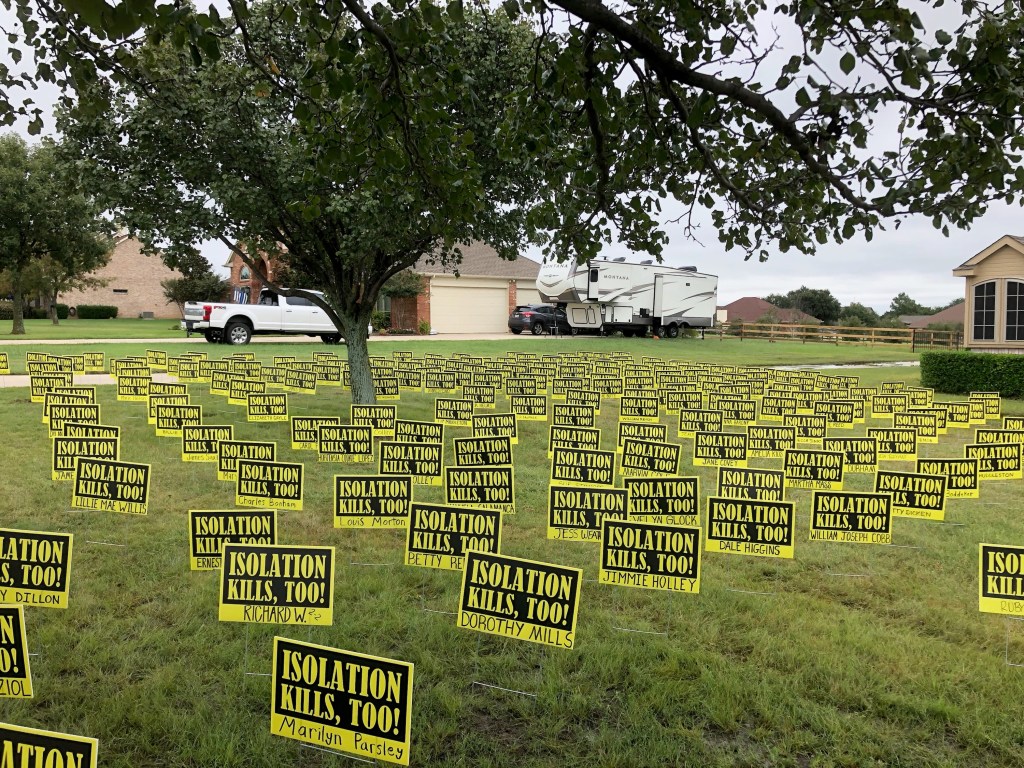
Drive by Stephanie Kirby’s lawn and you’ll see yard signs across her front yard with people’s names and the words: ‘Isolation Kills, Too!’
Signs on Stephanie Kirby's lawn. Photograph provided by Kirby.
They aren’t political, but rather a plea for understanding and support.

Full Article & Source:
Families with Loved Ones in State Homes Desperate for In-Person Visits

Monday, August 31, 2020

Mama bear at the gate: Denton resident fears for daughter in lockdown at state living center

By Lucinda Breeding
Angela Biggs

Angela Biggs has a hair-thin line to walk during the pandemic.

She doesn’t want to alienate the staff members who give her 29-year-old daughter, Amber Reynolds, the care she needs at the Denton State Supported Living Center. Amber and Briggs have a lot of love and respect for the staff.

But Biggs isn’t going to stop trying to connect with her daughter in spite of the state lockdown policies that have kept her from seeing her daughter since March 9, when she helped shepherd Amber through medical tests — a process that can frighten and agitate Amber, who has developmental disabilities and a brain injury from birth.

“Amber can’t speak for herself,” Biggs said. “Her yes doesn’t always mean yes, and her no doesn’t mean no. But my yes means yes, and my no means no. And Amber understands that. She takes it very seriously when I say, ‘I will see you soon.’ I can see where I am losing my integrity with Amber. It just breaks my heart. I have always followed through with her.”

The Denton State Supported Living Center is considered an intermediate care facility, and according to data state officials updated on Aug. 26, the local center reports nine active cases of COVID-19 among residents and 16 among staff. Active cases refers to positive tests, and doesn't reflect how many cases include symptoms. Until the facilities staff and residents test negative for 14 consecutive days, visitors are not allowed in the center.

The center is governed by Gov. Greg Abbott’s declaration of emergency in response to COVID-19, which was recently extended for Texans in nursing and long-term care living facilities through Sept. 29, according to an email from the health commission. Now, long-term care centers can have limited indoor and outdoor visits, but only if there are no active cases of COVID among residents, if staff members have tested negative for 14 days, and there are enough staff to facilitate visits in compliance with infection control requirements. For indoor visits, residents and visitors must be separated with a Plexiglass safety barrier.

Biggs is among caregivers demanding a better response for the elderly in nursing and memory care facilities and Texans living in long-term care facilities. Biggs has joined Texas Caregivers for Compromise, a group of advocates that is petitioning the Texas Health and Human Services Commission and the state Legislature to let them visit their loved ones in person. Nichols collated the stories of Texans desperate to visit their loved ones in nursing or long-term care centers.

“Because isolation kills too, that’s part of the name,” Biggs said. “People are dying. They’re dying alone and untouched. It doesn’t make any sense. People can come into the center from the outside — plumbers, electricians. I get it that they have to be able to get onto the campus. But they’re going into the residential units; caregivers can’t. Judges can come in if they determine that it’s essential. But guardians can’t. Amber is my child. I’m her guardian, not the state.”

Through a Facebook page, caregivers and advocates share stories of their loved ones’ progress or decline during the pandemic, and the group founder, Mary Nichols, posts resources, webinars and videos from officials from the commission.

The Denton center was hit hard by the novel coronavirus last March, and Biggs said she went to the center hoping to see her daughter, who suffers from acute psychosis occasionally but thrives on her routine. Before the pandemic, Biggs would see her daughter twice a week, taking her off the campus to shop and get some stimulation.

“She loves going to Twice as Nice and picking out things for her friends,” Biggs said, adding that the local thrift store is a bright spot for her daughter. “She loves picking out things for her sister.”

She took a bright, colorful care package for Amber but didn’t get to see her daughter. It’s been almost six months since she has been able to talk to Amber face to face. On the phone, Amber sometimes sounds confused, and Biggs said she saw a note about her daughter leaving her residence unit and wandering on the campus at night when she was reviewing Amber’s more recent records. Biggs said she sees this as a sign that her daughter is suffering in isolation, and vulnerable to psychosis. All Briggs can offer her daughter are the Scriptures the two love, singing silly songs and “pivoting” to lighthearted tones when Amber sounds distressed.

The family moved Amber to the center in 2014, and Biggs said the staff gives her the care she needs. Biggs said she “shadows and models” for the staff how to best interact with Amber, who gets nervous during medical appointments. Amber has a medical test coming up, Biggs said.

“That means they have to put a mask on her, which she’s not going to do,” Biggs said. “I’m worried that she’s not going to sleep. If she doesn’t sleep, she can go into psychosis. She’s already sleeping on the couch instead of her bed. And if she goes into psychosis, I can’t be there to help her. I can’t be there to model for the staff what she needs.”

Biggs said it’s frustrating for caregivers, who understand both their role and the risks of COVID-19.

“What happened to our rights and the rights of the residents?” Biggs said. “We can’t even come up and go into the office. Judges can. Police can. Medical students can. Why is that everyone under the sun can come in and wear PPE — but we can’t?”

Biggs said Gov. Abbott is “playing God” with the state’s most vulnerable residents.

“Abbott and Health and Human Services, they are the ones who have laid this out. Their hands are on the rudder,” Biggs said. “I’m asking the governor what good parent doesn’t take all precautions to prevent injury and illness for their children? Abbott said earlier during the pandemic, ‘We are Texans. We can do this. We can wash our hands and do the social distancing.’ But we [caregivers] can’t be trusted? We have given our trust over to the state. Amber is my child; she is not the state’s.”

Biggs said caregivers feel abandoned by Abbott and the state, and that the staff and administration at the center are powerless to stoke connections that reinforce the rights of residents.

“Abbott has robbed us of the right and the joy of caring for our parents and our children,” she said. “It’s moral injury. For us, the guardians, it’s a moral injury ... It’s almost six months since I’ve seen my daughter. She’s been wandering the campus at night. What if she gets off of the campus and starts wandering there on the highway? I can’t help her. I’m not allowed. What if she gets off of the campus and gets raped or killed? Never finding her is one of my biggest fears aside from psychosis.

“We deserve so much better. Our loved ones deserve better.”

Full Article & Source:
Mama bear at the gate: Denton resident fears for daughter in lockdown at state living center