Showing posts with label advocate. Show all posts

Sunday, November 14, 2021

The Passing of NASGA Advocate Berna Jones


With heavy hearts, NASGA mourns the passing of advocate Berna Jones. Berna battled the guardianship of her Mother and was successful in getting her Mother home and under her care. We all know “wins” are very rare in guardianship abuse cases and Berna won.

It was a long and hard-fought battle, but Berna was made up of determination and endurance - and a strong and sturdy soul that kept her always looking forward. She comforted and inspired many family members of guardianship abuse victims and she always looked for ways she could help. She is gone too soon and sorely missed.

Godspeed, Berna.

Berna's obituary

Thursday, November 4, 2021

Judge Park named Excellent Advocate by State Long-Term Care Ombudsman

The Office of the State Long-Term Care Ombudsman recently presented its Excellent Advocate Award to Judge Dixie Park of Canton.

The agency says Park ensures that people served by Stark County’s probate court have a voice for their rights, independence, and dignity. She also ensures that guardians in her county are held to high ethical standards. 

Ohio’s Office of the State Long-Term Care Ombudsman advocates for people receiving home care, assisted living, and nursing home care. The office presents the Excellent Advocate Award to those who demonstrate remarkable character in protecting the rights of long-term care consumers through advocacy, service, collaboration, process improvement, or other accomplishments.  

Park was presented the award and special commendation from Ohio Gov. Mike DeWine by retired State Long-Term Care Ombudsman Beverley Laubert and Regional Ombudsman Program Director Sam McCoy during a special meeting on Oct. 21 in Canton. 

 
Full Article & Source:

Saturday, August 14, 2021

After Decades Apart, Woman Connects With Secretly Institutionalized Sister

by Bill Jones

CHICAGO — Until she was 13 years old, Palos Park’s Katherine Hamann did not know she had a sister. It took her 13 more years before the two finally met. Today, she is strengthened by a relationship once lost to her, and works as both guardian and advocate for others with intellectual and developmental disabilities.

“I went from being an English major and thinking I was going to teach English to being involved in the disability field,” Hamann said. “It’s been a wonderful life in many ways. It’s been rewarding and enriching for me, all of the people I’ve gotten to know.”

Hamann’s parents had their first child, Margaret Doering, in the 1940s during World War II. She was born with intellectual and developmental disabilities.

“In those days, there was such an aura of shame having a child who was disabled,” Hamann said. “My parents were told by the family doctor that it would be much better for my sister to be institutionalized because she would probably not live past 13. The idea was that she would be a burden on them and it would be hard for them to have other children and that it would be a stigma for the other children if they wanted to have a family.”

Hamann’s parents followed the doctor’s advice and put Doering in state-run care at age 2. The couple had a boy eight years after Doering, Hamann after that and then another boy. Grandparents, aunts, uncles and others were “sworn to secrecy” about the existence of their sibling.

“It definitely was deliberate that we didn’t know,” Hamann said. “We’re not sure that they even wanted to ever tell us.”

But when Hamann was 13, a friend’s mother had a miscarriage. Hamann started to wonder if anything like that had ever happened to her own mother.

“I just asked her if she ever had any other children,” Hamann said. “She just burst into tears.”

She told Hamann that she had a sister. The teen said she was shocked but also excited by the revelation.

“I was kind of thrilled I had a sister, because I always wanted a sister,” Hamann said.

For a long time, Doering still was not part of Hamann’s life. The family did not go to the Dixon State School together to see her, and when the parents eventually started visiting, the children typically only found out after the fact, Hamann said.

“There was a period of about 17 years where no one visited,” Hamann said records show.

When Hamann was 26 and married, she finally met her sister, then 36. Doering has been a constant in her life ever since. Hamann became her guardian and moved Doering closer to the area, despite her parents advising against it.

“They were not enthusiastic about my getting involved with her, because they always felt she was going to be a burden on us in some way,” Hamann said.

‘An alternate universe’

First, Hamann made regular visits to get to know her sister. Doering does not speak or sign, so Hamann had to rely on records to learn more about her life.

“She doesn’t communicate in any conventional way,” Hamann said. “But she does communicate by touch. Over the years, she’s learned to hug me, which is just amazing.”

Hamann said there were constant revelations about Doering’s life in the facility, but maybe none quite as jarring as the scene when they first came face to face.

“When I met my sister, she was in a locked hallway with about 20 people who were just milling around,” Hamann recalled. “That was the activity. There weren’t even enough chairs for everyone. I felt like I’d entered an alternative universe. I had no idea that people were living like this and this could be her life.”

It also struck her how no choice in Doering’s life up until that point was her own. Hamann’s parents had led her to believe her sister was incapable of making them.

“They said she was feebleminded and she should always be in an institution,” Hamann said. “As soon as I met her, she was this spunky little lady. She’s so strong. She’s such a survivor and she has so much personality.”

Hamann started seeing positive changes in her sister as they got together. She moved Doering to Tinley Park’s Howe Developmental Center. Hamann volunteered there for a while and then ended up working there. She ultimately spent 11 years at the facility, doing everything from kitchen work to human resources.

It allowed her to be more involved with her sister, but she also saw firsthand what a state-run facility was like.

“It really wasn’t a good fit for her,” Hamann said. “It wasn’t a very positive environment for her.”

So Doering moved again, this time to a community integrated living arrangement. She has been doing great there for more than a decade, according to her sister.

Rewarding work

A little over a decade ago, Hamann was contacted by The Arc of Illinois, an organization that empowers people with disabilities to fully participate in community life. The organization heard her story and was looking for someone who could be compassionate and encouraging while talking to families going through similar situations. Hamann has worked for the organization since 2010, becoming the director of its family transition project.

The organization, which Hamann calls a great resource, advocates for choices for people with intellectual and developmental disabilities, as well as fully funded services to help them live independent and fulfilling lives.

State changes

The Dixon State School and Howe Developmental Center have been shut down by the state, part of a decades-long shift toward community-based care for those with intellectual and developmental disabilities, said Allison Stark, director of the Division of Developmental Disabilities for the Illinois Department of Human Services.

“The change from that was the idea that people with intellectual and developmental disabilities can be supported to live in communities just like everyone else, and that they actually have a right to live in communities just like everyone else,” Stark said.

That change started in earnest nationally in 1999. But 2011 marked a big shift for Illinois, according to Stark, who has served in her position for just under two years but has been involved in the disability community for roughly two decades. At that point, the state had roughly 13,000 people in community-based care. Since then, it has added roughly 7,000 to those numbers.

But Illinois still runs seven state-operated developmental centers, which serve about 1,600 individuals.

“They don’t offer a very high quality of life for people,” Hamann said. “Sometimes they’re the only option for people who need more advanced medical or behavioral services.”

Stark said some residents choose to stay in the larger centers. In other cases, families may have had bad experiences trying to integrate a loved one into a community setting, or they simply prefer an environment they see as “insulated and supportive,” despite the push toward community-based care, she said.

The developmental centers are the only facilities operated directly by the state, but Illinois also funds close to 12,000 individuals who are in private group homes, working with roughly 225 providers to operate them, Stark said. There is another shift toward people with intellectual and developmental disabilities holding their own leases in subsidized, supportive housing that is integrated with a broader population, Stark said.

Of course, money is always a concern. Illinois has invested $650 million since 2017 to try to make community options more attractive, Stark said. Illinois legislators recently added $170 million in new funding for community-based services, the largest single increase seen in the division, according to Stark.

But the Division of Developmental Disabilities is one of many under the state’s human services department’s umbrella, and all face their struggles, Stark said.

Hamann said there is still a long way to go to full inclusion in the state. Her sister opened the door to a greater disability community that Hamann said has been rewarding to know. She wants other people to know it, too.

“People with disabilities don’t need to be hidden away,” she said. “They’re part of our world, and they want to be part of our world.”

Hamann, now 68, understands that as well as anyone. Once unknown to her, Doering, now 78, is a beloved sister who loves music and ice cream. They go for drives together and play the stereo loudly. They take walks. And Doering shows she cares by taking Hamann’s hand.

These are all things many take for granted, but Hamann has come to appreciate in a unique but beautiful way.

“It’s wonderful to have a sister,” Hamann said. “It’s just been wonderful having her in my life.”

Full Article & Source:

Monday, July 6, 2020

Nursing home resident, advocate in Massachusetts experiences staffing shortage first-hand

by  Kathy Curran

Click to Watch Video
Penny Shaw was in pain as she lay helpless in her bed at Braintree Manor Nursing Home amid the COVID-19 pandemic. She became so desperate she even called Braintree Police.

"I was screaming, get me out of here, get me out of here, I was in terrible pain," she said. "And they didn't come for me."

Shaw, 77, suffers from quadriparesis and needs total care. She is also a national advocate for nursing home residents who were named earlier this month to the White House's Coronavirus Commission for Safety and Quality in Nursing Homes.

"I can't lay in bed for hours and hours in pain like that," she said. "We need a quality, safe, respectful, individualized care, person centric care, all care."

Her complaints about the care at Braintree Manor filed with the Department of Public Health put the spotlight on several issues also playing out nationwide. She said in her complaints that:
  • staffing shortages were impacting basic care, including that aides did not have enough time to give her a weekly shower
  • one morning, there were only two certified nursing assistants for 39 residents
  • She was stuck in bed for hours and had missed breakfast several times
  • there was not always enough personal protective equipment
  • on one day, a COVID-positive resident was wandering around without a mask and entering other people's rooms.
"We need to have adequate staff. We need to keep people separate the physical distancing," she said. "We need to have infection control procedures."

WCVB-TV


Braintree Manor Healthcare 
 
The staffing issues in Braintree Manor Healthcare were cited repeatedly in a 2019 inspection of the home that found actual harm-investigators discovered residents were being improperly restrained because there weren't enough staff to supervise them.

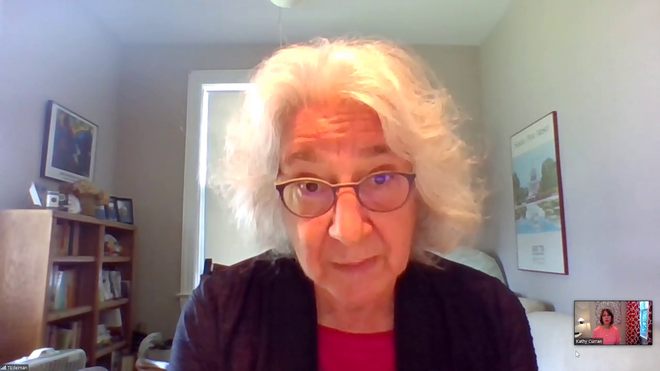
Toby Edelman with the Center for Medicare Advocacy says staffing shortages and improper infection control had a devastating impact in facilities across the country.

"Having not enough staff is the most serious problem. And it made the pandemic much worse," she said.

WCVB-TV

Toby Edelman, senior policy attorney with the Center for Medicare Advocacy, said low staffing and poor infection control has been an issue in nursing homes for years.

 
In Massachusetts, nursing homes were hit especially hard. Sixty-two percent of all COVID-19 deaths in the state were in long term care facilities, according to state data.

"Nursing homes were not prepared for this pandemic. They didn't have enough staff. They did not have proper infection control practices for a very, very long time. And so when this pandemic hit, they were they did not know what to do," Edelman said.

Next Step Healthcare, the company that owns Braintree Manor Healthcare, said in a statement that ample personal protective equipment has been secured and is available, and the home passed its most recent on-site audit with a perfect score.

"The safety of our residents and employees is of the utmost importance, and this is at the center of all decisions we make," the company statement said.

Shaw said she wants her speaking out and serving on the White House panel to be a wake-up call for nursing homes everywhere.

"I would say the hope with this project is to save lives today as soon as possible and in the future," she said.

Full Article & Source:
Nursing home resident, advocate in Massachusetts experiences staffing shortage first-hand

Thursday, June 18, 2020

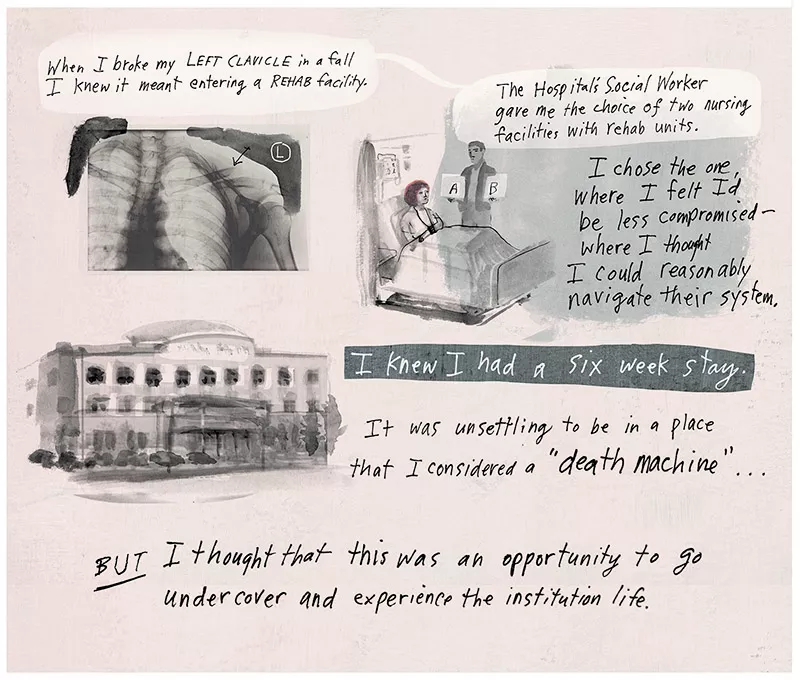
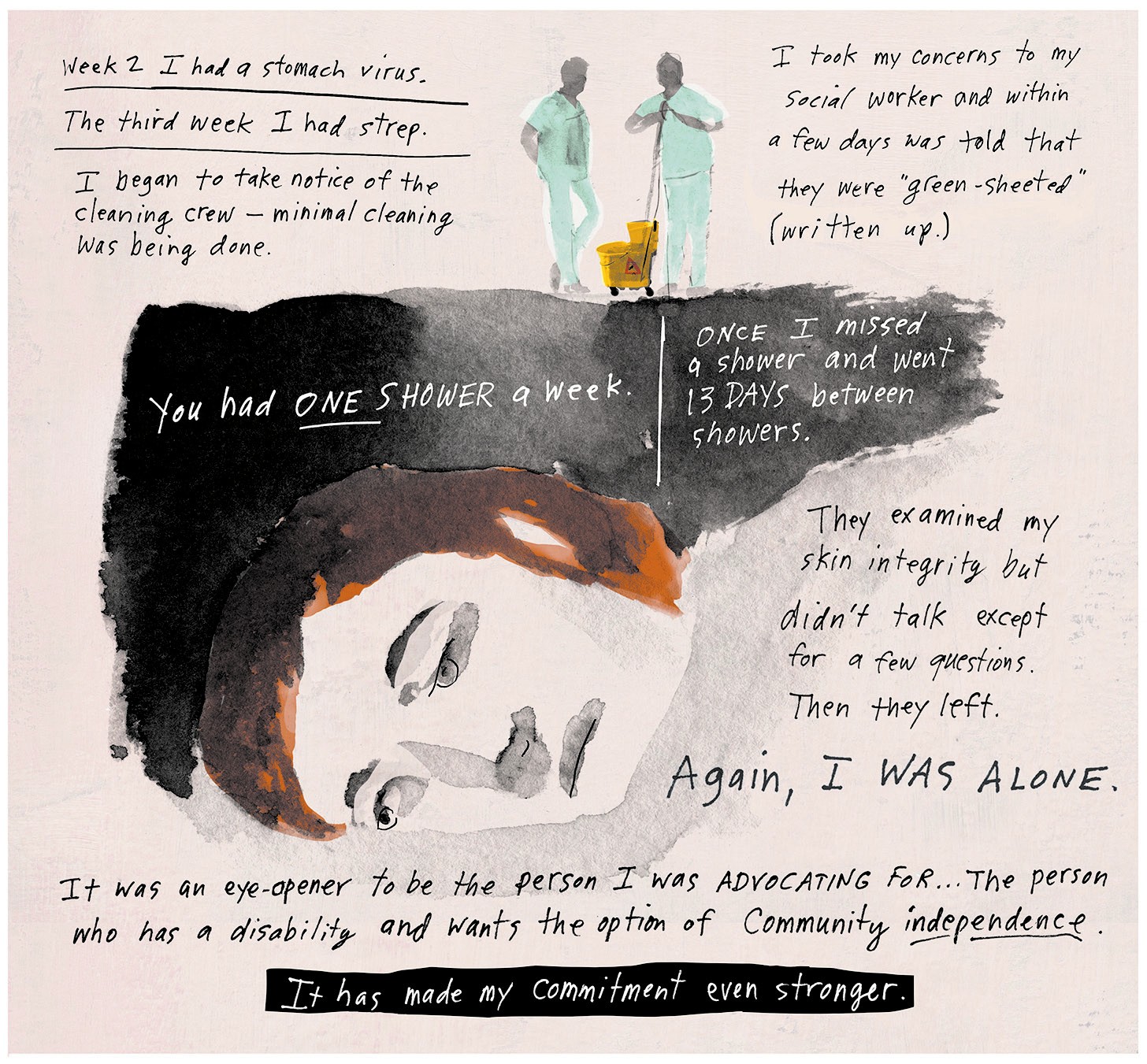
For people with disabilities, an extended stay in a rehab or nursing facility during a pandemic can be especially worrying


A comics journalism story on Covid-19

written by Kate Blaker with illustrations by Stacy Innerst

About the project:
“I have had a career of being a strong advocate for other persons with disabilities, and I tell people that I will die in the streets protesting. (Sorely, I miss doing this for the present.) It was empowering to work on this issue of the nursing facility’s treatment of people who require that care — whether it be a short-term stay or a more involved term — where many people become not a person, but someone that the facility staff tends to recognize as no longer a contributor. It was easy for them (NFs) to hide what was going on for the last two months. The cost of living in the community is a third of a nursing facility cost; 70% of Pennsylvania’s population that passed away from the virus were in nursing facilities. Shame on the Governor and the Secretary of Health for not doing more to protect them.”
— Kate Blaker 

“I was honored to be asked to illustrate Kate Blaker’s story about her experiences in a nursing facility during the Coronavirus pandemic. Hers is one of the many voices that should be heard as society comes to terms with how we treat our most vulnerable members, especially in times of crisis.” — Stacy Innerst

Full Article & Source:
For people with disabilities, an extended stay in a rehab or nursing facility during a pandemic can be especially worrying

Wednesday, April 8, 2020

Lori Stiegel, Early Champion of Elder Justice

by Edwin L. Walker, Deputy Assistant Secretary for Aging
Lori Stiegel
A week ago, a bright light went out.  I was shocked and profoundly saddened to learn of the death of our dear colleague and friend, Lori Stiegel.  I knew Lori for decades, so long that I cannot recall exactly when we met.  She was such a presence in my life – and in the lives of so many others.  Lori was gentle, humble, a consummate advocate for justice, and a great friend. 
Lori was a valued member of the American Bar Association Commission on Law and Aging for over 30 years.  She started her career as a legal aid lawyer, working with older Americans. She then worked supporting legal assistance through legal assistance development and as the Georgia Legal Assistance Developer prior to joining the ABA Commission on Law and Aging.  Her dedication and passion for her work was always informed by what she learned from having “boots on the ground” experience.
Lori was one of the earliest, and certainly the most consistently passionate, advocates for the agency and rights of all adults to make their own decisions.  She taught many of us how to fight against financial exploitation of seniors. She led the way in pushing for guardianship reform and was the national leader and force behind WINGS, Working Interdisciplinary Networks of Guardianship Stakeholders.  She believed deeply that collective action and bringing together diverse arrays of constituencies can move the needle on seemingly intractable barriers – and she was right. She educated, nurtured and encouraged generations of legal aid lawyers, policy makers, and thought leaders.
Many considered Lori a dear friend and I was among them.  I treasured our conversations, whether they were about deep pressing issues of the day or about light topics that would bring out a shared smile or laugh.
Our memories of Lori can comfort us and propel us forward, as advocates and as friends. I will miss her, and mourn our loss. As we share stories of what she accomplished and how she united disparate communities to advance the cause of autonomy and self-determination, we will continue her work, inspired by her spirit and positive approach, and her belief that we can come together on difficult issues.  We will succeed, led by her example, and because of that, Lori will live on.

Monday, December 17, 2018

We Say Goodbye to Dorothy Luck: A true advocate for guardianship reforms

The recent passing of Dorothy Luck, will be sad news for the many people she worked to help free from this human trafficking of the elderly.  Having freed herself from one of these so called guardianships, Dorothy spent the remainder of her time on earth helping to try and reform this insidious system.  She was described by those close to her as “a true advocate and wonderful friend”.

Dorothy traveled many times to the Texas State Capital and worked with many advocates for guardianship reforms.  She never feared those who forced her into this injustice and she accomplished freeing herself from those who used her for her wealth.  Her guardianship was closed and her rights were restored.  She accomplished this by exposing what Guardianship was truly about, money, as it was much better protected than she was, yet many court appointees profited from her wealth.  She tells it like it is in the story below.


Imagine losing control of the most basic decisions in your life: the right to speak for yourself, how to spend your money or even what medicines you should be taking. Dorothy Luck was in a dispute with family over trust money. After a court-ordered medical exam, she was declared incompetent to make big financial decisions and ended up a ward of the state. In this excerpt from America Tonight, Sheila MacVicar investigates shocking cases of elderly Americans at the mercy of court-appointed guardians.

Thank you Dorothy for all your dedication and efforts on behalf of others.  You will be dearly missed!

Full Article & Source:
We Say Goodbye to Dorothy Luck: A true advocate for guardianship reforms

Wednesday, June 6, 2018

Little Hocking woman placed in Ohio Senior Citizens Hall of Fame

Gail J. Rymer
LITTLE HOCKING — A clinical psychologist from Little Hocking was inducted Thursday into the 2018 class of the Ohio Senior Citizens Hall of Fame.

Working with older adults, Gail J. Rymer realized the barriers to health care for seniors were notable and was shocked by the conditions of state mental hospitals where elders comprised more than half the population. At the time, many were restrained and had little if any cognitive stimulation.

Rymer wrote articles exposing the poor conditions and mobilized families and others to lobby for mental health changes.

She continued to advocate, starting programs such as “We Care,” a hotline for elders and others to call when in need of assistance or services. She helped start and hopes to expand the Southeast Ohio Elder Abuse Commission to educate the public that elder abuse is a rapidly growing crime in America.

“I hope that I have, in some way, touched the lives of others by my actions and words so they might know the spirit of love,” she said. “I know that I have walked with many as they struggled, and I was fortunate to see many grow and blossom.”

The Hall of Fame is a project of the Ohio Department of Aging to recognize the achievements and contributions of older Ohioans. More than 450 people have been inducted since 1977.

Rymer received her bachelor’s, master’s and doctorate degrees from Ohio University. Her career began with jobs in health planning and the ministry.

She saw there were few opportunities in the community for older adults to feel valued, loved and engaged and organized efforts to visit elders and host senior luncheons and fellowship meetings. Rymer collaborated with other churches and their congregations to help and started food banks and Christmas Day dinners for those who were alone during the holidays.

Rymer after she received her doctorate worked in community mental health then opened her private practice. Her practice focuses on services to the elderly while advocating for their quality of life.

She is an elder in the Presbyterian Church and a lay pastor of a rural church. Rymer works with churches to complete home modifications and repairs for seniors. In October 2017, volunteers made 19 homes safe and accessible for older residents.

Rymer also is working with churches and other organizations to write ethical statements and guidelines to prevent elder abuse and exploitation and to support broader mandatory reporting requirements.

She plans to write a children’s book with junior high school students about a severely abused Pug, Liberty, which she rehabilitated. Rymer belongs to multiple professional and civic organizations and has had many community leadership roles, including the Attorney General’s Elder Justice Unit as a board member.

Rymer and her husband, Donald, met at Ohio University and are looking forward to celebrating their 50th wedding anniversary by dancing in the streets of Santorini, Greece.

Full Article & Source:
Little Hocking woman placed in Ohio Senior Citizens Hall of Fame

Wednesday, August 10, 2016

For advocate, mistreated kin fuel life's work

Martha Deaver
CONWAY -- Martha Deaver has not forgotten the times her mother, grandmother and mother-in-law spent in nursing homes and is determined to help others get better treatment.

As president of the nonprofit Advocates for Nursing Home Residents since 2008, Deaver has been honored over the years by organizations, including the FBI and more recently the Arkansas Trial Lawyers Association.

The Ladies Home Journal wrote about Deaver's experiences in 2006, and she worked with Consumer Reports on a 2006 article about the country's nursing homes. Most importantly, Deaver offers consumers a mountain of research on nursing-home conditions at no charge through the advocacy group's website, a̶a̶n̶h̶.̶o̶r̶g̶ aanhr.org.*

Deaver works from an office in her Conway home. As a volunteer, she is not paid. When she goes somewhere related to her advocacy work, she wears a large button with a picture of her mother, Helen Steger, who died in a nursing home in 2001. A large green-and-white magnet on her vehicle says, "Protect the Rights of Nursing Home Residents."

"I've been doing advocacy for years, and I get calls daily from family members who are hysterical," Deaver said. "They don't know what to do, don't know where to go. They don't know there's an oversight agency. Their loved ones have been found with broken bones ... bed sores ... gangrene. ... I have dealt with thousands of complaints."

Asked for comment on Deaver and her work, Rachel Davis, executive director of the Arkansas Health Care Association, said in an email Friday that the association had no comment. The association has 212 member facilities, or 93 percent of the state's nursing-home and long-term care facilities, according to its website.

Deaver said she gets calls from relatives of nursing-home residents, whistleblowers and others. She said she never gets used to the problems. She still has pictures, more than a decade old, of one resident who was covered with ant bites.

"I turn over information from whistleblowers in abuse cases that come across my desk to state and federal investigators," she said. "I give them detailed information. They're always receptive."

Sometimes her information has led to government action.

In awarding her the 2010 FBI Director's Community Leadership Award for Arkansas, the FBI said it based her selection on "her diligent and dedicated work to not only improve the lives of the nursing home residents in Arkansas, but also across the United States, by protecting them from crimes and abuses committed against these elderly and infirm citizens, as well as to raise the public's attention to this tragedy."

Deaver, whose late father, Edward Steger, was an Air Force colonel, also advocates for veterans. She helped expose problems with the Fayetteville Veterans Home in recent years and now serves on a committee working on the development of a new veterans nursing home at Fort Roots in North Little Rock.

Deaver said her mother, grandmother and mother-in-law all received substandard care or were abused while in nursing homes. Deaver began filing complaints with the state's oversight agency, the Office of Long Term Care.

Little Rock attorney Bob Edwards, a past president of the Arkansas Trial Lawyers Association," said Deaver "truly cares."

"What happened to her mother -- she's going to do her best not to let that happen to anyone else," said Edwards, who met Deaver in 1999 when he worked for the Arkansas attorney general's office.

Praise also came from Thomas Buchanan, the attorney who represents the family of Martha Bull, a Perryville woman whose 2008 death in a Greenbrier nursing home led to a negligence lawsuit and later the federal conviction of Michael Maggio, the former judge who admitted taking a bribe to lower the lawsuit judgment. Maggio has since appealed to withdraw that plea.

Buchanan called Deaver "a tireless advocate for the elderly and all folks who are in nursing homes."

"I have a great deal of respect for Martha Deaver and the work that she's done to bring about change and to bring issues to light that the public is either unaware of or doesn't want to think about," he said.

Among the people Deaver has helped is Virginia Brown, whose 41-year-old son has been in a nursing home since a car wreck in 2008 left him paralyzed.

Brown said Deaver has helped her "mentally and every other way to deal with his situation."

"She's gotten me help for him, whereas any other time it would be like a brick wall for me to ... get the resources for him that he needs," said Brown, who lives in Redfield.

Such resources, she said, have included wheelchairs and a computer on which her son can communicate with others.

"I just know if she was not there to educate me on a lot of things, I wouldn't know what to do and how to do" some things for him, Brown said. "She's educated me to better assist him."

Deaver said the federal government's ratings have many of Arkansas' 228 nursing homes as average or worse.

"They're not all bad," Deaver said of the Arkansas facilities. "But too many of them are forced by the owners to cut costs to the detriment of the residents."

"It's important for me to let the public know what's really happening out there," she said.

The memory of her own family members' problems keeps her going. "I had nobody to help me," she said.

"Don't think for a minute that I don't make a difference in people's lives and save lives. In many, many cases, I'm able to stop the abuse, help the family member, stop the death from occurring."

She said she looks at her ability to bring about change as a blessing. The same can be said about her strength.

"I'm not weak," said Deaver, who wore big, silver, hoop earrings, a large necklace and colorful bracelets during a recent interview. "I may wear lipstick and earrings and all that, but do not take me for granted. It will be your worst mistake, and a lot of people have found that out the hard way."

"You have to be strong, you have to be tough, you have to be very outspoken to get things done," she said.

State Desk on 08/08/2016

*CORRECTION: The website address for Arkansas Advocates for Nursing Home Residents is aanhr.org. The address was listed incorrectly in this article. 

Full Article & Source:
For advocate, mistreated kin fuel life's work

Saturday, June 11, 2016

Stories from the Field - Robin


What is your story? 

My name is Robin and I have had Cerebral Palsy my whole life. My mother and sister acted as my caregivers until they both passed away several years ago. For the last few years, I have been a resident in a nursing home facility in Baltimore City, Maryland. I volunteer with the National Consumer Voice for Quality Long-Term Care where I serve as an advocate to improve the lives of people in similar situations to mine.

Why do you choose to advocate for older adults? 

I chose to become an advocate for others after serving as an advocate for myself for the last five years. I have seen things in my nursing home facility that I wanted changed or thought could be improved and have chosen to speak up. This made me interested in being a voice for others and I appreciate working with Consumer Voice to improve the lives of others who need long-term care.

What are your experiences with the eldercare workforce? 

The biggest concern I have about the workforce is the quantity and quality of staff.  Staffing is so important. At my facility, there are so many people to care for and it’s important that there are enough staff members to provide quality care. It can be hard to be attentive to individual needs when staff members are caring for too many people. Having more staff available to care for residents is critical to ensure that everyone receives high-quality care to meet individual needs and goals.

What is the most important thing you want members of your care team to understand about providing high-quality care? 

I wish all members of my care team would treat me as an individual. I wish that they understood that my needs change day-to-day and not everything is a set routine. I don’t need the same care or attention every day and my interactions with my care team should change based on my needs. I also don’t have the same goals or priorities as my neighbors so it is important for health care providers to understand the unique perspectives of those they treat.

Why is the training of the health care workforce to care for older adults so important? 


It is so important to have a well-trained health care workforce because many people in residential facilities don’t have anybody else to care for them. Some of my fellow residents have friends and family who come visit, but many others only have the people they see every day in their care facility. Therefore, the health care workers are critical in ensuring consumers have a high quality of life.

Whether it be providing social interaction, ensuring residents make their favorite art class, or helping individuals get out and interact with the world, the health care workforce plays an important role in bringing joy to residents in long-term care facilities.  

Full Article & Source:
Stories from the Field - Robin