Showing posts with label nursing facility. Show all posts

Saturday, May 16, 2026

Nursing facility employee arrested for alleged abuse of 86-year-old patient in North Bergen


An respiratory therapist at the center, physically abused and neglected the elderly woman on several occasions throughout April and May 2026.

by Pedro Carmona

A Belleville man is facing charges of elder abuse and neglect following a joint investigation into his conduct at a local nursing facility.

North Bergen Police, working alongside the Hudson County Prosecutor’s Office, announced the arrest of 69-year-old Harry Elias.

The charges stem from an investigation into the treatment of an 86-year-old female patient at the Harborage Nursing Facility. Authorities allege that Elias, who was employed as a respiratory therapist at the center, physically abused and neglected the elderly woman on several occasions throughout April and May 2026.

The nature of the allegations has prompted a strong response from local law enforcement. Chief Robert J. Farley Jr. characterized the incident as a grave violation of professional responsibility toward a vulnerable resident.

"This case represents a serious breach of trust involving one of our most vulnerable residents," Chief Farley said. "We remain committed to thoroughly investigating allegations of abuse and ensuring those responsible are held accountable."

While an arrest has been made, the North Bergen Police Department noted that the investigation remains active and ongoing. Elias has been charged in connection with the abuse and neglect.

Full Article & Source:
Nursing facility employee arrested for alleged abuse of 86-year-old patient in North Bergen  

Friday, March 28, 2025

Neglect at Chillicothe nursing facility raises concerns

by The Guardian


CHILLICOTHE, Ohio —
A Chillicothe nursing and rehabilitation facility is facing allegations of neglect after a resident reported being locked in a room, physically mishandled by staff, and denied necessary medication.

Neglect and Abuse Allegations

A resident of Legacy, located on Columbus Street in Chillicothe reported to police that she was locked in a room while suffering from the flu. According to police documents, she “stated that she did not have the proper care from the staff and that the room was not suitable to be in.” She also said that when she tried to get out, she was “banging on the door to be let out and that none of the staff would let her out.” When she asked if she could at least keep the door open due to her claustrophobia, she stated, “the staff just shut the door on her.”

In addition to being allegedly confined against her will, the resident claims she was physically injured by the staff while being moved. According to the police report, she “stated she was transported to ARMC because staff at Legacy bumped her head when they were moving her from beds.” The extent of her head injury was not disclosed in the report.

Further allegations of mistreatment include improper handling by nurses when assisting her. The resident reported that “when she was being changed by nurses she asked the nurse not to grab her left knee because it needs to be replaced.” Despite this, she stated that “the nurse continued to grab her knee and roll her over with it,” causing significant pain and leading her to seek X-rays.

Additionally, the resident accused the facility of withholding her prescribed medication. The police report notes that she “stated that the staff at Legacy have been withholding her medication Celebrex and not giving it to her.” She also claimed that “the doctors have taken her off the medication and has requested to be back on it and has not received any answers.”

Police Response

Despite the severity of the allegations, local law enforcement took no apparent investigative action at the facility. Instead, the responding officer documented the claims and deferred the matter to another agency, stating in the report, “I referred [the resident] to contact the Ohio Department of Health to file a complaint and to obtain resources for the situation.” While the report ends with the phrase “investigation continues,” it provides no indication of any further steps taken by police.

Full Article & Source:
Neglect at Chillicothe nursing facility raises concerns

Thursday, August 8, 2024

Nursing Facility Accused of Elder Abuse After Resident Suffers Severe Injuries


By Northern California Record

A skilled nursing facility in California is facing serious allegations of elder abuse and negligence after a resident suffered severe injuries due to inadequate care. The complaint was filed by Virginia Estrada, through her successor in interest, Ester Baldwin, against O'Connor Woods Housing Corporation and Eskaton Properties, Inc., on July 24, 2024, in the Superior Court of California, County of Sacramento.

According to the complaint, Virginia Estrada was admitted to Meadowood A Health & Rehabilitation Center on May 12, 2023. She required extensive assistance with daily activities due to chronic Type II diabetes mellitus. Despite knowing her medical needs, the defendants allegedly failed to provide adequate care. Estrada's condition deteriorated significantly during her stay at the facility from May 12 to May 16, 2023. On May 16, she was found unresponsive with low blood sugar levels and improperly administered oxygen.

The lawsuit details multiple instances where the facility's staff neglected Estrada's needs. For example, a licensed nurse gave her orange juice instead of the physician-ordered glucagon gel for low blood sugar and failed to notify her physician or recheck her blood sugar levels every 15 minutes as required. The California Public Health Department investigated these incidents and issued deficiencies against the facility for failing to meet professional standards of care.

Estrada's complaint accuses the defendants of understaffing and underfunding the facility to maximize profits at the expense of residents' health and safety. It alleges that this neglect led directly to Estrada's severe injuries and emotional trauma. The plaintiffs seek general and special damages, punitive damages for elder abuse claims, attorneys' fees, treble damages under applicable laws, and other relief deemed appropriate by the court.

The case is being handled by Stephen M. Garcia of Garcia & Artigliere law firm. The presiding judge is yet to be named under Case No. 24003014737.

Full Article & Source:
Nursing Facility Accused of Elder Abuse After Resident Suffers Severe Injuries

Sunday, September 4, 2022

Nursing facility ‘held’ patient against family’s wishes, provided ‘substandard care’

by: Renée Cooper

SAVOY, Ill. (WCIA) — A patient says a nursing home and rehab center in Savoy would not release her against her family’s wishes while profiting off of a treatment plan they weren’t properly providing.

Champaign-Urbana Nursing and Rehab (CUNR) did not keep up with the care Lori Dixon needed to heal and kept her past multiple agreed-upon release dates, Lori’s sister-in-law and power of attorney Lisa Dixon said.

Lisa also chairs the Board of Directors for the non-profit Champaign County Health Care Consumers.

Meyer Magence, an attorney representing CUNR disputed the Dixons’ reporting of events. Patient care notes from doctors and an external nurse practitioner would show that Lori Dixon was not kept any longer than was medically necessary, he said.

Lori was released to her Urbana home in the last two weeks after what the Dixons’ laid out as about a month and a half of requests, something Magence said the doctor was still reluctant to agree to.

Lisa said she struggled to get clear communication on the phone and during a number of in-person visits from the CUNR doctor, social worker and other administrators for more than a month, all as the clock was winding down on the time Lori’s insurance would help cover the cost of that stay.

“I thought, Oh, my God, if I’m going through this, think of all the other people,” Lori said during an interview at her home Tuesday.

She told stories of other patients not receiving timely care and hearing other patients’ calls for assistance go unanswered by a strained, small staff of nurses and CNAs.

“It was bigger than just me,” Lori said.

Lori is in the final stage of multiple sclerosis. For her, the autoimmune disease has become disabling.

“She’s able to use her right arm, she’s completely of sound mind. But much of the rest of her body is paralyzed. And so she needs some care,” Lisa explained.

Lori lies in her living room in a bed specialized to her condition. Nearby was a chair that Lisa says she and another caretaker move her in and out of to keep her strength up and to keep her from developing bed sores.

Bed sores were a part of why Lori fell deathly ill, as described by Lisa, in early April.

“My brother called me and called an ambulance and they took her to Carle,” Lisa said. “Basically she was septic and had some sores and she had a bladder infection and many infections.”

After about three weeks in the hospital, Lori was transferred to Champaign-Urbana Nursing and Rehab (CUNR), and “The saga really started there,” Lisa said.

A critical part of Lori’s treatment plan there was having the dressing on her wounds changed twice a day to ensure they didn’t get re-infected.

Lisa says, instead, “very often it happened once a day or over the weekends, very often it would not happen at all because they were constantly short-staffed.”

CUNR has a one-star overall rating from Medicare.gov, and it’s not the only Champaign County facility with that rating. CUNR also has a one-star rating for its staffing.

CUNR nurses are responsible for about 30 more patients per day than both the national and state averages, according to the website.

“Lori was just telling the story that she turned her call light on, on a Friday afternoon, and that call light did not get answered until Saturday afternoon,” Lisa said.

“Because you can’t turn it off yourself, so it just blinked for 24 hours.”

By early July, Lisa began trying to get Lori released to home care. She got insurance approval, knowing Lori’s 100 allotted days of Medicare coverage expired at the end of the month.

The CUNR social worker then said the family needed doctor approval, Lisa said, noting it was a challenge to track him down.

“We would try and set up a time to see the doctor. ‘Oh, well, he makes his rounds on Wednesday. Show up on Wednesday at 8 a.m.’ And, ‘Wait, oh, well, no. He doesn’t come until the weekend,'” she said.

Lisa said the first scheduled release date was set a couple of weeks after she began inquiring: July 19. But when the day came, Lisa was told Lori’s home care equipment wasn’t ready to go.

“All these things that the doctor was supposed to order,” Lisa said. “I really am not exaggerating this. I don’t know how to explain it except to say, it’s incredibly frustrating.”

“You do the thing that you’ve been told to do. And then they say, ‘Well, there’s one more thing you need to do.’ Well, you can’t do it, because of that, you still have to have this thing. And so this went on, and on, and on,” she continued.

July 19 became July 31 and the final day the nursing home would receive Medicare payments.

“So I did begin to feel that they were trying to keep her because of the money,” Lisa said.

Magence refuted any assertion that CUNR was motivated to keep Lori for money. He said, again, that the primary reason for not releasing Lori in July was her medical condition.

When reporters raised the cost concerns associated with her coverage running out at the end of the month and the fact that the family was wanting to set up total care at home — something the family says Lori wasn’t fully receiving at CUNR to begin with — he acknowledged the expense associated but re-asserted that it just wasn’t an option, according to staff.

July 31 came and went.

“And things get a lot darker from there, shall we say,” Lisa said.

She says two things happened once the calendar flipped to August: Lori was whisked to a smaller, shared room and got even less staff attention, and the cost of her stay became her sole responsibility.

“Nobody was ever really concerned about the pain I was in or the tears that I shed, you know, or the help I needed,” Lori said.

It was August 19, according to Lisa — a month and a half from the first attempt — that she took her sister-in-law home.

“I don’t know what I’d do without them,” Lori said through “tears of joy,” referring to her sister-in-law and another friend who she described as an advocate. “Really, I’d be there. I would have never gotten out.”

Although she is at home, Lori’s homecare was never fully coordinated, Lisa said.

Lori lives with her husband who is disabled himself and unable to tend to the extent of Lori’s medical needs. Lisa said she was traveling a lot around the time Lori fell ill in the spring. She and the other friend Lori mentioned are handling homecare full-time for now but are working toward setting up care with a nurse and additional in-home equipment.


Full Article & Source:

Saturday, October 30, 2021

Bruising, alleged neglect drives daughter to move mother from Colonial Heights nursing facility

by: Kerri O'Brien
 
COLONIAL HEIGHTS, Va. (WRIC) — Fearing for her mother’s health and safety, Hazel Drumgoole said she has pulled her mother out of Colonial Heights Rehabilitation and Nursing Center and filed complaints at both the state and federal level.

8News has found that the facility has a history of problems.

Marie Drumgoole was transported to the Colonial Heights health care center to rehab after a stroke. Her stay, lasting just three weeks after a her daughter noticed bruising on her mom.

“A large bruise on the left side of her stomach and a large bruise on her thigh,” Hazel Drumgoole said.

Hazel Drumgoole claims the nursing center couldn’t explain what happened to her mother.  She has her own ideas. 

She said, “I’ve taken care of my mother for years, I never bruised her. I am thinking unnecessary roughness.”

She shared photos with 8News to prove it. 


Her 94-year-old mother arrived at the Colonial Heights nursing center with a heart monitor but Hazel Drumgoole said it was never connected.

“She was here two weeks and they did not know she had a heart monitor” Hazel Drumgoole said. “It’s neglect, I think it’s neglect.”

Hazel Drumgoole said her mother couldn’t even talk to her family over the phone for her first ten days at the center.  

She said, “The receiver was missing from the phone.”

Hazel Drumgoole wasn’t permitted to visit her mom in-person at first because of COVID-19 restrictions but she demanded a compassion visit. She said when she got inside, it was clear to her no one had washed or combed her mom’s hair.  

“Her hair was all tangled in the back,” she said.

In addition, a packed suitcase with personal belongings was empty.

“All her clothes and her shoes were missing,” Drumgoole said.

Eventually, a pair of her pants were found in the laundry room and an outfit and shoes were found in the roommate’s closet. However, Hazel Drumgoole said the majority of her mom’s belongings are still unaccounted for.

It’s not the first time the facility had been accused of losing personal items. 8News found an investigation into a complaint last year determined facility staff failed to investigate a concern for missing hearing aids.

“It was total neglect here,” Drumgoole said.


8News requested an interview with management at the Colonial Heights Rehabilitation and Nursing Center.  They declined but we were told in a statement:

“We are very sorry to hear of the issues alleged by the family of our former resident. The quality care and wellbeing of our residents is always of utmost importance to everyone at Colonial Heights Rehabilitation Center. We are fully committed to our residents and hold ourselves to the highest of standards always. We are unable to comment further, due to HIPPA and privacy practices for the former resident and family.”

-Tyler Mackall Administrator, Colonial Heights Rehabilitation and Nursing Center

8News found the nursing facility gets a much below average rating from the federal government and at the height of pandemic, the center had a COVID-19 outbreak resulting in 24 deaths.

Hazel Drumgoole urges others with loved ones in a nursing facility to check in on them and request a compassion visit to see what is going on inside.  

She said, “A lot of patients here, they are non-verbal they can’t express, they can’t talk, they can’t tell their story. Family needs to visit them.”

Medical experts tells us sometimes medical details like a heart monitor can get lost in transit if not noted by a doctor. So, it’s important to ask questions and make sure the doctor and facility have communicated.

If you are having an issue with a facility and want to file a complaint, you can do so fill out a Nursing Home Complaint Form and send it to the Virginia Department of Health.


Full Article & Source:

Friday, October 15, 2021

St. Joseph's Home of Springfield, a Catholic nursing facility, is closing in December

by Steven Spearie

St. Joseph's Home of Springfield, a Catholic nursing care facility for men and women, announced that it would close Dec. 15.
(Justin L. Fowler/The State Journal-Register)

Sarah Allen said family members were on the phone immediately after finding out Tuesday that St. Joseph's Home was closing after 118 years.

Allen's father, Jim Morris, has lived in the nursing care facility owned and operated by a Roman Catholic women's religious community since May 2017.

The home at 3306 S. Sixth Street Road is closing Dec. 15.

Allen admitted she was "surprised and shocked" by the announcement, but that didn't keep her and her five siblings from the task of trying to relocate their 85-year-old father.

"Shocked because he loves it there and we love it, too," Allen said. "He has done really, really well there and has found a community and a family and a place to be."

The announcement was made on the Sisters of St. Francis of the Immaculate Conception website. Family members, residents and staff were also informed Tuesday.

The Illinois Department of Public Health has been notified and has approved the plan of closure. The home's leadership confirmed it will surrender its license.

The Franciscan Sisters, also known as "the Sisters of Heading Avenue," have owned and operated the home since its founding in 1903.

The president of the West Peoria, Illinois-based congregation, Sister Kathleen Ann Mourisse, said in a news release one of the main reasons for the decision was the declining number of sisters to staff the home. 

“This is not something we want to do," Mourisse said. "We do not have enough sisters to continue this beloved ministry. Many, if not most, religious communities in our country are also facing the same dilemma. In addition, the climate created by COVID-19 has contributed to both a reduction in the resident census and a severe staffing shortage, not only at St. Joseph’s but throughout the healthcare industry.”

Mourisse declined further comment to The State Journal-Register.

The home's administrator didn't immediately return a phone call to the newspaper.

There are just under 50 residents living at the home, which includes Holy Family, a memory care unit.

The home's plan of closure stated that it will make "every reasonable effort to accommodate each resident's goals, preferences and needs regarding receipt of services, location and setting." Home administrators are working with IDPH and a local ombudsman to ensure it complies with all regulations and required procedures governing the transition.  

Allen, the only one of six siblings who lives in Springfield, said the home gave residents' families resources, including phone numbers and contacts for all of the nursing homes in the Springfield area.

Allen said she had an appointment to look at another nursing home for her father, a former state of Illinois worker, on Wednesday.

"We're hopeful," Allen admitted. "Our options are fairly limited, though, but we're trying to find a place to accommodate him."

Mike Armstrong, who has visited a number of friends at the home, including Morris, also professed surprise at the announcement, but stood by the sisters.

"Those sisters really had the well-being of all those patients in their hearts," Armstrong said. "They really worked hard to keep the patients not just alive, but really enjoying life. They are very special people."

Springfield Catholic Bishop Thomas John Paprocki, in a prepared statement, said he was grateful to the sisters who have worked "across many generations in this community."

"I know this decision has been a difficult but necessary one for the sisters, and I also know they and their staff are committed to working with families to find new homes for the residents of St. Joseph’s Home," Paprocki added.

Springfield Mayor Jim Langfelder said the news was "heartbreaking."

"It's a sad day in Springfield (with the closure)," Langfelder admitted. "It's a turning of the page, so to speak. It's a wake-up call for all of us to understand that those services are still needed and how do we move forward, making sure that people are taken care of.

"It's something you never thought would happen, but it has."

Allen said one of the things she appreciated was that her father could attend daily Mass at the home. 

"That's one of the main things that makes me sad for him is the community he has developed and leaving that behind," Allen said. "It'll be interesting to see how things move from here."

Despite the timing of the announcement, Allen, a teacher at Blessed Sacrament School, said she bore no ill will toward the sisters.

"I think they would keep it going as long as they could, if they could," Allen said. "I really believe they're trying to do everything they can."

Full Article & Source:

Saturday, August 15, 2020

Opinion: COVID-19 is exposing the inherent ableism in healthcare system

by Toni Mac Crossan

Blake Wadley
From microaggressions like ignoring those with invisible illnesses when they ask for accommodations due to their higher risk of contracting COVID-19 to outright allowing people to die without medical treatment or even nutrition, medical responses to COVID-19 have knowingly left people with disabilities behind.

Michael Hickson was a 46-year-old father of five who loved his wife, his children and answering trivia questions. Hickson, who was quadriplegic and lived in a nursing facility, was taken to St. David’s with a high temperature and trouble breathing and was admitted to the intensive care unit the next day. Three days later, his wife was told he was stable and had been moved out of the ICU—but that hospice care would be calling her shortly.

Hickson was denied nutrition and hydration through his PEG tube. Five days later, he was dead, and his body was transported to a funeral home without his wife’s knowledge.

Months prior, in February, Hickson’s wife’s temporary guardianship over her husband was temporarily taken away after Hickson’s sister filed for guardianship over him at the request of a probate court investigator in Travis County.

In the meantime, a Probate Court judge ordered Hickson’s guardianship to be handed temporarily to a non-profit serving the elderly in central Texas until a hearing could be scheduled to determine his permanent guardian—the same non-profit that moved him to the care facility where he contracted COVID-19. Without Hickson’s family’s knowledge or input, that non-profit agreed with St. David’s doctors that Hickson’s nutrition and hydration could be withheld.

St. David’s released a statement July 2 claiming that “the loss of life is tragic under any circumstances,” but since they had approval from Hickson’s court-appointed guardian, they made the “difficult decision” to discontinue invasive care for Hickson. The statement has since been deleted.

People with disabilities who live in care facilities, as Hickson did, are at a far higher risk of contracting COVID-19, and thus at a far higher risk of dying. People with intellectual disabilities in New York and Pennsylvania, for example, were more than twice as likely to get sick and die from COVID-19 compared to the rest of the population.

Group homes in which many people with intellectual disabilities reside are staffed by underpaid, under-trained and under-protected workers, some of whom were not even given N-95 masks and other personal protective equipment. Those workers, coming in and out of the group homes—largely by means of public transportation—expose the residents there to infectious disease, which can be a death sentence to those who have historically fallen through the cracks of the American healthcare system.

States are codifying their disregard for the lives of people with disabilities into their COVID-19 response plans. Alabama’s plan specifically lists people with “severe mental retardation, advanced dementia or severe traumatic brain injury as those who may be “poor candidates for ventilator support.”

While Texas does not yet have a specific COVID-19 plan for those dealing with disabilities, its prior guidelines for prioritizing care and many of the guidelines used by Texas hospitals, also place people with disabilities at the bottom of the list for those who deserve life-saving measures. Additionally, Lt. Gov. Dan Patrick has made it clear he believes certain at-risk parts of the population would be willing to die to save the economy.

One of the main Republican talking points against the Affordable Care Act and other healthcare reforms has been the idea that bureaucratic “death panels” would decide who deserves to receive adequate healthcare. While these claims had absolutely no basis in reality when used in debates against those who support healthcare reforms, they strike far closer to the current state of medical care in the age of COVID-19.

Hickson was not the only person with a disability to be affected by COVID-19. This pandemic has affected people in countless ways—from those without transportation being left out of drive-up testing to deaf and blind people being left behind when medical care is carried out mainly through telemedicine.

The St. David’s Foundation, which co-owns the St. David’s HealthCare system, gave $6 million to Texas State’s St. David’s School of Nursing, earning a name on the building and an academic affiliation with the hospital group. Many Texas State students, faculty, staff and their families have disabilities or other chronic conditions that will affect their ability to return to face-to-face instruction.

While Texas State is offering its employees modifications based on medical certification of their risk, it does not appear the same accommodations are being made for students across the board; instead, it leaves their fate in the hands of the faculty teaching them.

Similarly, being a caretaker for a loved one with a disability, or working at a healthcare facility, does not seem to be a qualification for accommodations. This leaves faculty, students and staff with a choice: Get left behind or put their loved ones at a higher risk of contracting COVID-19.

We must be cognizant of how people with disabilities go ignored when we talk about allocating hospital resources, reopening schools and businesses and healthcare reform as a whole. Michael Hickson’s death is unacceptable. We should not sit back and allow this to happen to anyone else.

-Toni Mac Crossan is a biology graduate student

Full Article & Source:
Opinion: COVID-19 is exposing the inherent ableism in healthcare system

Sunday, July 26, 2020

California nursing facility devastated by 17 coronavirus deaths will close permanently

Don and Gerry Warren were married for 71 years. She spent her final three at Stollwood Convalescent Hospital in Woodland CA. Before she died in March of Alzheimer’s. Don moved in with her. A month later, he died of COVID-19 as it hit the facility. By David Caraccio | RenĂ©e C. Byer

Stollwood Convalescent Hospital, a Woodland skilled nursing facility devastated by 17 coronavirus deaths in the earlier months of the pandemic, will close permanently this fall.

A message posted Wednesday morning to Stollwood’s website, signed by CEO Sean Beloud, says that after a “thorough financial analysis,” the facility “would operate at a significant monthly loss with no assurance the admissions would increase.” Beloud and other Stollwood officials decided to close the skilled-nursing facility and suspend its license effective Sept. 30, a date approved last week by the California Department of Public Health.

Beloud told The Sacramento Bee he has been in talks with each of the remaining 16 residents and their families. Some might be relocated to the assisted-living side of the campus, and others might move to nearby nursing homes.

It was unclear as of Wednesday how many employees might be moved to jobs elsewhere on the campus and how many might be laid off altogether, Beloud said.

“We’ll navigate through it,” said Beloud, who took the top job in August after working as a physical therapy assistant at the campus for 24 years. “I feel that I will be here to lead and grow and transition this into the future.”

Stollwood appears to be the first nursing home in Northern California to close because of the coronavirus, though industry experts have said the financial strains from the pandemic could overwhelm many facilities across the state and country.

The nursing home is part of the larger St. John’s Retirement Village complex on Woodland Avenue. The rest of the St. John’s campus, which includes assisted living facilities providing a lower level of medical care to residents, will remain open, Beloud said.

The horrific coronavirus outbreak at Stollwood was chronicled in depth by The Bee earlier this month, including interviews with Beloud as well as family members of elderly residents of the 48-bed facility who passed away from the highly contagious respiratory disease, with most dying in April.

Many of those who talked to The Bee nonetheless spoke glowingly of the staff and the nonprofit facility, which has a five-star review on the federal government’s Nursing Home Compare website and had boasted a nearly spotless record based on recent inspection reports that only turned up relatively minor issues such as lapses involving hand washing.

Patricia Warren, whose father died of COVID-19 at Stollwood, said in a recent interview she thinks the nursing home “did everything they could … knowing what we knew back then” about the emerging virus.

“I’ve looked and I’ve searched for answers. I’m a caregiver at heart. And to be honest, this whole transition has broken my heart with what could have, or what should have,” Beloud, the CEO, told The Bee weeks prior to the closure announcement. “... And I know we had the policies in place, procedures in place following every guideline that was put forth in front of us.”

Wednesday’s announcement notes how the “infiltration of COVID in nursing homes” brought on “extremely dark days,” but that Stollwood worked diligently with state and county health officials to eradicate the virus, resulting in it being taken off a state list for active outbreaks at skilled nursing facilities in June.

The nursing home’s 17 deaths, which included at least one staff member, continue to represent half of the COVID-19 death toll for all of Yolo County, where 34 have now died of the disease. All told, 32 residents and 34 staff members at Stollwood tested positive for COVID-19, the disease caused by the novel coronavirus, during the outbreak.

Full Article & Source:
California nursing facility devastated by 17 coronavirus deaths will close permanently

Thursday, June 18, 2020

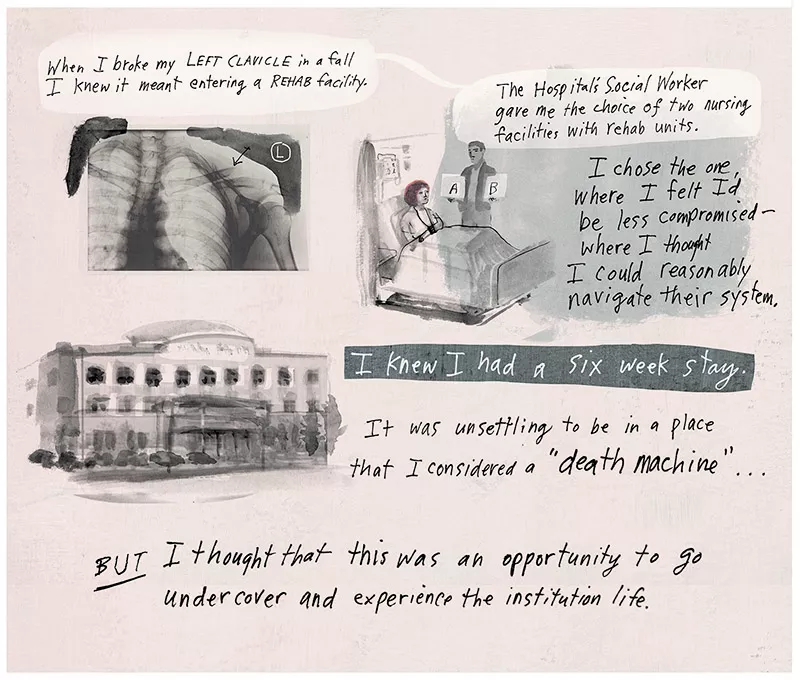
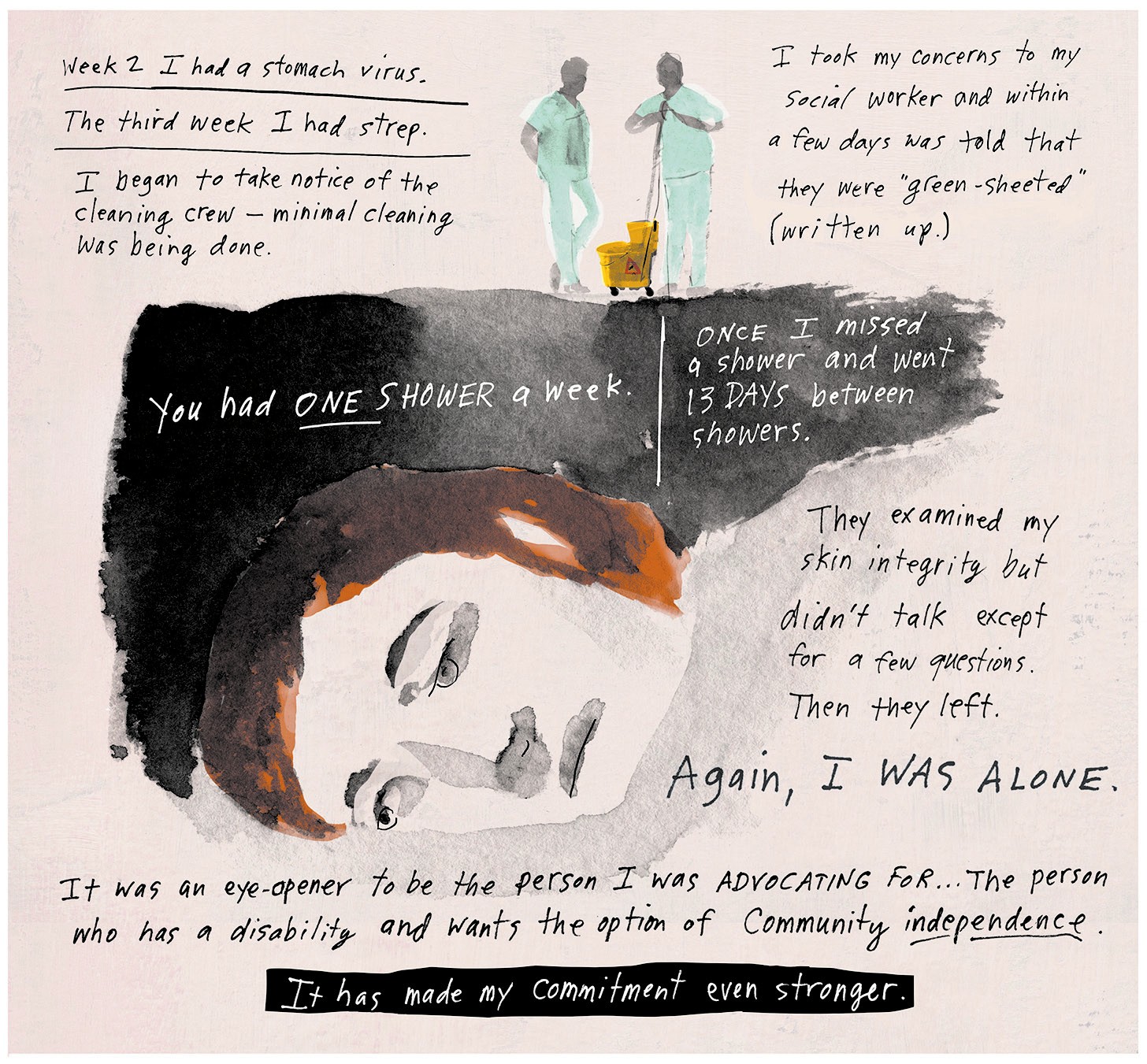
For people with disabilities, an extended stay in a rehab or nursing facility during a pandemic can be especially worrying


A comics journalism story on Covid-19

written by Kate Blaker with illustrations by Stacy Innerst

About the project:
“I have had a career of being a strong advocate for other persons with disabilities, and I tell people that I will die in the streets protesting. (Sorely, I miss doing this for the present.) It was empowering to work on this issue of the nursing facility’s treatment of people who require that care — whether it be a short-term stay or a more involved term — where many people become not a person, but someone that the facility staff tends to recognize as no longer a contributor. It was easy for them (NFs) to hide what was going on for the last two months. The cost of living in the community is a third of a nursing facility cost; 70% of Pennsylvania’s population that passed away from the virus were in nursing facilities. Shame on the Governor and the Secretary of Health for not doing more to protect them.”
— Kate Blaker 

“I was honored to be asked to illustrate Kate Blaker’s story about her experiences in a nursing facility during the Coronavirus pandemic. Hers is one of the many voices that should be heard as society comes to terms with how we treat our most vulnerable members, especially in times of crisis.” — Stacy Innerst

Full Article & Source:
For people with disabilities, an extended stay in a rehab or nursing facility during a pandemic can be especially worrying

Monday, March 23, 2020

Siblings come up with a unique way to visit their mother in nursing home

By Emerson Lehmann

WESTON, Wis. (WSAW) - Siblings Sara Helmer and Mark Michlig understand why they can’t visit their mother, Carol like they normally would while she is living at the Rennes Health and Rehab Center in Weston. Like most nursing homes and assisted living facilities, Rennes isn’t allowing in-person visits during the COVID-19 outbreak to help protect both the people living there and the staff.

Mark Michlig and Sara Helmer hold up the signs made for their mother at Rennes Health and Rehab Center in Weston. (WSAW photo 3/19/20)
“We are really focused on following the guidelines of the CDC and DHS,” explained Vikki Baumler, the public information officer at Rennes. “The data shows that this virus is extremely dangerous for the elderly and people with extreme health conditions. The best thing we can do is try to keep visitors out of the building and prevent the virus from ever entering our facility.”

Instead of choosing to just call or Facetime their mother, Helmer and Michlig got creative.

“The idea of saying ‘Hello’ in a different way and making light of putting a little humor in this,” said Michlig. “My mom is restricted to her bed, so going to her window with a sign that says ‘Good morning’ or ‘I love you’ or ‘Hi Mom’ was a surprise for her.”

Helmer agrees, crediting her brother with coming up with the idea.

“She loves it,” Helmer said. “The first time we went there, she cried because we didn’t tell her. We went up there and knocked on the window and she loved the signs, and she was crying, and she just loved it, talking on the phone so we talked on the phone for a few minutes and sat out there.”

It has become a daily tradition for the brother and sister duo to visit their mother from outside her window, with other residents and staff members taking notice.

“It’s definitely meant a lot to our residents and our staff,” said Katie McMahon, activities director at Rennes. “Anything positive right now is just really nice to see.

While Michlig and Helmer aren’t sure when they’ll be able to go inside and sit with their mother again, they’re happy that they can still see her, and show her how much they love her, through the window.

“We’re just adults being children,” Michlig beamed. “This is a way of expressing our love for my mother and all the residents that are here. Hopefully, they get some attention, too.”

“A big thank you to the nurses and the staff here,” Helmer added. “We totally appreciate everything they do for all the residents here.”

Full Article & Source:
Siblings come up with a unique way to visit their mother in nursing home

Wednesday, March 18, 2020

Parent company of Carlisle nursing facility to pay $15.4 million to settle overbilling allegations

Forest Park Healthcare and Rehabilitation Center is located at 700 Walnut Bottom Road, Carlisle.
Guardian Elder Care Holdings, the owner of Forest Park Healthcare and Rehabilitation Center in Carlisle, has agreed to pay $15,466,278 to resolve allegations that it over-billed patients.

The Department of Justice announced the settlement in a news release last week.

Guardian operates more than 50 nursing facilities throughout Pennsylvania, Ohio and West Virginia.

According to the news release, Guardian facilities allegedly billed patients at the highest level of Medicare reimbursement from January 2011 through December 2017. Services at that level were not medically necessary, and were influenced by financial considerations.

“Seniors rely on the Medicare program to provide them with appropriate care, and to ensure that they are treated with dignity and respect,” said Assistant Attorney General Jody Hunt of the Department of Justice’s Civil Division. “The department will not tolerate nursing home operators that put their own economic gain ahead of the needs of their residents, and will continue to hold accountable those operators who bill Medicare for unnecessary rehabilitation services.”

The allegations were originally introduced by two former Guardian employees, Phillipa Krause and Julie White, under the whistleblower provisions of the False Claims Act, which allow private parties to sue on behalf of the government for false claims and to share in any recovery. The whistleblowers in this case will receive approximately $2.8 million.

The settlement also resolves allegations voluntarily disclosed by Guardian that it had employed two people who were excluded from federal health care programs. As a result of its employment of those two people, Guardian inappropriately received payment for ineligible services.

Contemporaneous with the civil settlement, Guardian agreed to enter into a chainwide Corporate Integrity Agreement with the U.S. Department of Health and Human Services Office of Inspector General. The agreements are intended to promote compliance and protect nursing home residents.

Full Article & Source:
Parent company of Carlisle nursing facility to pay $15.4 million to settle overbilling allegations

Tuesday, March 3, 2020

Health officials: Dozens at Kirkland nursing facility reporting symptoms that might suggest coronavirus

KIRKLAND, Wash. — Dozens of residents and staff at LifeCare Center of Kirkland, a nursing and rehab facility, are reporting symptoms that might suggest coronavirus, according to a statement from King County Public Health.

Four coronavirus-related deaths have been linked to the nursing facility. 50 people at the facility are being tested for the virus.


  • The second coronavirus death in Washington and across the U.S., a man in his 70s, died at EvergreenHealth on March 1. He had underlying health conditions and had been a resident at LifeCare, King County Public Health said.
  • A woman in her 70s, a resident of LifeCare, was hospitalized at EvergreenHealth. The woman had underlying health conditions and died March 1.
  • A woman in her 80s, a resident of LifeCare, was hospitalized at EvergreenHealth. She also had underlying health conditions and died March 1.
  • Additionally, a woman in her 80s who was in critical condition at EvergreenHealth, died March 1 from coronavirus.

Another case is a woman in her 40s who works as a health care worker at Life Care. She is currently in satisfactory condition at Overlake Hospital and does not have a history of known travel outside the United States, officials said.

A woman in her 70s, is a resident at Life Care and is in serious condition at EvergreenHealth Hospital.

Ellie Basham, the executive director at Life Care Center of Kirkland, provided KIRO 7 with this statement Saturday, before King County Public Health had released new information Sunday:
"Residents are our highest priority at Life Care Center of Kirkland. Their safety and well-being are our primary concerns.

Recently, one of our associates and one of our residents were diagnosed with coronavirus (COVID-19) while receiving care in local hospitals. Current residents and associates are being monitored closely, and any with symptoms or who were potentially exposed are quarantined. As precaution, all visits to the facility from families, volunteers or vendors are not allowed.

Concerned family members or responsible parties may call our facility number at (425) 823-2323 with any questions. The facility is currently placing a hold on admissions as well to fully focus on our current residents and associates.

We take the event very seriously and have members of our corporate clinical team en route to provide extra assistance. We are in contact with the Centers for Disease Control as well as the Washington Health Department. We are following their guidance exclusively and will continue to take all precautions necessary for our residents, staff and the community at large."

Full Article & Source:
Health officials: Dozens at Kirkland nursing facility reporting symptoms that might suggest coronavirus

Tuesday, March 5, 2019

Nursing home employees indicted for involuntary manslaughter after patient’s death from bedsores

Ohio Attorney General Dave Yost (Photo by Justin Merriman/Getty Images)
The Ohio attorney general has indicted seven former Columbus nursing facility workers on dozens of charges following a patient’s 2017 death from bedsores.

Dave Yost announced charges last week against six employees and a contracted nurse practitioner at the Whetstone Gardens and Care Center. All told, the seven individuals have been hit with 34 charges, including involuntary manslaughter, with some stemming from alleged neglectful care of a second patient.

“This case goes to the heart of protecting the unprotected,” Yost said in a statement. “[E]vidence shows these nurses forced the victims to endure awful mistreatment and then lied about it.”

The first patient developed serious wounds on his body in February 2017, which progressed to gangrenous and necrotic tissue. Despite his worsening condition, nurses allegedly failed to take steps to save his life, with the man dying a month later from septic shock. A jury last week indicted Sandra Blazer, Jessica Caldwell and Kimberly Potter of involuntary manslaughter and gross patient neglect.

In the second case, staffers allegedly documented treatments that were never provided to a different patient, who suffered “physical harm as a result of the inadequate care,” Yost said. Records for that patient contained false information and forged signatures, with some care occurring at times when the woman was not physically present at the facility.

Five employees, including Blazer, were indicted on charges of forgery and/or patient neglect.

In a statement to McKnight’s, spokesman Ryan Stubenrauch said that Whetstone “vehemently disagrees” with any suggestion that its employees caused the 2017 death of its patient who suffered bedsores. He was transferred to the hospital five days before passing away.

On the second case, Stubenrauch said those issues came to the facility’s attention two years ago during an annual survey and were immediately addressed.

“As always, the health, safety and well-being of our residents is our No. 1 priority and we will continue to ensure that all of our residents receive high-quality care,” he said.

Full Article & Source:
Nursing home employees indicted for involuntary manslaughter after patient’s death from bedsores

Saturday, September 1, 2018

Dying badly despite all my efforts

I’m a palliative care nurse practitioner so you would think that my mother would have had a good end-of-life experience, but she didn’t.

She had done everything she could to prepare for a “good” death.” She was aware of her health situation and willing to discuss it with her family and health care providers. I lived nearby, was her health care power of attorney, and we talked regularly about her wishes. She had a living will and a MOLST (Medical Orders for Life-Sustaining Treatment) form. And she chose to live in a continuing care retirement community outside of Baltimore, a place with varying levels of care.

She lived there for more than 16 years in its independent living section. But in her 91st year, her doctor recommended hospice. The care they provided was wonderful. My mother was comfortable, and we felt supported.

The first challenge came when the alarm sounded on my mother’s oxygen concentrator. I called the equipment company, and they agreed to send a replacement. Hours went by. Calling them again, the answering service told me if this was a medical emergency I should call 911. Then the on-call person called back to say my mother wasn’t one of their patients. Minutes later, the delivery driver called to say he had arrived but couldn’t find the apartment.

But the real trials came when we moved my mother to the nursing facility within the continuing care retirement community (CCRC). This was when we discovered that the CCRC had no process to move her there, even though it was only a few hundred yards away. I had to explain that taking her in a wheelchair through the public areas was not going to work. The facility asserted that my mother’s hospice should arrange — and pay — for the ambulance, which the hospice rightly refused. After multiple phone calls, the CCRC ordered transport.

When my mother finally arrived, the problems with care coordination began. It took an hour to be seen by a nurse. The nurse said she had to check my mother’s chart, which was puzzling because my mother didn’t have one, having not come from a medical facility. However, without such a chart, the staff had no idea who my mother was or why she was there, even though her medical records from the previous 16 years were in the adjoining clinic. When they finally examined her, they tore her fragile skin, which bled. Finally, the charge nurse asked me for the details on my mother’s terminal diagnosis, medical problems, medications and even which hospice was providing her care. I could provide that, but what about a family who couldn’t?

The charge nurse agreed that my mother urgently needed medication for her breathing. Her physician had ordered it, but it hadn’t arrived, and as the hours went by her breathing became rapid and labored. The pharmacy sent an emergency delivery of a laxative, but not the breathing medication. That finally arrived eight hours after her admission and took a while to work.

The next day an aide came in to note that “he seemed to be sleeping” and left. Then the nurse tried to place some medication ordered for my mother’s mouth in her eyes instead. That evening, the manager came by, noted our exhaustion, and sent us home saying someone would check on my mother every hour that night.

Early the next morning a tearful nurse called to tell me she hadn’t given my mother any of her ordered medications overnight because she hadn’t known about them. We rushed to the nursing facility where the staff was apologetic. Not long after, my mother died.

There’s so much about this that’s hard to understand but little that’s unusual. Our health care system is not really a system. It does a bad job of coordinating transitions between clinical settings. Communication is poor and inconsistent, and the CCRC was using paper charts. The nurses had too many patients, and they were licensed practical nurses (LPNs), who lacked the training that registered nurses (RNs) have.

We thought we could overcome these issues and did as long as my mother was in our care. We managed to keep her comfortable and at home until 42 hours before her death. But those last hours were awful because of our decision to move her to the CCRC’s nursing facility.

I have to live with that. My mother may have died badly because of it. The question is: How many more will?

Full Article & Source:
Dying badly despite all my efforts