
Written by Jake Lehrer
Just the other day, I had a text warning me to pay a fine or else I was in trouble. The number, of course, looked like a randomly generated Facebook password. Over time, I’ve learned to ignore certain calls, delete certain texts, and yes, although this may sound rude, hang up on the A.I. trying to sell me health insurance.
Scams have always existed since people could deceive each other, and it just keeps evolving with new technology. In a surprising report by the FBI, cryptocurrency crimes are on the rise, and taking billions of dollars from consumers all around the nation. Texas was second in the nation for the amount of money lost to cryptocurrency scams in 2025.
According to an FBI report, in 2025, Texas consumers lost 1 billion in cryptocurrency fraud scams. $56 million of that was attributed to scammers having consumers deposit cash in cryptocurrency kiosks. That $56 million belonged to a total 1200 Texans scammed out of a significant amount of cash.
Those interviewed about the scams report that they deposited thousands to tens of thousands of dollars. One person reportedly put in around $100,000. Completely losing their money. Only a few were able to recover theirs.
The scam works like this: A consumer such as yourself gets a phone call from someone claiming they are from the police, bank, sheriff’s office, state agency, or other, and say that you either missed jury duty and have to pay a fine, or have an outstanding balance on an account, need to pay a toll violation, or whatever they can use that seems serious enough that you need to pay immediatly or risk consequences.
Scammers will provide documents and files that seem legitimate to trick consumers. They might even have personal info that they’ve gathered from the dark web. Once a consumer believes them, scammers direct their victims to withdraw cash and say they need to pay at a specific kiosk. They might even claim it is the official payment center for whoever they are impersonating.
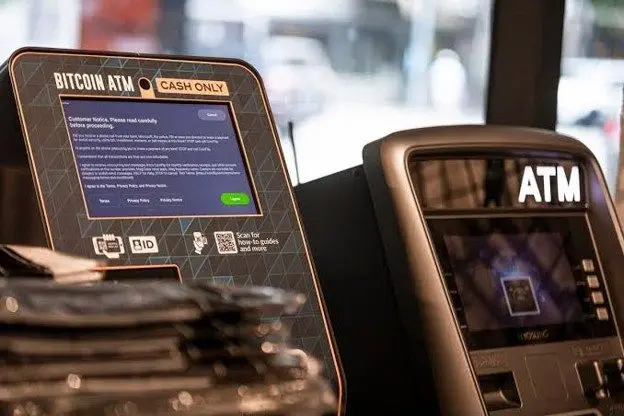
These kiosks, found in convenience stores, gas stations, grocery stores, and other businesses, are cryptocurrency kiosks. They look like ATMs, and you can find them where you might find most ATMs.
If a consumer has not yet realized they are being scammed, they are directed to deposit the money, and their “fine” is covered. The cash is converted into cryptocurrency and goes to different digital wallets. Scammers will have the money bounce around with legitimate funds to look legitimate and avoid detection. After about 36-48 hours, consumers have no hope of recovering, and the money is lost.
Cryptocurrency kiosks are designed to allow people to convert cash into cryptocurrency. There are reportedly 4000 around the state of Texas, although with a lack of state oversight, it is not clear how many there actually are. Those who use crypto have digital wallets. Once cash is deposited, the consumer enters their digital wallet address.
While this seems a legitimate way for consumers of digital currency to transfer their hard cash for bitcoin, these cryptocurrency kiosks have become a staple for scammers, since these kiosks are not regulated by the state.
According to the Texas Tribune, in an article interviewing people who had been scammed, “Cryptocurrency is increasingly preferred by scammers because it is not subject to the same banking laws as traditional currency — especially in how it can be transferred internationally, where most scammers are based, according to law enforcement.”
Crystal Intelligence, a company that assists law enforcement with crypto fraud crimes, states that in Texas, “transmission of virtual currency alone is not money transmission.”
Additional crypto fraud crimes involve “investment schemes where victims buy fraudulent cryptocurrencies or use crypto to invest in fake businesses.” Or, scammers will build relationships or friendships with people online before attempting to scam them out of money.
There are mixed solutions proposed by Texas Legislators. While some seek to ban the kiosks altogether, others are skeptical about the state interfering in something that deals with the market.
Texas House Speaker Dustin Burrows has charged the Criminal Jurisprudence Committee in the Texas House to consider legislation on: “Fraud and Financial Exploitation of Elderly and Vulnerable Texans: Examine trends related to the crimes of fraud, financial exploitation, and abuse targeting elderly and vulnerable Texans, including crimes involving telecommunications and emerging technologies “
Texas Lt. Governor Dan Patrick has charged the Business and Commerce Committee of the Texas Senate to look into “Fostering Financial Technology Innovation: Evaluate the future of blockchain technology and cryptocurrency in the state of Texas and assess Texas’s coordination with federal rules. Assess how the state’s financial regulatory agencies respond to emerging financial technologies and business models, while prioritizing the protection of consumers. Examine the prevalence of virtual currency kiosks in Texas and make recommendations to support their use while protecting vulnerable Texans from scams.”
Texas has no regulatory oversight for crypto kiosk stands around the state. With a lack of an enforcement policy, Texas officials who can enforce cryptocurrency crimes are not trained to. There is a policy on market frameworks for cryptocurrency in the state of Texas. Texas has even bought a cryptocurrency reserve. But when it comes to fraud, Texas falls behind other states in meaningful legislation to protect consumers, especially from cryptocurrency kiosk scams.
There is federal legislation that has already been passed to regulate the crypto market, with another bill in the U.S. Senate that would aid in market regulation of cryptocurrency. But state agencies will still be responsible for enforcing cryptocurrency laws.
Texas Financial Crimes Intelligence Center states that the machines are mostly used for scams. Different Texas departments and legislators acknowledge they need better oversight regulations, while some local officials around the state would prefer Texas to ban these kiosks completely, as other states have done.
According to the FBI: “In 2025, the IC3 received more than 13,400 complaints reporting the use of cryptocurrency kiosks, with losses over $388 million — a 23% increase in complaints and a 58% increase in losses from 2024. More than half of the complaints involved individuals over 50, with losses over $302 million.”
It is important to report scams. Many do not report out of feeling embarrassed for being tricked. But we should not have that type of culture. Reportedly, 1 in 4 people have been scammed in their lifetime. Scammers target everyone, and they get more advanced in tricking us by the day. They will provide documents that look real, reveal they know personal information, and can make phone numbers look legitimate. People of all ages need to be vigilant against scammers.
According to News From the States: “No bank or government agency, including a court, police department, or licensing board, will ask for cryptocurrency or request payment through a crypto kiosk. If asked to do so, contact your local authorities.”
Lastly, if you are not sure if a phone call, text, or email is legitimate or not, contact the official offices (courts, police departments, DMVs, etc.) the person claims to represent.
The FBI has a fact sheet on how to prevent yourself from getting scammed, or how to identify if you or others are being scammed out of money:
“Spotting Indicators of Cryptocurrency Kiosk Scam
- Individuals reporting unsolicited contact and conversations by email, social media applications, or phone with individuals offering services or requesting payments in cryptocurrency,
- Individuals in possession of QR code documentation that they cannot explain or make themselves,
- Individuals making large cash withdrawals, especially for the first time, and requesting currency in large bill denominations,
- Individuals exhibiting confusion or nervous behavior when asked general questions about the purpose of a cash withdrawal, needing to pay a large expense in cash, or having a new financial advisor who requires cash,
- Individuals taking large sums of cash to a location with a cryptocurrency kiosk,
- Individuals talking on cell phones and exhibiting signs of confusion while making cash withdrawals from a financial institution or attempting to operate a cryptocurrency kiosk, and
- Individuals lingering at cryptocurrency kiosks and/or aiding individuals operating the kiosk.
Tips for Protecting Yourself
- Do not send payment to someone you have only spoken to online, even if you believe you have established a relationship with the individual.
- Do not follow instructions from someone you have never met to scan a QR code and send payment via a cryptocurrency kiosk.
- Do not respond to a caller who claims to be a representative of a company and who requests personal information or demands cryptocurrency. Contact the entity directly for verification.
- Do not respond to a caller from an unknown telephone number who identifies as a person you know and requests cryptocurrency.
- Practice caution when an entity states they can only accept cryptocurrency and identifies as the government, law enforcement, a legal office, or a utility company. No legitimate law enforcement or government official will call to demand payment via a cryptocurrency kiosk.
- If you are using a cryptocurrency kiosk and the kiosk operator calls you to explain that your transactions are consistent with fraud and advises you to stop sending money, you should stop or cancel the transaction.
- If you send funds via a cryptocurrency kiosk, be sure to keep any receipts or cryptocurrency transaction documentation.
Report It
If you believe you have been the victim of a scam involving a cryptocurrency kiosk, in addition to filing police reports with your local police department, file a complaint with the IC3 at www.ic3.gov. Please provide the following information, if available.
- The transaction ID (TXID), wallet address where funds were sent, and location of the cryptocurrency kiosk.
- Any information related to the subject, such as phone numbers, email addresses, domains, or aliases.
- A description of the scam.”
By Jake Lehrer
Staff Writer
Full Article & Source:
Texans Lose Millions to Crypto Scams


No comments:
Post a Comment