BALDWIN COUNTY, Ala. (NBC 15) — A Bay
Minette woman is accused of stealing nearly $400,000 in cash from a
private residence over several months while working as a cleaning lady,
according to the Baldwin County Sheriff’s Office.
The sheriff’s
office said it received a report on Tuesday about the theft of a large
amount of U.S. currency from a home. The victims told investigators that
nearly $400,000 in cash had been taken and identified their cleaning
lady as the primary suspect.
Investigators
identified the suspect as Tabitha White, 28, of Bay Minette, and
interviewed her about the theft, the sheriff’s office said. During the
interview, White told investigators that over the course of several
months, she had taken “handfuls” of cash while cleaning the residence.
As
the investigation continued, investigators said they learned White had
allegedly used stolen funds to purchase numerous items. That information
led to a search warrant being executed at her residence, where
investigators seized documents related to the purchases and items
believed to have been bought with the stolen money.
The sheriff’s
office said evidence seized included vehicles, four-wheelers,
electronics, lawn equipment, construction supplies and other property.
White was charged with one felony count of financial exploitation of the
elderly. The sheriff’s office said additional charges may be filed as
the investigation continues.
MONTGOMERY, Ala. (WBRC)
- The Alabama Supreme Court issued a ruling confirming the circuit
court has the power to act as a check on Jefferson County’s probate
court, despite its broad powers. This case is also connected to a
complaint involving suspended Jefferson County Probate Judge Yashiba
Blanchard.
The unanimous ruling, written by Justice
Will Sellers, rejected the argument that Jefferson County’s probate
court answers to no one but the Alabama Supreme Court itself, due to a
local act that provides additional power. It holds that circuit courts
retain their statutory authority to oversee probate courts, including
the power to issue a writ of mandamus forcing a probate judge to undo an
order.
While this ruling may feel distant for everyday Alabamians who aren’t involved the court system, it’s highly relevant.
This ruling stems from a case involving
vulnerable Alabamians who don’t have the ability to manage their own
finances, including adults with severe disabilities, those with dementia
and children who receive settlements, among others. A probate judge
appoints a conservator to hold and spend that money and they must be
accountable for every dollar. The accounts are subject to routine audits
by the probate office.
The complaint charges Blanchard with seven judicial ethics violations
and outlines significant allegations involving the way she ran her
office. These are not criminal charges, they are alleged violations of
standards for Alabama judges. Blanchard denies all wrongdoing.
If the Court of the Judiciary finds Blanchard violated judicial standards, she could be removed from the bench.
How We Got Here
In
January 2026, Blanchard ordered a forensic audit of roughly 146 cases.
The fees for the accounting firm were to be paid out of each account
with no cap. It’s worth noting, the Supreme Court ruling doesn’t decide
whether that order was lawful.
The
attorneys, Ripon Britton Jr. and Gregory H. Hawley, filed a petition,
asking a Jefferson County circuit court judge to intervene in
Blanchard’s forensic audit order. The petition stated Blanchard’s order
lacked case numbers, names and directed a specific accounting firm, BAT
Solution, L.L.C., to conduct forensic accountings on every estate
Britton and Hawley had handled as conservator for previous
administrations.
According to court records, of the roughly 146 cases, 14 were guardian-only matters with no money involved.
Of the remaining 132 conservatorship cases:
77
were closed with a final settlement filed, which had been examined by
the court’s own accounting staff and a judge’s final decree entered.
75
of those 77 cases had final judgments, legally the court no longer has
jurisdiction to reopen without a finding of fraud or mistake.
18 cases had gone through a final hearing and were waiting on the judge to sign the closing paperwork.
37 cases were open, according to filings.
Britton
and Hawley argued Blanchard’s order violated due process, exceeded the
probate court’s authority and ignored Rule 53 of Alabama’s civil
procedure rules which governs outside appointments and requires notice, a
defined scope and case-specific findings. The circuit court agreed to
freeze the order while it considered the case, explicitly directing
Blanchard to take no further action to enforce it.
The
JIC complaint cites that according to state law, land valuations are
subtracted when determining bond amounts and were not needed for the
bond evaluations.
On March 30, Presiding Jefferson County
Circuit Judge Elisabeth French dismissed the case for lack of
jurisdiction, referencing a prior Alabama Supreme Court case suggesting
only the Supreme Court, not a circuit court, could review a Jefferson
County probate order.
With the Supreme Court’s latest ruling, the case now goes back to Judge French with instructions to take up the petition.
“Nobody
objects to auditing a conservator,” stated Alan Duke, one of the
attorneys representing Britton and Hawley. ”The objection is to auditing
cases the court had already audited and closed, without notice or
cause, and charging an uncapped fee to the protected persons. The
decision today that the circuit court has supervisory authority over the
probate court allows the circuit court to hear that objection and
decide whether the order itself was lawful.”
The
JIC’s complaint directly references this case, citing it as evidence
that Judge Blanchard engaged in a pattern and practice of exhibiting
bias against Britton and Hawley, detailing legal issues from Jan. 2025
through the spring of 2026.
It cites, among other instances, that
Blanchard filed a State Bar complaint against Britton in October 2025
seeking his suspension or disbarment. The Bar notified her on Jan. 26,
2026 that it would take no action. The forensic accounting order is
dated three days later.
The complaint
also lays out a timeline showing Britton had already filed detailed
inventories in December and again in January that Blanchard did not flag
as deficient. It also notes Blanchard’s office emailed Britton on Jan.
28 requesting an updated inventory of all assets for each estate.
Britton,
according to the complaint, responded on Jan. 29, agreeing to provide
that information - the same that Blanchard ordered the audit.
Separately,
the complaint describes Blanchard filing a police report on Jan. 29,
2026, the same day as the forensic order, reporting that she felt
threatened by Britton. Days later, photographs of Britton and Hawley
were posted at Jefferson County Courthouse security checkpoints, which
the complaint says led both attorneys to leave the city and retain
criminal defense counsel out of fear of arrest.
So far, no hearing has been set in the circuit court case.
WBRC contacted Blanchard’s attorney Matt Hart. He declined to comment.
WBRC obtained financial
records showing the court’s public archival fund was used to pay a
political consulting firm nearly half a million dollars, buy radio
advertising, and reimburse the judge personally
By Jonathan Hardison and Morgan Hightower
BIRMINGHAM, Ala. (WBRC)
- While patients allegedly sat in hospital beds waiting for mental
health hearings that never came, and families watched their loved ones’
estates stall in a courthouse backlog, Jefferson County Probate
Judge Yashiba Blanchard was spending public money on items at least one
of her predecessors said that money was never intended for.
Suspended Judge Yashiba Blanchard appears in court for alleged judicial ethics violations.(WBRC)
The
records — bank statements, check registers, and contracts covering May
2024 through June 2026 — show the Jefferson County Probate Court’s
Archival Discretionary Fund was used to pay a political communications
firm nearly half a million dollars, purchase tens of thousands of
dollars in radio and broadcast advertising, and reimburse Blanchard
personally for expenses that included a gala ticket, a catering bill,
and a Zoom subscription.
Blanchard took office in January 2025, so these financial records cover a period that begins before her tenure.
Blanchard was suspended in May 2026
after the Judicial Inquiry Commission (JIC) filed a 120-page complaint
against her. She faces trial before the Court of the Judiciary — a
nine-member panel with the authority to remove her from the bench —
currently scheduled for November 2026. Her attorney, Emory Anthony, has
said she denies the allegations.
The state’s Department of Examiners of Public Accounts confirmed in July 2026 that it is conducting an audit
of the Jefferson County Probate Court, both the Birmingham and Bessemer
divisions. That audit began in March 2026 — two months before Blanchard
was suspended.
A fund built on fees from everyday residents
To understand why these records matter, it helps to understand the source of the money.
Under
Alabama law, every time a Jefferson County resident records a property
document at the probate court — a deed, a mortgage, a lien — they pay an
$11 special indexing and filing fee on top of standard recording costs.
That money flows directly into the Archival Discretionary Fund, which
the judge of probate controls. The law says it is to be used for
salaries of judicial assistants and for improving the office’s indexing,
recording, archiving, and retrieval systems.
Former Jefferson County Probate Judge
Alan King helped write that law. He lobbied for and helped pass the 2012
legislation that created the fund, and he oversaw it until he left
office in 2020.
“It was created to
safeguard our millions of records, deeds, other real estate records,
marriage licenses, judicial records for future generations,” King told
WBRC.
King said that during his
tenure, every expenditure from the fund went through a review process,
despite the law not requiring oversight and giving the probate judge
discretion over the spending of the funds.
“Everything
that was ever spent out of these funds was approved by the county
attorney’s office in advance, and also, by the state auditor’s office,”
he said. “All those proceeds that I used were all approved in advance,
and then I oversaw the expenditures.”
When Blanchard took office on January 20,
2025, the Bessemer division’s Archival Discretionary Fund held $5.9
million. The Birmingham division’s account held approximately $1.38
million. Combined, the office she inherited had roughly $7.3 million in
public funds under her control.
By the
time she was suspended 16 months later, the Birmingham account had
dropped to approximately $250,000 — a decline of more than $1.1 million.
The Bessemer account had grown to a peak of nearly $6.5 million by
December 2025, then fallen to under $1 million by May 2026.
The single largest vendor in the financial records is CBG Strategies LLC, a communications and consulting firm.
According
to contracts and check registers obtained by WBRC, CBG Strategies was
paid at least $192,000 under a 2025 agreement before Blanchard signed a
new contract with the firm on January 5, 2026. That new contract, which
runs through December 2026, is valued at $440,200, billed at $115,050
per quarter.
Date
Payee
Memo
Payment
Archival Discretionary Fund
3/27/25
CBG Strategies, LLC
Consulting Services
$67,500.00
Birmingham
5/9/25
CBG Strategies, LLC
Direct Mail, Reimbursement
$31,301.69
Birmingham
10/20/25
CBG Strategies, LLC
Consulting Services
$76,559.80
Birmingham
12/11/25
CBG Strategies, LLC
Consulting Services
$17,000.00
Birmingham
1/15/26
CBG Strategies, LLC
Consulting Services
$115,050.00
Birmingham
1/15/26
CBG Strategies, LLC
Consulting Services
$60,252.00
Birmingham
5/12/26
CBG Strategies, LLC
Direct Mail
$22,331.50
Birmingham
5/29/25
CBG Strategies, LLC
Consulting Services
$67,500.00
Bessemer
3/24/26
CBG Strategies, LLC
Inv#1364 &1371; Feb 2026 Mailer/Consulting Service Quarter 2 payment
$157,713.00
Bessemer
5/12/26
CBG Strategies, LLC
Direct Mail
$22,331.50
Bessemer
According
to the contract, the firm manages the court’s Facebook, Instagram, and
TikTok accounts, writes press releases, handles media inquiries,
develops “talking points for court leadership,” plans community events,
and provides what the contract calls an “onsite administrative
coordinator” — a person physically working inside the courthouse every
day.
In total, CBG Strategies received
at least $637,000 from the Archival Discretionary Fund across 2025 and
2026, based on the records reviewed by WBRC.
King, who wrote the law that created the fund, said that kind of spending was never what the legislation intended.
“That was not the intent of the
legislation,” he said. “It’s up to each person, whether they’re a
probate judge, circuit judge, mayor, to run their own campaign. To use
personal or county funds for basically their own personal campaign
purpose, is incredible to me. I’m astounded that the money was allegedly
spent in that way.”
The second major consulting firm in the records is Greene Consulting Group LLC, based in Huntsville.
Greene
Consulting was brought on to provide election-related services — voter
education, poll worker training, election communications, and what the
contract describes as an “Elections Operations Modernization
Initiative.” The firm’s principal is Samuel T. Greene, whose business
contact listed on invoices is a personal Gmail address.
Greene
Consulting signed a contract with Blanchard on January 5, 2026 — the
same day as the CBG contract — for $350,000 per year, billed at $87,500
per quarter, plus a $35,000 upfront retainer.
But something unusual appears on the
signature page of that contract. A handwritten notation reads: “voided
terminated at Date 1/13/2026.” The contract, in other words, appears to
have been canceled just eight days after it was signed.
Despite
that notation, the financial records show that on February 5, 2026, the
Bessemer Archival Discretionary Fund paid Greene Consulting Group
$124,500.
The
invoice submitted for that payment — dated January 30, 2026 — lists
$100,000 for “1st Quarter Consultant Pay” and $22,000 for an “Executive
Dashboard Summary.” The Executive Dashboard Summary itself is a single
page of narrative describing vague “foundational infrastructure” work
with no measurable outcomes, no attendance data, and no deliverables.
Greene Consulting had also been paid
under a prior contract in 2025 — records show payments of $31,250,
$62,500, $31,250, and $17,500 before the January 2026 contract was ever
signed. That prior contract has not been produced in the records
request.
In total, Greene Consulting
Group received at least $461,000 from the Archival Discretionary Fund,
based on the records reviewed by WBRC.
Advertising buys, gala tickets, and a catering bill
Beyond
the consulting contracts, the financial records contain a series of
expenditures that raise questions about whether public archival funds
were used for appropriate purposes.
Broadcast advertising:
The records show the court paid Summit Media — a radio and digital
advertising company — $53,875 on February 12, 2026. The memo line says
the expense is for “Order 673217, 673219, 673223, 673225A.” The court
also paid Richardson Broadcasting Corporation a total of approximately
$49,500 across multiple payments in 2025 and 2026, with invoices
described as “advertising.” Cumulus Media was paid $19,250 for a :30
commercial on Talk 99.5 Radio in March 2026. Courtney French
Broadcasting was paid $20,000 between February and March 2026 for radio
broadcast, and commercial spots.
Promotional merchandise: The court
paid JJ’s T-Shirts & Team approximately $9,629 for shirts, and
Superior Promos Inc. approximately $10,273 for promotional products —
both categorized as miscellaneous office expenses.
Photography:
A vendor called The Price Approach Photography was paid at least $7,650
across nine separate transactions. Memo descriptions on the checks
include “headshots,” “event photography,” “Judge Blanchard - Biography,”
and “photos for Judge Knox.”
Personal reimbursements to Blanchard:
The records show Blanchard herself was reimbursed or paid directly more
than 25 times over 16 months, with individual payments ranging from
$36.73 to $4,585.09. Among the items: a Zoom subscription ($159.90), a
catering bill from “The Happy Catering” ($249.25), a payment described
as a “2025 Foundation Gala” ($550), and multiple travel advances to
cities including Chicago, Salt Lake City, and San Antonio.
Community event sponsorships:
The records show two payments of $3,500 each to “Brenda’s Brown Bosom
Buddies” for what is described as a “Sistah Strut Sponsorship,” a $1,500
payment to “Men of Powderly” with the memo “Donation - Yashiba,” a
$1,500 payment to “Pinktopps Inc.” explicitly labeled as a “Donation,”
and a $1,000 payment to “The A List Network LLC” for a “Gala
Sponsorship.”
The law establishing the Archival
Discretionary Fund does not list community event sponsorships or
donations among its authorized uses.
King said the fund’s purpose was always narrow and specific.
“It was created to safeguard our millions of records,” he said. “That was the intent.”
Context: A court already under fire
All
this spending was happening as the Jefferson County Probate Court was,
by the Judicial Inquiry Commission’s (JIC) account, failing at its core
mission.
The JIC complaint, filed in May 2026,
alleges Blanchard did not hear a single involuntary commitment hearing
for the first nine months of her term — leaving the other probate judge
to handle all of them. When she did begin hearing cases, she capped her
docket at four cases per day and six commitment hearings per month —
handling only about 20% of the county’s caseload while the other judge
absorbed the rest.
The complaint
describes a patient who remained hospitalized through Thanksgiving
because Blanchard canceled her hearing to attend a meeting — and only
held the hearing after the hospital sent three requests explaining the
patient was “lying in bed crying and upset.”
Meanwhile,
dozens of estate and conservatorship cases sat without rulings for
months or years. Families paid mounting attorney fees. In at least two
cases, immigration authorities dismissed filings for delay, forcing
families to refile and pay fees again.
The
complaint also alleges Blanchard retaliated against staff, intimidated
attorneys, filed an unsupported State Bar complaint against a lawyer
(which was dismissed), and filed a police report against two attorneys,
resulting in their photographs being shared with courthouse security.
The
state audit of the Jefferson County Probate Court — covering both the
Birmingham and Bessemer divisions — is ongoing. The Alabama Department
of Examiners of Public Accounts has not said when it will conclude or
whether it has flagged any specific transactions.
WBRC
has submitted additional public records requests for contracts,
competitive bid documentation, and authorization records related to the
transactions identified in this report.
CBG Strategies declined comment on its contract and work with the Probate Judge’s office.
We reached out to Blanchard’s attorney, Emory Anthony, for comment on the financial records.
We also reached out to Greene Consulting Group and are waiting for a reply.
The allegations read like an elder exploitation nightmare: dozens of checks, two iPhones, and two Satsuma homes, all tied to one victim.
In an NBC 15 exclusive interview, Mobile County Sheriff Paul Burch said the investigation began after the victim's daughter noticed unusual activity in her father's financial accounts — a discovery that investigators say uncovered a years-long scheme targeting an elderly Mobile County man.
"The investigation began November of last year when a family member of the victim came forward with what they saw some inconsistencies in his financial accounts," Burch told NBC 15. "The Sheriff's Office launched an investigation."
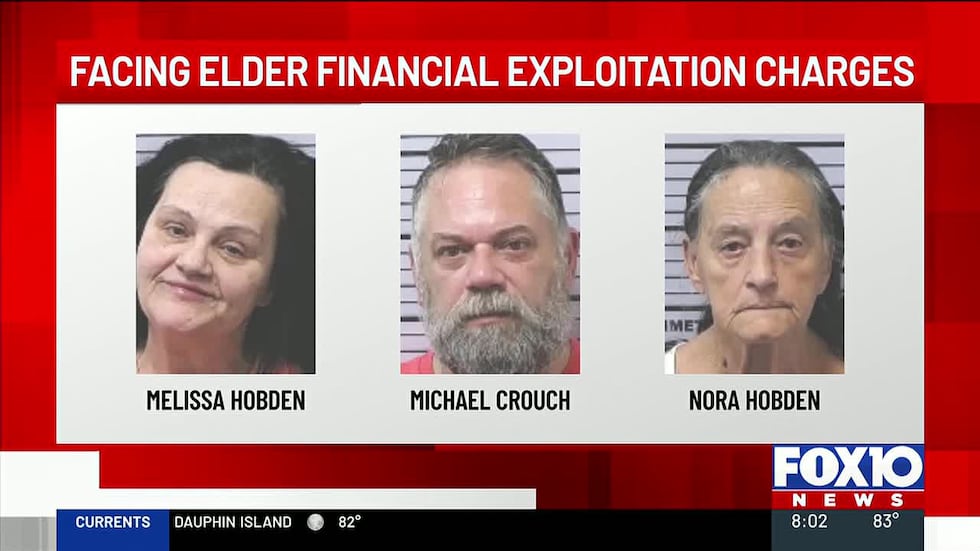
Court records show three people — Nora Powe Hobden, Melissa Lynn Hobden and Michael Lewis Crouch — are facing felony charges tied to allegations they stole checks, property and personal information from Tom Baxter.
The largest accusation is against Melissa Hobden. Criminal complaints filed in Mobile County District Court allege she took and cashed 35 checks belonging to Baxter, totaling $371,980. She is charged with first-degree financial exploitation of an elderly person and first-degree theft of property connected to those checks.
But the allegations go beyond checks.
Investigators also accuse Melissa Hobden of forcing Baxter to sign over two Satsuma properties: one at 13165 Williams Ave., valued in the complaint at $88,000, and another at 5515 Darring St., valued at $105,000. Separate theft charges were filed over each property.
Mobile County property records reviewed by NBC 15 show the Darring Street property has been in Melissa Hobden's name since 2022. A current property record lists her as the owner of 5515 Darring St. and shows a 2026 appraised value of $160,800.
NBC 15 also confirmed both Melissa Hobden and Michael Crouch list the Darring Street address in jail booking records — the same address investigators say was taken from Baxter.
Melissa Hobden is also charged with identity theft. According to investigators, she used Baxter's identifying and banking information to purchase two iPhone 17s under his name and had the phones shipped to her address.
Nora Hobden is accused in separate complaints of unlawfully obtaining and cashing a $46,842 check belonging to Baxter. She is charged with first-degree financial exploitation of an elderly person and first-degree theft of property.
Crouch is accused of cashing or attempting to cash checks tied to Baxter. One complaint alleges he cashed a $38,042 check. Another alleges he attempted to present a fraudulently obtained check valued at $9,450. He faces charges including first-degree theft, attempted first-degree theft and possession of a forged instrument.
Taken together, the complaints describe hundreds of thousands of dollars in checks, real estate and other property allegedly taken or targeted. Some of the charges involve the same alleged conduct under different criminal counts, meaning the court filings do not represent a final loss total.
But in his exclusive interview with NBC 15, Burch said detectives believe they're still uncovering the full scope of the alleged scheme.
MOBILE COUNTY, Ala. (WALA)
- The Mobile County Sheriff’s Office arrested three people following a
months long investigation into the alleged financial exploitation of an
elderly Mobile County resident.
A third suspect is being sought.
The
investigation began in November 2025 after the victim’s daughter
reported concerns that her elderly father had been targeted through
fraud, extortion, forgery and theft, according to the sheriff’s office.
Detectives
and the agency’s Special Investigations Unit reviewed financial
records, executed court-authorized subpoenas, served search warrants for
electronic devices and conducted interviews with victims and witnesses.
Investigators say three people allegedly worked together between 2019
and 2025 to obtain money, real property and other assets from the
victim.
Authorities
said about $659,314 in assets — including the estimated value of two
properties — was supported by available evidence and included in the
criminal charges. Investigators believe the total loss approached $1
million, but said only losses supported by evidence and within legal
timeframes were charged.
The Mobile County District Attorney’s Office approved the following felony charges:
Melissa
Lynn Hobden: two counts of financial exploitation of the elderly (first
degree), three counts of theft of property (first degree), and one
count of identity theft.
Michael Lewis
Crouch: one count of theft of property (first degree), one count of
attempted theft of property (first degree), and two counts of criminal
possession of a forged instrument.
Nora
Powe Hobden: one count of theft of property (first degree) and one
count of financial exploitation of the elderly (first degree).
The
sheriff’s office said its Special Operations Unit executed a
residential search warrant around 6 a.m. July 15, 2026, at 5515 Darring
Street in Satsuma. Deputies took Melissa Hobden and Crouch into custody
without incident, authorities said.
During
the search, investigators recovered multiple cell phones, a laptop, a
notebook believed to contain financial records, mail, handwritten
documents, legal paperwork and property deeds containing the victim’s
personal identifying information, the sheriff’s office said.
Authorities said Nora Powe Hobden was arrested at a separate location on Middle Road on July 15.
Sheriff
Paul Burch said the case underscores the agency’s focus on protecting
vulnerable residents. “Financial crimes against our elderly citizens are
among the most heartbreaking crimes we investigate because they involve
the abuse of trust,” Burch said in a statement.
The investigation remains active and additional charges are possible, the sheriff’s office said.
Anyone with information is asked to contact the Mobile County Sheriff’s Office at (251) 574-8633.
Prichard, Alabama Police Sgt. Aaron Tucker, as well as his sister, have
been removed as co-conservators of Tucker's wife. Former Saraland Police
Officer Jackie Tucker was left incapacitated after being shot in the
line of duty over a decade ago.
A Mobile County Probate Judge determined that much of the money
benefited her husband instead of Jackie. A good chunk of that money was
gambled away at Mississippi casinos, according to court documents.
Court
audits uncovered "numerous" red flags with the conservatorship,
including the failure to report money received from fundraisers and a
$343,000 Department of Justice benefit payment. The court also flagged
"large amounts of cash" Aaron withdrew from the conservatorship account
and checks he wrote to himself.
According to an August 6th 2025
court order, Jackie's conservatorship estate received $554,305, and by
June 2022, nearly all of it had been spent.
The order also says
Aaron purchased a $97,000 Mercedes Sprinter van that lacked
accessibility equipment for Jackie and used conservatorship funds to buy
a food truck for his "personal use."
Hartford
is now attempting to collect on its judgment. Court filings say the
Prichard Police Department has not responded to the company's attempt to
garnish Aaron's wages.
The probate findings could potentially
be referred to prosecutors or investigated as financial exploitation,
theft or another offense. Aaron Tucker is yet to be charged with any
wrongdoing and has not publicly commented on the accusations.
The Prichard Police Department has been under intense scrutiny over the past year.
In
2025, the department opened an internal investigation after Prichard
officer David Cunningham was arrested on kidnapping charges stemming
from an incident in Mississippi. The department said it was reviewing
whether Cunningham violated departmental policies, including operating a
city vehicle across state lines.
Separately, local reporting has
indicated that the Alabama Attorney General's Office and other law
enforcement agencies have been conducting a broader public-corruption
investigation involving the City of Prichard and matters connected to
the police department. Public reporting has not identified all subjects
or the precise scope of that investigation, and officials have released
limited details.
Jackie Tucker's injuries have been described as
catastrophic and permanent. She has required years of intensive
rehabilitation, ongoing medical care, and assistance with daily living.
Jackie
was shot in the head on December 21, 2016 while reporting to a domestic
disturbance call. A male resident, later identified as Blake
Richardson, opened fire on Tucker and another officer almost immediately
upon their arrival.
Despite the catastrophic wound, Tucker
remained conscious long enough to draw her service weapon and fire back
at Richardson, wounding him. Richardson was able to flee the scene but
police quickly took the wounded man into custody. He was pronounced dead
after being transferred to an area hospital.
Accounts honoring
her service describe her actions after being shot as an extraordinary
effort to protect herself and her fellow officer.
An attorney has now been appointed Guardian ad Litem for Jackie.
State auditors are
examining finances and operations at Jefferson County Probate Court
offices in Birmingham and Bessemer at the same time the probate judge
awaits a trial.
Auditors say the look is routine.
Even
so, the audit from the state Examiners of Public Accounts comes at the
same time that Judge Yashiba Blanchard is suspended from the bench and
faces a trial that will determine the fate of her legal career.
"I
can confirm that we are conducting an audit of the Jefferson County
Probate Court, both the Birmingham and Bessemer Division," Chief
Examiner Rachel Laurie Riddle responded to AL.com in an email. "This was
a scheduled routine audit that began in March of 2026."
The
current audit was also discussed during the hearing. Judge Bill Cole
gave Blanchard permission to return to the courthouse to download
documents related to her cooperation in the audit.
The
last audit of probate court was filed in 2023 and covered the
administrations of previous probate judges Alan King, Jim Naftel and
Sherri Friday.
"Testing
performed during the examination did not disclose any significant
instance of noncompliance with applicable state or local laws and
regulations," auditors wrote in their Sept. 22, 2023 findings.
Jefferson County Probate Judge Yashiba Blanchard faces losing her position over accusations of misconduct.Joseph D. Bryant
The
state examination includes a review of finances in the department,
including a look at spending from the probate archival fund, a
discretionary account controlled by the presiding probate judge.
The
fund was created primarily to preserve and digitize old county records.
Probate judges during the previous audit period from 2017 to 2022 spent
about $3.1 million from the fund.
In an earlier statement to AL.com, Blanchard said spending under her direction was done for the benefit of the citizens.
Blanchard took office in early 2025. The new state audit will likely cover her brief term along with her predecessor Naftel.
The
state audit is separate from the action taken by Blanchard when she
ordered a forensic audit of about 146 estate cases that were handled by
outside appointed law firms.
The
probate court oversees private estates and trusts worth millions. The
presiding judge appoints law firms as managers to handle those assets
for individuals.
A
portion of the Judicial Inquiry Commission complaint alleges that
Blanchard improperly removed cases from one firm and gave them to
another. The complaint concludes that some of Blanchard's actions
stemmed from personal disagreements with the firm rather than legitimate
grievances.
The
complaint also alleges that Blanchard was wrong to issue a blanket order
for financial audits that covered multiple estates without an
explanation of why the reviews and costs were necessary.
The
complaint accuses Blanchard of ordering wholesale audits of cases, some
of which were already closed, without requests from the parties and
without due process for any of the interested parties. The complaint
notes that fees from the audits will be paid from each estate.
"The
January 29 forensic accounting orders also preapproved any fees
associated with the forensic accounting to be paid from each estate
precluding the opportunity for the interested parties and Judge
Blanchard to determine whether the fees charged for the forensic
accounting were reasonable or beyond the fair value of the services
rendered," according to the complaint.
Blanchard
is also the subject of a related lawsuit from Hand Arendall attorneys
claiming that Blanchard, without justification, exceeded her authority
by ordering the audits on accounts that they had previously managed.
Blanchard reassigned Hand Arendall's cases to another firm. That lawsuit was filed in February.
The
trial for Blanchard may begin in November, could include 25 to 30
witnesses for the prosecution and could last up to five days.
Jefferson
County Probate Judge Yashiba Blanchard is featured in a newsletter
mailed to residents throughout Jefferson County. Blanchard used money
from a discretionary account to fund the project.Tamika Moore
By Joseph D. Bryant
In
a little over a year, the probate judge for Alabama’s largest county
approved more than $1 million in spending for two consultants, along
with thousands more for radio commercials and promotional materials
including T-shirts and photo shoots.
According
to documents obtained and reviewed by AL.com, the spending occurred
under Jefferson County Probate Judge Yashiba Blanchard.
Money
for the seven-figure spending came from a discretionary fund that was
created primarily to preserve and digitize old county records.
Blanchard’s
spending from the discretionary fund expanded the types of expenditures
it paid for, current and former county employees told AL.com.
“Based on what I’ve seen and heard, I don’t think this is typical,” said former Jefferson County Manager Tony Petelos.
Petelos
has insight into the fund and its use. As the county’s first CEO, who
retired in 2021, Petelos worked alongside Probate Judge Alan King, who
created the discretionary fund, in addition to working with his
immediate successor, Judge Jim Naftel.
The
county manager does not control the probate judge’s spending, but
county accountants and staff members process the spending requested by
the presiding judge.
In a statement to AL.com
through her attorneys, Blanchard said she remains committed to
digitizing and modernizing the probate court, and that’s how the money
was spent.
“I
wanted to build community engagement, expand outreach and improve the
communication infrastructure with all citizens of Jefferson County,” she
said. “We hired experienced consultants to streamline services for
residents and redesigned how information and services are delivered to
the citizens of Jefferson County.”
Blanchard,
who took office in early 2025, approved spending of at least $637,000
to CBG Strategies LLC, a Birmingham-based political and public relations
firm led by Lindsey McAdory.
Reached by AL.com,
McAdory declined to comment, saying his firm has a policy of not
discussing clients. But McAdory said his work is detailed in his
contract with the court. AL.com has requested a copy of the contract.
AL.com obtained detailed spending records from the probate court’s discretionary account.
While
most check entries are labeled as “professional services,” a few notes
give some indication of what CBG provided. Those services include a note
on a $31,301 check entry, dated May 2025, for “direct mail
reimbursement” and a similar note for a $22,331 check in May 2026.
The
probate court under Blanchard also paid $450,000 to Greene Consulting
Group LLC. Most of those entries were labeled generally as professional
services. The Huntsville-based government affairs and consulting company
was founded by Samuel T. Greene II.
Greene
previously served as a legislative aide and outreach coordinator in the
U.S. House of Representatives and was the director of governmental
affairs for the Madison County Commission, according to a 2024 press release.
Greene was also a lobbyist registered with the state of Alabama, according to public records.
AL.com’s calls and messages to Greene were not returned.
Additionally,
Blanchard spent $142,000 for radio ads, some of which featured her
giving guidance on how to prepare for upcoming elections. The probate
judge is the county’s elections official.
Records show spending from the probate court fund included at least $9,400 in photography.
A
photo invoice entry in October 2025 detailed $850 in services for
photos for assistant Probate Judge Jacqueline Knox, Blanchard’s
appointed deputy judge. Other photos listed include headshots for staff
members and images showcasing office and community events.
Spending
from the discretionary fund also included thousands more for office
furnishings and donations to community health and neighborhood
organizations.
Probate
Judge Alan King, at the time, sought to create the fund to pay for
preserving millions of pages of documents that spanned nearly 200 years,
including property records, marriage licenses and military papers. Some
of those records were crumbling in the courthouse basement archives.
The
fund is supported by fees charged to the public for documents filed in
probate court. According to the legislation, the fund would also pay the
salary for a judicial assistant.
King told AL.com that he used a two-tiered system of checks and balances when spending money from the fund.
“While
I was the Jefferson County Probate Judge, every expenditure from the
archival and technology fund was made with the prior approval of the
county attorney’s office, who are the attorneys for probate court and
for other county departments, and with the prior approval of the Alabama
State Auditor’s Office,” he said.
King
served four terms as a probate judge, beginning with his election in
2000, until his retirement as presiding probate judge in 2020.
State
legislation that created the fund gives the probate judge a degree of
flexibility in using the money, but stipulates that beyond improved
archive-related systems and equipment, the money must be used for
“services necessary for the improvement of the office of the judge of
probate.”
The
probate court’s discretionary fund includes several bank accounts that
are separately managed from the Jefferson County budget. AL.com has requested additional details regarding fund totals and historic spending.
In her statement to AL.com, Blanchard said spending under her direction was done for the benefit of the citizens.
“These
efforts culminated into strategic planning and execution of a mobile
app, a robust social media and digital/physical communications plan, a
more efficient case management system, and an ADA-compliant website, a
more efficient land records system, and various community engagement
opportunities for our residents hosted by the courthouse with all aimed
at delivering faster, better services to our citizens,” Blanchard said.
While
the legislation specifically names the use of the fund to preserve
records and pay for an assistant, it does not reference any other
specific types of spending.
The
absence of guardrails and specific language regarding the use of public
funds is problematic, said Jim Sumner, a retired longtime director of
the Alabama Ethics Commission.
“Public funds should be generally limited to the stated purpose for which they were established,” Sumner told AL.com.
“Public monies which can be dispersed solely at the discretion of an
office holder, without any guidelines or restrictions, is an invitation
for abuse and misuse. From an ethical perspective, it is simply not good
public policy.”
Susan
Pace Hamill, a University of Alabama Professor Emerita of Law who
specializes in business organizations and ethics, questioned the
spending.
“In
this case, we can charitably deem the narrative as an example of an
attempt to engage in ‘creative interpretation’ of the law,” Hamill said.
Like
Sumner, Hamill said she was concerned about the lack of guidance and
regulations for a public fund that generates millions of dollars. Hamill
said the rules are too broad and rely too much on the honesty of the
judges in charge.
“This
is why it is important to vigorously scrutinize for abuse of flexible
standards and then harshly penalize obvious violations of the spirit of
the law,” Hamill said. “Public funds don’t come from the sky - these
funds have been extracted from taxpayers and blatant abuse of the funds
erode taxpayer confidence, which is already quite low in Alabama.
LAUDERDALE CO., Ala. (WAFF) - A Lauderdale County man is in the hospital while his daughter is charged with elder abuse.
Investigators
say the man was not being properly taken care of. Now he’s in the ICU
waiting on multiple surgeries to fix what’s wrong.
Lauderdale County investigators tell me this is up there with one of the worst cases of elder abuse that they’ve seen.
“The sooner you can say something, the more we can probably help out the victims,” Sergeant Jordan Craig said.
On around June 10, investigators were called to the hospital to check in on an elderly man.
When they got there, they could clearly see someone who needed help.
“Some
pretty severe infections from some bed sores and what appear to be
other injuries,” Sgt. Craig said. “Nothing that appears to be actual
physical abuse just lack of care. Which can be just as bad. Yes.”
Court
records state that the man fell and got stuck between furniture for
almost an hour before someone other than his caregiver took him to the
hospital.
He’s bedbound so he relies on his caregiver for everything: bathing, eating and using the restroom.
And his caregiver was his own daughter and power of attorney.
“Unfortunately
a lot of the time these cases go unreported because of that,” Craig
said. “Because the only people that see them is their caregiver.
And
to combat that, Lauderdale County Sergeant Jordan Craig suggests
checking in on them yourself or calling for a welfare check.
There are some things to look out for.
“Lack
of proper care, malnourishment, lack of treatment,” Craig said. “A lot
of time these patients are bedridden so they need to be turned so they
don’t get bed sores. They need to have their food to be brought to
them.”
According to court records, the
person who found the victim made sure to stop at multiple ATMs to
withdraw money for the victim’s daughter, before dropping him off at the
hospital.
Sergeant Craig said they are still investigating further to see.
Suspended Jefferson
County Probate Judge Yashiba Blanchard denies all allegations in a
120-page complaint against her that was sent to a state judicial
disciplinary court.
"Judge
Blanchard asserts all legal and equitable defenses as to the
allegations in these charges," lawyers wrote in the June 13 filing.
The
filing is the judge's first public declaration since her suspension.
Blanchard is represented by lawyers Emory Anthony Jr., Luckie Milad and
Moses Stone.
Under
the Alabama law, a judge is automatically suspended when the Judicial
Inquiry Commission brings a case to the Court of the Judiciary. The
Court of the Judiciary has authority to clear judges of wrongdoing,
suspend without pay, censure them or remove them from office.
Among the allegations, the complaint
claims that Blanchard's erratic schedule caused unnecessary delays in
multiple legal proceedings, including hearings for probate cases and
involuntary commitments.
According
to the complaint, Blanchard was responsible for some mental health
patients having unnecessary extended hospital stays or being denied
needed care.
The
probate court is also responsible for millions of dollars from estates
that are managed by lawyers appointed by the judge. The complaint
alleges that Blanchard improperly removed conservator cases from one
firm and gave them to another.
The
Judicial Inquiry Commission's complaint accuses Blanchard of acting in
bad faith by removing attorneys from the law firm of Hand Arendall
serving as conservators in probate cases without following procedures or
providing legal justification.
She is also accused of using her authority to settle personal disagreements rather than taking reasonable judicial action.
The
detailed report, which includes input from multiple participants,
alleges "a pattern and practice of bullying and retaliation against
probate court staff" that they say began on Blanchard's first day.
In one alleged
incident, Blanchard is accused of holding a meeting with employees on
Jan. 5, 2026, where she threatened them with suspension or firing if
they complained against her.
"Judge
Blanchard told employees that if anyone tried to report her to HR, they
had first better make sure that they themselves are 'clean,'" according
to the complaint. "At that meeting, Judge Blanchard declared that she
was the 'ultimate authority,' and that she had no boss. She told the
staff that whatever she says goes."
While
Blanchard and her lawyers have declined to comment, the judge's
supporters on social media and on talk radio have dismissed allegations
against her as retaliation because Blanchard changed the traditional
operations of her court by using different lawyers.
A pretrial hearing is scheduled July 9 in Montgomery.
A scathing 120-page complaint outlines seven charges against Jefferson County Probate Judge Yashiba Blanchard.
"Judge
Blanchard's conduct has degraded the public's confidence in the
integrity of the judiciary and brought the judicial office into
disrepute. Judge Blanchard's delay and lack of attention in handling her
cases have harmed the litigants, protected persons, respondents, family
members, attorneys, healthcare professionals, healthcare services, and
others who have business before the Probate Court," the report explains.
The
meticulously detailed complaint alleges that Blanchard's behavior made
life miserable for court staff, created a "threat to public safety,"
kept individuals hospitalized longer than necessary and created a logjam
of cases.
The charges against Blanchard include:
Pattern and practice of failing to diligently discharge judicial duties
Pattern and practice of failing to follow the law
Pattern and practice of exhibiting bias against attorneys appearing in Judge Blanchard's court
Failure to disqualify from a case in which Judge Blanchard served as an attorney
Harassment, intimidation, and retaliation against probate court staff
Allowing
other court officials subject to Judge Blanchard's direction and
control to engage in harassment and intimidation of probate court staff
Failure to maintain professional competence in judicial administration
The report repeatedly states that Blanchard was late to hearings on her schedule.
"Judge
Blanchard told her staff on one occasion that she was late to her
involuntary commitment docket because she had three dogs to walk," the
complaint says.
Included in the report is one of three emails from
hospital staff to the court regarding the consequences of the judge's
delay of the case:
“With the cancellation and the
rescheduling of her hearing to December 2, this patient will now remain
hospitalized for an additional two weeks solely due to the lack of
timely access to the hearing process. This not only prevents her from
being home with her family for Thanksgiving, but it also generates
unnecessary hospitalization costs and creates avoidable emotional
distress for the patient and her loved ones.
Beyond this single
case, the cancellation of the docket disrupts unit flow, delays care for
other patients needing admission which can pose a threat to public
safety and places our staff in untenable operational positions. It is
difficult to reconcile today's action with our shared responsibility to
ensure patients receive timely due process and appropriate,
least-restrictive care.
The sequence of events today reflects a
disregard for the rights of our patients, the time and safety of their
families, and the operational efficiency of the hospital.”
Following repeated emails advocating for the patient, Blanchard set a new hearing on November 20 and released the patient.
In another case, an individual was held for 18 days before having a hearing. State law says:
“When any respondent sought to be committed has any limitationimposed upon his liberty or any temporary treatment imposed upon himby the probate judge pending final hearings on such petition, the probatejudge, at the time such limitation or treatment is imposed, shall set aprobable cause hearing within seven days of the date of such imposition.”
Among
the human resources complaints are accusations that the court's chief
clerk and several other employees who were transferred from the
Birmingham Probate Court building in downtown Birmingham to the Bessemer
location, at times with little to no work or duties commensurate with
their skill and pay level, were subjected to acts of retaliation or for
no reason at all.
While each of those moved has their stories
shared in the report, one shows a level of indifference that would shock
even the hardest hearts.
“Another clerk sent an
email to Judge Blanchard and to the Place 2 Judge on August 28, 2025,
asking if she could be moved back to the Birmingham Division because her
sister was dying of cancer. The clerk liked to visit her sister in the
evenings after work and assist with her daily needs, and the commute to
Bessemer-which was 35-40 minutes longer through heavy traffic-made
visiting her sister more difficult. The Place 2 Judge expressed to the
employee in person that there was nothing she could do because Judge
Blanchard was the·Presiding Judge of the Probate Court. Judge Blanchard
never responded to the email at all. Shortly thereafter, the clerk's
sister died. The clerk was unable to make it to the hospital in time to
say goodbye because she was stuck in traffic driving to the hospital
from Bessemer.”
The full report details
how Blanchard's actions affected hundreds of conservatorship and
guardianship cases, as well as a detailed account of bar complaint
filings and other conduct that led to charges.
Complaint Against Jefferson County Probate Judge Yashiba Blanchard by aprylmarie.fogel
On Thursday, Blanchard was suspended from the bench, and retired Judge Sherri Friday was sworn in.