U.S. Senators Ron Wyden and Elizabeth Warren have requested additional information from UnitedHealth Group (UNH)
as part of an investigation into allegations that the health insurer,
in a bid to cut expenses, secretly paid incentives to nursing homes.
In
August, Wyden and Warren, members of the Senate Finance Committee,
launched the inquiry after The Guardian reported that the company paid
thousands of dollars in bonuses to nursing homes to reduce hospital
transfers of sick residents, putting their health at risk.
In a letter to UnitedHealth's (UNH)
new CEO Stephen Hemsley on Wednesday, the Senators noted that,
according to new reporting from the publication on Dec. 17, at least
three nursing home residents had died as the Minnesota-based managed
care giant denied or delayed them care.
Arguing
that the company's responses to their prior inquiries were inadequate
and citing the new allegations, the duo gave Hemsley until Jan. 28 to
provide further details on the matters they previously raised.
“As
new reporting alleges shocking harms resulting from the policies in
question, we expect you to meet the urgency of our inquiry,” the
Senators wrote.
U.S. Senators Ron Wyden and Elizabeth Warren are launching an investigation into UnitedHealth Group (NYSE:UNH)
related to allegations that the company secretly paid nursing homes
thousands in bonuses to cut hospital transfers of sick residents.
In the letter, the senators have asked more information from the managed care giant on the incident.
In May, The Guardian reported through
an investigation that the company secretly paid nursing homes that
helped it win Medicare enrollees and cut hospital transfers for sick
patients.
According
to the Guardian, the payments were linked to a company program under
which its own medical teams were operating from nursing homes, helping
the facilities to cut expenses attributed to its enrollees.
“We
are concerned that these bonus programs provide a heavy incentive to
nursing homes to limit hospitalizations of all kinds, even where
necessary, in order to meet a metric that can be poorly suited to
measure patient health and safety. Nursing home residents and their
families should not live in fear of a for-profit health care company
withholding care when it is most critical.” the letter stated.
The
senators have requested a reply from the company by September 8
regarding its policies on hospitalizations, guidelines for care planning
for nursing home residents in its institutional special needs plans,
marketing strategies associated with those plans, and the federal
oversight concerning them.
A
Guardian investigation finds insurer quietly paid facilities that
helped it gain Medicare enrollees and reduce hospitalizations.
Whistleblowers allege harm to residents
UnitedHealth Group, the nation’s largest healthcare
conglomerate, has secretly paid nursing homes thousands in bonuses to
help slash hospital transfers for ailing residents – part of a series of
cost-cutting tactics that has saved the company millions, but at times
risked residents’ health, a Guardian investigation has found.
Those
secret bonuses have been paid out as part of a UnitedHealth program
that stations the company’s own medical teams in nursing homes and
pushes them to cut care expenses for residents covered by the insurance
giant.
In
several cases identified by the Guardian, nursing home residents who
needed immediate hospital care under the program failed to receive it,
after interventions from UnitedHealth staffers. At least one lived with
permanent brain damage following his delayed transfer, according to a
confidential nursing home incident log, recordings and photo evidence.
“No one is truly investigating when a patient
suffers harm. Absolutely no one,” said one current UnitedHealth nurse
practitioner who recently filed a congressional complaint about the
nursing home program. “These incidents are hidden, downplayed and
minimized. The sense is: ‘Well, they’re medically frail, and no one
lives for ever.’”
The Guardian’s investigation
is based on thousands of confidential corporate and patient records
obtained through sources, public records requests and court files,
interviews with more than 20 current and former UnitedHealth and nursing
home employees, and two whistleblower declarations submitted to
Congress this month through the non-profit legal group Whistleblower Aid.
The
documents and sources provide a never-before-seen window into the
company’s successful effort to insert itself into the day-to-day
operations of nearly 2,000 nursing homes in small towns and urban
commercial strips across the nation – an approach which has helped
UnitedHealth secure a vast stream of federal dollars from Medicare
Advantage plans that cover more than 55,000 long-term nursing home
residents.
UnitedHealth said the suggestion that its
employees have prevented hospital transfers “is verifiably false”. It
said its bonus payments to nursing homes help prevent unnecessary
hospitalizations that are costly and dangerous to patients and that its
partnerships with nursing homes improve health outcomes.
Under Medicare Advantage, insurers collect lump sums from the federal government to cover seniors’ care. But the less insurers spend on care, the more they have for potential profit – an opportunity that UnitedHealth higher-ups havesystematically sought to exploit when it comes to long-term nursing home residents.
To reduce residents’ hospital visits,
UnitedHealth has offered nursing homes an array of financial sweeteners
that sounded more like they came from stockbrokers than medical
professionals.
Over the past seven years, the company hasshelled
out “Premium Dividend” and “Shared Savings” payments that boosted
nursing homes’ bottom lines. Through its “Quality and Shared Risk”
program, UnitedHealth offered an even bigger cut to nursing homes that
drove down medical spending, but threatened to claw back money from
those that didn’t, according to former employees and internal corporate
documents.
One term that UnitedHealth
executives obsessed over was “admits per thousand” – APK for short. It
was a measure of the rate that nursing homes sent their residents to the
hospital. Under the “Premium Dividend” program, a low APK qualified a
nursing home for the various bonus payments the insurer offered. A high
APK meant that a nursing home received nothing.
“APK
drove everything,” said one former national UnitedHealth executive who
worked on the initiative with nursing homes in more than two dozen
states and spoke about the confidential contracts on the condition of
anonymity. “You gain profitability by denying care, and when
profitability suffers for the shareholders, that’s when people get crazy
and do things that are not appropriate.”
Supporters of Luigi Mangione outside Manhattan criminal court as he appeared for his hearing on state murder and terrorism charges on 21 February. Photograph: Mostafa Bassim/Anadolu/Getty Images
The revelations come at a time of crisis for UnitedHealth, which became the subject of public outrage after December’s fatal shooting of Brian Thompson, a top executive at the company, and the arrest of a suspect named Luigi Mangione.
The
killing reignited concerns over the healthcare giant’s Medicare
windfalls and denials of care to patients. But a full accounting of
UnitedHealth’s cost-cutting push inside nursing homes has not previously
surfaced amid government and media investigations into the company’s
conduct.
Cost-cutting tactics
The
secret bonuses were just one of many maneuvers UnitedHealth devised to
track and cut expenses in its nursing home initiative.
Internal
emails show, for example, that UnitedHealth supervisors gave their
teams “budgets” showing how many hospital admissions they had “left” to
use up on nursing home patients.
The company
also monitored nursing homes that had smaller numbers of patients with
“do not resuscitate” – or DNR – and “do not intubate” orders in their
files. Without such orders, patients are in line for certain life-saving
treatments that might lead to costly hospital stays.
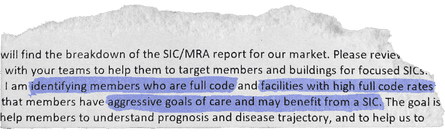
Two
current and three former UnitedHealth nurse practitioners told the
Guardian that UnitedHealth managers pressed nurse practitioners to
persuade Medicare Advantage members to change their “code status” to DNR
even when patients had clearly expressed a desire that all available
treatments be used to keep them alive.
“They’re pretending to make it look like it’s in
the best interest of the member,” another current UnitedHealth nurse
practitioner said. “But it’s really not.”
In
response to questions, UnitedHealth said its nursing home initiative
improves care for older residents by providing “on-site nurse
practitioners, tailored care plans for chronic conditions, and enhanced
communication between staff, families and providers”.
The
company denied that it had prevented hospital transfers or
inappropriately pushed patients to change their code status to DNR.