Showing posts with label severe mental illness. Show all posts

Friday, March 3, 2023

California lawmaker wants to reform conservatorships for those with severe mental illness

By Lindsey Holden

About 75 percent of lifetime cases of mental illness begin by age 24, according to the National Institute of Mental Health. But the average delay between onset and intervention is 8 to 10 years, meaning people could go years before getting help. By Jim Donaldson

A California lawmaker will again try to reform the state’s conservatorship system to make it easier for people caring for those with severe mental illness to compel treatment. Sen. Susan Eggman, D-Stockton, announced legislation Wednesday to amend the definition of “gravely disabled,” the term used to describe eligibility for a court-appointed conservator to assume decision-making powers for individuals because they can’t provide their own food, clothing or shelter. She unveiled the bill alongside the National Alliance on Mental Illness California and mental health care advocates, other legislators and mayors of San Francisco, San Diego, Anaheim and San Jose. Eggman’s bill would add criteria specifying the person is unable to ensure their own safety due to an untreated mental illness or substance abuse. The measure, Senate Bill 43, would also ask courts to take into account whether the person understands their illness and is able to make sound decisions based on the state of their mental health.

In addition, the bill would allow medical experts who have not directly treated a person being considered for a conservatorship to testify at court hearings without having their statements considered hearsay. Another bill in Eggman’s package would create a real-time online dashboard showing information about inpatient psychiatric beds, residential mental health facilities, crisis stabilization units and licensed substance abuse treatment facilities. “We’re still operating on laws that were a good idea at one point in our in our history and have now become obsolete and a barrier to care, versus a protection for people,” Eggman said during the news conference. Reforming California mental health care The state’s existing mental health care system dates back to the late 1960s, when California largely shut down its hospitals and left behavioral treatment to counties and cities.

The Lanterman Petris Short Act established a framework for involuntary mental health care ranging from short-term hospital stays to long-term conservatorships. But some families who believe their relatives would benefit from a conservatorship struggle to access that system, even if their loved ones suffer from severe untreated mental illness. That is because the current standards for that level of intervention are threats of harm to the mentally ill person or others or “grave disability.” Under existing criteria, it can be challenging for even very ill unhoused residents to reach eligibility for a conservatorship if they can minimally care for themselves. Eggman has previously attempted to reform the conservatorship system, but faced opposition from civil liberties organizations, such as Disability Rights California. Advocates from these groups say changing the current system would make it easier to push mentally ill Californians into conservatorships and force treatment against their will.

Her 2022 measure, Senate Bill 1416, died in the Assembly Judiciary Committee after failing to get a hearing. Disability rights advocates also lobbied against Gov. Gavin Newsom’s Community Assistance, Recovery and Empowerment (CARE) Court program, which he signed in September. That program establishes a system of mental health courts and requires counties to provide behavioral health care for residents with severe untreated bipolar disorder or schizophrenia who are experiencing psychosis. Disability Rights California in January filed a lawsuit against Newsom alleging CARE Court is unconstitutional and strips mentally ill people of their rights.

Eggman on Wednesday emphasized the CARE Court program is one part of an effort to reform mental health treatment in California. CARE Court would attempt to compel treatment on a voluntary basis, but lack of compliance with court-assigned plans could be a factor in determining conservatorship eligibility. Eggman said her new bill expanded the gravely disabled criteria based on feedback from mental health professionals. She said the newly-elected Assembly may be helpful to pushing it through the Legislature. “Last year, we got all the way to the very end with two no votes, I think, in the entire 120-body Legislature, and we weren’t able to get a hearing in the committee,” Eggman said. “This year, we feel very optimistic that we’ll be able to get all the way to the end. And we’ve had good talks with the administration about signing the bill when it reaches (the governor’s) desk.”

Full Article & Source:
California lawmaker wants to reform conservatorships for those with severe mental illness

Monday, July 1, 2019

Why Californians With Severe Mental Illness Are Caught Cycling From Prison To The Streets

by Alyssa Jeong Perry


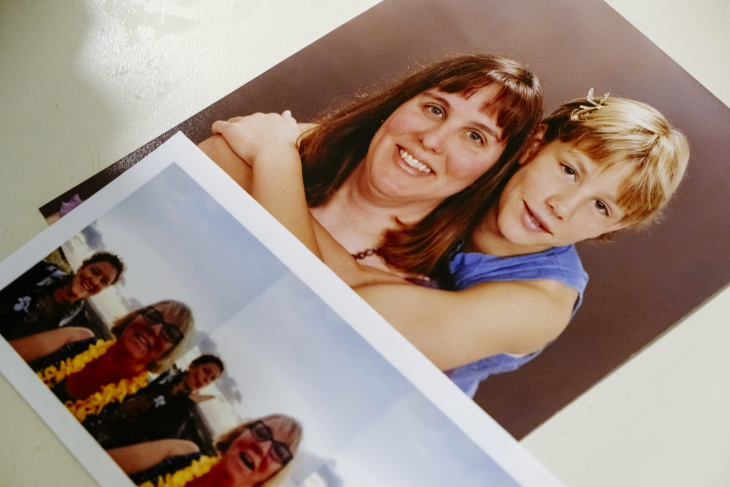
Family photos of Audrey Woolfolk and her daughter, Julie. (Chava Sanchez/LAist)
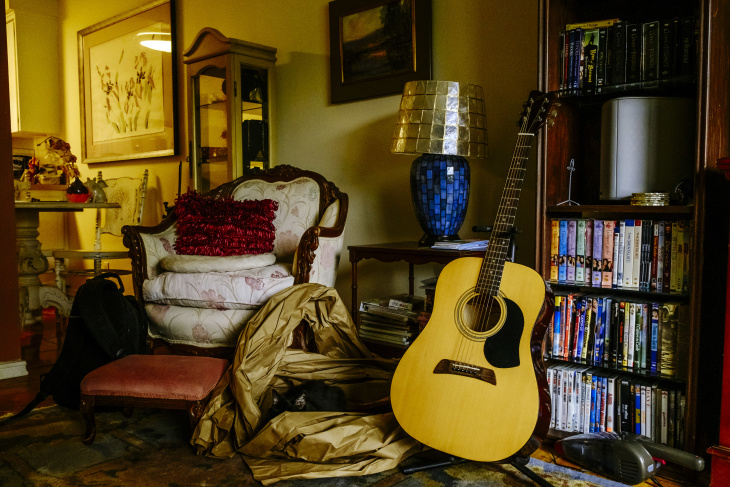
There's an acoustic guitar propped up near the center of Audrey Woolfolk's living room. It seems out of place against the floral and lace decor, but Woolfolk likes it there. It's the one visible trace in her Orange County condo of her only child, Julie, now 29.

Other memories of Julie are tucked away in photo albums and a plastic storage bin filled with childhood mementos like a handmade quilt, little dresses and dolls.

Woolfolk said Julie had her first psychotic break in her early 20s, back in the summer of 2011. Since then, she's been diagnosed as having schizoaffective disorder, which causes her to suffer from symptoms of both schizophrenia and a mood disorder similar to bipolar disorder.

"It wasn't safe for me to be around Julie anymore," Woolfolk said softly. She said she moved to a new home in Orange County when Julie's mental health began to severely decline after her daughter refused treatment.

For the past eight years, Julie has been cycling in and out of jail, in and out of treatment, and on and off the streets. But there was a time between 2014 and 2017, said Woolfolk, when Julie was doing better. Woolfolk had become her legal guardian, known under California laws as a conservatorship. It's a legal process in which the county or a private individual, like Woolfolk, is appointed by a judge to handle decisions for a person with mental illness.

In 2017, Julie petitioned to be free. She was able to make her own decisions again. Julie refused to take her medications, said Woolfolk, and fell apart. She ended up back on the streets and in and out of jail.

Since last summer, Woolfolk has desperately tried to get Julie conserved again.

The debate around conservatorship raises not only a legal question, but also an ethical one. When, if ever, should we take away someone's civil liberties if they refuse treatment?

These days, Woolfolk feels relieved when she sees Julie's name and birth date listed in the L.A. County Sheriff's Department online database where you can look up inmates. It means her daughter is alive.

Audrey Woolfolk keeps an acoustic guitar in her living room. Growing up, Julie took guitar lessons and loved to play music. (Chava Sanchez/LAist)
HOW WE GOT HERE

In 1959, there were 37,500 patients in California's mental hospitals — a high for the state.

That number fell over the next few decades as state resources were cut and the number of psychiatric hospitals shrank.

In 1967, the treatment of people with mental illness drastically shifted when the Lanterman-Petris-Short Act (LPS) was signed into law by then-California Gov. Ronald Reagan. LPS, which was in full effect in L.A. County by 1972, ended the ability to institutionalize people against their will or for an indefinite amount of time.

The law limits the involuntary detention of people who are mentally ill to no more than 72 hours before going before a judge. It's known as a "5150 hold", after that section of the law.

At the end of a 5150 hold, if a judge finds a person to be gravely disabled or a danger to themselves or others, they can be placed on a temporary hold for up to 30 days. Then the process of a permanent conservatorship can be begin.

Researchers say shortly after LPS was implemented, there was a significant increase in the number of individuals with mental illness who entered into the criminal justice system. The act is still in effect in California today.

"We have to look at, how is the mental health disorder preventing them from obtaining their basic needs of food, clothing and shelter?" said Connie D. Draxler, Deputy Director of L.A. County's Office of the Public Guardian. "And one of the things that the court will look at is, does the person have a viable plan for obtaining their food, clothing and shelter?"

In 2014, Julie ran away from Orange County. Woolfolk said she found her in San Francisco in a hospital after being on the streets.

"She hadn't taken care of herself in months," Woolfolk remembered. "Her hair was this complete mess. All she wanted to do in that hospital was just hoard trash in a room." That's when the courts allowed Woolfolk to become Julie's conservator.

A "permanent" conservatorship lasts for a year, or until a clinician or the court determines the conservatee no longer meets the legal requirements for conservatorship. A petition to renew can happen at the end of the year, if the conservatee still meets the legal criteria and there are no other alternatives.

By 2017, a doctor said Julie was well enough to make her own decisions, according to Woolfolk.
But within four months, she stopped taking medication, wandered the streets and ended up in the L.A. County jail system.

The cycle for Julie started all over again.

THE CYCLE

Currently, a third of California jail and prison inmates are considered to be severely mentally ill.

Last year, Woolfolk pleaded with L.A. County Supervisors, the head of L.A. County Department of Mental Health and L.A. County Superior judges to get her daughter conserved by the county. Woolfolk felt she could no longer be responsible. In 2018, Woolfolk was diagnosed with Stage 2 breast cancer.

There was a court hearing in September to see if Julie was sick enough to be conserved. She walked into the courtroom in DTLA, her hands shackled, wearing a yellow jumpsuit — the color reserved for inmates with mental illness. She had red lipstick smeared across her mouth.

The judge said the doctor did not find that Julie was gravely disabled. He provided her treatment options, but she refused and asked to take the time served.

This November, she was released onto the streets again. No one called Woolfolk.

And Julie went missing.

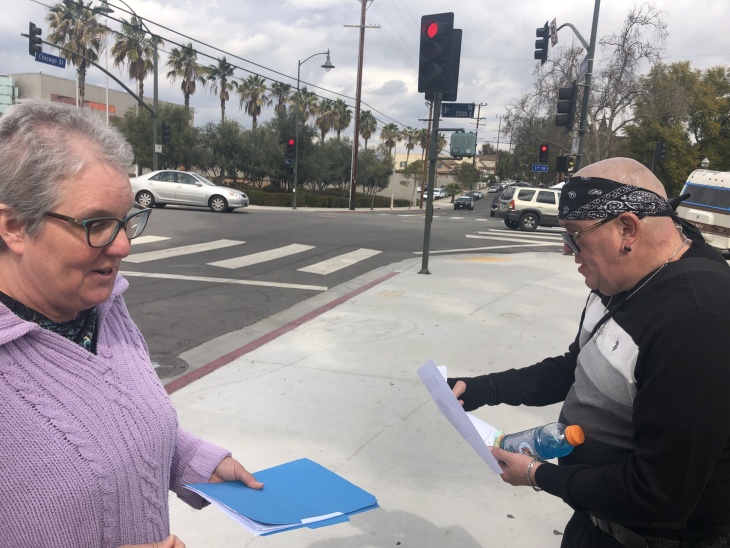
Three months later, Woolfolk still hadn't heard from her. So she went to a neighborhood near downtown LA to look for her and pass out missing person fliers.


This February, Audrey Woolfolk went to Boyle Heights to look for Julie and pass out missing person fliers. She hadn't heard from Julie since November 2018. (Alyssa Jeong Perry/LAist)
THE LAWS AROUND CONSERVATORSHIP

In the past few years, California lawmakers have discussed amending the conservatorship laws to make it easier to conserve if someone with a serious mental illness refuses treatment. State Senator Scott Wiener (D-SF) authored a bill, SB 1045, which passed last summer.

Under Wiener's bill, a person who has been in a hospital or psychiatric facility due to mental illness and/or substance abuse eight times in one year can be conserved.

"These people are not just on our streets, these are people who are dying," Wiener said. "They are unable to care for themselves or make decisions."

Wiener said it will only apply to the smallest fraction (50 to 100) of severely mentally ill people that need the most help.

Right now, it's only a five-year pilot program that's active in San Francisco.

But civil rights advocates, including the American Civil Liberties Union, believe that the government should instead do more to build supportive housing and create options for community mental health treatment.

"We have to try less restrictive options of supporting and stabilizing people before we take all of their civil liberties away by conserving them," says Susan Mizner, ACLU's disability counsel.

Others are worried that if there are more patients being conserved, it will put a strain on an already fragile mental health system, according to David Meyer, professor of Law and Psychiatry at the USC School of Medicine.

"We don't have enough doctors, we don't have enough housing," Meyers says. "So immense investments in these things need to be made in order to meet the demand."

MOVING FORWARD

This February, Woolfolk found Julie. She was back in L.A. County jail.

Julie had been arrested for assaulting a police officer in Glendale. In April, there was a court hearing in Department 95, the county's mental health court. It was to see if Julie was competent to stand trial. The judge ordered an evaluation.

Woolfolk seemed relieved, but also reluctant.

"I wish this would end," she said. "It's a horrible cycle."


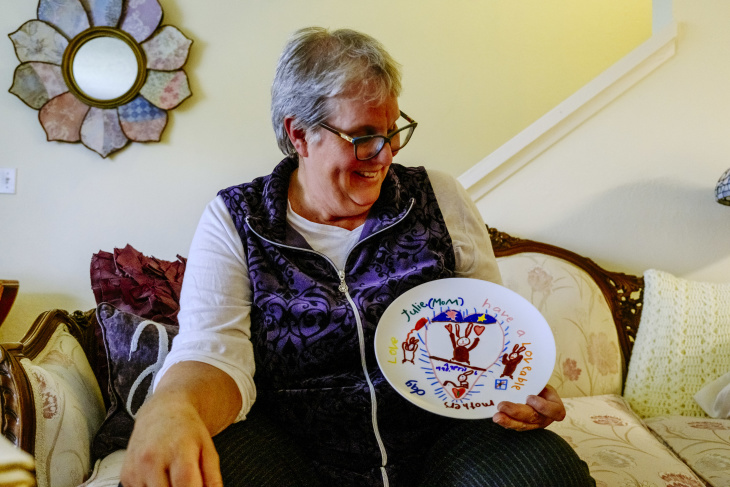
Audrey Woolfolk holds up a decorative plate that Julie made for her on Mother's Day back when she was young and before she became sick. (Chava Sanchez/LAist)
This Mother's Day, Woolfolk visited Julie in the Twin Towers Correctional Facility, where many of the most severely mentally ill inmates are housed.

"I would sure love to be able to give her a big hug," Woolfolk said. "I mean, you go visit her in the jails and there are these glass walls."

Ultimately, Woolfolk dreams of a time when her daughter's day-to-day reality might improve.

"I'm hoping that she'll get to experience a better quality of life."

Full Article & Source:
Why Californians With Severe Mental Illness Are Caught Cycling From Prison To The Streets