Keith Allen Bassi, a former lawyer, admitted Monday morning that he
stole half a million dollars from an elderly lady with dementia and used
some of it to run the newspaper, the Mon Valley Independent.
Mr. Bassi, 61, of Charleroi, pleaded guilty in federal court to mail
fraud counts in ripping off a woman identified as "N.J.L," who is 85 and
living in a Mt. Lebanon care home.
Prosecutors said he pilfered about $505,000 from her accounts and put
the money in his own accounts, including that of the paper he co-owns.
"It's certainly despicable," said the woman's 75-year-old cousin, who
is seeking to become her legal guardian and watched the proceedings
before U.S. District Judge Arthur Schwab.
He asked that he and she not be named publicly until guardianship is granted.
Mr. Bassi was charged Sept. 25 after an investigation by the FBI and U.S. postal inspectors.
Assistant U.S. Attorney Greg Melucci said he gained power of attorney
over her estate, which could be worth some $3 million, in 2006. The
woman, a former Pittsburgh public schools principal, was diagnosed with
dementia in 2012.
It was then that Mr. Bassi began maneuvering to transfer money out of her accounts and into his.
Mr. Melucci said he misappropriated the funds between 2013 and 2016.
As part of the scheme, he used her money to a $55,000 annual premium
on a life insurance policy between 2013 and 2015, then asked for a
"surrender request" for the policy in 2016 and deposited the amount,
about $163,000, into his personal account.
Mr. Bassi also deposited $110,000 of N.J.L.'s money into the publishing company account at CFS Bank.
Mr. Melucci said federal agents, who learned of the fraud by
monitoring suspicious banking transactions, confronted Mr. Bassi in May.
He admitted to the crime and said he did it because of "financial
issues."
Mr. Bassi's law license has been suspended. He remains free on bond pending sentencing March 14.
He said nothing in court except to answer Judge Schwab's questions
about his guilt. The exact amount of money he stole is in some dispute
and will be worked out before the sentencing.
"Mr. Bassi has agreed to pay full restitution," said his lawyer, Stephen Stallings.
He declined further comment as he left the courthouse with his client.
The victim's cousin, a former teacher and attorney, contacted the
U.S. attorney's office and Judge Schwab after reading about the fraud in
the Pittsburgh Post-Gazette last week.
In a letter to them, he said he suspects Mr. Bassi may have stolen
more than the $505,000 for which he was charged. He said he and other
family members had received a letter from Mr. Bassi after N.J.L. had
moved to the nursing home in 2015 indicating that he was auctioning off
the personal property that she had kept at the family farm in Washington
County.
The cousin said no one has seen those proceeds.
Among her collections, he said, was China worth some $100,000,
figurines valued at $2,000 each and family memorabilia. The house, which
was sold in 2012, dates to the 1780s.
"I'd just like to know what the hell happened to the other stuff," her cousin said.
MEMPHIS, Tenn. — The Midtown nursing home where a resident was found
with maggot infested open, wounds and later died, faced serious trouble
with federal regulators over the past nine months.
A corporate spokesperson for the owners of Ashton Place Health and Rehabilitation told WREG Tuesday “regulators” were on site.
He also said training was taking place at the facility, but wouldn’t comment on the resident’s death.
State health officials told WREG they’re aware of the incident, but couldn’t provide additional comment.
The News Channel 3 Investigators obtained records from federal
regulators showing Ashton Place paid a fine of roughly $163,000 earlier
this year.
Documents show the Centers for Medicare and Medicaid Services fined Ashton Place after visits in March and April of 2017.
The facility was also at risk of losing funding.
During a March visit, regulators found a patient faced “actual” harm.
Records show it was related to the facility’s failure to identify and
treat pressure sores in a timely manner.
Surveyors were also at the facility conducting a complaint
investigation at the same time. A resident suffered unwitnessed falls
and later died. Records show workers never documented whether they
performed required neurological checks after the falls.
A month later, regulators were back and the facility faced what’s
called an “immediate jeopardy” deficiency after one resident sexually
assaulted another.
Documents also reveal the perpetrator watched as a worker cleaned the victim up after the assault.
A letter dated June 21, 2017 shows CMS found Ashton Place was in
compliance, so the termination of payments didn’t go into effect. The
facility still paid the fine and faced a denial of payments on new
admissions for 15 days.
No word from CMS on what type of discipline the facility could face after the resident’s death last week.
WREG learned the police case was transferred to homicide. Shelby
County officials said it could take up to three months for the autopsy
to be completed.
LAS VEGAS (Reuters) - The company stacked brochures in funeral parlors around Sin City. On the cover: a couple clasping hands. Above the image, a promise: “Providing Options in Your Time of Need.”
The company, Southern Nevada Donor Services, offered grieving families a way to eliminate expensive funeral costs: free cremation in exchange for donating a loved one’s body to “advance medical studies.”
Outside Southern Nevada’s suburban warehouse, the circumstances were far from comforting. In the fall of 2015, neighboring tenants began complaining about a mysterious stench and bloody boxes in a Dumpster. That December, local health records show, someone contacted authorities to report odd activity in the courtyard.
Health inspectors found a man in medical scrubs holding a garden hose. He was thawing a frozen human torso in the midday sun.
As the man sprayed the remains, “bits of tissue and blood were washed into the gutters,” a state health report said. The stream weaved past storefronts and pooled across the street near a technical school.
Southern Nevada, the inspectors learned, was a so-called body broker, a company that acquires dead bodies, dissects them and sells the parts for profit to medical researchers, training organizations and other buyers. The torso on the gurney was being prepared for just such a sale.
Each year, thousands of Americans donate their bodies in the belief they are contributing to science. In fact, many are also unwittingly contributing to commerce, their bodies traded as raw material in a largely unregulated national market.
Body brokers are also known as non-transplant tissue banks. They are distinct from the organ and tissue transplant industry, which the U.S. government closely regulates. Selling hearts, kidneys and tendons for transplant is illegal. But no federal law governs the sale of cadavers or body parts for use in research or education. Few state laws provide any oversight whatsoever, and almost anyone, regardless of expertise, can dissect and sell human body parts.
“The current state of affairs is a free-for-all,” said Angela McArthur, who directs the body donation program at the University of Minnesota Medical School and formerly chaired her state’s anatomical donation commission. “We are seeing similar problems to what we saw with grave-robbers centuries ago,” she said, referring to the 19th-century practice of obtaining cadavers in ways that violated the dignity of the dead.
“I don’t know if I can state this strongly enough,” McArthur said. “What they are doing is profiting from the sale of humans.”
The industry’s business model hinges on access to a large supply of free bodies, which often come from the poor. In return for a body, brokers typically cremate a portion of the donor at no charge. By offering free cremation, some deathcare industry veterans say, brokers appeal to low-income families at their most vulnerable. Many have drained their savings paying for a loved one’s medical treatment and can’t afford a traditional funeral.
“People who have financial means get the chance to have the moral, ethical and spiritual debates about which method to choose,” said Dawn Vander Kolk, an Illinois hospice social worker. “But if they don’t have money, they may end up with the option of last resort: body donation.”
Few rules mean few consequences when bodies are
mistreated. In the Southern Nevada case, officials found they could do
little more than issue a minor pollution citation to one of the workers
involved. Southern Nevada operator Joe Collazo, who wasn’t cited, said
he regretted the incident. He said the industry would benefit from
oversight that offers peace of mind to donors, brokers and researchers.
“To be honest with you, I think there should be regulation,” said Collazo. “There’s too much gray area.”
“BIG MARKET FOR DEAD BODIES”
Donated
bodies play an essential role in medical education, training and
research. Cadavers and body parts are used to train medical students,
doctors, nurses and dentists. Surgeons say no mannequin or computer
simulation can replicate the tactile response and emotional experience
of practicing on human body parts. Paramedics, for example, use human
heads and torsos to learn how to insert breathing tubes.
Researchers
rely on donated human body parts to develop new surgical instruments,
techniques and implants; and to develop new medicines and treatments for
diseases.
“The need for human bodies is
absolutely vital,” said Chicago doctor Armand Krikorian, past president
of the American Federation for Medical Research. He cited a recent
potential cure for Type 1 diabetes developed by studying pancreases from
body donors. “It’s a kind of treatment that would have never come to
light if we did not have whole-body donation.”
Despite
the industry’s critically important role in medicine, no national
registry of body brokers exists. Many can operate in near anonymity,
quietly making deals to obtain cadavers and sell the parts.
“There
is a big market for dead bodies,” said Ray Madoff, a Boston College Law
School professor who studies how U.S. laws treat the dead. “We know
very little about who is acquiring these bodies and what they are doing
with them.”
In most states, anyone can legally
purchase body parts. As an upcoming story will detail, a Tennessee
broker sold Reuters a cervical spine and two human heads after just a
few email exchanges.
Through interviews and
public records, Reuters identified Southern Nevada and 33 other body
brokers active across America during the past five years. Twenty-five of
the 34 body brokers were for-profit corporations; the rest were
nonprofits. In three years alone, one for-profit broker earned at least
$12.5 million stemming from the body part business, an upcoming Reuters
report will show.
Because only four states
closely track donations and sales, the breadth of the market for body
parts remains unknown. But data obtained under public record laws from
those states – New York, Virginia, Oklahoma and Florida – provide a
snapshot. Reuters calculated that from 2011 through 2015, private
brokers received at least 50,000 bodies and distributed more than
182,000 body parts.
Permits from Florida and
Virginia offer a glimpse of how some of those parts were used: A 2013
shipment to a Florida orthopedic training seminar included 27 shoulders.
A 2015 shipment to a session on carpal tunnel syndrome in Virginia
included five arms.
As with other commodities,
prices for bodies and body parts fluctuate with market conditions.
Generally, a broker can sell a donated human body for about $3,000 to
$5,000, though prices sometime top $10,000. But a broker will typically
divide a cadaver into six parts to meet customer needs. Internal
documents from seven brokers show a range of prices for body parts:
$3,575 for a torso with legs; $500 for a head; $350 for a foot; $300 for
a spine.
Body brokers also have become
intertwined with the American funeral industry. Reuters identified 62
funeral operators that have struck mutually beneficial business
arrangements with brokers. The funeral homes provide brokers access to
potential donors. In return, the brokers pay morticians referral fees,
ranging from $300 to $1,430, according to broker ledgers and court
records.
These payments generate income for
morticians from families who might not be able to otherwise afford even
simple cremation. But such relationships raise potential conflicts of
interest by creating an incentive for funeral homes to encourage
grieving relatives to consider body donation, sometimes without fully
understanding what might happen to the remains.
“Some
funeral home directors are saying, ‘Cremation isn’t paying the bills
anymore, so let me see if I can help people harvest body parts,’” said
Steve Palmer, an Arizona mortician who serves on the National Funeral
Directors Association’s policy board. “I just think families who donate
loved ones would have second thoughts if they knew that.”
Some
morticians have made body donation part of their own businesses. In
Oklahoma, two funeral home owners invested $650,000 in a startup body
broker firm. In Colorado, a family operating a funeral home ran a
company that dissected and distributed body parts from the same
building.
When a body is donated, few states
provide rules governing dismemberment or use, or offer any rights to a
donor’s next of kin. Bodies and parts can be bought, sold and leased,
again and again. As a result, it can be difficult to track what becomes
of the bodies of donors, let alone ensure that they are handled with
dignity.
In 2004, a federal health panel
unsuccessfully called on the U.S. government to regulate the industry.
Since then, more than 2,357 body parts obtained by brokers from at least
1,638 people have been misused, abused or desecrated across America,
Reuters found.
The count, based on a review of
court, police, bankruptcy and internal broker records, is almost
certainly understated, given the lack of oversight. It includes
instances in which bodies were used without donor or next-of-kin
consent; donors were misled about how bodies would be used; bodies were
dismembered by chainsaws instead of medical instruments; body parts were
stored in such unsanitary conditions that they decomposed; or bodies
were discarded in medical waste incinerators instead of being properly
cremated.
Most brokers employ a distinctive language to describe
what they do and how they make money. They call human remains “tissue,”
not body parts, for example. And they detest the term “body brokers.”
They prefer to be known as “non-transplant tissue banks.”
Most
also insist they don’t “sell” body parts but instead only charge “fees”
for services. Such characterizations, however, are contradicted by
other documents Reuters reviewed, including court filings in which
brokers clearly attach monetary value to donated remains.
A
lien filed by one body broker against another cited as collateral “all
tissue inventory owned by or in the possession of debtor.” In bankruptcy
filings, brokers have claimed body parts as assets. One debtor included
as property not only cabinets, desks and computers, but also spines,
heads and other body parts. The bankrupt broker valued the human remains
at $160,900.
“There are no real rules,” said
Thomas Champney, a University of Miami anatomy professor who teaches
bioethics. “This is the ultimate gift people have given, and we really
need to respect that.”
Last December, Reuters
reported that more than 20 bodies donated to an Arizona broker were used
in U.S. Army blast experiments – without the consent of the deceased or
next of kin. Some donors or their families had explicitly noted an
objection to military experiments on consent forms. Family members
learned of the 2012 and 2013 experiments not from the Army but from a
Reuters reporter who obtained records about what happened.
In
another case, Detroit body broker Arthur Rathburn is scheduled to stand
trial in January for fraud, accused of supplying unsuspecting doctors
with body parts infected with hepatitis and HIV for use in training
seminars. U.S. officials cited the case as an example of their
commitment to protect the public. But Reuters found that, despite
warning signs, state and federal officials failed to rein in Rathburn
for more than a decade, allowing him to continue to acquire hundreds of
body parts and rent them out for profit. He has pleaded not guilty.
Given
the number of body brokers that currently operate in America, academics
and others familiar with the industry say regular inspections of
facilities and reviews of donor consent forms wouldn’t place a big
burden on government.
“This isn’t reinventing
the wheel,” said Christina Strong, a New Jersey lawyer who co-wrote a
set of standards that most states largely adopted for the organ
transplant industry. “It would not be a stretch to envision a uniform
state law which requires that those who recover, distribute and use
human bodies adhere to uniform standards of transparency, traceability
and authorization.”
But without consistent laws or a clear
oversight authority – local, state or national – “nobody is accounting
for anything,” said Todd Olson, an anatomy and structural biology
professor at Yeshiva University’s Albert Einstein College of Medicine.
“Nobody is watching. We regulate heads of lettuce in this country more
than we regulate heads of bodies.”
“RAW MATERIALS FOR FREE”
Body
brokers range in size from small, family-operated endeavors to national
firms with offices in several states. Brokers also vary in expertise.
Garland
Shreves, who founded Phoenix broker Research for Life in 2009, said he
invested more than $2 million in quality-control procedures and medical
equipment, including $265,000 on an X-ray machine to scan cadavers for
surgical implants.
But other brokers have
launched their businesses for less than $100,000, internal corporate
records and interviews show. Often, the largest capital expenses are a
cargo van and a set of freezers. Some brokers have saved money by using
chainsaws to carve up the dead instead of more expensive surgical saws.
“You have people who want to do it in a pretty half-assed way,” Shreves said. “I have really grown to dislike the business.”
Brokers
can also reduce expenses by forgoing the meticulous quality control
procedures and sophisticated training called for by a national
accreditation organization, the American Association of Tissue Banks.
In
Honolulu, police were called twice to storage facilities leased by body
broker Bryan Avery in 2011 and 2012. Each time, they found decomposing
human remains. Both times, police concluded that Avery committed no
crimes because no state law applied.
Steven
Labrash, who directs University of Hawaii’s body donation program, said
the Avery case illustrates the need for laws to protect donors.
“Everybody
knows that what he did was unethical and wrong,” Labrash said of Avery.
“But did he break any laws? Not the way they are written today.”
Avery
defended how he ran his business and said the incidents were the result
of misunderstandings. He said he is now raising capital for a new
company, Hawaii BioSkills, which he said will use body parts to train
surgeons.
“I’m all for oversight, and companies
that are doing this need to be transparent,” Avery said. “As long as it
doesn’t infringe upon the flow of business, that’s fine.”
Walt
Mitchell, a Phoenix businessman involved in the startup of three
brokers, said one reason the industry attracts entrepreneurs is that
businesses can profit handsomely from selling a donated product.
“If you can’t make a business when you’re getting raw materials for free,” Mitchell said, “you’re dumb as a box of rocks.”
Even
so, a third of the 34 brokers Reuters identified went bankrupt or
failed to pay their taxes, according to court filings. When failing
businesses in the industry cut corners to save money, the consequences
for the families of donors can be emotionally wrenching.
“THE LAST SELFLESS THING”
Harold
Dillard worked with his brother resurfacing bathtubs and kitchen
countertops in Albuquerque, New Mexico. He was diagnosed with terminal
cancer the day after Thanksgiving in 2009.
“He
was 56 years young, active, healthy, had a great life, and one night –
bam!” said his daughter, Farrah Fasold. “He wanted to do the last
selfless thing he could do before he died, and so he donated his body.”
As
her father lay dying, Fasold said, employees from Albuquerque broker
Bio Care visited father and daughter, and made a heartfelt pitch: The
generous gift of his body to science would benefit medical students,
doctors and researchers. Fasold said Bio Care cited several sample
possibilities, including that her father’s body might be used to train
surgeons on knee replacement techniques.
Fasold’s
view of Bio Care soon changed. It took weeks longer than promised to
receive what she was told were her father’s cremated remains. Once she
received them, she suspected they were not his ashes because they looked
like sand. She was correct.
In April 2010,
Fasold was told by authorities that her father’s head was among body
parts discovered at a medical incinerator. She also learned – for the
first time, she said – that Bio Care was in the business of selling body
parts.
“I was completely hysterical,” she
said. “We would have never have signed up if they had ever said anything
about selling body parts – no way. That’s not what my dad wanted at
all.”
Inside Bio Care’s warehouse, authorities said they found at least 127 body parts belonging to 45 people.
“All
of the bodies appeared to have been dismembered by a coarse cutting
instrument, such as a chainsaw,” a police detective wrote in an
affidavit.
Bio Care owner Paul Montano was
charged with fraud. According to the police affidavit, Montano denied
abusing bodies and told detectives that he ran Bio Care with “five
volunteer employees,” including his father. He did not respond to
requests for comment.
Prosecutors later withdrew the charge
against Montano because they said they could not prove deception or any
other crime. No other state law regulated the handling of donated bodies
or protected the next of kin. (Click to Continue)
In a key test of state ethics rules for prosecutors, the Louisiana Supreme Court has cleared a Vernon Parish assistant district attorney of misconduct over a decision to withhold allegedly exculpatory evidence in a murder case.
In ruling in favor of Assistant District Attorney Ronald Seastrunk, the court found that the state's legal ethics rules don't set a higher bar for prosecutors than the U.S. Constitution does when it comes to withholding evidence.
That means prosecutors in Louisiana likely won't face discipline — censure, suspension or disbarment — if they're caught failing to turn over evidence unless a court finds a "reasonable probability" that the evidence would have tipped the verdict.
That's the same standard the U.S. Supreme Court set for violations of Brady v. Maryland, the 1963 ruling that requires disclosure of all evidence favorable to a defendant.
Charles Plattsmier, the top enforcer for the state's Office of Disciplinary Counsel, which pushed for Seastrunk's suspension, said Wednesday's decision could affect numerous pending complaints against prosecutors.
"There are several cases in our inventory that we have paused further efforts on, pending a decision by the court" in the Seastrunk case, he said. "Now that we have the decision, we certainly will accept it, honor it and obey it. We're going to look at all of those cases and see if we can go forward."
The state's highest court hadn't previously addressed head-on whether a prosecutor can be punished and perhaps lose his or her law license for withholding evidence that might not cause a conviction to be overturned.
The answer came nearly six years after Justin Sizemore first stood trial over the June 14, 2010, murder of Christopher Hoffpauir, whose body was found in a roadside ditch.
Hoffpauir's wife, Kristyn, had carried on a relationship with Sizemore, and she eventually pleaded guilty to manslaughter, conspiracy to commit manslaughter and obstruction of justice. But her conflicting accounts of where Sizemore hid before the killing were never revealed to his defense team until during his first trial, which ended in a deadlocked jury.
Later, a detective interviewed a former brother-in-law who said that, three years before the murder, Kristyn Hoffpauir's mother had mentioned that she had found a .22-caliber revolver in her daughter's closet. That seemed to contradict Kristyn Hoffpauir's testimony that she had no experience with firearms and had never owned or fired a gun.
But Asa Skinner, district attorney for the 30th Judicial District, told the detective to leave the story about the gun out of his report. Skinner then told prosecutor Scott Westerchil, who tried the case with Seastrunk, not to turn over the report to Sizemore's attorney.
Westerchil also faced an ethics complaint, which was aborted when he was elected a judge in 2015 and Plattsmier's office lost jurisdiction.
The police report on the interview with the brother-in-law was revealed during Sizemore's second trial. Judge James R. Mitchell first denied a defense motion for a mistrial. But the judge and prosecutors soon agreed on a mistrial after the statement about the gun being found in Kristyn Hoffpauir's room was revealed, along with a claim that she had once threatened to kill her mother.
All of that evidence was included in a new police report that prosecutors turned over to the defense before Sizemore's third trial in 2012, which ended with a jury convicting him of murder. (Click to Continue)
New regulations, growing competition and frailer residents mean the industry must evolve
by Kenneth Terrell, AARP Bulletin
Chris O'Riley
Nursing homes must follow strict government guidelines, including providing 24-hour access to a skilled nursing staff.
En español |
In the aftermath of two major hurricanes that recently ravaged Texas
and Florida, nursing home administrator Janine Finck-Boyle said, “You
can’t just be prepared for when the disaster hits, you have to be
prepared for what comes after.”
Finck-Boyle’s words are also true of those facing the declining health of parents or others they care about.
Many families seek out a nursing home only when a health emergency
forces them to. Often that leaves them unprepared to make quick
decisions about which facility is the best for what may be many years of
residence. “It’s a time of real crisis, and families are pressured to
make these decisions,” says Kathleen Unroe, a nursing home doctor at the
Indiana University Center for Aging Research.
But the hurricane-related deaths at a nursing home in Florida and
photos of nursing home residents sitting in wheelchairs with water up to
their waists near Houston provide a stark illustration of the need to
learn everything possible about the nursing home industry before a
crisis.
Here are some answers that will help as you decide where your loved one should live.
How big is the nursing home industry?
There are about 15,600 nursing homes that participate in the Medicare
and Medicaid programs in the United States, a number that largely has
held steady since 2009. These operations serve as home for roughly 1.4
million of America’s most frail citizens.
Who pays for the care?
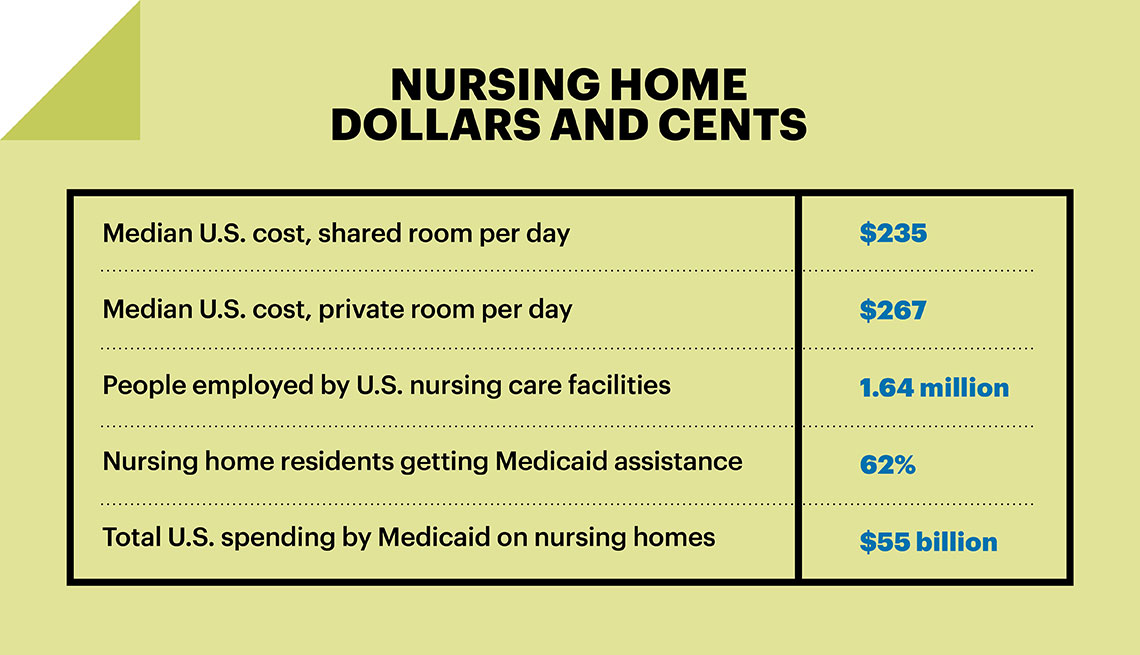
Taxpayers who fund Medicaid pay the majority of America’s nursing
home bills. In 2015, the program was the primary payer for roughly 62
percent of residents, Kaiser Family Foundation research showed. And some
patients get Medicare coverage in their first months at a facility.
Who owns nursing homes?
In 2015 about 68 percent were owned by for-profit corporations, and
24 percent were run by nonprofit organizations, with the rest
government-owned. All are regulated under a complex system. The federal
government’s Centers for Medicare & Medicaid Services (CMS) crafts
the regulations and guidelines for America’s nursing homes. But
enforcement is left to the states, each of which is required to perform
unannounced inspections of every facility. The state’s review of the
nursing home is subject to CMS approval.
AARP
What level of care is expected?
Nursing homes must follow strict government guidelines. Among the
requirements: Provide 24-hour access to a skilled nursing staff, and
make sure all medical treatment is supervised by a physician. The
regulations also require facilities to provide “services to attain or
maintain the highest practicable physical, mental and psychosocial
well-being” of each resident. Patients often have multiple medical
conditions, and also can require assistance with daily activities such
as bathing and dressing. In 2015, nursing home staff spent a national
average of 4.1 hours attending to each resident per day.
Who is the typical nursing home resident?
Most arrive after having exhausted other less comprehensive forms of
care. Many older adults who don’t require daily medical assistance
choose to live in lower-cost assisted living facilities. Others use a
home- or community-based service that allows them to receive help in
their own home. Changes in Medicaid policy let the government program
pay for more home- and community-based services for Americans who need
ongoing care. This has had an unforeseen consequence: More people are
arriving at nursing homes when their health is poor.
Federal rules were overhauled last year. What changed?
Government regulators have been striving to put more control into the
hands of residents, who now have more say over when they see visitors,
whom they share a room with and what they eat. There are also new rules
designed to protect residents against theft and financial rip-off, and
residents have more control over when they can be discharged. There is
also new legal protection for those with dementia, aimed to stop the
practice of nursing homes sending such residents to hospitals and then
refusing to readmit them.
What didn't change?
One essential change was not made, critics say: The government did
not address the need for staffing increases. Advocates had urged CMS to
mandate that nursing homes have at least one nurse on site 24 hours a
day (the current requirement is only eight hours). “Whenever you see a
concern or problem in a nursing home, you can generally trace it back to
inadequate staffing standards,” says Lori Smetanka, executive director
of the National Consumer Voice for Quality Long-Term Care. “Until we fix
that as a problem, we’ll not be able to improve the quality of care.”
But the nursing home industry successfully pushed back, noting the
additional taxpayer expense that such requirements would create, and the
difficulty in some places of finding trained workers. “It’s very hard
to find staff to work in nursing facilities, especially in rural areas,”
says David Gifford, a physician and senior vice president for quality
and regulatory affairs at the American Health Care Association.
What may lie ahead?
One promising initiative that is underway is a $30 million,
eight-year “innovation demonstration project” called OPTIMISTIC, which
is testing new approaches to improving the quality of care. In phase one
of that project, additional nurses were embedded in 19 long-term care
centers. The nurses were specially trained to coordinate the patients’
treatments to reduce the number of times residents had to be sent to
hospitals.
Another new approach is for nursing homes to specialize in specific
ailments. One home might be best equipped to care for patients with
Alzheimer’s disease, while another might focus on ALS (Lou Gehrig’s
disease). And some companies are launching care facilities that offer
unassisted living, assisted living and nursing home arrangements in one
complex. The goal: Keep a person in one location throughout his or her
later years.
MONTICELLO, N.Y. (WHDH/AP) — A woman who disappeared from upstate New York after being dropped off for a doctor’s appointment 42 years ago has been found suffering from dementia and living in the Care One assisted-living facility in Massachusetts, authorities said.
The sheriff’s office in Sullivan County, New York, said Flora Stevens, 78, was using the last name Harris when detectives tracked her down this week at the residence in Lowell, near Boston. Officials said they’ve been unable to figure out details of what happened to her between the time she disappeared in August 1975 and when she was finally found.
“It’s not too often we get to solve a 42-year-old missing-person case,” Sheriff Mike Schiff said in a press release. “The main thing is we know Flora is safe.”
Police said Stevens was a 36-year-old employee of a Catskills resort when her husband dropped her off for a doctor’s appointment at a hospital in Monticello, 75 miles (121 kilometers) northwest of New York City. When he returned to pick her up, she wasn’t there.
Police periodically reviewed her missing person case but kept hitting dead ends. They got a break in September, thanks to a query from a New York State Police investigator working on a different cold case. The unidentified remains of a woman had been found in neighboring Orange County, and the investigator said they roughly matched Stevens’ general characteristics.
The state police investigators asked Sullivan County for help tracking down any relatives who could provide a DNA sample for possible identification. During a records search, Detective Rich Morgan discovered someone was using Stevens’ Social Security number in Massachusetts.
Deputies tracked the number to the Lowell assisted-living residence, where staff confirmed the number belonged to a resident named Flora Harris, who has lived there since 2001. Morgan and another detective went there Tuesday and confirmed Harris was actually the Flora Stevens who had disappeared in 1975.
Because of her condition, she couldn’t provide details of her life since then, police said. But the detectives brought along Stevens’ employee photo identification card from the now-defunct Concord Resort, and she recognized herself, officials said.
“She pointed at it and said ‘me,'” Schiff told 7News.
Her medical records under her new name show she lived in nursing homes in New Hampshire and New York City before arriving in Lowell, police said. Stevens’ husband died in 1985, and she apparently has no living relatives, officials said.
Schiff said investigators have officially closed Stevens’ case.
WSMV News 4NASHVILLE, TN (WSMV) - Reba Sherrill’s legal bill for a lawyer she didn’t want and didn’t hire: $13,469.19.
"Oh my God!" she said when the News 4 I-Team showed her the 11-page detailed bill.
Davidson County's Probate Judge Randy Kennedy appointed attorney Cathryn Armistead in August to look after Sherrill's affairs.
Vanderbilt University Medical Center asked the judge to do that since Sherrill was a patient there and was about to be discharged.
Vanderbilt's lawyers told the judge that Sherrill had a borderline personality disorder and couldn't make her own decisions. Vanderbilt’s motion said no family members were able or willing to step in.
The same day Vanderbilt made the request, Judge Kennedy appointed Armistead at $175 an hour to arrange for Sherrill to be transferred to another facility and to handle the financial transactions. It's help Sherrill said was unneeded.
"I didn't want this. I didn't need this. Why should I pay for something that they sought?" she said. Sherrill hired her own lawyers and went to court Oct. 11. She fought for, and won her freedom. Armistead was removed as her fiduciary.
The I-Team showed Sherrill what Armistead is billing her for: dozens of legal meetings, emails and phone calls, as well as a trip to Whole Foods grocery store, on the clock at $175 an hour to purchase and deliver food, soap and shampoo.
“Oh my God, you have got to be kidding me; $437.50. Do you know how much food she brought? It was half a bag! Half a bag! Has this woman lost her mind?" Sherrill said.
Armistead charged $437 to make a two and a half hour trip to the store, not including the cost of the food.
Sherrill said Whole Foods could have had delivered the groceries.
“I didn't need her. I didn't need anybody," she said. "Myself and my family should not be penalized for this mess that Vanderbilt created."
How does something like this happen? Who gave hospitals the right to have someone appointed to take over their patient's lives?
The legislature did, in 2013. Rep. Andrew Farmer introduced an amendment to a conservatorship bill that he explained would help hospitals free up bed space.
"If we have folks in a hospital unable to make decisions for themselves, the hospital has the authority to move them from the hospital to a nursing home," Farmer said before the 2013 vote.
Rep. Bill Dunn questioned it at the time, asking why the amendment wasn't debated in the committee system.
"It just sort of sends off alarms when something like this shows up," Dunn said.
Farmer said before the vote that it did not go through the committee system.
"It did not. It did not. It was an oversight on my part. I was approached by Vanderbilt and a couple of other hospitals." Farmer said in 2013.
Dunn watched our story about Reba Sherrill. He said he's concerned about how Vanderbilt used the new law to take over Sherrill's life.
"Just by watching the story it's obvious this was not what the legislature intended," Dunn told the I-Team.
The law gives fiduciaries very limited powers.
Armistead's own bills show she took on far more responsibilities at $175 an hour.
"It's obvious you shouldn't be charging someone 400-plus dollars to go to the grocery store," Dunn told the I-Team.
We found Armistead also billed for conversations with the man Sherrill has been divorced from for 10 years.
“Oh my God! She wrote to my ex-husband! Holy cow!” Sherrill said when she saw the legal bill. The detailed billing showed Armistead also charged for investigating the value of Sherrill's house.
"And she demanded a key to my home; why? I'm not there," Sherrill said.
The legal bills show Armistead charged for repeatedly contacting Sherrill's attorney in Florida – an attorney who helped Sherrill win a million-dollar settlement after she was hit by a car.
Armistead got the judge to sign a court-order instructing the Florida lawyer to send the $1 million to the court system in Davidson County. That money would then become available to help pay the very lawyers who had taken control of Sherrill's life.
"That's what this whole thing was about. They wanted the money. If I was broke, do you really think they would bother with me?" Sherrill said.
Armistead did not return a call from the I-Team.
"In this case you all did a good job in discovering it, which will allow us to take a deeper look at the issue," Dunn told the I-Team.
Dunn said he wants the legislature to see if what happened to Reba Sherrill is an isolated case or an example of a glitch in the law that needs to be fixed.
"Oh yeah, I'm angry all right. Number one, they claim they are protecting the individual. I don't feel protected Nancy, I feel violated," Sherrill said.
Neglect by the Heritage House of Pequot Lakes led to the death of a client living at the assisted living facility, the Minnesota Department of Health reported.
An investigation completed by the state agency substantiated charges of neglect, described as improper catheter care and an unclean environment leading to death by a complex urinary tract infection.
"The home care provider is responsible for the neglect because it was not monitoring home health aides and their work performance," the report stated. "The facility ... failed to ensure that ordered and necessary cares were provided."
According to the report compiled by the Office of Health Facility Complaints at MDH, an investigator in February visited Heritage House, 5384 Country Care Lane, Pequot Lakes. Through interviews with staff, examinations of documents and observations of the facility, the investigator found a preponderance of evidence supporting a neglect finding. This included a failure to flush and change the client's catheter and a failure to maintain infection control on the catheter equipment.
Although not identified in the report, the Star Tribune reported the client who died at Heritage House within days of the investigation was 86-year-old Ralph Ford. Ford was admitted with diagnoses of Alzheimer's disease and a neurogenic bladder, or a lack of bladder control. This latter condition required a catheter inserted directly into the bladder through the abdomen.
Ford had a history of urinary tract infections and ongoing issues with his catheter becoming blocked, the report stated. Four months before Ford's death, a nurse practitioner ordered lab work and additional catheter flushes. Those orders were not processed by the provider, however, meaning they did not become part of the client's administration record.
The flushes were not completed, leading to further catheter blockages, the report stated. About seven weeks before Ford's death, a routine catheter change was performed by a urologist, who requested Heritage House instruct a nurse to change the catheter monthly going forward. A change was due three weeks before his death, although no records supported the change occurred.
Two weeks later, Ford became lethargic and had a low-grade fever, soon diagnosed with another urinary tract infection at the emergency room. The investigator was able to meet with Ford, who could make eye contact but was unable to communicate. While on site, the investigator observed a catheter bag hanging on a shower hand rail in the shared bathroom attached to Ford's room. The tip of the bag, which connects to the tube leading to the bladder, was seen touching the bathroom floor. Ford died within a week of the investigator's visit.
Nurses interviewed by the MDH said a sudden and recent departure by a nursing director made it "confusing for the remaining two RNs (registered nurses) to figure out when things were due." The nurse said she thought the urologist was changing Ford's catheter.
Twenty-one pages attached to the report outline specific violations noted and the degree to which violations were considered serious. Among those were two Level 4 violations, denoting when a violation results in serious injury, impairment or death. These violations were of state statutes preserving the right of a person receiving home care services "to be served by people who are properly trained and competent to perform their duties," and "the right to be free from physical and verbal abuse, neglect, financial exploitation and all forms of maltreatment."
Within the details of these violations, the care of several other clients was called into question. Staff care for eight of 12 clients showed a failure to ensure care orders and lab tests were completed, along with a failure to provide a clean environment. The investigator noted a strong urine smell in Ford's room, and urine left on the toilet seat in a shared bathroom among two other clients.
"None of the units observed had an available disinfectant to be used in any of the shared bathrooms between use," the report stated.
When interviewed, unlicensed personnel stated toilets were cleaned at the end of each shift, while a nurse stated they were cleaned after each use. The nurse said urine odors could be from spills from the catheter bag, although staff was supposed to lay down a towel. Unlicensed personnel were tasked with washing catheters, although a nurse told the investigator they'd had no time to monitor this practice since the nursing director left.
Several other Level 2 violations were noted—those that did not harm a client's health or safety, but had the potential to.
Ford's daughter, Constance Ford of Park Rapids, told the Star Tribune she'd long been concerned about her father's care and hygiene at Heritage House. She said she wanted him moved, but a guardian with legal authority over her father opposed the move.
An obituary for Ralph Ford posted on swnewsmedia.com described his death as occurring while "confined at the Heritage House of Pequot Lakes."
"Those who love him believe it is an injustice that a man who worked his entire life supporting the lives of others was not permitted to live out his life as he chose," Ford's obituary stated.
The substantiated neglect in this case comes on the heels of another serious incident at Heritage House. In August, a former employee pleaded guilty to sexually assaulting a 78-year-old woman with Alzheimer's disease in an incident occurring in May 2016. The woman was nonverbal, wheelchair-bound and unable to feed herself, requiring around-the-clock care, the complaint stated.
In June, a fire at the facility forcing the evacuation of more than 30 residents was determined to be arson, although there was not enough evidence to make an arrest, Pequot Lakes Police Chief Eric Klang reported.
BOGALUSA, LA (WAFB) - A Bogalusa woman is facing charges after allegedly financially exploiting an elderly relative.
Angie Stewart, 42, was arrested Monday, October 23 and booked into the Washington Parish Jail. She is charged with financial exploitation of an elderly relative. Her bond has been set at $100,00.
Officials with the Washington Parish Sheriff's Office say back in January, they learned of Stewart's activities and started an investigation. A detective spent several months sorting through fraudulent misappropriation of funds that had reportedly been going on for several years.
Stewart was granted power of attorney over her relative's finances to make the estate would be used only for the care of this elderly relative. Instead, officials say the money was used to benefit Stewart, causing the elderly relative to endure financial hardship, and almost lose her home. Stewart's power of attorney was revoked earlier this year.
"There is no way that I can fully comprehend an evil deed such as this. Words cannot adequately express the disgust I feel. Detective Rice spent many, many long hours on this case and did an exceptional job unraveling the complicated web of fraud and abuse which has gone on for the past several years. Finally, Stewart is being brought to justice and the matter is now in the hands of the criminal justice system to determine her fate. Thank you, Detective Rice, for your exceptional work," said Sheriff Randy Seal.
If convicted, Stewart faces a fine of up to $10,000, a possible prison sentence of up to 10 years, or both.