Showing posts with label New York. Show all posts

Tuesday, April 21, 2026

Parent Workshop: Supported Decision-Making, Guardianship, and Other Alternatives

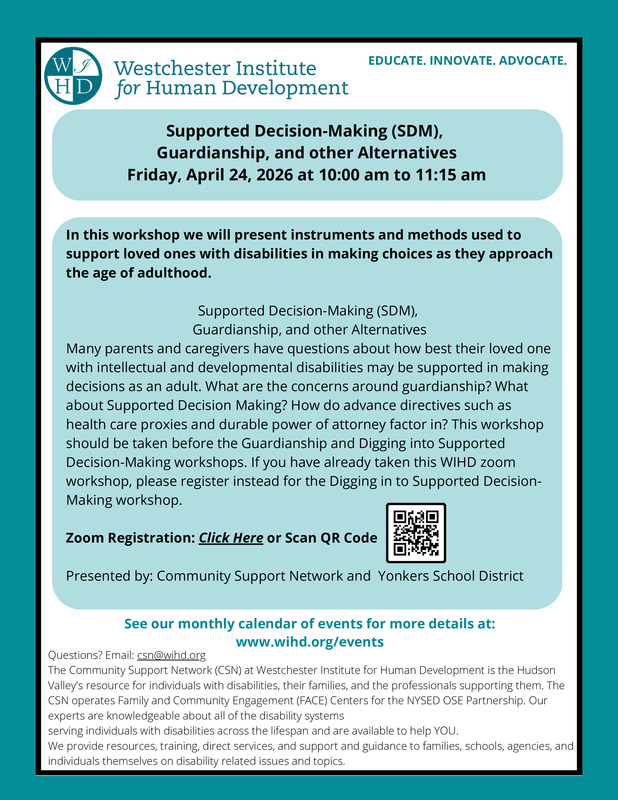
Parents and caregivers of students with disabilities are invited to attend an important virtual workshop focused on decision-making as students approach adulthood. This session will explore Supported Decision-Making (SDM), guardianship, and other legal and practical alternatives that help young adults with intellectual and developmental disabilities make informed choices about their lives.

The workshop will also discuss advance planning tools such as health care proxies and durable power of attorney, and help families better understand the benefits and concerns associated with each option. This session is recommended for families beginning to plan for the transition to adulthood.

Date: Friday, April 24, 2026

Time: 10:00–11:15 AM

Format: Zoom (virtual)

Presented by: Community Support Network in partnership with the Yonkers School District

Registration: Click the Zoom registration link or scan the QR code on the flyer

Questions: csn@wihd.org

This workshop is presented by the Community Support Network at the Westchester Institute for Human Development, a trusted regional resource supporting individuals with disabilities and their families across the lifespan.

flyer

Source:
Parent Workshop: Supported Decision-Making, Guardianship, and Other Alternatives 

Saturday, March 28, 2026

New program expands in­de­pen­dence for New Yorkers with dis­abil­ities

New strides are being made to help New Yorkers with disabilities live more independently and make more of their own choices.

For Keith Knox, that starts with something as simple as checking the mail. The routine walk to his mailbox is easy. Reading what is inside is not.

“I’m visually impaired,” Knox said in an interview. Once a month, he brings his mail to the Capital District Center for Independence, where staff read it with him, help him fill out food stamp and Medicaid forms, and navigate paperwork that has become harder to see as his vision declines.

Knox has hydrocephalus, a condition that can cause blurry, impaired vision. As his sight worsened over the years, he turned to the center for help staying in his own home.

“They call me frequently to check on me,” he said. “I told them I needed housing, and then they referred me.”

Beyond regular check-ins with Knox, the Capital District Center for Independence serves people of all ages with all types of disabilities from across the region and partners with organizations around New York state.

“People with disabilities are people first,” said Laurel Kelley, executive director of the center. “So everyone wants to live in the community. I mean, I think it’s a human need.”

Kelley said the organization follows the independent living philosophy, the idea that people with disabilities should have the same rights and choices as anyone else about where and how they live.

That push for independence is increasingly reflected in state policy. On Tuesday, the state Office for People With Developmental Disabilities and AIM Services, a nonprofit that supports people with developmental and other disabilities across New York, announced a new supported decision-making program.

Supported decision-making allows a person with a disability to choose trusted supporters to help them understand options and communicate decisions, instead of handing that authority to a court-appointed guardian. Advocates say it is a less restrictive alternative to guardianship and keeps control in the hands of the person.

“I do my own cooking, do my own meds,” said Dwight Joyner, who receives services through AIM. “When my meds get low, I can call people. I can call the pharmacy [and] tell them I’m low on meds, low on pills [and] low on insulin.”

Christopher Lyons, chief executive officer of AIM Services, said the model is designed to replace “draconian” forms of control.

“This replaces the draconian control of guardianship with the opportunity for people to learn from their choices, with support from those who they identify to impart meaning in their lives, on their terms,” Lyons said. “That’s what supported decision-making is designed to do.”

OPWDD Commissioner Willow Baer said the state’s goal is to expand tools that let people direct their own lives.

“We are putting the right tools in the hands of people with disabilities to make sure they can direct their own decisions about their own lives,” Baer said.

As more programs like this roll out, advocates say the goal is simple: treat everyone equally, and keep supporting independence for people with disabilities, no matter the label.

Full Article & Source:
New program expands in­de­pen­dence for New Yorkers with dis­abil­ities 

The Insider Guide to the New York Power of Attorney 2026: What It Does and Why It Matters

Article source: Burner Prudentilaw PC 


A medical crisis strikes without warning, instantly stripping away your ability to manage your finances or authorize healthcare. Yet, only 24% of U.S. adults possess a designated financial or healthcare power of attorney, leaving a staggering 76% completely unprepared for sudden incapacity. Broadening the scope, research shows that only 36.7% of U.S. adults have finalized some type of advance directive. The New York Power of Attorney acts as an active financial shield against this vulnerability. Without this legal instrument, individuals risk surrendering their personal agency to the courts the moment tragedy occurs.

An Overview of the New York Statutory Short Form Power of Attorney

A Durable Power of Attorney grants a designated agent the legal authority to manage your financial and legal affairs if you become incapacitated. This document ensures your bills get paid, your investments remain managed, and your real estate stays protected while you recover. The state explicitly defines the scope of this power through the Statutory Short Form, a standardized baseline for transferring financial authority.

Strict Execution Requirements in New York

State lawmakers have overhauled the execution requirements to protect vulnerable individuals while streamlining compliance. The updated statute dictates that the document must “substantially conform” to statutory wording and requires the physical presence of two witnesses during execution. Furthermore, the legislature modified default agent permissions regarding asset transfers. Unless otherwise specified, the default amount an agent can gift on behalf of the principal now stands at $5,000 annually. Minor errors no longer automatically invalidate the document, provided the principal strictly follows these updated execution protocols.

The Financial Stakes: POA vs. Court-Appointed Guardianship

Failing to designate an agent forces your family to petition the Surrogate’s Court for control over your assets. Unplanned Article 81 guardianship proceedings in New York rapidly drain estates. Families routinely face legal fees ranging from $3,000 to $10,000 or more just to establish guardianship. The court, rather than your personal preference, ultimately dictates who controls your bank accounts and medical decisions.

FeatureWith a Power of AttorneyWithout a Power of Attorney (Guardianship)
CostMinimal upfront preparation fees.$3,000 to $10,000+ in ongoing court and legal fees.
TimeframeImmediate authority upon execution or incapacity.Months of delayed court hearings and frozen assets.
PrivacyCompletely private family matter.Public court record detailing assets and medical status.
Control Over Agent SelectionPrincipal chooses a trusted individual.A judge appoints a guardian, potentially a stranger.

Selecting an Agent and Executing the Document

Appointing the right individual and formalizing the paperwork demands strategic foresight. Follow these steps to secure your financial continuity:

  1. Assess Financial Acumen: Choose an agent with a proven track record of financial responsibility and strict attention to detail.
  2. Define the Scope of Power: Decide whether to grant sweeping, universal authority or to limit powers specifically to certain accounts and real estate transactions.
  3. Address the Modifications Section: Explicitly detail custom powers, such as creating trusts or making gifts exceeding the $5,000 default, which the standard statutory form ignores.
  4. Execute with Precision: Sign the document before a notary public and two disinterested witnesses to satisfy New York’s rigorous statutory demands.

The Danger of Blank Modifications and Generic Forms

Downloading a generic legal template online severely jeopardizes your estate. These rigid, standardized forms frequently leave the critical “Modifications” section entirely blank. This crucial omission strips your agent of the legal authority to perform vital Medicaid planning, establish protective trusts, or execute complex tax strategies.

To truly safeguard unique assets and prevent catastrophic financial losses, these documents require customized legal drafting. Engaging an experienced estate planning attorney guarantees your documents cover every possible financial contingency.

Their firm ensures your advance directives, including the Power of Attorney, are precisely tailored and fully compliant with New York law. They structure every document to meet the unique statutory requirements of your estate, securing your assets against unpredictable medical crises and strict judicial scrutiny.

Managing Potential Challenges: Exploitation and End-of-Life Authority

Mitigating the Risk of Financial Exploitation

A Power of Attorney transfers immense financial control, inherently carrying a severe risk of abuse if handed to the wrong person. Financial exploitation currently affects 42 out of every 1,000 older New Yorkers, marking it as the most prevalent form of elder mistreatment in the state. The reality is actually far grimmer, as an estimated 44 cases go unreported for every single incident reported to authorities. Principals must institute strict checks and balances, such as naming co-agents or appointing an independent monitor to oversee the primary agent’s transactions.

Navigating New York’s Shifting End-of-Life Directives

Financial continuity means little without a parallel strategy for medical decision-making. Your financial POA must operate in coordination with a legally binding Health Care Proxy and a detailed Living Will. The landscape of medical directives in New York is rapidly shifting, fundamentally altering end-of-life planning.

State lawmakers have expanded these options significantly. The Medical Aid in Dying (MAiD) Act, taking effect in August 2026, establishes new legal end-of-life choices for terminally ill adults. This legislation makes possessing flawlessly executed healthcare directives alongside a financial POA absolutely urgent. Clear, legally sound documents provide the only guarantee that medical professionals will honor a patient’s exact treatment wishes.

Taking Command of Your Financial Continuity

A New York Statutory Short Form Power of Attorney operates as a foundational pillar of modern asset protection, far exceeding a simple contingency plan. It guarantees your financial framework remains intact, and your family avoids the devastating costs of judicial intervention. Act methodically today to secure your legacy, designate a trusted agent, and keep your financial destiny entirely out of the courtroom.

Full Article & Source:
The Insider Guide to the New York Power of Attorney 2026: What It Does and Why It Matters

Thursday, March 26, 2026

AIM Services will lead Supported Decision Making in New York

By Aaron Shellow-Lavine


A nonprofit based in Saratoga County is set to pioneer the statewide expansion of a program that supports individuals with intellectual and developmental disabilities.

Dwight Joyner says supported-decision making has allowed him to live a more independent, fulfilling life.

“It means that I can make my own choices and I can do things I want to do – making my own meals, take a walk down the street, be able to have relationships without somebody telling me I can’t be in a relationship,” said Joiner.

First piloted in New York in 2016, supported decision-making, or SDM, is a process that allows people with intellectual and developmental disabilities to make decisions with the help of a network of trusted individuals. The idea is to promote independence for people with IDD, putting them at the center of their day-to-day management, rather than relying on a singular person – typically a parent – as often happens in a traditional guardianship model.

In 2021, the New York Office for People With Developmental Disabilities expanded the state's pilot SMD program utilizing federal American Rescue Plan Act funds. Now, a nonprofit in Saratoga County — AIM Services — is continuing to expand SDM programming within the state over the next five years with a nearly $8 million contract.

OPWDD Commissioner Willow Baer says with AIM’s guidance, New York could be a model for the rest of the country.

“It's also available in New York State for people without disabilities, other people who are aging, for example, might need a little support in making decisions as they age. And supported decision making is available in New York State for anyone that wants to use it right. The $8 million contract focuses on people with developmental disabilities. We are excited to be the first in the nation to make that available, and to really be a model nationally for this program and for how person-centered it makes services in New York State,” said Baer.

Through SDM, an individual creates and signs an agreement that outlines various people, or supporters, to whom they can turn to help make decisions regarding their health, finances, and living opportunities.

“So, for example, for medical or health decisions, maybe somebody really wants their mom to assist with that. But when it comes to relationships, they actually want their best friend to help,” said Alexis Harrington.

Alexis Harrington is chief of program implementation at AIM, which in 2024 served 4,000 people in nearly 400 supported and independent residential facilities in Saratoga, Washington and Warren counties.

She says individuals participating in SDM are better equipped to lead their own lives.

“We make decisions every single day of our lives, and we don't even think twice about that. So, the fact that we have people with disabilities that are discriminated against for assuming no capacity. Right? We are now flipping that concept on its head. We are aligning with the United Nations perspective that every person is a person and a human being that is able to make their own decisions,” said Harrington.

AIM CEO Christopher Lyons says the organization is well on its way to reaching the roughly 100,000 New Yorkers who live with intellectual and developmental disabilities.

“People are having legal capacity. They're having autonomy. They're making their own choices. It's a beautiful thing to see somebody enjoy the good and the bad of their own choices. That's what makes us human right. It's the mosaic of our choices, our experiences, the good and the bad. You know, we used to keep somebody from dating somebody because they might break their heart who hasn't had their heart broken. So now everything is natural. It's we don't substitute our judgment. We're not in a control model or in a support model. Life is messy, but because of that, it’s beautiful,” said Lyons. 

Full Article & Source:
AIM Services will lead Supported Decision Making in New York 

Sunday, March 22, 2026

Honoring People’s Autonomy Through Supported Decision-Making


Dear Friends and Colleagues,

I was honored to join AIM Services in Saratoga to celebrate the official launch of facilitated Supported Decision-Making in New York State. At its core, Supported Decision-Making honors people’s ability to control their own lives by giving them the freedom to make decisions without the stigma of relying on support.

The road to Supported Decision-Making, as a less restrictive alternative to guardianship, has been a long one. New York’s Supported Decision-Making began ten years ago as a pilot program, led by Supported Decision-Making New York (SDMNY) and CUNY Hunter College, and funded by the Council on Developmental Disabilities. In 2021, OPWDD dedicated funding to extend and expand the pilot program, including the process of facilitating as an effective way to assist people in creating sustainable Supported Decision-Making Agreements.

In 2022 Governor Kathy Hochul signed Supported Decision-Making legislation into law, making it available to anyone in New York State and laying the groundwork for this monumental accomplishment.  Now, Supported Decision-Making expands even further. With the launch of paid facilitation, every New Yorker with a developmental disability who wants to choose this option will be able to do so as AIM Services assumes its role as the designated statewide coordinator of Supported Decision-Making Facilitation. AIM has already begun working with people to create Supported Decision-Making agreements and to develop a structured, replicable model for use across New York State.

As we continue our celebration of Developmental Disabilities Awareness Month, we are grateful for the self-advocates who dare to ask for more for themselves and who inspire us every day to continue pushing for autonomy, inclusion, and a life of dignity.

I am so proud of the work of everyone who had a hand in making this program a reality and I am excited to see more stories from people like Trina, who are making Supported Decision-Making work for them!

Sincerely, 

Willow Baer
Commissioner

Source:
Honoring People’s Autonomy Through Supported Decision-Making  

Sunday, March 1, 2026

Judge Upholds $5M Verdict Against Nursing Home in Veteran’s Death Case

Nassau Court Upholds $5M Verdict for Family of Veteran Neglected at Freeport Nursing Home


Port Washington, United States – February 22, 2026 / Parker Waichman LLP – Personal Injury Accident Attorneys /

A Nassau County Supreme Court judge has upheld a $5 million jury verdict against South Shore Rehabilitation and Nursing Center, a case recently highlighted by Newsday for its “egregious” evidence of neglect. The ruling finds that the facility’s failure to provide basic care directly contributed to the death of 69-year-old Army veteran and retired postal worker Henry Serrapica.

In a decision issued January 14, Justice Christopher McGrath denied the nursing home’s post-trial motions to set aside the verdict or reduce damages. The court’s affirmation preserves the jury’s findings of negligence and violations of New York State public health law.

Court Cites “Persistent” Neglect

The upheld verdict includes $1 million in punitive damages, an award the court determined was warranted based on the severity of the evidence presented at trial.

In the decision, Justice McGrath wrote: “The evidence entered reflected not only the negligent treatment of the pressure ulcers resulting in death but showed instances where [Mr. Serrapica’s] dignity was compromised that was not based on mere carelessness, but rather persistent instances that support the jury’s punitive damages award.”

Medical Evidence and Conditions

Mr. Serrapica was admitted to South Shore Rehabilitation following a stroke and pneumonia. Although his care plan required staff to reposition him every two to four hours, trial evidence indicated that this protocol was not consistently followed. He subsequently developed multiple Stage 4 pressure ulcers, including wounds to his heel, ankle, arm, pelvis, back, and buttocks.

During his final hospitalization, medical records documented an unstageable pressure injury near his pelvis measuring approximately 16 inches by 9 inches. Physicians diagnosed him with osteomyelitis, sepsis, and septic shock.

Family testimony further described unsanitary living conditions. Relatives reported finding Mr. Serrapica without pants, in soiled diapers, or near vomit that had not been cleaned. Records also showed that during his residency, he lost nearly 40 pounds and suffered six falls.

Legal Positions

Ryan McAllister, the Port Washington-based attorney for the Serrapica family, stated that the court’s decision and the subsequent media attention underscore the gravity of the case.

“This decision sends a powerful message,” McAllister said. “Punitive damages are reserved for the most egregious conduct, and courts are rightly cautious in allowing them to stand. The fact that the jury awarded punitive damages–and that the court upheld them–underscores how serious and systemic the failures in care were in this case.”

In court filings, South Shore Rehabilitation argued that the verdict was excessive and duplicative. The facility maintained that staff followed appropriate care protocols and that Mr. Serrapica received treatment from physicians and nursing personnel.

Facility History

New York State Department of Health records show that South Shore Rehabilitation and Nursing Center has received 28 health or life safety code violations since October 1, 2021. The facility has also been fined a total of $14,000 for deficiencies cited during inspections dating back to May 2018.

Contact Information:

Parker Waichman LLP – Personal Injury Accident Attorneys

6 Harbor Park Drive
Port Washington, NY 11050
United States

Jerrold Parker
(516) 466-6500
https://yourlawyer.com

Information contained on this page is provided by an independent third-party content provider. XPRMedia and this Site make no warranties or representations in connection therewith. If you are affiliated with this page and would like it removed please contact pressreleases@xpr.media

Source:
Judge Upholds $5M Verdict Against Nursing Home in Veteran’s Death Case

Wednesday, February 11, 2026

Commentary: New York needs a publicly funded guardianship system

Pass the Good Guardianship Act to ensure that all New Yorkers have access to this vital protection.

By


In a quiet office in upstate New York, a guardian opens a folder filled with a client’s documents: medical reports, housing records and correspondence from service providers. The person they are appointed to support once lived independently and made their own choices, but now, due to illness, disability or isolation, they cannot manage entirely on their own. What the guardian sees is not just an individual in need, but a system struggling to respond.

Across New York, judges routinely report difficulty finding qualified guardians for people who need them. Thousands of New Yorkers — older adults, people with disabilities and individuals without family or financial resources — require decision-making support to remain safe and housed, access health care, and live with dignity.

Yet New York remains one of the few states without a publicly funded guardianship program. Instead, access to guardianship depends largely on geography, philanthropy and the willingness of under-resourced nonprofits to stretch limited budgets even further.

Under Article 81 of the Mental Hygiene Law, guardianship is a vital protection for people who cannot fully care for themselves due to illness, injury, cognitive impairment or disability. When done well, guardianship is narrowly tailored, person-centered and focused on preserving autonomy while ensuring safety and well-being. But the system can only function if there are guardians available — and today, there are not enough.

There is a solution: the New York State Good Guardianship Act. The legislation would establish a statewide, publicly funded guardianship program, ensuring that people who need guardianship and have no one else to turn to can access qualified, well-supported guardians regardless of where they live. The measure would also strengthen oversight, promote person-centered practices and help build capacity in underserved regions.

New York’s guardianship crisis is not new, and it is not temporary. The state’s population is aging rapidly, dementia rates are rising, more people are aging without family supports, and more New Yorkers are living longer with complex disabilities and limited incomes. These realities have collided with a guardianship system that was never designed to meet statewide need.

The result is a patchwork approach that leaves judges with few options, guardians stretched thin, and vulnerable people waiting — sometimes for months — for help. In some cases, individuals remain stuck in hospitals, shelters or unsafe housing simply because no guardian is available to act on their behalf.

Investing in guardianship is not only the right thing to do; it is fiscally responsible. A recent cost-benefit analysis of a person-centered guardianship model in New York found that over nearly a decade, the program saved approximately $142 million in Medicaid expenditures by avoiding unnecessary nursing home placements, reducing hospitalizations and recovering liens. When accounting for avoided shelter placements for people at risk of homelessness, total public cost reductions ranged from $155 million to $166 million for just 236 clients — nearly $67,000 per person per year.

But this issue is about more than dollars. It is about dignity, justice and basic fairness.

New York’s Master Plan for Aging recognizes the importance of supporting alternatives to institutionalization and investing in systems that allow people to remain in their communities. A robust, publicly funded guardianship program is essential to achieving those goals — not as a substitute for other services, but as a necessary complement when individuals cannot navigate systems on their own.

The guardian at their desk, surrounded by files, is doing work that the state depends on but has never fully supported. The Good Guardianship Act offers New York a chance to correct that imbalance and build a guardianship system that is equitable, sustainable, and worthy of the people it serves.

Kimberly George is the president and CEO of Project Guardianship. State Sen. Cordell Cleare of Harlem represents the 30th Senate District.

Full Article & Source:
Commentary: New York needs a publicly funded guardianship system 

Thursday, February 5, 2026

We Found New York’s Guardianship System in Shambles. Now State Lawmakers Say They Have a Plan to Help Fix It.

Two years after ProPublica first documented the state’s dire shortage of guardians — and the substandard care some provide — lawmakers are pitching a $15 million-per-year fix. It’s unclear whether the law has the governor’s support.


by Jake Pearson 

New York state lawmakers have introduced legislation to boost spending on the state’s troubled guardianship system by $15 million a year — an unprecedented cash infusion for a bureaucracy that has long struggled to care for the tens of thousands of disabled or elderly New Yorkers who cannot care for themselves.

By law, judges appoint guardians to manage the health and financial matters of people they deem incapacitated, and these guardians are then compensated from the estates of their wards. But there are not enough guardians to serve the roughly 30,000 New Yorkers who need them, and the new bill, called the Good Guardianship Act, aims to help the most vulnerable segment of this population: those who are too poor to pay for a private guardian and who have no family or friends willing to serve.

In the industry, they are known as “the unbefriended,” and the millions in new funding would flow to a statewide network of nonprofit guardians who serve them.

The proposal follows a 2024 ProPublica investigation that revealed how the state’s guardianship system was failing this group in particular by conducting little to no oversight of guardians, some of whom provided substandard care and exploited those they were charged with looking after.

The stories prompted the state attorney general to open an investigation into several guardianship providers and spurred the court system to appoint a special counsel to enact reforms. But advocates said the Good Guardianship Act presents the most promising step to date in improving the system — if it can get the support of Gov. Kathy Hochul.

The legislation mirrors the recommendations of a task force appointed by the governor last summer, yet Hochul has not said whether she supports the plan and did not include any funding for guardianships in the $260 billion executive budget she recently unveiled.

“What’s it going to take for the governor to pay attention to guardianship and realize there’s a viable solution on the table?” said Kimberly George, who runs a nonprofit that serves about 200 New York City wards and helps lead Guardianship Access New York, a coalition of groups that’s pushing the bill in Albany.

A spokesperson for Hochul, a Democrat who is running for reelection, said the governor will review the legislation.

In recent years, Albany has provided just $1 million to help fund a statewide guardianship hotline, which provides advice for people considering guardianship for their relatives or friends. But the Good Guardianship Act would provide considerably more guardians for those who need them, effectively ensuring that qualified nonprofit groups with a history of providing guardianship services are available to be appointed by judges in cases involving the unbefriended.

To ensure that state funding only goes to what the legislation calls “reputable” nonprofits, groups must be in good standing with a state regulator and their guardianship plans and funding requests must be reviewed by a contractor picked by the director of the state’s Office for the Aging.

Assembly Member Charles Lavine, a Long Island Democrat who chairs the Assembly Judiciary Committee and introduced the legislation, expressed confidence that the bill would pass this session, noting it has no opposition and fixes a readily identifiable problem.

“It’s time that we did something to be able to provide those who are in actual, real need,” he said in an interview. “We believe we are working in the right direction.”

Lavine hosted a roundtable last fall focused on confronting what he dubbed “the crisis” in the guardianship system, describing it as being “stretched very, very thin.”

The legislation also has the support of legislative leaders in the state Senate — including its powerful majority leader, Andrea Stewart-Cousins, her spokesperson said.

State Sen. Cordell Cleare, a Harlem Democrat who chairs the Aging Committee, is shepherding the bill through the chamber. It’s on the panel’s agenda for Wednesday and is expected to be adopted. 

Full Article & Source:
We Found New York’s Guardianship System in Shambles. Now State Lawmakers Say They Have a Plan to Help Fix It.

Wednesday, January 28, 2026

Wendy Williams' Ex-Husband's Guardianship Bid Tossed By Judge

Story by Afouda Bamidele


Kevin Hunter
has hit a significant setback in his attempts to score $250 million in compensatory damages in Wendy Williams' guardianship drama.

The media personality, best known as the former talk show host's ex-husband, recently had his lawsuit dismissed. The update came months after he filed his allegations on behalf of his former partner; however, she repeatedly denied supporting his lawsuit.

Wendy Williams alleged that her ex-husband's filing did not stem from concern, as he claimed, but rather from his interest in earning a quick cash grab. Her former beau had previously butted heads with the showrunners of her defunct TV program, "The Wendy Williams Show."

Wendy Williams' Ex-Husband Told Not To Drag Her Into His Lawsuit


When Hunter filed his lawsuit in June, he claimed to be doing so on behalf of Williams, who was allegedly being held in an unfair and unlawful guardianship. Many slammed his actions, arguing that he had no right to pursue the end of the court-ordered guardianship as an ex-husband.

The court seemingly agreed with this stance, as new legal documents obtained by TMZ revealed a judge had dismissed Hunter's guardianship bid. The order noted that he could not pursue the lawsuit as a "friend" of Williams, as he claimed, and told him to leave her out of it.

Although he lost his attempt to score $250 million in compensatory damages, Hunter still had another opportunity. The judge stated that he could refile his allegations without Williams, stressing that the amended complaint must be on his own behalf.

The Former Talk Show Host Denied Sanctioning The $250 Million Lawsuit


Following news of Hunter's failed lawsuit, Williams called in during Thursday's episode of "TMZ Live Stream" to address the situation. She doubled down on not approving of her ex-husband's legal efforts and believed he wanted to make a quick cash grab.

Williams echoed similar sentiments in June after Hunter filed his $250 million lawsuit. The Blast covered the story, reporting that she clarified she had no part in the legal drama and was shocked her ex listed her as a plaintiff in the documents.

The former talk show host advised the public to dismiss Hunter's filing, claiming the move did not surprise her because of his tendency to engage in exploitative schemes. Williams' attorney, Joe Tacopina, added that Hunter had no right to fight Williams' guardianship and insisted his help was unnecessary.

More About Kevin Hunter's Guardianship Bid


In his legal filing, Hunter demanded the end of Williams' guardianship and accused her court-appointed guardian, Sabrina Morrissey, of scathing allegations. He alleged that his ex-wife was involuntarily confined, facing mistreatment, and the mismanagement of her assets.

Hunter argued that Williams' guardianship was an illegal scheme, slamming the judge for denying her proper legal representation and not reviewing the facts properly before deeming her "cognitively impaired."

He spotlighted the claim that his ex did not receive an independent medical examination to determine if she had dementia before being placed under guardianship. Additionally, Hunter alleged that Williams has since been overmedicated and unnecessarily restricted.

The Media Personality Previously Clashed With His Ex-Wife's Producers


Hunter is no stranger to lawsuits, as he clashed with the producers of his ex-wife's former talk show. The Blast shared that he filed a complaint against the showrunners in 2023, claiming that he was wrongfully terminated from his position as executive producer.

According to Hunter, he was let go after Williams filed for divorce in 2019. He argued that his termination was unjust because producers wanted him gone based on his marital status without considering his contributions to the TV program.

Hunter wanted $7 million in compensation, and producers initially lost their request to dismiss the lawsuit. However, in April 2025, the United States Court of Appeals for the Second Circuit overturned the decision, arguing that Hunter implied he was terminated over his relationship with Williams instead of his marital status.

Wendy Williams To Be Deposed in Lifetime Documentary Lawsuit


Before the latest update in her ex-husband's $250 million lawsuit, The Blast reported in September that Williams was scheduled to be deposed in the Lifetime documentary between her court-appointed guardian and A&E Television Networks.

A judge extended the stay of the legal proceedings while Williams' separate guardianship case was being reviewed and granted A&E the right to depose the TV personality. The deposition would hold as a "de bene esse" on November 4.

A "de bene esse" deposition was held in situations when a witness's ability to testify later on might decline due to circumstances like "age, health, or fading memory." In Williams' case, the judge noted that the law did not stop her from being deposed despite her alleged dementia diagnosis.

Will the dismissal of Kevin Hunter's lawsuit stop him from inserting himself in Wendy Williams' guardianship case?  

Full Article & Source:
Wendy Williams' Ex-Husband's Guardianship Bid Tossed By Judge 

See Also:
Wendy Williams’ Guardianship Will Reportedly End This Year

Tuesday, January 27, 2026

Three home health aides stole $173K from elderly woman in Suffolk, DA says

by Brian Harmon


Prosecutors say three home health aides stole nearly $173,000 from an 84-year-old woman in their care, leading to their arrest on grand larceny and identity theft charges, according to the Suffolk County District Attorney’s Office.

Suffolk County District Attorney Raymond A. Tierney said Danielle Guarino, 55, of Coram, along with Teresa Garcia, 53, and Mamerta Gonzalez, 72, both of Ridge, were charged following an investigation into the alleged financial exploitation of the elderly victim. The patient received care from the defendants between October 2019 and January 2022.

Prosecutors said that as the victim’s physical limitations increased, she was no longer able to write checks to pay her caregivers or household bills. The victim’s daughter then began signing blank checks and giving them to Guarino to complete.

Authorities allege Guarino wrote checks to herself, Garcia and Gonzalez in amounts exceeding the hours reported on timesheets submitted to the victim’s long-term disability insurance provider.

Investigators allege Guarino wrote checks totaling $160,712 beyond what was recorded on timesheets, including about $110,000 for herself, $43,560 for Garcia, and $7,152 for Gonzalez.

Tierney said further that Guarino failed to accurately record payees and dollar amounts in the victim’s manual check register in an effort to hide the alleged theft.

Authorities additionally alleged that between September 2019 and January 2022, Guarino used the victim’s credit cards without authorization to make $12,245 in Amazon purchases and then used the signed blank checks to pay the resulting credit card bills.

In total, $172,957 was stolen from the victim’s bank account.

Garcia was arraigned last Thursday before Suffolk County District Court Judge Bernard Cheng on a charge of third-degree grand larceny; she was released on her own recognizance. Gonzalez was arraigned on Friday on the same charge and also released without having to post bail.

Guarino was arraigned Wednesday before District Court Judge Evan Zuckerman on charges of second-degree grand larceny, third-degree grand larceny and first-degree identity theft. She too was released on her own recognizance.

Full Article & Source:
Three home health aides stole $173K from elderly woman in Suffolk, DA says 

Wednesday, January 7, 2026

Judge off bench after commission found he sided with defendants, ridiculed victims

Yates County town judge improperly tried to make prosecutor a witness in case, a state Commission on Judicial Conduct investigation finds 

By Patrick Tine


A foul-mouthed judge in the Yates County town of Jerusalem has resigned from his position after a state Commission on Judicial Conduct investigation determined he engaged in a pattern of “biased and discourteous behavior " and demonstrated a “significant misunderstanding of legal procedures” in multiple cases.

One of those was a case in which a man was found guilty of crashing into a horse-drawn buggy and injuring a Mennonite family. 

The judge, Todd C. Whitford, who is not an attorney, had served as the elected town justice since 2018. He resigned on Dec. 4 and agreed never to seek judicial office again, according to the commission’s decision.

The commission served him in September with a formal written complaint alleging misconduct in four cases.

During a preliminary hearing in a 2022 domestic violence case in which prosecutors said the male defendant violated an order of protection against the alleged female victim, Whitford said the woman had “the brain of a small child” and that her testimony in the case was “garbage,” according to a court transcript provided by the commission.

Whitford intimated that the woman invited the defendant’s alleged conduct, and the judge expressed sympathy for him. 

“I don’t even know why you’d want to even look at her. Don’t even — if she texts you, don’t text her back. . . you’re going to screw your entire life up…. Guys, they have it out for them,” Whitford said in the transcript. “This is like 15-year-old bull---- …. They’re going to freaking ruin your life. Don’t make contact with her. . . . Don’t. Go get a freaking lizard or a hamster or something. Spend your time with that. Don’t — man. Women, don’t do it.”

In a 2021 sentencing hearing, Whitford again expressed sympathy to the defendant who had admitted guilt in the car crash that injured seven people and killed their horse, according to the commission. “I hope you’re not mad at me,” the judge said.

Whitford also gave the man a pep talk, which touched on the significant local attention the case had received. “I just want you to walk tall,” Whitford said, according to the transcript provided by the commission. “Who gives a s--- about Facebook and what they post?”

The prosecutor noted every person riding in the buggy had been injured, and some victims were taken by helicopter to Strong Memorial Hospital in Rochester for treatment. The judge interrupted the assistant district attorney when he referred to the collision as a “crash.”

During a July 2025 suppression hearing in an assault and child endangerment case, Whitford improperly tried to compel the same Yates County assistant district attorney to verify initials on a document, an act that would make the prosecutor a witness in the case, the commission said. 

In a 2021 case, the judge apologized to a defendant who had been convicted of his second drunken driving offense in less than five years. The punishment for the offense, even if the prosecution offers a plea deal, requires a defendant to serve jail time. The prosecution’s offer was five days in jail and 30 days of community service.

“Unbelievable,” Whitford said. “A person who’s never been in jail is going to go to jail? I’m sorry that you’re going to jail. I think it’s disgusting. I think it’s wrong.

In his resignation letter, Whitford said money concerns prevented him from continuing a legal fight with the commission. He had been representing himself in proceedings with the body since September.

“I simply do not have the financial means required to secure the level of legal representation necessary to continue,” he wrote. “As a part-time justice earning a modest stipend, the cost associated with navigating the Commission’s formal procedures is far beyond my resources. I want to be clear that I take seriously the concerns that have been brought forward. I am committed to learning from this experience. I regret that I will not have the opportunity to continue serving this town, and that I cannot fully take part in the process due to financial limitations, despite my desire to participate and provide the context necessary for a fair and complete evaluation.” 

Full Article & Source:
Judge off bench after commission found he sided with defendants, ridiculed victims

Saturday, December 20, 2025

Filling the gaps in New York’s guardianship system

By David Lombardo


Dec. 19, 2025- Assembly Judiciary Committee Chair Chuck Lavine, a Long Island Democrat, talks about his legislation designed to address the shortcomings of the state’s guardianship system, which is failing elderly New Yorkers. 

Source:
Filling the gaps in New York’s guardianship system 

Thursday, December 11, 2025

Wendy Williams’ Guardianship Will Reportedly End This Year

By Zayna Allen


Attorney Joe Tacopina says Wendy Williams should be freed from her court-ordered guardianship before year’s end. The high-powered lawyer told “Nightline” Monday that guardianship attorneys have assured Williams she will be “out of guardianship” by December 31.

A Fight for Freedom for Wendy Williams

Williams has been under guardianship since 2022, when her bank froze her accounts and raised concerns she was “a victim of undue influence and financial exploitation.” The court appointed Sabrina Morrissey to oversee her finances and personal welfare. 

In 2023, Williams was reportedly diagnosed with Frontotemporal dementia (FTD) and primary progressive aphasia. But Williams has consistently denied those findings. On “The View,” she declared, “I don’t want Sabrina, period. … It’s been over three years. … It’s time for my money and my life to get back to status quo.” She also said she’s alcohol-free and ready to resume control over her affairs.

Her attorney’s recent announcement follows a new medical evaluation that — according to him — concludes Williams does not have FTD. He told “Nightline,” “[Williams] does not have frontotemporal dementia, so that should be game, set, match.”

Tacopina said that guardianship attorneys are “watching and waiting” and expect the guardianship to end by year’s end. He added that if the court refuses to end the guardianship, his team will seek a jury trial. 

The possibility of restoring Williams’ autonomy has drawn renewed attention to her living situation, which she has criticized as restrictive. In past statements she described her memory-care facility as a “dump,” and said she felt isolated, unable to control her phone, visitors or daily schedule.

If the guardianship ends as Tacopina promises, Williams could regain control over her finances and make independent decisions about her life. Her legal team appears prepared — whether through voluntary release or a jury ruling — to push for full restoration of her rights. 

Full Article & Source:
Wendy Williams’ Guardianship Will Reportedly End This Year 

See Also:
Wendy Williams calls her $25K-a-month assisted living facility a 'dump' amid guardianship

Friday, October 31, 2025

Massapequa home health aide arrested for stabbing 84-year-old patient, Long Island police say

By Mark Prussin, Jennifer McLogan

A home health care aide from New York City is under arrest for allegedly stabbing and critically injuring an 84-year-old patient at her home on Long Island. 

Amanda Fraser was charged with attempted second-degree murder in connection to the elder abuse case in Massapequa, Nassau County Police said Thursday. 

CBS News New York confirmed the 23-year-old suspect from Queens worked out of Aides At Home. Managers in the senior and elder care provider's Hicksville office said the stabbing was a tragedy and an isolated incident.

"The investigation is ongoing. We're cooperating fully," a manager said. 

Fraser was hospitalized after her arrest to undergo a psychiatric evaluation, sources told CBS News New York. She will be arraigned when medically practical. 

The victim, identified as Wendy Wilson, remains hospitalized in critical condition. Her son said she underwent surgery and was expected to survive. Her 85th birthday is in November.   

Home health aide charged with stabbing patient in bed

The stabbing happened Wednesday at Wilson's home on Bay Drive and Merrick Road.

According to Wilson's son, Fraser, her overnight home health aide, was seen on surveillance video getting into her bed and stabbing her. She allegedly tried to drive away, but crashed in the driveway and ran away. 

Another aide, arriving for the morning shift, discovered blood and a knife on the floor, then found Wilson stabbed in the chest in her bed, her son said. 


Wilson's neighbors and others in the community were left shocked and full of sorrow after the attack.  

"She had dementia and her daytime helper would sit out on the lawn with her, and she wouldn't speak at all," one person said. 

"I think we can all relate to it. I think we all need help, assistance with people, and really just hope that she makes it," said another. 

While police were on the scene searching for the suspect, Massapequa High School and Birch Lane Elementary School were placed under a secure lockdown for about 90 minutes as a precaution.

We reached out to the New York State Health Department, which oversees Aides at Home. They said there have been no enforcement actions in the last 10 years.   

Full Article & Source:
Massapequa home health aide arrested for stabbing 84-year-old patient, Long Island police say

Sunday, October 19, 2025

From The New York Times to the Screen: Todd J. Stein’s The Final Fight Takes Aim at America’s Hidden Crisis

News Provided By
Colin Harp, Stein Legacy Productions
October 17, 2025, 15:45 GMT


A gripping true story blending Brooklyn grit, boxing, and guardianship corruption, where family, justice, and survival collide.

The Final Fight is about a system that’s forgotten its humanity, and the everyday people who refuse to give up their fight for it.”
— Todd J. Stein, Producer
NEW YORK CITY, NY, UNITED STATES, October 17, 2025 /EINPresswire.com/ -- From the pages of The New York Times to the big screen, The Final Fight, a new feature film written by Todd J. Stein, brings to life a deeply personal and socially urgent story about dignity, justice, and the quiet war over who controls the lives of the elderly.

Inspired by John Leland’s New York Times article “The Fight of This Old Boxer Was With His Own Family,” the film tackles one of America’s most devastating but underreported issues: guardianship abuse. Based on Stein’s own experience fighting to free his father from an exploitative legal system, The Final Fight exposes how a network of court-appointed guardians, lawyers, and caretakers can strip seniors of their rights, finances, and independence, all under the guise of protection. “The Final Fight is more than a movie, it’s a movement,” says Stein. “It’s about exposing a crisis hiding in plain sight and giving a voice to families who have been silenced. Too many people are losing their homes, their rights, and their dignity, and it can happen to anyone.”

At its heart, The Final Fight is a story about love, courage, and redemption. It follows Scott Cohen, a sharp but emotionally guarded Hollywood producer whose life unravels when a phone call from his estranged father pulls him back to New York. What begins as a reluctant visit turns into a desperate battle to rescue his father, a once-celebrated boxer, from a corrupt guardianship that’s turned his final years into captivity. As Scott fights to save him, he must also confront his own failings as a son and rediscover the meaning of loyalty, integrity, and family.

Opposite him stands Martin Cohen, a proud, old-school New Yorker whose glory days as a Golden Gloves boxer and gym owner still echo through his neighborhood. Now in his late seventies, Martin finds his independence under siege, his health failing, his finances controlled, and his autonomy slipping away. Yet even as the world tries to define him by decline, his fighter’s instincts remain. Martin refuses pity, refuses silence, and refuses to quit. His battle becomes both literal and symbolic, one man’s stand against a system that treats the elderly as disposable.

What makes The Final Fight distinct is its fusion of atmosphere and authenticity, a cinematic portrait that blends the grit of Brooklyn boxing culture, the shadow of mafia influence, and the chilling reality of guardianship abuse. These elements collide to create a world that’s both familiar and wholly original, a story that moves from the sweat-stained gyms of old New York to the sterile halls of courtrooms, revealing the collision between street honor and systemic corruption. It’s a world that hasn’t been portrayed on screen before, a new cinematic space where the fight for dignity replaces the fight for fame.

With America’s aging population growing rapidly, the guardianship crisis is reaching a tipping point. Each year, thousands of seniors are placed under court control, often losing access to their families and life savings in the process. Stein’s film doesn’t just dramatize the issue, it humanizes it, showing the emotional and moral cost of a system that too often trades compassion for convenience. “The Final Fight is about more than one family,” Stein says. “It’s about a system that’s forgotten its humanity, and the everyday people who refuse to give up their fight for it.”

Now in financing and pre-production, The Final Fight is attracting attention from investors, producing partners, and socially conscious backers drawn to its potent mix of truth, tension, and emotional authenticity. Stein has developed Stein Legacy Productions and he and his his team are assembling a cast capable of delivering performances that resonate on both emotional and awards levels, and are developing partnerships with advocacy organizations focused on elder rights and guardianship reform. Interested investors can request access to the script, production materials, and private sizzle footage.

Beyond the film, Stein’s advocacy extends into real life. In 2023, he ran for District Leader in Manhattan’s 76th Assembly District, using his campaign as a platform to raise awareness about guardianship abuse and elder justice reform. Endorsed by former New York City Comptroller Scott Stringer and State Senator Brad Hoylman-Sigal, Stein leveraged his visibility to amplify stories like his father’s, stories of families caught in the web of a broken system. “I was honored that I brought so much attention to the circumstances of abuse,” Stein reflects. “My fight didn’t end in court, it just found a bigger ring.”

The Final Fight positions itself as both entertainment and advocacy, a story that blends cinematic realism with emotional truth. Films like Spotlight, it invites audiences to feel before they think, confronting injustice through the lens of love and humanity. For Stein, the project is the culmination of years spent turning personal pain into purpose. “Every fight has rounds,” he says. “For me, this one’s not about throwing punches, it’s about showing the world what happens when someone refuses to go down quietly.” For investment and partnership inquiries, or to request access to the production materials, contact Stein Legacy Productions. 

Source:
From The New York Times to the Screen: Todd J. Stein’s The Final Fight Takes Aim at America’s Hidden Crisis