PHOENIX (AP) - The parents of an incapacitated woman who was raped and later gave birth at a Phoenix long-term care center
alleges in a $45 million legal claim that the facility and state broke
their promise to have only female caregivers tend to their daughter.
Many of Nathan Sutherland's encounters with the patient at Hacienda
HealthCare occurred overnight, when fewer staff members and visitors
were around, said Christopher Cherney, a professor with more than 20
years of experience as a long-term care facility administrator who
reviewed the woman's medical records.
The family alleges in the
precursor to a lawsuit that Hacienda missed dozens of signs that the
woman was carrying a baby and discovered the pregnancy only after
another nurse saw the boy's head. The patient, who has a feeding tube
and whose nutrition was reduced in response to her weight gain during
the pregnancy, delivered the boy while severely dehydrated and without
pain medications, the claim said.
The family's lawyers say the woman suffered injuries from repeated
sexual assault. Notes from the hospital where she was treated say her
injuries suggest it wasn't her first pregnancy, but no other details were provided.
The
surprise birth on Dec. 29 triggered reviews by state agencies,
highlighted safety concerns for patients who are severely disabled or
incapacitated and prompted the resignations of Hacienda's chief
executive and one of the victim's doctors.
A spokeswoman for the Arizona Department of Economic Security, which
oversaw the woman's care, did not return a message seeking comment.
Hacienda spokesman David Leibowitz and Sutherland's lawyer, Edwin
Molina, declined to comment.
Representatives from Hacienda and
the state had told the woman's parents that their daughter would have
only female caregivers, the claim said. Documents from the Department of
Economic Security note that only female staff members should provide
her personal care, such as bathing and dressing.
Cherney, the
expert for the family, said Sutherland conducted safety checks,
administered medications and wrote notes on the woman's status during
his many encounters with her.
Investigators say Sutherland's DNA matched a sample from the woman's son, who is being cared for by her family.
Sutherland
has pleaded not guilty to charges of sexual abuse and abuse of a
vulnerable adult. He is challenging a court order requiring tests to see
whether he has HIV or other sexually transmitted diseases.
The
victim began suffering seizures at 2 months old and her medical
conditions stem from a brain disorder diagnosed afterward, family
attorney John Micheaels said. The disorder caused motor and cognitive
impairments and vision loss. She was also left with no functional use of
her limbs.
News organizations, including The Associated Press, previously reported that she was in long-term care after a near-drowning.
Despite
her disabilities, her family says she responds to some sensory stimuli.
She turns her head toward sounds she finds pleasing like soft music or
being read to, the claim said. She can groan and smile. Despite being
non-verbal, she will cry and make "throaty sounds" if she is feeling
pain or discomfort.
The claim said that Arizona has a duty to
provide services to people with developmental disabilities by
contracting with companies like Hacienda and that the state did a poor
job of monitoring its operations.
While the claim heavily criticizes Hacienda and Sutherland, it seeks money only from the state.
It
said Hacienda missed 83 opportunities to diagnose the woman's
pregnancy. She gained weight, had a swollen belly and missed menstrual
periods in the months before the child was born.
The family's lawyers said a simple blood test would have revealed the pregnancy.
Five months after it shocked the country and grabbed headlines, the
story of the incapacitated Arizona woman who unexpectedly gave birth in a
long-term care facility is back with another twist: A doctor has
determined the woman had been pregnant before.
A report from the Maricopa County Medical Center reveals the
29-year-old woman not only had gone through a previous pregnancy, but
also she’d been “violated repeatedly” during her years at Hacienda
HealthCare. The report is part of a $45 million notice of claim her
family’s lawyer filed on Wednesday against the state and the facility.
The unidentified woman’s story first surfaced in December, when she
gave birth to a boy in the long-term facility, where she had been in a
coma-like state for several years. DNA tests linked the sexual assault
to caregiver Nathan Sutherland, who’s been charged with sexual assault
and vulnerable adult abuse. He’s pleaded not guilty.
“It’s a classic tale of human greed. Their entire business model is predicated on not making payroll.”
— Tia Koonse
legal and policy research manager at the UCLA Labor Center
By Jennifer Gollan
She
alights from a black Ferrari convertible, her Christian Louboutin
stilettos glinting in the sunlight. The lid of her black lacquer grand
piano is propped open in the living room of her plush Beverly Hills home
on the aptly named Clear View Drive, overlooking a stunning panorama.
“I
own a chain of elderly care facilities,” she says into the camera on
Bravo’s reality television show “The Millionaire Matchmaker.”
“My net worth is $3 to $4 million, probably.”
Stephanie Costa was 30 and rich by most standards yet believed it was time to fetch a man of means.
“You
don’t want to date down,” the show’s host says to her. “You want to
date 200 grand and above who treats you like a princess.”
Costa nods. “Before I know it, I’m alone in the nursing home … in my own nursing home.”
Costa’s
lifestyle was supported in part by six board-and-care homes she owned
in California’s Central Valley that now operate under the names Clear
View Retirement Group and Copper River Retirement Group.
About
half of Costa’s net worth was threatened when she and her company
initially were cited for about $1.6 million for labor violations,
including wage theft – not paying 11 employees for working much of 24
hours a day, six days a week. They later would settle for pennies on the
dollar.
Costa, who declined
to be interviewed for this story, is a rare public face of a burgeoning
multibillion-dollar elder care industry that is enabling operators to
become wealthy by treating workers as indentured servants. Across the
country, legions of these caregivers earn a pittance to tend to the
elderly in residential houses refurbished as care facilities, according
to an investigation by Reveal from The Center for Investigative
Reporting.
A home owned by Stephanie Costa in
Beverly Hills, Calif.
CREDIT: Rachel de Leon/Reveal
The
profit margins can be huge and, for violators of labor laws, hinge on
the widespread exploitation of thousands of caretakers, many of them
poor immigrants effectively earning $2 to $3.50 an hour to work around the clock. The federal hourly minimum wage is $7.25.
Reveal
interviewed more than 80 workers, care-home operators and government
regulators and reviewed hundreds of wage theft cases handled by
California and federal labor regulators, workers and local district
attorneys. The investigation found rampant wage theft has pushed a vast
majority of these caregivers into poverty.
Workers
are left feeling desperate and trapped. Many caregivers say they rise
before daybreak to cook meals, shower residents and scrub toilets. At
night, they are deprived of sufficient sleep because they have to wake
to change adult diapers, dispense painkillers, return wandering dementia
residents to their beds and shift the bedridden every two hours to
thwart bedsores.
Workers describe sleeping in hallways and garages, on couches and the floor. Some care homes deduct $25 a day from caregivers’ paychecks for “lodging.”
Exploited
caregivers rarely are allowed a day off; even then, they often must pay
their substitutes. Two caregivers recounted having miscarriages after
their bosses refused to allow them time off or to stop lifting heavy
residents.
Because these
workers often live where they work, they are under the watchful eye of
their bosses. They are bullied into not cooperating with investigators.
In some cases, care-home operators have threatened to report
undocumented workers to authorities.
Human
trafficking – in which workers, particularly Filipinos, are coerced,
manipulated and exploited – also is not uncommon, according to
prosecutors and attorneys. For example, several family members were
charged last year with human trafficking and labor abuse in a case
involving caregivers in San Mateo County, California, south of San
Francisco.
“It’s
a classic tale of human greed,” said Tia Koonse, legal and policy
research manager at the UCLA Labor Center. “Their entire business model
is predicated on not making payroll. It relies on people being willing
to work for 24 hours a day for less than a dollar an hour. Only
trafficked people will put up with that.” (Click to continue)
PAINESVILLE, Ohio — A simple Google search confirmed what Robert
Rideout suspected – something was very wrong with the woman he hired to
take care of his aging mother.
“It came up with she’s known as the
Sweetheart Swindler,” said Rideout after looking at a screen filled
with links to old news articles.
THE RIDEOUT’S STORY
When
Robert Rideout needed a caregiver for his 83-year-old mother Rosa he
contacted a home health care agency in Lake County. In just a matter of
hours, he had a caregiver ready to start.
Rob Klein
“Two hours for an interview, to be hired, and in my mom’s house,” recalled Rideout.
Within weeks alarms went off. “My
mother was asking for money, regularly,” he said he was asked to
authorize hundreds of dollars in unaccounted expenses every couple of
weeks.
Thousands of dollars were missing before he searched the
internet and read the headline, “Tonya Weiss, The Sweetheart Swindler.”
“I was just alarmed because I hired her from an agency,” he said.
THE SWEETHEART SWINDLER
Law enforcement officials say Weiss earned the title by spending years posing as a caregiver and stealing victims’ life savings.
“A
monster who preys on seniors” is how former Ross County Sheriff
Investigator Dale Gillette described Tonya Weiss. Gillette spent years
tracking her crime spree which included a 1997 Florida case
for stealing more than $100,000. Weiss was also convicted in Ohio in 2003
for swindling two more victims and again in 2012 for a fraud case
.
“She is cold hearted,” said Gillette, “She could take somebody’s money and leave them homeless.”
Gillette
recalled a prison interview with Weiss where he remembers her saying,
“it wasn’t so much about the money as it was a challenge as to how much
money she could get.”
Ron Klein
Weiss was not convicted of a crime in Rideout’s case, but the family
filed a civil lawsuit against Nightingale Home Support and Care, Inc.
that hired her and was awarded an undisclosed settlement—alleging the
agency failed to perform a criminal background check.
Despite a judge approving the settlement
, the Rideout family says they never received a dime.
The 5 On
Your Side Investigators contacted Weiss outside of her home near
Chillicothe. Weiss declined to comment on her involvement.
Rob Klein
5 On Your Side Investigator Ron Regan asking Tonya Weiss about her criminal history.
WHAT KIND OF AGENCY WOULD HIRE A FELON?
Weiss worked for Nightingale Home Support and Care
in Lake County. The agency is owned by Stella Nsong--a licensed, registered nurse with no history of discipline.
Nsong also promotes other on-line enterprises
that describe how opening home care agencies can be a lucrative
business opportunity. Plus, she’s hired production companies to create
videos that attempt to convince you that Nsong is a recognized expert
that can be trusted. For example, you can see her interviewed on her own website, plus links to her “Six Figures Nurse Academy”
where you can also access what Nsong calls “Home Care Biz in a Box”
and “Launch Your Agency in a Weekend”
.
While we found no complaints involving these enterprises—we did
find the Ohio Department of Health shut down a Columbus assisted living
center in 2015 founded by Nsong
and where she served as its nurse administrator.
The Ohio Department of Health shut down
“Woodlands at Eastland” in 2015 citing “conditions presented a clear and present danger”.
Plus, we also found 17 Nightingale employees sued Nsong claiming they
were not paid—including Amber Boykin who says she was hired without a
shred of experience.
“I never worked as a home health aide,” said Boykin, adding that “for weeks I wasn’t paid.”
Her case
is being settled and court records show a federal judge ordered
$11-thousand in back pay for the remaining 16.
THE HUNT FOR ANSWERS
The
5 On Your Side Investigators attempted to speak with Nsong about her
business practices, a front desk employee at her agency in Mentor said,
“she is not here” and likely in New Jersey, but said he would to let her
know we had questions.
Nsong has yet to contact us.
But we
did find Nsong operating a series of webinars where she promotes
business opportunities for nurses and others who are interested in the
home health care industry.
“I started with $1,263 and in 36 months
I had made over a million dollars in gross revenue,” said Nsong during
the 35-minute webinar.
Finally, we reached her through a phone
number provided at the webinar’s conclusion where she told interested
participants that she was available for one-on-one counseling that could
be scheduled in advance.
On the phone, Nsong told us she was
currently in New Jersey but also had an office in Ohio. During the call
she began describing how she “coached people to build a successful home
healthcare company” and claimed she is “considered the expert in
non-medical home care”.
According to Nsong, you can “start a home health care agency for $200 or less”.
“The
is some good news for you,” said Nsong, “in the state of Ohio home care
is not licensed if you keep it private.” She would later say, “There is
big money to be made if you know what you are doing”.
Initially,
Nsong spoke for almost eight minutes until being told we were with the 5
On Your Side Investigators in Cleveland and had questions about her
business practices.
“I can’t answer questions about Nightingale
Home Support because this is not a section of time to answer questions
about that,” said Nsong, “you have to make an appointment with me to do
that privately.”
When asked if she had ever hired someone with a
criminal background, Weiss said “in the private sector home care in Ohio
is not regulated so actually an agency could.”
Even so, Ohio
revised code specifically bans hiring caregivers with specific criminal
convictions such as abuse, neglect or misappropriation of clients funds.
Nsong then hung up when questioned specifically about hiring Tonya Weiss.
THE UNPROTECTED
The
Rideout’s complaint and Nsong’s agency highlight an alarming lack of
regulation and oversight in Ohio when it comes to hiring caregivers.
While
agencies are required under state law to perform an initial criminal
background check—they can hire employees before checks are even
completed.
Also, Ohio has no requirements to perform mandated
annual checks, no required annual inspection and no licensing
requirements to ensure compliance.
Even more alarming, the 5 On
Your Side Investigation found agencies like Nightingale cater to private
pay clients who do not rely on either Medicare or Medicaid—so they are
exempt from any type of “initial certification” by the Centers for
Medicare and Medicaid.
Home health care experts estimate there are
hundreds of agencies similar to Nightingale across Ohio but no one
knows exactly how many since no one is tracking them.
According to
the Ohio Department of Health, “home health agencies are not licensed
or registered” by the department but “must be certified by the Centers
for Medicare and Medicaid Services if they intended to collect Medicare
or Medicaid payments”.
In Ohio, we found there are 763 “certified” home health care agencies, but half of those had no information available on the Medicare
or Ohio
websites regarding inspections or conditions.
The lack of information leaves families like the Rideout’s in the dark.
“You need a license to catch a trout in every state in the
country but you don’t need a license to take care of a senior,” said
Bongiorno.
The HCAOA, founded in 2002, is a leading trade
association representing nearly 3,000 companies that employs more than
500,000 caregivers across the United States.
Bongiorno said, “we
actually employ all of our caregivers” rather than what he calls
“placement agencies that are independently placing caregivers” with no
supervision or liability insurance.
According to Bongiorno, HCAOA
members supervise and oversee care, provide training, background checks
as part of doing business as compared to what he calls rogue caregivers
who have no affiliation and are simply hired in ads or on websites like
“Craig’s List”.
The HCAOA supports licensure and is currently working with state officials in Ohio to raise standards.
When a Nurse and a Social Worker Collaborate for Elder Justice, Good Things Happen
How Ferrell Moore and Laura Brown developed a powerful hospital training curriculum
https://www.bmhgiving.org
The most effective teams, whether in sports, business, or elder
justice, comprise people with a complementary set of skills. From that
perspective, Ferrell Moore and Laura Brown are a dream team, combining
their distinct personalities and talents to create a methodology for
training healthcare personnel to detect, treat, and hopefully prevent
elder abuse. Both will be honored for their work by receiving the
Georgia Anetzberger Award during the Second University of Southern
California Judith D. Tamkin International Symposium on Elder Abuse in
the spring of 2018.
The pair works at the Baptist Memorial Hospital in Memphis, Tenn.,
Moore as a Clinical Resource Nurse and Brown as a Licensed Master Social
Worker. Early 2014, Moore was asked if she would work on an elder abuse
project, figuring at most she would be responsible for making a poster
presentation. Moore says, after reviewing the hospital’s grant proposal
for the Plough Foundation:
“I quickly realized I’d said yes to a very needed and very huge undertaking. From the first meeting of our Coordinated Response to Elder Abuse (CREA) group, I knew I’d been placed on a path of purpose greater than myself.”
Although familiar with abuse cases, Moore hadn’t imagined that elder
abuse was so “rampant” in her community and that people were, as she
puts it, “getting away with it.” She quickly focused on creating a
program that would respond to the growing epidemic, and realized that
while the first response to abuse was typically medical in nature,
social workers performed the bulk of the ensuing work. And, she
recounts, when that became clear, the one person she wanted on her team
was Brown, a social worker in the hospital’s Emergency Department (ED).
Although Brown had been assigned to the ED for just a short time, she
had quickly earned a reputation as a passionate advocate who got things
done. While the ED didn’t want to give Brown up, Moore refused to work
on the grant without her.
Like Moore, Brown also initially imagined the project would require
only a small commitment, before realizing, she says, “how intensive the
work would be and how significant an impact” they could make. And
though neither woman was fully aware just how well-matched their
partnership would be, their interlocking skills soon became evident.
The Perfect Team
Says Brown: “Ferrell is calm and collected, and I am often not either of those things.”
Adds Moore: “Laura is the more outspoken, go-getter type, and I’m
more about doing research, on the computer, planning. Laura can work the
crowd, but can get a little rambunctious – her passion and drive are
inspirational — whereas I’ve learned how to deal with the corporate
politics and finesse a situation to get the desired results.”
“As different as we are,” agrees Brown, “we have a lot in common. We
are both single moms, both passionate about advocating for people that
cannot advocate for themselves. Neither of us commit to work unless we
plan to do it well and with conviction. Ferrell has taught me how to
focus my energy in a professional way. She has taught me that there is
often more power in silence or a calm response than there is in a loud
and fast reaction.”
Thus, this duo of neatly complementary differences and similarities attacked the task at hand. With consulting help from Laura Mosqueda, MD, Director of the National Center on Elder Abuse,
they collaborated on creating a training curriculum based on best
practices in the areas of forensics, law, medicine, risk management, and
law enforcement.
Their initial curriculum, which after feedback was winnowed down from
six hours to three hours, was pilot-tested on the hundred members of
the hospital’s emergency department – doctors, nurses, paramedics,
social workers, and ancillary staff. The plan is for it to be available
for implementation in hospital systems. Exactly how and when it will be
distributed is still being determined by the organizations that funded
the CREA project. Individuals can contact Moore and Brown if they are
interested in receiving progress updates and/or learning more about
potential implementation in their hospital system.
Overwhelming Positive Response
The response to the curriculum has been overwhelmingly positive. Both
Moore and Brown were surprised by the magnitude of the need – and the
desire – for such training. They have seen an increase in awareness and
knowledge in identifying and intervening in elder abuse. The curriculum
has been assessed using extensive evaluation instruments, and the
preliminary results have been promising. An overwhelming majority of the
medical professionals at Baptist Memorial reported that the curriculum
was engaging and resulted in “a significant increase in knowledge”
regarding elder abuse identification, response, and referral.
Implementation has also led to changes in policy and procedures, making
the process more conducive to the identification of elder abuse. A
proposal has also been floated for a multidisciplinary team in the
Emergency Department where the curriculum was piloted.
Moore and Brown were invited to present their curriculum at the June
2016 meeting convened by The John A. Hartford Foundation in Texas of the
“Seen in Hospital, Safe at Home” project. This project is aimed at
translating rigorous research results on elder mistreatment into a
coherent, practical model of care that will transform real-world
practice at scale. The conference led Moore to consider next steps. She
says, “That meeting helped me understand how beneficial it would be to
have a dedicated multidisciplinary team or lead within the hospital’s
ED. As a Clinical Resource Nurse, I’m in a great position to make this
happen, and I’m researching it now. After successfully implementing our
curriculum throughout our hospital, I plan to draft a proposal to my
management team, so that we can continue slowly branching out to the
community.”
The immediate goal for both Moore and Brown is to continue to teach
professionals how to intervene and advocate for elder abuse victims.
Long term, they are considering teaming up to do consulting and
certifying in Project Management.
Observes Brown: “If there is anything I have learned, it’s that elder
abuse is preventable. If we recognize signs early on, we can provide
resources and make appropriate intervention to keep older adults safe,
protected from their abusers, and living with dignity.”
Moore adds: “The most rewarding aspect is seeing an older adult who
has entered our system in a horrible, life-altering situation receive
the love, attention, action, compassion, and resources needed to turn
that situation around and begin a new life or better life.”
Laura
Brown, LMSW is currently working with the Coordinated Response to Elder
Abuse (CREA) to educate professionals on dynamics of elder abuse. Prior
to joining the CREA project she worked in various settings as a victim
advocate and conducted trainings for professionals and the community on
dynamics of abuse. While working in the emergency department at Baptist
Memorial Hospital Memphis, she and Ferrell Moore, RN developed and
piloted a multi-disciplinary curriculum for elder abuse, which was
sponsored by CREA and the Plough Foundation.Laura Brown can be contacted at laurabrownlmsw@gmail.com.
Ferrell
Moore works at Baptist Memorial Healthcare Memphis, where she has over
12 years of bedside nursing experience in the emergency department. She
is a charge and resource nurse of her unit, serves as Chair of the
Professional Practice Council of her unit and was honored as one of
Baptists’ top 100 nurses of Celebrate Nursing.
Yet her most prized
accomplishment is being a loving mother to her creative and gifted
17-year-old son Christopher. Her future plans include continuing her
education to obtain a Master’s Degree of Nursing, with the goal of
becoming a Certified Emergency Nurse Practitioner with a Holistic
Concentration.Ferrell Moore can be contacted at Ferrell.Moore@Bmhcc.org.
By Marilyn Harris, an independent writer and editor specializing in business, technology, legal, and social issues.
Join Marti Oakley and Coz Whitten-Skaife as they host "Allison" a major league activist in Wisconsin.
We will be covering a current abusive guardianship case in the courts right now along with the truth about organ donation, and the attempts across the states to pass laws to starve the mentally ill and those with dementia to death.
With fully functional seniors are being fraudulently determined to have dementia, the harvesting and euthanizing of the elderly is being kicked into high gear.
Following Hospice's example of dehydration and starvation along with drugging to create the conditions medically necessary to call for futility of care, more of our seniors and those chronically or mentally ill are slated for execution.
We are being culled.
But first! We want to rob you \of your life's work and disinherit your family.
Lots to talk about! Please tune in for what is sure to be a hot topic show!
(CNN)A disabled woman who gave birth at an Arizona long-term care facility had been raped repeatedly, and had likely been pregnant before, new documents allege.
Her
lawyers filed a $45 million notice of claim to Arizona on Wednesday
with allegations against the state along with Hacienda HealthCare, where the woman had lived since 1992.
Authorities
obtained DNA samples from male staff members and arrested licensed
practical nurse Nathan Sutherland, 36, who was caring for the woman. He
was charged with sexual assault and vulnerable adult abuse, and has pleaded not guilty.
New allegations revealed
In
the notice of claim filed before litigation for settlement discussion,
the family made a series of allegations against the state and the health
care facility where the now 29-year-old woman lived.
The
Maricopa County Medical Center examined the woman after she gave birth
and concluded she'd been "violated repeatedly," the documents allege.
Her giving birth was likely a "repeat parous event," which means she may
have been pregnant before, the documents say.
From the claim, it's unclear whether she carried the previous pregnancy her family believes she had to term.
It
said the woman suffered multiple sexual assaults that caused her
permanent physical and emotional pain, and caused her parents
significant emotional distress.
The
woman has intellectual disabilities as a result of childhood seizures,
and is bedridden and nonverbal. But she can move some of her
extremities, respond to sound and make facial gestures, according to her
family.
Her parents had
previously requested that she be cared for by female employees and was
assured that would happen, but it did not, the documents allege.
Instead, unsupervised male caretakers, including the suspect, were
allowed to go into her room, the documents say.
The
documents accuse the state of being "vicariously liable for the
negligence, gross negligence and medical negligence" at Hacienda.
911 call: We had no idea patient was pregnant02:30
The
documents also say there are claims of negligence, gross negligence and
"negligence per se" in addition to the vicarious liability. The first
two claims arise from the state's "placement of the victim "at Hacienda
and subsequent failure to exercise reasonable oversight" regarding her
care, the documents allege.
"The
unspeakable atrocities ... occurred as a result of systemic and
individual misconduct and mismanagement at the Hacienda (facility) and
virtually nonexistent oversight on the part of the state," the documents
allege.
CNN has reached out to
the Arizona Attorney General's office for comment, but has not received a
response. CNN is also reaching out to Hacienda HealthCare for comment
on the documents.
A spokesman for
Arizona Gov. Doug Ducey said his office is reviewing the notice of
claim. "The details in this matter continue to be extremely disturbing
-- since day one, the governor has been clear that those responsible for
this crime need to be held accountable to the fullest extent of the
law," Patrick Ptak said.
After the
sexual assault allegations were revealed this year, the facility said
it was making changes to ensure the safety of its patients.
Among
the improvements at the facility are "enhanced security," new security
cameras and officers, and retraining for staff members on abuse and
neglect protocols.
"Our patients,
their families, our team members and the community deserve nothing less
than this commitment from us," Hacienda HealthCare said.
Woman allegedly showed signs of pregnancy
Before
the patient delivered her baby, there were 83 missed opportunities to
diagnose the pregnancy, according to the documents.
"Over
the past couple of days to weeks, the staff had noticed increased
abdominal distention, and firmness," the documents allege.
The
day she gave birth, she was "undergoing a workup for possible GI
illnesses such as diverticulitis," according to the documents.
"The
nurse on staff had noticed the patient no longer had abdominal
distention or tenderness. An hour later, she returned to the room and
lifted the sheets, and found that the baby's head had delivered," the
documents say.
Her
caretakers failed to detect her pregnancy despite signs such as missed
periods, a "mass" in her abdomen, growing weight and swollen legs. As a
result, she went through her pregnancy without any proper care and in a
state of malnutrition, the documents allege.
The
claim seeks a $25 million settlement for the victim and $10 million for
each of her parents within two months or the lawyers will take the case
to court.
As
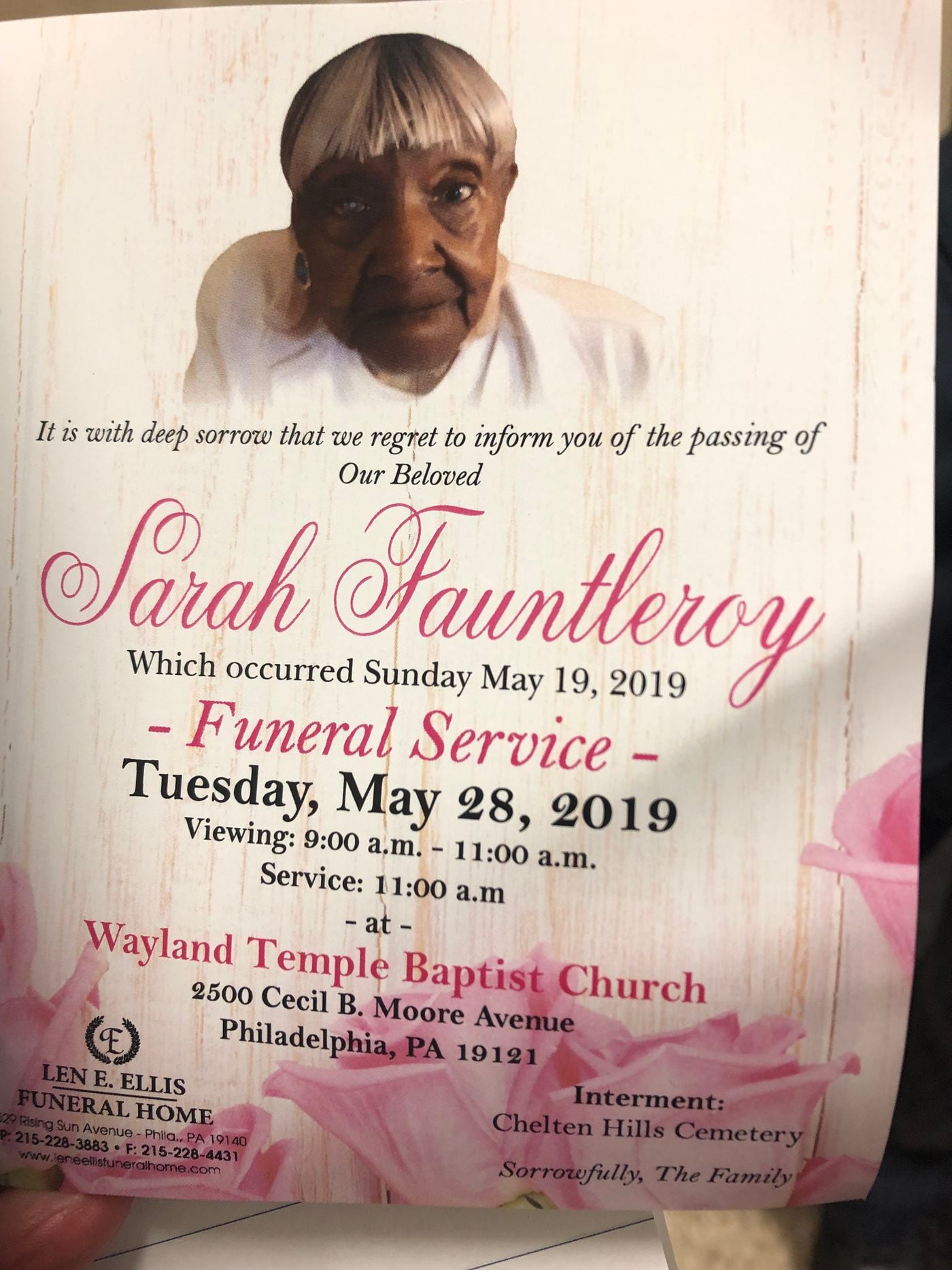
she grew more frail, elderly Philadelphia retiree Sarah Fauntleroy
signed over power-of-attorney rights to a local lawyer John Conner.
Conner, 63, was a well-known criminal defense lawyer – but he also had a gambling problem.
On
Thursday, Conner was sentenced in federal court for stealing more than
$100,000 from the 88-year-old woman, whose caretaker and neighbor
uncovered Conner’s crimes in 2017.
Conner
will serve 46 months in prison; his lawyer Arnold Joseph requested that
Conner be sent to the Fairton, N.J., correctional institute. Fauntleroy
wanted to attend, according to prosecutors, but she died Sunday.
What’s
so unusual about Conner isn’t just that he stole from an elderly
client, but that the Temple Law graduate worked as a high-profile lawyer
with Cozen and O’Conner, and for many years as a federal agent with the
Bureau of Alcohol Tobacco and Firearms. He started his own practice in 1995.
Prosecutors
said the Conner case is part of a national sweep of financial elder
abuse crimes that U.S. Attorney William “Bill” McSwain is pursuing under
U.S. Attorney General William Barr’s initiative.
“The
defendant’s conduct in this case was egregious,” said McSwain.
“Stealing an elderly woman’s life savings, gambling it away at casinos,
and then lying about it to federal agents – all as an officer of the
court, an attorney who took an oath to act in the best interest of his
clients and with a high moral standard.”
Erin Arvedlund
Sarah Fauntleroy, 88, testified against her former lawyer John K.
Conner, who stole nearly $100,000 out of her accounts to gamble. She
died Sunday, May 19, 2019, a few days before he was sentenced in federal
court to nearly 4 years in prison.
Although she had suffered a stroke, Fauntleroy testified against Conner in writing as part of the trial.
Conner
used her ATM card at casinos to withdraw money from Fauntleroy’s bank
accounts in the amount of $105,632.01, according to court filings.
She was left with $15.07.
Homer
Hills, a close friend and neighbor in Brewerytown, alerted the
authorities after Fauntleroy’s phone and electricity were shut off.
Hills and Fauntleroy’s caretaker suspected Conner of stealing her
assets.
Conner
subsequently lied to FBI agents and said Fauntleroy had given him
permission to “borrow” nearly all of her money so that he could gamble
at Parx and Sugarhouse casinos in Philadelphia and Tropicana and Borgata
in Atlantic City, according to prosecutor Mark Dubnoff.
“Elder
fraud is a pernicious crime, preying on the most vulnerable in society.
She trusted him … and he betrayed that trust,” Dubnoff said during the
hearing in front of U.S. District Judge Gerald McHugh of the Eastern
District of Pennsylvania.
In
2016, Fauntleroy asked her brother for help handling her affairs and
health care, and he introduced her to Conner. Fauntleroy was impressed
and signed a power-of-attorney agreement that granted Conner authority
to manage her finances and pay her bills.
As
part of the agreement, Conner promised to keep his assets separate from
hers. Shortly after executing the POA, however, Conner added himself as
a signatory to a checking account that she maintained at Wells Fargo
Bank and obtained an ATM card to withdraw funds.
Conner
also opened a joint savings account at Wells Fargo in his and
Fauntleroy’s names. He then liquidated an annuity she had set up for her
niece and deposited the proceeds, which exceeded $110,000, into that
account.
Over
eight months, Conner used the POA agreement to drain nearly all of
Fauntleroy’s money from her bank accounts. From Aug. 16, 2016, until
April 22, 2017, Conner used the ATM card to make 176 cash withdrawals at
casinos. Checks to her caregivers bounced.
Fauntleroy revoked Conner’s POA in April 2017 and the U.S. Attorney charged him in 2018.
“I’m
very happy with the sentence,” said Hills, who attended the hearing.
“He just stepped in and preyed on her. He didn’t have an epiphany about a
gambling addiction. He got caught.”
Conner
testified that the pressure and loneliness of caring for his
95-year-old father seven days a week and running a law practice prompted
him to turn to gambling -- in particular, slot machines.
“I’m
not a perfect man,” he told the judge. “I’m a gambling addict. I
gambled my own money until I ran out. Then I used her card. I’ve learned
that a compulsive gambler’s judgment is flawed.”
Conner
“has used this fall from grace to begin his road to recovery,” his
lawyer wrote in court filings, by enrolling in the Livengrin Center and
participating in Gamblers Anonymous. Conner also voluntarily placed
himself on the Pennsylvania Gaming Control Board Self-Exclusion from
Gaming Activities list.
A conservatorship, once ordered by a Superior Court judge in
California, deprives a person of the right to control his or her
financial affairs or person, or both. When the judge appoints counsel
for the proposed conservatee, what is the lawyer’s role? Are the
lawyer’s ordinary duties of loyalty and confidentiality diminished in
the conservatorship setting? Should they be?
These are vexing questions that have led to varying approaches in
California’s 58 counties. We sometimes represent siblings in contested
conservatorship proceedings, typically in “parent custody” disputes when siblings are vying for control over Mom and/or Dad.
The approach taken by court appointed counsel is an important factor in
how these cases move forward and it would be helpful to all concerned
to have a more uniform approach.
How Does the Conservatorship Process Unfold?
Probate conservatorship proceedings (called “guardianship” in states
other than California) begin when an interested party files a petition
in Superior Court to establish a conservatorship of the person and/or
estate of an adult. The court clerk sets the petition for an initial
hearing date and notice must be given to close family members.
Depending on calendaring constraints, the hearing may be set out several
months from the date of filing. In urgent situations, the petitioner
will also file a petition for a temporary (interim) conservatorship and
such petitions usually take at least a week or two to be heard.
Often the petitioner seeks to appoint himself or herself as
conservator for a failing relative or friend, but sometimes the
petitioner seeks the appointment of a private professional fiduciary to
serve in that role.
Under California Probate Code section 1470 and 1471,
judges are required to appoint counsel for the proposed conservatee in
certain situations and have discretion to appoint counsel even when not
required. Generally, the clerk maintains a rotating list of lawyers (shown here for the probate department of Sacramento County Superior Court)
who have volunteered to serve as court appointed counsel and the clerk
picks counsel from the next name on the list. It is randomized
matchmaking in that the proposed conservatee is not allowed to pick from
potential candidates.
Once appointed, the attorney will review the pleadings on file with
the court, talk to the interested family members and/or their lawyers,
and interview the proposed conservatee. Meanwhile, the court’s probate
investigator conducts a limited investigation and reports on the
propriety of the conservatorship.
The position taken by court appointed counsel usually has a big
impact on the conservatorship proceeding. The petitioner must establish
that a conservatorship is warranted by clear and convincing evidence, a
heightened burden of proof, and the proposed conservatee can demand a
jury trial, though such trials are rare.
So What’s the Problem?
Anne M. Rudolph and Ralph E. Hughes, attorneys with Hughes &
Pizzuto APC in San Diego, recently explored the ethical duties of court
appointed counsel in “A Lawyer is a Lawyer is a Lawyer,” a thoughtful
and well-researched piece that appeared in Volume 25, Issue 1, of California Trusts and Estates Quarterly.
As they discuss, California law generally imposes duties of
confidentiality and loyalty on attorneys without any express exception
for those appointed to represent proposed conservatees. The California
Supreme Court’s recent rejection of proposed Rule of Professional Conduct 1.14,
which would have given lawyers limited options to protect clients with
diminished capacity, shows the court’s continued concern about loyalty
and confidentiality. The authors note, however, that “attorneys
appointed to represent proposed conservatees in probate courts are
routinely encouraged, and even required, to provide the courts with
reports regarding their clients.”
Rudolph and Hughes argue that court appointed counsel should neither
be required nor encouraged to advise the judge about what the attorney believes
to be in the best interest of the conservatee, and instead should
zealously advocate for the client without disclosing confidences.
Under this approach, if the proposed client opposes the
conservatorship, court appointed counsel’s role presumably would be to
actively defend the conservatorship petition and request a trial on it.
This path would be followed even if counsel has the personal belief
that the circumstances warrant a conservatorship and that the client
would benefit from it.
Rudolph and Hughes suggest that probate judges consider appointing a
person to serve as guardian ad litem (“GAL”) to consider the best
interests of the proposed conservatee. The guardian ad litem, who might
be a lawyer (or retain a lawyer), would serve as a special agent of the
court and therefore would not owe fiduciary duties of loyalty and
confidentiality to the conservatee. Instead, the GAL would investigate
the situation, assess the conservatee’s interests, and report that
assessment to the court.
The conservatorship petitioner frames the presentation of the matter
to the judge. Appointment of a GAL would ensure that the judge hears
two distinctive perspectives on the imposition and terms of the
conservatorship: one from court appointed counsel who focuses on the
client’s expressed preferences and the other from the GAL who focuses on
the client’s best interests and who can report freely on communications
with interested parties.
Of course, appointment of both a GAL and court appointed counsel
causes increased expense to the conservatee, who ultimately pays for
such services under the court’s supervision.
Conclusion
Ethical issues abound when a California lawyer has a client or
prospective client with questionable mental capacity. When appointed to
represent proposed conservatees, requiring lawyers to stay true to
their duties of loyalty and confidentiality provides a clearer (if
sometimes unsatisfactory) line to follow. Rudolph and Hughes aptly
point out that appointment of a guardian ad litem can allow court
appointed counsel to stay in his or her ethical lane while giving the
court more information when making the weighty determination of whether
to impose a conservatorship.