Showing posts with label Office of Court Administration. Show all posts

Tuesday, February 14, 2017

Texas Senator Judith Zaffirini Voices Concerns

Following the indictment of local Judge Jesus “Chuy” Garza, state Sen. Judith Zaffirini called his court “the absolute worst in the state” and a “textbook on cronyism”

“Frankly, it was a category of its own,” Zaffirini wrote in an email to the Webb County Commissioners Court.

Zaffirini, D-Laredo, is requesting the Commissioners Court appoint a successor to Garza, Webb County Court at Law II judge. Garza was suspended without pay Jan. 13 by the State Commission on Judicial Conduct, three days after a grand jury indicted him in the 111th District Court on a misdemeanor influence-peddling charge.

In an email Zaffirini sent Jan. 13 to Webb County Judge Tano Tijerina and county commissioners, she calls for a successor who has the “ability, interest, energy, time and commitment to clean up this dire situation regarding guardianship in that court and who will commit to accountability and transparency in doing so.”

She suggests this successor should preclude anyone who has ties to Garza and who might become involved in a coverup.

Jesus M. Dominguez, one of Garza’s attorneys, declined to comment on Zaffirini’s email.

Reports indicate Garza appointed four local attorneys to the resounding majority of cases, paying them an overwhelming percentage and the highest average of fees paid in his court, according to Zaffirini.

Judith Zaffirini
“I hope you will take steps to ensure that governmental records in (Garza’s) court are not destroyed,” Zaffirini says in her email.

Zaffirini further alleges Garza’s court is what motivated her to pass laws requiring the rotation system for making appointments and monthly reports regarding appointments made and fees paid.

Senate Bill 1876 — authored by Zaffirini and passed in 2015 — directed state courts to use a rotation system for most appointments of attorneys and guardians ad litem, guardians and mediators, while preserving judicial discretion. Ad litem refers to the appointment by a court of an attorney to act in a lawsuit on behalf of another party, such as a child or an incapacitated adult.

All appointments and related payments for attorney ad litem, guardian ad litem, guardian, mediator and competency evaluator are now reported to the Office of Court Administration.

“As your state senator I am keenly interested in helping you address this important and timely issue,” the email states.

In response to her correspondence to commissioners, Tijerina requested Webb County Attorney Marco A. Montemayor take immediate action in addressing Garza’s suspension.

“I strongly feel that removal of office should be considered and would be essential in restoring the trust and integrity in the County Court at Law 2,” said Tijerina in an email obtained by LMT.

Garza, who has served as Webb County Court at Law 2 judge since 1993, was arrested and charged Jan. 12 with one count of gift to a public servant by a person subject to his jurisdiction, a Class A misdemeanor.

The indictment alleges that in January 2015, Garza asked local attorney Shirley Mathis for a $3,000 loan in exchange for appointing her to represent the wealthy Carlos Y. Benavides Jr. estate in a civil dispute. The loan was intended for Christopher Casarez, one of Garza’s court coordinators, the indictment states. Casarez died by suicide Dec. 11 in his home in the Lakeside Subdivision, according to Laredo police.

Zaffirini’s husband, Carlos M. Zaffirini Sr., represents Leticia Benavides, wife of Carlos Y. Benavides Jr., in multiple civil cases involving Carlos Y. Benavides Jr.’s estate, according to court records.

Oscar O. Peña, an attorney for Garza, said in a statement following his arrest that his client maintains his innocence.

“He intends to investigate the state’s claim and he looks forward to defending himself and putting this matter behind him,” the statement reads. “This is a difficult time for the judge, his family and his friends, but he has faced many challenges in his life and he intends to face this one too.”

Guardianship reports
Zaffirini said in her email that as a member of the Texas Judicial Council and Senate State Affairs Committee, she “received reports and heard extensive testimony that 90 percent … of the guardianship cases in Chuy’s court were not in compliance with state law.”

She wrote that “deficiencies include waived bonds for guardians (though there is no legal authority for waivers), no initial inventory, no annual report and missing assets (including an airplane).”

A 2016 report from the Texas Office of Court Administration indicates Webb County has the highest reporting deficiencies in guardianship cases when compared to the counties of Anderson, Bexar, Comal, Guadalupe, Hays, Lubbock, Montgomery, Orange, Tom Green and Tyler.

Reporting deficiencies included 79 percent of cases missing annual reports of person, 77 percent of cases missing annual accounting reports and 80 percent missing initial inventory reports in Webb County courts at law I and II.

Of those statistics, 97 cases in County Court at Law II were reported as missing annual reports, 88 were missing initial inventories and 79 were missing annual accounting reports.

A supplemental report shows County Court at Law II had 69 open cases where the ward was deceased, eight cases with deceased wards who had assets over $10,000, 84 cases where minors had reached the age of majority and 31 cases where the docket showed expired temporary orders or other miscellaneous deficiencies.

The Office of Court Administration additionally recommended the dismissal of 41 cases in Garza’s court due to guardianship not being established.

Full Article and Source:
Zaffirini Voices Concern

Saturday, October 15, 2016

Citing Observer Report, Senators Vow Stronger Protection for Texans Under Guardianship

Rosamond Bradley
Texas House of Representatives
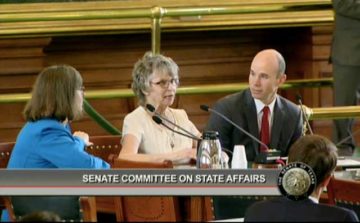
Rosamond Bradley testifies before the Senate State Affairs committee about her difficulty getting her guardianship case reviewed in Lubbock County. Office of Court Administration director David Slayton, right, asked lawmakers for more funding to examine guardianship records across Texas.


Hearing seeks solutions for courts’ weak safeguards for vulnerable Texans.

In the July issue, the Observer featured the story of Rosamond Bradley, a Dallas woman whisked away to Lubbock by her sons and placed under a court-ordered guardianship. Her son got the legal right to determine where she lived, who she saw and how she spent her money. Bradley had suffered a mental health crisis that prompted her sons to intervene. After recovering, she found herself unable to get the order lifted and her rights restored.

As in the vast majority of Texas counties, Lubbock has no staff dedicated to overseeing guardians to ensure they aren’t abusing or neglecting people in their care, or to check whether a guardianship is still necessary. For years, Bradley’s letters asking the judge to restore her rights went unanswered, and she remained under guardianship, even getting married secretly in Dallas in case the Lubbock court found the union invalid.

On Wednesday morning, Bradley recounted her story to a Texas Senate committee considering how it could keep people like Bradley from slipping through the cracks.

“The judge in Lubbock wouldn’t do anything about it,” she said.

Simply beginning to address this problem would cost Texas millions each year, but the senators sounded ready to spend it.

Over the past few months, auditors with the state Office of Court Administration (OCA) have been reviewing guardianships in seven counties to gauge the severity of the problem. The results, OCA director David Slayton told lawmakers Wednesday, have been “a little bit troubling.”

One-third of the cases they’ve reviewed are missing required annual reports on the condition of the person under guardianship. Nearly half of the cases are missing annual reports on how the guardian is spending the money entrusted to them. Forty-five percent are missing initial financial reports — without which it’s impossible to know whether the guardian went on to steal money later. In a quarter of the cases, Slayton said, judges waived the requirement that a guardian post a bond to guarantee they won’t run off with the money entrusted to them — even though waiving the bond is against state law.

In one case they reviewed, Slayton said, an initial inventory of the estate included an airplane but no longer does.

“How do you lose an airplane?” wondered State Senator Judith Zaffirini, D-Laredo.

“There’s no record of where that is now,” Slayton said.


In another case Slayton recalled, a woman living in New York was brought to Texas by her nephew, who secured a guardianship order over her, placed her in a nursing home and — according to his own filings with the court — began spending her money on truck payments, a refrigerator, gifts for family members and payments on two separate credit cards. The last report was filed seven years ago, Slayton said, and the guardian has since moved to Florida, where he has not been returning inquiries from the court.

The OCA review was part of a pilot program approved by the Legislature in 2015. Slayton told lawmakers it would cost around $3 million a year to expand the audit statewide and provide ongoing support for local judges. “What we’re finding is not that the judges don’t want to do this,” Slayton said, “they just don’t have the resources.”

Montgomery County Court at Law Judge Claudia Laird, one of the judges participating in the state audit, told senators there’s just no way she could keep track of the guardianships in her court and follow up in cases of fraud or abuse. “I can’t convince my commissioners to give me the staff that I need,” she said. “What you are asking the judge to do is to be a judge, to be an accountant, to be a social worker and to be a police officer.”

Even with the multimillion-dollar price tag, senators sounded ready to expand the OCA audit statewide. They discussed a draft of a bill from Zaffirini to do just that, and the only remaining question seemed to be whether counties’ participation in the audit should be voluntary or mandatory.

Committee chair Joan Huffman, R-Houston, figured it should be required. “We’re going to all be in agreement on that,” she predicted.

Slayton told lawmakers that only one county so far has refused to open its files to state auditors, though he declined to name it in the hearing and no lawmakers pressed him to do so. “Most places so far have voluntarily participated,” he said.

State Senator Brian Birdwell, R-Granbury, seemed especially riled by counties refusing to participate. “I want to make sure that every judge in this state understands that that court does not belong to them,” he said. “It is not up to them to say, ‘You do not get to come in.’”


Patrick Michels Rosamond Bradley with her husband, Jim Bithas. Bradley spent years trying to break free from a guardianship in Lubbock County, even after experts said she was fit to make her own decisions. After Bradley shared her story, lawmakers turned their questions to how capably Lubbock County has overseen the guardianships in its courts. What was the response, senators wondered, to Bradley’s letter-writing campaign?

“They ignored it,” she told them.

Bradley told senators that she credited Lubbock’s Office of Dispute Resolution and its director, Gene Valentini, with rescuing her case from limbo. “That’s where it all started,” she said.

As the Observer reported in July, Lubbock County had hired a court investigator, working in the county’s Office of Dispute Resolution, to review guardianship case files and coordinate in-person visits. The county cut that funding in 2013. Two days after the Observer’s story ran online, Lubbock County’s board of judges unanimously agreed “that Gene Valentini and [dispute resolution] personnel should not be involved in any form of guardianship activities or cases” unless ordered by the court, according to minutes from the meeting.

Asked why the panel made that decision, Lubbock County Court Administration Director Dean Stanzione explained in an email to the Observer that oversight authority rests with the judges, not Valentini’s office. “They were never given permission from the Board of Judges to oversee guardianship,” he wrote. Stanzione has yet to respond to a follow-up question about what prompted the judges’ decision in July.

On Wednesday, Zaffirini asked Slayton whether Lubbock County was also part of his audit.

“We’re working with Lubbock County right now to try to get in to assist,” he said. “We’ve reached out to them a couple of times. Currently we don’t have any agreement with them to go there, but that’s something we’d like to get.”

“I’d like to send them a message right now,” Huffman said, “that they need to let you come and look at their system. They can either do it on their own, or we can specifically mandate it to them through legislation.”

Full Article & Source:
Citing Observer Report, Senators Vow Stronger Protection for Texans Under Guardianship

See the Texas Senate Committee on State Affairs Hearing of September 2016