Showing posts with label commentary. Show all posts

Monday, April 17, 2023

Commentary: New York state must invest more in guardianship program

By investing in a guardianship system, New York can ensure that older residents in need of protective arrangements have access to the appropriate services.

Credit: Getty Images. SolStock/Getty Images

New York strives to be a progressive beacon that cares about every resident. Yet when it comes to one of our fastest-growing populations, New York has a lot to prove.

Our state is home to 3.2 million older adults — a figure expected to nearly double by 2030. Over the past decade, the poverty rate among older New Yorkers increased, with Black, Hispanic, Asian, and immigrant residents most likely to experience poverty in their older years.

Today, nearly a third of older New Yorkers are aging alone. Gov. Kathy Hochul has pointed to investments in aging services and long-term care as the pathway to greater equity in aging. But when it comes to caring for older adults who are poor and alone, we have yet to deliver on our promises.

Conservative estimates suggest that more than half of older New Yorkers will require some form of long-term care. One way to facilitate long-term care is Article 81 Guardianship — a legal tool that assigns a surrogate decision-maker for those who can no longer manage their affairs and are at risk of harm. When applied properly, guardianship can improve health, safety and quality-of-life outcomes.

Unfortunately, guardianship services are not equally accessible to all. Our law states that those in need of a guardian shall be appointed one yet offers no funding or infrastructure to adequately deliver on that promise. In this broken system, thousands are left without the services they need and wind up in nursing homes, hospitals are overcrowded, and community guardianship programs are stretched to capacity.

It doesn’t have to be this way. By investing in a guardianship system, we can ensure that older New Yorkers in need of protective arrangements have access to the appropriate services. We can address glaring inequities in our current system and prevent unnecessary guardianships by connecting community members with a range of resources. We can also save taxpayers millions of dollars long-term by keeping people out of hospitals and nursing homes.

We were thrilled to see a preliminary $5 million investment in the Senate one-house budget, and we will continue to work toward further investment, which would advance equity in aging, reverse an over-reliance on our guardianship system, and restore our commitment to older adults.

We are all aging, and we all deserve a system of care that aligns with our New York values. It’s time to act. It’s time to fund good guardianship. 

State Sen. Kevin Thomas of Nassau County represents the 6th Senate District. Kimberly George is president & CEO of Project Guardianship. Becky Preve, executive director of the Association on Aging in New York, also contributed.

Full Article & Source:
Commentary: New York state must invest more in guardianship program

Saturday, August 4, 2018

Parents Lose Custody of Disabled Adult Son for Questioning Psych Drugs

Ian Bankert at his high school graduation.
Commentary by Terri LaPoint
Health Impact News

Medical kidnapping can happen to adults as well as children. Health Impact News has reported a number of adult kidnapping stories over the years.

Some involve senior citizens. Others, like this one reported by ABC News in Raleigh, North Carolina, involve the seizure of adult children with mental illness or disability from their parents who have loved, raised, and cared for their children their entire lives.

Doctors (mostly psychiatrists) and courts have the power to step in and take over the entire lives of such individuals, isolating them from their families and ultimately deciding every aspect of their care.
Reporter Jonah Kaplan writes:
This may be the most painful symptom of mental illness and its impact on North Carolina families.
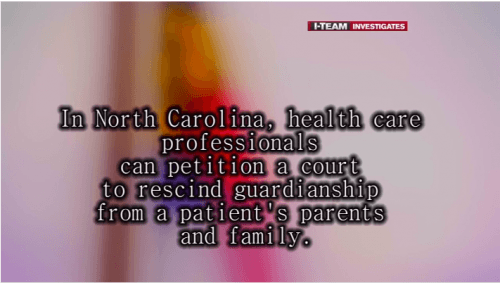
NC I Team guardians photo
The investigative team from ABC11, the I-team, found that more than 5,000 adults in North Carolina are under state guardianship care. Most of these adults have mental or developmental disabilities or have mental illness.

The cost to taxpayers is staggering. ABC11 found that the North Carolina Department of Health and Human Services (DHHS) reports that the state pays an average of $1,200 per person, per day, for each of the patients under public guardianship care.

Doctors Override Parental Decisions, Lock Up Their Son


David Bankert and Joanne Luterman are the parents of 24-year-old, Ian Bankert. They told reporters that their son was very athletic in school, on the swim team and track team. He was well-liked and did well academically. His parents noticed signs of his descent into mental illness during his high school years.

Ian graduated, then spent the next few years going in and out of the hospital. He was diagnosed with schizophrenia.

His parents became concerned about the doctors “overprescribing him with medication,” a concern which is shared by many parents and patients, and watchdog groups.

Doctors recommended “more medication and long-term care,” but his parents, according to ABC11, “instead insisted that a good diet, exercise and faith could restore Ian’s sense of self.”

More than that, according to a funding page set up by the parents,David Bankert and Joanne Luterman want:
to try to help our son get out of the state operated mental health system and get him on the road to recovery by way of a private doctor and team.
They are also “seeking out all other forms of help for him.” (See link.)
Dr. Stephen Ford and psychiatrist Dr. Gary B Pohl did not agree with the parents. Instead, Dr. Ford petitioned the court to take Ian away from the care of his parents.
“We were shocked and blown away,” Luterman told ABC11. “We want Ian to have some joy, to come home, lead a life with his family and have some sense of normalcy.”
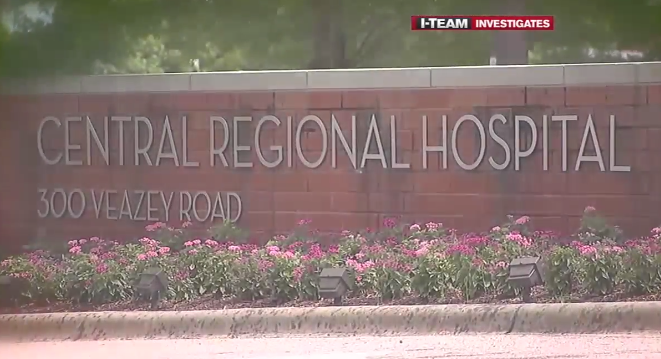
Instead, their son is locked away long-term in Central Regional Hospital in Butner, North Carolina. His parents have to get permission from the guardians to visit their son.
Ian locked away in hospital NC I Team photo
Ian is locked away in a psychiatric hospital, long-term, against his familys wishes. Photo source.

According to the website for Central Regional Hospital:
Central Regional Hospital (CRH) is one of three State psychiatric hospitals in North Carolina. It is operated by the Division of State-Operated Healthcare Facilities (DSOHF) within the North Carolina Department of Health & Human Services.
It is also a “psychiatry residency training site.”

Ian’s story is another in a long list of cases where the financial and academic interests of one group – psychiatrists and public guardians – are pitted against the civil rights and familial interests of individuals and their families.

The long arm of the state again overrides the decisions of parents who know and love their son and want what is best for him. They do not believe that locking him away from his life and loved ones and drugging him are the answer. The state does.

Ian parents NC I Team photo
Ian Bankert’s parents spoke with ABC11’s I-Team about the medical kidnapping of their son. Photo source.

Parents’ Concerns over “Overmedicalization” Well-Founded


In 2016 Health Impact News published an article by Gary G. Kohls, M.D., a doctor whose words stand in stark contrast to those of the psychiatrists who have robbed Ian Bankert of his freedom and his family.
Psychiatrists have long admitted that none of their drugs ever cure anything or anyone. They also admit that there are no medical, laboratory, radiological or biopsy tests to confirm that any given psychiatric diagnosis is an actual medical condition.
There are, however, thousands of lab, radiology and biopsy tests that confirm the existence of the long-term neurotoxic effects of the multitude of synthetic psychoactive drugs that continue to be given out in combinations that have never been adequately tested for efficacy or safety – even in the animal labs.
Therefore what the courts have erroneously criminalized as parental neglect must be re-assessed by the legal system. The parent that refuses potentially hazardous psychiatric drugs for their child because they happen to know more about the drug’s dangers than their prescriber, should be supported rather than punished by the courts.  And lawyers and judges interested in understanding the nature of the best neuroscience need to be increasingly mistrustful of psychiatrist “experts” who frequently have serious conflicts of interest when it comes to maintaining the prestige and/or economics of the big business of pharmaceuticals, medicine and psychiatry.
There have been more than 200 international drug regulatory agency warnings about the fact that psychiatric drugs can cause dangerous and potentially life-threatening effects (check them out here). When I was in medical practice, I was totally unaware of the existence of these warnings, so I suspect that most over-worked physicians and psychiatrists today are equally unaware. Undoubtedly, lawyers and judges are in the same boat.
See:

Does Prescribing Anti-psychotic Drugs to Infants, Toddlers and Young Children Meet the Definition of Reckless Endangerment?


Doctors do not agree even among themselves in regards to many medical conditions that are more easily quantified than psychological disorders. The philosophy of conventional medicine has challengers among many different fields, such as homeopathy, chiropractic, faith healing, Eastern medicine, herbal medicine, nutritional healing, and countless other health modalities.

Health Impact News has published hundreds of articles chronicling the stories of people who have suffered abuse at the hands of psychiatrists and other doctors with whom they or their parents disagree. See here and here.

The advocacy group, Citizens Commission on Human Rights, has reported that professional psychiatrists are among the top white collar criminal groups in the United States, committing 40% of all Healthcare Fraud, and incarcerating over 700,00 people against their will every year.

6 to 10 percent of psychiatrists and psychologists sexually abuse their patients, including children as young as three, and the sexual crimes committed by psychiatrists are estimated at 37 times greater than rapes occurring in the general community, according to one U.S. law firm. (Source.)  (Continue)

Full Article & Source:
Parents Lose Custody of Disabled Adult Son for Questioning Psych Drugs

Thursday, August 2, 2018

Commentary: Failing Bridget: How bureaucracy harms vulnerable Illinoisans

Two years ago, my aunt became the guardian for an adult with disabilities named Bridget. Bridget’s mother, a lifelong friend, had named my aunt her daughter’s guardian and trustee of her estate before she died. While Bridget lives in Illinois, my aunt is in another state. So Bridget’s daily care is provided by a state-licensed provider who converted the family’s home into a Community Integrated Living Arrangement home. Bridget, who has Down syndrome, is employed and active in her community. Keeping Bridget in a familiar place with familiar caregivers and activities was important.

But when her care moved under the control of a CILA operator, Bridget’s longtime caregivers were let go and alarming changes manifested in her physical and mental well-being. To be more directly involved in Bridget’s care, my aunt decided to move her out of Illinois. It was at that point my aunt felt the full force of the bureaucratic state.

Illinois’ system of delivering services to our developmentally disabled is ranked among the worst in the nation. This shameful designation exists for a variety of reasons, one of which is mismanagement.

Care in a state-run CILA costs $48,000 to $92,000 per resident per year. In Bridget’s case, the state pays a CILA operator $81,000 for her care. By contrast, a similar home run through a Wheaton nonprofit program, STARS, operates at a cost of just $32,000 per resident. It is a program in which each participant pools a stipend they receive from a federal waiver program to pay for the home and other services. The stipend is not dependent on a participant being in a state-run or -licensed facility.

The bureaucratic state’s inhumanity


In 2016, in the throes of a budget crisis that was crippling social services, the Illinois Department of Human Services attempted to shut down the STARS home in Wheaton after receiving information that six individuals were housed together instead of the state’s limit of four. STARS invited the state to inspect its facilities. Inspectors issued glowing reports with no violations. Still, DHS wanted to move those being served in the STARS program to state homes, for which there is a current waitlist of over 20,000. Those removed from the STARS home might wait for years for placement in a state home. In the meantime, their families would have had to figure out how to provide care for them, and when a state slot came open, the families would have little say about where. The state often moves our most vulnerable adults miles from their home community. Eight families had to sue in federal court to continue in the STARS program. In negotiating the settlement the judge admonished the state saying “… (STARS) does it cheaper and better than the State of Illinois.”

The bureaucratic state comes for Bridget


When my aunt decided to exercise her rights as legal guardian and move Bridget into a better situation out of state, Illinois’ contract CILA operator sued to end my aunt’s guardianship. The state’s lawyers went so far as to tell my aunt she would be charged with kidnapping if she took her across the state line. The state operator then declared to the court that my aunt — handpicked by Bridget’s own mother to protect her daughter — was an unfit guardian. The court appointed a guardian ad litem for Bridget. My aunt is still fighting to ensure Bridget will get the care she deserves.

Legislative solutions?


In 2018, I filed legislation on behalf of the STARS program that would allow the program to house up to six individuals. DHS opposed the legislation. The bill was shut down in committee by Senate Democrats. Nothing threatens the bureaucratic state more than a new idea that delivers better, cost-effective services with consideration for individual circumstances. Currently, STARS is not allowed to operate at full capacity despite having a waitlist. The current administration could fix this. So could state legislators, by either using general revenues to fund the homes or passing my bill in veto session.

Protecting Bridget


We are all responsible for this. The people we elect have grown state government into a machine that preys on our most vulnerable instead of protecting them. And yet, we keep sending those same lawmakers back to Springfield.

Agencies — beneficiaries of government largesse — work with big government legislators to shut down innovative, thoughtful solutions.

This is the system that has been put in place with our implied consent. It has to change.

We will be judged by how we treated our most vulnerable. Are we going to hold government accountable or look the other way, failing Bridget and those like her across the state?

Jeanne Ives is a Republican state representative from Wheaton.

Full Article & Source: